Black hole physics is the study of a mass sealed inside its own event horizon, the one-way surface at radius R_s = 2GM/c^2. That radius depends on the mass alone: 2.953 km per solar mass. A static clock at distance r ticks sqrt(1 – R_s/r) times for each far-away tick, and at the horizon it stops.
Almost nothing in the universe is this easy to describe. Choose a mass and three numbers follow at once: how wide the horizon is, how slowly a clock runs at a given distance from it, and how hard a body held there would be pulled apart. No composition, no temperature, no chemistry, no age — the mass does all of it.
That is also why the arithmetic is worth doing by hand. Ten Suns’ worth of mass hides behind a horizon of radius 29.53 km, and a clock held at the innermost stable orbit around it runs at 0.8165 of the rate yours does. Change the mass and the horizon follows in exact step.
What Is a Black Hole?
A black hole is a region of spacetime wrapped in an event horizon: a surface that matter and light cross inwards and never cross back out. Everything else about it — how big it is, how slowly clocks run near it, how violently it pulls a body apart — follows from one number, its mass.
Start with the geometry rather than the force. General relativity describes the empty space outside a non-rotating, uncharged mass with the Schwarzschild solution, and that solution contains a factor, 1 – R_s/r, which shrinks as you approach the centre and reaches exactly zero at one particular radius. That radius is the horizon. It is not a wall and not an object; it is the place where the geometry stops allowing an outward path.
The speed of light is what sets the scale of the whole thing. Because c is the limit on how fast anything can move or signal, the radius at which the geometry closes over is built out of c, and the ideas underpinning that limit belong to special relativity. Relativity puts a ceiling on speed; a horizon is what happens when a mass is packed tightly enough for that ceiling to matter.
Everything on this page reduces to three claims. The sections below are the evidence for each.
- Claim 1. The horizon radius is exactly proportional to the mass, and depends on nothing else — not on your distance, not on what the hole is made of, not on how it formed.
- Claim 2. A static clock near the horizon runs slow by a factor sqrt(1 – R_s/r), and at the horizon it stops. That factor depends only on your distance measured in horizon radii, never on the mass.
- Claim 3. The tidal stretch at a hole’s own horizon falls as one over the mass squared. A stellar-mass hole would shred a human body at its horizon; a supermassive one would barely tug at it.
Most accounts stop after the first. The second and third are what decide whether the picture in your head is right — and the third turns upside down if you compare two black holes carelessly.
The Schwarzschild Radius Formula
The radius of the event horizon is twice the mass times the gravitational constant, divided by the speed of light squared. Put a mass in kilograms on the right and a length in metres comes out.
- Rs — the Schwarzschild radius, the radius of the event horizon. Unit: metre (m), usually quoted in kilometres.
- M — the mass of the black hole. Unit: kilogram (kg), usually quoted in solar masses.
- G — the gravitational constant, 6.67430 x 10⁻¹¹. Unit: m3 kg-1 s-2.
- c — the speed of light, 299,792,458 m/s exactly, by the definition of the metre. Unit: metre per second (m/s).
- r — your distance from the centre, which does not appear in the formula at all. Unit: metre (m).
- x — that same distance counted in horizon radii, r / Rs, so x = 1 is the horizon itself. Dimensionless, and never less than 1.
Because mass is the only variable on the right-hand side, the relation is pure proportionality, and it is worth memorising in the units astronomers actually use. One solar mass corresponds to 2.953 km of horizon radius. Ten solar masses give 29.53 km, a hundred give 295.3 km, and so on for ever — or you can hand the mass straight to our Schwarzschild radius calculator, which also runs the relation backwards from a horizon radius to the mass behind it.
Notice what is not in the formula. The product GM is an input, taken from whatever mass you were given, so none of the Newtonian machinery of the law of gravitation is being derived here. Nor does r appear: move closer or further away and the horizon radius you compute does not budge by a millimetre.
The constant c carries all of the smallness. Dividing by c2 — about 9 x 10¹⁶ in SI units — is what turns a stellar mass into a city-sized length, and the speed of light is where that figure comes from. It also contributes no uncertainty, because the metre is defined from it.
One last thing about this expression, and then the article leaves it alone: a purely Newtonian calculation about escape velocity arrives at the identical algebra, which is a coincidence of arithmetic rather than a derivation, since a horizon is a property of the geometry and not a speed a projectile fails to reach.
What the Event Horizon Actually Is
The honest signature of a horizon is not a size but a stopped clock. Take a clock and hold it at a fixed distance r from the centre, well outside the horizon, and compare it with an identical clock far away: the near one runs slow, by a factor that has R_s in it and nothing else.
Write the distance in horizon radii and the mass disappears from the problem entirely. At x = 3, the innermost stable orbit, the rate is 0.8165. On the photon sphere at x = 1.5 it is 0.5774. At x = 2 it is 0.7071, and at the horizon itself, x = 1, the bracket is exactly zero and so is the rate: 0.0000.
That last number is the point. A one-solar-mass hole and a ten-billion-solar-mass hole have horizons differing in size by a factor of ten billion, and both stop a static clock completely. The radius is a length and lengths scale with mass; the clock rate at a given multiple of the radius does not scale at all, which is what makes the horizon a feature of the geometry instead of a measurement of bigness.
Be careful about which kind of slowing this is. The effect here comes from where the clock sits in the geometry, not from how fast it is travelling; a clock that is simply moving quickly also runs slow, and that velocity effect is time dilation in the special-relativistic sense, with a different cause and a different formula that this page never uses.
Two more cautions, both of which are easy to get wrong. The rate never actually reaches 1, however far out you stand — it is still below 1 at ten thousand horizon radii — so the correct phrasing is always “far enough away that the difference does not matter”, never “normal”. And the rate applies to a clock held still at that radius, so nothing on this page describes what a falling clock would read.
The simulator below carries the same three relations. The upper panel draws one hole’s horizon, photon sphere and innermost stable orbit against a labelled scale bar whose own value in kilometres is printed beside it; the lower panel plots the clock rate against distance, and that curve is identical at every mass, which is claim 2 made visible.
Three Radii That Matter: Horizon, Photon Sphere, ISCO
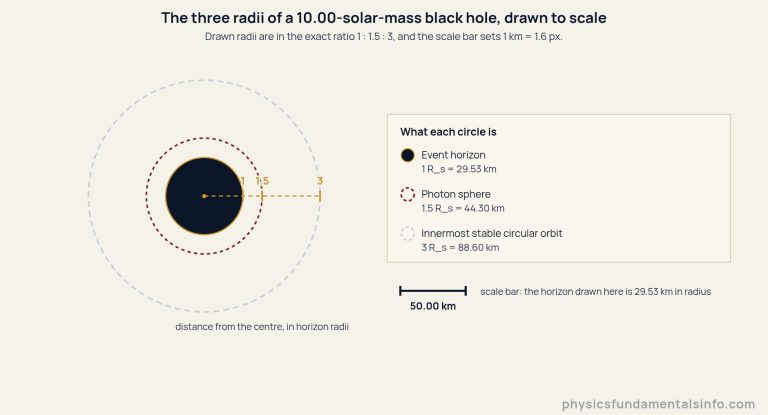
A non-rotating black hole has three special radii, and all three are fixed multiples of the horizon: the horizon at 1 Rs, the photon sphere at 1.5 Rs, and the innermost stable circular orbit at 3 Rs. Because they are multiples, a single drawing serves every mass.
The photon sphere, at 1.5 Rs = 3GM/c2, is the radius at which a ray of light can travel in a circle around the hole. It is a real orbit and a useless one: the orbit is unstable, so the faintest nudge inward sends the ray spiralling in and the faintest nudge outward sends it away for good. Nothing can linger there.
The innermost stable circular orbit, or ISCO, sits at 3 Rs = 6GM/c2. Outside it, matter can hold a stable circular path; inside it, no circular orbit survives a small disturbance. It is quoted here as a radius of the same geometry, not worked out from an orbital period, which is a different calculation belonging to a different page.
Put real numbers on them and the scale of the thing lands. For the ten-solar-mass hole of the hook, the horizon is 29.53 km in radius, the photon sphere 44.30 km and the ISCO 88.60 km — three surfaces inside a region you could cycle across in an afternoon, if a bicycle were any use there.
Why a Bigger Black Hole Is Gentler at Its Own Horizon
Compare two black holes each at its own horizon, and the more massive one is the gentler of the two — that qualifier, “at its own horizon”, is the whole claim, and dropping it makes the sentence false. What does the pulling is the tidal stretch: the difference in gravitational pull between your head and your feet, which is what tears a body apart rather than the pull itself.
Here h is the length of the body being stretched; every figure below is quoted across h = 1.80 m, roughly a person. The first form is the general one. The second is what you get by substituting r = Rs into it, and the mass has moved into the denominator and been squared.
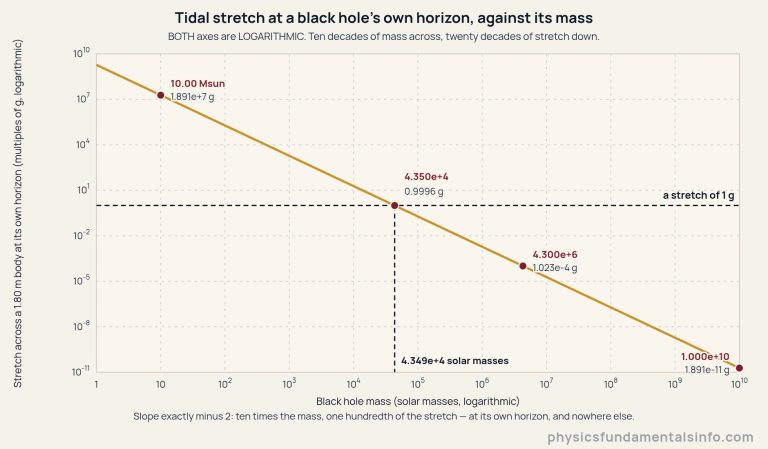
So at its own horizon, ten times the mass means one hundredth of the stretch. Run that down the ladder and the numbers are startling.
| Mass (solar masses) | Mass relative to the first row | Horizon radius R_s | Tidal stretch across a 1.80 m body at its own horizon |
|---|---|---|---|
| 10.00 | 1.000 | 29.53 km | 1.891e+7 g |
| 4.350e+4 | 4350 | 1.285e+5 km | 0.9996 g |
| 4.300e+6 | 4.300e+5 | 1.270e+7 km | 1.023e-4 g |
| 1.000e+10 | 1.000e+9 | 2.953e+10 km | 1.891e-11 g |
Read the last column downwards. A 1.80 m body at the horizon of the ten-solar-mass hole is stretched at nearly nineteen million g; raise the mass to 4.350e+4 solar masses and the stretch at that hole’s horizon is 0.9996 g, a head-to-foot difference no bigger than one g; raise it to 4.300e+6 and the stretch is 1.023e-4 g, a ten-thousandth of that. Multiply the mass by 4.300e+5 and the stretch falls by its square, 1.849e+11.
Now the trap, and it is the single most likely way this claim gets repeated wrongly. Hold the distance fixed in kilometres instead, and the comparison flips completely. At a fixed 1.000e+5 km from the centre, a 1.80 m body feels 4.872e-4 g of stretch from the ten-solar-mass hole and 209.5 g from the 4.300e+6-solar-mass one: the bigger hole is 4.300e+5 times stronger, which is exactly the mass ratio, because at fixed r the stretch is simply proportional to M.
Both statements are true, and they are answers to different questions. “Gentler” belongs to the comparison made at each hole’s own horizon, and nowhere else.
How Big Are Real Black Holes?
Real black holes come in two well-established size ranges: stellar-mass holes of a few to a few tens of solar masses, and supermassive holes of millions to billions. Their horizons therefore run from a few tens of kilometres to tens of billions.
There is a floor, and it is an observational one rather than an arithmetic one. Collapse theory and the measured masses of compact objects together give the rule that an object heavier than three solar masses can only be a black hole, which has become the observational definition in use. At three solar masses, the smallest well-established horizon is 8.860 km in radius.
Stellar-mass holes are the ones the formula makes most vivid. The ten-solar-mass example used throughout this article has a horizon 29.53 km in radius, and ten Suns’ worth of mass sits inside a sphere of exactly that size. The size itself gives no hint of what it contains.
At the other extreme sits the black hole at the centre of our own galaxy, Sagittarius A*, whose mass is given as about 4.3 million solar masses. If that is its mass, its horizon is about 1.3 x 10⁷ km in radius, some eighteen times the radius of the Sun. That figure is a consequence of the stated mass and not a measured property of the object; the two sources consulted for this article agree on its mass only to one significant figure, so two figures are all its horizon gets here and only the leading one is firm.
Larger ones exist still. A ten-billion-solar-mass hole, of the kind found at the centres of the biggest galaxies, would have a horizon 2.953e+10 km in radius, and the stretch across a 1.80 m body at that horizon would be 1.891e-11 g — utterly imperceptible. The largest black holes are the mildest places to stand.
Where This Model Breaks Down: 4 Common Mistakes
Everything above describes a Schwarzschild black hole: non-rotating, uncharged, isolated, with nothing falling into it. The arithmetic inside that model is exact, and four mistakes account for most of the wrong statements made with it.
Mistake 1: comparing two black holes at the wrong distance
“Bigger black holes are gentler” is true at each hole’s own horizon and false at a fixed distance in kilometres, where the stretch is proportional to the mass and the bigger hole wins. The two comparisons differ by a factor of the mass ratio cubed, so getting this wrong is not a rounding error. Always say which comparison you mean.
Mistake 2: reading the clock rate as what a falling observer sees
The factor sqrt(1 – R_s/r) is the rate of a clock held at rest at that radius, measured against one far away. It is not what a falling clock reads, and it is not a Doppler shift. Nothing in this model describes infall at all, so any sentence beginning “as you fall in, your clock…” is outside what has been computed here.
Mistake 3: using these radii for a real black hole
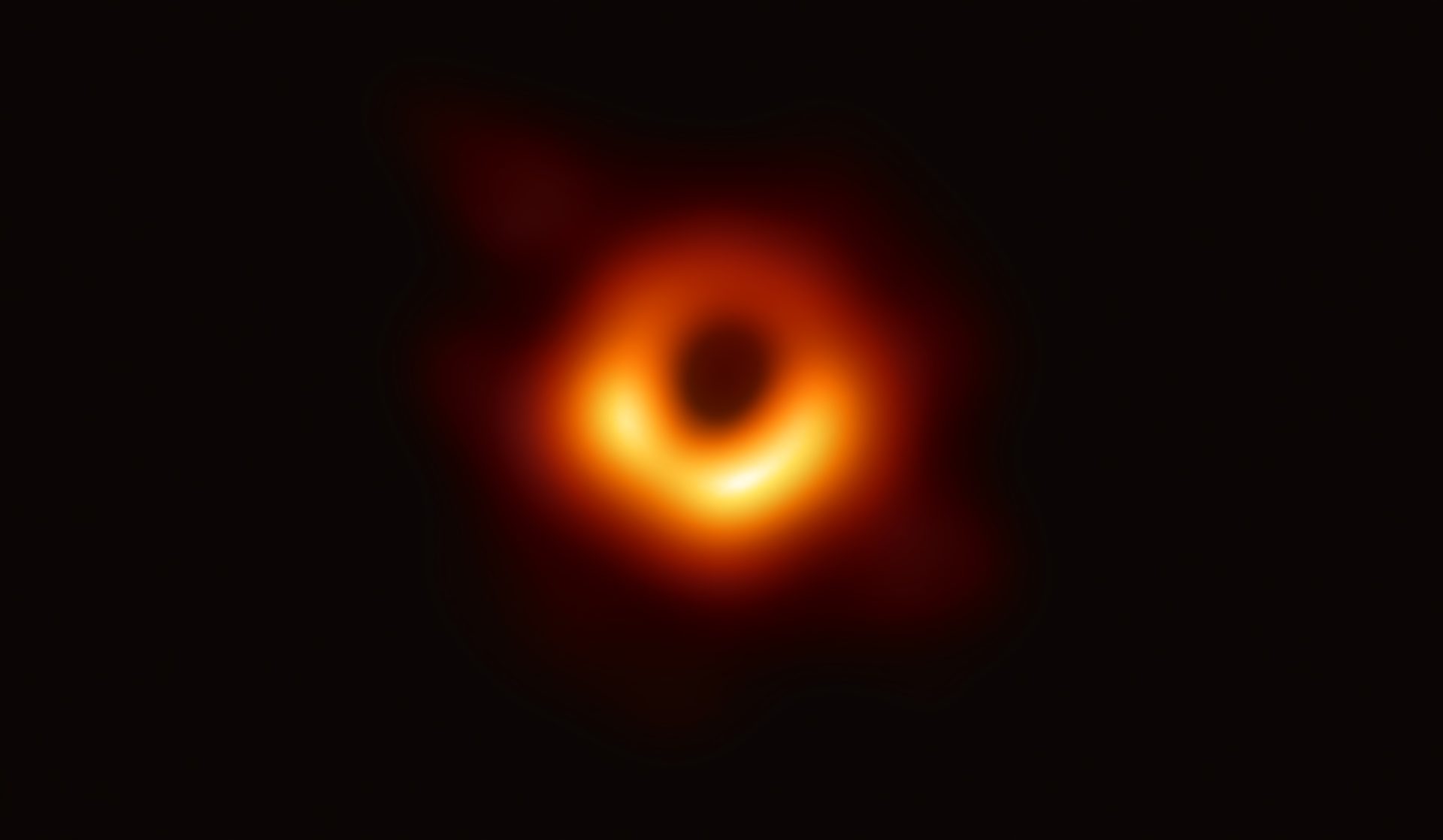
Real black holes spin, and spin changes every radius above. The source consulted for this article gives the rotational parameter of the hole in M87 as 0.90 plus or minus 0.05, which is close to the theoretical maximum — so the Schwarzschild figures are an idealisation, not the right numbers for that object. Treat every radius here as the non-rotating case, which is what it is.
Mistake 4: letting the formula decide what exists
R_s = 2GM/c2 will happily take any mass at all, including a third of a solar mass, and hand back a radius. Problem 3 below runs that backwards — a 1.000 km horizon needs 0.3386 solar masses — which is well under the three-solar-mass observational floor. The arithmetic is correct; the object is not one anybody has seen.
And a longer list of things this model simply does not describe, for which no figure appears anywhere on this page:
- Hawking radiation, evaporation times and black-hole entropy.
- Rotation: the ergosphere and frame dragging.
- The interior, and whatever the singularity means.
- Accretion-disc temperatures, jets and the geometry of lensed images.
- Gravitational waves from mergers.
Those are real physics and most are active research. They are simply not what three static relations about one isolated mass can tell you.