E_in = (into the store) + (to the surroundings)four pathway names: electrically · mechanically · by heating · by radiation · the surroundings branch is the remainder, never a reading
The energy transfers simulator is a free interactive lab that keeps one device’s books. Pick an electric kettle or an electric winch, set the supply and the job it has to do, and a Sankey diagram redraws with every branch as tall as the joules travelling along it. On arrival the four cards read 220.0 kJ, 209.1 kJ, 10.95 kJ and electrically -> by heating, by radiation.
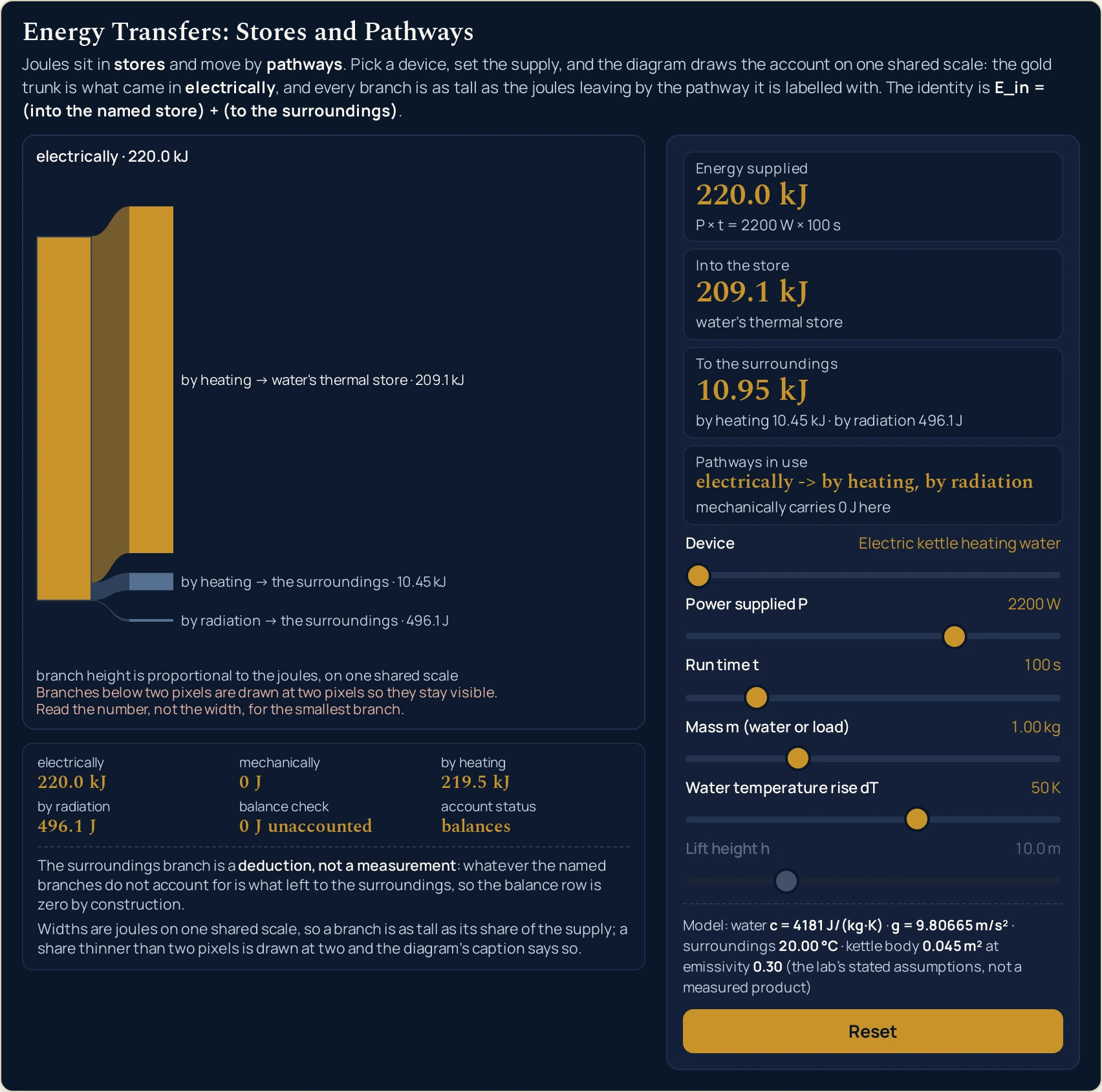
The branch worth dragging for is the thin one. With the lab’s stated 0.045 m² of kettle body at an emissivity of 0.30, the radiated branch on that opening setting is 496.1 J — too thin to draw against a trunk of 220.0 kJ, so the diagram floors it at two pixels and says underneath that it has. Stretch the run to 480 s at 500 W and the same 209.1 kJ still reaches the water while that branch grows to 2.381 kJ.
Energy Transfers: Stores and Pathways
Joules sit in stores and move by pathways. Pick a device, set the supply, and the diagram draws the account on one shared scale: the gold trunk is what came in electrically, and every branch is as tall as the joules leaving by the pathway it is labelled with. The identity is E_in = (into the named store) + (to the surroundings).
electrically220.0 kJ
mechanically0 J
by heating219.5 kJ
by radiation496.1 J
balance check0 J unaccounted
account statusbalances
The surroundings branch is a deduction, not a measurement: whatever the named branches do not account for is what left to the surroundings, so the balance row is zero by construction.
Widths are joules on one shared scale, so a branch is as tall as its share of the supply; a share thinner than two pixels is drawn at two and the diagram's caption says so.
Energy supplied
220.0 kJ
P × t = 2200 W × 100 s
Into the store
209.1 kJ
water's thermal store
To the surroundings
10.95 kJ
by heating 10.45 kJ · by radiation 496.1 J
Pathways in use
electrically -> by heating, by radiation
mechanically carries 0 J here
Electric kettle heating water
2200 W
100 s
1.00 kg
50 K
10.0 m
Model: water c = 4181 J/(kg·K) · g = 9.80665 m/s² · surroundings 20.00 °C · kettle body 0.045 m² at emissivity 0.30 (the lab's stated assumptions, not a measured product)
Load a real device in one click
Each button writes the six sliders and nothing else; the simulation does every calculation itself, exactly as it would if you had dragged them. They are in the order the device list runs in, three settings of the kettle and then two of the winch.
Press the first and then the third if you only press two. Those are the same litre of water taken up by the same 50 K, once at 2200 W for 100 s and once at 500 W for 480 s, and the second of them hands the surroundings almost three times as much.
Pick one of the five devices above, or drag the six sliders yourself.
What Is the Energy Transfers Simulator?
The energy transfers simulator is a free interactive physics lab that runs in your browser, with nothing to install and no sign-up. One real device goes in — an electric kettle heating water, or an electric winch lifting a load — and what comes back is its whole energy account, drawn as a Sankey diagram whose branch heights are the joules themselves.
Four reading cards carry the panel. Energy supplied gives the joules that went in, Into the store gives the joules that reached the store the device exists to fill, To the surroundings gives the joules that did not, and Pathways in use names the routes they travelled by. On the opening setting they read 220.0 kJ, 209.1 kJ, 10.95 kJ and electrically -> by heating, by radiation.
A sub-line under each card says where its figure came from. Under the first it reads P × t = 2200 W × 100 s; under the second, the store’s own name, water’s thermal store; under the third, the split by heating 10.45 kJ · by radiation 496.1 J; and under the fourth, mechanically carries 0 J here, which is how a pathway that carries nothing is still named rather than quietly dropped.
Six sliders drive it. One picks the device; two set the supply, from 0 to 3000 W in tens of watts and 0 to 600 s in fives of seconds; one sets a mass, which is water on the kettle and a load on the winch; and the last two are the device-specific pair, a temperature rise from 0 to 80 K on the kettle and a lift height from 0 to 40 m on the winch. Whichever of that pair is idle is disabled and dimmed, and keeps its own permanent label.
Under the diagram sits a strip of six more readings rather than six more cards. Four of them are the four pathway names with the joules each one carries — electrically 220.0 kJ, mechanically 0 J, by heating 219.5 kJ and by radiation 496.1 J at the opening setting — and the last two are balance check 0 J unaccounted and account status balances.
The by heating cell is the one most often misread. It is the TOTAL on that pathway, the branch that fills the store plus the branch that warms the room, which is 219.5 kJ where the To the surroundings card reads 10.95 kJ. The two are different quantities and the diagram draws them as two separate branches.
Branch height is joules on one shared scale, which is the whole claim the picture makes. On the opening kettle the branch into the water is far taller than either branch to the room, and a reader can see the proportions before reading a single figure. A branch that would come out thinner than two pixels is drawn at two so it stays visible, and the diagram’s own caption says so whenever that has actually happened — on some settings nothing is floored and the caption is correctly absent.
The balance row is zero by construction, and the lab says so in words under the diagram instead of presenting it as a discovery. The joules to the surroundings are never measured here: they are the remainder, what is left once every branch that can be named has been named. That makes the account honest about its own method, and it is the reason a 0 J unaccounted reading proves nothing by itself.
What the account can genuinely fail at is being asked for more than was supplied, and that state is reachable with one slider. Raise the mass on the opening kettle from 1.00 kg to 2.00 kg and Into the store climbs to 418.1 kJ while the supply stays at 220.0 kJ: the status cell changes to cannot balance — short by 198.6 kJ, the balance cell to no remainder to check, and the store’s sub-line gains · demanded, not supplied.
No negative figure is ever printed and no branch is ever drawn with a negative height. In that over-supplied state the trunk is still drawn, because the joules in the trunk really were supplied, and the named branches are clipped to it with a band saying in words that the widths are no longer to scale. The remainder is clamped to zero rather than allowed to go below it.
Five preset buttons on the landing page write the six sliders for you and recompute nothing. They run from a one-litre kettle to a single mug, then to the same litre heated slowly on a weaker supply, and finally to two lifts on the winch at 11.77 kJ and 58.84 kJ into the gravitational potential store. The slow kettle is the one to sit with: an identical 209.1 kJ reaches the water and the surroundings take 30.95 kJ instead of 10.95 kJ.
The constants behind those figures are the lab’s stated assumptions and not measurements of any product, and the panel prints them in a fixed line so nobody has to guess: water at 4181 J/(kg·K), standard gravity 9.80665 m/s², surroundings at 20.00 °C, and a kettle body of 0.045 m² at an emissivity of 0.30. Change a real kettle’s shell and the radiated branch changes with it, so treat any figure you intend to act on as unverified until it has been checked against the object in front of you.
Every joule figure is printed to four significant figures, in joules below one kilojoule and in kilojoules above it, with no megajoule step at all — the largest supply the two sliders can reach prints 1800 kJ. An exact zero prints 0 J rather than a string of decimal zeros, and the unit is chosen after the rounding, so a figure a whisker under one kilojoule prints 1.000 kJ rather than five figures in a four-figure field.
| Control | Range | Step, default and what it moves |
|---|---|---|
| Device | kettle or winch | step 1 on a two-position slider; opens on 0, which the readout names "Electric kettle heating water". Position 1 is "Electric winch lifting a load". The device decides which store the kept branch reaches - the water's thermal store or the gravitational potential store - and which of the last two sliders is live |
| Power supplied P | 0 to 3000 W | step 10; opens at 2200 W. With the run time it fixes the joules in the trunk, and the first card's sub-line shows the product it used: "P × t = 2200 W × 100 s". At 0 W nothing is supplied, so no trunk is drawn at all |
| Run time t | 0 to 600 s | step 5; opens at 100 s. It is the one slider that moves the radiated branch without touching the store: radiation is a rate times a time, so holding the store fixed and stretching the run makes the surroundings take more. Both sliders at the top print a supply of 1800 kJ, the largest this lab can reach |
| Mass m (water or load) | two ranges by device | on the kettle 0.20 to 3.00 kg of water in steps of 0.05, opening at 1.00 kg; on the winch 5 to 500 kg of load in steps of 5. The value is re-clamped into the new range on a device change rather than jumping to a default, so switching up from 1.00 kg lands on 5 kg, the winch's own minimum |
| Water temperature rise dT | 0 to 80 K | step 1; opens at 50 K, and live on the kettle only. It sets the joules into the water's thermal store, and it is also what the radiated branch depends on: at 0 K the body is at room temperature, the radiated branch is exactly zero, and the pathway line drops "by radiation" rather than printing a zero branch |
| Lift height h | 0 to 40 m | step 0.5; opens at 10.0 m, and live on the winch only. With the load it sets the joules into the gravitational potential store. At 0.0 m nothing reaches the store and the whole supply is accounted to the surroundings by heating. The slider that is not live is disabled, dimmed and marked as disabled for a screen reader, and it keeps its own permanent label |
| Reset | one button | it restores device 0 and the one-litre kettle: 2200 W, 100 s, 1.00 kg and 50 K. Those are the lab's own defaults and the first preset, so the panel returns to a state this cluster's independent reference owns rather than to an arbitrary one, and the diagram grows back from nothing rather than cutting to the answer |
How to use the energy transfers physics simulator
- Read the four cards before you touch anything. They sit at the top of the panel and are already answering for a one-litre kettle: Energy supplied
220.0 kJ, Into the store209.1 kJ, To the surroundings10.95 kJ, and Pathways in useelectrically -> by heating, by radiation. - Read the sub-line under each one, because that is where the card shows its working. They read
P × t = 2200 W × 100 s,water’s thermal store,by heating 10.45 kJ · by radiation 496.1 Jandmechanically carries 0 J here. The last of those is a pathway that carries nothing being named rather than hidden. - Now look at the strip of six cells under the diagram, and do not cross two of them.
by heatingreads219.5 kJthere, which is the total on that pathway — the branch into the water plus the branch into the room. It is a different quantity from the To the surroundings card’s10.95 kJ, and the diagram draws them as two separate branches. - Drag Run time t from 100 s to 200 s and watch only the store stand still. Energy supplied doubles to
440.0 kJ, To the surroundings goes to231.0 kJand the radiated cell to992.1 J, while Into the store sits exactly where it was at209.1 kJ. - Pull Water temperature rise dT all the way down to 0 K. Into the store reads
0 J, the radiated cell reads0 Jbecause the body is now at room temperature, and the pathway card shortens toelectrically -> by heating. A pathway carrying nothing is dropped from that line instead of being printed as a zero branch. - Break the account on purpose: put Mass m at 2.00 kg with everything else back at its opening value. Into the store climbs to
418.1 kJagainst a220.0 kJsupply, the status cell readscannot balance — short by 198.6 kJ, the balance cell readsno remainder to check, and the store’s sub-line gains· demanded, not supplied. - Move Device to the winch and watch the mass slider refuse to carry its old value. 1.00 kg is below the winch’s own minimum, so the slider comes to rest on
5 kgrather than jumping anywhere; Water temperature rise goes disabled and dimmed and Lift height h comes live. Press Winch, 120 kg load and the store becomes11.77 kJofgravitational potential store, withby radiation carries 0 J hereunderneath. - Press Reset when you have finished. It puts the device back to the kettle and the sliders back to
2200 W,100 s,1.00 kgand50 K, with the lift height disabled again at10.0 m, and it replays the settle, so the diagram grows back out of nothing rather than cutting straight to the answer.
Dragging is the right way to find out which readings move together and a poor way to hit an exact figure, because the supply slider steps ten watts at a time and the run time five seconds. When you already have a volume of water and a temperature rise in front of you and want the joules typed rather than dialled, the water heating energy calculator takes them directly. The written guide to energy transfers in physics is where the stores-and-pathways model itself is set out, with the four pathway names defined and worked problems on each.
One thing this panel will not decide for you is which store a given device is supposed to fill. That is a judgement about what the machine is for, and it is upstream of every joule on the screen: call the wrong branch the useful one and the account still balances perfectly while telling you nothing. Settle that first, then come back and read the widths.
Worked example: the same store, two different supplies
Nothing in the two tables below was worked out here. Each row is a setting the lab was put into through its own sliders and then read back from, cell by cell, so every string in them is the panel’s own. The first table is two presets side by side; the second is all five.
One: the same joules into the water, from two different supplies
Press Kettle, one litre and then Low power, long run. The mass and the temperature rise are identical in both, so the water takes identical joules; only the power and the run time differ, and they differ in opposite directions.
| What was set | Energy supplied | Into the store | To the surroundings | By heating, the pathway total | By radiation | Account status |
|---|---|---|---|---|---|---|
| Kettle, one litre: 2200 W for 100 s, 1.00 kg, 50 K | 220.0 kJ | 209.1 kJ | 10.95 kJ | 219.5 kJ | 496.1 J | balances |
| Low power, long run: 500 W for 480 s, 1.00 kg, 50 K | 240.0 kJ | 209.1 kJ | 30.95 kJ | 237.6 kJ | 2.381 kJ | balances |
Read the third column first, because it is the one that does not move. Both rows put 209.1 kJ into the water, and the panel prints the same four characters in both. The water cannot tell which supply filled it, and nothing in the second and third columns is a rounding coincidence.
Now read the fourth column. The slow run hands the surroundings 30.95 kJ where the fast one hands them 10.95 kJ, for the same job done. The whole of that 20.00 kJ difference is the extra supply: the trunk reads 240.0 kJ against 220.0 kJ, the store does not move, and most of the extra leaves by heating — the sub-line under that card goes from by heating 10.45 kJ to by heating 28.57 kJ.
The sixth column is the mechanism, not the bulk of it. The radiated branch grows from 496.1 J to 2.381 kJ, because radiation is a rate multiplied by a time and the slow run gives it 4.8 times as long, and that growth is under two kilojoules of the twenty. The three mechanisms behind the two thermal pathway names are set out in the guide to conduction, convection and radiation.
The fifth column is the one to read carefully. It is the total on the by-heating pathway, so it counts the branch into the water as well as the branch into the room, and that is why it reads 219.5 kJ and 237.6 kJ rather than anything resembling the fourth column.
Two: the five presets, and what each one is for
These are the buttons above with the readings they produce. The fourth column is the sub-line under Into the store, which is the only place the panel names the store by name, and the last column is the pathway card itself.
| Preset | Energy supplied | Into the store | The store it fills | To the surroundings | By radiation | Pathways in use |
|---|---|---|---|---|---|---|
| Kettle, one litre | 220.0 kJ | 209.1 kJ | water’s thermal store | 10.95 kJ | 496.1 J | electrically -> by heating, by radiation |
| One mug, fast boil | 66.00 kJ | 62.72 kJ | water’s thermal store | 3.285 kJ | 148.8 J | electrically -> by heating, by radiation |
| Low power, long run | 240.0 kJ | 209.1 kJ | water’s thermal store | 30.95 kJ | 2.381 kJ | electrically -> by heating, by radiation |
| Winch, 120 kg load | 15.00 kJ | 11.77 kJ | gravitational potential store | 3.232 kJ | 0 J | electrically -> mechanically, by heating |
| Hoist, heavy and slow | 67.50 kJ | 58.84 kJ | gravitational potential store | 8.660 kJ | 0 J | electrically -> mechanically, by heating |
Rows one and two are the same device at two sizes, and the diagram is identical. The mug takes under a third of the joules, and every branch shrinks by the same factor, so the three widths come out exactly where the kettle’s do. One shared scale means the picture shows shares, and shares are what two rows of this kind have in common.
Rows four and five are the other device, and the sixth column is the tell. It reads 0 J on both, because the winch has no modelled radiating surface, and the pathway card in the last column names mechanically in its place. At most three of the four pathway names ever carry joules at once, and on all five presets exactly three do; empty a branch, as the zero temperature rise above does, and the card simply gets shorter. The store those two rows fill is the subject of the guide to gravitational potential energy, which also covers the masses and heights this lab’s sliders cannot reach.
Formula and symbol reference: the names on the diagram
The identity at the head of this page is the whole model: the joules that came in equal the joules into the named store plus the joules to the surroundings. What fills in each term depends on the device, and the lab uses four short expressions and nothing else.
The trunk is E_in = P × t on both devices. The kept branch is m × c × dT on the kettle and m × g × h on the winch. The radiated branch is sigma × A × emissivity × (T_surf^4 - T_room^4) × t, with sigma the Stefan–Boltzmann constant and T_surf taken as the water temperature. The last term, the joules the surroundings take by heating, is then whatever is left of the supply.
The names the diagram prints, and what each one means
Four of these are pathways, two are stores, and the seventh is where the remainder goes. The lab never mixes the two kinds: a pathway is how joules travelled, a store is where they ended up, and no line in the panel describes a pathway as a place.
| Name on the diagram | What it means | Where it appears in this lab |
|---|---|---|
| electrically | Energy carried by an electric current doing work on a device. It is the supply pathway on both devices here, which is why it is the trunk and never a branch | the trunk whenever anything is supplied, labelled with its joules; 220.0 kJ on the opening kettle |
| mechanically | Energy carried by a force moving its point of application — a cable pulling a load upwards | the kept branch on the winch, 11.77 kJ on its preset; it carries 0 J on the kettle and the panel says so |
| by heating | Energy carried by a temperature difference, through contact and through bulk motion of the fluid | two branches at once on the kettle: into the water and into the room. The strip cell is their total, 219.5 kJ |
| by radiation | Energy carried away as electromagnetic waves from a warm surface, needing no material in between | the thinnest branch on the kettle at 496.1 J; it carries 0 J on the winch, and 0 J on the kettle when the temperature rise is set to zero |
| water’s thermal store | The store a heating device exists to fill: joules held in the random motion of the water’s own molecules | the gold branch’s destination on the kettle, named in the sub-line under the second card |
| gravitational potential store | The store a lifting device exists to fill: joules held in the position of a mass in a gravitational field | the gold branch’s destination on the winch, named in the same sub-line |
| the surroundings | Not a store the lab tracks, but everything outside the device. It is where the remainder goes, and it is never measured here | the destination of the dimmed branches, and the subject of the third card |
There is no row here for an electrical store, and that is the point rather than an omission. Electrically is a pathway in this model and only a pathway: joules travel by it and then stop somewhere else. The guide to what energy is in physics is where the question of what the quantity itself is gets answered.
Twelve quantities, and what each is allowed to do here
Five of the twelve rows below are sliders you can drag; the sixth slider is the device switch, which is in the control table higher up this page. The rest are cards, strip cells or fixed assumptions. For the sliders the last column gives the end stops, the step and a reading the panel printed at one of them; for everything else it gives the strings the lab printed and the setting they came from.
| Symbol or readout | Meaning | SI unit | In this lab |
|---|---|---|---|
| P | Power supplied — the rate at which the supply delivers joules. Together with the run time it fixes the whole trunk, and neither of the two can be read off the diagram separately | watt (W) | 0 to 3000 W, in steps of 10, opening at 2200 W. The first card’s sub-line shows the product it used: P × t = 2200 W × 100 s. |
| t | Run time — how long the supply runs for. It is the only slider that moves the radiated branch while leaving the store untouched, because radiation is a rate multiplied by a time | second (s) | 0 to 600 s, in steps of 5, opening at 100 s. Taking it to 200 s alone lifts the supply to 440.0 kJ and the radiated branch from 496.1 J to 992.1 J, with the store still at 209.1 kJ. |
| E_in | Energy supplied — the joules in the trunk, and the height every branch is measured against | joule (J) | the first card, to four significant figures. Both supply sliders at the top print 1800 kJ, the largest this lab can reach; at 0 W it prints 0 J and no trunk is drawn. |
| m | Mass — of the water on the kettle, of the load on the winch. One slider and one label, because it is a mass in both cases and no screen reader meets a control whose meaning has changed | kilogram (kg) | 0.20 to 3.00 kg in steps of 0.05 on the kettle, opening at 1.00 kg; 5 to 500 kg in steps of 5 on the winch. Dropping it to 0.20 kg alone takes the store to 41.81 kJ and the surroundings to 178.2 kJ. |
| dT | Temperature rise of the water — how much hotter the kettle has to make it. It sets the store and the radiated branch at the same time, which is why the two cannot be separated on this device | kelvin (K) | 0 to 80 K, in steps of 1, opening at 50 K, and live on the kettle only. At 0 K the store reads 0 J, the radiated branch is exactly 0 J, and the pathway card drops to electrically -> by heating. |
| h | Lift height — how far the winch raises the load. With the mass it is the whole of the kept branch on that device | metre (m) | 0 to 40 m, in steps of 0.5, opening at 10.0 m, and live on the winch only. At 0.0 m the store reads 0 J and the whole 15.00 kJ supply is accounted to the surroundings. |
| c | Specific heat capacity of water — the joules one kilogram needs for one kelvin. A stated model value here, not a slider and not a measurement of anybody’s tap water | joule per kilogram kelvin | fixed at 4181 J/(kg·K) and printed in the panel’s own line of assumptions. It is the figure behind every Into the store reading on the kettle. |
| g | Standard gravity — the acceleration a free mass has near the surface of the Earth. Exact by definition rather than measured | metre per second squared | fixed at 9.80665 m/s², printed in the same line. It is the figure behind every Into the store reading on the winch. |
| A and the emissivity | The radiating area of the kettle body and how efficiently that surface emits, on a scale from 0 to 1. Both are the lab’s stated assumptions and neither describes a product you can buy | square metre, and a pure number | fixed at 0.045 m² and 0.30. With those two stated values the radiated branch on the opening kettle is 496.1 J over 100 seconds; change either and that branch moves. |
| T^4 | The fourth power of the absolute surface temperature, which is what makes radiation rise so steeply with the temperature rise rather than in step with it | kelvin to the fourth | never printed as a figure, but visible in the behaviour: halving the temperature rise from 50 K to 25 K halves the store to 104.5 kJ and cuts the radiated branch from 496.1 J to 218.9 J, which is less than half. |
| balance check | The supply minus everything the named branches account for. Zero by construction, because the surroundings branch was defined as whatever was left | joule (J) | the fifth cell of the strip, reading 0 J unaccounted on every setting that balances and no remainder to check on every setting that cannot. |
| account status | Whether the branches that can be named fit inside the supply at all. This is the one reading in the lab that is not settled in advance | not a physical quantity | the sixth cell, reading balances or a deficit. Two kilogrammes of water on the opening kettle gives cannot balance — short by 198.6 kJ; a 1.000 kJ supply asked to heat three kilogrammes of water by 80 K gives cannot balance — short by 1003 kJ. |
If you read one row twice, make it T^4. It is the only non-linearity in the whole model, and it is why the radiated branch cannot be scaled in your head from the temperature rise the way the store can. The water’s own figure is the ordinary one: the specific heat calculator will do the same arithmetic for a material that is not water.
The physics: why the last branch is a deduction
The surroundings branch is the one figure on this panel that no slider produces. The trunk comes from the power and the run time; the store comes from the mass and either the temperature rise or the lift height; the radiated branch comes from the stated area, the emissivity and the two temperatures. Whatever is left of the supply after those three is handed to the surroundings by heating, because conservation leaves it nowhere else to be, and the balance cell therefore reads zero by construction — the method, not a coincidence.
Be blunt about that, because a panel printing 0 J unaccounted looks like a panel that has checked something. It has not. The cell is still worth watching, but for a different reason: a branch computed wrongly would land in the remainder, and the widths beside it would look absurd long before any figure complained. What the panel will not do is break that remainder into parts it has not modelled, which is why the third card has two components under it and no more.
The state that is not settled in advance is the one where the account cannot be closed. Ask for more joules than were supplied and there is nowhere for the deficit to go: the lab clamps the remainder at zero rather than printing a negative branch, says in the status cell by how much the account is short, and clips the drawn widths to the trunk with a band saying they are no longer to scale. That is the single place this panel teaches something the arithmetic could have hidden.
The picture itself is a Sankey diagram, which is a flow diagram in which the width of the arrows is proportional to the flow rate of the depicted extensive property; the form is named after the Irish engineer Captain Matthew Henry Phineas Riall Sankey, who used one in 1898 in a figure about a steam engine. Here the extensive property is energy and the width is joules, on one scale shared by the trunk and every branch. That is why the mug and the kettle draw the same shape at different totals.
What the diagram cannot do is show a branch that is too thin to see, so below about two pixels it stops being honest about width and says so in a caption instead. The number beside the branch is always exact to four figures, the width is not always exact, and on the settings where nothing has been floored the caption is left out rather than printed as a standing disclaimer.
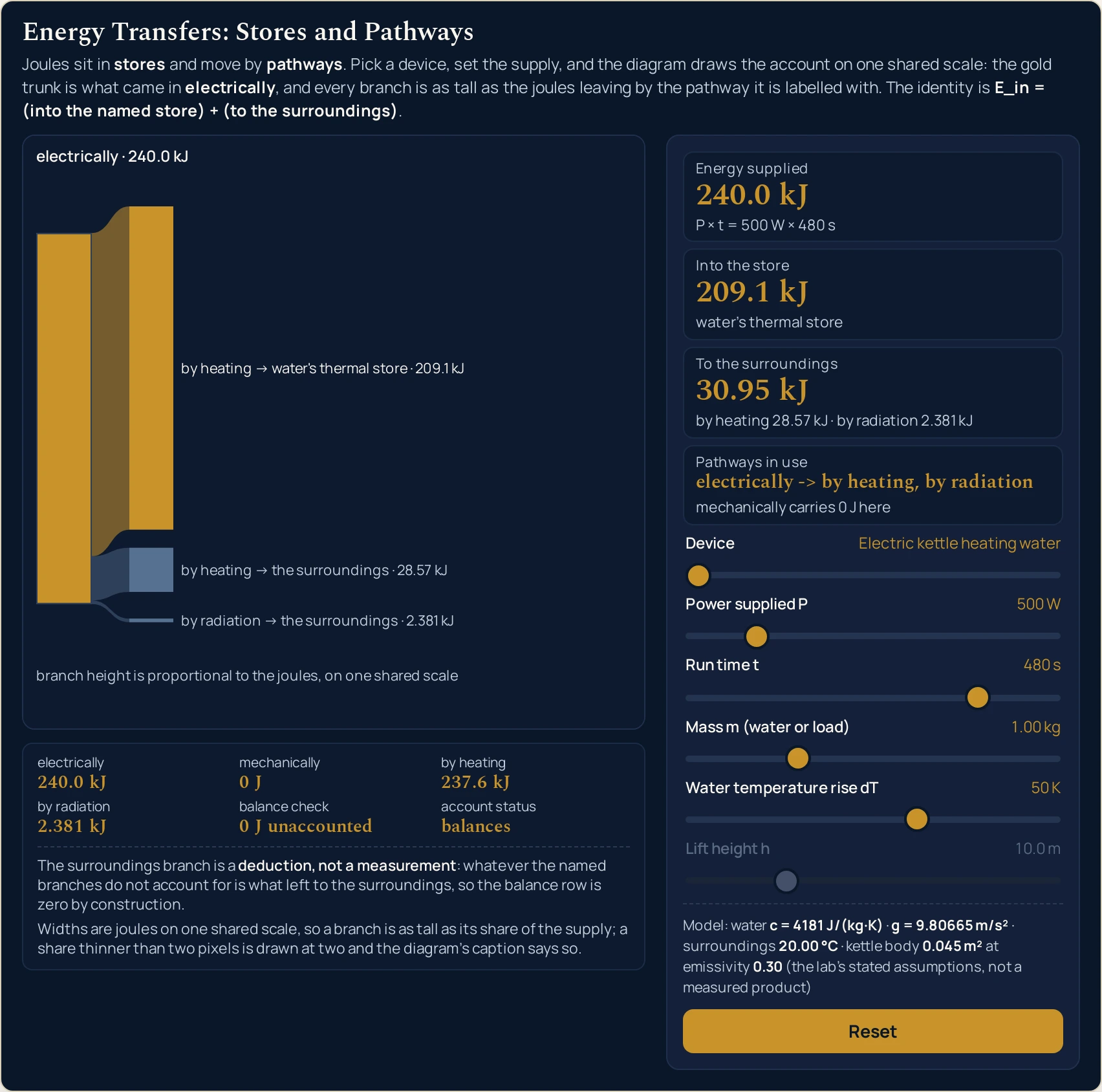
209.1 kJ; To the surroundings has gone from 10.95 kJ to 30.95 kJ. Compare the caption block with the shot above: here nothing was floored, so the two floor lines are gone.Where the energy transfers simulator breaks down
Every slider position this lab can reach is answered, and the arithmetic is not where it can let you down. What it cannot do is model a real appliance, and what it chooses not to do is split the remainder into named parts. Nine limits sit under the readings on this page.
- Four of the numbers behind the diagram are assumptions, not measurements
- The panel prints them in its own fixed line and calls them assumptions there: water at
4181 J/(kg·K), surroundings at20.00 °C, a kettle body of0.045 m²and an emissivity of0.30. The first is an ordinary textbook value for liquid water near room temperature. The last two are the lab’s own stand-in for a brushed stainless shell and describe no product you can buy, so the radiated branch should be read as what follows from those stated values rather than as a fact about kettles. - The kettle body has no thermal store of its own
- A real kettle warms up as well as the water in it, and those joules are genuinely stored rather than passed on. Here the body has a temperature and an area for the purpose of radiating, and no heat capacity at all. Anything that would have gone into warming the shell therefore turns up inside the remainder instead, which is one reason the surroundings branch is bigger than a careful experiment would find.
- Steam carrying energy out of the spout is inside the remainder, not beside it
- Evaporation is a real and sometimes large branch of a kettle’s account, and it is not drawn here. The lab names four pathways and splits the surroundings into the two it can compute, so everything else that left the device — steam, conduction through the base, convection off the sides — is lumped into the by-heating branch to the surroundings. The account still closes; it simply closes with one coarse branch where a real audit would have several.
- The surface is assumed to sit at the water temperature
- The radiated branch is computed from a surface temperature equal to the room temperature plus the water’s own rise, which is the most generous assumption available. A real shell is cooler than the water inside it, usually by a good deal, so the radiated figure here is an upper bound rather than an estimate. It is also the branch the
T^4term makes most sensitive to that choice. - The balance row cannot fail, so it proves nothing on its own
- It reads
0 J unaccountedon every setting that balances because the remainder was defined to make it so. Treat it as a bookkeeping line rather than a check. The reading that can genuinely change is the one beside it: the account status, which goes frombalancesto a deficit as soon as the named branches ask for more than the trunk holds. - No negative figure is reachable, and that is enforced rather than hoped for
- When the account cannot close, the remainder is clamped to zero instead of going below it, the balance cell prints
no remainder to checkrather than a number, and the branch widths are clipped to the trunk under a band saying they are not to scale. A 1.000 kJ supply asked to heat three kilogrammes of water by 80 K is reported ascannot balance — short by 1003 kJ, and even there no branch is drawn with a negative height. - A branch carrying nothing is not drawn at all
- A zero-width branch cannot be painted, so on the winch there is no radiation branch in the picture and on a kettle with no temperature rise there is no store branch. The strip of six cells under the diagram reports the
0 Jin each case, and the pathway card drops the name rather than printing an empty branch. If you are looking for a branch that is not there, read the strip before concluding the lab has lost it. - No pixel in the drawing is a measurement
- The scene is drawn to whatever width the canvas has, so the same account occupies a different number of pixels on a phone and on a desktop, and the drawing promises no fixed width per kilojoule. What it does guarantee is one shared scale across the trunk and every branch on a given setting. Below about two pixels even that is suspended for the branch concerned, and the caption underneath says so whenever it has happened.
- This lab answers a different question from the ratio one
- How much of the supply reached the store, as a proportion, is a real and useful question, and it is deliberately not asked here: this panel computes no ratio and prints no percentage at all. The branches in joules and the share they represent are two different readings, and conflating them is the easiest way to misread a Sankey diagram. The efficiency formula calculator is where the proportion is worked out properly, and it takes the kind of figures this panel prints.
Where energy accounting is actually used
- Deciding whether a slower setting is really kinder
- This is the clearest thing the panel does and it takes two clicks. The same litre at the same 50 K rise draws
220.0 kJon the fast preset and240.0 kJon the slow one, with209.1 kJreaching the water either way. The difference went to the room, and the radiated branch alone grew from496.1 Jto2.381 kJbecause it had 4.8 times as long to run. - Working out how much water a given supply can actually heat
- Put the supply where your appliance sits and raise the mass until the account breaks. At
2200 Wfor 100 s with a 50 K rise the panel stops balancing between 1.00 kg and 2.00 kg: at two kilogrammes it readscannot balance — short by 198.6 kJ. That boundary is the honest answer to how much you can heat in the time, and it arrives as a refusal rather than as a quietly wrong number. - Sizing a hoist against the job rather than against its plate
- Switch to the winch and the same question becomes a lifting one.
750 Wfor 20 s supplies15.00 kJ, and a 120 kg load raised 10.0 m takes11.77 kJof that; double the height with nothing else changed and the demand becomes23.54 kJ, which the panel reports ascannot balance — short by 8.536 kJ. Either the run gets longer or the supply gets bigger. The guide to power in physics is where the trade between the two is set out. - Seeing which branch is worth attacking before spending anything on it
- On the opening kettle the branch into the room by heating is
10.45 kJand the radiated branch is496.1 J, so radiation is under a twentieth of what the room took in all, and the widths say it before the figures do. The panel cannot price a fix, though: the emissivity and the area are fixed stated values, and since the remainder is whatever is left, a lower emissivity would move joules out of the radiated branch into the remainder and leave the10.95 kJtotal unmoved. Read the pair as which branch is large, not as what attacking it would save. On the slow run the balance shifts and the radiated branch becomes worth a second look. - Showing a class that a named pathway can carry exactly nothing
- Press the winch preset and the strip reads
0 Jbesideby radiation, withby radiation carries 0 J hereunder the pathway card. Press the kettle preset and the same thing happens tomechanically. Naming a pathway and then giving it zero is a much stronger demonstration than leaving it out, and it is the fastest way to stop a class assuming all four are always running. - Reading somebody else’s Sankey diagram without being fooled by it
- Published energy diagrams routinely redraw a thin branch so that it can be seen, and they do not always say so. This panel does the same thing at a two-pixel floor and prints a caption whenever it has, so it is a safe place to learn the habit of checking the number against the width. On the opening kettle the smallest branch is drawn more than three times wider than its share deserves, and the figure beside it is still exact.
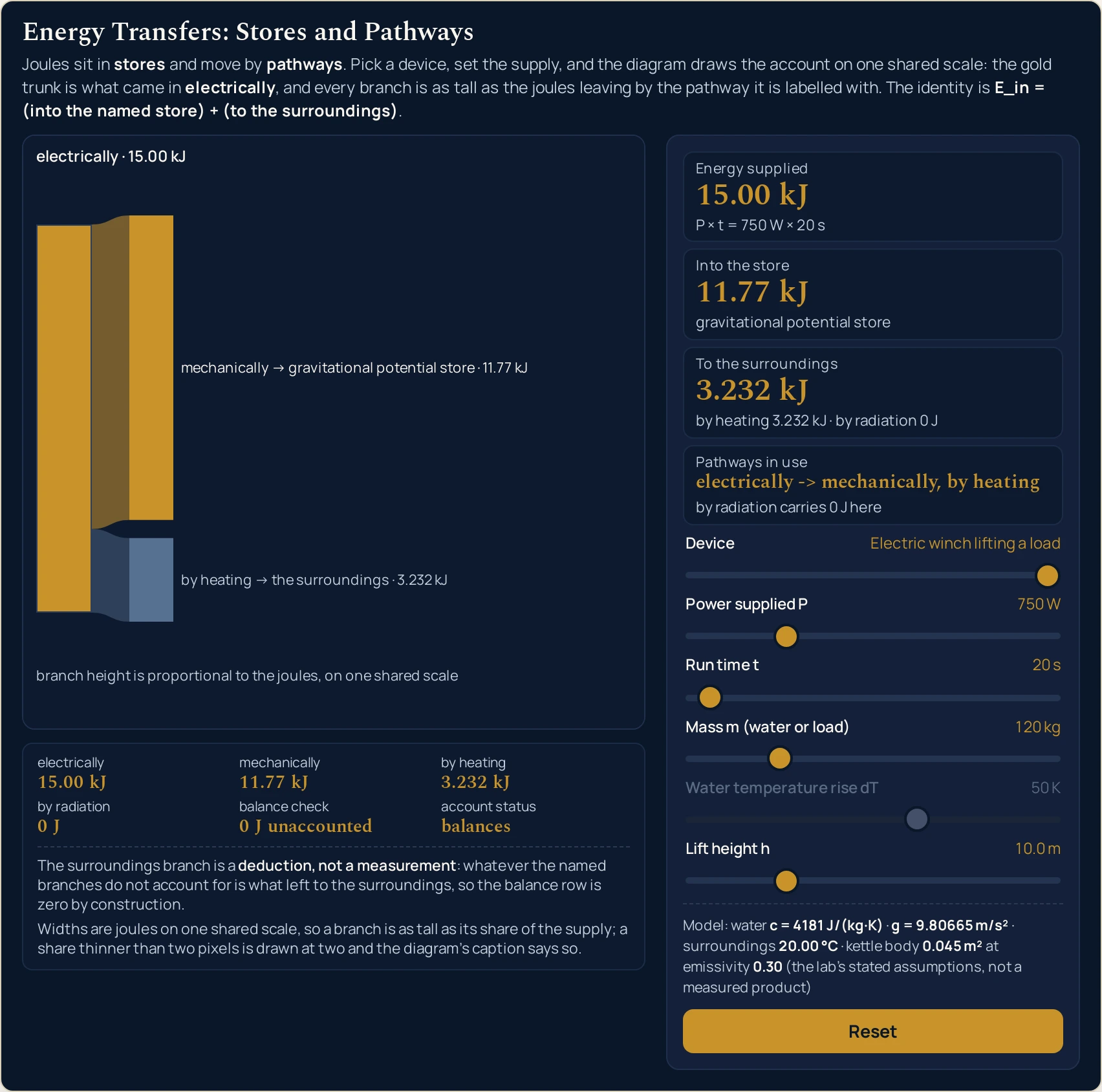
11.77 kJ of gravitational potential store, and by radiation reads 0 J in the strip while appearing nowhere in the drawing — a branch carrying nothing cannot be given a width, so the panel reports the zero in words instead.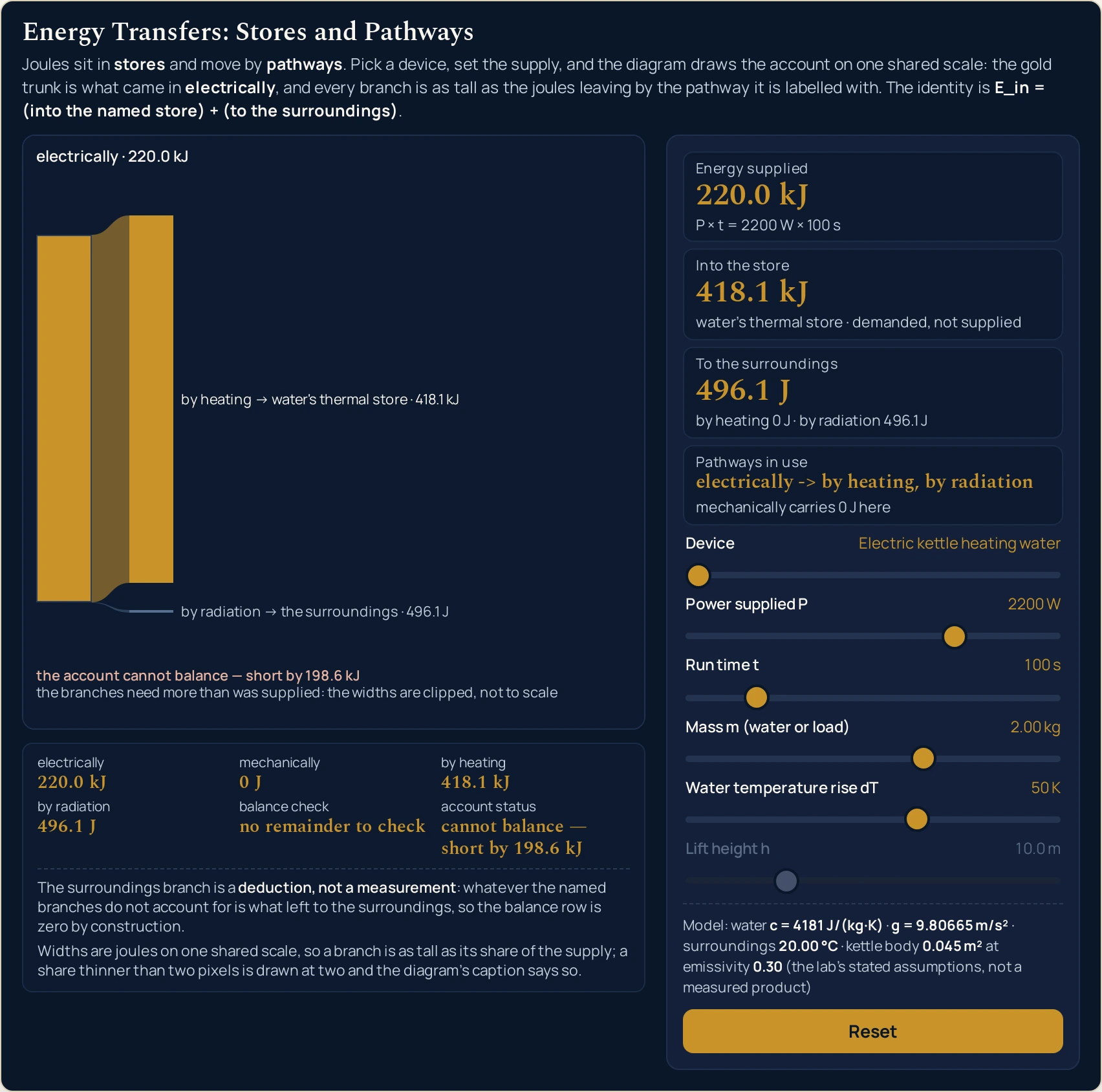
418.1 kJ out of a 220.0 kJ supply, so the balance cell stops pretending there is a remainder and the caption block drops the shared-scale claim it can no longer make. Nothing here is drawn or printed as a negative number.Where to go next
A panel can show you an account and let you break it, and that is the end of what a panel is for. Energy transfers in physics is where the subject itself is written out: what a store is, what a pathway is, how a transfer differs from a transformation, and worked problems on both devices with every step shown.
Two guides sit either side of this one. The guide to energy conversion examples keeps the other account of the same joules — what became what, rather than which route it took — and the guide to conservation of energy is where the rule that makes the remainder deducible in the first place is set out.
Three more are about the thermal half of the diagram. The guide to heat and temperature separates the two quantities the kettle slider pair keeps together, the three mechanisms guide names what is actually happening inside the two thermal pathways, and the guide to the first law of thermodynamics is the same bookkeeping written as a law.
On the tool side there are the water heating energy calculator, the specific heat calculator, the gravitational potential energy calculator and the work and power calculator, with the specific heat lab and the efficiency lab for the drawn versions. Beyond them there is the simulation library, an index of calculators, and the blog for everything written out at length.
Frequently asked questions
Why does the balance cell read zero whenever the account closes?
Because it was built to, and the lab says so under the diagram rather than treating it as a result. The joules to the surroundings are never measured here: they are the remainder left once every branch that can be named has been named, so adding the branches back up has to return the supply. A balance of "0 J unaccounted" is a bookkeeping statement about the method, not evidence that the method is right.
The strip says by heating 219.5 kJ but the card says 10.95 kJ. Which is wrong?
Neither, because they are different quantities. The strip cell is the total on that pathway, and on the opening kettle two separate branches travel by heating: 209.1 kJ into the water and 10.45 kJ into the room. The card headed "To the surroundings" adds only what left the device, which is that 10.45 kJ plus the radiated 496.1 J. The diagram draws them as two branches for exactly this reason.
Can I make the account fail, and is that a bug?
Yes, and it is the one state in this lab worth hunting for. Raise the mass on the opening kettle from 1.00 kg to 2.00 kg and the water now demands 418.1 kJ from a 220.0 kJ supply: the status cell reads "cannot balance - short by 198.6 kJ", the balance cell reads "no remainder to check", and the store sub-line gains "demanded, not supplied". No negative joule figure is printed anywhere.
Why is the smallest branch drawn at a width its number does not justify?
Because below about two pixels nothing is visible at all, and an invisible branch reads as an absent one. On the opening kettle the radiated branch would come out at roughly six tenths of a pixel against a trunk of some 280, so the diagram floors it at two and prints a caption saying it has. Where nothing needs flooring, that caption is correctly absent rather than carried as boilerplate.
Does this lab say a real kettle radiates 496 joules?
No, and the distinction matters. The panel prints its assumptions in a fixed line: a kettle body of 0.045 square metres at an emissivity of 0.30, surroundings at 20.00 degrees Celsius, water at 4181 joules per kilogram per kelvin. With those stated values the radiated branch over 100 seconds is 496.1 J. Change the shell, the finish or the room and that branch moves, so verify before use.
Why does the mass slider land on 5 kg when I switch to the winch?
Because the value is re-clamped into the new range rather than jumped to a preset. The kettle holds between 0.20 and 3.00 kg of water and the winch lifts between 5 and 500 kg, so a 1.00 kg setting is below the winch minimum and comes to rest on it. Press a winch preset if you want 120 kg, and the device key is written first so the load is never clipped on the way through.
Why does neither device carry joules down all four pathways?
Because neither device uses all four. The kettle supplies electrically and sends joules out by heating and by radiation, while mechanically carries nothing; the winch supplies electrically and sends joules out mechanically and by heating, while by radiation carries nothing. The pathway card names the live routes and the sub-line names the idle one, so a zero is stated rather than quietly dropped.
What does the two-slider supply pair change that the mass slider does not?
The supply pair changes the trunk without touching the store. Power and run time together set the joules that came in, and on the kettle the mass and the temperature rise together set the joules the water takes, so the two halves of the account move independently. That is what makes the slow-run comparison possible: the same 209.1 kJ reaches the water from a 240.0 kJ supply instead of a 220.0 kJ one.
References & formula source
- The flow diagram this lab draws is a Sankey diagram, and the one property that makes it a Sankey diagram rather than a flow chart is quoted from the source rather than asserted here. Source: Wikipedia, "Sankey diagram" - a flow diagram "in which the width of the arrows is proportional to the flow rate of the depicted extensive property". The same article records that the form is named after the Irish engineer Captain Matthew Henry Phineas Riall Sankey, who used one in 1898 in a figure showing the energy efficiency of a steam engine.
- Four constants in this lab are STATED MODEL ASSUMPTIONS and not measurements of any product: the specific heat capacity of water at 4181 joules per kilogram per kelvin, the surroundings at 20.00 degrees Celsius, a kettle body of 0.045 square metres, and an emissivity of 0.30 for that body. The panel prints all four in a fixed line and says in that line that they are the lab's assumptions. Writing "a kettle radiates 496 J" as a fact about kettles would be false; "with this lab's stated 0.045 square metres at emissivity 0.30 the radiated branch is 496.1 J" is what the simulation computed.
- Standard gravity is 9.80665 metres per second squared by definition rather than by measurement, and the Stefan-Boltzmann constant used for the radiated branch is 5.670374419e-8 watts per square metre per kelvin to the fourth, which follows exactly from the SI defining constants. Those two are the only figures in the model that are not either a slider position or an assumption, and neither is a measurement this site made.
- The surroundings branch is a deduction and the lab is built to say so. The joules reaching the named store are computed from the mass and either the temperature rise or the lift height; the radiated branch is computed from the stated area, emissivity and temperatures; and the remainder is then DEFINED as whatever is left of the supply. Adding the branches back up therefore returns the supply identically on every setting that balances, and the cluster's independent reference asserts that identity on 65 of them. A balance reading of zero is a statement about the method, not a test of it.
- What is not settled in advance is the over-supply guard, and that is the state worth exercising. When the branches that can be named demand more joules than were supplied, the remainder is clamped to zero rather than allowed to go negative, the status cell prints the deficit, the balance cell prints that there is no remainder to check, and the drawn widths are clipped to the trunk with a band saying they are no longer to scale. No readout in this lab ever prints a negative joule figure and no branch is ever drawn with a negative height.
- At most three of the four named pathways ever carry joules at once, and on all five presets exactly three do. The kettle supplies electrically and sends joules out by heating and by radiation; the winch supplies electrically and sends joules out mechanically and by heating. Fewer carry on the settings that empty a branch: a zero temperature rise drops by radiation, a zero lift height drops mechanically, and an over-supplied winch drops by heating. The pathway card names only the routes that really carry something and its sub-line names an idle one explicitly, so no reading on this page should be taken as a claim that all four are live together.
- Every joule figure here is printed to four significant figures, in joules below one kilojoule and in kilojoules above it, with no megajoule step: the largest supply the two sliders reach prints as 1800 kJ. The unit is chosen after the rounding, so a value a whisker under one kilojoule prints 1.000 kJ rather than five figures in a four-figure field, and an exact zero prints 0 J.
- Branch height is joules on one shared scale and that is the only geometric promise the drawing makes. No figure should be read off the length of anything in it: a branch below about two pixels is drawn at two pixels so that it stays visible at all, and the drawing prints a caption saying it has done so whenever it has. On settings where nothing needed flooring the caption is absent rather than carried as a standing disclaimer, and a branch carrying no joules is not drawn at all, with the strip under the diagram reporting its zero instead.
- Every figure quoted on this page is a string the simulation printed, read back out of the running lab in a browser at the slider position named beside it. The cluster's simulation report is where those strings are recorded: it walks the rendered panel state by state - all five presets, the over-supply case, the empty account and both range ends of every slider on both devices - and every cell of the two worked tables on this page is that report's own string. The cluster's independent reference, written separately from the simulation, runs 13,987 checks against the same arithmetic with none failing.
- Two browser engines were compared reading by reading rather than assumed to agree: the same slider positions were driven in Chrome and in Firefox at four widths and every readout compared per width, 174 values each time, all identical. There is a hole in that and it is Safari. The WebKit build on the machine this was tested on will not start without system access it has not been given, so Safari was never exercised and nothing on this page is evidence about it.
- No device on this panel is a product. The kettle and the winch are two shapes of energy account chosen because they fill different stores and use different pathways, and no manufacturer, model, rating plate or published specification is named anywhere in this cluster. Treat any figure you intend to act on as unverified until it has been checked against the object in front of you.
- Further reading: Energy transformation — Wikipedia