Infrared radiation is the 700 nm to 1 mm slice of the electromagnetic spectrum, immediately beyond the red end of what the eye can see. This free infrared radiation calculator takes any one of four figures for a single infrared photon — a wavelength, a wavenumber in per cm, a photon energy or a frequency — and returns the other three through E = h·c / λ and wavenumber = 1 / λ. Beside the answer it names the band twice over, on ISO 20473 and on the commonly used detector scheme, and sets the photon energy against kT at 300 K.
Load a real infrared source
Every button types the same photon into all four boxes, so whichever quantity the Solve for menu is pointing at, the other three already agree with it. The line underneath quotes back whatever the widget works out from that, so nothing in it is stored text.
Pick a source above, or type your own numbers.
What Is the Infrared Radiation Calculator?
The infrared radiation calculator is a free online tool for the four ways of naming one infrared photon. Give it a wavelength in micrometres, a wavenumber in per cm, a photon energy in milli-electronvolts or a frequency, and it returns the other three through E = h·c / λ and wavenumber = 1 / λ — in the convenient forms, E(meV) = 1239.842 / λ(µm) and wavenumber(per cm) = 10000 / λ(µm). Beside the answer it names the band twice, once on each of the two schemes it implements, and divides the photon energy by kT at 300 K, which is 25.8520 meV or 208.510 per cm. The wavenumber is what makes the page additive: it is the unit an infrared spectrum is actually plotted on, and no other calculator on this site returns one.
Infrared runs from 700 nm to 1 mm — a factor of 1428.57 in wavelength, and therefore the same factor of 1428.57 in photon energy, from 1771.20 meV at the short edge down to 1.23984 meV at the long one. Inside that range there is no single agreed subdivision, and at least five are in print. This page implements two of them side by side: ISO 20473, which cuts the band at 0.78, 3 and 50 µm, and the commonly used detector scheme, which cuts it at 0.75, 1.4, 3, 8 and 15 µm. Those two were chosen because both are gapless across the whole band, where the astronomy and sensor-response schemes leave stretches of it unnamed.
Both chips print their own scheme’s band name and that band’s own edges, and the page offers no verdict on which is right. That is deliberate: the two schemes share only 3 µm and the 1000 µm long edge of the band itself, so they give the same photon different names almost everywhere — 1.55 µm is near infrared on ISO 20473 and SWIR on the detector scheme, 9.4 µm is mid infrared on one and LWIR on the other. Every boundary is a convention rather than a physical edge, nothing in the arithmetic changes at 3.0 µm, and the Wikipedia article that reports both tables says so itself: these divisions are not precise and can vary depending on the publication. The one boundary convention the page applies is stated once, beside its table of the two schemes, and it is why 3 µm is mid infrared and 8 µm is LWIR.
Two things are not on this page at all, and it says so. Nothing here computes a power, a radiated energy per second, an emissivity, an area, the peak wavelength of a hot body or the fraction of a body’s output that lands in a chosen band: those belong to the Stefan-Boltzmann law, Wien’s law and blackbody radiation calculators, each linked once. And there is no atmospheric transmission figure of any kind — the 3 to 5 µm and 8 to 15 µm windows are named only because the published scheme descriptions and NASA name them. Everything here answers at what wavelength and with what photon, never how much.
| Symbol | Quantity | Default unit | Also accepts | Example value |
|---|---|---|---|---|
| λ | Wavelength | µm | nm, mm, m | 9.4 |
| 1/λ | Wavenumber | per cm | per m | 1063.82979 |
| E | Photon energy | meV | eV, J | 131.898083 |
| f | Frequency | THz | GHz, Hz | 31.8928147 |
How to use the infrared radiation calculator
- Choose the unknown. The Solve for menu opens on Wavelength, and the other three choices are Wavenumber, Photon energy and Frequency. Whichever you pick vanishes from the boxes below and the remaining three become your inputs.
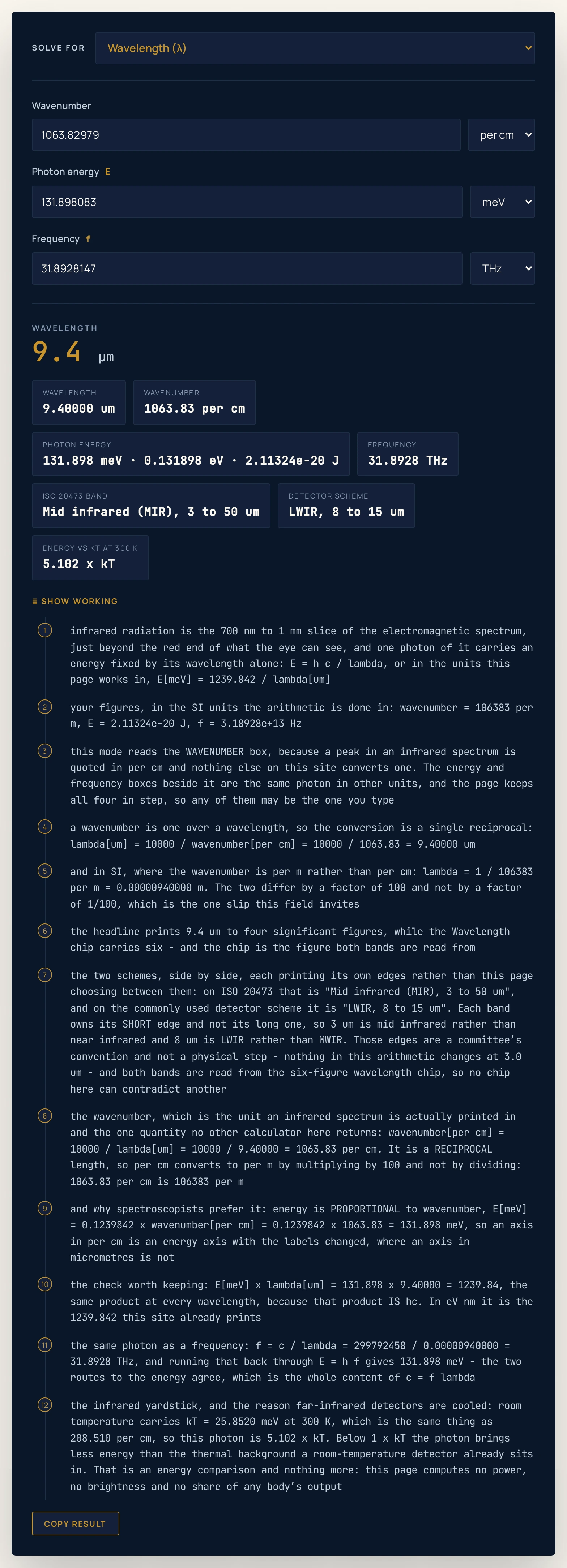
- Type the wavenumber. This box takes per cm or per m and opens on 1063.82979 per cm. It is the box the solve-for-wavelength mode reads, so it is where a peak position off an infrared spectrum goes, and it must be above zero because the conversion is a reciprocal.
- Type the wavelength. This box takes µm, nm, mm or m and opens on 9.4 µm. It must be above zero, because the wavelength is the denominator in the other three modes.
- Type the photon energy. The energy box takes meV, eV or J and opens on 131.898083 meV, which is the same photon as 9.4 µm. Milli-electronvolts are the habit here because the whole band sits between about 1.24 and 1771 meV.
- Type the frequency. The frequency box takes THz, GHz or Hz and opens on 31.8928147 THz, again the same photon. Frequency and wavelength hold identical information, so this box is a convenience rather than a second fact.
- Remember that the four boxes are one photon. Any one of the four fixes the other three, so editing any box rewrites the others from the same photon. That is why the boxes always agree with each other and with the answer.
- Read the answer. The headline always carries four significant figures: a plain decimal with trailing zeros dropped while the figure is at least 0.0001 and below 107, and the same four figures in exponential notation outside that range — so the energy of a 9.4 µm photon reads
131.9 meVbut2.113e-20 J. It appears in the unit that quantity’s own menu was showing, so the same photon reads as9.4 µmin one mode and1064 per cmin another. The box you are solving for is hidden, so set its unit while it is still an input and then point Solve for back at it. - Read the seven chips. They give the wavelength, the wavenumber, the energy in all three units, the frequency, the ISO 20473 band, the detector-scheme band and the energy against kT at 300 K. Every one is computed from the exact value and rounded once.
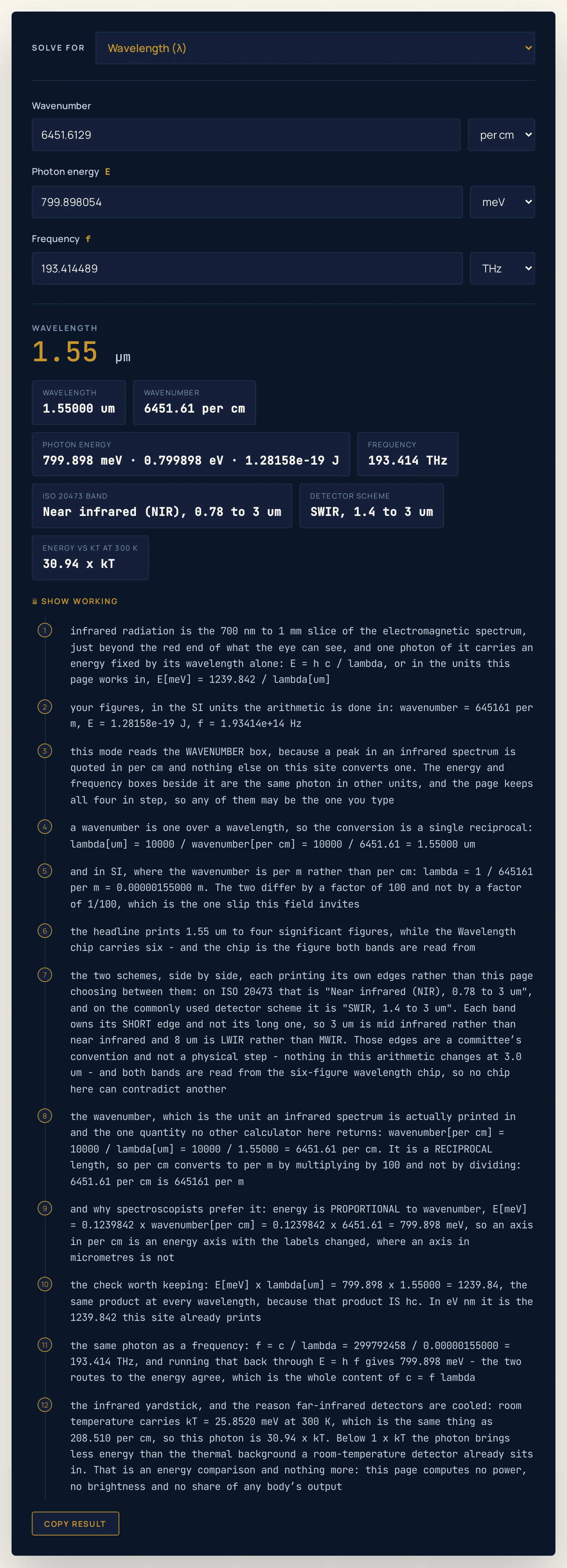
- Read both band chips, not one. Each prints its own scheme’s name and that band’s own edges, so at 1.55 µm one reads
Near infrared (NIR), 0.78 to 3 umand the other readsSWIR, 1.4 to 3 um. The page hands down no verdict on which is right. - Open Show working. The steps say which box the mode reads, list your figures in the SI units the arithmetic really uses, run the reciprocal both ways and print the unrounded value beside the rounding the headline applies to it.
This page exists because of a unit, not a formula. An infrared spectrum is conventionally plotted in per cm, and the absorption bands in it are quoted in per cm too, yet before this page no calculator on this site returned one at all. The only readout here that ever carried the name is in the wave simulator, and that one is the angular wavenumber 2π/λ rather than the 1/λ a spectroscopist means.
Five calculators here do take a wavelength, and every one of them solves different physics: de Broglie wavelength from a mass and a speed, the diffraction grating from an angle, Wien’s law from a temperature, wave speed from a frequency and a wavelength, and ultraviolet radiation across 100 to 400 nm. None of them converts per cm and none of them names an infrared band.
The prose half of this topic is elsewhere. The guide to infrared radiation carries both band schemes in full and seven worked problems; the electromagnetic spectrum guide is where infrared sits among the seven bands; and the photon energy formula guide is where E = hf is derived. This page states that relation once and uses it.
Two mistakes account for most wrong answers. The first is treating the wavenumber as though it were a length: per cm converts to per m by multiplying by 100, not by dividing, so a menu slip here moves the answer by a factor of 104 rather than 100. The second is expecting a band to change at a boundary the headline has already rounded across — the bands are read from the six-figure Wavelength chip, never from the four the headline carries.
kT at 300 K.Worked example: change one thing at a time
The table starts at the defaults, moves the unknown through all four quantities, then walks the wavelength across every boundary in both schemes, out of infrared at each end, and finally into the entries the calculator declines. Rows 1 to 4 are one photon solved four ways; rows 5 to 19 change only the wavelength. Every Headline answer and both band cells were read out of the running widget rather than worked out by hand, so where a cell and the tool ever part company, believe the tool.
| Step | Solving for | What you type | Headline answer | ISO 20473 band chip | Detector scheme chip |
|---|---|---|---|---|---|
| The page as it opens | Wavelength | 1063.82979 per cm | 9.4 µm | Mid infrared (MIR), 3 to 50 um | LWIR, 8 to 15 um |
| The same photon, solved for its wavenumber | Wavenumber | 9.4 µm | 1064 per cm | Mid infrared (MIR), 3 to 50 um | LWIR, 8 to 15 um |
| The same photon, solved for its energy | Photon energy | 9.4 µm | 131.9 meV | Mid infrared (MIR), 3 to 50 um | LWIR, 8 to 15 um |
| The same photon, solved for its frequency | Frequency | 9.4 µm | 31.89 THz | Mid infrared (MIR), 3 to 50 um | LWIR, 8 to 15 um |
| Just past red, where only one scheme starts | Photon energy | 0.76 µm | 1631 meV | Below the ISO 20473 floor (0.78 um) | NIR, 0.75 to 1.4 um |
| On the ISO 20473 floor | Photon energy | 0.78 µm | 1590 meV | Near infrared (NIR), 0.78 to 3 um | NIR, 0.75 to 1.4 um |
| A television remote | Photon energy | 940 nm | 1319 meV | Near infrared (NIR), 0.78 to 3 um | NIR, 0.75 to 1.4 um |
| The fibre-optic window, where the schemes part | Photon energy | 1.55 µm | 799.9 meV | Near infrared (NIR), 0.78 to 3 um | SWIR, 1.4 to 3 um |
| One hundredth of a micrometre below 3 | Photon energy | 2.99 µm | 414.7 meV | Near infrared (NIR), 0.78 to 3 um | SWIR, 1.4 to 3 um |
| Exactly on 3, which both schemes cut | Photon energy | 3 µm | 413.3 meV | Mid infrared (MIR), 3 to 50 um | MWIR, 3 to 8 um |
| The heat-seeking window | Photon energy | 4 µm | 310 meV | Mid infrared (MIR), 3 to 50 um | MWIR, 3 to 8 um |
| Exactly on 8, which only the detector scheme cuts | Photon energy | 8 µm | 155 meV | Mid infrared (MIR), 3 to 50 um | LWIR, 8 to 15 um |
| Exactly on 15, the detector scheme last line | Photon energy | 15 µm | 82.66 meV | Mid infrared (MIR), 3 to 50 um | FIR, 15 to 1000 um |
| Exactly on 50, which only ISO 20473 cuts | Photon energy | 50 µm | 24.8 meV | Far infrared (FIR), 50 to 1000 um | FIR, 15 to 1000 um |
| Far infrared, below kT at 300 kelvin | Photon energy | 100 µm | 12.4 meV | Far infrared (FIR), 50 to 1000 um | FIR, 15 to 1000 um |
| The long edge of the whole band | Photon energy | 1 mm | 1.24 meV | Far infrared (FIR), 50 to 1000 um | FIR, 15 to 1000 um |
| One micrometre past it | Photon energy | 1001 µm | 1.239 meV | Not infrared (microwave) | Not infrared (microwave) |
| The short edge of the whole band | Photon energy | 0.7 µm | 1771 meV | Below the ISO 20473 floor (0.78 um) | Below the detector scheme (0.75 um) |
| A heat lamp visible half | Photon energy | 500 nm | 2480 meV | Not infrared (visible) | Not infrared (visible) |
| A spectrometer peak, read back to a wavelength | Wavelength | 2500 per cm | 4 µm | Mid infrared (MIR), 3 to 50 um | MWIR, 3 to 8 um |
| The opening wavenumber typed in per m instead | Wavelength | 106382.979 per m | 9.4 µm | Mid infrared (MIR), 3 to 50 um | LWIR, 8 to 15 um |
| A wavenumber of zero is declined | Wavelength | 0 per cm | no answer | — | — |
| A negative wavenumber is declined | Wavelength | -1000 per cm | no answer | — | — |
| A wavelength of zero is declined | Photon energy | 0 µm | no answer | — | — |
Rows 1 to 4 are the same 9.4 µm photon with the Solve for menu in each of its four positions, and the two band chips are identical down the four because the band is a property of the photon rather than of the mode. The headline unit changes with the mode, which is the one thing about this engine worth remembering: it answers in the unit of the box that became the unknown.
Rows 5 and 6 are the disputed short edge of infrared. At 0.76 µm the detector scheme has already started and ISO 20473 has not, so one chip names a band and the other names its floor; two hundredths of a micrometre later both have started. Row 18 is the other end of that sliver, where neither scheme has begun even though the wavelength is already infrared.
Row 8 is the fibre-optic window, and it is why the page prints two chips at all: ISO 20473 still says near infrared there while the detector scheme has already moved to SWIR. Rows 9 and 10 cross 3 µm, the one interior edge both schemes share; rows 12 and 13 cross 8 and 15 µm, which only the detector scheme cuts; row 14 crosses 50 µm, which only ISO 20473 cuts. Row 11, at 4 µm, sits well inside a band on both schemes and is there for contrast.
Every one of those crossings obeys the single boundary convention this page sets out beside the scheme table below. Nothing in the arithmetic changes there. The energies at 2.99 and 3 µm differ by about one part in three hundred, while both chips change completely.
Row 15 is the first in the table where the photon falls below kT at 300 K. Rows 16 and 17 are the long edge: 1 mm stays far infrared, by the 1000 µm exception, and one micrometre past it both chips read Not infrared (microwave). Row 19 leaves the band at the other end, because 500 nm — the short half of NASA’s 500 to 3000 nm heat-lamp range — reads Not infrared (visible), which is why a heat lamp is not a purely infrared source.
Rows 20 and 21 are the reason the page was built: a peak at 2500 per cm comes back as 4 µm, and the opening wavenumber typed in per m instead of per cm still lands on the same photon. Rows 22 to 24 sit outside the domain and are declined there rather than answered, because a reciprocal of zero has no wavelength and a negative wavenumber has no photon.
Formula and symbol reference
Two relations do all the work, and the second is only a definition. A photon’s energy is the Planck constant times the speed of light divided by its wavelength, E = h·c / λ; the wavenumber is one over that same wavelength, wavenumber = 1 / λ. Written in the units this band is quoted in they become E(meV) = 1239.842 / λ(µm) and wavenumber(per cm) = 10000 / λ(µm).
That 1239.842 is not a fitted constant or a rounded measurement. It is h·c/e expressed in meV µm, and because h, c and e are all exact by the 2019 definitions of the SI units, so is it — 1239.8419843320026, with no uncertainty attached. The same digits are already this site’s house value for hc in eV nm, so this cluster introduces nothing new.
Put the two together and the useful fact appears: E(meV) = 0.1239842 × wavenumber(per cm). Energy is proportional to wavenumber where it is inversely related to wavelength, so an axis in per cm is an energy axis with different labels on it. That is why an infrared spectrum is drawn on a per cm axis rather than a wavelength one.
The 10000 in the other conversion is simply the number of micrometres in a centimetre. It is worth writing out, because the wavenumber is the one quantity on this page where a unit slip is not a factor of ten: per cm is 100 times per m, and a multiplier borrowed from a length field would be wrong by 104.
| Symbol | Meaning | SI unit | Values used on this page |
|---|---|---|---|
| λ | Wavelength of the light. The denominator in three of the four modes, and the quantity the band names are drawn on | metre; micrometres on this page | Boxes take µm, nm, mm or m: 9.4 is the default, 0.94 a remote, 1.55 the fibre-optic window, and 1 mm the long edge of the band. |
| 1/λ | Wavenumber: one over the wavelength, and the horizontal axis an infrared spectrum is printed on. A RECIPROCAL length, so per cm is 100 times per m and not one hundredth of it | per metre; per cm on this page | Boxes take per cm or per m: 1063.82979 per cm is the default, 2500 per cm is 4 µm, 100 per cm is 100 µm exactly. |
| E | Energy carried by one photon. Minute in joules, and small even in electronvolts, which is why this band is quoted in milli-electronvolts | joule; milli-electronvolts on this page | Boxes take meV, eV or J: 131.898083 is 9.4 µm, 1771.20 the most energetic infrared photon, 1.23984 the least. |
| f | Frequency of the same light. Carries exactly the same information as the wavelength, linked by the speed of light | hertz; terahertz on this page | Boxes take THz, GHz or Hz: 31.8928147 THz is 9.4 µm, 318.928 THz is 940 nm, 299.792 GHz is 1 mm. |
| h | The Planck constant. Exact by the 2019 SI definitions, so it carries no uncertainty | joule second | A constant: 6.62607015 × 10⁻³⁴ J s. |
| c | The speed of light in vacuum. Also exact, and the only place it stands alone is the frequency mode | metre per second | A constant: 299 792 458 m/s. |
| hc | The product of the two, divided by the elementary charge and expressed in milli-electronvolt micrometres. The single conversion this page runs on | milli-electronvolt micrometre | A constant: 1239.842 meV µm, the same digits as the 1239.842 eV nm the Bohr model and Schrodinger labs already use. |
| kT | The thermal energy scale at a stated temperature. Used here only as a yardstick for the photon energy, never as a power or a brightness | joule; milli-electronvolts on this page | One value, at 300 K: 25.8520 meV, which is 208.510 per cm. |
The physics: one photon, four names, two committees
A wavelength, a wavenumber, a frequency and a photon energy are not four facts about light. They are one fact in four units, tied together by two exact constants, which is why this calculator has four boxes and only ever needs one of them filled by hand. Infrared is the band where all four units are in routine use, which is why the page offers all four as inputs rather than one.
The relation to the wavelength is inverse rather than proportional, and that is where intuition usually fails. Infrared covers a factor of 1428.57 in wavelength, from 0.70 to 1000 µm, and therefore the same factor of 1428.57 in photon energy — 1771.20 meV at the short edge against 1.23984 meV at the long one. The ultraviolet band next door, at 100 to 400 nm, covers a factor of four.
Which is what brings in the committees. There is no single agreed way to divide a range that wide up, and at least five published subdivisions exist; this page implements two of them side by side. ISO 20473 cuts it into three at 0.78, 3 and 50 µm, and the commonly used detector scheme cuts it into five at 0.75, 1.4, 3, 8 and 15 µm.
The two schemes share only two edges — 3 µm, and the 1000 µm long edge of infrared itself — and nowhere in the band do they agree about both edges of a band at once. So the same photon gets two names almost everywhere: 1.55 µm is near infrared to one and SWIR to the other, 9.4 µm is mid infrared to one and LWIR to the other. Both are correct in their own publication, which is why this page prints both and adjudicates between neither.
| Scheme | Band name | Edges in micrometres | Chip string the page prints |
|---|---|---|---|
| ISO 20473 | Near infrared (NIR) | 0.78 to 3 | Near infrared (NIR), 0.78 to 3 um |
| ISO 20473 | Mid infrared (MIR) | 3 to 50 | Mid infrared (MIR), 3 to 50 um |
| ISO 20473 | Far infrared (FIR) | 50 to 1000 | Far infrared (FIR), 50 to 1000 um |
| Detector scheme | NIR | 0.75 to 1.4 | NIR, 0.75 to 1.4 um |
| Detector scheme | SWIR | 1.4 to 3 | SWIR, 1.4 to 3 um |
| Detector scheme | MWIR | 3 to 8 | MWIR, 3 to 8 um |
| Detector scheme | LWIR | 8 to 15 | LWIR, 8 to 15 um |
| Detector scheme | FIR | 15 to 1000 | FIR, 15 to 1000 um |
Read that table as two lists rather than one, because the bands do not line up. Each band owns its short edge and not its long one, so a wavelength exactly on a boundary belongs to the band above it: 3 µm is mid infrared, 8 µm is LWIR, 15 µm is FIR on the detector scheme and 50 µm is far infrared on ISO 20473. The single exception is 1000 µm, the long edge of the whole band, which stays far infrared.
Below 0.78 µm on ISO 20473 and below 0.75 µm on the detector scheme the chips stop naming a band and name the floor instead. That sliver, between 0.70 µm and the shorter of the two floors, is real content rather than an edge case: the short edge of infrared itself is genuinely disputed, with 700, 750 and 780 nm all in print, so a wavelength there can be infrared and outside both schemes at once.
Now the payoff, and it is the reason a wavenumber tool earns its place. The last chip divides the photon energy by kT at 300 K, which is 25.8520 meV or 208.510 per cm — the thermal energy scale of a room-temperature instrument. A 9.4 µm photon comes in at 5.102 times that; a 100 µm photon at only 0.4796 times it.
The crossover, where the photon energy equals kT at 300 K exactly, is at 47.96 µm — inside the far-infrared half of the band. Past it a single photon carries less energy than the thermal energy scale of a room-temperature detector, which is the one-line answer to why far-infrared instruments are cooled. It is a comparison of two energies and nothing more: how much a body radiates is the Stefan-Boltzmann law calculator, which wavelength it radiates most at is Wien’s law, and what share lands in a chosen band is blackbody radiation.
Near infrared (NIR), 0.78 to 3 um while the detector chip reads SWIR, 1.4 to 3 um — one photon, two published names, and the page picks neither.Where the infrared radiation calculator breaks down
The arithmetic here is exact to the last digit a double can hold, and the constants behind it carry no uncertainty at all. What fails is a convention being read as a physical edge, two of five schemes being read as all of them, a reciprocal being read as a length, and a wavelength being read as a source.
- Every band boundary is a convention, not a physical edge
- Nothing in the physics changes at 3.0, 8.0, 15.0 or 50.0 µm. The ISO 20473 and detector divisions are lines drawn by committees across a smooth range, and the Wikipedia article that reports both of them says so outright: “These divisions are not precise and can vary depending on the publication.” The calculator reports them because they are the language the subject is written in, not because it has found an edge.
- Two schemes, out of at least five in print
- ISO 20473 and the commonly used detector scheme are implemented here. The CIE scheme (IR-A, IR-B, IR-C), the astronomy scheme and the sensor-response scheme are not, and a figure quoted under one of those will not match either chip. The two were chosen because both are gapless across the whole band, where the astronomy and sensor-response schemes leave stretches of it unnamed.
- The page gives no verdict on which scheme is right — deliberately
- There is no agree-or-disagree chip here, and that absence was designed rather than overlooked. A name test is ambiguous at 4 µm, where “mid infrared” and “mid-wave infrared” are the same words over different ranges, and an edge test would read “different” at every wavelength in the band, because the two schemes share no pair of edges anywhere. Printing each band’s own edges carries the same lesson with no rule to get wrong.
- A wavenumber is a reciprocal, so a unit slip is a factor of 104
- Going from per cm to per m multiplies by 100, where going from cm to m divides by 100. Get that the wrong way round and the answer is out by 104, not by 100, and because the wavelength that comes back is still a perfectly plausible number the mistake does not announce itself. The Wavelength chip is the cross-check: if it does not sit where you expected, the wavenumber menu is the first thing to look at.
- The headline rounds to four figures and the bands do not
- Both bands are decided from the wavelength at six significant figures, which is the figure the Wavelength chip prints, so the three can never disagree. The headline carries four, so within a small fraction of a micrometre of 3, 8, 15 or 50 µm a rounded headline can sit on the other side of a line the chip is reading correctly. Believe the chip, and remember that the line itself is a convention.
- Four boxes, one photon — so three boxes per mode are redundant
- Because any one of the four quantities fixes the other three, the engine’s rule that every visible box must be filled leaves three boxes per mode that the arithmetic does not read. The page keeps all four in step from whichever box was last edited, and the working states which box the current mode reads. With scripting disabled the page still answers in every mode from its designated input; what you lose is the automatic rewriting of the other boxes.
- A real source is never one wavelength
- Everything here describes a single photon. A remote control, a heat lamp, a laser diode and a warm wall all emit over a range, often a wide one, and the single figure a datasheet quotes is a centre or a peak rather than the whole of it. NASA puts an infrared heat lamp at 500 to 3000 nm, and this calculator reports the 500 nm end as
Not infrared (visible)— which is the correct answer about that wavelength and a reminder that it was never the whole source. - Vacuum wavelengths only
- The wavelength here is the vacuum wavelength. Inside glass, water or an optical fibre the wavelength shortens while the frequency and the photon energy do not, so a wavelength measured in a medium needs converting before it is typed in. There is no refractive index, no absorption, no scattering and no line width in this model.
- Nothing here is a power, a brightness or a share of a spectrum
- The
kTchip compares two energies and is not a signal-to-noise figure, a detector specification or a radiated power. Nothing here computes a radiated power, an emissivity, an area, a band fraction or an atmospheric transmission — the 3 to 5 and 8 to 15 µm windows are named here only because the scheme descriptions and NASA name them. For how much a body radiates, and for what share of it lands in a chosen band, see the Stefan-Boltzmann law guide and the blackbody radiation guide. - The calculator measures nothing — you supply the number
- One quantity goes in, two relations are rearranged, and the answer describes that single photon. The preset names are shorthand for the wavelengths beside them rather than claims about any particular device, and both band tables are retrieved conventions rather than measurements made here. Verify anything you mean to rely on against your own data before you quote it.
Where infrared wavenumbers are actually used
- Reading a peak off an infrared spectrum
- This is the mode the page opens in. An infrared absorption band is quoted in per cm, and nothing else on this site turned one into a wavelength. Type 2500 per cm and the headline comes back as 4 µm with both band chips beside it, so a figure from a spectrum and a figure quoted in micrometres can be compared without a second tool.
- Working out which scheme a figure is quoted under
- A band called “NIR” runs 0.78 to 3 µm in one of these schemes and 0.75 to 1.4 µm in the other, and those are not the same stretch of the spectrum. Type the wavelength you care about and read both chips: when they give different names, the name alone is not enough and the edges are what to ask for. 1.55 µm is the clearest example, because the fibre-optic window sits exactly where the two schemes part.
- Comparing the two halves of the thermal band
- The detector scheme splits the thermal end of infrared in two at 8 µm, and the calculator makes the difference concrete. At 4 µm the chips read
MWIR, 3 to 8 umand the energy is 309.960 meV; at 9.4 µm they readLWIR, 8 to 15 umand the energy has fallen to 131.898 meV. NASA calls 8 to 15 microns thermal infrared, and the second figure is what one photon from that band brings. - Quoting the same photon in four units at once
- A figure given in micrometres often has to be restated in per cm, in milli-electronvolts or in terahertz before it can be compared with anything else. 9.4 µm is 1063.83 per cm, 131.898 meV and 31.8928 THz, and the chips give all four at once so no conversion table is needed. The guide to wavelength units covers the length side of that in more detail.
- Deciding whether something is infrared at all
- Both chips answer that honestly at either end. 500 nm comes back
Not infrared (visible), 1001 µm comes backNot infrared (microwave), and 0.70 µm comes back as infrared that is below the floor of both schemes. That last case is the useful one: it tells you a figure is inside the band and outside the tables, which is exactly the situation the 700-against-780 nm dispute creates. - Auditing a conversion you have been handed
- Multiply the energy in meV by the wavelength in micrometres: if the answer is not 1239.842, one of the two figures is wrong. The working prints that product on every mode for exactly that reason, and the proportional version — energy in meV divided by wavenumber in per cm is always 0.1239842 — catches the same slip from the other side. It finds a factor-of-ten error instantly and a wrong band immediately after.
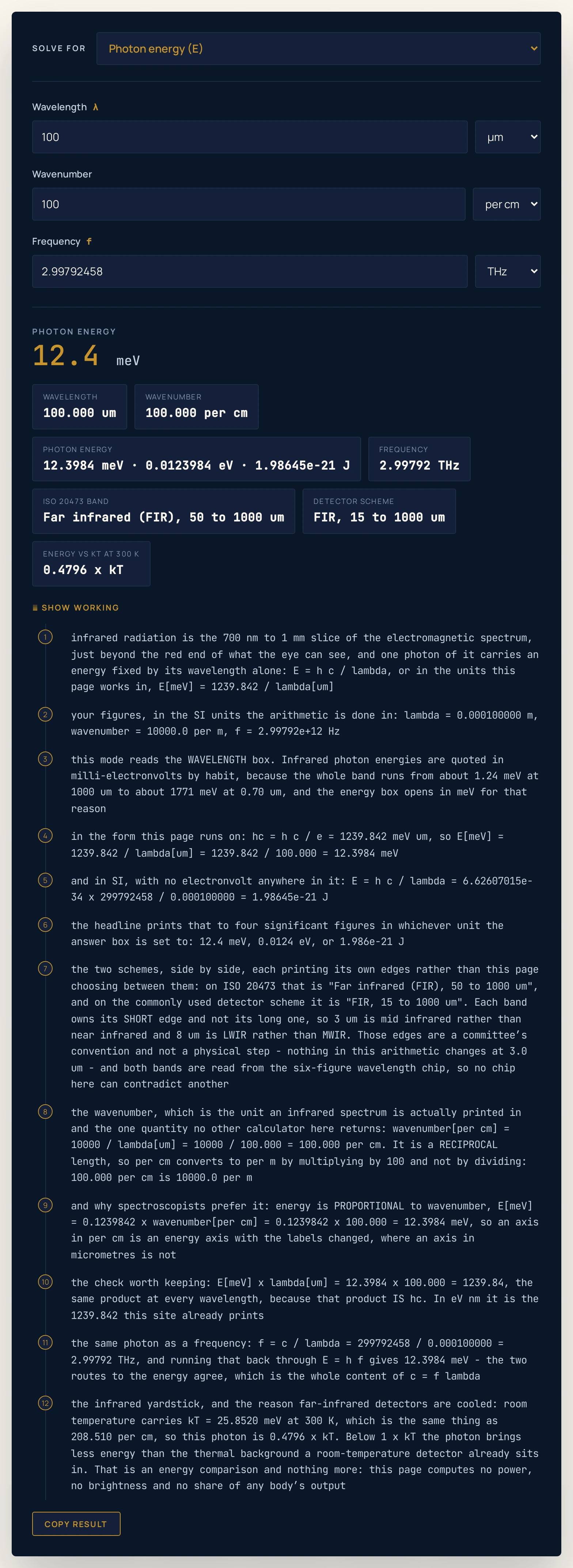
kT line. The photon energy of a 100 µm photon comes back as 12.4 meV, its wavenumber is 100.000 per cm exactly, and the last chip reads 0.4796 x kT — a number rather than the words “less than kT”, because the figure is the useful part.Where to go next
For what infrared radiation is, how the published schemes divide it, what sits in each part of the band and seven worked problems, read the guide to infrared radiation, which this tool is the arithmetic half of. The electromagnetic spectrum guide is the survey it sits inside, and the electromagnetic spectrum simulator walks a single slider across all seven bands.
Three tools are worth a bookmark beside this one. The ultraviolet radiation calculator does the same job for the band on the other side of visible light; the photon energy calculator is the frequency-first sibling; and the wave speed calculator links frequency, wavelength and speed for any wave rather than just light. The full physics lab library and the calculator index are open too.
Frequently asked questions
What does the infrared radiation calculator work out?
It converts between the four ways of naming one infrared photon: its wavelength, its wavenumber in per cm, its energy in milli-electronvolts or joules, and its frequency. Type any one of them and it returns the other three, names the band on two published schemes at once, and compares the photon energy with kT at 300 kelvin. The relation behind all of it is E = hc divided by the wavelength.
How do I convert a wavenumber in per cm to a wavelength?
Divide 10000 by the wavenumber in per cm and the answer is in micrometres. So 1000 per cm is 10 micrometres, and the 1063.82979 per cm this page opens on is 9.4 micrometres. The 10000 is simply the number of micrometres in a centimetre, which is what makes the conversion a single reciprocal rather than a formula worth memorising.
How do I convert micrometres to a photon energy in meV?
Divide 1239.842 by the wavelength in micrometres. That constant is hc expressed in meV micrometres, and it follows exactly from the Planck constant, the speed of light and the elementary charge, all three of which are exact by the 2019 definitions of the SI units. The same digits are this site's house value for hc in eV nanometres.
Why does this calculator print two band names instead of one?
Because the infrared band has no single agreed subdivision, and at most wavelengths the published schemes give the same photon different names. At 1.55 micrometres ISO 20473 says near infrared while the commonly used detector scheme says SWIR. Printing both, each with its own edges, shows you which convention a figure you have been handed is using.
Which band does the calculator put 3 micrometres in?
Mid infrared on ISO 20473 and MWIR on the detector scheme. The boundary convention behind that answer is stated once on this page, beside the table of the two schemes, and it is applied everywhere, so 8 micrometres is LWIR rather than MWIR and 50 micrometres is far infrared rather than mid. Nothing in the arithmetic changes at a boundary; only the name does.
Why does the calculator compare the photon energy with kT at 300 kelvin?
Because it is the comparison that explains why long-wavelength infrared is hard to detect. Room temperature carries kT of 25.8520 meV, so a 9.4 micrometre photon is 5.102 times that while a 100 micrometre photon is only 0.4796 times it. The crossover, where the photon energy equals kT at 300 kelvin, is at 47.96 micrometres.
What units does the infrared radiation calculator accept?
Wavelengths in micrometres, nanometres, millimetres or metres; wavenumbers in per cm or per m; energies in milli-electronvolts, electronvolts or joules; frequencies in terahertz, gigahertz or hertz. The arithmetic is always done in SI base units and the working prints your figures in those units, so a slipped unit menu shows up immediately.
Why is this a separate calculator from the photon energy calculator?
Because that tool solves for energy or frequency only, and wavelength is not one of its inputs. It also returns no wavenumber, and no calculator on this site did before this one. This page is wavelength-first and wavenumber-first, its Solve for menu holds all four quantities, and it names the infrared band, which is the part a reader of a detector datasheet actually needs.
References & formula source
- The infrared band runs from 700 nm to 1 mm. That is the range our own electromagnetic spectrum guide already publishes, alongside 300 GHz to 430 THz and about 1 meV to 1.8 eV, and it is the range the Wikipedia infrared article prints. This cluster corroborates it rather than re-deciding it: the figures this page returns at the two edges are 428.275 THz and 1.77120 eV at 0.70 um, and 299.792 GHz and 1.23984 meV at 1000 um, all four inside those signposts.
- The ISO 20473 scheme — near infrared 0.78 to 3 um, mid infrared 3 to 50 um, far infrared 50 to 1000 um — and the commonly used detector scheme — NIR 0.75 to 1.4, SWIR 1.4 to 3, MWIR 3 to 8, LWIR 8 to 15, FIR 15 to 1000 um — are both taken from the Wikipedia article on infrared, retrieved 2026-10-12, which reports them from the standards. The standards themselves are paywalled and were not fetched for this build. They are definitions published by committees, not measurements.
- The band boundaries are a CONVENTION, and every page in this cluster says so where it names one. Wikipedia states it plainly: "These divisions are not precise and can vary depending on the publication." Nothing in the physics changes at 3.0 or 8.0 um, the two schemes implemented here share only the 3 um edge and the 1000 um long edge of the band itself, and at least five published subdivisions exist. This page implements two of them and adjudicates between none.
- The boundary convention stated beside the scheme table above is this cluster’s own choice and not a published rule: neither source says which side of an edge a wavelength sitting exactly on it falls. It was fixed once so the simulator, this calculator and the guide cannot disagree about such a figure, and the cluster’s independent reference script asserts it.
- NASA Science, "Infrared Waves", Science Mission Directorate, retrieved 2026-10-12, for the claims about the world: that a typical television remote control uses infrared at a wavelength around 940 nanometres, that infrared heat lamps often emit both visible and infrared energy at wavelengths between 500 nm and 3000 nm, that the region from 8 to 15 microns is referred to by Earth scientists as thermal infrared, and that the spectrum is divided into near, mid and far infrared at all.
- h = 6.62607015e-34 J s, c = 299792458 m/s, e = 1.602176634e-19 C and k = 1.380649e-23 J/K are EXACT by the 2019 definitions of the SI units. None is a measured value, so none carries an uncertainty. From them hc = h c / e = 1239.8419843320026 meV um, which this page prints as 1239.842 — the same digits this site already uses for hc in eV nm in the Bohr model and Schrodinger equation labs — and kT at 300 K = 25.8520 meV, or 208.510 per cm.
- E = hc / lambda is used here once, as the tool that turns a wavelength into an energy, and E = h f is used once as the check on it. Neither is derived on this page: the derivation, and the role of the Planck constant in it, belong to our photon energy formula guide.
- No power, no radiated energy per second, no emissivity, no area and no fraction of any body’s output appears anywhere on this page, and the peak wavelength of a hot body is neither printed nor rearranged here. Those quantities belong to the Stefan-Boltzmann law, blackbody radiation and Wien’s law calculators, each of which is linked once. Everything here answers at what wavelength and with what photon, never how much.
- No atmospheric transmission figure, percentage or curve appears here either. The 3 to 5 um and 8 to 15 um windows are named because the published scheme descriptions and NASA name them, and for no other reason. Every other figure quoted above is a string this calculator printed for the inputs named beside it, a constant the page states, or a ratio the cluster’s independent reference asserts.
- Further reading: Infrared — Wikipedia