Ultraviolet radiation is the 100 to 400 nm slice of the electromagnetic spectrum, just beyond the violet end of what the eye can see. This free ultraviolet radiation calculator converts one UV wavelength into the photon energy that goes with it — in eV, joules or keV — reads the same relation backwards from an energy, or gives the frequency instead, through E = h·c / λ. Beside the answer it names the UVA, UVB or UVC band on the WHO boundaries, the energy per mole, what the atmosphere does with that band, and which of four metals the photon could free an electron from.
Load a real UV source
Every button types the same photon into all three boxes, so whichever quantity the Solve for menu is pointing at, the other two already agree with it. The line underneath quotes back whatever the widget works out from that, so nothing in it is stored text.
Pick a source above, or type your own numbers.
What Is the Ultraviolet Radiation Calculator?
The ultraviolet radiation calculator is a free online tool for the three ways of naming one ultraviolet photon. Type a wavelength in nanometres, a photon energy in electronvolts or joules, or a frequency, and it returns the other two through E = h·c / λ — in the convenient form, E(eV) = 1239.842 / λ(nm). Beside the answer it names the UVA, UVB or UVC band on the World Health Organization boundaries, gives the energy per mole in kilojoules, says what the atmosphere does with that band, and lists which of caesium, sodium, zinc and copper the photon could free an electron from. Its Solve for menu holds all three quantities, which is what makes it additive rather than a repeat of the photon energy calculator: that tool solves for energy or frequency only, and prints a wavelength as a derived display line rather than accepting one.
Two things on the page are stated rather than calculated, and it says so. The band boundaries — UVC 100 to 280 nm, UVB 280 to 315 nm, UVA 315 to 400 nm — are a convention agreed by committee and not a physical edge: nothing in the arithmetic changes at 315.0 nm. What the atmosphere does with each band is the WHO summary, quoted verbatim: UVA is approximately 95 per cent of the ultraviolet reaching the surface, most solar UVB is filtered out and UVC is filtered completely. The calculator also carries the qualification most pages on this topic leave out — ionising a hydrogen atom takes 13.6 eV, a photon of 91.1649 nm, which is shorter than the 100 nm short edge of ultraviolet, so the most energetic UV photon reaches only 91.16 per cent of the way and ultraviolet is not ionising radiation at these energies.
| Symbol | Quantity | Default unit | Also accepts | Example value |
|---|---|---|---|---|
| λ | Wavelength | nm | µm, Å, m | 254 |
| E | Photon energy | eV | J, keV | 4.88126765 |
| f | Frequency | THz | Hz, PHz | 1180.28527 |
How to use the ultraviolet radiation calculator
- Choose the unknown. The Solve for menu opens on Photon energy, and the other two choices are Wavelength and Frequency. Whichever you pick vanishes from the boxes below and the remaining two become your inputs.
- Type the wavelength. This box takes nm, µm, Å or m and opens on 254 nm, the germicidal mercury line. It must be above zero, because the wavelength is the only denominator in the whole calculation.
- Type the photon energy. The energy box takes J, eV or keV and opens on 4.88126765 eV, which is the same photon as 254 nm. This is the box the solve-for-wavelength mode reads, so it is where a work function or a quoted band edge goes.
- Type the frequency. The frequency box takes Hz, THz or PHz and opens on 1180.28527 THz, again the same photon. Frequency and wavelength hold identical information, so this box is a convenience rather than a second fact.
- Remember that the three boxes are one photon. Any one of the three fixes the other two, so editing any box rewrites the others from the same photon. That is why the boxes always agree with each other and with the answer, and why you can type whichever of the three you happen to know.
- Read the answer. The headline carries four significant figures while it stays a plain decimal and becomes a three-figure exponential outside that range. It appears in whatever unit that quantity’s own menu is set to, so an energy reads in
J,eVorkeVand a wavelength innmorÅ. The box you are solving for is hidden, so to change the answer’s unit, set it while that quantity is still an input and then point Solve for back at it. - Read the seven chips. They give the wavelength, the frequency, the energy in all three units, the UV band on the WHO boundaries, the energy per mole, what the atmosphere does with that band, and which of four metals the photon could free an electron from.
- Open Show working. The steps say which box the mode reads, list your figures in the SI units the arithmetic really uses, run the conversion both ways, and print the unrounded value beside the rounding the headline applies to it. They also check the product of energy and wavelength against
hc.
This page exists because of a gap in a tool that already looked as though it covered the ground. The photon energy calculator does E = h·f and prints a wavelength beside the answer, but wavelength there is a derived display line: it is not an input and not one of the two solve targets, so a reader holding “254 nm” has nowhere to type it. Several calculators here do take a wavelength — de Broglie wavelength from a mass and a speed, Wien’s law from a temperature, the diffraction grating and wave speed — but every one of them solves different physics, and none of them turns a wavelength into a photon energy, which is the gap this page fills.
For the derivation of E = hf itself, and for why the Planck constant appears in it at all, read the guide to the photon energy formula. This page states the relation once and uses it; the band names, the atmospheric picture and the worked problems are in the guide to ultraviolet radiation, which this tool is the arithmetic half of.
Two mistakes account for most wrong answers. The first is leaving the wavelength menu on nanometres while typing a figure meant as metres, which moves the answer by nine orders of magnitude — the Wavelength chip is there to catch it. The second is expecting the band to change at a boundary the headline has already rounded across: the band is read from the chip’s six figures, never from the four the headline carries.
Worked example: change one thing at a time
The table starts at the defaults and moves one thing at a time: the wavelength, then across each band boundary, then out of ultraviolet altogether, then which quantity is the unknown, then the unit the figure is typed in, and finally the entries the calculator declines. Rows 12 to 16 change which quantity is the unknown. Every Headline, UV band and Frees-an-electron cell was read out of the running widget rather than worked out by hand, so where a cell and the tool ever part company, believe the tool.
| Step | Solving for | What you type | Headline answer | UV band chip | Frees an electron from |
|---|---|---|---|---|---|
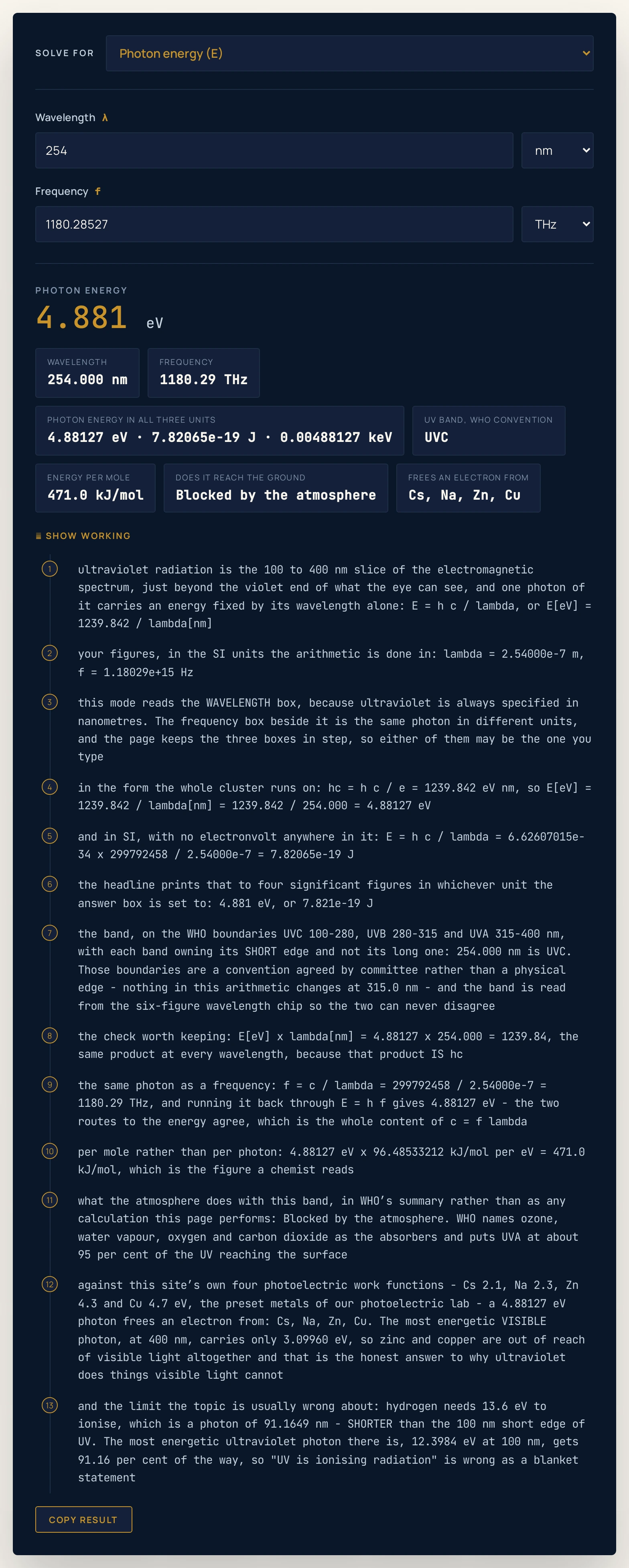
| The page as it opens | Photon energy | 254 nm | 4.881 eV | UVC | Cs, Na, Zn, Cu |
| The UVB sunburn band | Photon energy | 300 nm | 4.133 eV | UVB | Cs, Na |
| One nanometre below the UVB edge | Photon energy | 279 nm | 4.444 eV | UVC | Cs, Na, Zn |
| Exactly on the UVC/UVB line | Photon energy | 280 nm | 4.428 eV | UVB | Cs, Na, Zn |
| Exactly on the UVB/UVA line | Photon energy | 315 nm | 3.936 eV | UVA | Cs, Na |
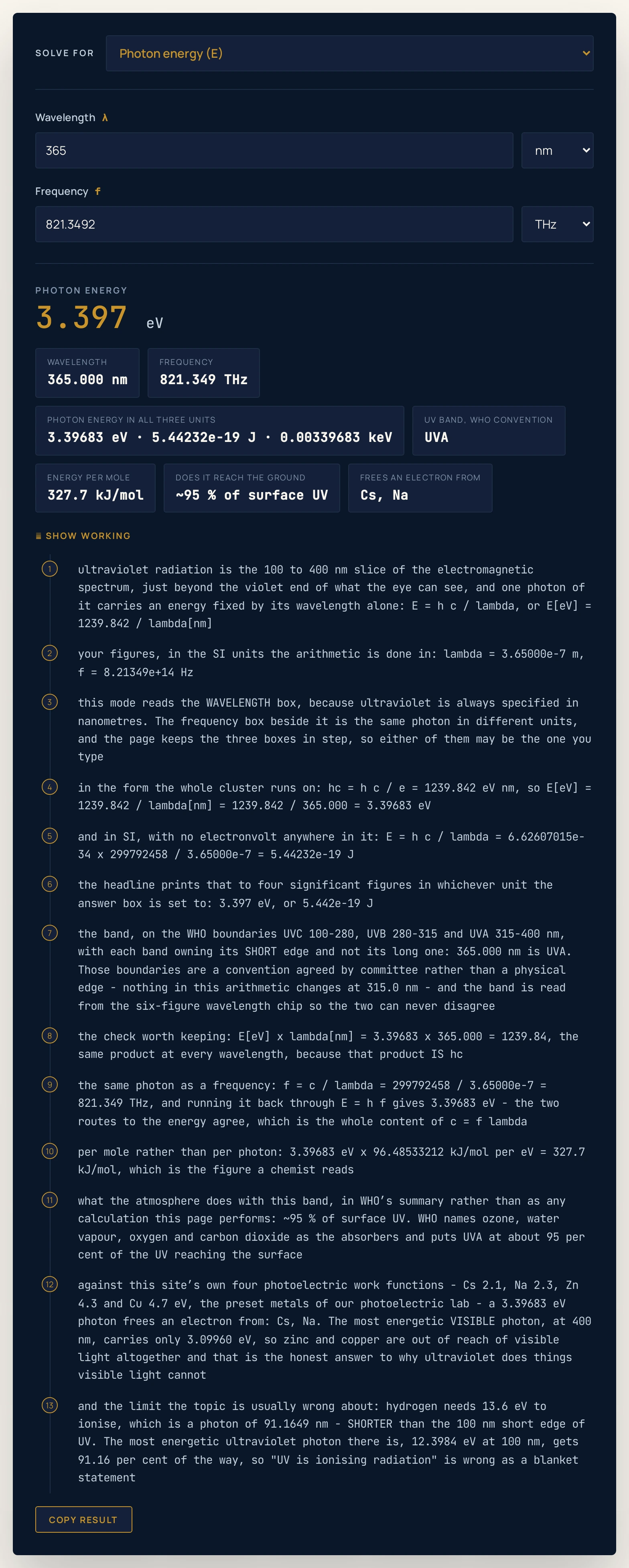
| The 365 nm black light | Photon energy | 365 nm | 3.397 eV | UVA | Cs, Na |
| The UV and visible edge | Photon energy | 400 nm | 3.1 eV | UVA | Cs, Na |
| One tenth of a nanometre past it | Photon energy | 400.1 nm | 3.099 eV | Not UV (visible or longer) | Cs, Na |
| The short edge of UV | Photon energy | 100 nm | 12.4 eV | UVC | Cs, Na, Zn, Cu |
| Green light, for contrast | Photon energy | 550 nm | 2.254 eV | Not UV (visible or longer) | Cs |
| Red light, for contrast | Photon energy | 700 nm | 1.771 eV | Not UV (visible or longer) | None of the four |
| What wavelength is a 4 eV photon? | Wavelength | 4 eV | 310 nm | UVB | Cs, Na |
| Zinc threshold, from 4.3 eV | Wavelength | 4.3 eV | 288.3 nm | UVB | Cs, Na |
| Copper threshold, from 4.7 eV | Wavelength | 4.7 eV | 263.8 nm | UVC | Cs, Na, Zn |
| Hydrogen ionisation, from 13.6 eV | Wavelength | 13.6 eV | 91.16 nm | Beyond UV (X-ray side) | Cs, Na, Zn, Cu |
| The frequency of the germicidal line | Frequency | 254 nm | 1180 THz | UVC | Cs, Na, Zn, Cu |
| The same line typed in angstroms | Photon energy | 2540 A | 4.881 eV | UVC | Cs, Na, Zn, Cu |
| The same line typed in micrometres | Photon energy | 0.254 um | 4.881 eV | UVC | Cs, Na, Zn, Cu |
| A wavelength of zero is declined | Photon energy | 0 nm | no answer | — | — |
| A negative wavelength is declined | Photon energy | -254 nm | no answer | — | — |
| An energy of zero is declined | Wavelength | 0 eV | no answer | — | — |
Rows 1 to 7 walk the ultraviolet range, and every one of them obeys the same division: the shorter the wavelength the larger the energy, which is why 279 nm sits above 300 nm in the Headline column even though it comes after it in the table. Rows 3 to 5 are the boundaries themselves: 279 nm is UVC, 280 nm is UVB and 315 nm is UVA, because each band owns its short edge and not its long one. Those are conventions, not physical edges, and the page never pretends otherwise.
Rows 8, 10 and 11 leave ultraviolet, and they are the contrast the payoff needs, while row 9 goes the other way, to the short edge of the range. One tenth of a nanometre past 400 nm the band chip reads Not UV (visible or longer) while the energy has barely moved, which is the clearest possible demonstration that the boundary is a label rather than a step in the physics. Green light at 550 nm still frees an electron from caesium; red light at 700 nm frees none of the four.
Rows 12 to 15 read the relation backwards, from an energy to a wavelength, and they are where a guard written in the wrong place would have shown itself. A 4 eV photon sits at 309.960 nm, which the headline rounds to 310 nm; zinc’s 4.3 eV work function puts its threshold at 288.335 nm, inside UVB; copper’s 4.7 eV puts its threshold at 263.796 nm, inside UVC. Hydrogen’s 13.6 eV ionisation energy lands at 91.1649 nm, which the chip reports as Beyond UV (X-ray side) because it is shorter than the 100 nm edge of the range.
Two of those rows look wrong until you read them twice. Rows 13 and 14 sit exactly on a threshold, so the metal in question is missing from the last column: at that energy the freed electron leaves with nothing left over, and one photon of shorter wavelength is needed before anything happens. Row 16 is the same 254 nm photon as row 1, solved for its frequency instead, and the band chip is unchanged because the band is a property of the photon rather than of the mode.
Rows 17 and 18 are the unit menus: 2540 Å and 0.254 µm are the same light as 254 nm, so both reproduce row 1 exactly. Rows 19 to 21 sit outside the domain and are declined there rather than answered. A wavelength of zero or a negative wavelength divides the one denominator this page has, and a photon energy of zero has no wavelength to find.
Formula and symbol reference
One relation does all the work. A photon’s energy is the Planck constant times the speed of light, divided by its wavelength: E = h·c / λ. Written that way the numbers are awkward, so the useful form divides through by the elementary charge and measures the wavelength in nanometres, which gives E(eV) = 1239.842 / λ(nm).
That 1239.842 is not a fitted constant or a rounded measurement. It is h·c/e expressed in eV nm, and because h, c and e are all exact by the 2019 definitions of the SI units, so is it — 1239.8419843320026, with no uncertainty attached. It is also already this site’s house value, used by the Bohr model and Schrodinger equation labs, and this cluster introduces no second version of it.
The inverse needs no algebra worth the name: λ(nm) = 1239.842 / E(eV). The frequency comes from the wave relation instead, f = c / λ, and running that back through E = h·f must return the energy the first route gave — a check the working prints on every mode. The invariant behind all three is that E(eV) × λ(nm) is 1239.842 at every wavelength, which is worth committing to memory in place of the formula.
| Symbol | Meaning | SI unit | Values used on this page |
|---|---|---|---|
| λ | Wavelength of the light. The only denominator in the whole calculation, and the quantity ultraviolet is always specified in | metre; nanometres on this page | Boxes take nm, µm, Å or m: 254 is the germicidal line, 365 the black light, 315 the UVA/UVB boundary, and 2540 Å is the same light as 254 nm. |
| E | Energy carried by one photon. Minute in joules, which is why physicists quote it in electronvolts | joule; electronvolts on this page | Boxes take J, eV or keV: 4.88126765 is 254 nm, 3.0996 the most energetic visible photon, 12.3984 the shortest ultraviolet. |
| f | Frequency of the same light. Carries exactly the same information as the wavelength, linked by the speed of light | hertz; terahertz on this page | Boxes take Hz, THz or PHz: 1180.28527 THz is 254 nm, 821.3492 THz is 365 nm. |
| h | The Planck constant. Exact by the 2019 SI definitions, so it carries no uncertainty | joule second | A constant: 6.62607015 × 10⁻³⁴ J s. |
| c | The speed of light in vacuum. Also exact, and the only place it appears alone is the frequency mode | metre per second | A constant: 299 792 458 m/s. |
| hc | The product of the two, divided by the elementary charge and expressed in electronvolt nanometres. The single conversion the whole cluster runs on | electronvolt nanometre | A constant: 1239.842 eV nm, the value the Bohr model and Schrodinger labs on this site already use. |
| phi | Work function of a metal: the least energy that frees one electron from its surface. Used here only for a yes or no, never derived | electronvolt | Four values from our photoelectric lab: Cs 2.1, Na 2.3, Zn 4.3, Cu 4.7 eV. |
The physics: one photon, three names for it
A wavelength, a frequency and a photon energy are not three facts about light. They are one fact in three units, tied together by two exact constants, which is why this calculator has three boxes and only ever needs one of them filled by hand. Ultraviolet is quoted in nanometres by universal habit — 254 nm germicidal, 365 nm black light, the 315 nm boundary — so the wavelength is the box the page is built around.
The relation is inverse rather than proportional, and that is where intuition usually fails. Energy goes as one over the wavelength, so the 100 nm short edge of ultraviolet carries four times the energy of the 400 nm long edge: 12.3984 eV against 3.0996 eV. A single band therefore spans a wider range of photon energies than the whole of visible light.
The band names are a convention, and the honest way to teach them is to say so first. The WHO divisions — UVC 100 to 280 nm, UVB 280 to 315 nm, UVA 315 to 400 nm — are a committee’s lines drawn across a smooth curve of atmospheric absorption and biological effect. Nothing in this calculator changes at 315.0 nm except the string in one chip, which is exactly what a convention looks like from the inside. The survey of the other bands belongs to the electromagnetic spectrum guide, and to the electromagnetic spectrum simulator beside it; infrared, on the long-wavelength side of visible, is simply the neighbour in the other direction.
What the atmosphere does with each band is quoted, not computed. WHO reports that UVA accounts for approximately 95 per cent of the ultraviolet reaching the Earth’s surface, that most solar UVB is filtered out, and that UVC is completely filtered and does not reach the ground at all — the absorbers being ozone, water vapour, oxygen and carbon dioxide. There is no transmission calculation anywhere on this page: the atmospheric chip is a summary of those three statements and nothing more.
Now the payoff, and it is the reason a wavelength-to-energy tool earns its place. “Ultraviolet is more damaging than visible light” is usually offered as though it were about brightness, and it is not: the effect has a threshold. Freeing an electron from a metal takes at least the work function of that surface, and no number of photons below it will ever do the job, however bright the lamp.
Put the four work functions this site already publishes against the most energetic visible photon there is, 3.0996 eV at 400 nm, and the claim becomes checkable arithmetic rather than a slogan. Caesium at 2.1 eV and sodium at 2.3 eV are freed by visible light; zinc at 4.3 eV and copper at 4.7 eV are not, and never will be. The photoelectric effect itself — the stopping voltage, the dependence on intensity, the whole experiment — belongs to the guide to the photoelectric effect; this page borrows four numbers from it for a yes or no.
| Metal | Work function phi / eV | Threshold wavelength / nm | Band the threshold falls in |
|---|---|---|---|
| Caesium (Cs) | 2.1 | 590.401 | Not UV (visible or longer) |
| Sodium (Na) | 2.3 | 539.062 | Not UV (visible or longer) |
| Zinc (Zn) | 4.3 | 288.335 | UVB |
| Copper (Cu) | 4.7 | 263.796 | UVC |
Read that table twice, because the surprise is in the top half rather than the bottom. Caesium’s threshold at 590.401 nm and sodium’s at 539.062 nm are not ultraviolet at all — orange and green light respectively do the job — so the photoelectric effect is not an ultraviolet phenomenon in general. It becomes one the moment the metal is ordinary: zinc needs UVB and copper needs UVC, and that is why the experiment is taught with an ultraviolet lamp.
Which leaves the claim this topic gets wrong more often than any other. Ionising a hydrogen atom takes 13.6 eV, the figure this site publishes in the Bohr model calculator, and that photon sits at 91.1649 nm — shorter than the 100 nm short edge of the ultraviolet range. The most energetic ultraviolet photon there is carries 12.3984 eV, which is 91.16 per cent of the way and no further, so no photon inside the WHO ultraviolet range can ionise a hydrogen atom. Ultraviolet does carry enough energy to break chemical bonds, a much lower bar, and that is where the damage actually comes from.
Where the ultraviolet radiation calculator breaks down
The arithmetic here is exact to the last digit a double can hold, and the constants behind it carry no uncertainty at all. What fails is a convention being read as a physical edge, a quoted summary being read as a calculation, a textbook work function being read as a property of an element, and a threshold being read as a dose.
- The band boundaries are a convention, not a physical edge
- Nothing in the physics changes at 280.0 or 315.0 nm. The WHO divisions are lines drawn by committee across a smooth curve, chosen because atmospheric absorption and biological effect both vary across the range, and another body could reasonably have drawn them a few nanometres away. The calculator reports them because they are the language the subject is written in, not because it has found an edge.
- The atmospheric chip is WHO’s summary, not a transmission calculation
- Real atmospheric transmission is a smooth function of wavelength that depends on the ozone column overhead, the altitude, the solar angle and the cloud. This page reduces that to three verdicts, one per band, taken verbatim from the WHO question-and-answer page. Treat them as the shape of the answer rather than as a number, and note that no dose, no ultraviolet index and no surface irradiance appears anywhere here.
- A work function belongs to a surface, not to an element
- The 4.3 eV quoted for zinc is a textbook figure for a clean surface, and a real one is not clean. Oxidation, adsorbed gas, crystal face and surface treatment all move it, and the threshold wavelength moves with it: a work function 0.1 eV higher pulls zinc’s threshold several nanometres shorter. The four values here are this site’s own published ones, chosen so the cluster is self-consistent, and they are not measurements of any particular sample.
- One photon, one electron — and nothing at all about intensity
- The metal chip answers a single-photon question: does one photon of this energy clear the work function? It says nothing about how many electrons, how fast they arrive, or what a brighter lamp would do. A lamp below the threshold ejects nothing however bright it is, which is the whole point of the photoelectric effect and is why this page carries no wattage, no irradiance and no exposure time.
- Ultraviolet is not ionising radiation at these energies
- The shortest ultraviolet photon carries 12.3984 eV against the 13.6 eV hydrogen needs, which is 91.16 per cent of the way. Every wavelength this calculator calls ultraviolet is therefore below the hydrogen ionisation threshold, and a page that calls ultraviolet ionising radiation without that qualification is wrong. Bond breaking is a different and much lower bar, and it is described here qualitatively because no bond-energy source was fetched for this cluster.
- The headline rounds to four figures and the band does not
- The band is decided from the wavelength at six significant figures, which is the figure the Wavelength chip prints, so those two can never disagree. The headline carries four, so within about a twentieth of a nanometre of 280 or 315 nm a rounded headline can sit on the other side of a line the chip is reading correctly. Believe the chip, and remember that the line itself is a convention.
- Three boxes, one photon — so one box per mode is redundant
- Because any one of the three quantities fixes the other two, the engine’s rule that every visible box must be filled leaves one box per mode that the arithmetic does not need. The page keeps all three in step from whichever box was last edited, and the working states which box the current mode reads. If you want a frequency-first solve with a frequency as the only input, the photon energy calculator is the tool for it.
- A single photon in a vacuum, and nothing else
- Wavelength here is the vacuum wavelength; inside glass or water the wavelength shortens while the frequency and the photon energy do not, so a wavelength measured in a medium needs converting before it is typed in. There is no refractive index, no absorption, no scattering and no line width in this model. Nothing here describes a real beam, a real lamp or a real atmosphere.
- The calculator measures nothing — you supply the number
- One quantity goes in, one relation is rearranged, and the answer describes that single photon. The preset names are shorthand for the wavelengths beside them rather than claims about any particular lamp, and the band table is a retrieved convention rather than a measurement made here. Verify anything you mean to rely on against your own data before you quote it.
Where ultraviolet wavelengths are actually used
- Germicidal lamps, and why 254 nm has to be manufactured
- The low-pressure mercury line at 254 nm is deep in UVC, and UVC is the one band the atmosphere removes completely. That is the whole engineering story in one sentence: a wavelength that never reaches the ground in sunlight has to be generated on purpose, and the tool says so in the atmospheric chip. Run the first preset and the chips give what one of those photons brings, 4.88127 eV or
471.0 kJ/mol. Photons at that end of the range carry enough energy to break chemical bonds where visible photons generally do not, which is why the effect is chemical rather than a matter of heating anything. - Black lights and fluorescence, at 365 nm
- The 365 nm mercury line sits in UVA, which is the band that does reach the ground, and it is the wavelength behind every security marking, mineral display and stage effect. The visible glow is not the ultraviolet: it is light re-emitted at longer wavelengths by whatever absorbed it. Switch the preset to 365 nm and the metal chip shortens to caesium and sodium, because 3.39683 eV no longer clears zinc.
- Choosing a lamp for a photoelectric experiment
- This is the question the threshold table answers directly. A demonstration on caesium or sodium works with visible light, so it proves the threshold exists but hides how sharp it is; zinc needs a source shorter than 288.335 nm and copper shorter than 263.796 nm, which is why the classic experiment is done with an ultraviolet lamp on an ordinary metal. Solve for the wavelength from a work function and the calculator hands you the longest wavelength that will work.
- Quoting a band edge in the unit your reader uses
- Spectroscopists quote nanometres, chemists quote kilojoules per mole, semiconductor and surface physicists quote electronvolts, and astronomers often quote a frequency. The same photon is 315 nm, 3.93601 eV and
379.8 kJ/mol, and the chips give all of them at once so a figure can be moved between those audiences without a second tool. - Ozone, and the band structure the atmosphere imposes
- The reason ultraviolet is divided into three bands at all is that the atmosphere treats it in three ways, and the chip names which. Ozone, water vapour, oxygen and carbon dioxide are the absorbers WHO lists; the ozone column is the one that varies enough to be monitored from orbit. The Wien’s law calculator is the companion for the other direction — which wavelength a hot body peaks at, and therefore how much ultraviolet a star of a given temperature puts out at all.
- Checking a conversion you have been handed
- The commonest practical use of a tool like this is auditing somebody else’s number. Multiply the energy in electronvolts by the wavelength in nanometres: if the answer is not 1239.842, one of the two figures is wrong, and the working prints that product on every mode for exactly that reason. It catches a factor-of-ten slip instantly and a wrong band immediately after.
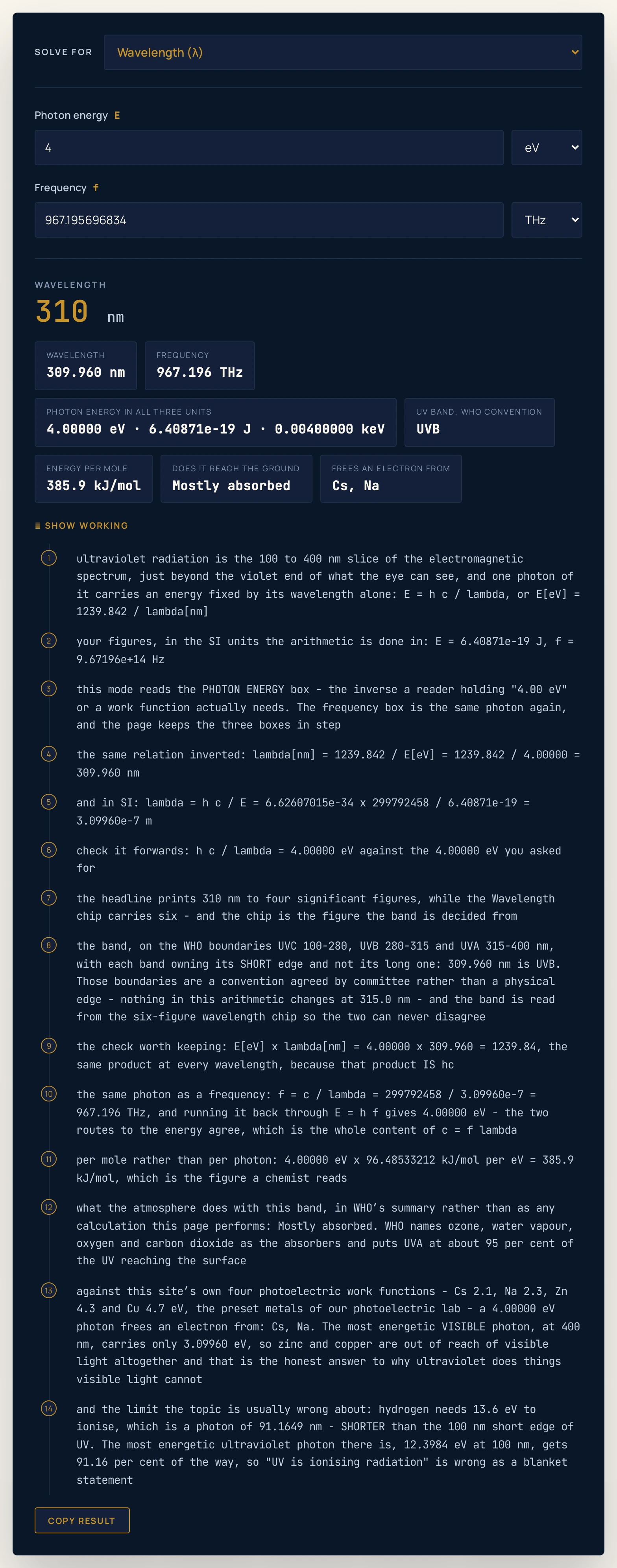
309.960 nm — inside UVB, with the band decided from the six-figure chip rather than the rounded headline.Where to go next
For what ultraviolet radiation is, the three bands in full, which of them reaches the ground and seven worked problems, read the guide to ultraviolet radiation, which this tool is the arithmetic half of. The electromagnetic spectrum guide is the survey it sits inside, and it is where the other bands are handled.
Three tools are worth a bookmark beside this one. The photon energy calculator is the frequency-first sibling; the wave speed calculator links frequency, wavelength and speed for any wave rather than just light; and the Bohr model calculator is where the 13.6 eV hydrogen figure on this page comes from. The full physics lab library and the calculator index are open too.
Frequently asked questions
What does the ultraviolet radiation calculator work out?
It converts between the three ways of naming one ultraviolet photon: its wavelength in nanometres, its energy in electronvolts or joules, and its frequency. Type any one of them and it returns the other two, names the UVA, UVB or UVC band on the World Health Organization boundaries, gives the energy per mole in kilojoules, says what the atmosphere does with that band, and lists which of four metals the photon could free an electron from. The relation behind all of it is E = hc divided by the wavelength, which in convenient units is E in eV = 1239.842 divided by the wavelength in nm.
What are UVA, UVB and UVC?
They are the three conventional divisions of the 100 to 400 nm ultraviolet range: UVA is 315 to 400 nm, UVB is 280 to 315 nm and UVC is 100 to 280 nm, on the WHO boundaries this calculator uses. The important thing about those numbers is that they are a convention agreed by committee rather than a physical edge. Nothing in the physics changes at 315.0 nm; the absorption the boundaries stand for is gradual, and a different body could reasonably have drawn the lines a few nanometres away.
How much energy does a UV photon carry?
Between 3.0996 eV at the 400 nm long edge and 12.3984 eV at the 100 nm short edge, which is 4.9661e-19 to 1.9864e-18 joules. UVA runs 3.0996 to 3.9360 eV, UVB 3.9360 to 4.4280 eV and UVC 4.4280 to 12.3984 eV. The energy is inversely related to the wavelength, so halving the wavelength doubles the energy, and the product of the energy in eV and the wavelength in nm is always 1239.842.
How do I convert nanometres to electronvolts?
Divide 1239.842 by the wavelength in nanometres. That constant is hc expressed in eV nm, and it follows exactly from the Planck constant, the speed of light and the elementary charge, all three of which are exact by the 2019 definitions of the SI units. So 254 nm gives 4.8813 eV and 365 nm gives 3.3968 eV; the same constant divided by an energy in eV gives the wavelength in nm back.
Is ultraviolet radiation ionising?
Mostly no, and the blanket claim that it is should be treated with suspicion. Ionising a hydrogen atom takes 13.6 eV, which is a photon of 91.1649 nm, and that is shorter than the 100 nm short edge of the ultraviolet range: the most energetic ultraviolet photon there is carries 12.3984 eV, or 91.16 per cent of what is needed. Ultraviolet photons do carry enough energy to break chemical bonds, which is a much lower bar than ionisation and is where the real damage comes from, but that is a different statement.
Why does UV damage things when visible light does not?
Because the effect has a threshold rather than a slope, and visible photons sit below it. The most energetic visible photon, at 400 nm, carries 3.0996 eV; freeing an electron from zinc takes 4.3 eV and from copper 4.7 eV, so no amount of visible light of any brightness will do either. Cross zinc’s threshold at 288.34 nm, inside UVB, and it lets go; copper needs 263.80 nm, which is inside UVC. The work functions used here are the four preset metals of this site’s own photoelectric lab.
Which types of UV reach the Earth’s surface?
On the WHO summary, UVA does, UVB partly does and UVC does not. UVA accounts for approximately 95 per cent of the ultraviolet radiation reaching the surface; most solar UVB is filtered by the atmosphere; and UVC is completely filtered and does not reach the ground at all. The absorbers WHO names are ozone, water vapour, oxygen and carbon dioxide. That is why a 254 nm germicidal lamp has to be manufactured rather than borrowed from sunlight.
Can you see ultraviolet light?
No. Ultraviolet begins where the eye stops, at about 400 nm, which is why it is called ultra-violet in the first place. What you see from a black light is not the 365 nm ultraviolet itself but visible light re-emitted by something that absorbed it, plus a little stray violet leaking through the filter.
Why is this a separate calculator from the photon energy calculator?
Because the photon energy calculator solves for energy or frequency only. It prints a wavelength as a derived display line, but wavelength is not one of its inputs and not one of its solve targets, so a reader holding 254 nm has nowhere to type it. This page is wavelength-first and its Solve for menu holds all three quantities, so it converts in every direction; the photon energy calculator remains the frequency-first tool for anyone who starts from a frequency.
References & formula source
- The 100 to 400 nm range, the three bands UVA 315-400 nm, UVB 280-315 nm and UVC 100-280 nm, the statement that UVA accounts for approximately 95 per cent of the ultraviolet reaching the surface, the statement that UVC is completely filtered by the atmosphere, and the four absorbers ozone, water vapour, oxygen and carbon dioxide are all from the World Health Organization question-and-answer page on ultraviolet radiation, retrieved 2026-09-29. They are quoted, never derived.
- The band boundaries are a CONVENTION. Every page in this cluster says so where it names one, because nothing in the physics changes at 280.0 or 315.0 nm and the absorption they stand for is gradual.
- h = 6.62607015e-34 J s, c = 299792458 m/s, e = 1.602176634e-19 C and NA = 6.02214076e23 /mol are EXACT by the 2019 definitions of the SI units. None is a measured value, so none carries an uncertainty. From them hc = h c / e = 1239.8419843320026 eV nm, which this cluster prints as 1239.842 - already the house value used by the Bohr model and Schrodinger equation labs - and 1 eV = 96.48533212 kJ/mol exactly.
- E = hc / lambda is used here once, as the tool that turns a wavelength into an energy. It is not derived on this page: the derivation of E = hf, and the role of the Planck constant in it, belong to our photon energy formula guide.
- The four work functions Cs 2.1 eV, Na 2.3 eV, Zn 4.3 eV and Cu 4.7 eV are this site’s own already-published values, the preset metals of the photoelectric effect lab. Kmax = E - phi is used on this page only for a yes or no and is not derived here; the photoelectric effect itself belongs to our photoelectric effect guide.
- The 13.6 eV ionisation energy of hydrogen is the value this site already publishes in the Bohr model calculator. The photon that carries it sits at 91.1649 nm, shorter than the 100 nm short edge of ultraviolet, which is why no photon inside the WHO ultraviolet range can ionise a hydrogen atom.
- NASA Science, Ultraviolet Waves, retrieved 2026-09-29, for the general description of the ultraviolet part of the spectrum and for the satellite ozone imagery the topic is usually illustrated with.
- No ultraviolet index figure, radiation dose, sun protection factor, lamp rating, bond dissociation energy or health statistic appears anywhere on this page, because none was sourced for this cluster. Every figure quoted above is a string this calculator printed for the inputs named beside it, a constant the page states, or a ratio the cluster’s independent reference asserts.
- Further reading: Ultraviolet — Wikipedia