Sensible heat is the heat exchanged with a body that changes its temperature, which is why a thermometer registers it. It contrasts with latent heat, which is exchanged at constant temperature while a substance changes phase. For a single phase the sensible heat is the mass times the specific heat capacity times the temperature change.
Put a thermometer into a pan of water on a hot ring and it climbs, steadily and visibly. Leave the ring on past boiling point and the reading stops dead while the energy keeps pouring in. The heat has not stopped arriving; it has stopped being the kind a thermometer can report.
That gap is what this page is built on. Sensible heat is the part of an exchange a thermometer registers, latent heat is the part it misses, and for water taken all the way to steam the part it misses is most of the energy. This page puts a number on “most”.
What Is Sensible Heat?
Sensible heat is heat exchanged with a body or a system in a way that changes its temperature, while leaving certain other macroscopic variables, such as volume or pressure, unchanged. It is the heat you can read off a thermometer.
Wikipedia’s summary of sensible heat puts it as heat whose exchange changes the temperature of the body or system but leaves unchanged certain other macroscopic variables, such as volume or pressure. Latent heat is its opposite number: heat that is hidden, in the sense that it is exchanged without any change of temperature at all. The same source calls the two complementary terms, and that is exactly how they behave.
The name is older than it looks, and it is not a comment on anybody’s judgement. Joule characterised it in 1847 as an energy that was indicated by the thermometer; sensible here means perceptible. If an exchange of heat moves a thermometer, it is sensible heat. If it does not, it is latent.
Now the warning, because it matters more than it sounds. Sensible and latent heat are not two special forms of energy; the source is explicit that they are exchanges of heat under conditions specified by their effect on a material. There is no pool of sensible energy sitting inside the water waiting to be let out. There is an exchange, and a label for what that exchange did.
One distinction underneath this one is assumed throughout. Heat is energy in transit and temperature is not energy at all — our guide to heat and temperature settles that properly, and this page takes it as read.
The Sensible Heat Formula and What Each Symbol Means
For a sample that stays in one phase, the sensible heat is the mass times the specific heat capacity times the temperature change.
Four quantities, each with the unit it has to be in before anything is multiplied:
- Qs — the sensible heat exchanged, in joules (J). Positive going in, negative coming out.
- m — the mass of the sample, in kilograms (kg).
- c — the specific heat capacity of the phase you are actually in, in J/(kg·K). Ice, water and steam each have their own value, and using the wrong one is the commonest error on this topic.
- ΔT — the temperature change, in kelvin or in degrees Celsius. Both give the same number, because only the difference enters.
This section states the formula and hands it on, rather than teaching it. The property doing the work is c, and it has a guide of its own: our specific heat capacity article defines it, tabulates it for real materials and works it in every direction. For the arithmetic, the Specific Heat Calculator already solves this line for heat, mass, specific heat capacity or the temperature change, which is quicker than rearranging it by hand.
What the formula will not tell you is when it applies. It holds while the sample stays in one phase. Reach a melting or a boiling point and the temperature stops moving, so ΔT is zero and this line returns zero for that whole stretch — correct, and completely unhelpful, which is what the next section is about.
Sensible Heat and Latent Heat on One Heating Curve
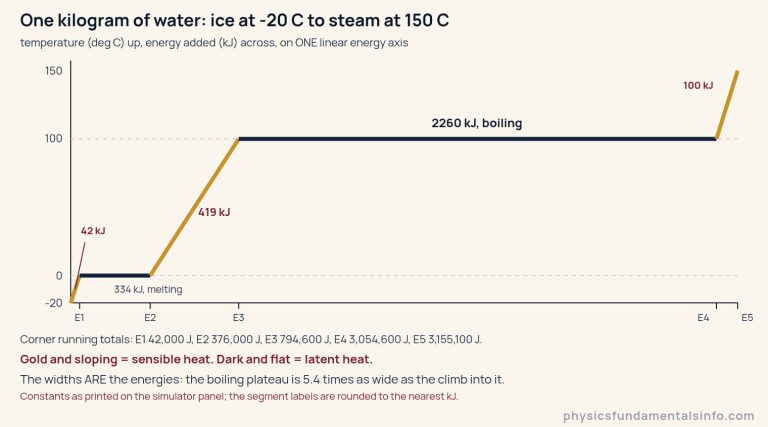
Follow one kilogram of ice all the way to superheated steam and the two kinds of exchange alternate: three stretches where the temperature climbs, two where it stops while the phase changes. The simulator below draws exactly that curve. It belongs to our latent heat guide — it is titled “Latent Heat & the Heating Curve” — and it is the one place on this site where you can watch the sensible stretches slope and the latent ones go flat.
Three sliders drive it, and only two of them move the corners of the curve: Sample mass and Starting temp (ice). The third, Heater power, changes only how fast the sweep fills, not where any corner sits. Let the sweep run to the end — it stops itself there, and the button reads Pause only while it is still running — and the corners it has drawn are how the five segment energies below can be checked against the thing that drew it.
Read what it actually reports, though. It gives you a temperature, a phase and an energy added — it does not display a sensible share, a ratio or a partition. The division is yours to do, and the rest of this page is that division done carefully. Fuller instructions sit on its own landing page, the Latent Heat Simulator.
Every constant it uses is printed on its own panel, which is why they can be quoted here without a reference: cice = 2100, cwater = 4186 and csteam = 2010 J/(kg·K), with Lf = 334,000 J/kg and Lv = 2,260,000 J/kg. Starting from the boot state — 1.0 kg of ice at −20 °C — the journey to steam at 150 °C breaks into five segments.
| Segment | What happens | Sensible or latent | Arithmetic | Energy (J) | Running total (J) |
|---|---|---|---|---|---|
| 1 | The ice warms from −20 °C to 0 °C | sensible | 1 × 2100 × 20 | 42,000 | 42,000 |
| 2 | The ice melts, at a fixed 0 °C | latent | 1 × 334,000 | 334,000 | 376,000 |
| 3 | The water warms from 0 °C to 100 °C | sensible | 1 × 4186 × 100 | 418,600 | 794,600 |
| 4 | The water boils, at a fixed 100 °C | latent | 1 × 2,260,000 | 2,260,000 | 3,054,600 |
| 5 | The steam warms from 100 °C to 150 °C | sensible | 1 × 2010 × 50 | 100,500 | 3,155,100 |
The two latent segments are the two flat stretches, and their arithmetic is Ql = m L — the subject of the latent heat guide, which explains why those plateaus behave as they do and where the two L values come from. They appear here for one purpose only: you cannot name a share without both parts of it. If you want the latent side worked on its own, the Latent Heat Calculator handles it.
How Much of the Energy Is Actually Sensible?
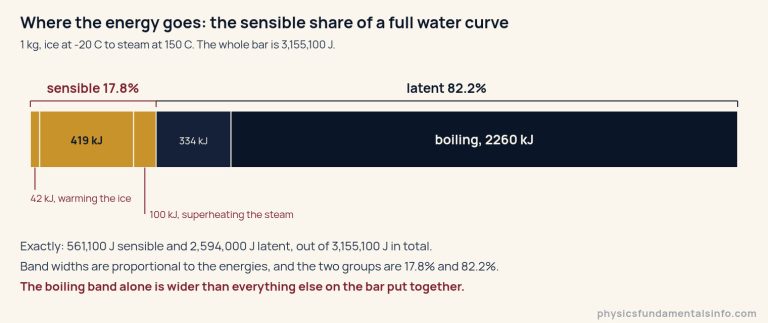
Only 17.8% of it. Of the 3,155,100 J needed to take 1 kg of ice at −20 °C all the way to steam at 150 °C, 561,100 J is sensible heat and 2,594,000 J is latent — so the thermometer accounts for under a fifth of the whole journey.
Add the table’s three sensible segments: 42,000 + 418,600 + 100,500 = 561,100 J. Add the two latent ones: 334,000 + 2,260,000 = 2,594,000 J. They sum to 3,155,100 J, and 561,100 / 3,155,100 = 0.177839, which is 17.8% sensible and 82.2% latent.
Check it against the sim rather than against this page. Let the sweep run to the end; it stops itself there. The energy readout then shows “3.16 MJ” — that is the panel rounding 3,155,100 J for display, not a second number, and the exact figure is the one every division here uses.
One segment does most of the work. Boiling the water takes 2,260,000 J at a temperature that does not move, which is more than everything else on the journey put together: the other four segments come to 895,100 J between them.
Now the result that earns this page its keep. Changing the mass does not move the share at all, because every term in both totals carries exactly one factor of m, so it cancels top and bottom. Drag the mass slider across its whole range and the curve itself does not move at all — same shape, same corners, same pixels; what changes is the energy the axis is scaled to, and how far along it the sweep has got. Every corner’s energy moves with the mass; their proportions, and so the share, cannot.
| Mass (kg) | Sensible (J) | Whole curve (J) | Sensible share |
|---|---|---|---|
| 0.2 (slider floor) | 112,220 | 631,020 | 0.177839 |
| 0.5 | 280,550 | 1,577,550 | 0.177839 |
| 1.0 (default) | 561,100 | 3,155,100 | 0.177839 |
| 2.5 | 1,402,750 | 7,887,750 | 0.177839 |
| 3.0 (slider ceiling) | 1,683,300 | 9,465,300 | 0.177839 |
The starting temperature does move it, and the surprise is how little. Start the ice at the slider’s floor of −50 °C and the sensible total rises to 624,100 J out of 3,218,100 J, a share of 19.4%. Start it at 0 °C and the sensible total falls to 519,100 J out of 3,113,100 J, a share of 16.7%. Colder means a bigger sensible share, every time.
| Ice starts at | Sensible (J) | Whole curve (J) | Sensible share |
|---|---|---|---|
| −50 °C (slider floor) | 624,100 | 3,218,100 | 19.4% |
| −20 °C (default) | 561,100 | 3,155,100 | 17.8% |
| 0 °C (slider ceiling) | 519,100 | 3,113,100 | 16.7% |
So across the entire reachable range of the mass and start-temperature sliders, the sensible share of a full water curve never reaches a fifth. From 16.7% to 19.4% is the whole of it, and nothing a reader can drag will break out of that band.
The Sensible-to-Latent Ratio, and the Name It Already Has
The ratio of the two halves already has a name, and it is not a new one. It is the Bowen ratio, written B = Qh/Qe, where Qh is that source’s symbol for the sensible heating and Qe its symbol for the latent heating. Divide joules by joules and the units vanish, which is why it is a unitless quantity — a plain number you can compare across completely different processes.
It is used most commonly in meteorology and hydrology, and it was named by Harald Sverdrup after Ira Sprague Bowen (1898–1973), an astrophysicist. The reading is simple: when the magnitude of B is less than one, more of the available energy is going out as latent heat than as sensible heat, and above one the converse holds.
Be precise about what it is a ratio of, though. The Bowen ratio proper compares two fluxes at a moist surface — energy per unit area per unit time, leaving a field or a lake. What follows is the same ratio applied to energies rather than to surface fluxes. A pan of water does not thereby have a Bowen ratio in the meteorological sense; it has the same algebra, which is a different claim.
| Process (1 kg of water) | Sensible (J) | Latent (J) | Sensible share | B |
|---|---|---|---|---|
| Warmed from 20 °C to 80 °C, no phase boundary crossed | 251,160 | 0 | 100% | undefined |
| Ice at 0 °C to water at 100 °C | 418,600 | 334,000 | 55.6% | 1.25 |
| Ice at −20 °C to steam at 150 °C | 561,100 | 2,594,000 | 17.8% | 0.22 |
Look at the middle two rows together, because they are the same substance. Over one stretch of its own curve a kilogram of water gives B = 1.25, which is sensible-dominated; over the whole of that curve it gives B = 0.22, which is latent-dominated. The split is a property of the process you choose, not of the material you chose it for.
There is also an identity worth having. The same source writes the evaporative fraction as EF = Qe/(Qe + Qh) = 1/(1 + B), and that is precisely the latent share by another route: 1/(1 + 0.216307) = 0.822161, which is the 82.2% already in the table. On the sensible-dominated stretch the same identity gives 1/(1 + 1.253293) = 0.443795, its own latent share of 44.4%.
One more use of the word, flagged once and left alone: the same quantities appear in meteorology as a sensible heat flux, which is a power per unit area at a surface rather than an energy, and our guide to heat flux is where that belongs.
Why the Split Decides the Engineering
Because a machine sized for one half of the exchange can fail completely at the other. An air conditioner has two jobs: dropping the air temperature, which is the sensible part, and condensing moisture out of the air, which is the latent part. They are not interchangeable, and a unit chosen only for the temperature drop can leave a room cool and unpleasantly clammy.
Evaporative cooling is the same trade read backwards. Water taken off a wet surface carries energy away as latent heat, and what the air gets in return is a lower temperature — sensible traded for latent, which is also why the trick works far better in dry air than in muggy air.
Then there is the instrument problem. A thermostat responds to the sensible part only, because a thermometer is all it has. That is precisely why a room can sit obediently at its set temperature and still feel wrong: the latent side of the load is invisible to the thing controlling it.
This section deliberately carries no figures. The numbers that would make it quantitative — moist-air properties, and the latent heat of vaporisation near a cooling coil, which is not the value this page quotes at boiling point — were not sourced for this article, and a remembered figure would be a guess. Take any you need from a source you can cite, and verify it before use.
Where the Idea Breaks Down, and What Gets Said Wrong
The commonest mistake is the one the definition warns against: treating sensible and latent heat as two kinds of energy that a substance contains. They are not. They are two descriptions of an exchange, sorted by what the exchange did to the material, and nothing in the water is labelled one way or the other before the energy arrives.
The ratio breaks before the physics does. Warm water without crossing a phase boundary and the latent term is exactly zero, so B divides by zero — as the latent heating approaches zero the ratio becomes unbounded, which the source itself flags as making B a poor choice of variable for arid surfaces. This page therefore prints no value of B for the all-sensible case and uses the evaporative-fraction form, which stays finite and reads zero there.
The other end is tamer but worth stating. With ΔT = 0 the sensible heat is exactly zero, so B = 0 and EF = 1. A zero mass makes every one of these fractions nonsense, which is why the simulator’s slider stops at 0.2 kg and why no such case is quoted here.
And c is not really a constant — it drifts with temperature, which our guide to the specific heat capacity of water takes apart properly; this page uses the single fixed values the simulator prints, so that every figure on it is reproducible.
One claim here is proved rather than generalised. For water taken all the way to steam, latent heat always wins: the sensible heat above 0 °C is fixed at 519,100 J, so making the two halves equal would need the ice to start roughly 990 °C below zero. Since absolute zero sits at −273.15 °C, that start does not exist — the result is impossible, not merely off the end of a slider.