The specific heat capacity of water is approximately 4,186 joules per kilogram per degree Celsius (4.186 J/g·°C), the energy needed to raise one kilogram of water by one degree. Expressed as Q = mcΔT, it is among the highest of any common substance — roughly nine times that of iron.
Look up this number and you will find 4,184. Then 4,186. Then 4,182, and a stubborn 1 in the older books. Three sources, three answers — and not one of them is wrong.
That scatter is not sloppiness. It is a real feature of the quantity itself, and once you see where it comes from, the value stops being something to memorise and becomes something you can reason about.
What Is the Specific Heat Capacity of Water?
The specific heat capacity of water is the energy required to raise the temperature of one kilogram of water by one degree Celsius, equal to about 4,186 J/kg·°C. It is written c and it is a property of the substance, not of how much you have.
Picture two identical pans on identical burners. One holds a kilogram of water, the other a kilogram of cooking oil. After a minute the oil is close to spitting; the water has barely stirred. Same energy in, wildly different temperature out.
That gap is c. Water simply demands more joules per degree than almost anything else you will meet — which is exactly why it turns up as the working fluid in radiators, kettles, cooling towers and the ocean.
Worth being precise about the wording, because it trips people up constantly: a high specific heat capacity does not mean water holds more energy. It means water’s temperature moves less for a given amount of energy. If that distinction feels slippery, our guide to heat versus temperature untangles the two properly.
Specific Heat Capacity of Water in Every Unit
Most of the confusion around this number is unit confusion, not physics. Here is the same quantity written six ways.
| Unit | Value for water | Where you meet it |
|---|---|---|
| J/(kg·°C) or J/(kg·K) | 4,186 | SI standard; physics exams |
| kJ/(kg·K) | 4.186 | Engineering, steam tables |
| J/(g·°C) | 4.186 | Chemistry, calorimetry labs |
| cal/(g·°C) | 1.000 | Older texts; defines the calorie |
| kcal/(kg·°C) | 1.000 | Nutrition-adjacent sources |
| BTU/(lb·°F) | 1.000 | US and HVAC engineering |
Notice the three 1s at the bottom. That is not a coincidence — the calorie and the BTU were both defined from water, so in those systems water’s specific heat capacity comes out as unity by construction.
The trap is the top three rows. 4,186 and 4.186 are the same physical quantity; only the mass unit changed. Writing 4,186 J/(g·°C) overstates the answer by a factor of a thousand — a slip worth watching for whenever you are converting between physics units.
Why Sources Disagree: 4184, 4186 and 4187
Different textbooks quote different values because each is quietly converting from a different definition of the calorie, and there is more than one calorie. Each was pinned to water warming by one degree, but at a different starting temperature or by a different committee.
- Thermochemical calorie = 4.184 J exactly, giving 4,184 J/(kg·°C). Standard in chemistry.
- 15 °C calorie = 4.1855 J, giving 4,186 J/(kg·°C). Water warmed from 14.5 to 15.5 °C.
- International Table calorie = 4.1868 J exactly, giving 4,187 J/(kg·°C). Used in engineering steam tables.
The thermochemical and International Table calorie values are fixed by definition rather than measured, and both are recorded in the NIST Guide to the SI.
Modern measurement is a separate matter. Directly measured, water’s specific heat capacity at 25 °C is about 4,182 J/(kg·K) — slightly below all three historical figures.
So which should you use? For school and exam work, 4,186 is the conventional choice and almost certainly what your mark scheme expects. For chemistry, use 4,184. For engineering to three significant figures, all four collapse to 4.18 kJ/kg·K anyway.
The Formula: Q = mcΔT for Water
Every calculation involving water’s specific heat capacity runs through one equation.
- Q — heat energy transferred, in joules (J)
- m — mass of water, in kilograms (kg)
- c — specific heat capacity, in J/(kg·°C); for water, 4,186
- ΔT — temperature change, final minus initial, in °C or K
Because a kelvin and a degree Celsius are the same size, ΔT is numerically identical in either unit. You never need to convert to kelvin for this formula — a rare mercy in thermodynamics.
One convenience of water specifically: 1 litre has a mass of almost exactly 1 kg, so you can read volumes straight off a measuring jug as masses. If you would rather skip the arithmetic and check an answer, our Specific Heat Calculator rearranges Q = mcΔT for whichever quantity you are missing and shows the working.
Try it with the lab below: push energy into a fixed mass of water and watch how little the temperature moves compared with the same energy poured into a metal.
How Water’s Specific Heat Changes With Temperature
Water’s specific heat capacity is not constant — it varies by roughly 1% between freezing and boiling, tracing a shallow curve with a minimum near 37 °C.
The shape surprises people. You might expect a straight line; instead the value falls from 0 °C, bottoms out around body temperature, then climbs again towards boiling.
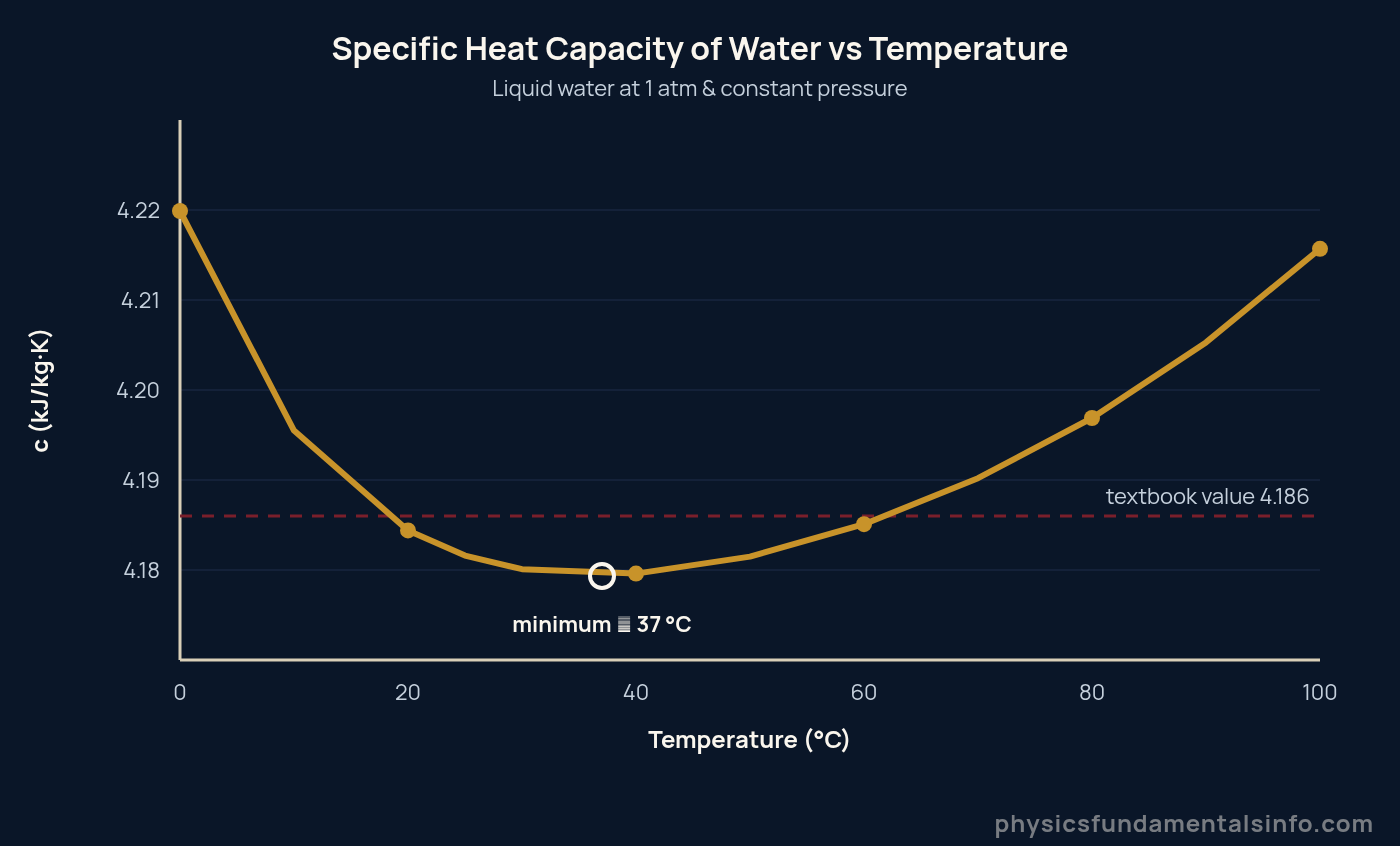
Specific heat capacity of water dips to a minimum near body temperature, then rises towards boiling. Note the compressed vertical scale — the entire swing is about 1%.
The figures below are isobaric (constant-pressure) values for liquid water, taken from standard steam-table data. The reference formulations behind such tables are maintained by the International Association for the Properties of Water and Steam.
| Temperature (°C) | c (J/kg·K) | c (kJ/kg·K) |
|---|---|---|
| 0 | 4,220 | 4.220 |
| 10 | 4,196 | 4.196 |
| 20 | 4,184 | 4.184 |
| 25 | 4,182 | 4.182 |
| 40 | 4,180 | 4.180 |
| 60 | 4,185 | 4.185 |
| 80 | 4,197 | 4.197 |
| 100 | 4,216 | 4.216 |
In practice this variation is negligible for school problems — using 4,186 across the whole liquid range costs you well under 1%. It matters in engineering, where a boiler running at 90 °C is designed with the 90 °C value; full tables of water’s specific heat versus temperature run all the way to 360 °C.
Ice, Water and Steam: Why the Value Halves
Ice and steam have specific heat capacities roughly half that of liquid water — about 2,100 and 2,000 J/(kg·K) respectively. The molecule is unchanged; only the way it stores energy has changed.
| Phase | Typical c (J/kg·K) | Conditions |
|---|---|---|
| Ice | ≈ 2,100 | Just below 0 °C |
| Liquid water | ≈ 4,186 | 0 to 100 °C |
| Steam | ≈ 2,000 | Near 100 °C, constant pressure |
Treat the ice and steam figures as approximate. Both drift noticeably with temperature, and different textbooks quote anything from 2,030 to 2,110 for ice — so always use the value your source specifies rather than a remembered one.
There is a bigger catch hiding here. Q = mcΔT only works while the temperature is actually changing; during melting or boiling, energy pours in while the thermometer sits still. That energy is latent heat, and it needs its own equation.
So heating ice at −20 °C into steam at 120 °C is a five-stage calculation, not one. Three stages use Q = mcΔT with three different values of c; two use latent heat.
Why Water’s Specific Heat Is So High
Water’s specific heat capacity is unusually high because its molecules are locked together by hydrogen bonds, so added energy goes into stretching and breaking those bonds rather than purely into faster motion.
Temperature only measures the average kinetic energy of the molecules. In most liquids, energy you add goes straight into that motion, and the thermometer responds immediately.
Water cheats. Each molecule is tugged by up to four hydrogen bonds from its neighbours, forming a shifting three-dimensional network. Feed energy in and much of it is spent flexing and snapping those bonds — real work, but work that raises no temperature.
The result is a substance that swallows energy quietly. Compare it against a few neighbours, all in J/(kg·K): ethanol about 2,440, olive oil about 2,000, glass around 840, iron 449, copper 385.
Only a handful of everyday substances beat water, and hydrogen gas is the standout at roughly 14,300. This same hydrogen-bond network is behind water’s other famous oddity — it expands when it freezes, bucking the usual pattern of thermal expansion. For the general theory behind the number, see our full guide to specific heat capacity.
Common Mistakes With Water’s Specific Heat
“4.184 and 4184 are different values”
They are the same value in different units: 4.184 J/(g·°C) and 4,184 J/(kg·°C). Mixing them up is a factor-of-1,000 error — by far the most common mistake on this topic. Check that your mass unit matches your c unit before you multiply.
“Water’s specific heat is a fixed constant”
It is not. It shifts by about 1% across the liquid range, roughly halves for ice and steam, and even the “standard” value depends on which calorie convention your source used.
“High specific heat means water is a poor heat conductor”
These are unrelated properties. Specific heat capacity tells you how much energy changes water’s temperature; thermal conductivity tells you how fast heat moves through it. Water conducts heat about 23 times better than air does — see conduction, convection and radiation for how the two ideas differ.
“A bigger container of water has a higher specific heat”
No — c is per kilogram, so mass is already divided out. A bathtub and a teaspoon have identical specific heat capacity. What the bathtub has is a much larger heat capacity, the product mc, which is why it takes so much longer to warm.
Where Water’s High Specific Heat Actually Matters
Oceans as the planet’s thermal flywheel
Water’s specific heat capacity, multiplied across the mass of the oceans, makes them an enormous thermal buffer. It is why coastal towns swing between milder extremes than inland ones at the same latitude, and why sea temperatures lag air temperatures by weeks.
Engine coolant and central heating
Engineers choose water to move heat precisely because it carries so many joules per degree. A radiator circuit shifts far more energy per litre than an air-based system could, which is why water-cooled engines and wet central heating dominate.
Kettles that feel slow
A 2.2 kW kettle takes over four minutes to bring 1.7 litres to the boil. That is not a weak element — it is 605,000 joules of demand, set almost entirely by water’s specific heat capacity.
Your own body
You are roughly 60% water, which is why your core temperature barely moves through a hot afternoon. Notice too that water’s specific heat is at its minimum right around 37 °C — a neat coincidence, not a design, but a memorable landmark on the curve.
Worked Problems
Show Solution
Solution:
Step 1: Use Q = mcΔT.
Step 2: Convert mass to kilograms: m = 250 g = 0.250 kg. Find ΔT = 100 − 20 = 80 °C.
Step 3: Q = 0.250 kg × 4,186 J/(kg·°C) × 80 °C = 83,720 J.
Answer: 83,720 J, or about 84 kJ
Show Solution
Solution:
Step 1: Rearrange Q = mcΔT to give ΔT = Q / (mc).
Step 2: Substitute with Q = 50,000 J, m = 2.00 kg, c = 4,186 J/(kg·°C): ΔT = 50,000 / (2.00 × 4,186).
Step 3: ΔT = 50,000 / 8,372 = 5.97 °C.
Answer: ΔT = 5.97 °C, about 6 °C
Show Solution
Solution:
Step 1: Rearrange Q = mcΔT to give c = Q / (mΔT).
Step 2: Substitute with Q = 12,600 J, m = 0.500 kg, ΔT = 6.0 °C: c = 12,600 / (0.500 × 6.0).
Step 3: c = 12,600 / 3.00 = 4,200 J/(kg·°C).
Answer: c = 4,200 J/(kg·°C) — within 0.4% of the accepted value
Show Solution
Solution:
Step 1: For water, 1.7 litres has a mass of 1.7 kg. Find the energy needed with Q = mcΔT.
Step 2: ΔT = 100 − 15 = 85 °C, so Q = 1.7 × 4,186 × 85 = 604,877 J.
Step 3: Power is energy per unit time, so t = Q / P = 604,877 / 2,200 = 274.9 s.
Answer: about 275 s, or 4 minutes 35 seconds
Show Solution
Solution:
Step 1: Energy lost by the hot water equals energy gained by the cold water: m1c(80 − T) = m2c(T − 20). Since both are water, c cancels.
Step 2: Substitute the masses: 0.200(80 − T) = 0.300(T − 20), giving 16.0 − 0.200T = 0.300T − 6.00.
Step 3: Collect terms: 22.0 = 0.500T, so T = 44.0 °C.
Answer: 44 °C — closer to the cold water, because there is more of it
Show Solution
Solution:
Step 1: For water, 50,000 litres has a mass of 50,000 kg. Use Q = mcΔT.
Step 2: Q = 50,000 × 4,186 × 1.0 = 209,300,000 J = 209.3 MJ.
Step 3: Convert to kilowatt-hours by dividing by 3.6 × 10⁶ J/kWh: 209,300,000 / 3,600,000 = 58.1 kWh.
Answer: 209.3 MJ, or 58.1 kWh — for a single degree