The kinetic theory of gases explains gas pressure as the momentum that molecules deliver to the walls. Add that momentum up and the result is PV = (1/3) N m v_rms^2, with m the mass of one molecule and v_rms their root-mean-square speed. This equation keeps the mass and speed that PV = nRT averages away.
Blow up a balloon and it holds its shape. Nothing inside is pushing the way a hand pushes: the inside is almost entirely empty space, crossed by molecules travelling at hundreds of metres a second. The rubber stays taut because those molecules keep arriving at it and bouncing off.
That is the whole idea, and it buys more than it looks worth. Count the momentum one bounce delivers, multiply by how many bounces arrive each second, and a pressure falls out of pure mechanics — no thermometer, no gas constant, nothing but mass and speed. Then comes the awkward follow-up question this page also answers: how fast is a gas molecule, really?
What Is the Kinetic Theory of Gases?
The kinetic theory of gases treats a gas as a vast number of tiny molecules in constant random motion, and derives its pressure and temperature from their mass, their speed and how often they strike the walls. Everything your instruments report is a statistical summary of that motion.
The model is deliberately crude. It throws away the shape of the molecules, the forces between them and nearly everything else about the substance — and it still predicts real gases accurately over an enormous range of conditions. Five assumptions do the throwing away.
The Wikipedia article on the kinetic theory of gases states them as follows. Each one buys a specific simplification:
- The particles are very small. The sum of the molecules’ own volume is negligible against the volume of the container, so the gas can be treated as mostly empty space.
- There are an enormous number of them. The count is large enough that a statistical treatment is justified — the thermodynamic limit — so averages behave like certainties.
- All collisions are perfectly elastic. Molecules collide with each other and with the walls without losing kinetic energy, which is why a sealed gas never quietly runs down. Our guide to elastic and inelastic collisions covers what that word means in mechanics.
- Collisions are strictly binary and uncorrelated. No three-body interactions, and the particles have no memory, so every bounce can be worked out on its own.
- Between collisions the molecules do not interact. They exert no other forces on one another, so each one travels in a straight line at constant speed until it hits something.
Those five lines are what make the arithmetic below possible, and they are also where the model eventually fails — a later section says exactly where. The pressure, volume and temperature relations that drop out at the far end have their own page in our guide to the gas laws.

Where Pressure Comes From: The Kinetic Theory Formula
Gas pressure is the rate at which molecules deliver momentum to a surface, and adding that delivery up over a whole container gives the central equation of the kinetic theory.
- P — pressure on the container walls, in pascals (Pa).
- V — volume of the container, in cubic metres (m3).
- N — the number of molecules. A plain count, not an amount in moles.
- m — the mass of one molecule, in kilograms (kg). You get it from the molar mass M in kg/mol as m = M / NA, with NA = 6.02214076e23 per mole. For nitrogen that is 4.65173e-26 kg.
- v_rms — the root-mean-square molecular speed, in metres per second (m/s): the square root of the mean square speed.
- rho — the mass density N m / V, in kg/m3, if you prefer the equivalent form P = (1/3) rho v_rms^2.
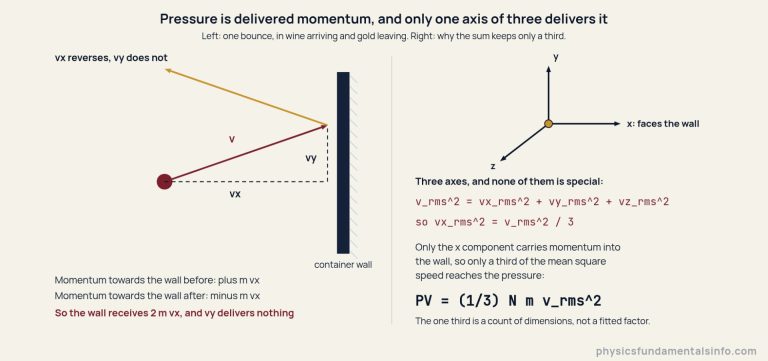
Watch a single molecule arrive. Its velocity splits into one component along the wall normal and two parallel to the wall, and the bounce reverses only the first of them: the molecule comes in carrying momentum +m vx towards the wall and leaves carrying -m vx, so the wall receives 2 m vx. The two parallel components finish the collision exactly as they started it.
Now for the one third, which is the single thing most often mistaken for a fudge factor. Spread the mean square speed over the three perpendicular directions — v_rms^2 = vx_rms^2 + vy_rms^2 + vz_rms^2 — and equilibrium leaves no direction favoured, so exactly a third belongs to each. Only the axis facing the wall ever reaches the pressure.
Put a number on that. Nitrogen at the ice point, 273.15 K, has an rms speed of 493.169 m/s; divide by sqrt(3) = 1.73205 and the rms speed along any one axis is 284.731 m/s. The one third is a count of dimensions, and problem 2 below works it through.
Run the equation forwards and it needs no temperature at all. Put 2.50e22 nitrogen molecules in a one-litre box at 500.0 m/s and the pressure is 96911.1 Pa, which problem 1 does step by step — or get it instantly from our kinetic theory of gases calculator, which solves PV = (1/3) N m v_rms^2 for whichever of the four quantities you are short of.
One convention, because it moves every figure on this page. Gas states here are quoted at 100 kPa rather than at one standard atmosphere, which is the reference pressure this site’s gas tools use and the reason a mole of gas fills 22.711 litres in them; our guide to Avogadro’s law sets out that choice. At 100 kPa and 273.15 K, a cubic metre holds 2.65165e25 molecules.
From Molecules to PV = nRT
The ideal gas law is what the kinetic theory produces the moment you say what temperature is. One substitution gets you there, and nothing else is needed.
The mass cancels on sight: the m in the spine meets the m underneath 3 k T and disappears. What survives, PV = N k T, is the familiar equation of state written per molecule rather than per mole, and our guide to the ideal gas law is that equation’s own page — the molar form, the four sub-laws hiding inside it and where it stops working.
Notice what the cancellation costs. The spine knows the mass and the speed of the molecules; PV = N k T has swallowed both into a single temperature and will not give them back. Running the same substitution the other way gives the mean translational kinetic energy per molecule, (3/2) k T, which our absolute zero guide uses to follow a gas down towards 0 K.
Here k is the Boltzmann constant, 1.380649e-23 J/K. Since the 2019 redefinition of the SI base units it is exact by definition rather than measured, which is what NIST’s CODATA entry for the Boltzmann constant means by a standard uncertainty marked “exact”. Multiply it by the Avogadro constant and the molar gas constant follows, 8.31446261815324 J/(mol K), which is why R never has to be typed into any tool in this cluster.
The Speed of a Gas Molecule Is Three Different Numbers
A gas has no single molecular speed. Its molecules are spread across a whole distribution of speeds, and three different averages of that distribution are in everyday use — which is why “the” speed of a nitrogen molecule has three defensible answers.
The spread is the Maxwell-Boltzmann speed distribution, the lopsided hump drawn below. Most molecules sit near the peak; a few crawl along near zero, and a thin tail runs out to several times the typical speed. Nothing in the gas sorts them out, because every collision reshuffles who is fast.
| Statistic | What it measures | Formula | Nitrogen at 273.15 K | As a % of v_rms |
|---|---|---|---|---|
| Most probable speed, v_p | The peak of the curve: the speed more molecules have than any other | sqrt(2RT/M) | 402.670 m/s | 81.65 % |
| Mean speed, v_bar | The plain arithmetic average of every molecule’s speed | sqrt(8RT/(pi M)) | 454.365 m/s | 92.13 % |
| Root-mean-square speed, v_rms | The square root of the mean of the squares — the average the pressure depends on | sqrt(3RT/M) | 493.169 m/s | 100 % |
Those percentages are not a nitrogen fact. Wikipedia’s kinetic theory article puts it plainly: “The most probable (or mode) speed v_p is 81.6% of the root-mean-square speed v_rms, and the mean (arithmetic mean, or average) speed [v_bar] is 92.1% of the rms speed (isotropic distribution of speeds).” Change the gas or the temperature and the ratio 1 : 1.12838 : 1.22474 does not move at all.
Why does the pressure need the awkward one? Because the momentum sum produces a mean of squares, not a mean of speeds, and those are different quantities. Squaring before averaging gives the fast molecules extra weight, which is exactly how v_rms ends up 8.54 per cent above the plain mean speed.
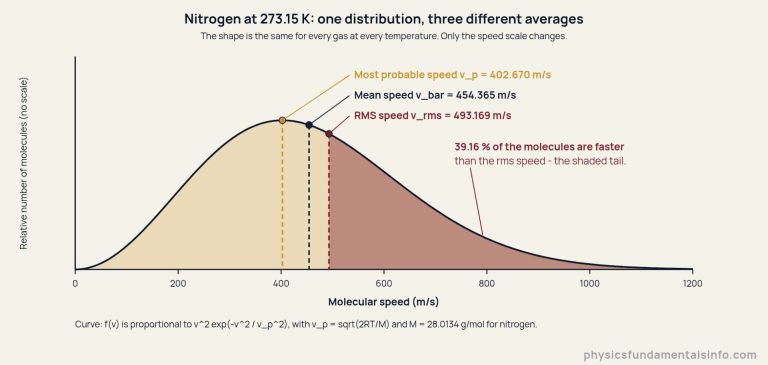
Read the shaded area and 39.16 per cent of the molecules are moving faster than the rms speed. That figure is the same for helium at 100 K and for carbon dioxide at 1000 K, because the shape of the curve depends only on the ratio v / v_p, and v_rms is always sqrt(3/2) times v_p. Push the threshold out to twice the rms speed and 0.738 per cent is left — fewer than one molecule in a hundred.
Why Helium Is Fast and Carbon Dioxide Is Slow
At the same temperature a light molecule moves faster than a heavy one by exactly the square root of the mass ratio, because temperature fixes the kinetic energy per molecule and not the speed. Quadruple the molar mass and you halve the speed.
Every speed on this page carries M under a square root in a denominator, so the ladder at the ice point runs over a factor of 3.3 from the lightest gas to the heaviest:
| Gas | Molar mass (g/mol) | v_rms at 273.15 K (m/s) | Speed relative to nitrogen |
|---|---|---|---|
| Helium (He) | 4.002602 | 1304.69 | 2.6455 |
| Nitrogen (N2) | 28.0134 | 493.169 | 1.0000 |
| Oxygen (O2) | 31.9988 | 461.436 | 0.9357 |
| Argon (Ar) | 39.948 | 412.982 | 0.8374 |
| Carbon dioxide (CO2) | 44.0095 | 393.464 | 0.7978 |
The factor between any two of them survives the temperature entirely. Helium’s molecules are sqrt(44.0095 / 4.002602) = 3.31590 times faster than carbon dioxide’s at the ice point, at 1000 K, and at every other temperature the two gases share — the T in the numerator cancels before you reach the square root. Problem 6 takes that apart.
Air is the case worth having. Treated as one average molecule of 28.9645 g/mol it comes out at 485.004 m/s at the ice point, between nitrogen’s figure and oxygen’s, exactly as a mixture of the two should. The mass density the second route needs, 1.27535 kg/m3, is what our gas density calculator returns from rho = P M / (R T), and problem 5 runs the inversion both ways.
One consequence reaches beyond the textbook: sound travels through a gas at a speed comparable to its molecules’, because the same molecules carry it. Our guide to the speed of sound takes that from there.
What the Model Gets You, and What It Does Not
The kinetic theory delivers the pressure, the equation of state and the whole distribution of molecular speeds out of five assumptions, and it loses accuracy in precisely the places where those assumptions stop holding. Two of the five fail first.
Assumption one goes first under compression. Squeeze a gas hard enough and the molecules’ own volume is no longer negligible beside the container’s, so the room they actually have to move in is less than V, and the real pressure runs above what this equation predicts.
Assumption five goes next as the gas cools. Real molecules attract one another weakly at a distance, which takes a little momentum out of each wall strike and pulls the pressure the other way. Where those two corrections become serious is laid out in the ideal gas law guide, which is also where the gas-specific fixes live.
One quantity from this model is deliberately absent here. The mean free path — the average distance a molecule covers between collisions — follows from the number density and a collision cross-section, in the shape 1 / (n sigma sqrt(2)); but a value for sigma has to be measured, and no measured cross-section was sourced for this page. Verify one before use rather than taking a number from here, because there is not one to take.
What you do get, from five lines of assumption, is worth the trade: a pressure out of pure mechanics, an equation of state as a consequence rather than a measurement, and a speed distribution precise enough to name the fraction of a gas above any threshold you care to pick.
Common Misconceptions About the Kinetic Theory of Gases
Misconception 1: gas molecules all move at the same speed
They do not, and the spread is wide. The curve above is the honest picture of one box of nitrogen at one temperature: molecules at a hundred metres a second and molecules at a thousand, simultaneously. Collisions keep reshuffling which molecule is which, so the distribution holds its shape while no individual molecule holds its speed.
Misconception 2: pressure is the gas pushing on the wall
Pressure is momentum delivered per second per unit area, not a steady shove. Between strikes the wall feels nothing at all; the sensation of a constant push comes from the sheer number of arrivals. That distinction is what puts the one third there, since only the velocity component facing the wall ever reverses.
Misconception 3: heavier molecules hit harder, so a heavy gas sits at a higher pressure
At the same temperature and the same number of molecules per cubic metre, every gas sits at exactly the same pressure. Heavier molecules do deliver more momentum per strike, but they are slower by precisely the compensating factor, and the product m v_rms^2 comes out identical. Helium at 1304.69 m/s and carbon dioxide at 393.464 m/s read 100.000 kPa in the same box.
Misconception 4: the rms speed is the average speed
It is 8.54 per cent higher than the average. Squaring before averaging weights the fast molecules more heavily than a plain arithmetic mean does, so v_rms sits above v_bar for every gas at every temperature — 493.169 against 454.365 m/s for nitrogen at the ice point. Our absolute zero guide makes the same point about that 8.5 per cent gap.