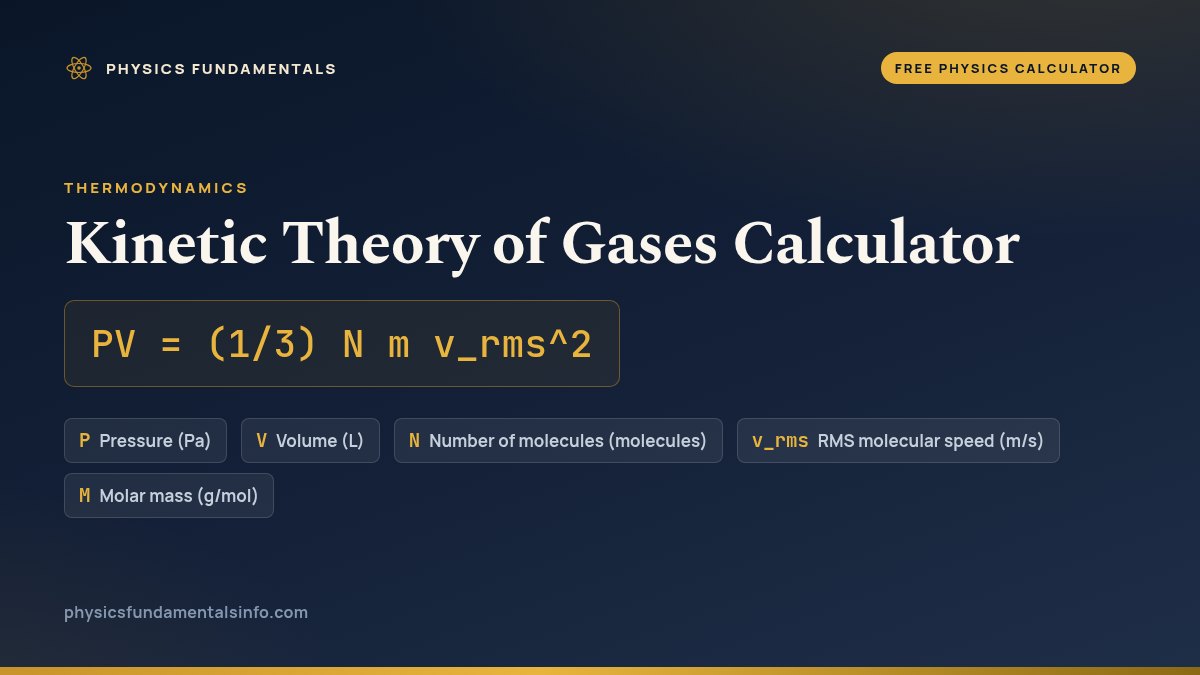
The kinetic theory of gases treats a gas as a crowd of molecules in flight and gets its pressure from nothing but their mass and their speed. This free kinetic theory of gases calculator solves PV = (1/3) N m v_rms^2 for the pressure, the volume, the number of molecules or the rms molecular speed, from a molar mass you supply in every mode. Beside the answer it prints the two other averages of the molecular speed distribution, the mass density, and the temperature that speed implies — which is a result here, not an input.
Load a real gas state
Every button writes all five boxes in their default units, so whichever quantity the Solve for menu is pointing at, the remaining four already agree with it to nine significant figures. The line underneath quotes back whatever the widget works out from that, so nothing in it is stored text.
Pick a state above, or type your own numbers.
What Is the Kinetic Theory of Gases Calculator?
The kinetic theory of gases calculator is a free online tool for the one equation that still remembers what a gas is made of: PV = (1/3) N m v_rms^2, where m is the mass of a single molecule and N is how many of them are in the box. Give it any three of the pressure, the volume, the molecule count and the root-mean-square molecular speed, add the molar mass of the gas, and it returns the fourth. The molar mass is an input in every mode, never one of the unknowns, because the equation is written per molecule and the only way to the mass of one molecule is to divide the molar mass by the Avogadro constant — a step the page does for you and shows in the working.
There is no temperature box, and that is deliberate. The whole point of this equation is that it produces a pressure from a mass and a speed with no thermometer anywhere in it, which is exactly what PV = nRT cannot do. The temperature appears only as a chip, inverted out of the speed you typed, so it is a result and not a setting; nothing here converts between kelvin and Celsius. Beside it sit three more chips: the most probable speed, the mean speed and the mass density, each computed from the exact value and rounded once.
Two results come out of the arithmetic that are worth knowing before you start. The first is that at a fixed molecule count, volume and temperature the pressure is the same for every gas: helium, nitrogen, dry air, oxygen, argon and carbon dioxide in a litre at 100 kPa and 273.15 K all read 100000 Pa, even though their rms speeds run from 1304.69 down to 393.464 m/s. The heavier molecules are slower by precisely as much as they are heavier. The second is that “the” speed of a gas molecule is three different numbers, standing in fixed ratios that no gas and no temperature alters: the most probable speed is 81.6497 per cent of the rms speed and the mean speed is 92.1318 per cent of it, always.
What the page does not do, it says. It computes no heat capacity, no ratio of specific heats, no internal energy, no entropy and no speed of sound, and no mean free path — that needs a measured collision cross-section, which was not sourced for this build, so no figure for it is published. The reference pressure behind the defaults is 100 kPa rather than one standard atmosphere, which is the pressure this site’s gas tools standardise on and why a mole of gas here fills 22.711 litres; one atmosphere, 101325 Pa, is offered as a unit on the pressure box instead. Both constants it runs on, k and NA, are exact by the 2019 definitions of the SI units, so the molar gas constant it derives from them, 8.31446261815324 J/(mol K), is exact too and is computed rather than typed.
| Symbol | Quantity | Default unit | Also accepts | Example value |
|---|---|---|---|---|
| P | Pressure | Pa | kPa, bar, atm | 100000 |
| V | Volume | L | m3, mL | 1 |
| N | Number of molecules | molecules | mol (x 6.02214076e23) | 2.65164580e22 |
| v_rms | RMS molecular speed | m/s | km/s, km/h | 493.168593 |
| M | Molar mass | g/mol | kg/mol | 28.0134 |
How to use the kinetic theory of gases calculator
- Choose the unknown. The Solve for menu opens on Pressure, and the other three choices are Volume, Number of molecules and RMS molecular speed. Whichever you pick vanishes from the boxes below and the rest become your inputs.
- Type the molar mass. This box is an input in every mode and is never one of the four unknowns, because the equation needs the mass of a single molecule. It takes g/mol or kg/mol and opens on 28.0134 g/mol, which is nitrogen.
- Type the rms molecular speed. This box takes m/s, km/s or km/h and opens on 493.168593 m/s. It must be above zero, because it appears squared in three modes and under a square root in the fourth.
- Type the number of molecules. This box counts molecules, not moles, and opens on 2.65164580e22 of them. Switch it to mol and the engine multiplies by the Avogadro constant for you, because the base unit here is one molecule.
- Type the volume. It takes L, m3 or mL and opens on 1 L. It must be above zero: it is the denominator in the pressure mode, so a zero is declined rather than answered with an infinity.
- Type the pressure. It takes Pa, kPa, bar or atm and opens on 100000 Pa. That is 100 kPa, the reference pressure this site’s gas tools use, and not one standard atmosphere.
- Read the answer. The headline always carries four significant figures: a plain decimal with trailing zeros dropped while the figure is at least 0.0001 and below 10 million, and the same four figures in exponential notation outside that range — so a molecule count reads
2.652e+22. It appears in the unit that box was showing, so set the unit while the quantity is still an input and then point Solve for back at it. - Read the four chips. They give the most probable speed, the mean speed, the temperature that speed implies and the mass density. Every one is computed from the exact value and rounded once, never from the figure printed beside it.
- Read the temperature chip as an output. It is a consequence of the speed you typed, which is why there is no temperature box on this page at all. For the other direction — a temperature and a molar mass into an rms speed — use the absolute zero calculator instead.
- Open Show working. The steps turn your molar mass into the mass of one molecule, show where the one third comes from, print the other two speed averages, run the same pressure a second way through the mass density, and give the implied temperature in full.
This page exists because of a quantity, not a formula. PV = nRT has averaged the molecules away, so it cannot tell you how fast they are going or how heavy they are; the spine equation keeps both. The prose half of the topic, with the derivation and seven worked problems, is the guide to the kinetic theory of gases, and the equation of state these molecules add up to has its own page in the ideal gas law guide.
Three mistakes account for most wrong answers here. The first is typing a molar mass where the equation wants the mass of one molecule, which is out by a factor of 6.02214076e23 and is why this page does that division for you. The second is reading the Number of molecules box as moles, and the third is forgetting that the pressure follows the square of the speed, so a 10 per cent error in a speed is a 21 per cent error in a pressure.
Worked example: change one thing at a time
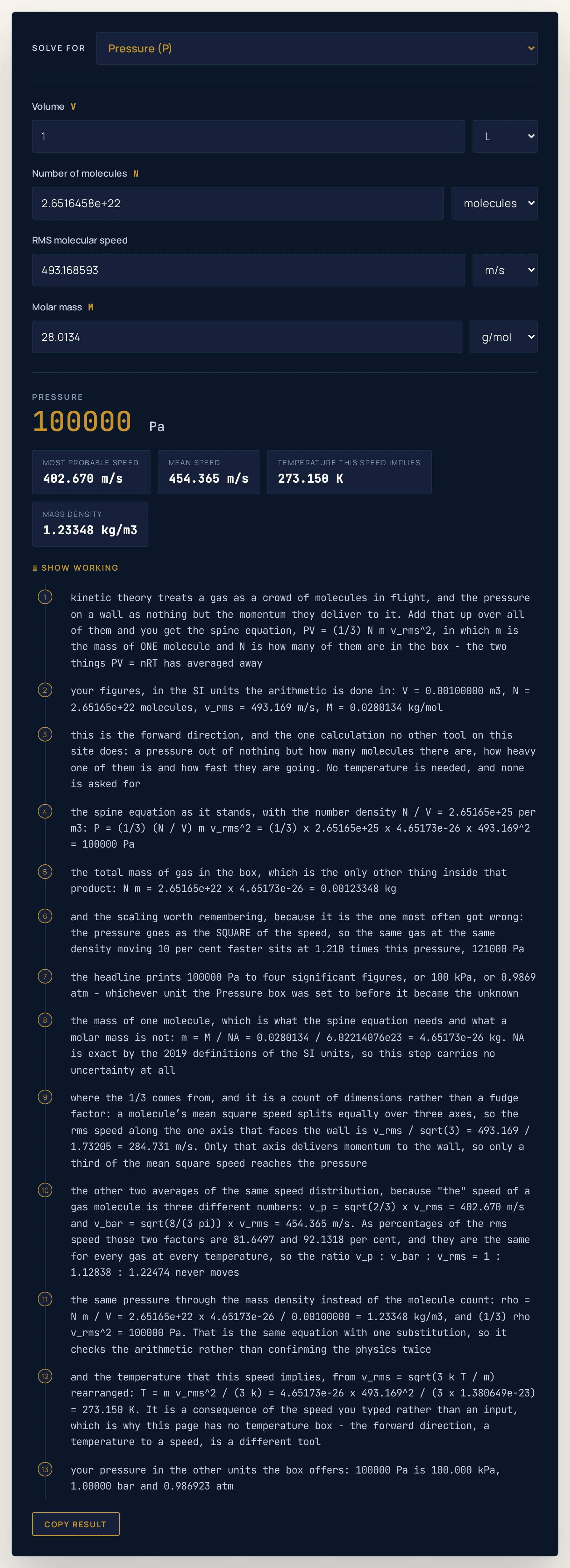
The table starts at the defaults, moves the unknown through all four quantities, then changes the gas at a fixed molecule count and volume, changes the speed at a fixed gas, walks every unit menu, and finally reaches the entries the calculator declines. Rows 1 to 4 are one state solved four ways. Every Headline answer and both chip cells were read out of the running widget rather than worked out by hand, so where a cell and the tool ever part company, believe the tool.
| Step | Solving for | What you type | Headline answer | Most probable speed | Temperature implied |
|---|---|---|---|---|---|
| The page as it opens | Pressure | 2.65164580e22 molecules at 493.168593 m/s | 100000 Pa | 402.670 m/s | 273.150 K |
| The same state, solved for its volume | Volume | 100000 Pa and 2.65164580e22 molecules | 1 L | 402.670 m/s | 273.150 K |
| The same state, solved for its molecule count | Number of molecules | 100000 Pa in 1 L at 493.168593 m/s | 2.652e+22 molecules | 402.670 m/s | 273.150 K |
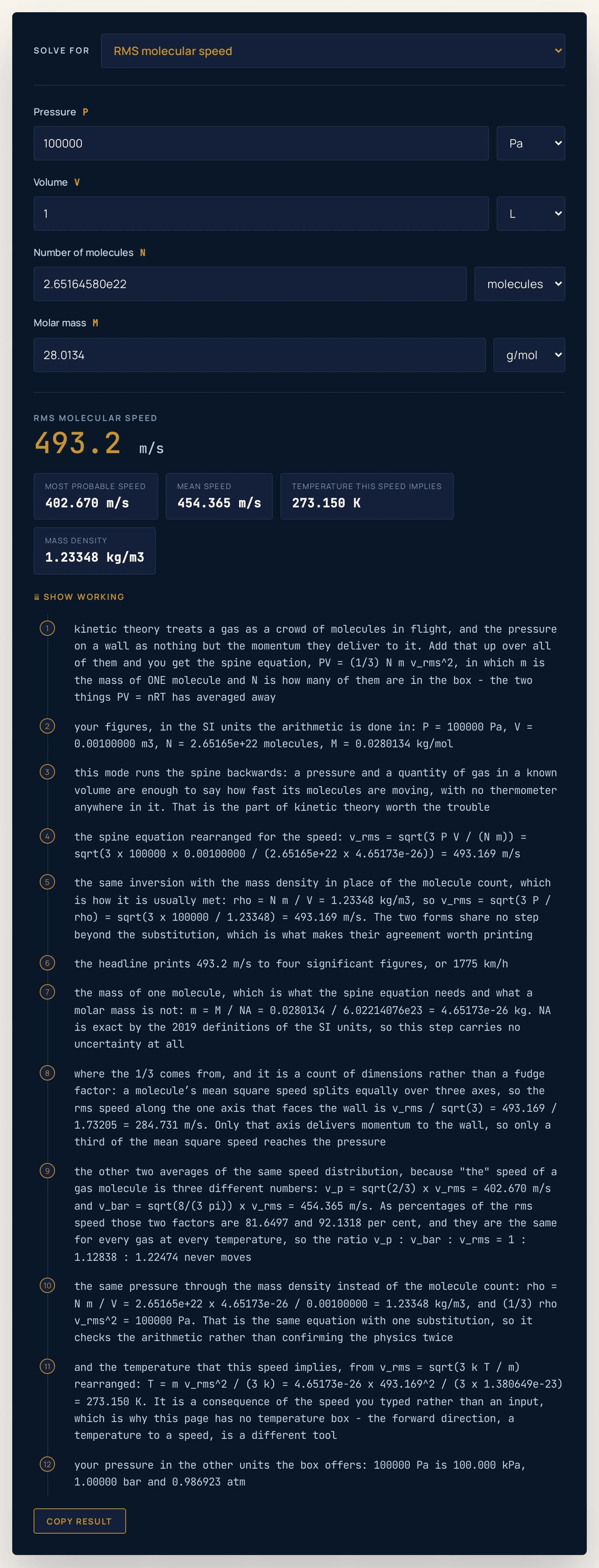
| The same state, solved for its rms speed | RMS molecular speed | 100000 Pa, 1 L, 2.65164580e22 molecules | 493.2 m/s | 402.670 m/s | 273.150 K |
| A litre of nitrogen at 500 m/s | Pressure | 2.50e22 molecules at 500 m/s | 96910 Pa | 408.248 m/s | 280.770 K |
| The same litre, read in kilopascals | Pressure | 2.50e22 molecules at 500 m/s | 96.91 kPa | 408.248 m/s | 280.770 K |
| The same litre, read in atmospheres | Pressure | 2.50e22 molecules at 500 m/s | 0.9564 atm | 408.248 m/s | 280.770 K |
| Ten per cent faster, at the same density | Pressure | 542.4854523 m/s instead of 493.168593 | 121000 Pa | 442.938 m/s | 330.512 K |
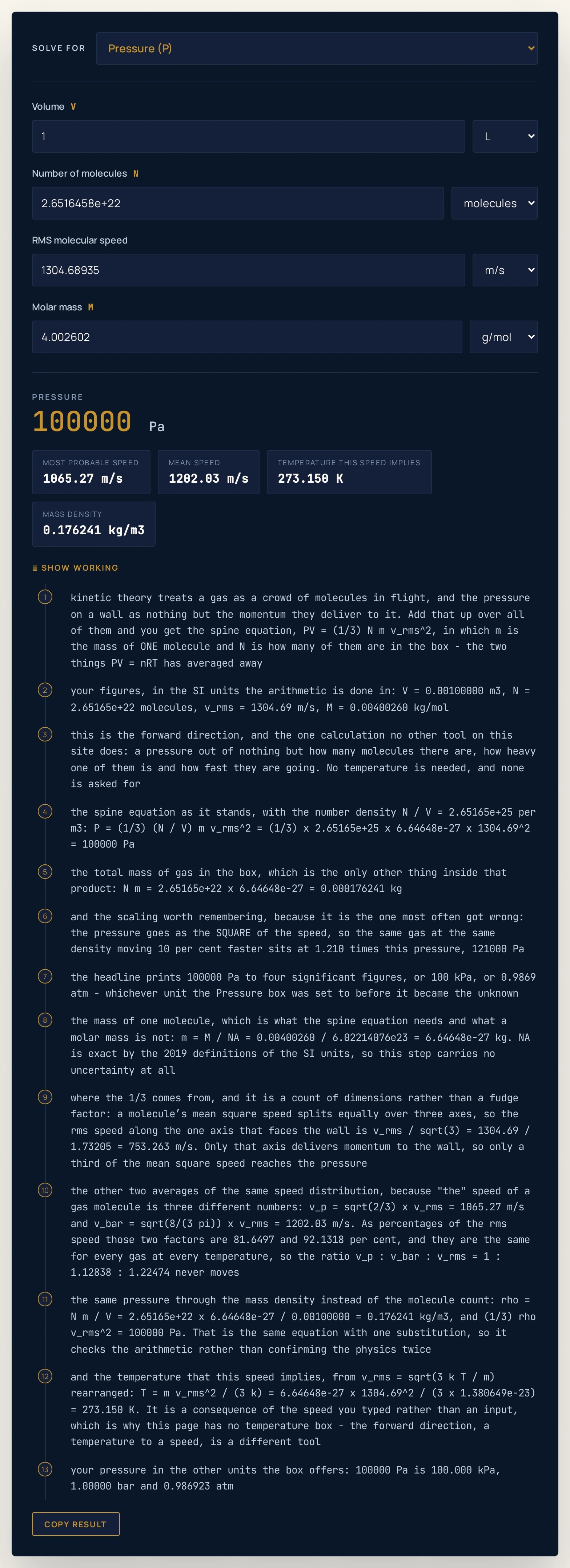
| Helium, same count, volume and temperature | Pressure | M = 4.002602 g/mol at 1304.68935 m/s | 100000 Pa | 1065.27 m/s | 273.150 K |
| Carbon dioxide, same state again | Pressure | M = 44.0095 g/mol at 393.464093 m/s | 100000 Pa | 321.262 m/s | 273.150 K |
| Dry air, same state again | Pressure | M = 28.9645 g/mol at 485.003982 m/s | 100000 Pa | 396.004 m/s | 273.150 K |
| The same nitrogen ten times hotter | Pressure | 943.614941 m/s instead of 493.168593 | 366100 Pa | 770.458 m/s | 1000.00 K |
| And a tenth of that temperature | Pressure | 298.397245 m/s instead of 493.168593 | 36610 Pa | 243.640 m/s | 100.000 K |
| The count typed in moles instead | Pressure | 0.0440316 mol | 100000 Pa | 402.670 m/s | 273.150 K |
| The speed typed in kilometres per hour | Pressure | 1775.40693 km/h | 100000 Pa | 402.670 m/s | 273.150 K |
| The volume typed in millilitres | Pressure | 1000 mL instead of 1 L | 100000 Pa | 402.670 m/s | 273.150 K |
| The molar mass typed in kg/mol | Pressure | 0.0280134 kg/mol | 100000 Pa | 402.670 m/s | 273.150 K |
| Dry air, solved for its rms speed | RMS molecular speed | 100000 Pa, 1 L, M = 28.9645 g/mol | 485 m/s | 396.004 m/s | 273.150 K |
| The molecule count, read in moles | Number of molecules | 100000 Pa in 1 L at 493.168593 m/s | 0.04403 mol | 402.670 m/s | 273.150 K |
| A volume of zero is declined | Pressure | 0 L | no answer | — | — |
| A negative speed is declined | Pressure | -493.168593 m/s | no answer | — | — |
| A molar mass of zero is declined | RMS molecular speed | 0 g/mol | no answer | — | — |
| A molecule count of zero is declined | RMS molecular speed | 0 molecules | no answer | — | — |
Rows 1 to 4 are the same litre of nitrogen with the Solve for menu in each of its four positions, and both chip columns are identical down the four because the chips describe the state rather than the mode. The headline unit changes with the mode, which is the one thing about this engine worth remembering: it answers in the unit of the box that became the unknown.
Row 5 is the forward substitution on its own: 2.50e22 nitrogen molecules in a litre at 500 m/s come to 96910 Pa, with no temperature anywhere in the arithmetic. Rows 6 and 7 are that same pressure read in kilopascals and in atmospheres, which is the whole of what the unit menu does — 96.91 kPa and 0.9564 atm are the same answer.
Row 8 is the square law, and it is the error this calculator most often catches. Raising the speed by 10 per cent, from 493.168593 to 542.4854523 m/s, takes the pressure from 100000 to 121000 Pa — a rise of 21 per cent, not 10. The implied temperature chip moves by the same factor, from 273.150 to 330.512 K.
Rows 9 to 11 change the gas while holding the molecule count, the volume and the temperature fixed, and the headline does not move. Helium at 1304.68935 m/s, carbon dioxide at 393.464093 and dry air at 485.003982 all read 100000 Pa, while the most probable speed column runs from 1065.27 down to 321.262 m/s. That is the spine saying plainly that pressure does not know the molecular mass.
Rows 12 and 13 change the temperature instead, by a factor of ten each way from the ice point. The pressure goes with the temperature, 366100 and 36610 Pa against 100000, while the speeds go only as its square root — 943.614941 and 298.397245 m/s against 493.168593. The implied temperature chip reads back 1000.00 and 100.000 K, which is the state those speeds came from.
Rows 14 to 17 walk the unit menus and change nothing at all: the same state typed as 0.0440316 mol, as 1775.40693 km/h, as 1000 mL and as 0.0280134 kg/mol returns 100000 Pa every time. Rows 18 and 19 answer in the other two modes, and row 19 is the molecule count landing in a mol box as 0.04403 mol.
Rows 20 to 23 sit outside the domain and are declined there rather than answered. A volume of zero would make the pressure infinite, a negative speed has no physical state behind it, and a molar mass or a molecule count of zero leaves the equation with nothing to work on. In each case the widget says so in words instead of printing a number.
Formula and symbol reference
One equation does all the work. The pressure of a gas is a third of its number density times the mass of one molecule times the mean square speed, P = (1/3) (N / V) m v_rms^2, which rearranges to PV = (1/3) N m v_rms^2. Written with the mass density rho = N m / V in place of the count it becomes P = (1/3) rho v_rms^2, which is the same statement with one substitution.
The 1/3 is a count of dimensions and not a fitted factor. A molecule’s mean square speed is the sum of its three components, v_rms^2 = vx_rms^2 + vy_rms^2 + vz_rms^2, and in a gas at equilibrium no axis is special, so each of the three is a third of the total. Only the component along the wall normal delivers momentum, so only a third of the mean square speed reaches the pressure — at the defaults, an rms speed of 493.169 m/s on one axis is 284.731 m/s.
The mass of one molecule is the only quantity here you cannot type directly. It is m = M / NA, so nitrogen’s 28.0134 g/mol becomes 4.65173e-26 kg and helium’s 4.002602 g/mol becomes 6.64648e-27 kg. Both the Boltzmann and Avogadro constants are exact by the 2019 definitions of the SI units, so their product, the molar gas constant 8.31446261815324 J/(mol K), is exact too and is computed here rather than typed.
| Symbol | Meaning | SI unit | Values used on this page |
|---|---|---|---|
| P | Pressure on the container walls. The momentum the molecules deliver per second per unit area, and the quantity this page opens solving for | pascal | Boxes take Pa, kPa, bar or atm: 100000 Pa is the default, 366099 Pa the same gas at 1000 K, 101325 Pa one standard atmosphere. |
| V | Volume of the container. The denominator in the pressure mode, which is why a zero is declined rather than answered | cubic metre; litres on this page | Boxes take L, m3 or mL: 1 L is the default, which is 0.001 m3 or 1000 mL. |
| N | Number of molecules. A count, not an amount in moles — the spine equation is written per molecule, which is the whole difference between it and PV = nRT |
dimensionless count | Boxes take molecules or mol: 2.65164580e22 molecules is the default, which is 0.0440316 mol. |
| vrms | Root-mean-square molecular speed: the square root of the mean square speed, which is the average the pressure actually depends on | metre per second | Boxes take m/s, km/s or km/h: 493.168593 m/s is the default, which is 1775.40693 km/h. |
| M | Molar mass of the gas. An input in every mode, because the equation needs the mass of one molecule and this is the only way in | kilogram per mole; grams per mole on this page | Boxes take g/mol or kg/mol: 28.0134 is nitrogen, 4.002602 helium, 44.0095 carbon dioxide, 28.9645 dry air. |
| m | Mass of ONE molecule, computed here as M / NA and never typed. The quantity that makes this equation remember which gas it is about |
kilogram | Derived: nitrogen gives 4.65173e-26 kg, helium 6.64648e-27 kg. |
| rho | Mass density, N m / V. The spine can be written P = (1/3) rho v_rms^2, which is the form you meet when the molecule count is not known |
kilogram per cubic metre | A chip: 1.23348 kg/m3 for the defaults, 1.27535 kg/m3 for dry air in the same state. |
| k | The Boltzmann constant. Used on this page for one thing only, the temperature chip, and exact by the 2019 SI definitions | joule per kelvin | A constant: 1.380649 × 10⁻²³ J/K. |
| NA | The Avogadro constant. Turns the molar mass into the mass of one molecule, and a mole into a molecule count. Also exact | per mole | A constant: 6.02214076 × 10²³ per mole, so k NA is 8.31446261815324 J/(mol K). |
The physics: one speed, three averages, and a pressure that does not know the gas
A molecule hits a wall, reverses, and leaves behind twice its momentum along that one axis. Count the molecules arriving per second, add up the momentum they deliver, divide by the area, and the spine equation is what comes out. That is the whole of it: pressure is a momentum delivery rate, and the only properties of the gas that enter are how many molecules there are, how heavy one of them is and how fast they move.
Substitute the rms speed’s own dependence on temperature into that result and PV = NkT drops out, which is where the equation of state comes from; the ideal gas law guide is that equation’s own page, and the gas laws guide covers the five pressure, volume and temperature relations that follow from it. This page never asks for a temperature, so it reports the substitution the other way round, as the chip.
That chip is worth a moment. It inverts v_rms = sqrt(3 k T / m) to T = m v_rms^2 / (3 k), so a heavy molecule at a given speed implies a hotter gas than a light one at the same speed. Run the Helium at the ice point and Carbon dioxide at the ice point presets and the chip reads 273.150 K for both, even though the two speeds differ by a factor of 3.31590 — which is exactly the square root of their mass ratio, 10.9952. Going the other way, from a temperature to a speed, is the absolute zero calculator.
The same two presets settle the question this calculator is most often used to settle. At the same molecule count, the same volume and the same temperature, every gas sits at the same pressure: the headline stays at 100000 Pa for helium, nitrogen, air, oxygen, argon and carbon dioxide alike. The heavier molecules are slower by exactly as much as they are heavier, and the product m v_rms^2 comes out the same.
| Gas | Molar mass in g/mol | RMS speed in m/s | Pressure in Pa | Mass density in kg per cubic metre |
|---|---|---|---|---|
| Helium (He) | 4.002602 | 1304.69 | 100000 | 0.176241 |
| Nitrogen (N2) | 28.0134 | 493.169 | 100000 | 1.23348 |
| Dry air | 28.9645 | 485.004 | 100000 | 1.27535 |
| Oxygen (O2) | 31.9988 | 461.436 | 100000 | 1.40896 |
| Argon (Ar) | 39.948 | 412.982 | 100000 | 1.75897 |
| Carbon dioxide (CO2) | 44.0095 | 393.464 | 100000 | 1.93781 |
The mass density column is the one that does change, and it is the route into the spine when the molecule count is unknown. Dry air at that state comes to 1.27535 kg/m3, and sqrt(3 P / rho) fed the full-precision density rather than that rounded one returns 485.004 m/s — the same rms speed the gas table gives for air by a completely different route. The gas density calculator is where that density comes from, and the molar volume behind the molecule count is in the Avogadro's law guide, which is also why the defaults here sit at 100 kPa and give 22.711 litres per mole.
The last thing the equation gives you is the one no other page on this site carries: “the” speed of a gas molecule is three different numbers. The molecules have a spread of speeds, and the three usual averages of that spread stand in fixed ratios — the most probable speed is 81.6497 per cent of the rms speed and the mean speed is 92.1318 per cent of it, for every gas at every temperature. Those are the two chips beside the answer, and at the defaults they read 402.670 and 454.365 m/s against an rms speed of 493.169.
Where the kinetic theory of gases calculator breaks down
The arithmetic here is exact to the last digit a double can hold, and both constants behind it carry no uncertainty at all. What fails is a model assumption meeting a real gas, a count being read as an amount, one average of a distribution being read as the whole of it, and a derived chip being read as a measurement.
- The molecules are assumed to be points with no volume of their own
- The model takes the total volume of the molecules to be negligible against the volume of the container. Squeeze a real gas hard enough and that stops being true: the space the molecules are free to move in is less than the volume you typed, so the real pressure is higher than this page reports. The accuracy question belongs to the equation of state rather than here, and the ideal gas law guide has its own breakdown section on it.
- And to exert no forces on one another between collisions
- Real molecules attract each other weakly at a distance, which pulls them away from the walls slightly and lowers the real pressure below the figure here. The two failures therefore push in opposite directions, which is why the model stays useful over a wide range before either shows. Cool a gas far enough and the attraction wins completely, but what happens then is a question about phase and not about this equation.
- Collisions are assumed perfectly elastic, and strictly in pairs
- Nothing in the spine equation survives if a collision can lose kinetic energy, because the molecules would slow and the pressure would fall away on its own. The model also assumes collisions are binary and uncorrelated, so a molecule carries no memory of the last one it met. Perfectly elastic collisions is where that idealisation itself is set out.
- A count is not an amount, and the box says which it wants
- The Number of molecules box is a count. Its mol setting multiplies by 6.02214076e23 rather than dividing, because the base unit is one molecule, and getting that the wrong way round moves the answer by a factor of about 3.6e47 — large enough that it is obvious, which is the one mercy of this particular slip. The working always prints your figures back in molecules.
- The rms speed is not the average speed
- It is the square root of the mean square speed, and it runs about 8.5 per cent above the plain arithmetic mean — 493.169 against 454.365 m/s at the defaults. The rms speed is the one the pressure depends on, which is why it is the field here, but a figure quoted as “the average molecular speed” elsewhere is probably the mean and belongs in neither box unquestioned. The absolute zero guide states that 8.5 per cent gap first.
- No single molecule is moving at any of the three speeds
- All three chips are averages over a distribution, and the distribution is broad: a large minority of the molecules are moving faster than the rms speed at any instant, and a few are moving at several times it. A single-figure speed is a summary of the crowd and never a description of a molecule, so nothing on this page should be read as “the” speed of anything.
- The temperature chip is derived, and the page has no thermometer
- It inverts the rms speed’s own temperature dependence, so it can only ever agree with the speed you typed. It is not an independent check on anything, and the page converts no temperature scales, computes no heat capacity and reports no ratio of specific heats. Those are different tools; a temperature into an rms speed is the absolute zero calculator.
- Nothing here is a mean free path, a collision rate or a speed of sound
- A mean free path needs a measured collision cross-section for the gas, and no such figure was sourced for this build, so none is published anywhere in this cluster. Sound happens to travel through a gas at a speed comparable to its molecular speeds, because the same molecules carry it, and the speed of sound guide is where that is worked out. This page computes no wave speed, no viscosity and no diffusion.
- Monatomic or not, the spine does not care — but other things do
- Only translational motion delivers momentum to a wall, so a rotating or vibrating molecule has energy that never appears in this equation. That is why the pressure column of the gas table is flat across argon, which is a single atom, and carbon dioxide, which is not. It is also why the internal energy of a gas, and how it stores heat, is a separate question with a separate answer: see the specific heat capacity guide.
- The calculator measures nothing — you supply the numbers
- Four quantities go in, one equation is rearranged, and the answer describes the state you described. The preset names are shorthand for the five figures behind them and not claims about any particular sample of gas, and the molar masses offered as examples are quoted from pages this site already publishes. Verify anything you mean to rely on against your own data before you quote it.
Where a pressure from molecular speeds is actually used
- Checking an equation of state against the molecules underneath it
- This is the mode the page opens in. Type a molecule count, a volume and an rms speed and the pressure comes back with no temperature anywhere in the calculation, which is the whole claim of kinetic theory. Compare it against the same state through the ideal gas law calculator and the two agree — which is a result rather than a coincidence, because one is derived from the other.
- Working out how fast the molecules in a known sample are moving
- Point Solve for at the rms speed and the inputs become an ordinary laboratory state: a pressure, a volume, a quantity and a gas. At 100 kPa in a litre of nitrogen holding 2.65164580e22 molecules the answer is 493.2 m/s, and the working shows the same figure a second way from the mass density. That second route is the one to use when the count is not known.
- Comparing two gases without a temperature in the way
- Because the pressure does not depend on the molecular mass at a fixed count, volume and temperature, every difference between two gases in the same state shows up in the speeds and the density instead. Helium and carbon dioxide at the ice point come out at 1304.69 and 393.464 m/s, a ratio of 3.31590, and both sit at 100000 Pa. That ratio is the square root of 10.9952, their mass ratio, and it is the same at every temperature.
- Counting the molecules in a container
- Point Solve for at the molecule count and the page answers in molecules and, in the working, in moles. It is a useful sanity check on an amount of substance that has been quoted to you, because the count goes as one over the square of the speed and a slipped speed shows up immediately. A litre at 100 kPa and the ice point holds 2.652e+22 molecules, which is 0.0440316 mol.
- Separating the three speed averages before quoting one
- A figure handed to you as “the molecular speed” of a gas could be any of three numbers that differ by up to 22 per cent. Type the rms speed and the chips give the other two, so you can see which of them a quoted figure is. At the defaults they are 402.670, 454.365 and 493.169 m/s, and the ratios between them never change.
- Auditing a pressure you have been handed
- Divide the pressure by a third of the mass density and take the square root: if the speed that comes back is not the one you expected, one of the two figures is wrong. The working prints that route on every mode for exactly that reason. A factor-of-ten error in a density shows up as a factor of 3.16 in the speed, which is far easier to spot than the original.
Where to go next
For what the kinetic theory of gases is, the five assumptions behind it, where the one third comes from and seven worked problems, read the guide to the kinetic theory of gases, which this tool is the arithmetic half of. The heat and temperature guide is where what a temperature actually measures is set out, and the Boyle's law guide is the constant-temperature case of the equation of state.
Three tools are worth a bookmark beside this one. The ideal gas law calculator is the state equation these molecules add up to; the absolute zero calculator runs the speed direction forwards from a temperature; and the gas density calculator supplies the density the second route needs. The ideal gas law simulator and the absolute zero simulator are the two neighbouring labs, and the full physics lab library and calculator index are open too.
Frequently asked questions
What does the kinetic theory of gases calculator work out?
It solves PV = (1/3) N m v_rms^2 for any one of its four quantities: the pressure, the volume, the number of molecules or the root-mean-square molecular speed. You supply the molar mass in every mode, because the equation needs the mass of one molecule rather than the mass of a mole. Beside the answer it prints the most probable speed, the mean speed, the mass density and the temperature that speed implies.
How do I get a gas pressure from a molecular speed?
Multiply the number density by the mass of one molecule and by the square of the rms speed, then divide by three. With the page defaults that is one third of 2.65164580e25 per cubic metre times 4.65173e-26 kg times 493.168593 m/s squared, which comes to 100000 Pa. The mass of one molecule is the molar mass divided by the Avogadro constant, and the calculator does that step for you and shows it in the working.
Why is there no temperature box on this calculator?
Because a temperature input would make this the wrong page. The spine equation contains the mass and the speed of the molecules and no temperature at all, and that is exactly what makes it worth having beside the gas laws. The temperature appears here only as a chip derived from the speed you typed, and the forward direction, from a temperature and a molar mass to an rms speed, belongs to the absolute zero calculator instead.
Can I enter the number of molecules in moles?
Yes. Switch the Number of molecules box to mol and the engine multiplies your figure by the Avogadro constant, 6.02214076e23, because the base unit on this page is one molecule. That is a multiplication and not a division, which is the one unit slip worth watching on this page: getting it the wrong way round moves the answer by a factor of about 3.6e47. The working always prints your figures back in molecules so the slip shows up at once.
What molar mass should I type for air?
Dry air behaves as one average molecule of 28.9645 g/mol, which is the figure our own speed of sound simulator already uses. At 100 kPa and 273.15 K that gives a mass density of 1.27535 kg per cubic metre and an rms speed of 485.004 m/s. Air is mostly nitrogen and oxygen, which is why that figure sits between 28.0134 and 31.9988 g/mol.
Why do the most probable and mean speed chips never change relative to the rms speed?
Because all three are averages of the same distribution, and the shape of that distribution is the same for every gas at every temperature once speeds are measured in units of the most probable speed. The most probable speed is always 81.6497 per cent of the rms speed and the mean speed is always 92.1318 per cent of it. Only the absolute figures move, so the ratio 1 to 1.12838 to 1.22474 is printed once in the working and never recomputed.
Why does the calculator refuse a volume of zero?
Because the volume is the denominator in the pressure mode, so a volume of zero makes the pressure infinite rather than large. The page declines that input and says so instead of printing an infinity, and it does the same for a zero or negative molar mass, molecule count, speed or pressure wherever that quantity is an input. A guard returns nothing at all rather than a number that happens to look plausible.
References & formula source
- k = 1.380649e-23 J/K and NA = 6.02214076e23 per mole are EXACT by the 2019 definitions of the SI units, so neither carries an uncertainty. The Boltzmann constant was confirmed for this build against the NIST CODATA page for k, retrieved 2026-10-13, which gives 1.380 649 x 10^-23 J K^-1 with "Standard uncertainty (exact)" under the 2022 CODATA recommended values.
- The molar gas constant is never typed on this page: it is computed as k times NA, which gives 8.31446261815324 J/(mol K). That agrees with the 8.314462618 our own absolute zero guide already publishes, so this calculator corroborates that page rather than introducing a second value.
- Every molar mass offered as an example is taken from a page this site already publishes: helium 4.002602, nitrogen 28.0134, oxygen 31.9988 and carbon dioxide 44.0095 g/mol from the absolute zero simulator, and argon 39.948 and dry air 28.9645 g/mol from the speed of sound simulator. They are quoted rather than re-sourced, so this page cannot contradict those two.
- The reference state behind the defaults is 100 kPa and 273.15 K, which is the pressure this site's gas tools standardise on and not one standard atmosphere. At 100 kPa the molar volume is 22.711 litres per mole, the figure our own Avogadro's law guide publishes; at 101325 Pa it would be 22.414, which would contradict that guide. One standard atmosphere is 101325 Pa by definition and is offered here as a unit on the pressure box.
- The three speed statistics and the fixed ratios between them come from the Wikipedia article on the kinetic theory of gases, retrieved 2026-10-13, which states that the most probable speed is 81.6 per cent of the root-mean-square speed and the mean speed 92.1 per cent of it, for an isotropic distribution of speeds. This page reproduces those as 81.6497 and 92.1318 per cent, computed from the square roots rather than from the rounded percentages.
- The same article is the source for the model's own assumptions: that the molecules are small enough for their own volume to be negligible against the container, that there are enough of them for a statistical treatment, that collisions are perfectly elastic, that those collisions are strictly binary and uncorrelated, and that between collisions the molecules exert no forces on one another. Those are statements of what the model assumes, not measurements.
- Nothing on this page converts a temperature between scales, computes a heat capacity, a ratio of specific heats, an internal energy, an entropy or a speed of sound, and no mean free path number appears anywhere in this cluster. The mean free path needs a measured collision cross-section, which was not sourced for this build, so a figure for it would have been invented. Temperature scales belong to the absolute zero calculator and the equation of state to the ideal gas law calculator.
- Every figure quoted in the prose above and in the tables below is either a string this calculator printed for the inputs named beside it, a constant stated on this page, or a ratio the cluster's independent reference script asserts: tests/ref.js, written before this page existed, runs 2742 checks with 0 failures. Where a cell and the running widget ever part company, believe the widget.
- Further reading: Kinetic theory of gases — Wikipedia