An isothermal process holds the temperature still while the volume changes, so the gas travels the curve PV = nRT = constant and the work it does is the area underneath. This free isothermal process calculator returns that work, W = nRT ln(V2/V1), and rearranges the same relation for either volume, the amount of gas or the temperature. Beside the answer it prints the heat, the entropy change, both pressures and the two ratios, all from R = 8.314 J/(mol·K).
Load a real case
Each button points the Solve for menu at the unknown its own case is asking about, sets every unit menu it names and fills the remaining boxes. Whatever the widget then works out is read back into the line underneath, so nothing there is stored text. Run the last four in order for a closed round trip: the work that comes out of The classic doubling goes back in and returns the volume, the amount and the temperature it started from.
Pick a case above, or type your own numbers.
What Is the Isothermal Process Calculator?
The isothermal process calculator is a free online tool for the work a gas does while its temperature is held still. Type the amount of gas, the temperature and the two volumes and it returns W = nRT ln(V2/V1), the area under the curve PV = nRT, together with the heat, the entropy change, the pressure before and after and both ratios. Point the Solve for menu at any of the other four quantities instead and it rearranges the same relation, so a known work gives back either volume, the amount of gas or the temperature, declining rather than inventing an answer when equal volumes leave the question with no single solution.
The temperature box takes kelvin, degrees Celsius or degrees Fahrenheit and converts before it multiplies, which matters more here than in a gas law written as a ratio: the temperature is a prefactor, so at 0 degrees Celsius the unconverted shortcut returns exactly zero work and below it the sign reverses. This page rounds the gas constant to four figures, R = 8.314 J/(mol·K), so its opening state reads 1728.85 J where the SI 2019 value 8.314462618 would give 1728.94 J.
| Symbol | Quantity | Default unit | Also accepts | Example value |
|---|---|---|---|---|
| n | Amount of gas | mol | mmol, kmol | 1.00 |
| T | Temperature | K | °C, °F | 300 |
| V1 | Volume before | L | mL, m³ | 10.0 |
| V2 | Volume after | L | mL, m³ | 20.0 |
| W | Work done by the gas | J | kJ, cal | 1728.848 |
How to use the isothermal process calculator
- Choose the unknown. The Solve for menu opens on Work done by the gas. The other four choices are Volume after, Volume before, Amount of gas and Temperature, and whichever you pick vanishes from the boxes below.
- Type the amount of gas. Amount of gas takes mol, mmol or kmol and is held fixed for the whole change. It scales the work and the entropy change in direct proportion, so two moles do exactly twice the work of one.
- Type the temperature, and read this step twice. Temperature takes K, °C or °F and is converted to kelvin before anything is multiplied. Only one temperature appears in this relation and it multiplies the whole answer, so there is no second copy for a Celsius slip to be absorbed by, which is why the box is fussy about it.
- Type the two volumes. Volume before and Volume after take L, mL or m3. Only their ratio decides the work, so 10.0 to 20.0 L and 0.01 to 0.02 m3 both return 1728.85 J, but their actual size decides the two pressure chips.
- Or type the work and ask for something else. Point the menu at any of the other four and a Work done by the gas box appears, taking J, kJ or cal. It opens on 1728.848 J, which is what the other four defaults produce, so the reverse modes land straight back on 10 L, 1 mol and 300 K.
- Read the answer and the chips. The headline carries six significant figures. The chips give the heat, the internal energy change, the entropy change, the pressure before and after, the two ratios and the temperature in degrees Celsius — the last of those only when the temperature is not itself the answer, because then the headline already carries it.
- Read the two ratio chips as one ratio. Both pressures are
nRTdivided by a volume, soP1/P2works out asV2/V1exactly, the same way up. Each chip is rounded to four figures on its own, so the printed pair can still part company in the last digit — on the 5,261,100-state grid swept for the section on rounded figures below, it does so in 4,508 of them, 0.09 %. That is the curve being named rather than the tool checking itself, so neither chip is a verification of the other. - Open Show working. The steps restate the relation, list your figures in the units the arithmetic really uses, print
nRTand the logarithm separately and then multiply them. Each reverse mode also prints a check forwards, so a rounded work can be compared against the work its own answer would produce.
Three calculators here already own the neighbouring questions, and none of them can answer this one. The first law of thermodynamics calculator balances the energy ledger once two of its three terms are known, but it has no idea where a work came from; the Boyle’s law calculator finds where the gas ends up and never costs the journey; and the entropy change calculator needs a heat handed to it. Each is the right tool for its own job, and this is the only page on the site that turns two volumes and a temperature into a quantity of work.
For the derivation, the diagrams and eight worked problems, the guide to the isothermal process is the companion piece to this tool. If PV = constant is itself the unfamiliar part, the complete guide to the gas laws sets out where that relation comes from and how it sits beside the other three.
Two mistakes account for most wrong answers. The first is typing a Celsius figure into a box left on kelvin, which is quantified below and is worse here than in any ratio law; the second is reading a negative work as an error rather than as a compression, when the sign is the whole point of the convention this page uses.
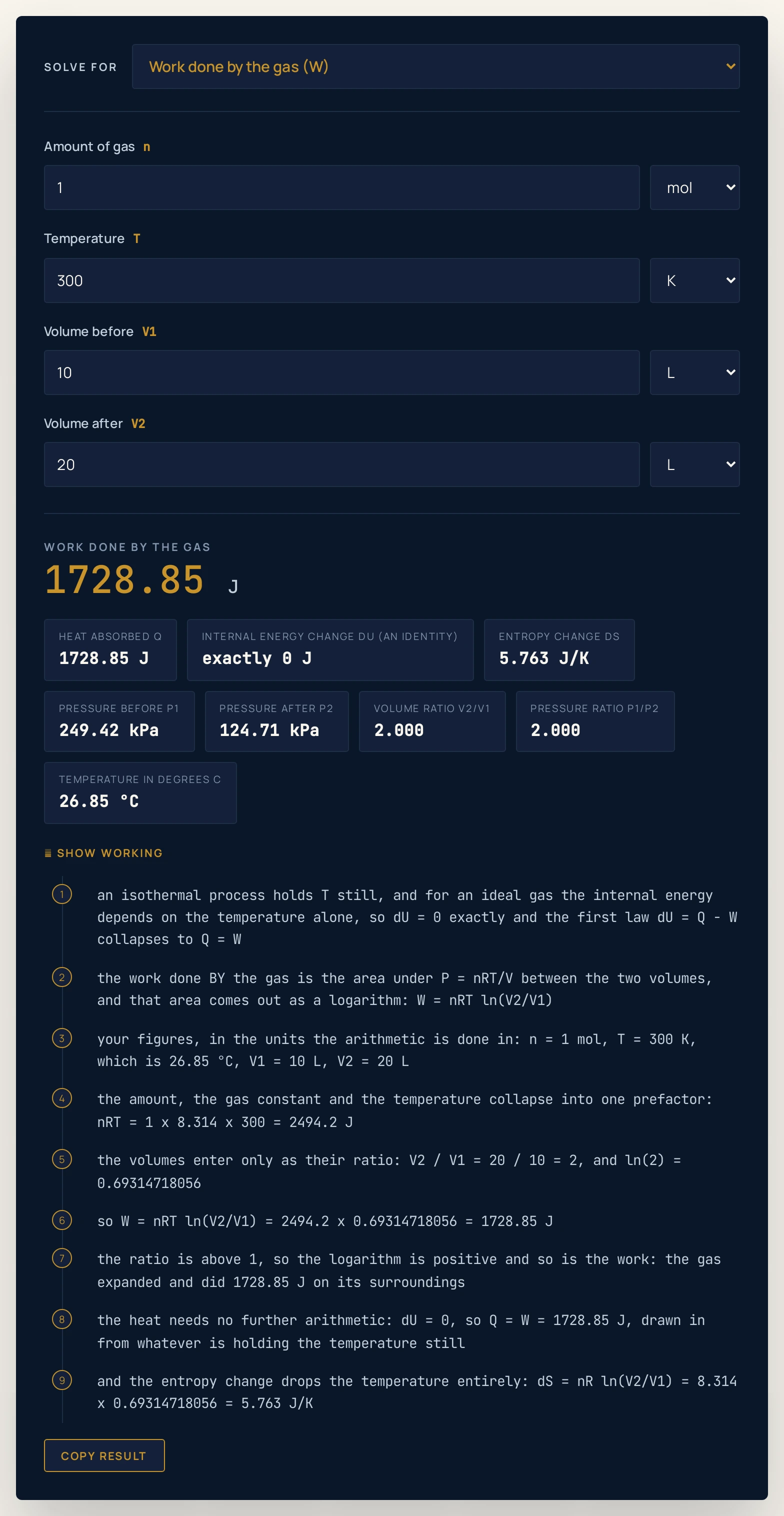
1728.85 J headline and the 1728.85 J heat chip are the same number because the internal energy chip reads exactly 0 J — and the 5.763 J/K entropy chip would be unchanged at any temperature, because it depends on the 2.000 ratio alone.Worked example: change one thing at a time
The table starts at the defaults and moves one thing at a time: the direction, the temperature, the amount, then which quantity is the unknown, then the unit the figures are typed in, and finally the entries the calculator declines. Rows 7 to 10 are the closed round trip, so the work that leaves row 1 comes back in and returns the volume, the amount and the temperature it started from. Every Result, Heat and Entropy cell was read out of the running widget rather than worked out by hand, so where a cell and the tool ever part company, believe the tool.
| Step | Solving for | What you type | Result | Heat absorbed | Entropy change |
|---|---|---|---|---|---|
| The page as it opens | Work done by the gas | 1.00 mol, 300 K, 10.0 to 20.0 L | 1728.85 J | 1728.85 J | 5.763 J/K |
| Squeeze it back instead | Work done by the gas | 1.00 mol, 300 K, 20.0 to 10.0 L | -1728.85 J | -1728.85 J | -5.763 J/K |
| Nothing moves at all | Work done by the gas | 1.00 mol, 300 K, 10.0 to 10.0 L | 0 J | 0 J | 0.000 J/K |
| Twice as hot, same ratio | Work done by the gas | 1.00 mol, 600 K, 10.0 to 20.0 L | 3457.7 J | 3457.7 J | 5.763 J/K |
| Squeezed to a third | Work done by the gas | 2.00 mol, 350 K, 15.0 to 5.00 L | -6393.7 J | -6393.7 J | -18.27 J/K |
| The same expansion, typed in Celsius | Work done by the gas | 1.00 mol, 27.0 °C, 10.0 to 20.0 L | 1729.71 J | 1729.71 J | 5.763 J/K |
| How far must it expand? | Volume after | 2.00 mol, 300 K, 10.0 L, 5000 J | 27.2461 L | 5000 J | 16.67 J/K |
| Where did it start? | Volume before | 1.00 mol, 300 K, 20.0 L, 1728.848 J | 10 L | 1728.85 J | 5.763 J/K |
| How much gas is there? | Amount of gas | 300 K, 10.0 to 20.0 L, 1728.848 J | 1 mol | 1728.85 J | 5.763 J/K |
| How hot was it? | Temperature | 1.00 mol, 10.0 to 20.0 L, 1728.848 J | 300 K | 1728.85 J | 5.763 J/K |
| The amount typed in millimoles | Work done by the gas | 1000 mmol, 300 K, 10.0 to 20.0 L | 1728.85 J | 1728.85 J | 5.763 J/K |
| Both volumes in cubic metres | Work done by the gas | 1.00 mol, 300 K, 0.01 to 0.02 m3 | 1728.85 J | 1728.85 J | 5.763 J/K |
| Absolute zero is refused | Work done by the gas | 1.00 mol, -273.15 °C, 10.0 to 20.0 L | no answer | — | — |
| One hundredth of a kelvin answers | Work done by the gas | 1.00 mol, -273.14 °C, 10.0 to 20.0 L | 0.0576283 J | 0.0576283 J | 5.763 J/K |
| No gas at all is refused | Work done by the gas | 0 mol, 300 K, 10.0 to 20.0 L | no answer | — | — |
| Equal volumes, solving for the amount | Amount of gas | 300 K, 10.0 to 10.0 L, 1728.848 J | no answer | — | — |
Rows 1 to 3 are one gas at one temperature going three ways. Doubling the volume gives 1728.85 J, halving it back gives -1728.85 J, and leaving the volume alone gives exactly 0 J with no heat and no entropy change. The negative figure is not an error message: the convention here is that a positive work is work done by the gas, so a compression has to come out negative.
Row 4 doubles the temperature and doubles the work, from 1728.85 J to 3457.7 J, while the entropy chip does not move at all. That pair is the most useful thing in the table. The work depends on the amount, the ratio and the temperature; the entropy change depends on the amount and the ratio only, so the same doubling of one mole is 5.763 J/K at 300 K, at 600 K and at 0.01 K.
Rows 5 and 6 change two different things. Two moles squeezed to a third of their volume at 350 K need -6393.7 J, which is 6393.7 J of work done on the gas and the same amount shed as heat. Row 6 is the same expansion as row 1 with the temperature typed as 27.0 °C, and the answer is 1729.71 J rather than 1728.85 J, because 27.0 °C is 300.15 K and not 300 K.
Rows 7 to 10 run the relation backwards in all four remaining modes. Two moles at 300 K have to reach 27.2461 L to do 5000 J, which is 2.7246 times the volume they started from. The last three take the 1728.848 J the opening state produces and return 10 L, 1 mol and 300 K exactly, which is what it means to say that one relation is being read five ways.
Rows 11 and 12 are the unit menus. 1000 mmol is the same gas as 1.00 mol, and 0.01 to 0.02 m3 is the same expansion as 10.0 to 20.0 L, so both reproduce row 1 to the last digit. The volume row would reproduce it even if the conversion were wrong in a consistent way, because the work depends on the ratio — but the pressure chips would not, and they are unchanged too.
Rows 13 to 16 are the edges of the domain. Exactly -273.15 °C is 0 K and is declined, while -273.14 °C is 0.01 K and answers 0.0576283 J, so the refusal sits at absolute zero rather than near it. Row 15 declines a gas that is not there, and row 16 declines the one question on this page that genuinely has no answer.
Formula and symbol reference
The calculator uses one relation in five arrangements. The path is P = nRT/V, so PV holds still at nRT; the work done by the gas is the area under that path between the two volumes, W = ∫P dV = nRT ln(V2/V1); and because the internal energy of an ideal gas depends on temperature alone, ΔU = 0 and the first law leaves Q = W. The entropy change is ΔS = nR ln(V2/V1), which is the same logarithm without the temperature in front of it.
Only one constant is typed into this page: R = 8.314 J/(mol·K), the four-figure rounding rather than the SI 2019 figure, and it is named because the choice shows in the last two digits of every answer. Calculators elsewhere on this site are not all built on that same rounding, so a last-digit difference between two pages is worth checking against the constant first. Everything else on screen is worked out from your four figures, which is why the reference below lists what each box takes as well as what it means. Pressures are absolute pressures, and the two volumes must describe the same gas.
The rearrangements are worth writing out, because each is the form one of the Solve for modes uses. Reading the work backwards gives V2 = V1exp(W/nRT) and V1 = V2exp(-W/nRT); dividing instead gives n = W/(RT ln(V2/V1)) and T = W/(nR ln(V2/V1)). Those last two are the reason equal volumes have no answer in two of the five modes, because both divide by a logarithm that is then zero.
| Symbol | Meaning | SI unit | Values used on this page |
|---|---|---|---|
| n | Amount of gas, held fixed for the whole change. It scales the work and the entropy change in direct proportion, so twice the gas is twice both of them | mole, mol | Boxes take mol, mmol or kmol: 1.00 on the opening case, 2.00 squeezed to a third, 3.00 hot and wide, and 1000 mmol is the same gas as 1.00 mol. |
| T | Absolute temperature, held fixed. It is a prefactor rather than one side of a ratio, which is why it must be absolute and why the 273.15 offset never cancels | kelvin, K | Boxes take K, degrees Celsius or degrees Fahrenheit: 300 on the opening case, 600 twice as hot, and 27.0 degrees Celsius is 300.15 K rather than 300 K. |
| V1 | Volume before the change. Only its ratio to the volume after decides the work, but its actual size decides the pressure before | cubic metre; litres on this page | Boxes take L, mL or m3: 10.0 on the opening case, 15.0 squeezed to a third, 0.01 m3 is the same as 10.0 L. |
| V2 | Volume after the change. Larger than the volume before is an expansion and the work is positive; smaller is a compression and the work is negative | cubic metre; litres on this page | Boxes take L, mL or m3: 20.0 on the opening case, 5.00 squeezed to a third, 27.2461 is the answer when 5000 J is asked for. |
| W | Work done BY the gas on its surroundings, and the area under the curve between the two volumes. Positive means the gas pushed outwards | joule, J | Boxes take J, kJ or cal: 1728.848 closes the round trip, 5000 asks how far the gas must expand. |
| Q | Heat drawn in from whatever holds the temperature still. Equal to the work because the internal energy does not change, and printed as a chip rather than typed | joule, J | Computed, never typed: 1728.85 J on the opening case, -6393.7 J when the gas is squeezed to a third. |
| dS | Entropy change of the gas. It depends on the amount and the volume ratio only, so it is the same at 100 K as at 800 K for the same expansion | joule per kelvin, J/K | Computed, never typed: 5.763 J/K for any doubling of one mole, -18.27 J/K squeezed to a third, 16.67 J/K on the 5000 J case. |
| R | Molar gas constant, typed into this page as 8.314 and never derived from anything else. The choice is visible in the last printed digits | joule per mole per kelvin | A constant: 8.314. The SI 2019 value 8.314462618 would return 1728.94 J rather than 1728.85 J on the opening case. |
The physics: why the work is a logarithm and the heat has no choice
Naming the curve is only half of an isothermal process. PV = constant tells you where the gas ends up, and that is the part the Boyle’s law calculator already does. What it does not tell you is what the journey cost, and that is an area rather than an end point.
Adding up P dV along the path means adding up nRT/V as the volume grows, and a sum of reciprocals is a logarithm. So the work is nRT ln(V2/V1), and the logarithm is not a convenience — it is why the returns diminish so sharply. Moving from a doubling to a twentyfold expansion is ten times as much room and buys only 4.3219 times the work, and to double the work you have to square the ratio rather than double it.
That the area and the logarithm agree is worth one sentence because it is the only non-circular check available here. Measuring the area under nRT/V numerically and comparing it with a single call to a logarithm are genuinely different computations, and across 6,352 combinations of the four inputs, spread over the whole range these boxes accept, the two never differ by more than one part in a thousand million. Watching PV come out the same at both ends is not a check of anything, because that is how both pressures were computed in the first place.
The same warning applies to the two ratio chips on this page. As quantities they are one number, because P1/P2 reduces to V2/V1 as an identity once both pressures come from nRT/V — the same way up, not inverted. As printed strings they are rounded to four figures separately, so on the 5,261,100-state grid described below their last digits differ in 4,508 states, 0.09 %. Neither chip is evidence for the other, and a last-digit mismatch is the rounding rather than a fault in the arithmetic.
The heat has no freedom at all here. For an ideal gas the internal energy depends on temperature alone, so holding the temperature still holds the internal energy still: ΔU = 0 is an identity rather than a result.
The first law then reads 0 = Q - W, which is why the heat chip repeats the headline exactly, and why every joule of work is paid for in real time by a joule flowing in from the reservoir. The guide to the first law of thermodynamics sets that ledger out in full, and the first law of thermodynamics simulator is the better tool when it is the heat you know and the volume you want.
The genuinely surprising result is what happens when you take the same two states by a different route. Let one mole at 300 K go from 10 L to 20 L against a piston and this page returns 1728.85 J of work and 1728.85 J of heat; let it rush into an empty vessel instead and it pushes against nothing, so both are zero. The end states are identical, ΔU is zero either way, and the entropy change of the gas is 5.763 J/K either way — because entropy and internal energy are state functions while work and heat are path functions.
Both halves of that have to be said together or the second law looks broken. The reversible expansion leaves the entropy of the universe unchanged, because the reservoir loses exactly the entropy the gas gains. The free expansion leaves the gas with the same 5.763 J/K and takes nothing from anywhere, so the entropy of the universe rises by that amount instead, which is what makes it irreversible.
Last, the temperature. Because T stands in front of the logarithm rather than inside a ratio, the 273.15 between Celsius and kelvin cannot cancel. At 27 °C the shortcut of typing 27 returns 155.596 J against a true 1729.71 J; at 0 °C it returns exactly zero, which is the worst kind of wrong answer because it looks like a statement about the gas; and below 0 °C it reverses the sign so an expansion is reported as a compression.
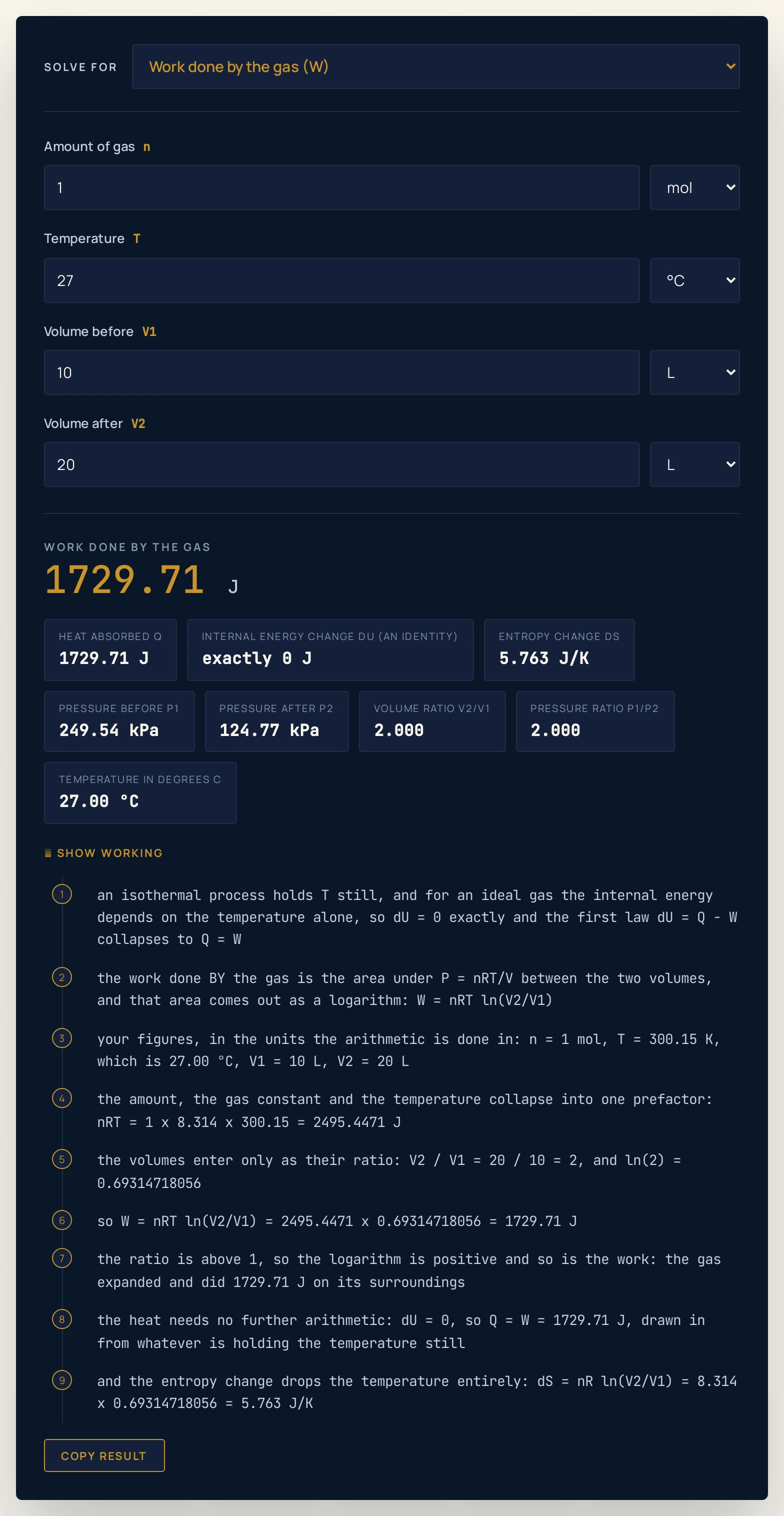
27.0 °C. The answer is 1729.71 J and not 1728.85 J, because 27.0 °C is 300.15 K — while the 5.763 J/K entropy chip has not moved, because the temperature never enters it.Where the isothermal process calculator breaks down
The arithmetic is exact to the last digit a double can hold. What fails is an ideal gas being mistaken for a real one, a path being assumed where there is none, or a temperature arriving in the wrong scale.
- Kelvin is not a preference here, it is a prefactor
- In a gas law the temperature appears on both sides of a ratio, so how badly a Celsius slip hurts there depends on how far above the ice point both figures sit. Here there is only one temperature and it multiplies the whole answer, so the error works out to exactly 273.15 divided by the absolute temperature every time: 91 % low at 27 °C, exactly 100 % at 0 °C where the shortcut returns no work at all, and more than 100 % below that, where the sign reverses and an expansion is reported as a compression. Across the range this topic is usually taught in, roughly 100 K to 800 K, that fraction never falls below 34.1 %, so the shortcut is always wrong rather than usually wrong. The box takes °C and °F precisely so that nobody has to do the conversion by hand, and it declines a Celsius figure that lands at or below absolute zero rather than returning the zero or the reversed sign.
- The gas has to be ideal for the internal energy chip to read zero
- That chip is an identity for an ideal gas, whose internal energy depends on temperature alone. A real gas has an internal energy that depends on volume as well, because its molecules attract one another, so a real isothermal expansion is not quite a zero-energy-change process and the heat is not quite equal to the work. A real gas expanding freely into a vacuum also drifts in temperature rather than holding it, which is the Joule effect: an expansion at constant internal energy, and a different experiment from Joule-Thomson throttling through a valve, where it is the enthalpy that is held instead. No figure on this page describes any particular real gas, because none was measured for it.
- The area is the work only for a slow, reversible path
- Every figure here assumes the gas stays in equilibrium all the way, so that it has a single pressure at every volume and there is a curve to take the area of. A free expansion into a vacuum breaks that completely: the gas is not in equilibrium in between, there is no path to draw, and the work between the same two volumes is zero rather than 1728.85 J. Anything in between — a piston released quickly against a lower pressure — does less work than this page reports and is not an isothermal process in the sense used here.
- Something has to be holding the temperature still
- An expanding gas does work, and if nothing replaces that energy it cools. An isothermal process therefore assumes a reservoir large enough to supply the heat as fast as the gas needs it, which in practice means a thermostatted bath, a very slow change, or both. Push the same expansion through quickly and the gas cools no matter what the equation says; the result is then somewhere between this page and an adiabatic calculation, and neither one describes it exactly.
- The amount of gas is held, and the pressures are absolute
- One amount of gas appears in the whole calculation, so a leak, a chemical change or a phase change puts you outside the model entirely. The two pressure chips are absolute pressures in kilopascals, not gauge pressures: a gauge figure has to have the surrounding atmosphere added to it before it means anything here. The volumes must likewise describe the same gas at both ends rather than two different samples.
- Do not check the two pressure chips by multiplying them out
- It is tempting to read 249.42 kPa against 10.0 L and 124.71 kPa against 20.0 L and confirm that the products agree. Two things are wrong with that. The first is that agreement would prove nothing, because both pressures were computed as
nRT/Vand their products arenRTby construction. The second is that the products on screen do not always agree anyway: multiply out the rounded figures over a grid of 5,261,100 states spanning 0.1 to 5 mol, 100 to 800 K and 1.0 to 20.0 L and they disagree in about 6 % of them, because two decimals of a pressure and one of a volume are not enough to survive the multiplication. Your arithmetic is fine in those cases; the display is rounded. - Equal volumes have no answer in two of the five modes
- Solving for the amount of gas or for the temperature divides by
ln(V2/V1). Make the two volumes the same and that logarithm is zero, and the work is zero for every amount of gas and every temperature, so there is nothing in the data to single one out. The calculator declines rather than returning the enormous or infinite figure the arithmetic would otherwise produce. Solving for the work with equal volumes is a different matter and answers 0 J, because a gas that did not move really did no work. - Zero is refused wherever it would look like an answer
- With no gas at all, or at a temperature of absolute zero, the formula returns exactly 0 J — a number indistinguishable from “nothing happened” and far more dangerous than an error message. Both are therefore declined as inputs, and because they are declined as inputs they are also declined as answers: a work whose sign disagrees with the volume change would otherwise hand back a negative amount of gas or a temperature below absolute zero. The refusal is at zero and not near it, so 0.05 K answers 0.288141 J and one hundredth of a kelvin answers 0.0576283 J.
- Rounded figures in, rounded figures out
- The headline carries six significant figures and the arithmetic behind it is unrounded, so feeding a printed answer back in as an input moves the result slightly. The round trip on this page lands exactly on 10 L because it uses 1728.848 J; retype the displayed 1728.85 J instead and the volume before comes back as 9.99999 L. Show working prints every operand unrounded for exactly this reason, so each line there can be checked as it stands. None of these answers is a round number in any case:
nRT ln(ratio)is irrational for every set of figures you can type. - A pressure chip reading 0.00 kPa is not a pressure of zero
- The two pressure chips carry two decimal places, so anything below 0.005 kPa prints as 0.00 kPa. One mole at one hundredth of a kelvin really is at 0.01 kPa in 10 L and 0.00 kPa in 20 L on the chips, while the headline for that state, 0.0576283 J, is unaffected. Read the headline rather than a chip whenever a figure is near the bottom of its range, and never conclude from a chip that a gas has no pressure.
- Which gas constant, and it is visible
- This page uses
R = 8.314 J/(mol·K), the four-figure rounding, and not the SI 2019 figure. The exact value is 8.314462618, about 56 parts per million larger, and that is enough to matter at the precision printed here: the opening state returns 1728.85 J with the rounded constant and 1728.94 J with the SI one. Nothing site-wide follows from that choice, because several calculators here — the speed of sound page among them — are built on the SI figure instead. If your textbook, spreadsheet, lab sheet or another page disagrees with this one in the last two digits, check which constant it used before looking for a deeper cause. - The calculator measures nothing — you supply every figure
- Four numbers go in, one ideal-gas relation is rearranged, and the answer describes that ideal process and nothing else. It is not a measurement of a cylinder, a compressor or a laboratory bath, and the preset names are shorthand for the figures beside them rather than claims about any apparatus. Verify anything you mean to rely on against your own data before you quote it.
Where isothermal work is actually used
- The lower bound on the work a compressor needs
- Compressing a gas warms it, and a warmer gas pushes back harder, so any real compression costs more work than the same compression carried out slowly enough to stay at the starting temperature. The isothermal figure is therefore the floor: squeezing one mole at 300 K from 20.0 L to 10.0 L takes at least 1728.85 J, and a real machine takes more. Intercooling between stages exists to bring a real compression back towards that floor.
- Compressed-air energy storage, in both directions
- Storing energy as compressed air means paying the compression work and recovering the expansion work, and the difference between the two is where the round-trip efficiency goes. Both are calculations of exactly this shape, and the heat is not a side effect: the compression sheds it and the expansion must be given it back, or the gas cools and delivers less than this page says. Running the same two volumes in both directions gives the two halves of that ledger.
- Osmotic and dilution work in chemistry
- Diluting an ideal solution and expanding an ideal gas have the same logarithm in them, because both are counting how many more places a particle can be. The same
nRT ln(ratio)gives the minimum work to concentrate a solution or the maximum work available from letting it dilute, which is why the figure turns up in osmosis, in desalination and in electrochemical concentration cells. The volume ratio simply becomes a concentration ratio. - The two isothermal legs of a Carnot cycle
- A Carnot cycle is two isothermal legs joined by two adiabatic ones, and the heat taken in and given out belongs entirely to the isothermal pair. Working out either leg is a single use of this page at the reservoir temperature concerned. The cycle efficiency itself is a separate and much shorter calculation, which is why it lives on its own page rather than here.
- Gas thermometry and thermostatted baths
- A gas held in a bath and allowed to change volume slowly is the closest a laboratory gets to this model, and it is how the relation is usually demonstrated. The calculation is used the other way round there: a measured work and two measured volumes give back the temperature, which is the fifth of this page’s five modes. That is also the honest test of whether a bath really held the temperature, because a drifting bath shows up as a temperature that does not match the thermometer.
- Teaching what a path function is
- The pairing of this page with a free expansion is the cleanest demonstration in elementary thermodynamics that some quantities depend on the route and others do not. Same two states, same internal energy change, same entropy change, and yet 1728.85 J of work one way and zero the other. Nothing else in the subject separates state functions from path functions with so little machinery.
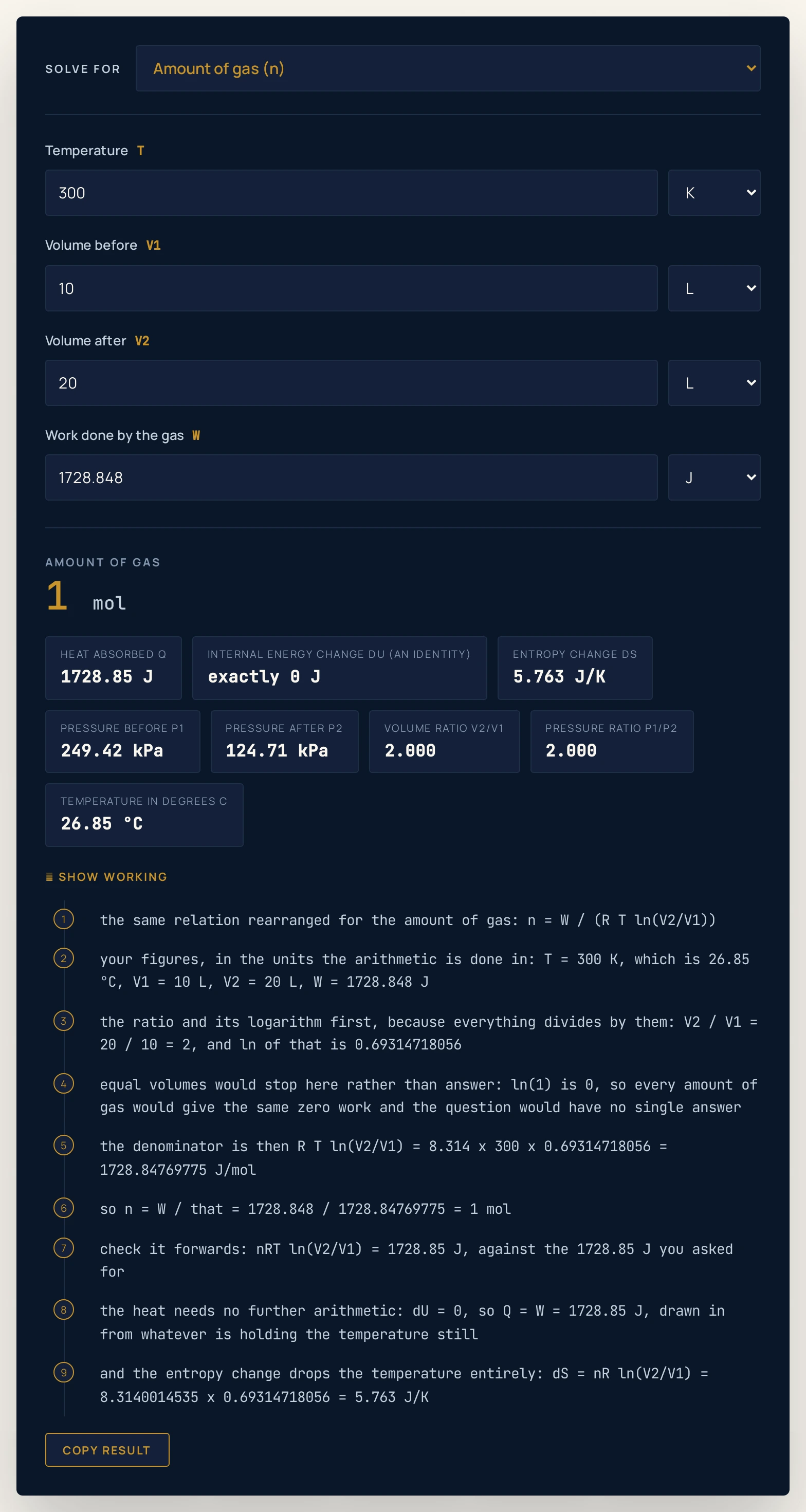
1 mol. This is the mode that declines equal volumes: with V2 set to 10.0 L the logarithm is zero and every amount of gas fits the data equally well, so there is no answer to give.Where to go next
For the method in full, with the curve drawn, the area shaded and eight worked problems, read what an isothermal process is and where the logarithm comes from. For the relation this path is built on, the guide to Boyle’s law is the companion piece, with the Boyle’s law calculator and the Boyle’s law simulator beside it.
Three more are worth a bookmark. The guide to entropy explains the 5.763 J/K chip and why it is the same at every temperature; the guide to the laws of thermodynamics puts all four in order; and the ideal gas law calculator handles a single state rather than a process. The whole physics lab library is open too, and the site search will find anything this page has not.
Frequently asked questions
What does the isothermal process calculator work out?
It works out the work done by a gas that expands or is squeezed while its temperature is held still, from the formula W = nRT ln(V2/V1). Enter the amount of gas, the temperature and the two volumes and it returns that work, along with the heat, the entropy change, the pressure before and after, the volume and pressure ratios and the temperature in degrees Celsius. Point the Solve for menu at any of the five quantities instead and it rearranges the same relation, so a known work can give you either volume, the amount of gas or the temperature.
What is an isothermal process?
An isothermal process is a change in which the temperature is held constant while other properties move. For an ideal gas that fixes the path: pressure times volume stays equal to nRT, so the gas travels along a hyperbola rather than a straight line, and the work it does is the area under that curve. Holding the temperature still takes a reservoir of some kind, because an expanding gas would otherwise cool as it worked.
Why does the calculator insist on an absolute temperature?
Because the temperature here is a prefactor rather than one side of a ratio, so the 273.15 offset between Celsius and kelvin never cancels out. Typing 27 instead of 300.15 does not shift the answer by a little; it returns 155.596 J where the truth is 1729.71 J, an error of 91 per cent. At 0 degrees Celsius the shortcut returns exactly zero work, which looks like a real answer and is not, and below 0 degrees Celsius it reverses the sign so that an expansion is reported as a compression.
Why is the heat equal to the work?
Because the internal energy of an ideal gas depends on its temperature alone, and an isothermal process holds the temperature still, so the internal energy does not change at all. The first law says that the internal energy change is the heat in minus the work out; with the first term identically zero, the heat in must equal the work out. That is the first law with one term removed rather than a coincidence, and it means every joule the gas does on its surroundings is paid for by a joule flowing in from whatever is holding the temperature.
What units does it take?
The amount of gas takes moles, millimoles or kilomoles; the temperature takes kelvin, degrees Celsius or degrees Fahrenheit; both volumes take litres, millilitres or cubic metres; and the work takes joules, kilojoules or calories. Everything is converted before any arithmetic happens, and the second line of Show working restates your figures in the units the calculation really uses, which is moles, kelvin, litres and joules. The pressures are absolute pressures in kilopascals, never gauge pressures.
Why is there no answer when I make both volumes the same?
Only when you are solving for the amount of gas or the temperature, and the reason is that the question genuinely has no answer. With equal volumes the ratio is one, its logarithm is zero, and the work is zero for every amount of gas and every temperature you could name, so nothing in the data can single one out. Solving for the work with equal volumes is perfectly fine and returns zero, because that is a real statement about a gas that did not move.
Does a free expansion into a vacuum give the same work?
No, and that contrast is the most useful thing on this page. Let one mole at 300 K go from 10 L to 20 L against a piston and the calculator returns 1728.85 J of work and the same again as heat; let it rush into an empty vessel instead and it pushes against nothing, so the work and the heat are both zero. The two end states are identical, the internal energy change is zero in both, and the entropy change of the gas is 5.763 J/K in both, because entropy is a state function while work and heat are not.
Which value of the gas constant does this page use?
It uses R = 8.314 J/(mol K), the four-figure rounding, and the choice is stated here rather than hidden because it is visible in the answer. The SI 2019 value is 8.314462618 J/(mol K), about 56 parts per million larger, and on the opening state it would return 1728.94 J instead of 1728.85 J. Calculators on this site are not all built on the same one of those two, so if you are comparing this page against a textbook, a spreadsheet or another page, check which constant it used before deciding that anything disagrees.
References & formula source
- Atkins & de Paula, Physical Chemistry, the chapter on the first law, for the reversible isothermal expansion of a perfect gas and the integral that produces the logarithm.
- Zemansky & Dittman, Heat and Thermodynamics, for the distinction between a quasi-static path whose area is the work and an irreversible one whose area is not, and for the free expansion of a gas into a vacuum.
- R = 8.314 J/(mol K) is the constant typed into this calculator, and it is named because the choice is visible at this page precision: the SI 2019 value 8.314462618 J/(mol K) is larger by about 56 parts per million, and the opening state returns 1728.85 J with the first and 1728.94 J with the second. No site-wide convention follows from that, because other calculators here, the speed of sound page among them, are built on the SI figure instead. The ice point 273.15 K is exact by definition of the Celsius scale.
- Every figure quoted in the text above is a string this calculator printed for the inputs named beside it, or a constant the page states. The percentages describing the Celsius mistake are ratios between two figures this same formula produces, not measurements of any gas.
- Further reading: Isothermal process — Wikipedia