Avogadro's law: while the pressure and the temperature hold still, the volume of a gas follows the amount of gas in it and nothing else about it, so V / n stays put — V1/n1 = V2/n2. This free Avogadro's law calculator rearranges that ratio for whichever of the four you are missing, working in litres and moles, and prints the molar volume, the amount ratio and the molecule count beside the answer.
Load a real gas sample
Each button puts the tool back on the final volume and fills the three boxes with a measured volume and a pair of amounts. Whatever the widget then works out is read back into the line underneath, so nothing there is stored text.
Pick a case above, or type your own numbers.
What Is the Avogadro's Law Calculator?
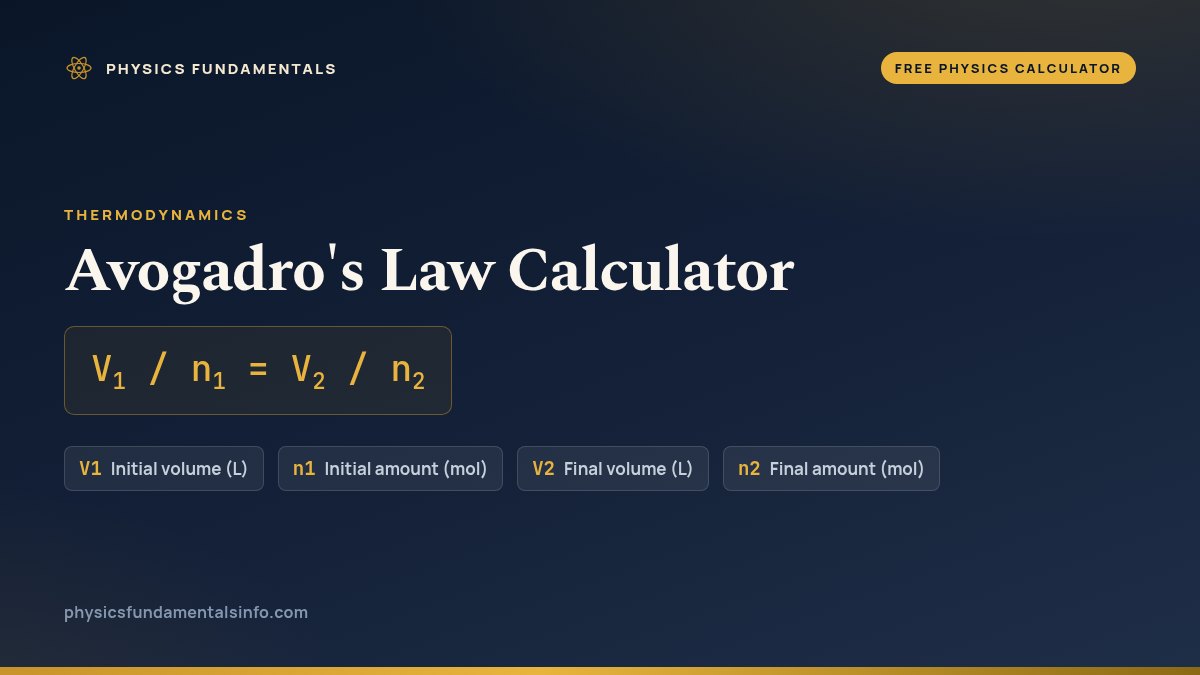
The Avogadro's law calculator is a free online tool built on the formula V1 / n1 = V2 / n2. Enter the volume and the amount of gas you have, plus whichever of the other two you know, and it solves for the missing volume or amount and shows every step of the substitution. It is a pure ratio, so it never asks for a pressure or a temperature: both cancel as long as the two states share them.
| Symbol | Quantity | Default unit | Also accepts | Example value |
|---|---|---|---|---|
| V1 | Initial volume | L | mL, m³ | 22.71 |
| n1 | Initial amount | mol | mmol, kmol | 1 |
| V2 | Final volume | L | mL, m³ | 45.42 |
| n2 | Final amount | mol | mmol, kmol | 2 |
How to use the Avogadro's law calculator
- Choose what to solve for. The menu opens on the final volume V2. Switch it to V1, n1 or n2 and the engine rearranges the ratio, hides that box and asks for the other three instead.
- Enter the volume you measured. Type it in L, mL or m3. It is the volume the gas actually occupies in the container you are describing, not a volume reduced to any standard condition.
- Enter the two amounts. Amounts go in mol, mmol or kmol. The first is what the container holds to begin with; the second is what it holds after gas has been pumped in or drawn off.
- Read the result and the extras. The headline is the missing quantity. Molar volume V/n is the volume one mole takes up in this case, Amount ratio n2/n1 is the factor the volume changes by, Gas added is the change in moles, and Molecules in the final state counts the molecules afterwards.
- Open Show working. The steps restate the rearrangement and then substitute your figures, always in litres and moles, so the arithmetic can be checked by hand whichever units the boxes are set to.
No pressure box and no temperature box appear, and that is deliberate rather than an omission. Both quantities fix how much room one mole takes up, but that molar volume sits above and below the line in V2/V1 and cancels; the full state equation behind it is set out in the guide to the ideal gas law. When you do need a pressure or a temperature in the answer, the ideal gas law calculator is the tool that asks for them.
Three slips account for most wrong answers here. The first is entering a volume already reduced to standard conditions beside one that was not, which breaks the shared-conditions rule the whole ratio depends on. The second is leaving a unit menu on litres while typing millilitres into the box beneath it, and the third is reading the headline without its unit label: the working always comes back in litres and moles, but the headline carries whatever unit the box for that quantity was last left on, and that setting survives a change of the Solve for menu.
Worked example: change one thing at a time
The table below walks away from the opening case one entry at a time, then asks the same question backwards. Each cell was copied out of the running widget rather than worked out by hand, so where a cell and the tool ever part company, believe the tool. A dash marks the box the engine hides because it is the one being solved for.
| Step | Solve for | Initial volume | Initial amount | Final volume | Final amount | Result | Amount ratio | Molecules after |
|---|---|---|---|---|---|---|---|---|
| Start: one mole at 100 kPa and 0 °C | Final volume | 22.71 L | 1 mol | — | 2 mol | 45.42 L | 2.000 | 1.204e24 |
| Final amount to 3 mol | Final volume | 22.71 L | 1 mol | — | 3 mol | 68.13 L | 3.000 | 1.807e24 |
| Final amount to 0.5 mol | Final volume | 22.71 L | 1 mol | — | 0.5 mol | 11.36 L | 0.5000 | 3.011e23 |
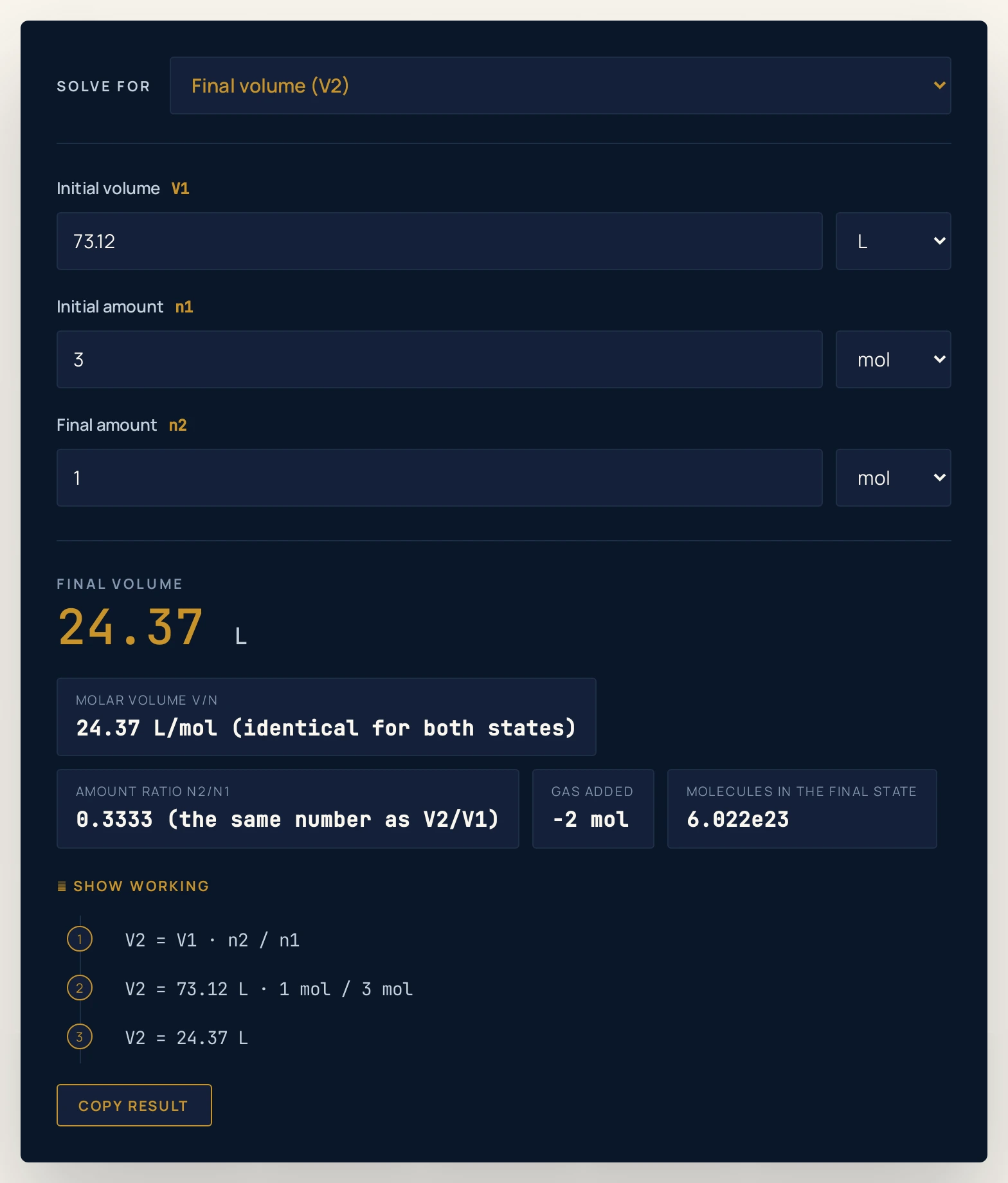
| Back to 2 mol, solving for the final amount | Final amount | 22.71 L | 1 mol | 45.42 L | — | 2 mol | 2.000 | 1.204e24 |
| Both volumes in millilitres | Final amount | 22710 mL | 1 mol | 45420 mL | — | 2 mol | 2.000 | 1.204e24 |
| Solving for the initial volume | Initial volume | — | 1 mol | 45.42 L | 2 mol | 22.71 L | 2.000 | 1.204e24 |
| Solving for the initial amount | Initial amount | 22.71 L | — | 45.42 L | 2 mol | 1 mol | 2.000 | 1.204e24 |
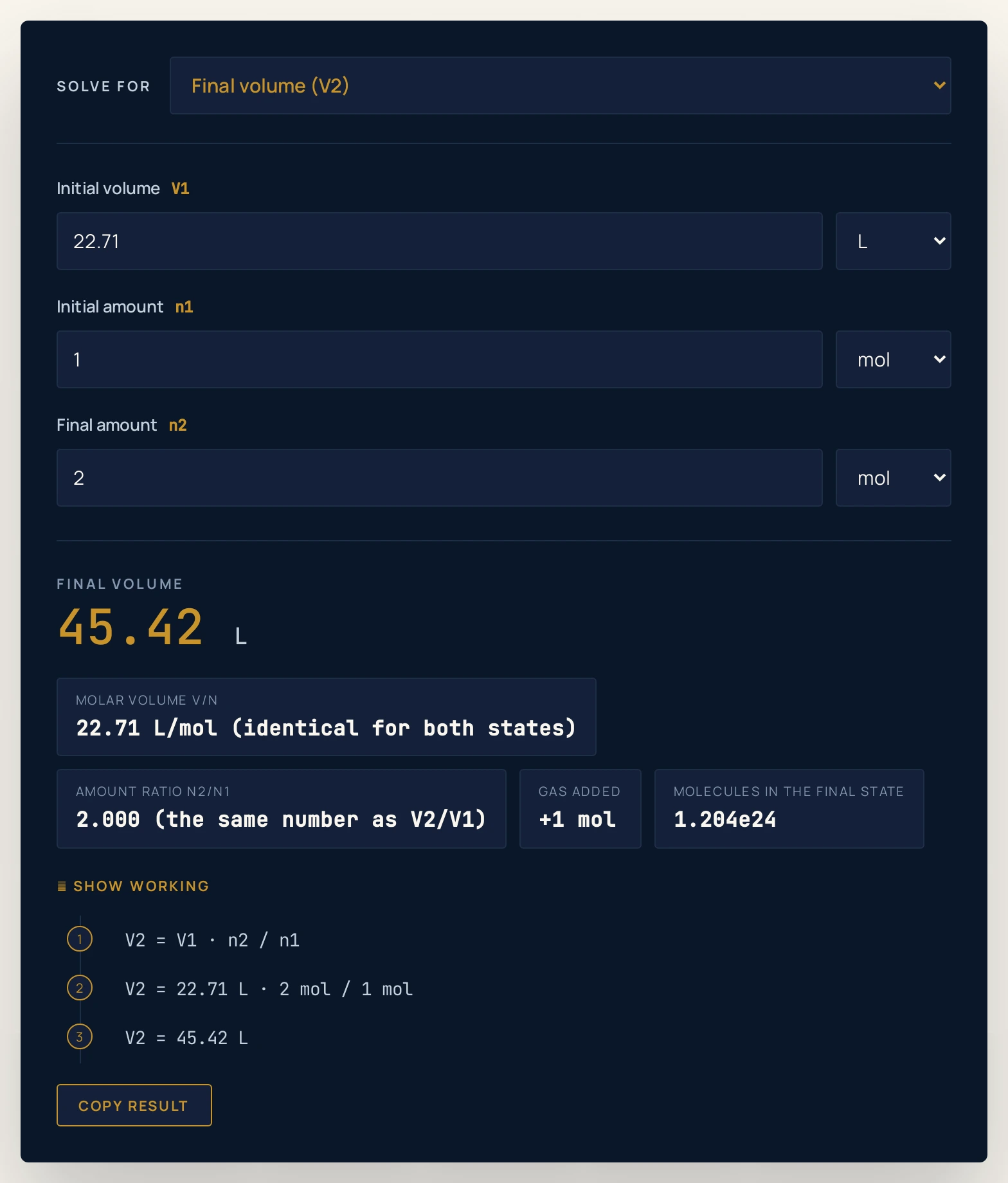
| A gas holder emptied: 73.12 L, 3 mol down to 1 mol | Final volume | 73.12 L | 3 mol | — | 1 mol | 24.37 L | 0.3333 | 6.022e23 |
| The same case with the amount in millimoles | Final volume | 73.12 L | 3000 mmol | — | 1 mol | 24.37 L | 0.3333 | 6.022e23 |
Rows 1 to 3 hold the starting pair still and move only the final amount. Three moles instead of two multiplies 22.71 L by 3 and gives 68.13 L; half a mole halves it, and the 11.355 L that falls out prints as 11.36 L at four figures. The molecule count follows the same factor every time, from 1.204e24 up to 1.807e24 and down to 3.011e23, because it is the amount multiplied by a fixed number.
Rows 4 and 5 turn the question round. Solving for the final amount with 45.42 L in the final volume box returns 2 mol, the figure row 1 started from. Retyping both volumes in millilitres, as 22710 mL and 45420 mL, changes nothing at all: the ratio has litres on the top and litres on the bottom, so the unit divides out.
Rows 6 and 7 solve for the two starting quantities and recover 22.71 L and 1 mol, which is the check worth doing whenever an answer looks surprising. Rows 8 and 9 move to a gas holder at 100 kPa and 20 °C, where a mole occupies more room; drawing two of its three moles off leaves 24.37 L, and typing that same amount as 3000 mmol gives the identical answer. Heating rather than emptying that holder would be a different law, the one the Charles's law calculator handles.
Formula and symbol reference
The calculator uses one relation in four arrangements: V2 = V1·n2/n1, V1 = V2·n1/n2, n2 = n1·V2/V1 and n1 = n2·V1/V2. The extras come from V/n on the first state, from n2/n1, from n2 - n1 and from n2·NA. Nothing else is computed, and no constant except Avogadro's number enters the page.
| Symbol | Meaning | SI unit | Values used on this page |
|---|---|---|---|
| V1 | The volume you start with, at whatever pressure and temperature the case is at | cubic metre, m3 | Boxes take L, mL or m3: 22.71 L for one mole at 100 kPa and 0 °C, 2.545 L for a breath, 73.12 L for a small gas holder. |
| n1 | The amount of gas in that volume, in moles: how many molecules there are, not how heavy they are | mole, mol | Boxes take mol, mmol or kmol: 0.1 mol in a breath, 1 mol in the opening case, 3 mol in the gas-holder case. |
| V2 | The volume after the amount of gas has changed, at the same pressure and temperature | cubic metre, m3 | 45.42 L when 1 mol becomes 2 mol at 100 kPa and 0 °C; 24.37 L when 3 mol becomes 1 mol at 100 kPa and 20 °C. |
| n2 | The amount of gas afterwards; larger than n1 if gas was added, smaller if it was let out | mole, mol | 0.2 mol in the breath case, 1.5 mol in the balloon case, 2 mol in the opening case. |
| V/n | The molar volume: the volume one mole occupies at the pressure and temperature of the case. The same for every gas there | cubic metre per mole, m3/mol | Reported to four figures: 22.71 L/mol at 100 kPa and 0 °C, 24.37 L/mol at 100 kPa and 20 °C, 64.28 L/mol at 100 kPa and 500 °C. |
| NA | Avogadro's number, the count of entities in one mole. A fixed number, not a measurement, and not the law | per mole | 6.02214076e23 exactly. Multiplying it by the final amount gives the Molecules in the final state extra. |
The physics: why the volume follows the molecule count
A gas exerts its pressure by battering the walls of its container, and each molecule contributes to that battering regardless of what it is made of. Add more molecules at the same temperature and the pressure would climb, unless the container grows until the blows are as spread out as before. That is why the law needs a wall that is free to move: a piston, a balloon skin, the roof of a gas holder or a chest.
Put that into the state equation and the volume one mole occupies is V/n = R·T/P, which is the same for every gas at a given pressure and temperature. The calculator never evaluates that expression, because it does not know your pressure or your temperature; it reports Molar volume V/n straight from the volume and amount you typed. At 100 kPa and 0 °C that figure is 22.71 L/mol, and the whole of the guide to Avogadro's law is built around it.
Plot volume against amount and you get a straight line through the origin whose slope is that molar volume. Doubling the amount doubles the volume exactly, halving it halves the volume, and the line passes through zero because no molecules means no gas to occupy anything. Change the pressure or the temperature and the line tilts, but it stays straight and it still goes through the origin.
Two things are worth keeping apart, because they carry the same name. Avogadro's law is the proportionality above; Avogadro's number is 6.02214076e23 per mole, the count of entities in a mole, which has been exact by definition since the mole was redefined and was named after him long after his lifetime. The calculator uses the first to get the answer and the second only to turn the answer into a molecule count.
Because the law counts molecules rather than weighing them, equal volumes of different gases hold equal numbers of molecules but quite different masses. Two moles of helium and two moles of carbon dioxide both fill 45.42 L at 100 kPa and 0 °C and both hold 1.204e24 molecules, yet they weigh 8.006 g and 88.02 g. That mass-per-volume view is where the gas density calculator picks the story up, since density is molar mass divided by molar volume.
Where Avogadro's law breaks down
Dividing one pair of numbers by another can hardly go wrong. What fails is the vessel the numbers describe, the conditions the two volumes were measured at, or the assumption that a real gas behaves like an ideal one.
- A container that cannot change size
- This is the commonest misuse. Pump gas into a sealed steel bottle and the volume is fixed by the steel, so the pressure rises instead and the ratio the tool applies never comes into play. Only a vessel free to expand against a steady outside pressure obeys the law.
- Symptom: a gauge reading that climbs while the container obviously stays the same size.
- Two volumes measured at different conditions
- The ratio only holds when both states share a pressure and a temperature. A volume read in a cold laboratory and another read in a warm one are not comparable, and neither is a measured volume set against one already reduced to standard conditions.
- High pressure
- Real molecules take up room and pull on one another, and the straight line through the origin is an idealisation that ignores both. The departure grows as a gas is compressed, and squeezing a gas at a fixed temperature is Boyle's law rather than this one, which the Boyle's law simulator shows directly. No percentage is quoted here, because nothing on this page measures one.
- Cooling towards condensation
- Cold and dense is where gases stray furthest from the ideal line, and near their boiling points they leave it altogether by turning liquid. Carbon dioxide is already a solid near -78 °C at ordinary pressures, so a case set below that describes a volume an ideal gas would occupy rather than anything a real sample would do.
- Gas that leaks, dissolves or reacts
- The amount in the second box has to be the amount still there as gas. A balloon losing helium through its skin, a gas dissolving into a liquid beneath it, or one being consumed in a reaction all change that amount without anybody adding or removing anything on purpose.
- Rounded figures in, rounded figures out
- The tool answers from the digits you type, not from the unrounded measurement behind them. Type a volume already cut to four figures and the answer inherits that rounding, which is why a result can differ in the last digit from one worked through with full precision.
- The law confused with the number
- Avogadro's number is not a property of any particular gas and never appears in V1/n1 = V2/n2. It converts an amount into a count, which is what the last extra does, and nothing in the ratio changes if you ignore it entirely.
Where Avogadro's law is actually used
- Gas syringes and gas burettes
- A graduated syringe reads a volume, and at a steady room pressure and temperature that volume stands in for a number of molecules. Doubling the reading means twice the amount collected, which is exactly what the amount ratio extra reports.
- Respiratory measurement
- A lungful is a volume at a stated pressure and body temperature, and it is the number of molecules behind it that matters to the body. The breath preset takes 2.545 L for 0.1 mol and doubles the amount, which doubles the volume the chest has to make room for.
- Gas metering and reduction to standard conditions
- A meter measures the volume that passed through it at whatever pressure and temperature the pipe happened to be at, and billing is in a standard volume. The step that converts one to the other rests on the fact that the molecule count, not the reading, is what was actually delivered.
- Balloon and airship lift
- A balloon full of helium and the air it pushed aside hold the same number of molecules, because they share a pressure, a temperature and a volume. The lift is the mass difference that follows from their molar masses, and it is gross lift, before the skin, the string and any payload are counted.
- Reaction stoichiometry by volume
- For gases measured at one pressure and temperature, volume ratios are mole ratios, so a balanced equation can be read straight off a pair of volumes. Two volumes of hydrogen to one of oxygen is the same statement as two moles to one.
- Checking that a mixture behaves
- Air is a mixture and follows the law exactly as a pure gas does, which is why a conventional mean molar mass of 28.96 g/mol is enough to describe it by mass. The volume side never needs a molar mass at all.
Where to go next
For the reasoning behind the ratio, the 22.4 against 22.711 question and seven worked problems, read Avogadro's Law (V1/n1 = V2/n2), and for the equation all four gas laws fold into, the ideal gas law. Take a pressure change to the Boyle's law calculator, a temperature change to the Charles's law calculator, or a molar mass to the gas density calculator. The whole physics lab library is open if you would rather watch a quantity move than type it.
Frequently asked questions
Why does the calculator never ask for a pressure or a temperature?
Because both of them cancel. The volume one mole occupies is fixed by the pressure and the temperature, but that same molar volume sits in the top and the bottom of V2/V1, so it disappears the moment you take the ratio. Whatever pressure and temperature the two states share, doubling the amount of gas doubles the volume, and the tool needs only the three numbers you already have.
Which conditions does the default 22.71 litres for one mole belong to?
A pressure of 100 kPa and a temperature of 0 degrees Celsius, which is the standard pressure and temperature that IUPAC uses. One mole of any gas fills 22.71 L there, and the calculator reports that back as the Molar volume extra because it is simply the 22.71 L divided by the 1 mol you typed. At 1 atm, or 101.325 kPa, the same 0 degrees Celsius gives the 22.414 L that most textbooks quote.
Can I mix millilitres with moles, or litres with millimoles?
Yes: every box has its own unit menu and the engine converts each entry before any arithmetic, so 22710 mL and 22.71 L behave identically. The working is always printed in litres and moles, while the headline carries the unit that quantity's own box was last left on: set the final amount box to mmol, solve for it, and the opening case answers 2000 mmol over a working line reading n2 = 2 mol. Both volumes must still describe the same gas at the same pressure and temperature.
Why is a zero or a negative entry refused?
A volume and an amount of substance are both strictly positive quantities, and the ratio would divide by zero if either starting value were zero. Type 0 or a negative number in any box and the result area asks you to check your inputs rather than printing a meaningless answer. Clearing a box entirely gives the gentler message naming which quantity is still missing.
Does the tool work for air, or only for a pure gas?
It works for air, and for any other mixture. Avogadro's law counts molecules and takes no interest in which kind they are, so a litre of air and a litre of helium at the same pressure and temperature hold the same number of them. Their masses are quite different, because that depends on molar mass, but no mass appears anywhere in V1/n1 = V2/n2.
What happens if I use it on a sealed rigid bottle?
You get an answer that the bottle cannot deliver, which is the commonest misuse of this law. Pump more gas into a container whose walls cannot move and the volume stays exactly where it was, so the pressure climbs instead. That is the full ideal gas equation at constant volume, not Avogadro's law, and the tool has no way of knowing which kind of vessel you had in mind.
How does the calculator turn an amount of gas into a count of molecules?
The Molecules in the final state extra multiplies the final amount by Avogadro's number, 6.02214076e23 per mole, which has been exact by definition since the mole was redefined. So 2 mol comes back as 1.204e24 molecules. The arithmetic is exact; the count is only ever as good as the amount of substance you measured and typed into the box.
References & formula source
- Atkins & de Paula — Physical Chemistry, the chapter on the properties of gases.
- Halliday, Resnick & Walker — Fundamentals of Physics, the chapter on the kinetic theory of gases.
- Young & Freedman — University Physics, the chapter on equations of state.
- BIPM — The International System of Units (SI brochure): the definition of the mole and the fixed numerical value of the Avogadro constant.
- Further reading: Avogadro's law — Wikipedia