An adiabatic process is one that runs with no heat crossing the system boundary, so work alone changes the energy inside. For an ideal gas that means pressure and volume move along P V^gamma = constant, with gamma set by how many ways the molecule can store energy. Compress it and it heats; let it expand and it cools.
There is no spark plug in a diesel engine. Not one, anywhere in it. The fuel lights anyway, on every compression stroke, and nothing in the cylinder was hot until the piston made it hot.
What heats the air is the squeeze itself, driven fast enough that no warmth escapes through the cylinder wall in time. That is an adiabatic process, and run the other way it cools a gas just as effectively. The useful question is the quantitative one: a fast squeeze beats a slow one, but by how much? The answer is a single number, and you can read it off the shape of a molecule.
What Is an Adiabatic Process?
An adiabatic process is one in which no heat enters or leaves the gas, so work is the only currency crossing the boundary. Sometimes the walls really are lagged. Far more often the change is simply too quick for heat to get anywhere.
Set Q = 0 in the first law and a single line survives: ΔU = -W, the internal energy changing by exactly minus the work the gas does. Do work on the gas and its internal energy climbs, which for an ideal gas means its temperature climbs with it. The full energy balance belongs to our first law of thermodynamics page; everything below is the special case where the heat term is simply absent.
Drive the change slowly enough that the gas stays in step with itself all the way, with no friction and no turbulence, and it is reversible as well as adiabatic. Engineers then call it isentropic, because a reversible change with no heat exchange holds its entropy fixed — the naming NASA’s isentropic flow equations page spells out. Every relation on this page assumes that ideal version.
The Adiabatic Process Formula: P V^gamma = constant
One relation ties pressure to volume through an adiabatic change, and the exponent sitting on the volume is the whole difference between it and every other gas law you have met.
| Symbol | Quantity | SI unit | Note |
|---|---|---|---|
| P | Absolute pressure of the gas | pascal (Pa) | Absolute, never gauge. Only the ratio P2/P1 matters, so any consistent unit works. |
| V | Volume occupied by the gas | cubic metre (m3) | Litres are fine too. Again only the ratio V1/V2 enters. |
| T | Absolute temperature | kelvin (K) | Kelvin only. A Celsius figure here gives a wrong answer, not a shifted one. |
| gamma | Heat capacity ratio, Cp/Cv, also called the adiabatic index | dimensionless | A property of the molecule, not of the squeeze. Always greater than 1. |
| f | Thermally accessible degrees of freedom per molecule | a count | 3 monatomic, 5 diatomic, 6 for a non-linear polyatomic molecule. |
The exponent is written here as the word gamma rather than as the Greek letter, to match the ASCII readouts the simulator and the calculator print and to survive the table headings above, where the uppercasing this site’s CSS applies would turn a lower-case gamma into a capital one. It is the same quantity textbooks print as the ratio of specific heats.
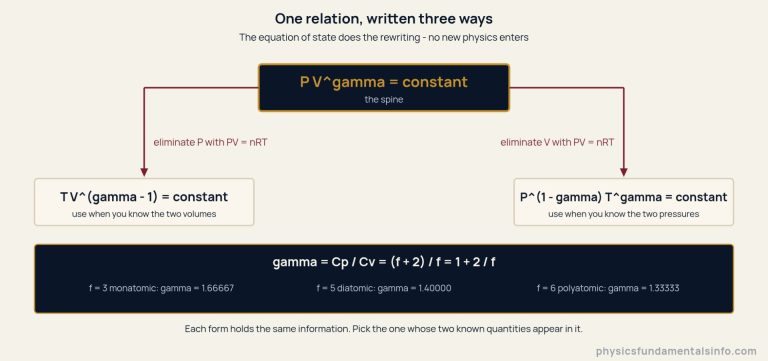
Two more forms of the relation get quoted constantly, and students memorise all three as though they were three separate facts. They are not. Take the ideal gas law, PV = nRT, use it to eliminate the pressure, and the spine becomes the first of these; use it to eliminate the volume instead and you get the second.
Put numbers on it. One mole of dry air at 100 kPa and 20.0 C — that is 293.15 K — occupies V1 = n R T1 / P1 = 24.3738472 L, with R the molar gas constant, 8.31446262 J/(mol K), a figure CODATA now lists as exact rather than measured. The adiabatic process calculator will rearrange the relation above for whichever of the four quantities you are missing.
Squeeze that air 8.00 to 1 with no heat flow and the pressure does not merely multiply by eight. It multiplies by 8.00^1.40 = 18.3792, taking 100 kPa to 1837.92 kPa. The temperature follows from the second form: 8.00^0.400 = 2.2973967, so 293.15 K becomes 673.482 K — a rise of 380.332 K, delivered by a piston rather than by a flame. The panel and the calculator both round that factor to 2.29740; the longer form is kept here, and wherever else it multiplies a temperature, because 293.15 K x 2.29740 lands on 673.483 K instead.
Where Gamma Comes From: Counting Degrees of Freedom
Gamma is not fitted to data. It is counted. Give a molecule f independent ways of holding thermal energy and equipartition hands you the ratio directly, as Wikipedia’s heat capacity ratio article states it.
- f = 3, monatomic (helium, argon, neon): three directions to move in, nothing else. gamma = 1.66667.
- f = 5, diatomic (nitrogen, oxygen, dry air): three directions plus two ways to tumble end over end. gamma = 1.40000.
- f = 6, non-linear polyatomic (water vapour, methane, ammonia): three directions plus three ways to tumble. gamma = 1.33333.
Why does a bigger f mean a smaller gamma, and why should you care? Because pressure and temperature only notice one of those energy stores — the straight-line motion that lets a molecule hit a wall. Work done on a floppy molecule gets shared out among its rotations too, so less of it ends up in the motion the thermometer and the gauge can see.
A squeezed polyatomic gas therefore heats less, and pushes back less hard, than a monatomic one squeezed exactly the same amount. Counting is all it takes to know which is which.
| Gas model | f | Model gamma | Measured, near 20 C | Largest gap |
|---|---|---|---|---|
| Monatomic | 3 | 1.66667 | helium 1.66, argon 1.670, krypton 1.680 (19 C), neon 1.640 (19 C) | 0.027, at neon |
| Diatomic | 5 | 1.40000 | dry air 1.400, oxygen 1.400, carbon monoxide 1.400, nitric oxide 1.400 | 0.000: exact to three decimals |
| Non-linear polyatomic | 6 | 1.33333 | water vapour 1.330, methane 1.320 | 0.013, at methane |
| Linear polyatomic (carbon dioxide) | 5, by the same rigid count that gives nitrogen 5 | 1.40000 | carbon dioxide 1.300 | 0.100: the model’s worst miss |
Read that table the right way round. The diatomic row is the triumph — four different gases, three decimal places, no adjustable parameter — and the last row is the warning that comes with it.
Carbon dioxide is a linear molecule, so the same rigid count that hands nitrogen f = 5 hands it f = 5 as well, and predicts 1.400. It measures 1.300. Force f = 6 on it instead and you land on 1.33333, still 0.033 too high — exactly 1/30 — because its bending modes are already soaking up energy at room temperature and no count of rotations knows they are there.
Two footnotes worth having. The monatomic model gives 1.66667, which rounds to the 1.67 our speed of sound page quotes for helium, while the measured figure at 20 C is 1.66 — one gamma, seen at three levels of precision, and none of the three is wrong. And gamma belongs to the molecule, not to the squeeze: pushing harder will not shift the exponent.
How Much Steeper Is an Adiabat Than an Isotherm?
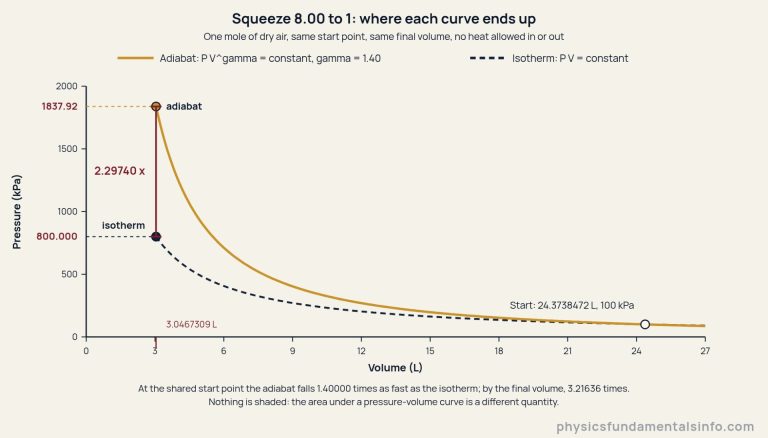
At every point the two curves pass through together, the adiabat’s slope is exactly gamma times the isotherm’s — for air, 1.40000 times as steep. Differentiating both relations shows it in one line.
No approximation hides in that result, though it does carry a condition. Dividing one gradient by the other cancels the volume outright, and cancels the pressure only where the two pressures agree — which, for a single pair of curves, is the one state they both occupy. Squeeze past that state and the adiabat is already the higher curve, so its gradient wins by more: at the finish of the 8.00 to 1 squeeze drawn below, by 1.40000 × 2.29740 = 3.21636. Let the gas expand instead and the ordering reverses — at twice the starting volume the adiabat lies below the isotherm and its gradient leads by only 1.40000 × 0.757858 = 1.06100.
The claim can be rescued in full, though only by trading gradients for percentages. Trim the volume by a sliver thin enough that its square does not matter, and the adiabatic pressure gains gamma times the percentage the isothermal one gains — 1.40000 times for air, at the start of the squeeze, at its finish, or anywhere between. Trim by a finite one per cent instead and the ratio drifts a shade above gamma, because the sliver argument holds only in the limit. That proportional reading is the cleanest thing anyone can say about what gamma means on a pressure-volume plot.
Our page on the isothermal process already says an adiabat falls more steeply through a shared point, and our Carnot efficiency page notes that the cycle’s two adiabatic legs are the steeper pair. Both statements are correct. Neither puts a number on the comparison, and the number is just gamma.
Follow it through to the end of the squeeze and the gap becomes dramatic. A slow 8.00 to 1 compression — one that lets the gas shed its heat and stay at 293.15 K — obeys Boyle’s law and reaches 800.000 kPa. The adiabatic version reaches 1837.92 kPa: 1037.92 kPa higher, a factor of 1837.92 / 800.000 = 2.29740.
That factor has a tidy form of its own. It is r^(gamma – 1), the compression ratio raised to gamma minus one, which here is 8.00^0.400 = 2.29740 — the very same number that multiplies the temperature. Push gamma down towards 1 and the advantage shrinks continuously towards nothing; at gamma = 1 exactly the adiabat is the isotherm and the temperature never moves at all. No real gas gets there, since that would need a molecule with infinitely many ways to store energy, but the lab’s gamma slider goes down to 1.10 so you can watch the two curves close up on each other.
Why a Diesel Engine Needs No Spark Plug
A diesel engine needs no spark plug because the compression stroke supplies the ignition temperature itself. Our first law page states that outright and leaves the number out, so here is the number. Squeeze air 18.0 to 1, quickly enough that nothing reaches the cylinder wall in time, starting from 100 kPa and 293.15 K.
Then 18.0^0.400 = 3.1776715, so the air arrives at 293.15 K × 3.1776715 = 931.534 K, which is 658.384 C. Fuel sprayed into air that hot lights on contact. The pressure meanwhile reaches 100 kPa × 57.198087 = 5719.81 kPa, or 5.71981 MPa, where a constant-temperature squeeze would have managed only 1.80 MPa.
Nothing was heated. The temperature came out of the work, and the gas model decided how much of it there would be.
Change the gas and the same squeeze lands somewhere else
Here is the ladder that makes gamma concrete. Three gas models, the same 8.00 to 1 compression, the same 100 kPa and 293.15 K start. Two of the three land on numbers you can check in your head.
| Gas model | gamma | Final pressure | Final temperature | Why it lands there |
|---|---|---|---|---|
| Monatomic (helium, argon) | 5/3 = 1.66667 | exactly 3.20 MPa | 1172.60 K | 8.00^(5/3) = 32 and 8.00^(2/3) = 4, both exact, so the temperature exactly quadruples |
| Diatomic (dry air, nitrogen) | 7/5 = 1.40000 | 1.83792 MPa | 673.482 K | 8.00^1.40 = 18.3792, which has no exact form: do not round it to look as though it does |
| Non-linear polyatomic (methane, water vapour) | 4/3 = 1.33333 | exactly 1.60 MPa | 586.300 K | 8.00^(4/3) = 16 and 8.00^(1/3) = 2, both exact, so the temperature exactly doubles |
Two of those three pressures are exact and one is not, and that distinction matters more than it looks. Printing 1.83792 MPa to the same false confidence as 3.20 MPa would quietly claim an exactness the number does not have.
Run the same arithmetic backwards
Expansion is the mirror image, and it is the case readers most often get wrong. Let a gas expand with no heat coming in and it must pay for the work out of its own internal energy, so it cools. Crack the valve on a cylinder of compressed gas and what rushes out is cold; nothing refrigerated it.
The same mechanism runs at the scale of weather. Air driven up a mountainside meets lower pressure, expands, and cools as it climbs — which is why cloud so often forms along a ridge line rather than over the valley floor.
Where the Adiabatic Model Breaks Down
Three things fail before the arithmetic does, and all three are worth knowing before you trust a number to three decimal places.
Gamma is not a constant of the gas. It drifts with temperature, because more of a molecule’s energy stores wake up as things get hotter. For dry air the published figures run like this.
| Temperature (C) | -15 | 0 | 20 | 200 | 400 | 1000 |
|---|---|---|---|---|---|---|
| gamma for dry air | 1.404 | 1.403 | 1.400 | 1.398 | 1.393 | 1.365 |
End to end that is a fall of 0.039, and most of it happens above 400 C. Carrying 1.400 into a combustion calculation at 1000 C is wrong by 0.035, which is a far bigger error than anything in the counting model itself.
The counting model is weakest for floppy molecules. Carbon dioxide is the clearest failure in the table above: linear, so the rigid count gives f = 5 and 1.400, against a measured 1.300. Even the kinder f = 6 reading leaves it 0.033 too high. Vibration is what the count misses, and the bigger the molecule the more of it there is.
And “adiabatic” is an idealisation about speed, not a material property. A real squeeze is never perfectly adiabatic and never perfectly isothermal; it sits between the two, closer to whichever end the timescale favours. Our isothermal process page argues that case already, so take the two curves on Figure 2 as the honest bracket around what really happens rather than as a prediction either side will hit. Close to the pressure at which a gas liquefies, the ideal-gas relation stops applying at all, and any figure there should be checked against real-gas data before use.
Common Misconceptions About Adiabatic Processes
“Adiabatic means the temperature stays constant”
That is the isotherm, and it is the opposite error. An adiabatic process holds the heat flow at zero, which is precisely what lets the temperature move: with nowhere to dump the energy, the gas has to absorb it. The constant-temperature case is the one where heat does flow, continuously, to keep the thermometer still.
“A gas only heats up if you heat it”
Work heats a gas just as effectively as a flame. The diesel above goes from 293.15 K to 931.534 K with nothing hot anywhere near it — the piston does the whole job. Internal energy does not care how it arrived.
“Gamma belongs to the gas, so it is fixed”
Gamma belongs to the gas at a temperature. The drift table above is the proof: dry air moves from 1.404 to 1.365 across the range quoted. Treating 1.4 as a universal constant is fine at room temperature and poor inside an engine.
“Adiabatic and reversible mean the same thing”
They are independent conditions. Adiabatic says no heat crosses the boundary; reversible says nothing was wasted to friction or turbulence on the way. P V^gamma = constant needs both, which is why a violent, lossy compression can be perfectly adiabatic and still miss the curve.