Gay-Lussac’s law states that the pressure of a fixed quantity of gas in a rigid sealed container rises in direct proportion to its absolute temperature, so P1/T1 = P2/T2 with every temperature in kelvin. Heating the gas gives it no room to expand into, so the whole effect appears as pressure.
Every aerosol can carries a line telling you not to leave it in the sun. It is not decoration. The can is a sealed steel box that cannot grow, so warming the propellant inside has only one outlet: the pressure pushing outwards on the walls.
The same physics shows up in a duller place — the tyre pressure gauge on the forecourt. Check your tyres after half an hour on the motorway and every one of them reads high, not because air has been added, but because the air inside is hotter than it was on the driveway. One short equation covers both cases.
What Is Gay-Lussac’s Law?
Gay-Lussac’s law is the rule that the pressure of a fixed amount of gas held at constant volume is directly proportional to its absolute temperature. Heat the gas by a certain fraction on the kelvin scale and the pressure rises by exactly that fraction.
Three conditions have to hold, and each one earns its place. The container must keep the same volume, so there is nowhere for the expansion to go. The amount of gas must stay the same, which rules out leaks. And the temperature must be measured on an absolute scale, in kelvin.
Put like that, the law is a statement about a ratio. Divide the pressure by the absolute temperature at any moment and you get the same number every time, however hot or cold the gas becomes. That number is fixed by how much gas you sealed in and how big the container is.
You will meet the same law under two other names. Some textbooks call it the pressure-temperature law, which says what it does; others call it Amontons’s law, which is closer to who found it. All three names describe one behaviour: a sealed, rigid container of gas whose pressure tracks its absolute temperature.
The Gay-Lussac’s Law Formula
Written for two states of the same sealed gas — before and after a temperature change — the law takes this form:
| Symbol | Quantity | SI unit | Notes |
|---|---|---|---|
| P1 | absolute pressure in the starting state | Pa | measured from a vacuum, not from the surrounding air; kPa, bar, atm and psi all work provided both pressures use the same unit |
| T1 | absolute temperature in the starting state | K | kelvin only; T/K = temperature in °C + 273.15 |
| P2 | absolute pressure in the final state | Pa | the quantity you usually want |
| T2 | absolute temperature in the final state | K | kelvin only, again |
| V, n | volume and amount of gas | m3, mol | do not appear in the formula because both are held fixed |
Rearranged for the pressure you are usually chasing, it reads:
So the working is short: convert both temperatures to kelvin, form the ratio T2/T1, and multiply the starting pressure by it. If you would rather have the arithmetic and the unit conversions done for you — including solving backwards for a temperature — the Gay-Lussac’s law calculator takes pressures in Pa, kPa, atm, bar or psi and temperatures in K, °C or °F.
One habit will save you marks. Keep the temperature ratio in full during the calculation and round only the final answer, because rounding the ratio first can shift the result by a whole digit. Problem 1 below shows exactly where that goes wrong.
The lab underneath lets you build the experiment instead of imagining it. You choose the pressure and the temperature at which the vessel was sealed, then move the current temperature and watch what happens.
Two things are worth staring at. The vessel outline never changes size at any setting, because the volume is fixed by the walls, and the pressure-temperature graph beside it stays a single straight line that runs back to zero pressure at -273.15 °C, whichever starting state you choose.
Why the Temperature Must Be in Kelvin
Temperatures must be in kelvin because the law is a statement about ratios, and a ratio is only meaningful on a scale whose zero is the real zero. The Celsius zero is the melting point of ice — a useful landmark, but an arbitrary one as far as a gas is concerned.
Watch what the choice does to a number. Take gas sealed at 100.0 kPa at 27 °C and heat it to 327 °C. In kelvin the temperatures are 300.15 K and 600.15 K, the ratio is 1.9995002, and the pressure ends at 199.950 kPa. Work in Celsius and you would compute 327/27 = 12.111111, predicting 1211.11 kPa — too high by a factor of 6.057.
The kelvin scale exists precisely because gases behave this way. Measure the pressure of a sealed sample at several temperatures, plot the points and extend the straight line backwards, and it always reaches zero pressure at the same place: -273.15 °C. As NIST’s introduction to the kelvin puts it, the scale is absolute in the sense that it starts at absolute zero, and 0 K is exactly -273.15 °C.
Modern metrology no longer puts a gas in the definition, though gas thermometry is still one of the ways the kelvin is realised in the laboratory. The BIPM’s definition of the kelvin fixes the Boltzmann constant at 1.380 649 × 10-23 J/K, which pins the size of one kelvin to an energy. The gas experiments came first, though, and they are still the clearest way to see where the zero comes from.
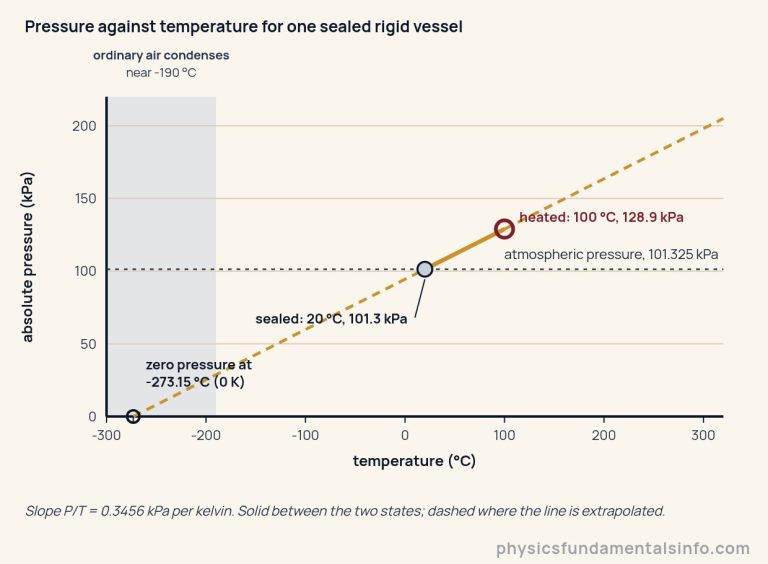
The table reads that same line off at nine temperatures. Every row belongs to one sealed vessel, and the last column is the giveaway: divide the pressure by the absolute temperature and you get 0.3456 kPa per kelvin every time.
| Temperature (°C) | Absolute temperature (K) | Pressure (kPa) | P/T (kPa per K) |
|---|---|---|---|
| -200 | 73.15 | 25.28 | 0.3456 |
| -78 | 195.15 | 67.44 | 0.3456 |
| -30 | 243.15 | 84.02 | 0.3456 |
| 0 | 273.15 | 94.39 | 0.3456 |
| 20 (sealed here) | 293.15 | 101.3 | 0.3456 |
| 50 | 323.15 | 111.7 | 0.3456 |
| 100 | 373.15 | 128.9 | 0.3456 |
| 200 | 473.15 | 163.5 | 0.3456 |
| 300 | 573.15 | 198.1 | 0.3456 |
The coldest row carries a warning. Ordinary air condenses near -190 °C at atmospheric pressure, and once the gas has turned to liquid the law has nothing left to describe, so the -200 °C row says where the straight line goes, not where a flask of air would follow it.
What Happens Inside the Gas When You Heat It
Pressure is the drumming of molecules on the walls, and temperature sets how hard they drum. Raise the absolute temperature and each molecule carries more momentum and arrives at the wall more often — two effects, both growing with the molecular speed.
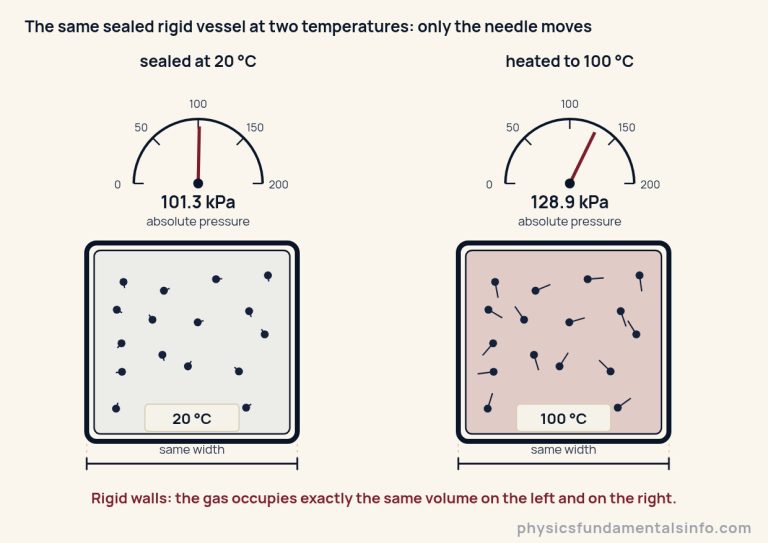
Here is where the square root earns its keep. Mean molecular speed grows as the square root of the absolute temperature, so warming a gas from 20 °C to 100 °C multiplies the speed by sqrt(373.15/293.15) = 1.1282277. The molecules therefore hit about 1.128 times as often and about 1.128 times as hard.
Multiply those two factors together and the square root undoes itself: 1.1282277 × 1.1282277 = 1.2728977, which is the temperature ratio 373.15/293.15 = 1.2728978 back again, to within the rounding of the square root. Pressure ends up proportional to the absolute temperature, not to its square root, and not to anything on the Celsius scale.
This is also the cleanest way to see why the law needs an absolute scale. Temperature in kelvin is a direct measure of the average kinetic energy of the molecules, which is why it is not the same quantity as heat: heat is energy in transit, temperature is the vigour of the jostling already there.
Gauge Pressure or Absolute Pressure?
Gay-Lussac’s law needs absolute pressure, measured from a vacuum, not the gauge reading you get from a tyre gauge or a workshop manometer. Those instruments read the amount by which the pressure inside beats the air outside, which is why a flat tyre reads zero rather than 101 kPa.
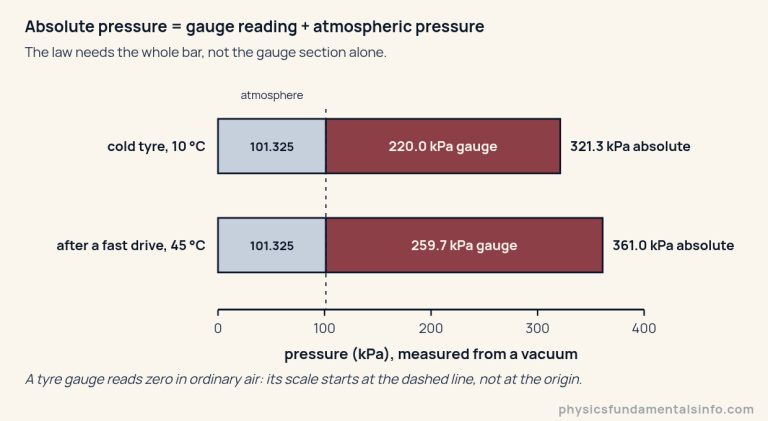
The round trip has three steps. Add the atmosphere to the gauge reading, apply the law to the absolute pressures, then subtract the atmosphere from the answer. Skip the first step and the law is fed a number that is about 101 kPa too small, and every proportional change you compute comes out too small with it.
For the tyre in Problem 2 the honest answer is a gauge reading of 259.7 kPa; feeding the gauge figure straight into the law gives 247.194 kPa, which is 12.525 kPa short. A common student slip is to notice that the units match and conclude that the numbers must be interchangeable.
One practical caveat: 101.325 kPa is the standard atmosphere, an agreed reference value. The actual air pressure where you are standing departs from it with the weather, and departs much further with altitude, so treat the conversion as a working approximation rather than as an exact accounting. If the difference matters for your answer, measure the local pressure instead of assuming it.
Gay-Lussac’s Law, Boyle’s Law and Charles’s Law
The three simple gas laws are one experiment run three ways: hold one of the three state variables fixed and watch how the other two trade against each other. Gay-Lussac’s law is the member of that family whose walls cannot move.
| Law | Held constant | What it links | Relation |
|---|---|---|---|
| Boyle’s law | temperature, amount | pressure and volume | P1V1 = P2V2 |
| Charles’s law | pressure, amount | volume and temperature | V1/T1 = V2/T2 |
| Gay-Lussac’s law | volume, amount | pressure and temperature | P1/T1 = P2/T2 |
| Combined gas law | amount only | all three at once | P1V1/T1 = P2V2/T2 |
| Ideal gas law | nothing | pressure, volume, amount, temperature | PV = nRT |
Reading down the table, the family resemblance is obvious. A syringe with its nozzle blocked, squeezed at room temperature, is Boyle’s law at work; a balloon shrinking in a freezer, free to change size at constant air pressure, is Charles’s law; a sealed steel cylinder in the same freezer is this one.
All three are special cases of the same statement. Fix any one variable in PV = nRT and the corresponding simple law drops out, which is why the ideal gas law is worth learning once you are comfortable with the three simple ones.
The practical question is which member of the family your container belongs to. If the walls cannot move, use Gay-Lussac’s law; if the container is free to change size while the outside pressure holds steady, you are in Charles’s territory instead.
Everyday Examples of Gay-Lussac’s Law
Sealed rigid containers are everywhere once you start looking, and the law explains something you can check in all of them.
- An aerosol can in a hot car. A can at 300.0 kPa absolute on a 20 °C morning reaches 340.9 kPa if the cabin gets to 60 °C — a rise of nearly 41 kPa with nobody touching it. That is why the labels warn against heat and against throwing empties on a fire.
- Tyres, checked cold. Manufacturers quote cold pressures because a warm tyre reads high. The same tyre at 220.0 kPa gauge on a 10 °C morning reads about 203 kPa gauge after a night at -5 °C, which is how a tyre can look soft in winter without having lost any air.
- Constant-volume gas thermometers. Turn the law around and the pressure becomes the thermometer. A rigid bulb of gas of known pressure at the ice point measures temperature directly from the pressure it reaches, which is the instrument that mapped out the absolute scale in the first place.
- Gas cylinders left outside. A cylinder filled to 250.0 kPa absolute in a 25 °C workshop falls to about 203.9 kPa at -30 °C. Nothing has escaped; the gauge simply shows the lower absolute temperature.
- Sealed electronics and dry packaging. A sealed sensor housing or a dry sealed package pushes harder on its seams as it warms, and that load grows in proportion to the absolute temperature of the gas inside it. Put liquid in the container and this law no longer governs the total: the liquid’s own vapour adds a pressure that climbs far faster than the temperature does.
A word on those warnings. Aerosol labels commonly tell you not to expose the can to temperatures above 50 °C, and that is a manufacturer’s instruction rather than a number this law produces. The law tells you how the pressure grows; what a given can can withstand is a question for its maker.
Common Mistakes and Where Gay-Lussac’s Law Breaks Down
Most lost marks come from four habits, and the first two are just bookkeeping.
- Using Celsius in the ratio. The commonest error of all, and the most expensive: in Problem 5 it inflates the predicted pressure more than sixfold.
- Feeding a gauge reading into the law. Add the atmosphere first, then take it off the answer.
- Rounding the temperature ratio early. Carry it in full to the end; Problem 1 shows how a fourth-figure rounding moves the printed answer.
- Assuming any closed container is rigid. A glass flask or a steel cylinder is close to rigid. A car tyre is not.
That last one deserves a sentence of its own, because it is physics rather than arithmetic. A tyre’s sidewalls flex, so a warm tyre grows very slightly, and the extra volume takes the edge off the pressure rise — the real increase is a little smaller than the law predicts, though it is close enough for everyday checks.
The law is an ideal-gas result, and real gases drift away from it. At ordinary pressures the agreement is excellent; near liquefaction, and at pressures of many atmospheres, the departure becomes measurable, and a sealed cylinder at hundreds of bar is not a place to trust a one-line proportion.
Cooling has a harder limit. The straight line can be extended all the way to -273.15 °C on paper, but ordinary air has condensed near -190 °C long before it gets there — nitrogen boils at about -196 °C and oxygen at about -183 °C — and a liquid obeys no gas law. The extrapolation is how the absolute scale was inferred; it is not a prediction about a real flask.
Two more quiet assumptions are worth naming. The amount of gas must be constant, so a slow leak or gas dissolving into a liquid inside the container breaks the law before any physics does. And the container itself changes size a little when heated, since thermal expansion applies to steel and glass as much as to the gas inside.
Who Actually Discovered Gay-Lussac’s Law?
The name is a historical accident, and the honest answer is that Guillaume Amontons got there first, around 1700, when he found that the pressure of a fixed volume of air tracks its temperature. That is why many textbooks, chemistry ones especially, call the pressure-temperature relation Amontons’s law.
Gay-Lussac’s own paper of 1802 was about something adjacent: how gases expand when heated at constant pressure. In it he credited unpublished work by Jacques Charles, which is why that relation now usually carries Charles’s name — and why NASA’s Beginner’s Guide to Aeronautics still files the volume-temperature result under Charles and Gay-Lussac’s Law. The labels have been shuffled more than once.
There is a second Gay-Lussac’s law to keep clear of this one. In chemistry, the law of combining volumes says that gases react in simple whole-number ratios by volume, which is a statement about reactions, not about heating a sealed can. If you arrived here looking for that law, it is a different result with the same surname attached.