An adiabatic process lets no heat cross the boundary, so the gas has to pay for every joule of work out of its own internal energy and its pressure climbs the steeper curve P V^gamma = constant rather than Boyle’s. This free adiabatic process calculator solves P1 V1^gamma = P2 V2^gamma for either pressure or either volume, from a heat capacity ratio you supply in every mode. Beside the answer it prints the compression ratio, the temperature a 20 C start would reach, the work, and the pressure the same squeeze would have reached at constant temperature — which is the comparison the rest of this site makes only in words.
Load a real compression
Every button writes all five boxes in their default units, so whichever quantity the Solve for menu is pointing at, the remaining four already agree with it to nine significant figures. The line underneath quotes back whatever the widget works out from that, so nothing in it is stored text.
Pick a compression above, or type your own numbers.
What Is the Adiabatic Process Calculator?
The adiabatic process calculator is a free online tool for the one gas relation that has no temperature and no amount of substance in it: P1 V1^gamma = P2 V2^gamma, where gamma is the ratio of the two heat capacities of the gas. Give it any three of the starting pressure, the starting volume, the final pressure and the final volume, add the heat capacity ratio, and it returns the fourth. That ratio is an input in every mode and never one of the unknowns, because it is a property of the molecule rather than of the squeeze.
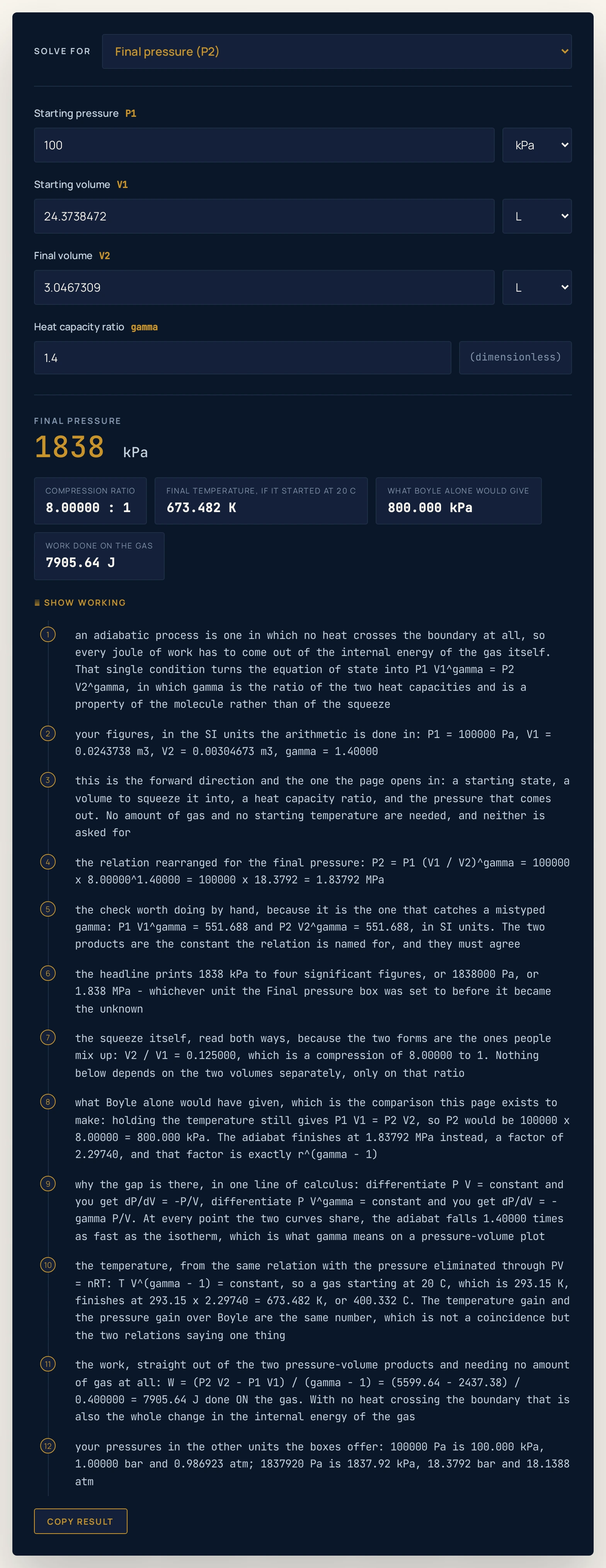
Beside the answer sit four chips, and the third is the reason the page exists. It gives the pressure the same squeeze would have reached had the temperature been held still, so the gap between it and the headline is the whole difference an adiabatic process makes: at the defaults, 800.000 kPa against 1838 kPa. The other three give the compression ratio, the temperature a 20 C start would reach, and the work, which needs no amount of gas because the two pressure-volume products already carry it. The work chip prints a magnitude and names its direction, so it is never a bare negative number under an ambiguous label.
Where the exponent comes from is worth knowing before you type one. A molecule with f ways of storing energy has gamma = 1 + 2/f, so a monatomic gas takes 1.66667, a diatomic gas such as dry air takes 1.40000 and a non-linear polyatomic gas takes 1.33333. Hold the volumes still and change only that number and the final pressure moves from 1600 kPa to 3200 kPa, while the constant-temperature figure does not move at all — an isotherm does not know what the molecule is. Gamma also drifts with temperature: dry air measures 1.404 at −15 C and 1.365 at 1000 C, so it is not a constant of the gas either.
What the page does not do, it says. There is no amount-of-gas box and no starting-temperature box, because the relation contains neither; the temperature appears only as a chip inverted out of the volume ratio you typed, and nothing here converts between kelvin and Celsius. It computes no work from nRT and a logarithm, no entropy, no efficiency, no coefficient of performance, no heat capacity in joules per mole per kelvin and no speed of sound, and it handles one leg of a process rather than a closed cycle. Every unit entry is a multiplier to the SI base: one standard atmosphere is 101325 Pa exactly, and a millilitre and a cubic centimetre are the same unit.
| Symbol | Quantity | Default unit | Also accepts | Example value |
|---|---|---|---|---|
| P1 | Starting pressure | kPa | Pa, bar, atm (x 101325), MPa | 100 |
| V1 | Starting volume | L | m3, mL, cm3 (mL and cm3 are the same) | 24.3738472 |
| P2 | Final pressure | kPa | Pa, bar, atm (x 101325), MPa | 1837.91737 |
| V2 | Final volume | L | m3, mL, cm3 (mL and cm3 are the same) | 3.0467309 |
| gamma | Heat capacity ratio | dimensionless | no unit menu: a plain number above 1 | 1.4 |
How to use the adiabatic process calculator
- Choose the unknown. The Solve for menu opens on Final pressure, and the other three choices are Starting pressure, Starting volume and Final volume. Whichever you pick vanishes from the boxes below and the rest become your inputs.
- Type the heat capacity ratio. The gamma box is an input in every mode and is never one of the four unknowns, so it stays on screen whichever quantity the menu is pointing at. It opens on 1.4, which is dry air; helium and argon take 1.66666667 and methane takes 1.33333333.
- Type the starting pressure. It takes Pa, kPa, bar, atm or MPa and opens on 100 kPa. One standard atmosphere, 101325 Pa, is offered as a unit rather than as the reference pressure.
- Type the two volumes. Both take L, m3, mL or cm3, and a millilitre and a cubic centimetre are the same unit. Only the ratio between them matters, so a pair of swept volumes works as well as a pair of absolute ones.
- Read the answer. The headline always carries four significant figures: a plain decimal with trailing zeros dropped while the figure is at least 0.0001 and below 10 million, and the same four figures in exponential notation outside that range. It appears in the unit that box was showing, so set the unit while the quantity is still an input and then point Solve for back at it.
- Read the compression ratio chip. A volume ratio of 0.125 and a compression of 8 to 1 are one fact said two ways, and the second is the form engines are quoted in. On an expansion the chip says so in words instead of printing a ratio below one without comment.
- Read the Boyle chip. The third chip carries the constant-temperature pressure for the very same volume change, so the climb from it up to the headline is what the no-heat condition bought. At the defaults it reads 800.000 kPa against a headline of 1837.92 kPa, a factor of 2.29740.
- Read the temperature chip as an output. It is the temperature a gas starting at 20 C would reach, derived from the volume ratio you typed, which is why there is no temperature box on this page at all. Nothing here converts between kelvin and Celsius.
- Read the work chip and its label. The work needs no amount of gas, because the two pressure-volume products already carry it, and the label flips between on the gas and by the gas so the figure is never a bare negative number under an ambiguous heading.
- Open Show working. The steps restate the relation, list your figures in SI units, rearrange it for the quantity you asked for, check that the two pressure-volume products still agree, and then give the Boyle comparison, the slope result, the temperature and the work in full.
This page exists because of a gap rather than a formula. Two of our own guides already say the adiabat is steeper than the isotherm without ever saying by how much, and the answer is gamma: the adiabatic process guide is the prose half of that argument, with the derivation and seven worked problems. The condition this page starts from, that no heat crosses the boundary so the change in internal energy is minus the work, is set out in the first law of thermodynamics guide, which is the law this relation is a special case of.
Three mistakes account for most wrong answers here. The first is raising the pressure ratio to gamma when solving for a volume, where the exponent is one over gamma; the second is typing a compression ratio of 8 into a Final volume box that wants a volume. The third is reaching for the Boyle’s law calculator for a fast squeeze, which is the slow-squeeze answer and is why the Boyle chip is printed here beside the real one.
Worked example: change one thing at a time
The table starts at the defaults, moves the unknown through all four quantities, then changes only the gas, only the squeeze and only the direction, walks both unit menus, and finally reaches the entries the calculator declines. Rows 1 to 4 are one state solved four ways. Every Headline answer and both chip cells were read out of the running widget rather than worked out by hand, so where a cell and the tool ever part company, believe the tool.
| Step | Solving for | What you type | Headline answer | Compression ratio | Final temperature |
|---|---|---|---|---|---|
| The page as it opens | Final pressure | 24.3738472 L squeezed into 3.0467309 L, gamma 1.4 | 1838 kPa | 8.00000 : 1 | 673.482 K |
| The same state, solved for its starting pressure | Starting pressure | 1837.91737 kPa after the same squeeze | 100 kPa | 8.00000 : 1 | 673.482 K |
| The same state, solved for its final volume | Final volume | 100 kPa to 1837.91737 kPa, gamma 1.4 | 3.047 L | 8.00000 : 1 | 673.482 K |
| The same state, solved for its starting volume | Starting volume | 3.0467309 L at 1837.91737 kPa | 24.37 L | 8.00000 : 1 | 673.482 K |
| Monatomic gas, the same 8 to 1 squeeze | Final pressure | gamma 1.66666667 instead of 1.4 | 3200 kPa | 8.00000 : 1 | 1172.60 K |
| Polyatomic gas, the same 8 to 1 squeeze | Final pressure | gamma 1.33333333 instead of 1.4 | 1600 kPa | 8.00000 : 1 | 586.300 K |
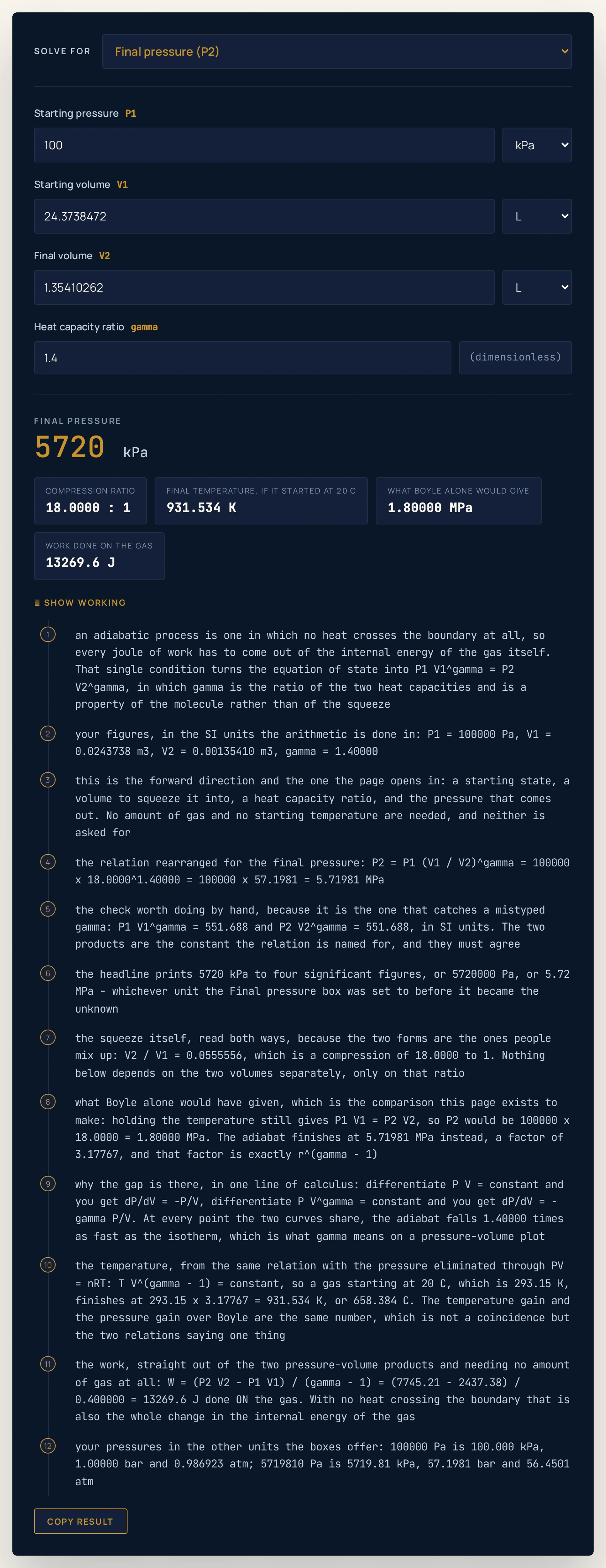
| Diesel compression, 18 to 1 | Final pressure | 24.3738472 L squeezed into 1.35410262 L | 5720 kPa | 18.0000 : 1 | 931.534 K |
| Let it expand to twice the volume | Final pressure | 48.7476943 L instead of 3.0467309 L | 37.89 kPa | 0.500000 : 1 - an expansion | 222.166 K |
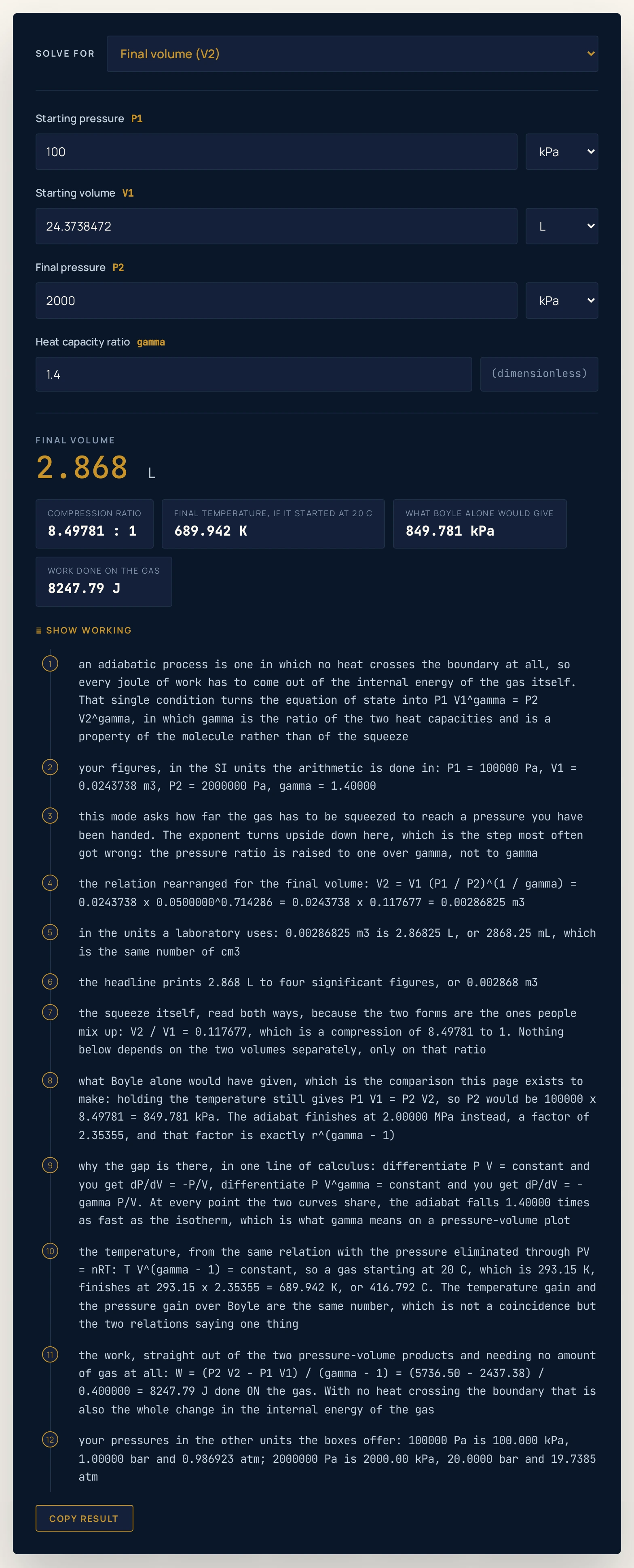
| Raise the pressure to 2.00 MPa | Final volume | 2000 kPa as the target pressure | 2.868 L | 8.49781 : 1 | 689.942 K |
| Nearly an isotherm, gamma 1.10 | Final pressure | gamma 1.10 instead of 1.4 | 984.9 kPa | 8.00000 : 1 | 360.910 K |
| The same squeeze, read in megapascals | Final pressure | the Final pressure box set to MPa | 1.838 MPa | 8.00000 : 1 | 673.482 K |
| The same squeeze, read in bar | Final pressure | the Final pressure box set to bar | 18.38 bar | 8.00000 : 1 | 673.482 K |
| The same squeeze, read in atmospheres | Final pressure | the Final pressure box set to atm | 18.14 atm | 8.00000 : 1 | 673.482 K |
| The volumes typed in cubic metres | Final pressure | 0.0243738472 m3 and 0.0030467309 m3 | 1838 kPa | 8.00000 : 1 | 673.482 K |
| The volumes typed in millilitres | Final pressure | 24373.8472 mL and 3046.7309 mL | 1838 kPa | 8.00000 : 1 | 673.482 K |
| The volumes typed in cubic centimetres | Final pressure | the same figures with the boxes set to cm3 | 1838 kPa | 8.00000 : 1 | 673.482 K |
| The starting pressure typed in atmospheres | Final pressure | 0.986923267 atm instead of 100 kPa | 1838 kPa | 8.00000 : 1 | 673.482 K |
| No change in volume at all | Final pressure | 3.0467309 L replaced by 24.3738472 L | 100 kPa | 1.00000 : 1 | 293.150 K |
| A heat capacity ratio of 1 is declined | Final pressure | gamma 1 | no answer | — | — |
| A heat capacity ratio below 1 is declined | Final pressure | gamma 0.9 | no answer | — | — |
| A final volume of zero is declined | Final pressure | 0 L | no answer | — | — |
| A negative starting pressure is declined | Final pressure | -100 kPa | no answer | — | — |
| A final pressure of zero is declined | Final volume | 0 kPa | no answer | — | — |
Rows 1 to 4 are the same compression with the Solve for menu in each of its four positions, and both chip columns are identical down the four because the chips describe the state rather than the mode. The headline unit changes with the mode, which is the one thing about this engine worth remembering: it answers in the unit of the box that became the unknown.
Rows 5 and 6 change only the gas. The same 8.00000 : 1 squeeze takes a monatomic gas to 3200 kPa and a polyatomic one to 1600 kPa, while the Boyle chip reads 800.000 kPa for all three, because an isotherm does not know what the molecule is. The temperature column tells the same story at 1172.60, 673.482 and 586.300 K, which are exactly four, 2.29740 and exactly two times 293.15 K.
Rows 7 to 10 are the four states worth knowing. The diesel at 18.0000 : 1 arrives at 931.534 K, the expansion to twice the volume cools the gas to 222.166 K and flips the work chip, reaching 2.00 MPa needs a squeeze of 8.49781 : 1, and at a gamma of 1.10 the adiabat has nearly collapsed onto Boyle at 984.9 kPa against 800.000. Only the last of those four is a state no real gas has.
Rows 11 to 18 change nothing but the units and the direction. One answer reads 1838 kPa, 1.838 MPa, 18.38 bar and 18.14 atm, and the volumes typed in cubic metres, millilitres or cubic centimetres all return 1838 kPa, because a millilitre and a cubic centimetre are the same unit. Row 18 is the identity state: no volume change, so no pressure change, no heating and no work.
Rows 19 to 23 sit outside the domain and are declined there rather than answered. A heat capacity ratio of 1 or below would divide by zero in the work and is unphysical besides, a final volume of zero would make the pressure infinite rather than large, and a zero or negative pressure has no state behind it. In each case the widget says so in words instead of printing a number.
Formula and symbol reference
One relation does all the work. For a gas that exchanges no heat with anything, P V^gamma keeps the same value from one end of the process to the other, so P1 V1^gamma = P2 V2^gamma and each of the four quantities follows from the other three. The exponent is the ratio of the gas’s two heat capacities, Cp/Cv, spelled out as the word gamma on every line of this page for two practical reasons: the widget’s own readouts, chip labels and working are pure ASCII, and a lower-case Greek letter dropped into one of the table headings below would come back as a capital, because this site’s stylesheet uppercases them.
The other two forms on the band above are the same statement with a different variable removed. Eliminate the pressure using PV = nRT and it becomes T V^(gamma-1) = constant; eliminate the volume instead and it becomes P^(1-gamma) T^gamma = constant. They are three ways of writing one relation, not three facts to remember, which is why the temperature chip here needs no extra physics.
Gamma itself comes from counting. A molecule with f ways of storing energy has gamma = 1 + 2/f, so three gives 1.66667, five gives 1.40000 and six gives 1.33333. More ways to store energy means less of the work goes into the motion that pressure and temperature measure, which is why a polyatomic gas heats least under the same squeeze.
| Symbol | Meaning | SI unit | Values used on this page |
|---|---|---|---|
| P1 | Starting pressure, before the gas is squeezed or allowed to expand | pascal | Boxes take Pa, kPa, bar, atm or MPa: 100 kPa is the default, 101325 Pa one standard atmosphere. |
| V1 | Starting volume. Only its ratio to the final volume matters, so any consistent pair works | cubic metre; litres on this page | Boxes take L, m3, mL or cm3: 24.3738472 L is the default, which is 0.0243738472 m3. |
| P2 | Final pressure, and the quantity the page opens solving for | pascal | Boxes take Pa, kPa, bar, atm or MPa: 1837.91737 kPa is the default, which is 1.83792 MPa. |
| V2 | Final volume. The denominator of the compression ratio, which is why a zero is declined rather than answered | cubic metre; litres on this page | Boxes take L, m3, mL or cm3: 3.0467309 L is the default, which is 3046.7309 mL and the same number of cm3. |
| gamma | Heat capacity ratio, Cp/Cv. An input in every mode and never one of the four solve targets: it belongs to the gas, not to the process |
dimensionless | A plain number: 1.4 for air and any diatomic gas, 1.66666667 monatomic, 1.33333333 non-linear polyatomic such as methane. |
| f | The number of ways a molecule can store energy, which is where gamma comes from through gamma = 1 + 2/f |
dimensionless count | Not a box: f = 3 gives 1.66667, f = 5 gives 1.40000, f = 6 gives 1.33333. |
| r | Compression ratio, V1/V2. The only thing about the two volumes that the relation uses |
dimensionless | A chip: 8.00000 : 1 at the defaults, 18.0000 : 1 on the diesel preset. |
| W | Work, computed as (P2V2 − P1V1)/(gamma − 1) and printed as a magnitude with its direction in the label. That ordering is the convention in which work done on the gas comes out positive, so a page that writes the same quantity as (P1V1 − P2V2)/(gamma − 1), as the lab panel for this topic does, is giving the identical magnitude the other way up |
joule | A chip: 7905.64 J on the gas at the defaults, 1475.48 J by the gas on the expansion preset. |
The physics: how much steeper the adiabat is, and why
Differentiate the two curves and the answer falls out in one line. On an isotherm PV is constant, so dP/dV = -P/V; on an adiabat P V^gamma is constant, so dP/dV = -gamma P/V. At every point the two curves share, the adiabat falls exactly gamma times as fast, which is the whole of what gamma means on a pressure-volume plot.
That slope result is what the Boyle chip turns into a finishing pressure. Squeeze air 8 to 1 and Boyle gives 800.000 kPa while the adiabat gives 1837.92 kPa, a factor of 2.29740, and that factor is the compression ratio raised to gamma minus one. Our isothermal process guide already states that an adiabat is steeper than an isotherm through the same point; this page is where the sentence acquires a number, and the isothermal process lab is where the gentler curve can be watched on its own.
The temperature follows from the same relation with the pressure eliminated. Because T V^(gamma-1) is also constant, the temperature rises by the same factor the pressure beats Boyle by, so air squeezed 8 to 1 from 20 C arrives at 673.482 K. The arithmetic lands on round numbers for the other two gas models: at 8 to 1 a monatomic gas quadruples its temperature exactly and a polyatomic one exactly doubles it, because 8 to the two thirds is 4 and 8 to the one third is 2.
None of this needs to know how much gas there is. Both end states still satisfy the ideal gas law, and you can check that with the ideal gas law calculator if you want the amount or the temperature in absolute terms. The relation this page solves is free of both, which is why a swept volume and a peak pressure are enough to use it.
Where the adiabatic process calculator breaks down
The arithmetic here is exact to the last digit a double can hold. What fails is an idealisation meeting a real process, a ratio being treated as a constant of the gas, an exponent being used upside down, and a chip being read as a measurement.
- Adiabatic is an idealisation about rate, not a property of a container
- Nothing is perfectly insulated. The relation describes a squeeze fast enough that no appreciable heat escapes while it happens, and a real compression is neither adiabatic nor isothermal but somewhere between the two curves this page prints side by side. The isothermal process guide already sets out the slow limit, so the honest reading of the two figures is that the truth lies between them.
- And it assumes the process is reversible
- The relation holds for a reversible adiabatic process, which is also called isentropic. A sudden irreversible expansion into a vacuum is adiabatic too, and does not follow this curve at all, so a quoted pressure for one of those cannot be reproduced here. If the squeeze involves shock, turbulence or friction, treat the answer as a bound rather than a value.
- Gamma is not a constant of the gas
- Dry air measures 1.404 at -15 C, 1.400 at 20 C and 1.365 at 1000 C, so a 1.4 carried to the hot end of that table is off by 0.035, which is the second decimal place and not the third. The 0.039 across that range is larger than the gap between the diatomic model and its own measurement, which is zero to three decimals. For a process that spans hundreds of degrees, run the calculation at both ends and treat the spread as the uncertainty.
- The degrees-of-freedom model is worst for polyatomic gases
- It is excellent for the two noble gases the references below quote, helium at 1.66 and argon at 1.670 against a counted 1.66667, and exact to three decimals for dry air, oxygen, carbon monoxide and nitric oxide at 1.400. The genuinely non-linear gases drift a little low — water vapour 1.330 and methane 1.320 against 1.33333 — and carbon dioxide is the real failure, because it is linear and so counts out at the diatomic 1.40000 while measuring 1.300. Floppier molecules store energy in ways the simple count does not reach, so type a measured gamma rather than a counted one when you have it.
- The exponent goes upside down when you solve for a volume
- Pressure from volumes uses the ratio raised to gamma; volume from pressures uses it raised to one over gamma. Getting that the wrong way round at 8 to 1 and gamma 1.4 moves the answer by a factor of 7.36, which is large enough to notice but not always large enough to be obviously absurd. The working prints the exponent it actually used on every mode for exactly that reason.
- The temperature chip is derived, and the page has no thermometer
- It assumes a start of 20 C and applies the ratio you typed; it is not an independent check on anything, and a different starting temperature scales it in proportion. The page converts no temperature scales, computes no heat capacity in joules per mole per kelvin, and reports no entropy. The same ratio also fixes how fast sound travels through the gas, which is the speed of sound guide, not this one.
- Nothing here is a cycle
- This page handles one leg, from one state to another, and never a closed loop. Two adiabatic legs do appear joined to two isothermal ones in the Carnot efficiency guide, where the loop and its efficiency belong; no efficiency, no coefficient of performance and no heat-engine arithmetic is computed here. Running this calculator twice does not make a cycle.
- Real gases stop obeying it before they liquefy
- The relation inherits every assumption of the ideal gas model, so a squeeze that takes a gas close to its own condensation point will leave the curve. The two pressure-volume products the working prints are the thing to watch: they are equal by construction here, and in a real cylinder they are not. Verify anything you mean to rely on against your own data before you quote it.
- The calculator measures nothing — you supply the numbers
- Three quantities and a heat capacity ratio go in, one relation is rearranged, and the answer describes the state you described. The preset names are shorthand for the five figures behind them and are not claims about any particular engine or sample of gas. A gamma of exactly 1, a zero volume and a negative pressure are all refused rather than answered.
Where an adiabatic compression is actually used
- Working out what a compression stroke does to the air in it
- This is the mode the page opens in. A swept volume and a clearance volume give the ratio, a heat capacity ratio gives the gas, and the final pressure and the temperature chip come back together. The Diesel compression, 18 to 1 preset is that calculation at the ratio a compression-ignition engine actually uses.
- Sizing the squeeze needed to reach a pressure
- Point Solve for at the final volume and the question turns round: how far must this gas be compressed to reach the pressure I have been given. The Raise the pressure to 2.00 MPa preset is that question for air, and the exponent is one over gamma rather than gamma, which is the step worth checking twice.
- Deciding whether a process was fast or slow
- Measure the two volumes and the two pressures, type three of them, and compare the fourth against what you measured. A result that lands on the Boyle chip says the process had time to exchange heat; a result on the headline says it did not. The isothermal process calculator is the tool for the other end of that comparison once the work matters.
- Costing the work of a compressor without knowing the charge
- The work chip needs only the two pressure-volume products and gamma, so an amount of gas never has to be established. At the defaults the figure is 7905.64 J on the gas, and it is also the whole rise in internal energy, because no heat left. On an expansion the same chip flips to work done by the gas and the temperature falls instead.
- Explaining why a gas cools when it is let go
- Load the Let it expand to twice the volume preset and the temperature chip drops to 222.166 K from a 20 C start. Nothing took heat out: the gas did work on its surroundings and had only its own internal energy to pay with. That is the half of the subject readers most often get wrong, and it is one preset away.
- Comparing two gases under the same squeeze
- Hold both volumes and change only gamma. The Monatomic and Polyatomic presets do exactly that at 8 to 1, and the final pressure moves from 1600 kPa to 3200 kPa while the Boyle chip does not move at all. The isotherm does not know what the molecule is, and that contrast is the fastest way to see what gamma is actually doing.
Where to go next
For what an adiabatic process is, where gamma comes from, how much steeper the adiabat is and seven worked problems, read the adiabatic process guide, which this tool is the arithmetic half of. The Boyle’s law guide is what a slow squeeze does instead, and the gas laws guide sets out the pressure, volume and temperature relations this one sits beside.
Four tools are worth a bookmark next to this one. The isothermal process calculator costs the constant-temperature journey the Boyle chip points at; the Boyle’s law calculator finds where a slow squeeze ends up; the ideal gas law calculator ties either end state back to an amount and a temperature; and the first law of thermodynamics calculator balances the energy once the work is known. The first law simulator and the ideal gas law simulator are the neighbouring labs, and the full physics lab library and calculator index are open too.
Frequently asked questions
What does the adiabatic process calculator work out?
It solves P1 V1^gamma = P2 V2^gamma for any one of its four quantities: the starting pressure, the starting volume, the final pressure or the final volume. You supply the heat capacity ratio in every mode, because that is the one number in the relation that is a property of the gas. Beside the answer it prints the compression ratio, the temperature a 20 C start would reach, the pressure the same squeeze would have reached at constant temperature, and the work.
Why is there no amount of gas and no starting temperature on this calculator?
Because the relation contains neither, and that is exactly what makes it worth having. P1 V1^gamma = P2 V2^gamma needs only two pressures, two volumes and the heat capacity ratio, so a swept volume and a measured peak pressure are enough on their own. The temperature appears here only as a chip derived from the volume ratio you typed, and the amount of gas appears nowhere at all.
What value of gamma should I type?
For dry air and any other diatomic gas, 1.4. For a monatomic gas such as helium, neon or argon, 1.66666667, and for a non-linear polyatomic gas such as methane, water vapour or ammonia, 1.33333333. Those three come from gamma = 1 + 2/f, where f counts the ways a molecule can store energy, and the measured values sit within about 0.03 of them; carbon dioxide is the exception, because it is linear, so the count hands it the diatomic 1.40000 rather than 1.33333 while it measures 1.300.
Why does the calculator refuse a heat capacity ratio of 1?
Because gamma minus one is a denominator in the work, so a ratio of exactly 1 would divide by zero. It is also unphysical: a value of 1 needs a molecule with infinitely many ways to store energy, and at that value the adiabat would simply be the isotherm and the temperature would never move. The guard refuses anything at or below 1 and says so rather than printing an infinity.
What is the Boyle comparison chip for?
It is the pressure the same squeeze would have produced if the gas had been allowed to stay at one temperature, which is the curve an adiabat is steeper than. Printing the two side by side turns a qualitative statement into a number: at the defaults the adiabat finishes 2.29740 times higher. That factor is the compression ratio raised to gamma minus one, so it grows with both the squeeze and the gas.
Can I use this calculator for an expansion as well as a compression?
Yes. Type a final volume larger than the starting one and the pressure falls, the temperature chip drops below 293.15 K, the compression ratio chip says in words that it is an expansion, and the work chip flips its label to work done by the gas. A gas that expands with no heat coming in has to pay for the work out of its own internal energy, which is why it cools.
Why does the calculator refuse a volume of zero?
Because a final volume of zero makes the pressure infinite rather than large, and the relation has nothing to say about it. The page declines that input and says so instead of printing an infinity, and it does the same for a zero or negative pressure or volume wherever that quantity is an input. A guard returns nothing at all rather than a number that happens to look plausible.
References & formula source
- The definition, the three equivalent relations and gamma = Cp/Cv = (f+2)/f are taken from the Wikipedia article on the adiabatic process, retrieved 2026-10-14, which states that such a process occurs without transferring heat between the system and its environment, that a reversible one can be represented by P V^gamma = constant, and that the same statement can be rewritten as T V^(gamma-1) = constant and as P^(1-gamma) T^gamma = constant.
- The degrees-of-freedom relation gamma = 1 + 2/f, and the measured values quoted on this page, come from the Wikipedia article on the heat capacity ratio, retrieved 2026-10-14. It gives 1.400 for dry air, oxygen, carbon monoxide and nitric oxide at 20 C, 1.66 for helium and 1.670 for argon, and 1.330 for water vapour and 1.320 for methane, against model values of 1.40000, 1.66667 and 1.33333 respectively. Its figure for carbon dioxide is 1.300, and that one belongs beside 1.40000 rather than 1.33333: carbon dioxide is linear, so the rigid count that gives nitrogen f = 5 gives it f = 5 as well, which makes the 0.100 between them the largest gap in the table.
- The same source gives the temperature drift of dry air: 1.404 at -15 C, 1.403 at 0 C, 1.400 at 20 C, 1.398 at 200 C, 1.393 at 400 C and 1.365 at 1000 C. Gamma is therefore not a constant of a gas, and the 0.039 that separates the ends of that table is larger than the gap between the diatomic model and its own measurement.
- The default state is one mole of dry air at 100 kPa and 20 C. Its volume was worked out for this build rather than copied from a table: with the Boltzmann constant 1.380649e-23 J/K and the Avogadro constant 6.02214076e23 per mole, both exact by the 2019 definitions of the SI units, the molar gas constant is 8.31446261815324 J/(mol K) and n R T / P is 24.3738472 L. That arithmetic happened once, offline, purely to fix the number the box opens on; the running widget never touches the gas constant at all, because the relation it solves is free of it.
- Twenty degrees Celsius rather than 300 K, because that is the temperature at which the measured ratio 1.400 for dry air is quoted in the source above, and because our own gas pages already work there. One standard atmosphere is 101325 Pa by definition and is offered here as a unit on both pressure boxes, never as the reference pressure.
- Nothing on this page computes an entropy, an efficiency, a Carnot cycle, a heat capacity in joules per mole per kelvin, a speed of sound or a work from n R T and a logarithm, and no polytropic index other than gamma appears anywhere. Those belong to other pages, and this one links to them rather than repeating them. No real-gas or van der Waals correction is applied, so a figure near the point where a gas liquefies should be verified before use.
- Every figure quoted in the prose and tables above is either a string this calculator printed for the inputs named beside it, a constant stated on this page, or a ratio the cluster independent reference script asserts: tests/ref.js, written before this page existed and sharing no code with it, runs 440 checks with 0 failures. Where a cell and the running widget ever part company, believe the widget.
- Further reading: Adiabatic process — Wikipedia