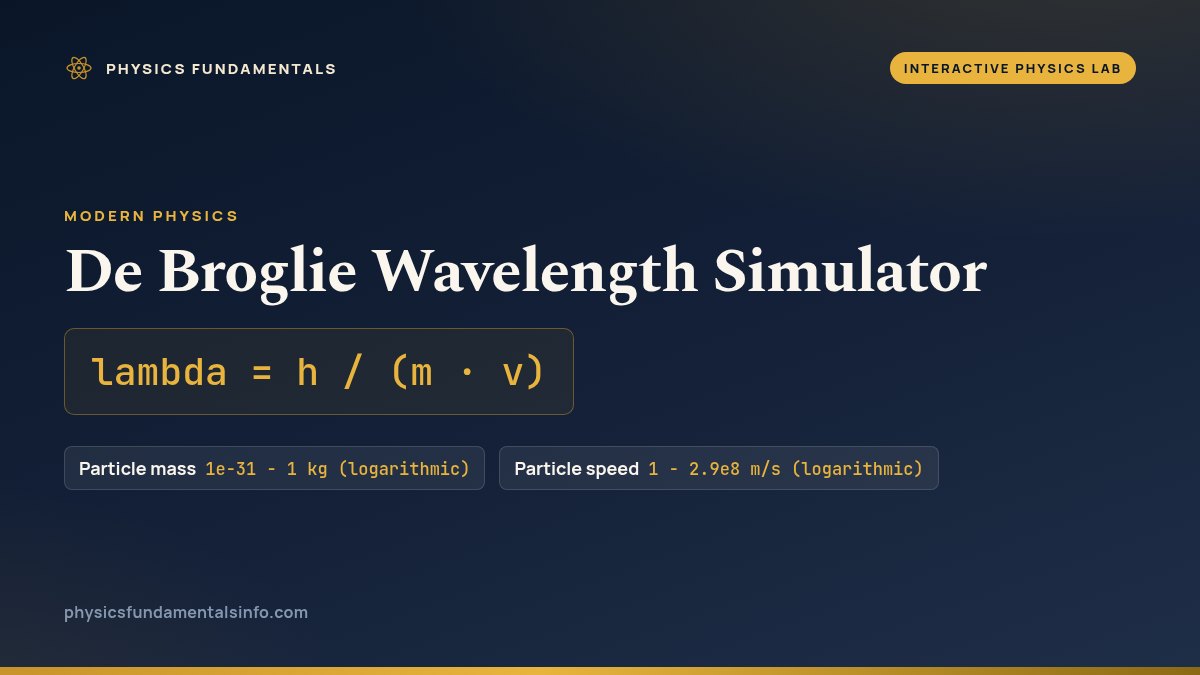
Every moving particle carries a wavelength, lambda = h / (m · v). Drag the sliders below to change the particle mass and its speed, and watch the wavelength, the momentum and a live detectable? verdict respond — with the matter wave drawn against a row of atoms and the diffraction fringes it would actually produce.
De Broglie Wavelength of a Moving Particle
Every moving object carries a wavelength, λ = h / (m·v). Drag the mass and speed sliders and watch that wavelength shrink against a row of atoms 0.2 nm apart — and watch the diffraction fringes below it vanish once the wave is far finer than the gaps it has to pass through.
What Is the De Broglie Wavelength Simulator?
The De Broglie wavelength simulator is a free interactive physics lab that runs in your browser — nothing to install and no sign-up. Drag the mass and speed sliders to see lambda = h/mv collapse from nanometres to nothing at all. It reports wavelength λ, momentum and Lorentz factor γ as you drag the sliders.
| Control | Range | Step |
|---|---|---|
| Particle mass | 1e-31 - 1 kg (logarithmic) | — |
| Particle speed | 1 - 2.9e8 m/s (logarithmic) | — |
Reading the Two Sliders Against Each Other
Both sliders move in decades rather than even steps, and they have to. Mass runs from 1e-31 kg up to 1 kg — thirty-one factors of ten — and on a linear track the whole subatomic world would be crushed into the first pixel. A logarithmic track hands every factor of ten the same travel, so an equal drag multiplies the value by the same amount wherever you grab it. The speed slider does the same from 1 m/s to 2.9e8 m/s.
Pin one slider and move the other, and the two readouts prove something the formula only asserts. Hold the mass and drag the speed: momentum climbs in exact step while the wavelength falls by precisely the same factor. Halve the speed and the wavelength doubles — not approximately, but exactly, anywhere below one per cent of the speed of light where no relativistic correction applies. Swap which slider you hold and nothing changes, because mass and speed sit in the same place in the fraction.
What it solves is lambda = h / (m · v), with the Planck constant pinned at its exact SI value of 6.62607015e-34 J·s and printed under the sliders rather than offered as a choice. Push the speed past one per cent of the speed of light and the sim switches to lambda = h / (gamma · m · v), where gamma = 1 / sqrt(1 − v²/c²); the Lorentz factor gets its own readout, so you can watch the correction grow out of the sixth decimal place. The de Broglie wavelength calculator runs the same arithmetic one particle at a time.
The detectable? verdict exists to kill one misconception: that everyday objects have no wavelength at all. Load the cricket-ball preset and the readout hands you about 1.04e-34 m — not zero, not undefined, just a real number some 24 powers of ten below the spacing between atoms in a crystal. Watch the fringe strip flatten into a blank wash while that figure sits there, stubbornly finite. Nothing has stopped being a wave; there is simply no gap narrow enough to make it behave like one.
Frequently asked questions
Why does the mass slider use a log scale?
Because the range it has to cover is 31 powers of ten, from 1e-31 kg up to 1 kg. On a linear track everything lighter than a gram would sit inside the first thousandth of the slider's length, and you could not separate an electron from a C60 molecule at all. A logarithmic track gives every factor of ten the same amount of travel, so an equal drag anywhere multiplies the mass by the same amount rather than adding the same amount. The speed slider works the same way across its own range of 1 m/s to 2.9e8 m/s.
Why does the wavelength barely move when I drag mass at the heavy end?
It is moving, in exactly the same proportion as everywhere else: a drag that multiplies the mass by ten still divides the wavelength by ten. What stops moving is the picture. Once the wavelength falls below roughly 1e-11 m the drawn wave is already finer than a single pixel and the fringe strip has already washed flat, so shrinking it further changes nothing you can see. Watch the exponent on the smaller line beneath the headline figure instead of watching the canvas, and you will see it keep counting down.
When does the simulator apply the relativistic correction?
Above one per cent of the speed of light, which is 2997924.58 m/s. Below that the Lorentz factor differs from 1 by less than five parts in a hundred thousand, so the simulator uses the plain lambda = h / (m · v) and says so on the line under the momentum readout. Above it the momentum becomes gamma · m · v, with gamma = 1 / sqrt(1 − v²/c²), and the wavelength shrinks to match. The speed slider is also capped below 0.999c so that square root can never turn imaginary.
Why does the ball preset say "not detectable" if it still has a wavelength?
Because having a wavelength and being able to observe one are two different claims. The cricket ball preset returns about 1.04e-34 m, a real, finite, non-zero figure that the formula produces like any other. Diffraction only becomes visible when the wavelength is somewhere near the size of the gap the wave has to squeeze through, and the finest gap nature offers is the spacing between atoms in a crystal, around 2e-10 m. The ball's wavelength sits about 24 powers of ten below that, so no aperture, natural or manufactured, is fine enough to spread it. The verdict is about detectability, not existence.
References & formula source
- L. de Broglie — "Recherches sur la théorie des quanta" (doctoral thesis, 1924); English summary in Annales de Physique 10(3).
- C. Davisson & L. H. Germer — "Diffraction of Electrons by a Crystal of Nickel", Physical Review 30, 705 (1927).
- M. Arndt et al. — "Wave-particle duality of C60 molecules", Nature 401, 680 (1999).
- Young & Freedman — University Physics with Modern Physics, §39.1 (Electron Waves).
- SI defining constant: the Planck constant h = 6.62607015 × 10^-34 J·s, exact since the 2019 SI redefinition (BIPM/NIST).
- Further reading: Matter wave — Wikipedia