In uniform circular motion the speed stays constant but the direction keeps changing, so there is always an acceleration toward the centre, a = v²/r. Drag the sliders below to change the speed, radius and mass, watch the velocity and acceleration arrows respond, then cut the string to see where the mass really goes.
Circular Motion
Drag the sliders to see a = v² ÷ r come alive: the gold arrow is the tangential velocity, the wine arrow is the centripetal acceleration that always points to the centre. Then cut the string and watch the mass fly off along the tangent.
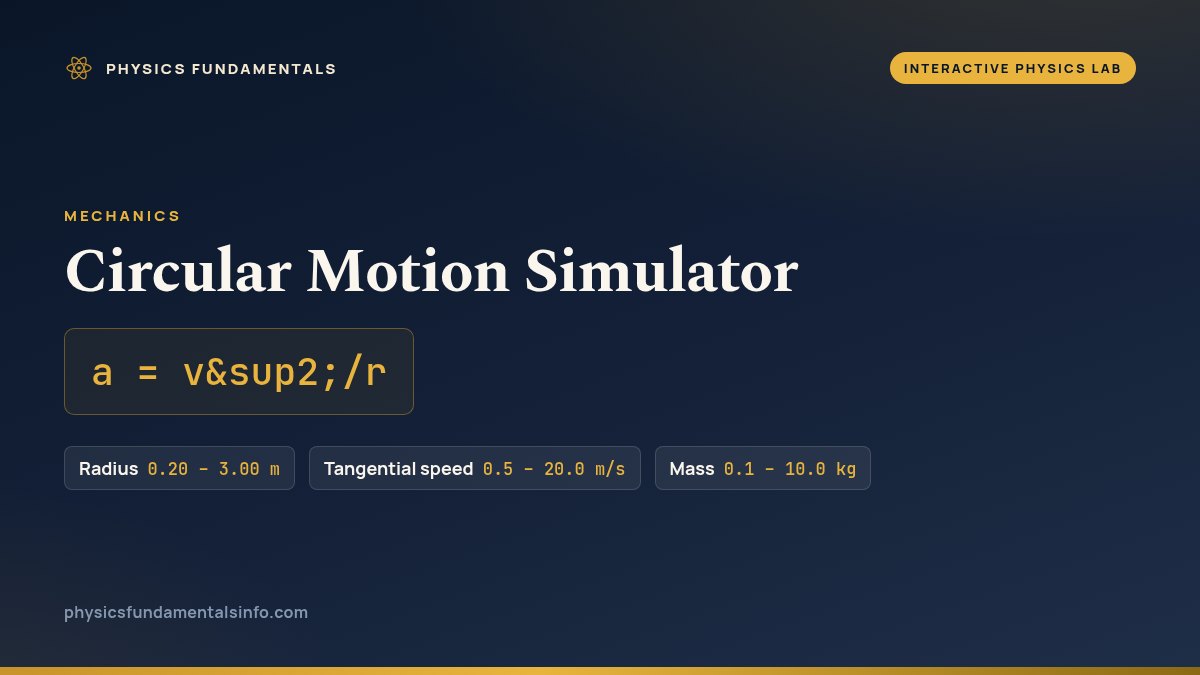
What Is the Circular Motion Simulator?
The circular motion simulator is a free interactive physics lab that runs in your browser — nothing to install and no sign-up. Drag speed, radius and mass to watch a = v2/r respond live, and cut the string to see the tangent escape. It reports centripetal acceleration as you drag the sliders.
| Control | Range | Step |
|---|---|---|
| Radius | 0.20 – 3.00 m | 0.01 |
| Tangential speed | 0.5 – 20.0 m/s | 0.1 |
| Mass | 0.1 – 10.0 kg | 0.1 |
How to Read the Two Arrows
Every scenario in this lab is built from two arrows that never point the same way. The gold arrow is the velocity: it lies along the tangent, showing the direction the mass would travel if it were suddenly set free. The wine arrow is the centripetal acceleration, and it always aims at the centre of the circle. That perpendicular pairing is the whole secret of circular motion — the object is forever accelerating toward a point it never reaches, and the result is a curved path at steady speed.
Use the speed slider first. Because acceleration follows a = v²/r, the reading grows with the square of speed: nudge the speed to twice its value and the acceleration jumps to four times, with the centripetal force F = m·v²/r climbing in the same steep way. Now try the radius slider. Here the relationship inverts — a wider circle at the same speed lowers the acceleration, since a is inversely proportional to r, while the period T = 2πr/v stretches out in direct proportion to the radius.
The mass slider is the one that teaches by not changing things. Slide it from light to heavy and watch carefully: the acceleration, angular velocity, period and frequency do not budge. Only the centripetal force responds, because a heavier object simply needs a stronger inward pull to be held on the very same circle. Mixing up "needs more force" with "moves differently" is one of the most common circular-motion mistakes, and seeing four readouts sit perfectly still while one moves is the fastest cure for it.
Finally, press Cut the string. Many people expect the mass to fly outward along the radius; instead it shoots off along the tangent, in a straight line, at the speed it already had. With no centre-seeking force left, Newton's first law takes over and the acceleration and force readouts fall to zero. To put numbers on a specific bend or orbit, open the circular motion calculator; to dig into the force that holds the object in, read the guide to centripetal force, or explore more models in the full simulation collection.
Frequently asked questions
What does this circular motion simulator show?
It shows a mass on a string orbiting a central point. A gold arrow marks the tangential velocity (which always points along the circle) and a wine arrow marks the centripetal acceleration (which always points to the centre). The panel reports the acceleration a = v2/r, the centripetal force F = m*v2/r, the angular velocity, the period and the frequency in real time as you drag the sliders.
Why does doubling the speed quadruple the acceleration?
Because acceleration depends on the square of the speed: a = v2/r. If you double v, the v2 term becomes four times larger while r is unchanged, so the reading climbs to four times its value. The centripetal force F = m*v2/r follows the same squared law, which is why cornering fast is so much harder on tyres and passengers than cornering slowly.
Why does a bigger radius lower the acceleration?
For a fixed speed, acceleration is inversely proportional to radius: a = v2/r. Doubling r halves the reading, because the same speed now bends the path more gently. The period behaves the other way — T = 2*pi*r/v grows in direct proportion to r, so a wider circle at the same speed takes proportionally longer to complete.
Does changing the mass change the acceleration or the period?
No. Acceleration, angular velocity, period and frequency depend only on the speed and radius, never on the mass. Mass changes just one thing: the centripetal force F = m*v2/r needed to hold the object on the circle. Slide the mass control and you will see only F move — a, the angular velocity, T and f stay put. This is the single most useful idea the lab makes visible.
What happens when you cut the string?
The centripetal force vanishes, so nothing bends the path any more. By Newton's first law the mass keeps the velocity it had at that instant and travels in a straight line along the tangent — not outward along the old radius. The acceleration and force readouts drop straight to zero, showing there is no longer any centre-seeking pull.
References & formula source
- Halliday, Resnick & Walker — Fundamentals of Physics, Chapter 4 (Motion in Two and Three Dimensions), uniform circular motion.
- Young & Freedman — University Physics with Modern Physics, §3.4 (Motion in a Circle).
- R. Nave — HyperPhysics, Georgia State University, "Centripetal acceleration" / uniform circular motion section.
- Further reading: Circular motion — Wikipedia