Relative velocity is the velocity one body has as measured by another, and you get it by subtracting the two velocity vectors rather than the two speeds: v_AB is v_A minus v_B, taken component by component. Both velocities have to be written down in one common frame first. Reverse one body and the answer grows.
Stand on a bridge over a motorway and the traffic below is doing 110 km/h. Sit in one of those cars and the one beside you in the next lane, also doing 110, might as well be parked. Neither reading is wrong.
The two of you are simply measuring against different things — the bridge and the car. Pick who is doing the measuring, subtract their velocity from the one you care about, and every answer on this page follows. Get the subtraction the wrong way round and you have a car closing on you at 220 km/h that is actually sitting on your wing mirror.
What Is Relative Velocity?
Relative velocity is the velocity one body has as measured by another, and it is the vector difference of the two velocities written down in a single common frame. No comparison of speeds will do it. The directions have to be subtracted along with the magnitudes.
That common frame is usually the ground, and choosing it is the first thing you do, not an afterthought. Write both velocities against the same reference, then subtract. The frame itself never appears in the answer, which is the quiet miracle of the whole subject.
Which way round the subscripts read
The notation carries the answer to a question students ask constantly: who is watching whom? On this page v_AB means the velocity of A as measured by B, so A is the body being watched and B is the observer doing the watching.
Textbooks genuinely disagree about which subscript goes first, and that is worth knowing before you trust a sign in someone else’s working. Read the pair the other way and you get v_BA, which has the same relative speed on exactly the opposite bearing. The two are mirror images: v_BA is minus v_AB, always.
A velocity and a speed are different animals, and the difference is the reason this is a subtraction rather than an arithmetic comparison — velocity versus speed is where that distinction is set out properly. Here it is simply assumed.
The Relative Velocity Formula
The relative velocity formula subtracts the two velocities component by component, then recombines the components into a speed and a direction. One line does all of it.
In one dimension that is the whole calculation: pick a positive direction, give each velocity its sign, subtract. In two dimensions you resolve both velocities onto a pair of axes first, subtract axis by axis, then put the two differences back together.
Resolving onto axes is the only piece of vector machinery this page needs, and it is borrowed rather than built here — scalar and vector quantities teaches the component method, and the vector addition calculator does the arithmetic the other way round, adding where this page subtracts.
| Symbol | What it is | SI unit | River example from this page |
|---|---|---|---|
| v_A | Velocity of body A, the one being watched, measured in the common frame | metre per second (m/s) | boat through the water, 4.00 m/s across |
| v_B | Velocity of body B, the observer, measured in the same common frame | metre per second (m/s) | water over the ground, 3.00 m/s downstream |
| v_AB | Relative velocity: the velocity of A as measured by B | metre per second (m/s) | boat over the ground, 5.00 m/s |
| v_BA | The reciprocal: the velocity of B as measured by A, equal to minus v_AB | metre per second (m/s) | same 5.00 m/s, opposite bearing |
| vABx | Component of v_AB along the first axis, taken here as east or downstream | metre per second (m/s) | 3.00 m/s downstream |
| vABy | Component of v_AB along the second axis, taken here as north or across | metre per second (m/s) | 4.00 m/s across |
| relative speed | The magnitude of v_AB, which has no direction attached to it | metre per second (m/s) | 5.00 m/s |
| relative direction | The bearing v_AB points along, undefined when the relative speed is zero | degree (°) | 36.87° off the straight line across |
The quickest way to feel what the formula does is to put numbers through it and change one of them at a time. Our relative velocity calculator takes two speeds and two bearings, hands back the relative speed with its components and its reciprocal, and prices the difference of the two speeds beside the real answer so you can watch the two part company. The simulator below does the same job visually, and it also has a page of its own if you would rather open it full-screen.
One Dimension: Why Head-On Speeds Add
Head-on speeds add because reversing one body flips the sign of the velocity you subtract, and subtracting a negative number is addition. Nothing else changes. The slower body’s speed is untouched; only its sign moves.
Take two cars on a straight road and call east positive. A does 100 km/h east, B does 80 km/h east, so v_AB is 100 – 80 = 20 km/h. From inside B, A pulls ahead at the pace of an unhurried cyclist, which is 5.556 m/s.
Now turn B round without changing its speedometer. Its velocity becomes minus 80 km/h, and v_AB is 100 – (-80) = 180 km/h. The two cars are identical in every respect except the direction of one of them, and the answer has moved by 180 – 20 = 160 km/h — exactly twice the 80.
That factor of two is worth holding on to, because it is where the danger on a road actually lives. Overtaking on a two-lane road is a 180 km/h problem dressed up as a 100 km/h one.
The overtaking train
Two trains run the same way on parallel tracks at 120 and 90 km/h. The express sees the goods train drifting backwards at 30 km/h, which is 8.333 m/s — exactly 25/3 of a metre per second. If it needs 400 m of relative movement to clear the goods train completely, that takes 400 x 3 / 25 = 48.00 s.
For two bodies strung out along one line, the relative speed and the rate the gap closes are the same number, which is why a single division finishes the problem. Hold that thought until the closing-speed section below, where it stops being true.
Walking on a moving train
A passenger strolls along the aisle at 1.50 m/s while the train does 20.0 m/s over the ground. Forwards, the ground sees 21.5 m/s; back towards the rear, 18.5 m/s. The two differ by 3.00 m/s, which is twice the walking speed and the same factor of two in a gentler setting.
One sentence on a neighbouring idea so it does not confuse you later: in a collision the quantity that matters is the relative velocity of the two bodies just before and just after impact, and elastic and inelastic collisions is where that identity is worked out.
Two Dimensions: Crossing a River
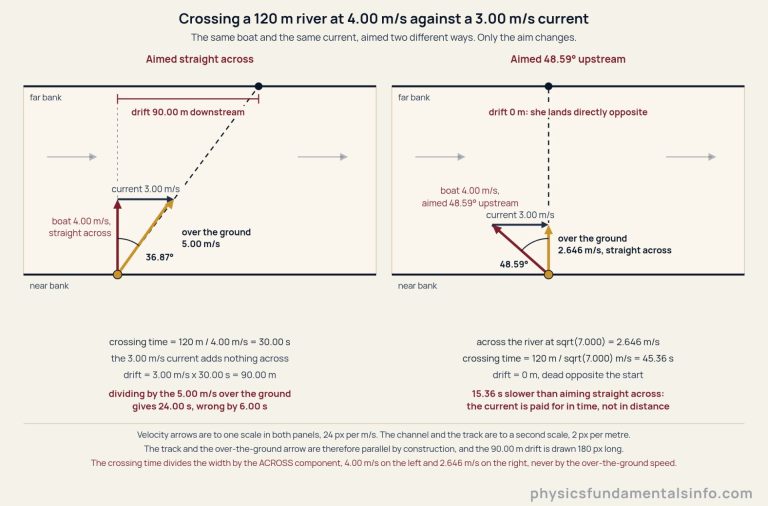
A boat crossing a river moves with its own velocity through the water plus the water’s velocity over the ground, and the crossing time depends only on the component that points across. The current contributes nothing across. It contributes everything downstream.
Take a river 120 m wide with a 3.00 m/s current, and a boat that makes 4.00 m/s through still water. Point it straight at the far bank. Over the ground it travels sqrt(3.00 x 3.00 + 4.00 x 4.00) = sqrt(25.00) = 5.00 m/s, on a track atan(0.7500) = 36.87° downstream of the straight line across. It is the 3-4-5 triangle, hiding in a boat.
Now the part almost everyone gets wrong. The crossing takes 120 divided by 4.00 m/s, which is 30.00 s, because the only velocity carrying the boat across the river is that 4.00 m/s. Dividing the width by the 5.00 m/s over the ground gives 24.00 s instead — 6.00 s short, a 20.0 per cent error, and the single commonest mistake on this problem.
In 30.00 s the current has carried the boat 3.00 x 30.00 = 90.00 m downstream, so it lands 90.00 m along the far bank from the point directly opposite. Spin the rudder as you like: aimed straight across, the time is fixed and the drift is the price.
Landing directly opposite
To kill the drift you have to aim upstream far enough that the boat’s upstream component cancels the current exactly: 4.00 x sin(theta) = 3.00, so sin(theta) = 0.7500 and theta = 48.59°. That is a long way round — nearly half a right angle into the flow.
What is left to carry you across is sqrt(4.00 x 4.00 – 3.00 x 3.00) = sqrt(7.000) = 2.646 m/s, and the crossing now takes 120 divided by sqrt(7.000) m/s = 45.36 s. The drift is zero. The extra 15.36 s is what the zero drift cost, and it is a real trade: you pay for position in time.
Carry the root rather than the rounded figure into that division. Dividing 120 by the printed 2.646 returns 45.35 s, one in the last place out, which is the kind of discrepancy that makes a reader think the page is wrong when it is only rounded.
Flying in a Crosswind: Drift Angle and Crab Angle
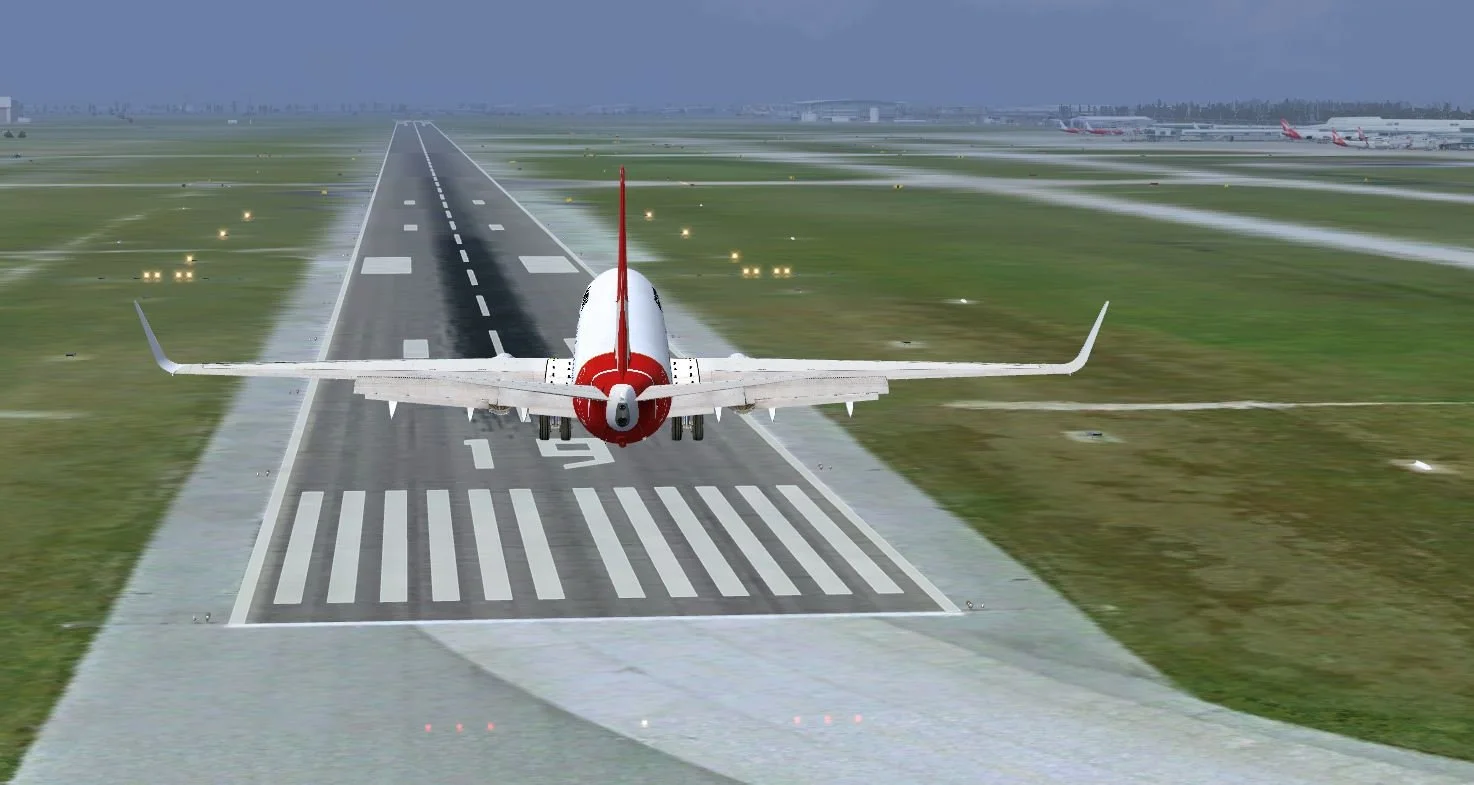
A crosswind hands a pilot two different angles, and they are not the same number. The drift angle is how far off course the wind pushes you if you do nothing; the crab angle is how far you must turn into the wind to hold the course you wanted.
An aircraft holds an airspeed of 250 km/h due north while a 60.0 km/h wind blows from the west. Airspeed is the aircraft’s velocity relative to the air, so the ground sees the airspeed vector plus the wind vector: 60.0 km/h east and 250 km/h north. NASA Glenn states the same relation the other way round — airspeed is the vector difference between the ground speed and the wind speed, which is v_AB = v_A – v_B with the air as the observer.
Over the ground that comes to sqrt(60.0 x 60.0 + 250 x 250) = sqrt(66100) = 257.1 km/h, and the track runs atan(0.2400) = 13.50° east of north. Notice what has not changed: the northward progress is still 250 km/h, because the wind has no northward part to contribute. The aircraft is not flying north any slower. It is simply also flying east.
To track due north instead, the aircraft has to point west of north by enough that its own eastward component cancels the wind: 250 x sin(crab) = 60.0, so sin(crab) = 0.2400 and the crab angle is asin(0.2400) = 13.89°.
Those two angles come from the same ratio of 0.2400 and they are still 13.89 – 13.50 = 0.39° apart, because one is an arctangent and the other an arcsine. Using one for the other is a real error, not a rounding quibble, and at four significant figures there is nowhere for it to hide.
Holding the track also costs ground speed. With the crab applied the aircraft makes sqrt(250 x 250 – 60.0 x 60.0) = sqrt(58900) = 242.7 km/h, so the correction is worth sqrt(66100) – sqrt(58900) = 14.41 km/h of progress. Pilots call that turn the wind correction angle; the FAA publishes its whole Pilot’s Handbook of Aeronautical Knowledge as free chapter PDFs, navigation among them, if you want the aviation treatment rather than the physics one.
This is the arithmetic behind a sentence you may already have met: a plane’s airspeed indicator reads one steady number while a crosswind nudges its actual track sideways. Velocity versus speed raises that as an illustration of why velocity needs a direction. This is the page that puts the angles on it.
Relative Speed Is Not Closing Speed
Relative speed is the magnitude of v_AB. Closing speed is only the part of v_AB that points along the line joining the two bodies, which makes it a projection — and a projection can never be bigger than the thing it is a projection of.
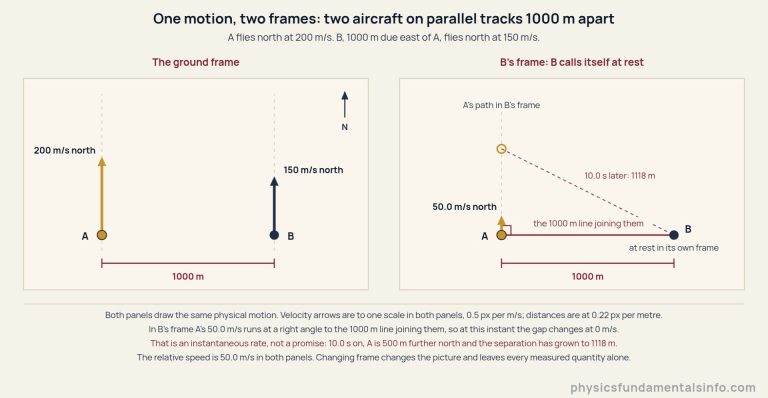
Here is the case that separates them. Aircraft A flies north at 200 m/s. Aircraft B is 1000 m due east of A and also flying north, at 150 m/s. The relative speed is 200 – 150 = 50.0 m/s, so in B’s frame A is sliding steadily northwards at 50.0 m/s.
And yet the gap between them is, at that instant, not changing at all. The relative velocity points due north; the line joining the two aircraft points due east; the two are at right angles, so none of the 50.0 m/s does any closing. The rate of change of the separation is 0 m/s.
That is an instantaneous rate, though, and not a standing promise — which is exactly the sort of claim worth testing rather than trusting. Ten seconds later A has gone 500 m further north than B, and the separation is sqrt(1000 x 1000 + 500 x 500) = sqrt(1250000) = 1118 m. The gap was momentarily frozen and then began to open.
Put the same two aircraft in line instead, one 1000 m ahead of the other on the same track, and the two quantities coincide: the relative speed is 50.0 m/s and the gap really does shrink at 50.0 m/s. That coincidence is why the terms get muddled. It holds only for motion along the line of sight.
Collision-avoidance radar lives on this distinction, and so does one other place you have met: a siren’s pitch depends on the relative motion of source and observer along the line between them and on nothing else, which is what the Doppler effect is built from.
Every result on this page in one place
Here is every case worked above, with its inputs and its answers side by side. Each figure is rounded once, at four significant figures, so the table and the prose agree digit for digit.
| Situation | Both velocities in the common frame | Relative velocity v_AB | What follows from it |
|---|---|---|---|
| Two cars, same direction | A 100 km/h east, B 80 km/h east | 20 km/h east (5.556 m/s) | A gains one car length every second or so |
| The same two cars, head-on | A 100 km/h east, B 80 km/h west | 180 km/h east (50.00 m/s) | 160 km/h more than the row above, from one minus sign |
| Express overtaking a goods train | 120 km/h and 90 km/h, same way | 30 km/h (8.333 m/s) | 400 m of relative movement takes 48.00 s |
| Passenger walking on a train | train 20.0 m/s, walk 1.50 m/s | 1.50 m/s relative to the train | 21.5 m/s over the ground forwards, 18.5 m/s back |
| Boat straight across a 120 m river | boat 4.00 m/s, current 3.00 m/s | 5.00 m/s at 36.87° off the straight line | crossing 30.00 s, drift 90.00 m downstream |
| The same boat, landing opposite | boat 4.00 m/s aimed 48.59° upstream | 2.646 m/s straight across | crossing 45.36 s, drift 0 m |
| Aircraft in a crosswind, no correction | 250 km/h airspeed north, 60.0 km/h wind from the west | 257.1 km/h at 13.50° east of north | northward progress still 250 km/h |
| The same aircraft, crabbing | same pair, heading 13.89° into the wind | 242.7 km/h due north | the track is held; sqrt(66100) – sqrt(58900) = 14.41 km/h is the bill |
| Rain and a cyclist | rain 8.00 m/s down, cyclist 6.00 m/s | 10.00 m/s at 36.87° from the downward vertical | the rain arrives from in front; tilt the umbrella forward |
| Two aircraft on parallel tracks | both north, 200 and 150 m/s, 1000 m apart | 50.0 m/s north | separation changing at 0 m/s at that instant |
Where the Galilean Rule Breaks Down
Subtracting velocities is exact for anything you will ever drive, row or fly, and it fails only when the speeds involved become a measurable fraction of the speed of light. Everywhere else it is not an approximation at all. It is the answer.
Put a number on that. For the two cars meeting head-on at 100 and 80 km/h, the relativistic correction to the 180 km/h answer is a fractional 6.9 x 10⁻¹⁵ — about seven parts in a thousand million million. The four-significant-figure ceiling this page works to is about ten orders of magnitude coarser than that, so there is nothing to correct and no apology to make.
Now push it. Two craft approach each other, each doing 0.800c in the ground frame. Subtracting gives 1.600c, which is not a velocity at all — nothing carries information faster than light, so the rule has handed back an answer outside its own domain without the slightest complaint.
The correct composition returns 0.9756c, which is fast and still under the limit, and special relativity is where that composition law belongs. The same framework is what makes moving clocks run slow, which time dilation handles; neither is derived here.
Worth knowing where the crossover sits, because it is so absurdly far away. A simple subtraction survives the four-figure ceiling until each body passes roughly 0.007c, about 2,120 km/s — getting on for two hundred times the speed needed to escape the Earth’s gravity. Below that, use v_AB = v_A – v_B and do not look back.
Common Misconceptions About Relative Velocity
Four mistakes account for almost every wrong answer on this topic, and the first one is in a class of its own because it is so nearly right.
“Relative speed is just the difference of the two speeds”
It is, in exactly one case: when the two bodies move along the same line in the same sense. Outside that case it can be wildly wrong, because subtracting two numbers throws away the directions they came with.
Rain falling at 8.00 m/s and a cyclist riding at 6.00 m/s are the cleanest demonstration. The difference of speeds is 8.00 – 6.00 = 2.00 m/s. The relative speed, with the two motions at right angles, is 10.00 m/s — five times larger, and the rain arrives from in front rather than from above.
Quieter, but the crosswind case says it too. The aircraft and the wind differ in speed by 250 – 60.0 = 190.0 km/h, while the ground speed the subtraction actually produces is 257.1 km/h. In one case the naive answer is a fifth of the truth; in the other it is too small by more than a third.
“The current makes the crossing take longer”
Aimed straight across, it makes no difference whatsoever. The current runs along the bank, so it has no component across the river and cannot touch the crossing time: 120 m divided by a 4.00 m/s across-component is 30.00 s in a 3.00 m/s current, in a 1.00 m/s current and in dead still water.
What the current changes is where you arrive, 90.00 m downstream here. It only starts costing you time once you aim upstream to cancel the drift, and then it costs 15.36 s.
“Drift angle and crab angle are the same angle”
They are two different inverse functions of the same ratio. With 60.0 km/h of wind on 250 km/h of airspeed the ratio is 0.2400 both times, but the drift is atan(0.2400) = 13.50° and the crab is asin(0.2400) = 13.89°.
Half a degree sounds like nothing until you notice that a four-figure answer has no room for it. The two angles answer different questions: one is where the wind takes you, the other is what you must do about it.
“There must be a frame in which things really move”
There is not, and the formula says so in one line. Add the same velocity to both bodies and the subtraction cancels it exactly, so v_AB comes out identical in every frame you could choose.
Two passengers facing each other down a carriage agree about each other’s motion whether the train is standing in a siding or doing 300 km/h. Neither of them is “really” moving. The 300 km/h belongs to the choice of frame, not to the passengers.
One honest consequence, and it is a valid answer rather than an error: if two bodies have identical velocities, the relative velocity is exactly zero. A zero vector has no direction, so there is no bearing to report — and a tool that printed “due north” there would be inventing one.