Distance vs displacement is the difference between the total path length an object travels and its straight-line change in position. Distance is a scalar measured in metres with size only; displacement is a vector with both size and direction. Distance is always positive, while displacement can be zero or negative.
Picture walking the dog around the block and arriving back at your own front door. Your fitness tracker proudly reports 800 metres — yet you are standing exactly where you began. So how far did you really travel?
That gap between the ground you cover and where you end up is the whole story of distance versus displacement. It sounds like hair-splitting. But mix the two up in an exam, or in a navigation system, and the numbers quietly fall apart. Let’s make the difference stick.
What Is the Difference Between Distance and Displacement?
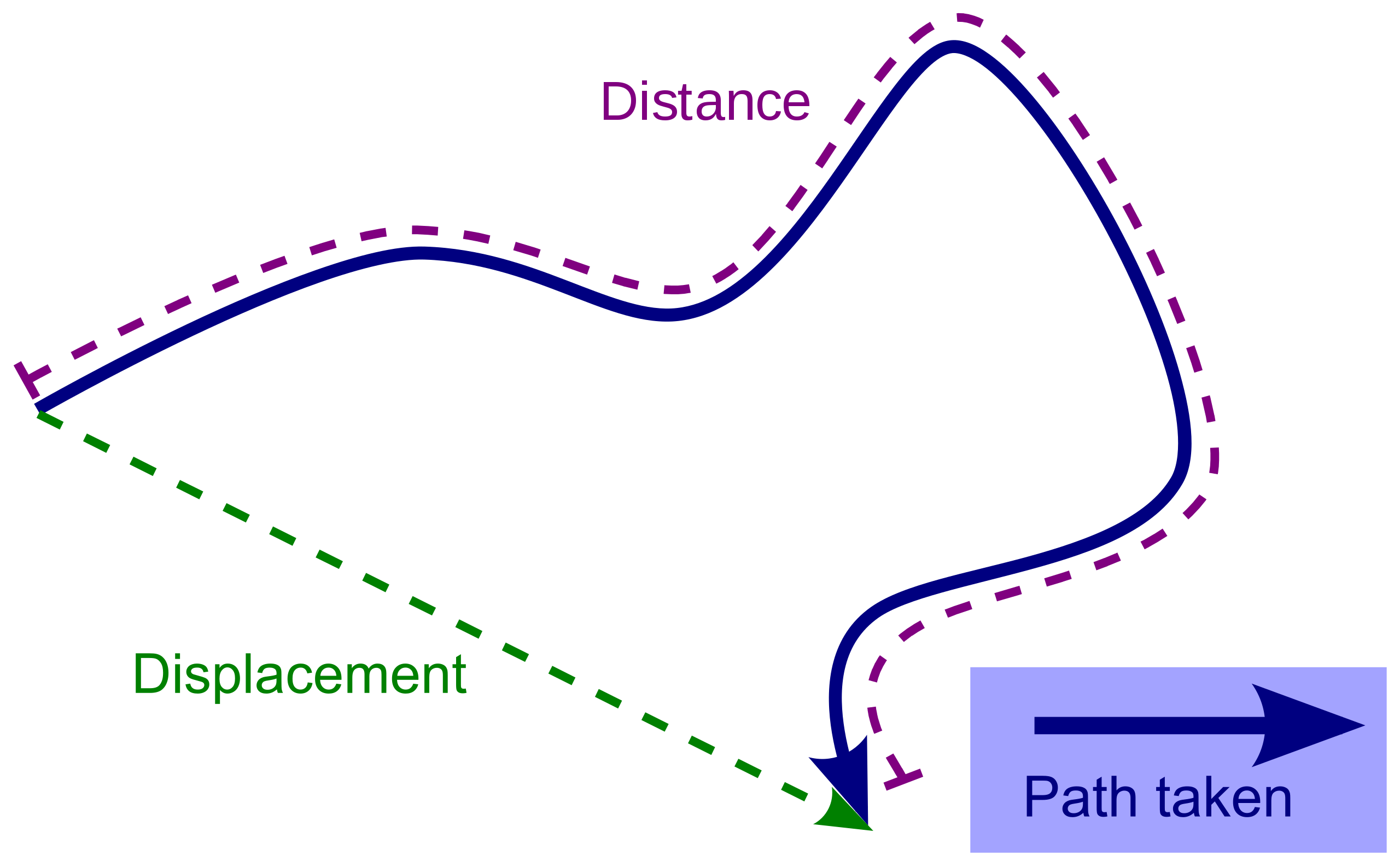
Start with the everyday picture. Distance is how much ground you cover — every step and every twist of the route, added up. Displacement is narrower: how far you finish from where you started, and in which direction.
A satnav quietly tracks both. The “route” figure that ticks upward as you weave through streets is distance. The “as the crow flies” arrow pointing straight from home to destination is displacement.
Distance: the ground you cover
Distance is a scalar quantity, which means it has size only — no direction attached. Walk 3 m in a straight line or 3 m in a tight spiral, and either way you have covered a distance of 3 m.
Because it only ever adds up, distance can never shrink and never goes negative. The SI unit is the metre (m), the internationally standardised unit of length.
Displacement: where you end up
Displacement is a vector. It carries both a size and a direction, written as something like “5 m east” or “−4 m along the x-axis”. Reverse your direction and the displacement can fall — even back to zero.
Formally, displacement is the change in position: your final position minus your starting position. Standard university courses classify displacement as a vector quantity, separate from the scalar distance, precisely because direction is built in.
The Displacement Formula
In one dimension, displacement is simply the change in position — where you end minus where you began.
- Δs — displacement, the change in position, measured in metres (m). The symbol Δ (“delta”) means “change in”.
- s_final — the final position along the line, in metres (m).
- s_initial — the starting position along the line, in metres (m).
The sign of Δs tells you the direction. Pick a positive direction first — say, east or “right” — and a result like −4 m simply means 4 m the other way.
Displacement in two dimensions
When motion turns a corner, displacement is the straight line joining start to finish. For a right-angled route, its size comes from Pythagoras’ theorem.
- |s| — the magnitude (size) of the displacement, in metres (m).
- Δx — the horizontal change in position, in metres (m).
- Δy — the vertical change in position, in metres (m).
Distance, by contrast, has no formula to memorise. You simply add up the length of every segment of the actual path.
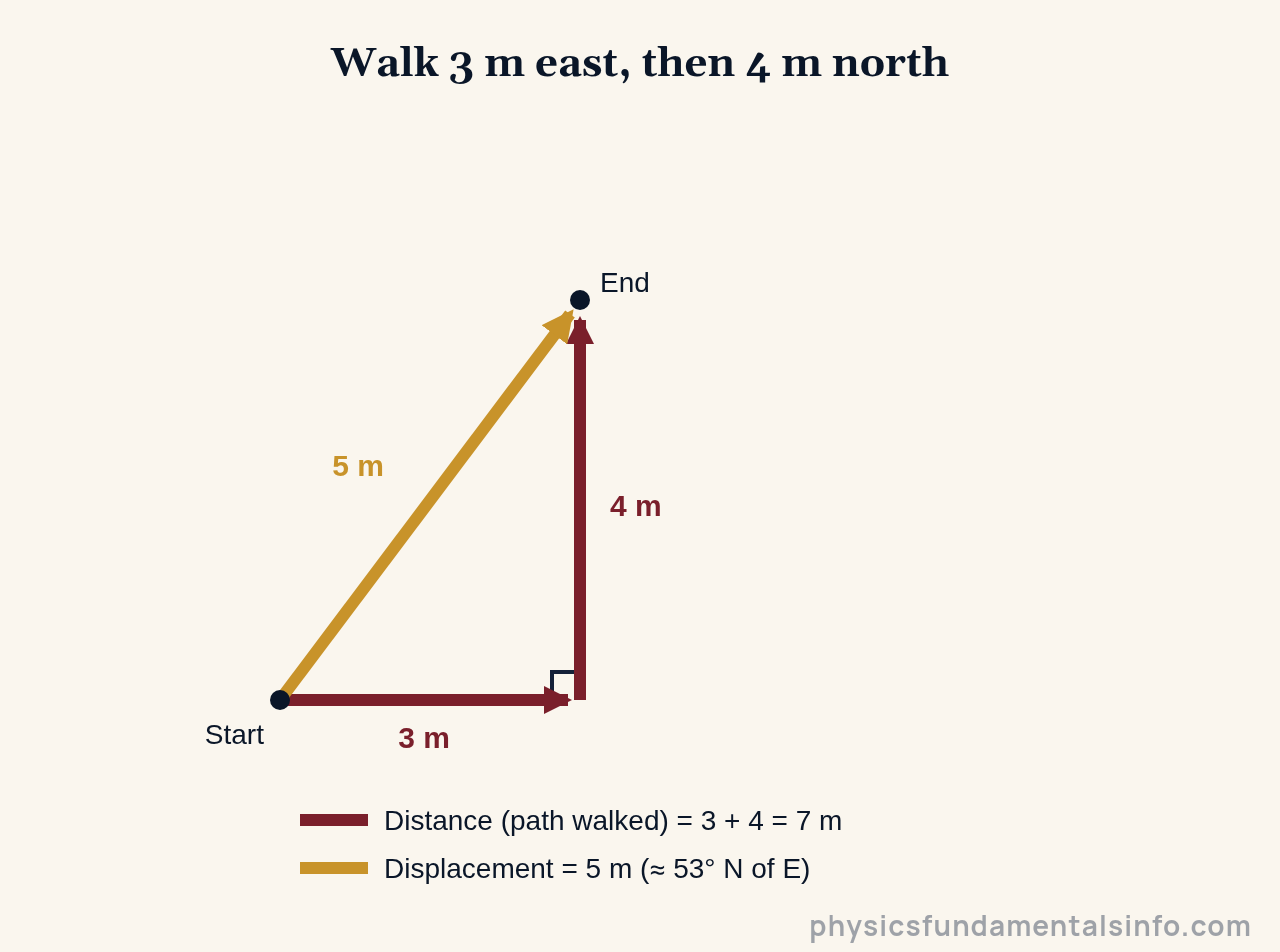
The route covers a distance of 7 m, but the displacement is the straight 5 m line from start to end — found with Pythagoras’ theorem.
How Distance and Displacement Work
The mechanism is easiest to feel with a single trip broken into steps. Keep two running totals as you move: one that only ever grows (distance) and one that tracks where you are relative to the start (displacement).
Imagine a number line and a marker that starts at 0.
- Step right to +6 m. Distance so far: 6 m. Displacement: +6 m.
- Now step left to −2 m. You walked another 8 m, so distance is 14 m. But your position is −2 m, so displacement is −2 m.
Notice the split. Distance counted both legs and climbed to 14 m. Displacement only cares about your final position, which sits 2 m to the left of the start.
Why a round trip gives zero displacement
Return to your exact starting point and the final position equals the initial position, so Δs = 0. The distance, meanwhile, is the full length you walked. That is why one complete lap of a track is the classic case.
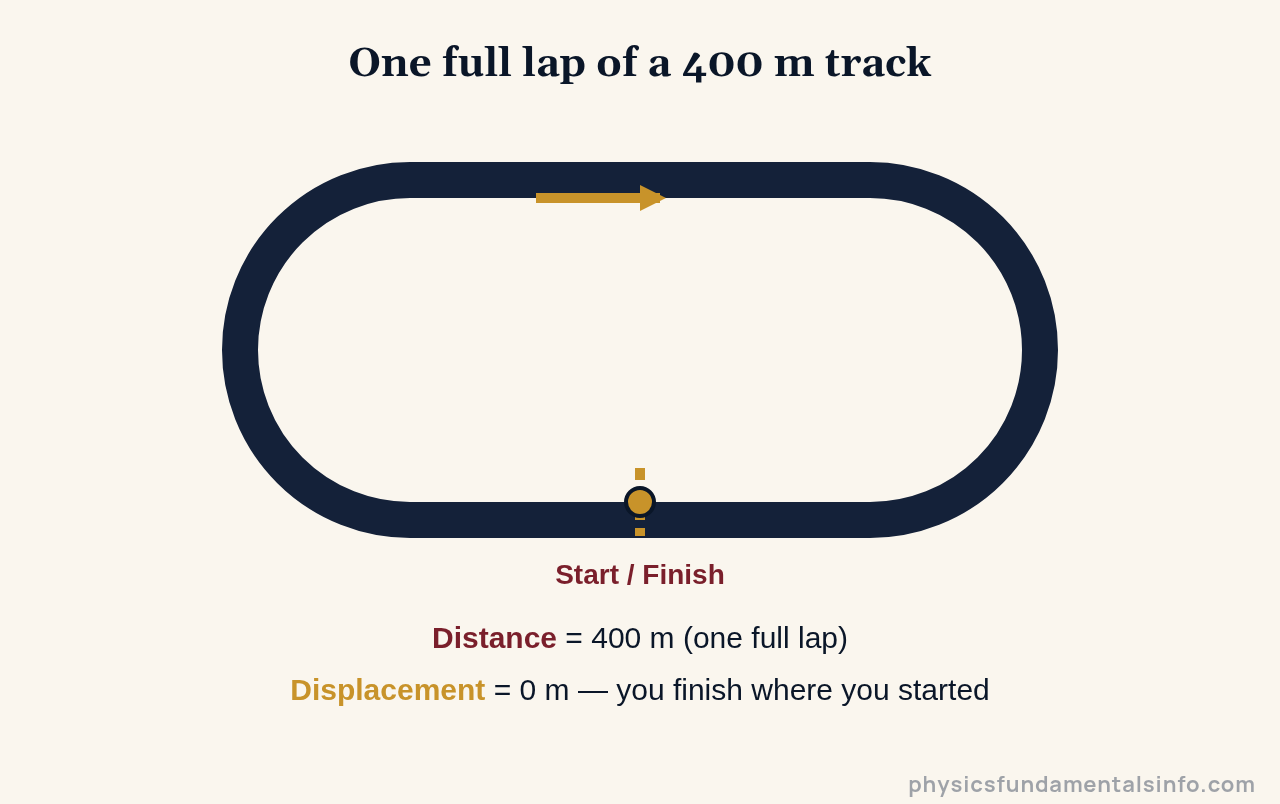
A complete lap covers real distance, yet the displacement is zero because the finish point is the start point.
Try it yourself. Adjust the legs of a journey below and watch the distance total climb while the displacement arrow stretches, shrinks, or vanishes back to zero.
Distance vs Displacement: Key Differences at a Glance
Five differences capture almost everything you need. Read across each row: it is the same journey, measured two ways.
| Feature | Distance | Displacement |
|---|---|---|
| Quantity type | Scalar — size only | Vector — size and direction |
| Direction | None | Always specified (e.g. east, +x, 53° N of E) |
| Possible sign | Always positive (or zero) | Positive, negative, or zero |
| What it measures | Total length of the path actually taken | Straight line from start to finish (change in position) |
| SI unit & symbol | metre (m); often d or s | metre (m); often s or Δx, shown bold or with an arrow |
One relationship ties them together: the distance is always at least as large as the size of the displacement. They are equal only when the motion runs in a straight line and never doubles back.
Real-World Examples of Distance and Displacement
The cleanest way to lock this in is to watch the two quantities pull apart in ordinary situations.
1. Your morning commute
Your satnav says 12 km to the office, yet the office is only 8 km away “as the crow flies”. The 12 km is distance — every bend of the road counted in. The 8 km straight line is the magnitude of your displacement.
2. One lap of the track
A 400 m runner who completes a full lap finishes on the same line they started. Distance covered: 400 m. Displacement: 0 m. Every metre of effort, zero net change in position.
3. A ball thrown straight up
Toss a ball 5 m up and catch it in the same hand. It travelled 10 m — 5 m up, then 5 m down — so the distance is 10 m. It came back to your hand, so the displacement is 0 m.
4. A flight around bad weather
A plane diverting around a storm flies extra kilometres, and every one of them adds to the distance. The displacement — the straight line between the departure and arrival airports — does not change at all. Only the path did.
Common Misconceptions About Distance and Displacement
A handful of sticky errors trip up most learners. Clear these and the rest of kinematics gets noticeably easier.
“They’re just two words for the same thing”
They share a unit (the metre) and often share a value, which is exactly what fuels the confusion. But one is a scalar and one is a vector. A common student slip is to report displacement as a bare number and forget the direction — quietly losing half the answer.
“Displacement can’t be negative”
It can, and the minus sign is information, not a mistake. Once you pick a positive direction, a displacement of −4 m means 4 m in the opposite direction. Distance, though, is never negative.
“Bigger distance always means bigger displacement”
Not so. You can walk a huge distance and end with zero displacement — just complete any loop. Distance grows with every step; displacement depends only on the start and finish.
“Displacement is the shortest distance, so it’s a kind of distance”
The magnitude of displacement does equal the shortest straight-line length between two points. But displacement also carries direction, which distance never does. Treating it as “just a distance” is what derails people in vector questions.
How Distance and Displacement Relate to Speed and Velocity
Here is where the distinction earns its keep. Divide each one by time and you get the next pair of physics quantities.
- Speed = distance ÷ time. A scalar, because distance is a scalar.
- Velocity = displacement ÷ time. A vector, because displacement is a vector.
So the same scalar-versus-vector split runs straight up the chain. If you are comfortable telling distance from displacement, you already understand the difference between speed and velocity.
The idea also explains motion in two dimensions. When a projectile arcs through the air, its displacement splits into independent horizontal and vertical parts — exactly the Δx and Δy from the formula above.
Worked Problems
Work through these in order — each one adds a twist. Keep a positive direction in mind and carry your units the whole way through.
Show Solution
Solution:
Step 1: The path is a single straight segment with no change of direction.
Step 2: Distance = total path length = 10 m.
Step 3: Displacement = change in position = 10 m, directed east.
Answer: distance = 10 m; displacement = 10 m east.
Show Solution
Solution:
Step 1: Distance adds every segment, regardless of direction: 8 m + 3 m.
Step 2: Total distance = 11 m.
Step 3: Take east as positive. Displacement = (+8 m) + (−3 m) = +5 m.
Answer: distance = 11 m; displacement = 5 m east.
Show Solution
Solution:
Step 1: Distance is the length of the path run — one complete lap.
Step 2: Distance = 400 m.
Step 3: The final position equals the starting position, so Δs = 0.
Answer: distance = 400 m; displacement = 0 m.
Show Solution
Solution:
Step 1: Distance ignores direction: 6 m + 10 m.
Step 2: Total distance = 16 m.
Step 3: Displacement = (+6 m) + (−10 m) = −4 m.
Answer: distance = 16 m; displacement = −4 m (4 m in the negative x-direction).
Show Solution
Solution:
Step 1: Distance = sum of the two legs = 30 m + 40 m = 70 m.
Step 2: Displacement magnitude uses Pythagoras: |s| = √(302 + 402) = √(900 + 1600) = √2500.
Step 3: |s| = 50 m. Direction: θ = tan−1(40 ÷ 30) ≈ 53° north of east.
Answer: distance = 70 m; displacement = 50 m at ≈53° north of east.
Show Solution
Solution:
Step 1: Distance is the arc length of a semicircle: half of 2πr, which is πr.
Step 2: Distance = π × 50 m ≈ 3.14 × 50 = 157 m.
Step 3: Displacement is the straight line across — the diameter = 2r = 2 × 50 m = 100 m, directed across the circle.
Answer: distance ≈ 157 m; displacement = 100 m.
Show Solution
Solution:
Step 1: Average speed = distance ÷ time = 70 m ÷ 50 s.
Step 2: Average speed = 1.4 m/s (a scalar — no direction).
Step 3: Average velocity = displacement ÷ time = 50 m ÷ 50 s = 1.0 m/s, directed 53° north of east.
Answer: average speed = 1.4 m/s; average velocity = 1.0 m/s at ≈53° north of east.