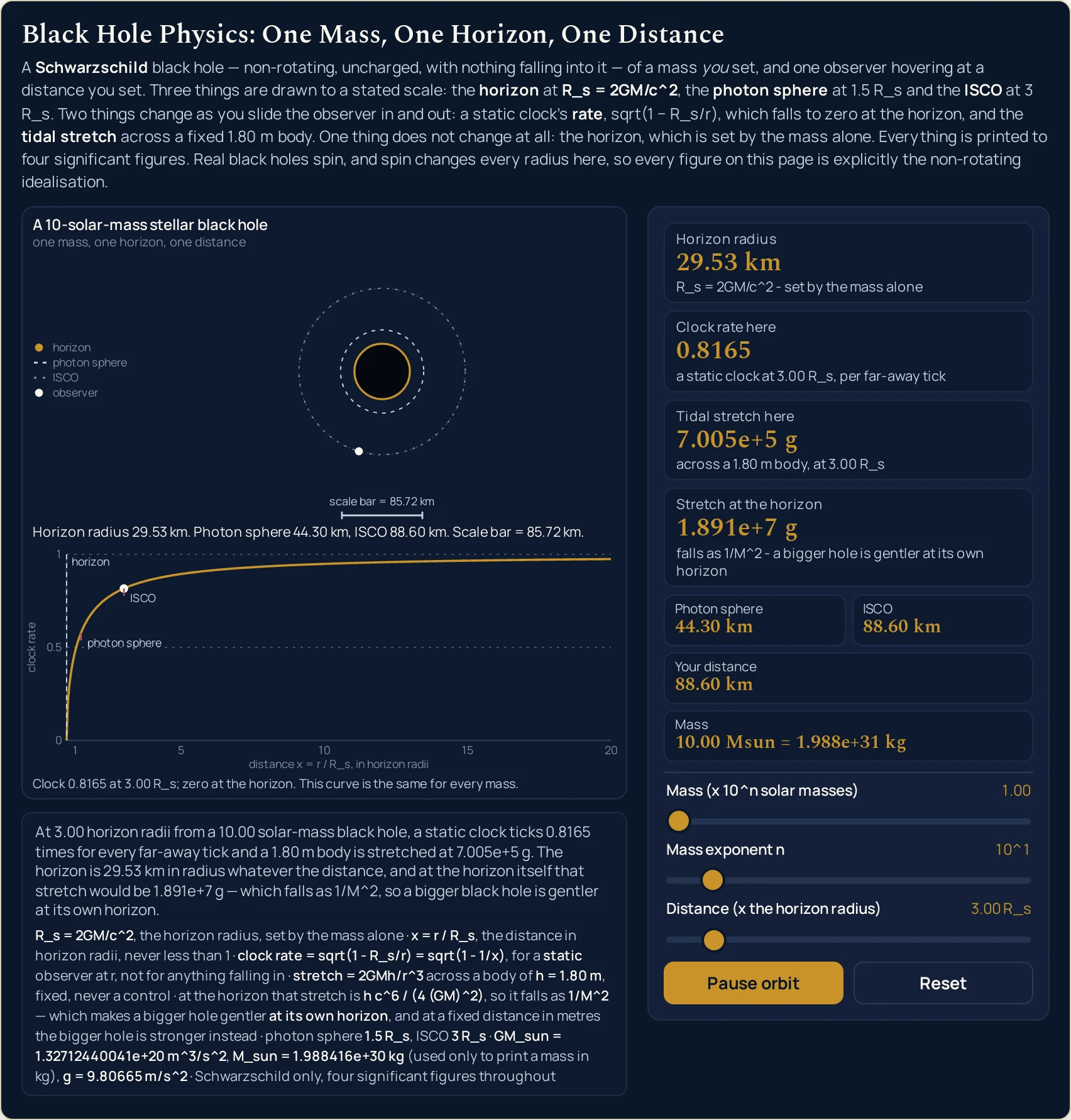
The black hole simulator is a free interactive lab with three sliders and eight readings, and the first reading will not move however far you drag the third slider. Two sliders set the mass as a mantissa and a power of ten; the third sets how far out you are standing, counted in horizon radii rather than kilometres. What that third slider does move is the clock and the tide — from 0.8165 down to 0.0000 and from 7.005e+5 g up to 1.891e+7 g on the hole the lab opens with.
Black Hole Physics: One Mass, One Horizon, One Distance
A Schwarzschild black hole — non-rotating, uncharged, with nothing falling into it — of a mass you set, and one observer hovering at a distance you set. Three things are drawn to a stated scale: the horizon at R_s = 2GM/c^2, the photon sphere at 1.5 R_s and the ISCO at 3 R_s. Two things change as you slide the observer in and out: a static clock's rate, sqrt(1 − R_s/r), which falls to zero at the horizon, and the tidal stretch across a fixed 1.80 m body. One thing does not change at all: the horizon, which is set by the mass alone. Everything is printed to four significant figures. Real black holes spin, and spin changes every radius here, so every figure on this page is explicitly the non-rotating idealisation.
Load a real black hole in one click
Each button writes the three sliders and touches nothing else, which is exactly what your own hand would do. They are arranged in three overlapping groups, and each group is one claim that you can watch rather than take on trust.
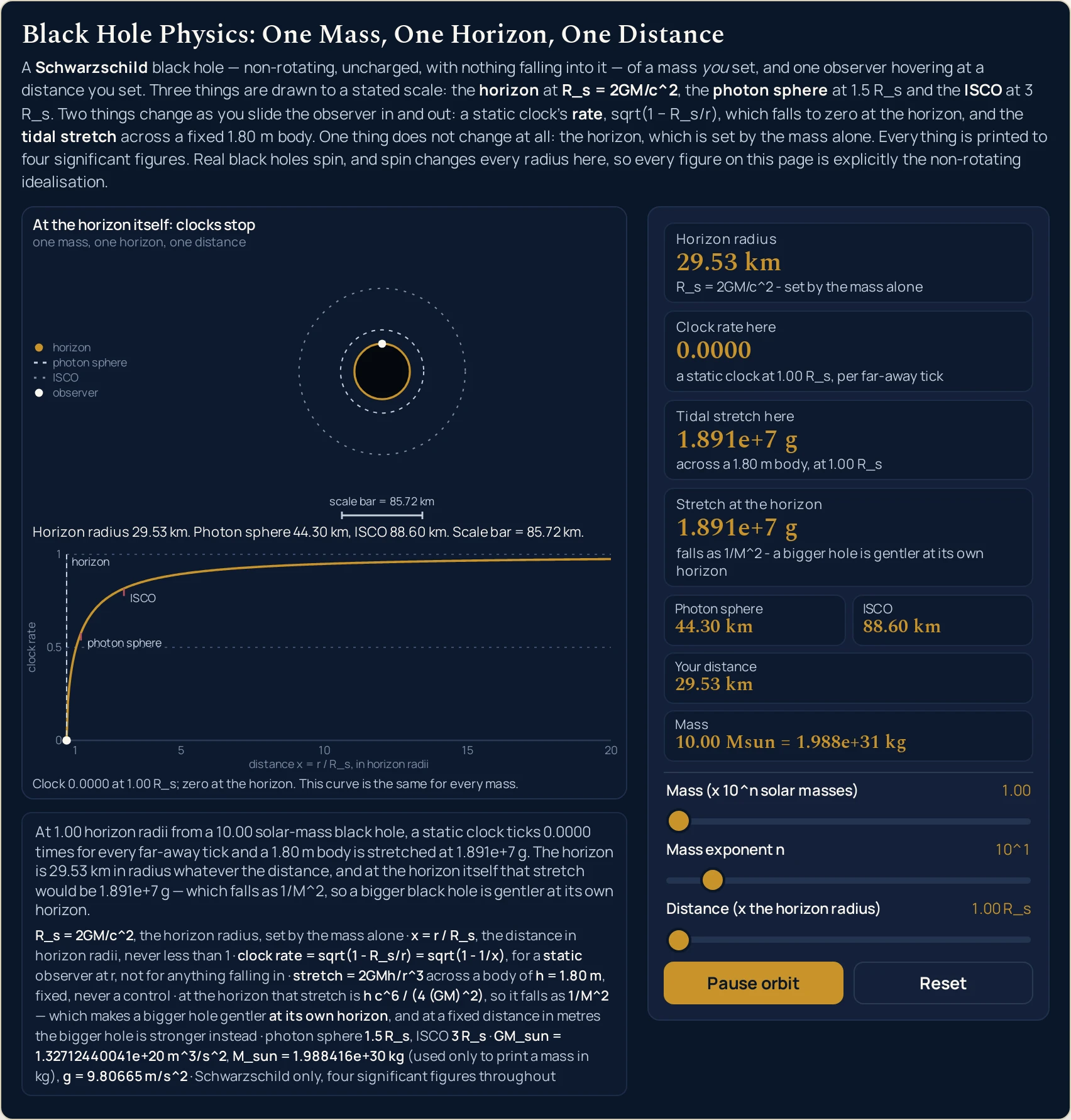
Buttons one and three are the mass pair: same distance, same clock rate, and the horizon radius goes from 2.953 to 29.53 km, exactly ten times. Buttons three, four and five are the distance triple on one unchanged hole, where Clock rate here runs 0.8165, 0.5774, 0.0000 and Horizon radius never budges from 29.53 km. Buttons five to eight are the tide ladder, all at the horizon, with only the mass changing.
Pick one of the eight black holes above, or drag the three sliders yourself.
What Is the Black Hole Simulator?
The black hole simulator is a free interactive physics lab that runs in your browser, with nothing to install and no sign-up. It draws one Schwarzschild black hole face-on — non-rotating, uncharged, with nothing falling into it — and puts you at a distance you choose. Three sliders set the mass as a mantissa and a power of ten and set that distance; eight readings answer.
The distance is counted in horizon radii rather than kilometres, and that is the choice the whole panel rests on. A setting of 1.00 puts you on the horizon whatever the mass is, and 3.00 puts you on the innermost stable circular orbit; a slider in kilometres could never land on either for an arbitrary mass. Your distance as a length is still shown, in the compact row.
One card refuses to move, and it is the first one. Hold the two mass sliders at 1.00 and 10^1 and drag Distance (x the horizon radius) from 1.00 to 20.00, the full width of the slider: Horizon radius reads 29.53 km at every step, and its sub-line stays byte-identical at R_s = 2GM/c^2 - set by the mass alone. Photon sphere and ISCO hold at 44.30 km and 88.60 km through all of it.
What the distance does move is the clock. Clock rate here is how many times a static clock where you are standing ticks for every tick of one far away, and it collapses as you close in: 0.9747 twenty horizon radii out, 0.8165 at the innermost stable circular orbit, 0.5774 on the photon sphere, 0.09950 one hundredth of a radius above the horizon and exactly 0.0000 on it. It never reaches 1.000 at any distance this slider offers.
Those five strings are the same for every mass the sliders reach, which is the sharpest thing the lab has to say. Checked at one solar mass, at ten and at ten billion, the clock rate at a given setting does not change at all, so the cliff in the drawn curve sits in the same place for a city-sized hole and a galaxy-centre one. A length can always be rescaled; a clock coming to a stop cannot.
A compact row of four more readings sits under the cards. Photon sphere is at one and a half times the horizon radius and ISCO at three times it, both quoted as radii of the same geometry rather than worked out from an orbital period; Your distance is where you are in kilometres; and Mass prints what the two mass sliders come to, 10.00 Msun = 1.988e+31 kg at the opening setting.
The two tidal cards carry the claim the lab exists for, and one qualifier the claim is false without. Tidal stretch here is the pull across a fixed 1.80 m body where you are standing, and Stretch at the horizon is the same quantity evaluated on the horizon instead, so only the first of them answers to the distance slider. The body length is deliberately not a control.
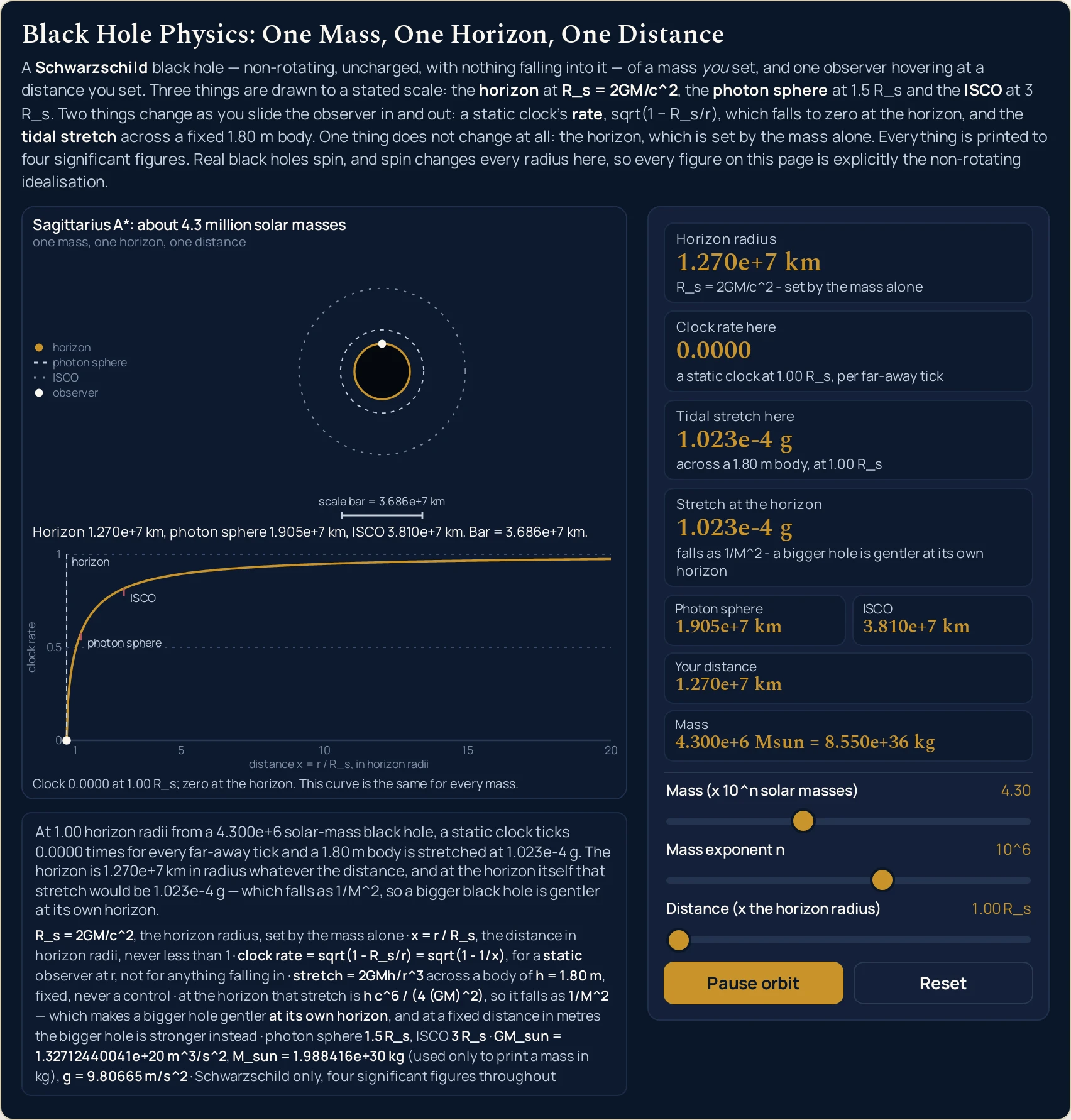
At each hole’s own horizon that second figure falls as one over the mass squared, so a bigger hole is gentler there: 1.891e+7 g at ten solar masses, 0.9996 g at 4.350e+4, 1.023e-4 g at about 4.3 million, 1.891e-11 g at ten billion. Line both holes up at the same distance in metres instead and that order flips, because at a fixed radius the pull across the body simply tracks the mass, so the heavier one wins by exactly the mass ratio.
Eight preset cases on the landing page write the three sliders for you, and they are arranged in three overlapping groups rather than a list. Two of them differ only in mass and show the horizon going from 2.953 to 29.53 km, exactly ten times. Three of them differ only in distance on one unchanged hole. Four of them sit at the horizon and walk the mass, which is the order the tidal claim has to be read in.
The drawing is a face-on map above a graph, not a plot against time. Because the horizon spans ten decades across the sliders the map auto-fits, so a short scale bar beneath it prints its own value in kilometres — and that printed value is the only honest way to read a distance off the picture. The graph below is the clock-rate curve against distance, with the rate on a plain axis from zero to one so the cliff at the horizon is visible rather than hidden.
A marker shows where you are standing and a small dot circles the hole through it. The dot claims nothing about a rate: no string in the lab states a speed, a period or a number of orbits, and at the horizon itself it is drawn stationary, because there is no circular orbit there. It is already circling when the page loads, so the button beside Reset reads Pause orbit rather than asking to be started, and pressing it changes no reading.
Every radius here is the non-rotating Schwarzschild case, and real black holes spin, so these figures are an idealisation rather than numbers for a particular object. The region inside the horizon is neither drawn nor described, and the panel carries no reading at all for radiation from a horizon, an entropy, an ergosphere, a dragged frame, a disc, a jet, a bent light path or a ripple in spacetime. Every computed reading is four significant figures with the trailing zeros kept.
| Control | Range | Step, default and what it moves |
|---|---|---|
| Mass mantissa | 1.00 to 9.99 | step 0.01; opens at 1.00. The first of two mass sliders, labelled Mass (x 10 to the n solar masses). It is the slider that lets a named mass be hit exactly rather than approached: 4.35 and 4.30 are both on its grid, so 4.350e+4 and 4.300e+6 solar masses are reachable |
| Mass exponent | 0 to 10 | step 1; opens at 1, shown as a power of ten. The second mass slider. Each whole step is a factor of ten in the horizon radius and in every other radius on the panel: 2.953 km at one solar mass, 29.53 km at ten, 295.3 km at a hundred, and so on to 2.953e+10 km |
| Distance | 1.00 to 20.00 horizon radii | step 0.01; opens at 3.00, which is the innermost stable circular orbit. The only control the first card ignores, and the only one the clock rate answers to. Its full width takes the clock from 0.0000 to 0.9747 and the tide where you stand from 1.891e+7 g to 2364 g on the opening hole |
| Body length | fixed at 1.80 m | not a control at all, and the panel states it in both tidal sub-lines and in the definition line under the drawing. The two tidal readings are strictly proportional to it, so a slider would let a reader change the figure for a reason that teaches nothing. The calculator exposes it instead |
| Orbit | circles from load; pauses | one button, and the dot is already circling when the lab loads, so the button starts out reading Pause orbit. Pressing it freezes the frame. Nothing the motion touches reaches any readout, so pausing changes no reading at all, and no string anywhere states a speed or a period |
| Reset | back to the opening setting | one button; it restores all three sliders to a mantissa of 1.00, an exponent of 1 and a distance of 3.00 horizon radii, and leaves the dot circling |
How to use the black hole physics simulator
- Read the eight readings before you touch anything. The four cards are already answering for a ten-solar-mass hole with you standing at three horizon radii: Horizon radius 29.53 km, Clock rate here 0.8165, Tidal stretch here 7.005e+5 g and Stretch at the horizon 1.891e+7 g. The compact row under them reads 44.30 km, 88.60 km, 88.60 km and 10.00 Msun = 1.988e+31 kg.
- Notice that the mass is two sliders, not one. Mass (x 10^n solar masses) carries the mantissa and Mass exponent n carries the power of ten, so the chips read
1.00and10^1at load. That split is what lets a named mass be reached exactly:4.35with10^4, or4.30with10^6, rather than whatever a logarithmic slider happened to land on. - Drag Mass exponent n alone and watch the first card and the drawing together.
10^0gives 2.953 km,10^1gives 29.53 km,10^2gives 295.3 km,10^3gives 2953 km. Each whole step is a factor of ten in the radius and nothing else in the relation changes. - Now drag Distance (x the horizon radius) and watch the first card refuse. Take it from
1.00to20.00: Horizon radius reads 29.53 km at every stop, and so do Photon sphere and the innermost stable circular orbit. The grid reading that moves is Your distance, from 29.53 to 590.7 km. - Read Clock rate here while you do it, because this is the card the lab exists for. 0.0000 at
1.00 R_s, 0.5774 at1.50, 0.7071 at2.00, 0.8165 at3.00, 0.9747 at20.00. Change the mass by ten decades and those five strings do not change at all. - Compare the two tidal cards, which answer to different things. Tidal stretch here falls as you move out — 1.891e+7 to 2364 g across the distance slider. Stretch at the horizon ignores the distance entirely and stays on 1.891e+7 g, because it is always evaluated at the horizon rather than where you are.
- Read the drawing in two halves, and read the scale bar first. The upper scene is the hole face-on with its two rings and your marker on it; the lower one is the whole clock-rate curve with your distance marked by a filled dot. The scene auto-fits, so the disc never looks much bigger or smaller — the short bar underneath prints the kilometres that make the picture honest.
- Press Pause orbit when you would rather read than watch. The dot is already circling when the page loads, so the button reads Pause orbit rather than asking to be started, and pressing it changes no reading at all. Reset puts the three sliders back to
1.00,10^1and3.00 R_sand leaves the dot circling.
Dragging is the right way to find out which readings a control is allowed to move, and a poor way to hit an exact figure — the mantissa steps in hundredths, the exponent in whole powers of ten and the distance in hundredths of a horizon radius. When you already have a mass, or a radius you want the mass behind, the Schwarzschild radius calculator takes typed input and solves the relation in either direction. It has no drawing and no sliders; this panel has no unit menus and no inverse. The written guide to black hole physics is where the subject itself is set out at length.
Worked example: change one thing at a time
Nothing in the three tables below was worked out here. Each row is a setting the lab was put into and then read back from, cell by cell, so every string in them is the panel’s own. Each table moves one slider down its column and pins the others, which is what makes the column that changes diagnostic.
One: the mass, with the distance pinned at three horizon radii
The distance slider stays on 3.00 R_s in all five rows. Only the two mass sliders move, a factor of a thousand from top to bottom.
| Mass sliders | Mass reading | Horizon radius | Photon sphere | ISCO | Clock rate here | Stretch at the horizon |
|---|---|---|---|---|---|---|
| 1.00 and 10^0 | 1.000 Msun = 1.988e+30 kg | 2.953 km | 4.430 km | 8.860 km | 0.8165 | 1.891e+9 g |
| 3.00 and 10^0 | 3.000 Msun = 5.965e+30 kg | 8.860 km | 13.29 km | 26.58 km | 0.8165 | 2.102e+8 g |
| 1.00 and 10^1 | 10.00 Msun = 1.988e+31 kg | 29.53 km | 44.30 km | 88.60 km | 0.8165 | 1.891e+7 g |
| 1.00 and 10^2 | 100.0 Msun = 1.988e+32 kg | 295.3 km | 443.0 km | 886.0 km | 0.8165 | 1.891e+5 g |
| 1.00 and 10^3 | 1000 Msun = 1.988e+33 kg | 2953 km | 4430 km | 8860 km | 0.8165 | 1891 g |
Read the three radius columns down the page first. Every one of them scales by exactly the same factor as the mass: ten times the mass gives ten times the horizon radius, ten times the photon sphere and ten times the innermost stable circular orbit. Rows one and three are the two buttons worth pressing one after the other — 2.953 becoming 29.53 km is the whole of the first claim, in one click.
Now read the clock column, which does not move at all. 0.8165 in all five rows, from one solar mass to a thousand. The distance slider has not been touched, and the clock rate answers to that slider and to nothing else — which is why the curve the lab draws needs one axis and carries no mass anywhere in it.
The last column is the one that surprises people. 1.891e+9, 2.102e+8, 1.891e+7, 1.891e+5, 1891 g: the horizon tide falls as the mass rises, and it falls as the square. Ten times the mass divides it by a hundred. The qualifier that makes this true is at its own horizon, and the third table is where it is worth reading slowly.
Two: the distance, with the mass left alone at ten solar masses
Now the two mass sliders are pinned at 1.00 and 10^1, and only the distance moves, from the floor of its slider to its ceiling.
| Distance slider | Horizon radius | Photon sphere | Your distance | Clock rate here | Tidal stretch here | Stretch at the horizon |
|---|---|---|---|---|---|---|
| 1.00 R_s | 29.53 km | 44.30 km | 29.53 km | 0.0000 | 1.891e+7 g | 1.891e+7 g |
| 1.01 R_s | 29.53 km | 44.30 km | 29.83 km | 0.09950 | 1.836e+7 g | 1.891e+7 g |
| 1.50 R_s | 29.53 km | 44.30 km | 44.30 km | 0.5774 | 5.604e+6 g | 1.891e+7 g |
| 2.00 R_s | 29.53 km | 44.30 km | 59.07 km | 0.7071 | 2.364e+6 g | 1.891e+7 g |
| 3.00 R_s | 29.53 km | 44.30 km | 88.60 km | 0.8165 | 7.005e+5 g | 1.891e+7 g |
| 6.00 R_s | 29.53 km | 44.30 km | 177.2 km | 0.9129 | 8.757e+4 g | 1.891e+7 g |
| 10.00 R_s | 29.53 km | 44.30 km | 295.3 km | 0.9487 | 1.891e+4 g | 1.891e+7 g |
| 20.00 R_s | 29.53 km | 44.30 km | 590.7 km | 0.9747 | 2364 g | 1.891e+7 g |
Two whole columns are constant, and that is the point of the table. 29.53 km and 44.30 km down all eight rows, with 1.891e+7 g beside them. Three of these eight rows are the preset buttons A 10-solar-mass stellar black hole, On the photon sphere and At the horizon itself, so you can press the claim instead of reading it.
The clock column is where the cliff is. It climbs gently over most of the slider — 0.8165, 0.9129, 0.9487, 0.9747 — and then collapses in the last hundredth before the horizon: 0.09950 at 1.01 R_s and 0.0000 at 1.00. That is the shape the drawn curve shows, and it is why the lab plots the rate on a plain linear axis from zero to one.
The rate never reaches 1.000 anywhere on this slider. Twenty horizon radii out it is still 0.9747, so a clock at any finite distance is running slow and the honest phrasing is always “far enough away for the difference to be negligible”. A clock that is merely moving also runs slow, for a different reason and by a different formula, and that is the kind of time dilation a moving clock shows rather than this one.
Three: the tide ladder, with the distance pinned at the horizon
The distance slider sits on 1.00 R_s in all seven rows, so every reading is taken at each hole’s own horizon. Only the mass moves, over ten decades.
| Mass reading | Horizon radius | ISCO | Clock rate here | Stretch at the horizon |
|---|---|---|---|---|
| 1.000 Msun = 1.988e+30 kg | 2.953 km | 8.860 km | 0.0000 | 1.891e+9 g |
| 10.00 Msun = 1.988e+31 kg | 29.53 km | 88.60 km | 0.0000 | 1.891e+7 g |
| 1000 Msun = 1.988e+33 kg | 2953 km | 8860 km | 0.0000 | 1891 g |
| 4.350e+4 Msun = 8.650e+34 kg | 1.285e+5 km | 3.854e+5 km | 0.0000 | 0.9996 g |
| 1.000e+5 Msun = 1.988e+35 kg | 2.953e+5 km | 8.860e+5 km | 0.0000 | 0.1891 g |
| 4.300e+6 Msun = 8.550e+36 kg | 1.270e+7 km | 3.810e+7 km | 0.0000 | 1.023e-4 g |
| 1.000e+10 Msun = 1.988e+40 kg | 2.953e+10 km | 8.860e+10 km | 0.0000 | 1.891e-11 g |
Read the last column top to bottom and the claim is unmistakable. 1.891e+9 g down to 1.891e-11 g as the mass climbs from one solar mass to ten billion: twenty decades of tide across ten decades of mass, because the fall is as the square. The fourth row is where it crosses something you can feel — 0.9996 g, which is why that preset is named for a tide of about 1 g and not exactly one.
The second column goes the other way, and that is the whole trick. The horizon radius rises with the mass while the tide at it falls, so the bigger hole is gentler at its own horizon — and only there. Line two of these holes up at the same distance in metres instead and the comparison reverses, because at a fixed radius the stretch is simply proportional to the mass.
The clock column is constant down every row, and that is the sharper claim. 0.0000 at one solar mass and 0.0000 at ten billion, a factor of ten billion apart in radius. The horizon is a place in the geometry rather than a size, and the clock is what says so. The speed of light in the denominator of the horizon relation is exact by the definition of the metre, so none of these radii carries any uncertainty from it.
Formula and symbol reference
The lab prints its own relations under the drawing, in the fixed definition line, in plain ASCII so that no radical sign and no subscript glyph is ever needed. Written out the same way, with sqrt spelled and every subscript an underscore:
R_s = 2GM/c^2 is the horizon radius; x = r / R_s is the distance slider, so clock rate = sqrt(1 - R_s/r) = sqrt(1 - 1/x) for a static observer; and stretch = 2GMh/r^3 across the fixed h = 1.80 m body, which at the horizon becomes h c^6 / (4 (GM)^2). That last form is where the one-over-mass-squared behaviour of the fourth card comes from. The photon sphere sits at 1.5 R_s and the orbit limit at 3 R_s.
Those two rings are quoted here as radii and are never worked out from a period. This panel has no orbital period in it at all: the Kepler third law calculator is where a period comes from a semi-major axis and a mass, and nothing on it transfers to a ring this close to a horizon. A Newtonian calculation does reach the same algebra for the horizon radius, for the wrong reason, and that route belongs to the escape velocity guide rather than here.
Twelve rows follow and only three of them are something you drag. The rest are cards, cells of the compact row, or quantities the panel names without giving you a control for. For the sliders the right-hand column gives the end stops and the step; for everything else it gives the strings the lab printed and the span it printed them over.
| Symbol or reading | Meaning | SI unit | In this lab |
|---|---|---|---|
| M | The mass of the hole, and the only quantity the horizon radius depends on. Set by two sliders rather than one | kilogram, entered in solar masses | the mass chip runs from 1.000 Msun = 1.988e+30 kg at the bottom corner of both sliders to 9.990e+10 Msun = 1.986e+41 kg at the top of both. Every preset mass is an exact grid value, including 4.350e+4 and 4.300e+6. |
| mant | The mass mantissa — the first slider, labelled Mass (x 10^n solar masses). The chip above it prints two decimals |
a number, so no unit | 1.00 to 9.99 in steps of 0.01, opening at 1.00. It is the slider that lets a named mass be hit exactly: 4.35 and 4.30 are both on its grid. |
| exp | The power of ten the mantissa is multiplied by — the second slider, Mass exponent n. The chip prints it as a power |
a number, so no unit | 0 to 10 in steps of 1, opening at 10^1. Ten whole steps, because the subject runs from a few solar masses to ten billion and a linear slider cannot cover that. |
| Rs | The horizon radius — the first card, labelled Horizon radius. Exactly proportional to the mass, and the one card no distance can move |
metre, printed in kilometres | from 2.953 km at one solar mass to 2.950e+11 km at the top of both mass sliders. Its sub-line reads R_s = 2GM/c^2 - set by the mass alone at every setting the distance slider can reach. |
| x | Your distance from the centre as a multiple of the horizon radius — the third slider, and the only control the first card ignores | a ratio, so no unit | 1.00 to 20.00 in steps of 0.01, opening at 3.00. The chip prints 1.00 R_s and 20.00 R_s at the ends. The floor is 1.00 because inside a horizon there is no static observer for the readings to belong to. |
| r | Your distance as a length — the third cell of the compact row, Your distance. The one grid reading that moves when only the distance slider does |
metre, printed in kilometres | from 2.953 km to 5.901e+12 km across the grid. On the opening ten-solar-mass hole it runs 29.53 km to 590.7 km as the distance slider crosses its full width. |
| clock rate | How many times a static clock at your distance ticks for every far-away tick — the second card, Clock rate here. A pure function of the distance |
dimensionless | from 0.0000 at 1.00 R_s to 0.9747 at 20.00 R_s, and those two strings are identical at every mass the sliders reach — checked at one, ten and ten billion solar masses. It never reaches 1.000 at any distance the slider offers. |
| rphoton | The photon sphere — the first cell of the compact row, at one and a half times the horizon radius. A radius of the same geometry, quoted rather than derived | metre, printed in kilometres | from 4.430 km to 4.425e+11 km across the mass sliders, and like the horizon it does not move when the distance slider does: 44.30 km in all eight rows of the distance table below. |
| rISCO | The innermost stable circular orbit — the second cell of the compact row, at three times the horizon radius. The outer of the two rings the scene draws round the horizon | metre, printed in kilometres | from 8.860 km to 8.851e+11 km across the mass sliders. The opening distance of 3.00 puts you exactly on it, which is why Your distance and the innermost stable circular orbit both read 88.60 km at load. |
| stretch | The tidal stretch across the body at your distance — the third card, Tidal stretch here, printed as a multiple of the standard acceleration of free fall |
multiple of the standard gravity | from 1.891e+9 g at the closest, lightest corner of the grid to 2.369e-17 g at the furthest, heaviest one — about twenty-six decades. On the opening hole the distance slider alone takes it from 1.891e+7 g to 2364 g. |
| stretch at the horizon | The same stretch evaluated at the horizon instead — the fourth card, Stretch at the horizon. Falls as one over the mass squared, at each hole’s own horizon |
multiple of the standard gravity | from 1.891e+9 g at one solar mass to 1.895e-13 g at the top of both mass sliders, about twenty-two decades. Its sub-line is byte-identical at all eight presets: falls as 1/M^2 - a bigger hole is gentler at its own horizon. |
| h | The length of the body the two tidal cards are measured across. Fixed at 1.80 m and deliberately not a control — the lab states it in both tidal sub-lines and in the definition line under the drawing | metre | the same 1.80 m at every one of the settings on this page. A body-length slider would let a reader change the tidal figure for a reason that teaches nothing; the calculator exposes it instead, because a reader there may have a real object in mind. |
If you read one row twice, make it the clock rate row. It is the only reading on the panel whose span is the same two strings for every mass the sliders can reach, and that is what separates this lab from a radius calculator.
The physics: the three claims the panel lets you test
The first is that the horizon belongs to the mass and to nothing else. Two sliders set it, the third cannot touch it, and you can try to break that: hold the mass still, sweep the distance from 1.00 to 20.00, and the first card’s sub-line stays byte-identical at R_s = 2GM/c^2 - set by the mass alone. The drawn disc does not change size either, although the scale bar under it does.
The second is the one the lab exists for, and it needs the curve as well as the cards. A static clock at your distance ticks sqrt(1 - 1/x) times for every far-away tick, and at the horizon that is exactly 0.0000. Sample it at three masses ten decades apart and the string does not change: the cliff in the drawn curve is in the same place for a one-solar-mass hole and a ten-billion-solar-mass one.
That mass-independence is why the curve caption says what it says rather than naming a mass. A radius is a length and lengths scale; a clock stopping is not a length. Any account of a black hole that defines it purely by how big it is has described the easy half, and this panel puts the hard half on a card next to it.
The third claim is the awkward one, and it comes with four words it is false without. At each hole’s own horizon the tide across the fixed 1.80 m body falls as one over the mass squared, so a bigger hole is gentler there. At a fixed distance in metres the bigger hole is the stronger one instead, by exactly the mass ratio, and the lab’s own definition line under the drawing says both halves of that in one breath.
The constant that ties the three claims together is the speed of light, which appears squared in the horizon relation and to the sixth power in the horizon tide. Special relativity is where it is set up as a limit rather than as a constant in a denominator, and the horizon is where the geometry takes that limit seriously.
Where the black hole simulator’s readings break down
Every slider position this lab can reach is answered, and the arithmetic is not where it can let you down. The drawing is, and so is the model behind it. Nine limits sit under the readings on this page; four are choices the panel makes on purpose, and five are bounds on the physics rather than on the panel.
- Real black holes spin, and every radius here is the non-rotating one
- The whole lab is the Schwarzschild case: non-rotating, uncharged, isolated, with nothing falling in. Spin changes the horizon, the photon sphere and the innermost stable circular orbit, and it is not a small correction. The Wikipedia black hole article gives the rotational parameter of M87* as 0.90 plus or minus 0.05, which is close to the maximum a black hole can have. Treat every figure on the panel as an idealisation, and do not apply it to a named object except as one.
- “A bigger hole is gentler” is only true at its own horizon
- This is the one place this lane could ship something false, so the qualifier rides with the claim everywhere it appears: on the fourth card’s sub-line, in the sentence strip, in the definition line and in every paragraph above. At a fixed multiple of the horizon the tide falls as one over the mass squared. At a fixed distance in metres it is simply proportional to the mass, so there the bigger hole is the stronger one by exactly the mass ratio. Both statements are true, about different comparisons.
- The clock belongs to a static observer, and nothing in this lab falls in
- The second card answers for a clock held at that radius, against one infinitely far away. Nothing in this lab falls, so no reading on it predicts what a clock would do on the way through a horizon, and nothing here is a shift caused by motion towards or away from you. That is also half the reason the distance slider stops at
1.00: below it nothing could hold a radius for a card to answer about. - The scene auto-fits, so the drawn disc is never a measurement
- The horizon radius runs from 2.953 km to 2.953e+10 km across the presets alone, and no fixed scale is legible over ten decades. The scene therefore scales itself until whatever it draws furthest out uses about seventy per cent of the room it has, which means the disc looks about the same size whether the first card says 2.953 km or 2.950e+11 km. The short bar beneath it prints the kilometres it stands for, and that printed value is the only honest way to read a distance off the picture.
- The ring names are dropped whole on a narrow screen, never half-drawn
- The upper scene cannot label its rings in place, because the orbiting dot and its dotted path sweep through every angle and at three of the eight presets that path lies exactly on a named ring. The names therefore live in a reserved column beside the scene, and below roughly 290 pixels of scene width that column plus a legible drawing will not fit, so it is dropped whole rather than clipped. Nothing is lost: the caption underneath still prints the horizon radius and the bar’s own value, and the compact row names both rings with their figures a little further down.
- The orbiting dot claims no rate, and there is nothing to read off it
- No string anywhere in the lab states a speed, a period or a number of orbits, and that is deliberate rather than an omission: a real orbital period at a given radius is a calculation this lane does not make. The dot marks where you are standing and keeps the scene alive. At
1.00 R_sit is drawn stationary on the horizon, because there is no circular orbit there at all, and one hundredth of a radius further out it circles again. - The scene stops naming a case as soon as you touch a slider
- The title above the drawing reads a preset’s name only when all three sliders match one of its eight stored value sets. Nudge any one of them off — even by a single hundredth of a horizon radius — and it prints
A non-rotating black holeinstead. That is a refusal rather than a fault: every card carries on answering exactly as before, and the band is declining to claim a case the sliders are not on. - The interior is outside the model, and so is everything quantum
- Each of the three relations behind the eight readings is a statement about the geometry outside the horizon, and no slider can leave it. There is no control, card or drawn mark anywhere in the lab for an evaporation time, a temperature, an entropy, an ergosphere, a dragged frame, a singularity, an accretion disc, a jet, a bent light path or a gravitational wave, and no figure for any of them is printed or implied. Even the photon sphere is a bare ring here, with no light path drawn on it.
- The relation is arithmetic; what exists is a separate question
- The mass sliders start at one solar mass, which is below the sourced three-solar-mass observational floor — the limit above which a compact object can only be a black hole. The preset at 8.860 km is named for that floor for exactly this reason. The lab will happily draw a lighter one, and it claims no formation mechanism for it and does not call it an observed object.
Where black hole physics is actually used
- Watching one claim at a time, which is what the groupings are for
- This is the forward use of the panel and the reason the presets are in the order they are. Press buttons one and three and only the mass has changed, so the 29.53 against 2.953 km is the proportionality and nothing else. Press three, four and five and only the distance has changed, so the 0.8165, 0.5774, 0.0000 is the clock and nothing else. Two claims, five clicks, nothing to take on trust.
- Showing that the cliff sits in the same place for every mass
- The drawn curve is the quickest answer to “how close is close?” that this subject has. Because the horizontal axis is in horizon radii, the shape is the same for every mass: 0.5774 on the photon sphere and 0.8165 at the orbit limit hold for a one-solar-mass non-rotating hole and for a ten-billion-solar-mass one alike. Those two numbers are worth carrying around, and the panel is where you can check that they really do not move.
- Finding the mass at which a horizon stops being a shredder
- Walk the tide ladder table and watch one column: 1.891e+7, 1891, 0.9996, 0.1891, 1.023e-4 g. The crossing is the interesting part — somewhere around the fourth rung the tide across a 1.80 m body at the horizon is roughly your own weight, and the preset’s 0.9996 g is as close as the mantissa slider lands. Above that mass the tide across that 1.80 m body at the horizon is under 1 g.
- Reading a radius off a drawing without being fooled by it
- This is a transferable habit rather than a fact about black holes. Any picture that has to span ten decades must auto-fit, and an auto-fitted picture with no stated scale tells you only the ratios of what is in it. The bar under this scene prints its own length in kilometres at every setting, which is the thing that turns the drawing back into a measurement — and it is why the caption beneath the scene always carries that figure.
- Separating what the mass sets from what the distance sets
- Split across two controls, the readings sort themselves into two groups you can name. The mass alone fixes the horizon radius, the photon sphere, the orbit limit and the tide at the horizon. The distance alone fixes the clock rate. Only your distance as a length and the tide where you are standing need both. That is a cleaner division than the formulae look like they give, and it is the thing dragging one slider at a time shows you.
- Keeping the gravitational clock effect apart from the velocity one
- Two different effects slow a clock and they are easy to run together. What this panel prints comes from where the clock is; the other comes from how fast it is going, and the Lorentz factor calculator is the tool for that one. One is a fact about position and the other a fact about motion, they take different inputs, and a clock in a real orbit is subject to both at once. Nothing on this panel is evidence about the moving kind.
Where to go next
A panel can show you which readings a control is allowed to move, and that is the end of what a panel is for. Black hole physics is where the subject itself is written out: what a black hole is, how the horizon, the clock and the tide fit together, the worked problems and the misconceptions. The calculator that takes a typed mass or a typed radius and solves either direction heads the related tools below.
Two posts carry the effects this panel deliberately keeps out. The time dilation guide belongs to clocks that are moving rather than clocks that are deep in a field, and the escape velocity guide owns the calculation whose algebra arrives at the horizon radius without the geometry that justifies it.
For the constant underneath all of it, the special relativity guide sets up the speed of light as a limit and the speed of light guide is the constant itself. Further out, the law of gravitation guide and the universal gravitation lab are the Newtonian field this geometry replaces close in, while the Kepler laws guide and the orbital velocity guide are where orbits are the subject rather than two quoted radii.
Beyond those there is the simulation library, an index of calculators, and the blog for everything written out at length.
Frequently asked questions
Why does the Horizon radius card not move when I drag the distance slider?
Because the distance is not in the relation that card evaluates. Hold the mass sliders at 1.00 and 10^1 and take Distance (x the horizon radius) from 1.00 all the way to 20.00: Horizon radius reads 29.53 km at every stop, and its sub-line stays on R_s = 2GM/c^2 - set by the mass alone. What moves instead is Your distance, from 29.53 km to 590.7 km.
Why is the mass two sliders instead of one?
Because the panel spans ten decades of mass and no single slider reaches both ends while still landing exactly on a named value. Mass (x 10^n solar masses) carries the mantissa in hundredths and Mass exponent n carries the power of ten, so the mass chip can read 1.00 and 10^1 for ten solar masses or 4.30 and 10^6 for about 4.3 million. Every preset value is an exact step.
Why is the distance measured in horizon radii rather than kilometres?
So that the same slider position means the same place for every mass. At 1.00 R_s you are on the horizon whatever the mass is, and at 3.00 R_s you are on the innermost stable circular orbit; a slider in kilometres could never land on either for an arbitrary mass. The absolute distance is still on the panel, in the compact row as Your distance.
Why does Clock rate here print 0.0000 at the horizon rather than a very small number?
Because at 1.00 R_s the quantity under the square root is exactly zero, so the reading is a result rather than a rounding. The lab prints four significant figures with the trailing zeros kept, which is why you see 0.0000 and not 0. Press the horizon preset and then the ten-billion-solar-mass one: both read 0.0000, a billion-fold difference in radius apart.
The drawing looks much the same at 1.000 and at 1.000e+10 solar masses. Why?
Because the scene auto-fits, so whatever it draws furthest out always uses about seventy per cent of the room it has. That is the only way one picture can cover a horizon from 2.953 km to 2.953e+10 km, and it is why a short scale bar under the scene prints its own value in kilometres. Read a distance off that bar or off the cards, never off how big the disc looks.
Is a bigger black hole really gentler?
At its own horizon, yes, and the four words are the whole claim. Walk the presets at 1.00 R_s and Stretch at the horizon reads 1.891e+7 g, then 0.9996 g, then 1.023e-4 g, then 1.891e-11 g. At a fixed distance in metres the comparison reverses, because there the stretch is simply proportional to the mass and the bigger hole is the stronger one.
Why does the title above the drawing change to A non-rotating black hole?
Because the lab names a case only when all three sliders match one of its eight stored value sets. Nudge any one of them off and it stops claiming a case and prints the plain title instead. That is a refusal rather than a fault: every card carries on answering exactly as before, and the band is declining to call an arbitrary setting by a name that would be false.
Does the orbiting dot tell me how fast anything is moving?
No, and nothing on the panel states a speed, a period or a number of orbits. The dot marks where you are standing and keeps the scene alive; a real orbital period at that radius is a calculation this lab does not make. At 1.00 R_s it is drawn stationary on the horizon, because there is no circular orbit there at all, and one step out it circles again.
Why will the distance slider not go below 1.00?
Because below 1.00 you would be inside the horizon, where the clock-rate expression puts a negative number under a square root and, more to the point, where nothing can hold a fixed radius at all. The readings belong to a static observer, and inside a horizon there is none. A distance of exactly 1.00 is not an error: it prints 0.0000 and a finite stretch.
References & formula source
- Every reading on this panel comes out of three numbers a reader chooses on a slider and three closed-form relations, with nothing fitted and nothing measured. The lab prints those relations on itself, in the fixed definition line under the drawing rather than leaving them to be taken on trust.
- Written out, they are these. The horizon radius is R_s = 2GM/c^2. The clock rate of a static observer is sqrt(1 - R_s/r), which in horizon radii is sqrt(1 - 1/x). The tidal stretch across a body of length h is 2GMh/r^3, and evaluated at the horizon that same quantity is h c^6 / (4 (GM)^2), which is where the one-over-mass-squared behaviour comes from. The photon sphere is at 1.5 R_s and the innermost stable circular orbit at 3 R_s; both are quoted as radii of the same geometry and neither is worked out from an orbital period.
- The Schwarzschild radius is taken here as the result of general relativity for a non-rotating, uncharged, isolated mass, and it is stated rather than derived. A Newtonian calculation that sets an escape speed equal to the speed of light reaches the same algebraic expression, and it does so for the wrong reason, because light does not slow down and fall back the way a stone does. That route belongs to the escape velocity guide, which is linked where this page mentions it, and no figure on this page comes from it.
- The constants the lab carries are the product of the gravitational constant and the solar mass, 1.32712440041e+20 m^3/s^2 from the IAU Division I Working Group, the IAU nominal solar mass 1.988416e+30 kg, which is used for exactly one job here, printing a mass in kilograms, the speed of light 299792458 m/s, exact by the SI definition of the metre, and the standard acceleration of free fall 9.80665 m/s^2, exact by definition. Sources: Wikipedia, "Solar mass" and "Schwarzschild radius".
- The second card answers for a STATIC observer, one holding a fixed radius, against a clock infinitely far away. The cause is where that observer is standing and not how fast it is going, so neither the velocity effect of special relativity nor a shift caused by motion is any part of it. Nothing in the lab falls, which is why no reading on it is a statement about crossing a horizon, and which is half the reason the distance slider has a floor of 1.00.
- The claim that a bigger black hole is gentler is true at each hole's OWN horizon and false at a fixed distance in metres, where the stretch is simply proportional to the mass instead. The qualifier appears in the fourth card's sub-line, in the sentence strip, and every time the claim is made on this page. At a fixed distance the bigger hole is the stronger one by exactly the mass ratio.
- Every radius this panel draws or prints is the non-rotating Schwarzschild case, and real black holes spin. The fetched source gives the rotational parameter of M87* as 0.90 plus or minus 0.05, which is close to the maximum, and spin changes every radius here, so none of these figures is the right one for a particular object. The one preset that names a real object quotes its mass only as the source states it, about 4.3 million solar masses, and presents its horizon radius as a consequence of that stated mass.
- The tidal form the lab uses is linearised in the body length. Measured against the exact difference of fields by an independent reference written before this lab existed, it is off by 1.859e-7 per cent at a body length of 1.80 m, which is five orders below the four figures the cards print, and the caveat belongs only to a body comparable with the horizon itself, which this lab never uses because the length is fixed.
- Nothing beyond the three relations above is modelled. The lab prints no temperature, no evaporation time, no entropy, no ergosphere radius, no frame-dragging rate, no accretion-disc figure, no jet, no bent light path and no gravitational-wave amplitude, and nothing on this page supplies one either. The region inside the horizon is not drawn and not described.
- The map scene auto-fits, so whatever it draws furthest out always uses about seventy per cent of the room it has, and the drawn size of the horizon disc is therefore not a measurement. A scale bar of fixed pixel length under the scene prints its own value in kilometres, and that printed value is the only honest way to read a distance off the picture. The radius recovered from the drawing alone, as the drawn horizon radius in pixels divided by the scale bar in pixels times the bar in kilometres, is asserted against the first card at every sampled setting.
- The orbiting dot is decorative and its rate is labelled nowhere. No string in the lab states a speed, a period or a number of orbits, because a real orbital period at a given radius is a calculation this lab does not make. At the horizon itself the dot is drawn stationary, because there is no circular orbit there. That nothing the animation touches reaches a readout was asserted rather than argued: all twenty-four readout strings were compared before and after a run of the animation at every viewport, and none of them moved.
- Four significant figures with the trailing zeros kept is the ceiling on every computed reading, and it is a house choice rather than a limit of the data. All three inputs are exact values chosen on a slider, so there is no measurement uncertainty to propagate. That is why the clock rate at the horizon reads 0.0000 rather than 0, why the rate just one hundredth of a horizon radius outside it reads 0.09950, and why the preset named for a horizon tide of about 1 g prints 0.9996 g, which is as near as its mantissa slider lands.
- Two engines were compared reading by reading rather than assumed to agree: slider positions were put side by side in Chrome and in Firefox at four widths and 114 readout values compared, all identical, with desktop heights within 0 px across engines. There is a hole in that, and it is Safari. The WebKit build on this machine will not start without system access it has not been given, so Safari was never exercised and nothing on this page is evidence about it.
- Every reading quoted on this page is a string this simulation printed for the slider positions named beside it, read back out of the running lab in a browser rather than worked out by hand. Where a figure here and the lab part company, believe the lab, and verify anything you rely on before using it.
- Further reading: Schwarzschild radius — Wikipedia