A black hole has one length of its own, the horizon radius R_s = 2GM/c^2, and the mass is the only thing in it. Every solar mass is worth 2.953 km of horizon, so ten solar masses give a 29.53 km radius — a city, holding ten Suns. This free Schwarzschild radius calculator solves that relation in either direction and prints the photon sphere, the innermost stable circular orbit, your distance from the centre, the rate a static clock runs there, and the tidal stretch across a body both at that distance and at the horizon itself.
Load a real black hole
Every button writes all four boxes in their default units, so whichever quantity the Solve for menu is pointing at, the remaining three already agree with it. Each one carries the horizon to eight significant figures, which is what makes both directions return the same mass. The line underneath quotes back whatever the widget works out, so nothing in it is stored text.
Pick a black hole above, or type your own numbers.
What Is the Schwarzschild Radius Calculator?
The Schwarzschild radius calculator is a free online tool for the one length an isolated black hole has of its own. In the Schwarzschild solution of general relativity the metric coefficient 1 - R_s/r falls to zero at R_s = 2GM/c^2, and that radius is the event horizon. Give the tool a mass and it returns the horizon; give it a horizon and it returns the mass.
Those are the only two solve targets, and two is the right number rather than a shortfall. The speed of light is a constant, so the radius and the mass determine each other completely and there is no third unknown left to find. The menu opens on the radius, which is the direction almost every question arrives in.
The distance and the body length are the two boxes that never leave the form, because both are inputs in each mode and neither is ever an unknown. The distance is counted in horizon radii, so 1 is the horizon itself and 3 is the innermost stable circular orbit; it can never go below 1, since inside a horizon there is no static observer and the radius is not a radius. Neither box touches the headline: only the mass appears in the formula.
Seven readings sit beside the answer. They are the photon sphere at 1.5 times the horizon radius, the innermost stable circular orbit at 3 times it, your distance from the centre as a length, the rate a static clock runs at that distance, the tidal stretch across the body there, the same stretch at the horizon itself, and the mass in kilograms. All seven are worked out from the complete state with the solved value substituted back, which is what makes them the same seven whichever quantity you asked for.
The calculator carries GM for the Sun as a single constant rather than multiplying a solar mass by the gravitational constant, and the reason is a real one. The horizon needs only that product, which is known to ten significant figures, while G on its own is known to six; going through G would throw away four figures for nothing. The solar mass in kilograms is used for exactly one job here, printing a mass in kilograms, and an independent check measures the two routes as 3.08e-6 apart, comfortably inside the 2.2e-5 relative standard uncertainty CODATA gives for G itself.
What makes a horizon special is the clock, not the size. The radius is a length and it scales: ten times the mass gives ten times the radius, exactly, so 2.953 km per solar mass is the whole relation. The clock rate sqrt(1 - 1/x), by contrast, is exactly 0.0000 at the horizon for every mass, from one solar mass to ten billion, and that mass-independence is what makes the horizon a place in the geometry rather than a size. The rate also never quite reaches 1, however far out you go, so a clock at any finite distance is always running slow.
The tidal readings carry the page's most surprising claim, and one qualifier that the claim is false without. At each hole's own horizon the stretch falls as one over the mass squared, so a bigger black hole is gentler there: across a 1.80 m body it is about nineteen million g at a ten-solar-mass horizon and a ten-thousandth of a g at one of about 4.3 million solar masses. At a fixed distance in metres the comparison reverses, because there the stretch is simply proportional to the mass and the bigger hole is the stronger one by exactly the mass ratio.
Four kinds of entry are declined rather than answered. A zero or negative mass has no horizon behind it, a zero or negative horizon radius cannot be inverted to a mass, a distance below 1 puts the clock rate under a negative root, and a zero or negative body length makes the tidal stretch vanish. In each case the page says so in words instead of printing an infinity or a NaN, and a distance of exactly 1 is not an error at all.
Two residuals are published rather than hidden. The default boxes cannot all be exactly true at once, because ten solar masses give a horizon of 29.532501 km and the four-figure 29.53 km sitting in the box inverts to 9.999 solar masses rather than 10.00; every preset removes that by writing the horizon to eight figures. And an input carrying two significant figures cannot support a four-figure answer, which is why a horizon of one solar radius is read as about 2.370e+5 solar masses.
What the page does not do, it says. Every radius here is the non-rotating, uncharged Schwarzschild case, and real black holes spin, so none of these figures is the right one for a particular object. Nothing is modelled inside the horizon, and no figure is given for Hawking radiation, evaporation, entropy, the ergosphere, frame dragging, the singularity, an accretion disc, a jet, lensing or a gravitational wave. The clock rate belongs to a static observer and is not what an infalling clock reads, nothing here describes falling in, and the velocity kind of time dilation and the escape-velocity route to the same algebra are both left to their own pages.
| Symbol | Quantity | Default unit | Also accepts | Example value |
|---|---|---|---|---|
| R_s | Horizon radius | km | m | 29.53 |
| M | Mass | solar masses | kg | 10 |
| x | Distance (in horizon radii) | R_s | — | 3 |
| h | Body length | m | cm | 1.8 |
How to use the Schwarzschild radius calculator
- Choose the unknown. The Solve for menu opens on Horizon radius, and the other choice is Mass. There are only two, and that is correct:
cis a constant, so the two fix each other and there is no third unknown. - Type the mass. It takes solar masses or kg and opens on 10 solar masses. A solar mass is
1.988416e30 kg, so the two options are the same quantity written two ways. - Type the distance. It is in horizon radii and opens on 3, the innermost stable circular orbit. It is an input in both modes, so it never leaves the form — and it never touches the headline.
- Type the body length. It takes m or cm and opens on 1.80 m. It is the length the tidal stretch is measured across, and only the last three readings notice it.
- Read the headline. Four significant figures, with trailing zeros dropped, in the unit that box was showing — switching to scientific notation outside the range 0.0001 to 10,000,000. Set the unit while the quantity is still an input and then point Solve for back at it.
- Read the photon sphere and the ISCO first. They are
1.5and3times the horizon radius, and neither moves when you change the distance box. That is the first claim of the page in two readings. - Read the clock rate.
0.8165at the innermost stable circular orbit,0.5774on the photon sphere,0.0000at the horizon. It depends on the distance alone, so it reads the same for a one-solar-mass hole and a ten-billion-solar-mass one. - Read the two tidal stretches. The first is the stretch at your distance; the second is the stretch at the horizon, which falls as one over the mass squared — so a bigger hole is gentler at its own horizon.
- Open Show working. The steps give
GM,2GM,c^2and the quotient on four separate lines, then the proportionality as a check, then every reading with its arithmetic and your figures in every unit the boxes offer.
This page exists for the one step that turns a mass into a horizon, and then says what happens to clocks and bodies near it. The black hole physics guide is the prose half of it, with the mechanism, the worked problems and the misconceptions set out in full. The constant in the denominator has its own story too: the speed of light is exact by the SI definition of the metre, which is why the c^2 line of the working contributes no uncertainty at all.
Three mistakes account for most wrong answers here. The first is expecting the distance box to move the headline: it cannot, because x does not appear in R_s = 2GM/c^2 at all. The second is reading the clock rate as something an infalling observer would see — it is the rate of a static clock held at that radius, and nothing on this page models anything falling in.
The third is confusing this effect with the one a moving clock shows. A clock that is merely moving also runs slow, but for a different reason and by a different formula: that is velocity time dilation, and the time dilation calculator is the tool for it. The rate printed here comes from where the clock is, not from how fast it is going.
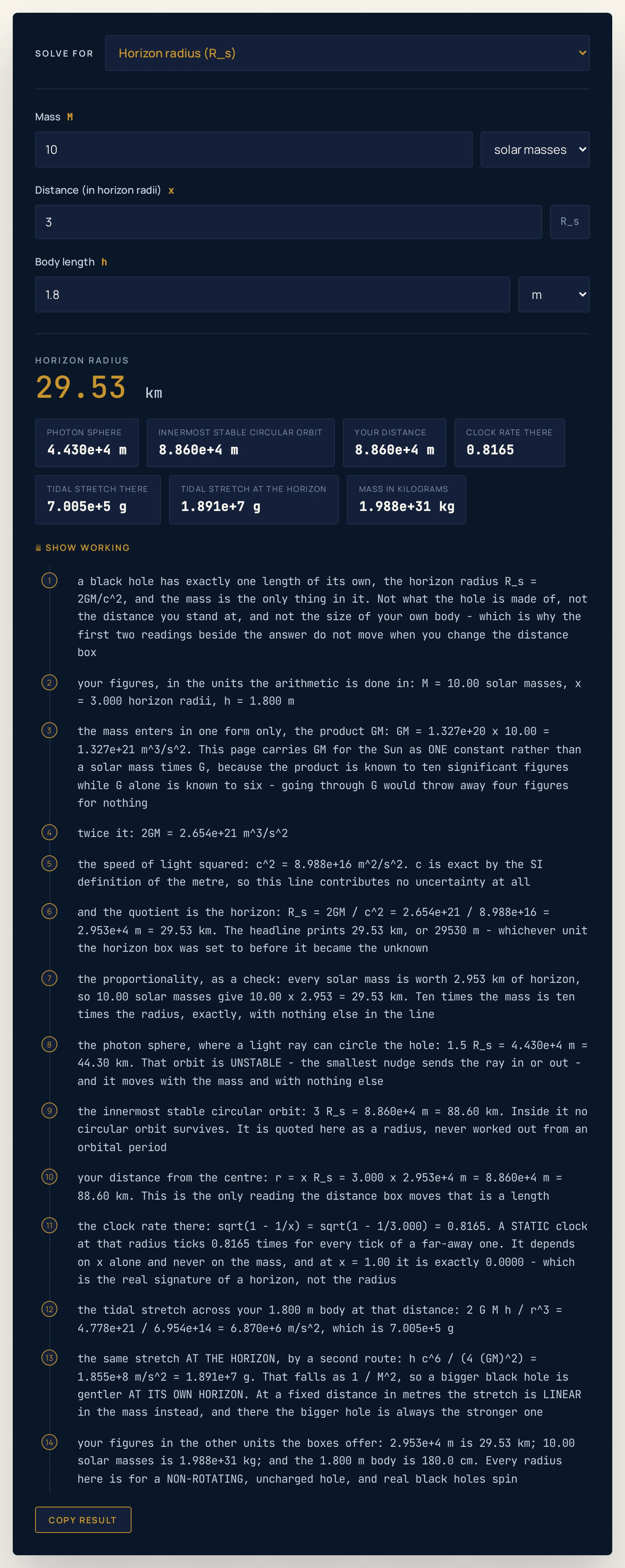
29.53 km. The distance box is on 3, the innermost stable circular orbit, where a static clock ticks 0.8165 times for every far-away tick and a 1.80 m body is pulled at 7.005e+5 g.Worked example: change one thing at a time
The table starts at the defaults, moves the unknown through both quantities, then loads each preset in turn, walks every unit menu, and finally reaches the entries the calculator declines. Rows 1 and 2 are one set of boxes solved two ways; row 3 is the same thing once the horizon carries eight figures instead of four. Every answer and reading cell was read out of the running widget rather than worked out by hand, so where a cell and the tool ever part company, believe the tool.
| Step | Solving for | What you type | Headline answer | Photon sphere | ISCO | Your distance | Clock rate | Stretch there | Stretch at horizon | Mass in kg |
|---|---|---|---|---|---|---|---|---|---|---|
| The page as it opens | Horizon radius | M 10 solar masses, x 3, h 1.80 m | 29.53 km | 4.430e+4 m | 8.860e+4 m | 8.860e+4 m | 0.8165 | 7.005e+5 g | 1.891e+7 g | 1.988e+31 kg |
| The same boxes, solved for the mass | Mass | R_s 29.53 km, x 3, h 1.80 m | 9.999 solar masses | 4.430e+4 m | 8.859e+4 m | 8.859e+4 m | 0.8165 | 7.007e+5 g | 1.892e+7 g | 1.988e+31 kg |
| The same hole with the horizon to eight figures | Mass | R_s 29.532501 km, x 3 | 10 solar masses | 4.430e+4 m | 8.860e+4 m | 8.860e+4 m | 0.8165 | 7.005e+5 g | 1.891e+7 g | 1.988e+31 kg |
| On the photon sphere | Horizon radius | x 1.5 instead of 3 | 29.53 km | 4.430e+4 m | 8.860e+4 m | 4.430e+4 m | 0.5774 | 5.604e+6 g | 1.891e+7 g | 1.988e+31 kg |
| At the horizon itself | Horizon radius | x 1 instead of 3 | 29.53 km | 4.430e+4 m | 8.860e+4 m | 2.953e+4 m | 0.0000 | 1.891e+7 g | 1.891e+7 g | 1.988e+31 kg |
| Twice as far out as the ISCO | Horizon radius | x 6 instead of 3 | 29.53 km | 4.430e+4 m | 8.860e+4 m | 1.772e+5 m | 0.9129 | 8.757e+4 g | 1.891e+7 g | 1.988e+31 kg |
| If the Sun became a black hole | Horizon radius | M 1 solar mass, x 3 | 2.953 km | 4430 m | 8860 m | 8860 m | 0.8165 | 7.005e+7 g | 1.891e+9 g | 1.988e+30 kg |
| The observational floor | Horizon radius | M 3 solar masses, x 3 | 8.86 km | 1.329e+4 m | 2.658e+4 m | 2.658e+4 m | 0.8165 | 7.784e+6 g | 2.102e+8 g | 5.965e+30 kg |
| A horizon tide of about 1 g | Horizon radius | M 43500 solar masses, x 1 | 128500 km | 1.927e+8 m | 3.854e+8 m | 1.285e+8 m | 0.0000 | 0.9996 g | 0.9996 g | 8.650e+34 kg |
| Sagittarius A*, at its horizon | Horizon radius | M 4300000 solar masses, x 1 | 1.270e+7 km | 1.905e+10 m | 3.810e+10 m | 1.270e+10 m | 0.0000 | 1.023e-4 g | 1.023e-4 g | 8.550e+36 kg |
| A ten-billion-solar-mass giant | Horizon radius | M 10000000000 solar masses, x 1 | 2.953e+10 km | 4.430e+13 m | 8.860e+13 m | 2.953e+13 m | 0.0000 | 1.891e-11 g | 1.891e-11 g | 1.988e+40 kg |
| The mass behind a one-kilometre horizon | Mass | R_s 1 km, x 3 | 0.3386 solar masses | 1500 m | 3000 m | 3000 m | 0.8165 | 6.110e+8 g | 1.650e+10 g | 6.733e+29 kg |
| The mass behind a Sun-sized horizon | Mass | R_s 7.0e8 m, x 3 | 237000 solar masses | 1.050e+9 m | 2.100e+9 m | 2.100e+9 m | 0.8165 | 0.001247 g | 0.03367 g | 4.713e+35 kg |
| The ten-solar-mass hole far out, at x 1000000 | Horizon radius | x 1000000 instead of 3 | 29.53 km | 4.430e+4 m | 8.860e+4 m | 2.953e+10 m | 1.000 | 1.891e-11 g | 1.891e+7 g | 1.988e+31 kg |
| Sagittarius A* at the SAME distance in metres | Horizon radius | M 4300000 solar masses, x 2.3255814 | 1.270e+7 km | 1.905e+10 m | 3.810e+10 m | 2.953e+10 m | 0.7550 | 8.133e-6 g | 1.023e-4 g | 8.550e+36 kg |
| The mass typed in kilograms | Horizon radius | 1.988416e31 kg instead of 10 solar masses | 29.53 km | 4.430e+4 m | 8.860e+4 m | 8.860e+4 m | 0.8165 | 7.005e+5 g | 1.891e+7 g | 1.988e+31 kg |
| The body typed in centimetres | Horizon radius | 180 cm instead of 1.80 m | 29.53 km | 4.430e+4 m | 8.860e+4 m | 8.860e+4 m | 0.8165 | 7.005e+5 g | 1.891e+7 g | 1.988e+31 kg |
| The horizon box set to metres | Horizon radius | M 10 solar masses, answer in m | 29530 m | 4.430e+4 m | 8.860e+4 m | 8.860e+4 m | 0.8165 | 7.005e+5 g | 1.891e+7 g | 1.988e+31 kg |
| A one-centimetre body | Horizon radius | h 0.01 m instead of 1.80 m | 29.53 km | 4.430e+4 m | 8.860e+4 m | 8.860e+4 m | 0.8165 | 3892 g | 1.051e+5 g | 1.988e+31 kg |
| A zero mass is declined | Horizon radius | M 0 solar masses | no answer | - | - | - | - | - | - | - |
| A negative mass is declined | Horizon radius | M -10 solar masses | no answer | - | - | - | - | - | - | - |
| A distance inside the horizon is declined | Horizon radius | x 0.9 | no answer | - | - | - | - | - | - | - |
| A zero body length is declined | Horizon radius | h 0 m | no answer | - | - | - | - | - | - | - |
| A zero horizon is declined in the mass mode | Mass | R_s 0 km | no answer | - | - | - | - | - | - | - |
| A negative horizon is declined in the mass mode | Mass | R_s -29.53 km | no answer | - | - | - | - | - | - | - |
Rows 1 to 3 are the rounding trap, caught in the act. The boxes open on 29.53 km and 10 solar masses, and those two cannot both be exactly true. Ten solar masses give 29.532501 km, so the four-figure 29.53 km in the box is 0.008468 per cent below it and row 2 inverts to 9.999 solar masses.
Row 2 shows the knock-on in the readings too: the ISCO there reads 8.859e+4 m rather than 8.860e+4 m. Nothing is wrong — a radius typed to four figures simply does not pin a mass to four figures. Row 3 removes it: any preset writes the horizon to eight significant figures, and the mass direction then returns a clean 10 solar masses with every reading matching the forward direction.
Rows 4 to 6 move the distance and nothing else. The headline does not budge from 29.53 km in any of them, and neither does the photon sphere or the ISCO — which is the first claim of the page in three rows. What moves is the clock rate: 0.5774 on the photon sphere, 0.0000 at the horizon, 0.9129 at twice the ISCO.
Row 5 is the one to look at twice. At the horizon your distance is the horizon radius, so the two tidal readings become the same number.
Rows 7 to 11 are the mass scan, and the third claim. One solar mass gives 2.953 km and ten gives 29.53 km, exactly ten times. Follow the second-to-last column down those rows — 1.891e+9 g, 2.102e+8 g, 0.9996 g, 1.023e-4 g, 1.891e-11 g — and at each hole's own horizon the stretch falls as one over the mass squared.
Rows 12 and 13 run the inverse direction. A 1.000 km horizon needs 0.3386 solar masses, which is below the sourced three-solar-mass floor. A horizon the size of the Sun, 7.0e8 m, needs 237000 solar masses — and because that input carried only two significant figures, the honest reading is about 2.370e+5.
Rows 14 and 15 are the one comparison that reverses, and they are the most important two rows here. Both put a body at the same 2.953e+10 m from the centre: the ten-solar-mass hole at x 1000000 and the 4.3-million one at x 2.3255814. At that fixed distance in metres the stretch is 1.891e-11 g and 8.133e-6 g, so the bigger hole is now 4.300e+5 times stronger — exactly the mass ratio.
Row 14’s clock cell wants one caveat before you read it. At x 1000000 the rate rounds to 1.000 at four significant figures, but the exact value is sqrt(1 - 1/1000000) = 0.9999995. That clock is still running slow, just not by enough to survive four figures — and no finite distance ever gets the rate to 1.
Compare rows 5 and 10 instead and the big hole is the gentler one, because there each is read at its own horizon. Both statements are true, and they are about different comparisons.
Rows 16 to 19 change nothing but the units and the body. 1.988416e31 kg is the same 10 solar masses and 180 cm the same 1.80 m, so both return the identical 29.53 km with identical readings. Row 18 shows the other half of the rule: the answer comes back in whichever unit the target box was showing, so the horizon reads 29530 m there.
Row 19 shrinks the body to one centimetre. Only the two tidal readings move, and they move by the factor of 180 the linearity demands.
Rows 20 to 25 sit outside the domain and are declined there rather than answered. A zero mass gives a zero horizon, so the tide divides by zero, and a negative mass gives a negative radius. A distance of 0.9 is inside the horizon, where the clock-rate expression has a negative number under its square root and no static observer exists to carry a clock.
A zero body length makes the stretch vanish, and a zero or negative horizon cannot be inverted to a mass. In every case the widget says so in words instead of printing an infinity or a NaN.
Formula and symbol reference
One relation does the first half of the work. The Schwarzschild solution of general relativity describes the geometry outside a non-rotating, uncharged mass, and the coefficient 1 - R_s/r in it vanishes at R_s = 2GM/c^2. That radius is the event horizon, and rearranged the other way it reads M = R_s c^2 / 2G — the two positions of the Solve for menu.
A Newtonian calculation reaches the same algebraic expression, and it is worth knowing why that is a coincidence rather than a derivation. Set the escape velocity of a mass equal to the speed of light and rearrange for the radius, and 2GM/c^2 drops out — but light does not slow down and fall back the way a stone does, and the honest account of a horizon needs general relativity. The escape velocity calculator is the tool for that quantity in its own right; this page takes R_s as the relativistic result and goes no further down that road.
The second half is what happens near the horizon. Two radii follow from the same geometry: the photon sphere at 1.5 R_s = 3GM/c^2, where a light ray can circle the hole on an unstable orbit, and the innermost stable circular orbit at 3 R_s = 6GM/c^2, inside which no circular orbit survives. Both are quoted here as radii of the geometry and neither is worked out from an orbital period.
Two readings then describe where you are standing. The clock rate is sqrt(1 - R_s/r), which in horizon radii is sqrt(1 - 1/x) and so depends on x alone. The tidal stretch is 2GMh/r^3 across a body of length h, and at the horizon that same quantity can be written h c^6 / (4 (GM)^2), which is where the one-over-mass-squared behaviour becomes visible.
| Symbol | Meaning | SI unit | Values used on this page |
|---|---|---|---|
| R_s | Horizon radius — the Schwarzschild radius, the radius of the event horizon. A solve target, and the quantity the page opens solving for | metre | Boxes take km or m: 29.53 km is the default, which is 2.953e+4 m. Presets walk 2.953 km, 8.860 km, 1.285e+5 km and 1.270e+7 km. |
| M | Mass of the black hole, and the only thing the horizon radius depends on. The other solve target | solar mass | Boxes take solar masses or kg: 10 solar masses is the default, which is 1.988e+31 kg. Presets reach 1, 3, 4.350e+4, 4.300e+6 and 1.000e+10 solar masses. |
| x | Distance from the centre, counted in horizon radii, so x = 1 is the horizon itself. An input in both modes and never a solve target | dimensionless | One unit, R_s, so the engine renders no menu: 3 is the default, which is the innermost stable circular orbit. The presets also use 1.5 and 1. Never below 1. |
| h | Length of the body the tidal stretch is measured across. An input in both modes, and the stretch is strictly proportional to it | metre | Boxes take m or cm: 1.80 m is the default, a human height, which is 180 cm. |
| r | Your distance from the centre as a length, x times the horizon radius. A reading rather than a box | metre | A reading: 8.860e+4 m at the default state, 4.430e+4 m on the photon sphere and 2.953e+4 m at the horizon of the same hole. |
| clock rate | Ticks of a static clock at r for every tick of a far-away one, sqrt(1 - 1/x). Depends on x alone and never on the mass | dimensionless | A reading: 0.8165 at the innermost stable circular orbit, 0.5774 on the photon sphere and exactly 0.0000 at the horizon. |
| stretch | Tidal stretch across the body at your distance, 2GMh/r^3, printed in multiples of g | multiple of g | A reading: 7.005e+5 g at the default state and 1.891e+7 g at the horizon of the same ten-solar-mass hole. |
| stretch at R_s | The same stretch evaluated at the horizon, h c^6 / (4 (GM)^2). Falls as one over the mass squared, at each hole's own horizon | multiple of g | A reading: 1.891e+9 g for one solar mass, 1.891e+7 g for ten, 0.9996 g for 4.350e+4 and 1.023e-4 g for 4.300e+6. |
The physics: why the clock, not the radius, is the signature
The horizon radius is just a length, and lengths scale. Ten times the mass gives ten times the radius exactly — 2.953 km for one solar mass, 29.53 km for ten — so a radius on its own tells you nothing about what makes the surface special. What is special is what happens to time there.
A static clock at a radius r ticks sqrt(1 - R_s/r) times for every tick of one far away, and at r = R_s that is exactly zero. Load the at the horizon itself preset and then the ten-billion-solar-mass giant: the headline changes by a factor of a billion while the clock rate reads 0.0000 in both. That mass-independence is what makes a horizon a place in the geometry rather than a size.
The rate never reaches 1 either, however far out you go. It is still below 1 at ten thousand horizon radii, which is why a clock at a finite distance is always running slow and the honest phrasing is “far enough away for the difference to be negligible”. The limit c that sets the scale of all of this is set up in special relativity, and the horizon is where the geometry takes that limit seriously.
The tidal stretch is the third claim, and it is the one that surprises people. At its own horizon a bigger hole is gentler: across a 1.80 m body the stretch is 1.891e+9 g at the horizon of a one-solar-mass hole, 1.891e+7 g at ten solar masses, 0.9996 g at 4.350e+4 and 1.023e-4 g at about 4.3 million. Those four come from the if the Sun became a black hole, ten-solar-mass stellar black hole, horizon tide of about 1 g and Sagittarius A* buttons in that order, which is not the order they sit in the grid — or read rows 7 to 11 of the table above, which already run in order of mass.
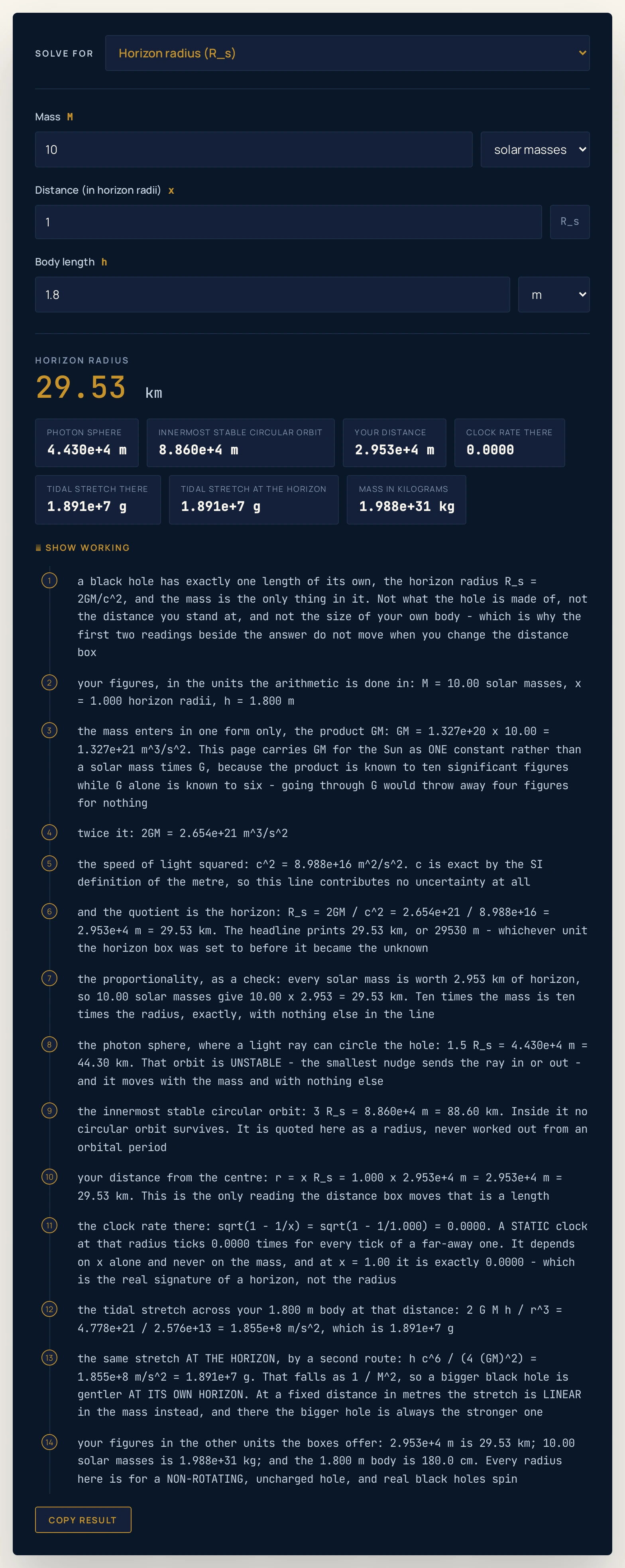
29.53 km, but the clock rate is now exactly 0.0000 and the two tidal readings have become the same number — because your distance is the horizon.Where the Schwarzschild radius calculator breaks down
The arithmetic here is exact to the last digit a double can hold. What goes wrong is physical: a hole that spins, a question about the inside, a comparison made at the wrong distance, and a mass the formula will happily accept for an object that has never been seen.
- Real black holes spin, and these are the non-rotating radii
- Every figure here is the Schwarzschild case: non-rotating and uncharged. Spin changes the horizon, the photon sphere and the innermost stable circular orbit, and it is not a small correction — the fetched source gives M87*'s rotational parameter as 0.90 plus or minus 0.05, which is close to the maximum a black hole can have. Treat these radii as an idealisation, and do not apply them to a named object except as one.
- “A bigger hole is gentler” is only true at its own horizon
- This is the one place the page could ship something false, so the qualifier appears every time the claim does. At a fixed multiple of the horizon the stretch falls as one over the mass squared. At a fixed distance in metres it is simply proportional to the mass, so the bigger hole is the stronger one there by exactly the mass ratio — a factor of
4.300e+5between a ten-solar-mass hole and one of about 4.3 million. Both statements are true, and they are about different comparisons. - The clock rate is for a static observer, and nothing here falls in
- The reading is what a clock held at a fixed radius does, measured against one infinitely far away. It is not what an infalling clock reads, it is not a Doppler shift, and it is not a prediction about anybody's experience of crossing a horizon. No figure on this page describes infall, and the distance box stops at 1 partly because below it there is no static observer for the reading to belong to.
- Nothing here describes the inside, and nothing here is quantum
- The three relations this page evaluates all describe the geometry outside the horizon. Hawking radiation, evaporation times, black-hole entropy, the ergosphere, frame dragging, the singularity and the interior are all outside the model, and no figure for any of them appears anywhere on this page. The same goes for accretion discs, jets, lensing geometry and gravitational waves: they are real physics and they are not this calculator's.
- The formula is arithmetic; what exists is a separate question
- Point Solve for at the mass, type a
1.000 kmhorizon, and the answer is0.3386solar masses. That is correct arithmetic for an object below the sourced three-solar-mass observational floor — the limit above which a compact object can only be a black hole. The page quotes no formation mechanism for a sub-floor object and does not call one observed. - Two input figures do not make a four-figure answer
- Type one solar radius,
7.0e8 m, into the horizon box and the mass comes back as237000solar masses. The input carried two significant figures, so the honest reading is about2.370e+5solar masses, and the extra digits the headline prints are a property of the arithmetic rather than of the answer. The same applies to the mass of Sagittarius A*, which is why its preset name says about 4.3 million. - The linear tidal form needs no caveat at human scale, but it has one
2GMh/r^3is the stretch linearised inh. Measured against the exact difference of fields it is off by1.859e-7per cent ath = 1.80 m— five orders below the four figures this page prints — so for any real body the form is exact as far as the page can show. It fails only whenhbecomes comparable with the horizon itself, where the error reaches17.71per cent ath = 18000 m, and nothing on this page uses a body that long.- A refusal is an answer, not a fault
- A zero or negative mass, a zero or negative horizon radius in the inverse direction, a distance below 1 and a zero or negative body length are all declined in words rather than answered with an infinity or a NaN. The distance case is the one worth understanding:
x = 1is not an error and prints a clock rate of0.0000, whilex = 0.9is inside the horizon and has no static observer at all. - The calculator measures nothing — you supply the numbers
- Two quantities and two auxiliaries go in, one relation is rearranged, and the answer describes the idealised hole you described. The preset names are shorthand for the four figures behind them; the only one that names a real object quotes its mass exactly as the source states it, about 4.3 million solar masses, and presents its horizon as a consequence of that stated mass.
Where the Schwarzschild radius calculator is actually used
- Turning a mass into a size you can picture
- This is the forward question and the reason the page opens where it does. Ten solar masses give
29.53 km: a city-sized radius holding ten Suns. One solar mass gives2.953 km, and the proportionality means you never need the formula twice — multiply the solar-mass figure by the number of solar masses and you have it. - Going the other way, from a horizon to a mass
- Point Solve for at the mass and the question inverts: a size you can imagine, and the mass it would take. A
1.000 kmhorizon needs0.3386solar masses; a horizon the size of the Sun,7.0e8 m, needs about2.370e+5. This is the direction in which a rounded radius costs you most, because the mass is strictly proportional to it. - Working out how much a clock loses at a given orbit
- Set the distance to 3 and the clock rate reads
0.8165: a clock at the innermost stable circular orbit ticks about four fifths as fast as one far away. Set it to 1.5, the photon sphere, and it falls to0.5774. Because the reading depends on the distance in horizon radii alone, both figures hold at those two distances for a non-rotating hole of any mass — and only for a non-rotating one, because spin moves the two radii off 3 and 1.5 in the first place. - Deciding which holes a body could survive approaching
- Take the presets in order of mass rather than in the order they sit in the grid, and one reading runs
1.891e+9 g,2.102e+8 g,1.891e+7 g,0.9996 g,1.023e-4 g,1.891e-11 g— six values from eight buttons, because three of them share the ten-solar-mass hole. The crossing point is the interesting one: around4.349e+4solar masses the horizon stretch across a 1.80 m body is roughly your own weight, and the preset's4.350e+4gives0.9996 grather than exactly 1. Past that mass the horizon reading for the same body comes out below 1 g, which is a figure this tool prints and not a verdict on anybody crossing. - Separating the gravitational clock effect from the velocity one
- Two different effects slow a clock, and they are easy to run together. The rate printed here comes from where the clock is; the other comes from how fast it is moving, and the Lorentz factor calculator is the tool for that one. They have different formulae, different causes and different inputs, and a real satellite clock carries both at once.
- Checking where
GMfor your object comes from - The mass box wants solar masses, and in practice what is measured for a real system is the product
GM, from an orbit. The gravitational force calculator is where that Newtonian force law lives, and this page takesGMas an input rather than deriving it — the innermost stable circular orbit is quoted as a radius here, never worked out from a period.
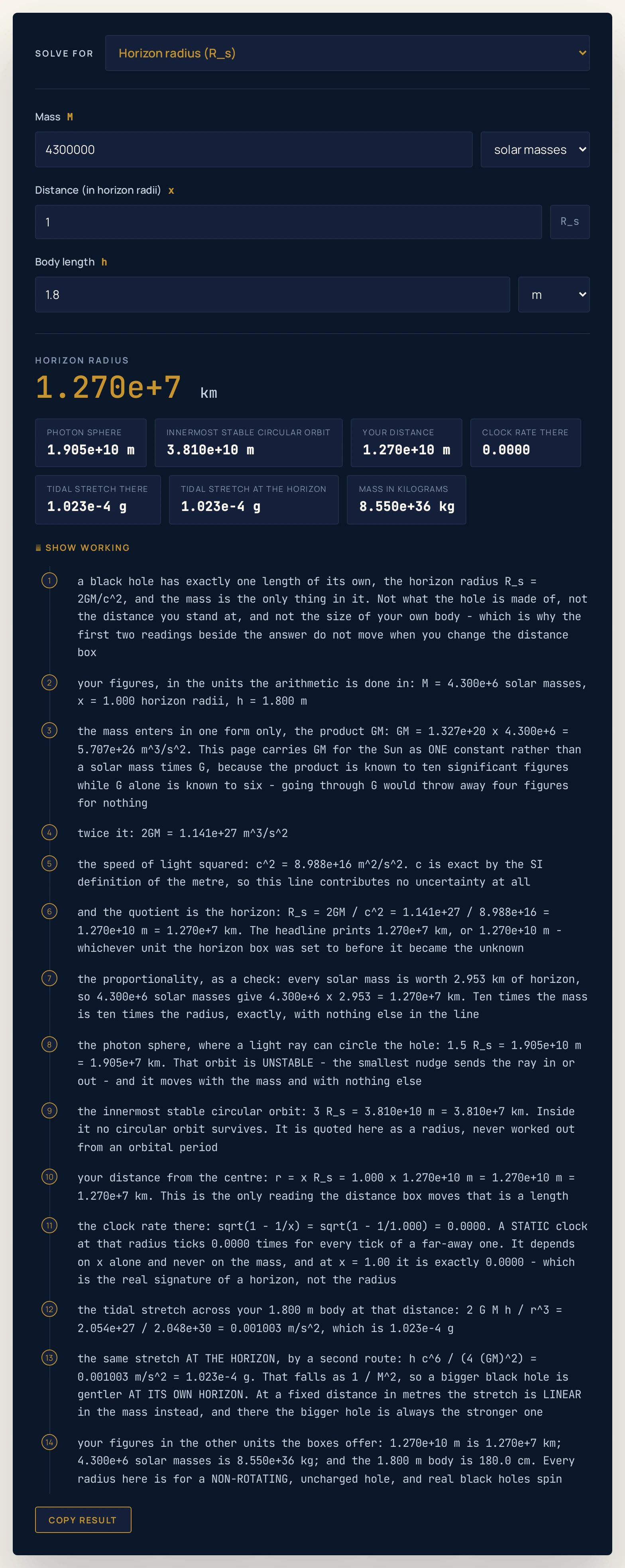
1.891e+7 g on a ten-solar-mass horizon feels 1.023e-4 g here — a factor of 1.849e+11, which is exactly the square of the mass ratio. The mass is the one the source states, about 4.3 million solar masses; the horizon is a consequence of it.Where to go next
For what a black hole is, how the horizon, the clock and the tide fit together, the worked problems and the misconceptions, read the black hole physics guide, which this tool is the arithmetic half of. The special relativity guide is where the constant speed of light is set up, and the speed of light guide is the constant itself.
Two more posts pick up what this page leaves out. The time dilation guide is the velocity kind of clock slowing, a different effect with a different cause, and the escape velocity guide is the Newtonian calculation that lands on the same algebra for the wrong reason.
Four tools sit next to this one. The time dilation calculator handles the velocity effect; the escape velocity calculator handles the speed needed to leave a mass behind; the gravitational force calculator is the Newtonian force law; and the Lorentz factor calculator is how far relativity stretches time and length at a given speed.
The full physics lab library and calculator index are open too.
Frequently asked questions
What does the Schwarzschild radius calculator work out?
It solves R_s = 2GM/c^2 in either direction: the event-horizon radius of a black hole of a mass you choose, or the mass behind a horizon radius you already have. Beside the answer it prints the photon sphere, the innermost stable circular orbit, your distance from the centre, the rate a static clock runs there, the tidal stretch across your body at that distance, the same stretch at the horizon itself, and the mass in kilograms.
What is the Schwarzschild radius formula?
R_s = 2GM/c^2, where M is the mass, G is the gravitational constant and c is the speed of light. It is the radius of the event horizon of a non-rotating, uncharged black hole, and the mass is the only thing in it. Every solar mass is worth 2.953 km of horizon, so the relation is exact proportionality: ten solar masses give 29.53 km, which is exactly ten times.
Why does the calculator carry GM for the Sun instead of a solar mass times G?
Because the horizon needs only the product GM, and that product is known far better than either factor. The IAU value for GM of the Sun carries ten significant figures while G on its own is known to six, and an independent check this cluster runs measures the two routes as 3.08e-6 apart, comfortably inside the 2.2e-5 relative standard uncertainty CODATA gives for G itself. Multiplying a solar mass by G would therefore throw away four figures for nothing, so the page keeps the product and uses the solar mass in kilograms for one job only: printing a mass in kilograms.
Why does solving for the mass give 9.999 solar masses when the box says 29.53 km?
Because 29.53 km is the four-figure form of a longer number. Ten solar masses give a horizon of 29.532501 km, and the rounded 29.53 km sitting in the box is 0.008468 per cent below that, which inverts to 9.999 solar masses rather than 10.00. It is a real consequence of typing a rounded radius, not a fault, and any preset removes it because every preset writes the horizon to eight significant figures.
Why is the clock rate exactly zero at the horizon?
Because the clock rate is sqrt(1 - 1/x) with x the distance in horizon radii, and at x = 1 the bracket is exactly zero. The square root of zero is zero, not a rounding of something small, so the reading 0.0000 is a result. It is also the same zero for every mass, which is why the clock rather than the radius is the real signature of a horizon: a one-solar-mass hole and a ten-billion-solar-mass one both stop a static clock completely.
Is a bigger black hole really gentler?
At its own horizon, yes, and the qualifier is the whole claim. The stretch at each hole's own horizon falls as one over the mass squared, so across a 1.80 m body it is 1.891e+7 g at the horizon of a ten-solar-mass hole and 1.023e-4 g at the horizon of one of about 4.3 million solar masses, a factor of 1.849e+11. At a fixed distance in metres the comparison reverses completely, because there the stretch is simply proportional to the mass and the bigger hole is the stronger one by exactly the mass ratio.
Why will the distance box not go below 1?
Because the distance is measured in horizon radii, and below 1 you are inside the horizon. There the clock-rate expression puts a negative number under a square root, and more importantly there is no static observer to carry a clock: nothing can hold a fixed radius inside a horizon. The calculator declines the entry in words rather than printing a NaN, and x = 1 itself is not an error at all.
Does this calculator describe a spinning black hole?
No. Every radius here is the Schwarzschild case: non-rotating and uncharged. Spin changes all of them, and real black holes spin, so these figures should be read as an idealisation rather than as numbers for any particular object. The page quotes no radius for any named rotating hole on that basis.
What are the photon sphere and the innermost stable circular orbit?
The photon sphere is at 1.5 times the horizon radius and is the radius at which a light ray can travel in a circle around the hole. That orbit is unstable, so the smallest nudge sends the ray inwards or escaping. The innermost stable circular orbit is at 3 times the horizon radius, and inside it no circular orbit is stable; this page quotes it as a radius rather than deriving it from an orbital period.
Does the calculator say anything about Hawking radiation or what is inside?
No, and the omission is deliberate. Nothing here models Hawking radiation, evaporation times, black-hole entropy, the ergosphere, frame dragging, accretion discs, jets, lensing or gravitational waves, and no figure for any of them appears anywhere on the page. The interior is outside the model entirely: the three relations this page evaluates describe a static observer outside the horizon and nothing else.
References & formula source
- The relation this page solves is the Schwarzschild radius of general relativity, R_s = 2GM/c^2: the radius at which the Schwarzschild metric coefficient 1 - R_s/r vanishes, for a non-rotating, uncharged, isolated mass. It is stated here rather than derived. A Newtonian calculation that sets an escape speed equal to the speed of light reaches the same algebraic expression, but it does so for the wrong reason and is not the route taken here. Source: Wikipedia, "Schwarzschild radius".
- The photon sphere at 1.5 R_s = 3GM/c^2 and the innermost stable circular orbit at 3 R_s = 6GM/c^2 are quoted as radii of the same geometry, not derived from an orbital period. The photon-sphere orbit is unstable. Sources: Wikipedia, "Photon sphere" and "Black hole"; both radii were also reproduced independently at stage 1 by extremising the null effective potential and by bisecting the circular-orbit stability discriminant, which share no algebra with the closed forms.
- The constants are GM for the Sun = 1.32712440041e20 m^3/s^2 (IAU Division I Working Group, TDB-compatible) and the IAU nominal solar mass 1.988416e30 kg, both from Wikipedia, "Solar mass"; the speed of light 299792458 m/s is exact by the SI definition of the metre, and the standard acceleration of free fall 9.80665 m/s^2 is exact by definition. The horizon needs only the product GM, which is why it is carried as one constant.
- The clock rate printed here is sqrt(1 - R_s/r) for a STATIC observer at radius r, per tick of a clock infinitely far away. It is a gravitational effect, it is not the velocity time dilation of special relativity, and it is not a Doppler shift. Nothing on this page models anything falling in, so no figure describes what an infalling clock would read.
- The tidal stretch is the linearised radial tidal acceleration 2GMh/r^3 across a body of length h. Measured against the exact difference of fields by an independent reference written before this page existed, the linear form is off by 1.859e-7 per cent at h = 1.80 m and by 17.71 per cent at h = 18000 m, so it needs no caveat at human scale and the caveat belongs only to a body comparable with the horizon itself.
- Every radius on this page is the non-rotating Schwarzschild case. The fetched Wikipedia article "Black hole" states the rotational parameter of M87* as 0.90 plus or minus 0.05, i.e. near-maximal, and spin changes every radius quoted here, so none of these figures is the right one for a real spinning hole. The mass of Sagittarius A* is quoted only as that article states it, about 4.3 million solar masses, because a second fetched page gives a value 3.51 per cent away and the two agree to one significant figure only.
- Hawking radiation, evaporation times, black-hole entropy, the ergosphere, frame dragging, the interior and the singularity, accretion-disc temperatures, jets, lensing geometry and gravitational waves are not modelled and no figure for any of them is published or implied anywhere on this page.
- Every figure quoted in the prose and tables above is either a string this calculator printed for the inputs named beside it, or a figure from an independent reference written before this page existed and sharing no code with it, which runs 114 checks with 0 failures. Where a cell and the running widget ever part company, believe the widget.
- Further reading: Schwarzschild radius — Wikipedia