A reading falls off with distance because it is spreading over a sphere, and that sphere grows as r². So two distances and one reading are all you need: the source’s power cancels out of I1 · r1² = I2 · r2² entirely. This free inverse square law calculator runs that relation in all four directions — point Solve for at either intensity or either distance — and prints the power behind your figures, the distances that halve and double the reading, and what a one per cent slip in the distance would cost.
Both distances are measured from the source’s centre — not from its surface and not from the front of its housing. Measuring a 60 mm lamp “at 60 mm” and squaring that distance gives a reading 4.0000× too high, and the error only falls below 1 per cent past about 200 source radii. The source’s power is not needed: I1 r1^2 = I2 r2^2 cancels it, so the P box is optional and may stay at 0. The boxes accept 1e-12 to 1e12 W/m^2 for either intensity, 1e-6 to 1e9 m for either distance and 0 to 1e12 W for the power; a zero or negative distance or intensity is declined rather than answered, and so is anything outside those ranges. This page is the inverse-square case only — there is no exponent box, because a line source goes as 1/r and a flat source does not fall off at all.
Load a real reading
Every button writes all five boxes in their default units, so whichever quantity the Solve for menu is pointing at, the remaining four already agree with it. The line underneath quotes back whatever the widget works out from that, so nothing in it is stored text.
Pick a reading above, or type your own numbers.
What Is the Inverse Square Law Calculator?
The inverse square law calculator is a free online tool for the one step that turns a reading at one distance into a reading at another: I1 r1^2 = I2 r2^2, in watts per square metre and metres. Give it any three of the two intensities and the two distances and it returns the fourth in whichever unit that box was set to, with every step of the substitution.
Both distances are measured from the centre of the source, not from its surface and not from the front of its housing. That distinction is worth a factor of four at close range. For a source of radius R, taking a distance s from the surface and squaring it predicts a reading too high by exactly one plus R over s, all squared: 4.0000 times too high one radius out, 1.2100 times ten radii out, and the figure only drops below one per cent past about 200 source radii. Adding the radius back before you type is the whole fix.
The power of the source is not needed, and that is the method rather than an omission. Dividing the relation through cancels it completely, so two distances and one reading are enough, and a source a hundred million times stronger returns exactly the same ratio answer. There is an optional power box for readers who happen to have a figure, and filling it in changes which power reading is printed beside the answer rather than changing the answer itself.
There is no exponent box and no geometry selector, and that is deliberate. The exponent is a property of the surface the quantity spreads over rather than of the radiation: a sphere of area four pi r squared gives one over r squared, a cylinder around a long line source gives one over r, a flat sheet gives no fall-off at all, and a radar echo that crosses a sphere twice goes as one over r to the fourth. Those other three geometries belong to the companion simulator, which has the slider for them.
Three readings sit beside the headline, all worked out from the complete state with the solved value substituted back rather than from the boxes. They are the total power behind your figures, which is four pi r squared times the intensity and is only that power if the source radiates equally in all directions; the distances at which this reading halves and doubles, which are your distance multiplied and divided by the square root of two; and what an error in the distance does to the answer, which is the rule under everything on the page. A one per cent slip in either distance is a 2.0100 per cent slip in the intensity, and the excess over double is exactly the square of the slip, every time.
Every box is checked against a declared range and not merely against zero, because every intensity and every distance here sits in a division or under a square root. A zero or negative distance or intensity is refused on the input rather than tidied up afterwards, since a zero distance makes the intensity infinite, a zero target intensity makes the distance infinite, and a negative ratio under the square root returns a NaN. A positivity test alone is not enough either: infinity is greater than zero, and an infinite distance would otherwise return a perfectly finite reading of nought. So both intensities are accepted between 1e-12 and 1e12 watts per square metre, both distances between 1e-6 and 1e9 metres, and the optional power between 0 and 1e12 watts. Anything outside those is declined in words.
What the page assumes, stated as assumptions: a point source, or a spherically symmetric one with the distance taken from its centre; the same output in every direction, so no beam, no reflector and no laser; a medium that neither absorbs nor scatters; nothing reflecting energy back across the sphere; and a detector that faces the source and is small compared with the distance. The source is explicit that the proportionality does not hold in practical situations unless the source dimensions are much smaller than the distance, and that for non-isotropic radiators such as parabolic antennas, headlights and lasers the effective origin lies far behind the beam aperture. No figure for any beam, any absorbing medium or any reflection is published here, because the model produces none.
| Symbol | Quantity | Default unit | Also accepts | Example value |
|---|---|---|---|---|
| I1 | Known intensity | W/m^2 | mW/m^2, kW/m^2, uW/m^2 | 48 |
| r1 | Distance of that reading | m | cm, mm, km | 0.5 |
| I2 | Intensity wanted | W/m^2 | mW/m^2, kW/m^2, uW/m^2 | 1.3333333333 |
| r2 | Distance wanted | m | cm, mm, km | 3 |
| P | Source power (optional) | W | mW, kW, MW | 0 |
How to use the inverse square law calculator
- Choose the unknown. The Solve for menu opens on Intensity wanted, and the other three choices are Distance wanted, Known intensity and Distance of that reading. The source power is never the unknown.
- Type the known intensity. The reading you already have, in W/m^2, mW/m^2, kW/m^2 or uW/m^2, opening on 48 W/m^2 with presets at 48, 100 and 1000. The box accepts 1e-12 to 1e12 W/m^2.
- Type the distance of that reading. How far it was taken from the source, measured from the centre — not the surface, not the housing. It takes m, cm, mm or km and opens on 0.5 m.
- Type the distance wanted. Where you want the reading, from the same centre, opening on 3 m with presets at 1, 3 and 10 m. Tripling it divides the reading by nine.
- Leave the power box alone unless you have it. It opens on
0, which means you do not know the source power, and the ratio form never needs it. Fill it in and the first reading beside the answer shows your own figure instead. - Read the answer. The headline carries the answer to six significant figures, trailing zeros dropped, in the unit that box was showing, and it switches to scientific notation below 0.0001 and at or above 10 million. Set the unit first, point Solve for at the target second and type your figures last — switching the target wipes every box back to its default and only the unit menus survive it.
- Read the source power.
P = 4πr²Iat your second distance, and it is that power only if the source radiates equally in all directions, which is why the label says so. - Read the halving and doubling distances. Your distance multiplied and divided by the square root of two. At 1 m those are
1.414 mand70.711 cm. - Read what a slip in the distance costs. A 1 per cent error in
ris a 2.0100 per cent error inI, and the excess over double is exactly the square of the error. - Open Show working. The steps give the relation, the boxes in SI base units, the substitution, the centre rule, the ratio and its square, the power behind the reading, the halving and doubling distances with the source’s own quick rules beside them, the price of a slip, the assumptions and every unit conversion.
This page exists for the one step that turns a reading at one distance into a reading at another. The inverse square law guide is the prose half of it, where the exponent is derived and the problems are worked. The P in the optional box is a total radiated power in watts, which is the power guide’s quantity rather than this page’s.
Two mistakes account for most wrong answers here. The first is measuring the distance from the surface of a source that has a size, instead of from its centre. The second is reaching for the source’s power: there is an optional box for it, but the relation cancels it and you will not need it.
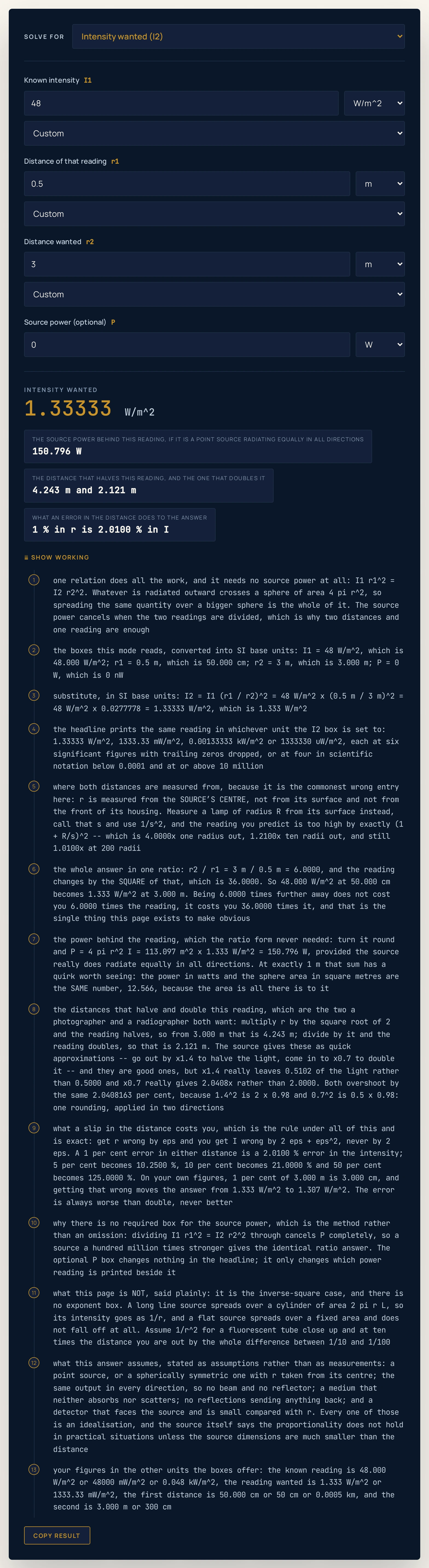
48 W/m^2 measured at 0.5 m, wanted at 3 m. The answer is 1.33333 W/m^2 — six times further away, and thirty-six times thinner. The power behind it, 150.796 W, was never needed to get there.Worked example: change one thing at a time
The table starts at the defaults, runs the unknown through all four modes on one state, asks the distance question, loads the anchor case with and without a power, walks every unit menu, and finally reaches the entries the calculator declines. Every answer and reading cell was taken from the running widget rather than worked out by hand. Where a cell and the tool ever part company, believe the tool.
| Step | Solving for | What you type | Headline answer | Source power reading | Halves and doubles at | Slip in the distance |
|---|---|---|---|---|---|---|
| The page as it opens: 48 W/m^2 at 0.5 m, read at 3 m | Intensity wanted | I1 = 48 W/m^2, r1 = 0.5 m, r2 = 3 m, P = 0 W | 1.33333 W/m^2 | 150.796 W | 4.243 m and 2.121 m | 1 % in r is 2.0100 % in I |
| The same state, solved for the far distance | Distance wanted | I1 = 48 W/m^2, r1 = 0.5 m, I2 = 1.3333333333 W/m^2, P = 0 W | 3 m | 150.796 W | 4.243 m and 2.121 m | 1 % in r is 2.0100 % in I |
| The same state, solved for the known reading | Known intensity | I2 = 1.3333333333 W/m^2, r2 = 3 m, r1 = 0.5 m, P = 0 W | 48 W/m^2 | 150.796 W | 4.243 m and 2.121 m | 1 % in r is 2.0100 % in I |
| The same state, solved for the near distance | Distance of that reading | I1 = 48 W/m^2, I2 = 1.3333333333 W/m^2, r2 = 3 m, P = 0 W | 0.5 m | 150.796 W | 4.243 m and 2.121 m | 1 % in r is 2.0100 % in I |
| How far until 48 W/m^2 has fallen to 3 W/m^2 | Distance wanted | I1 = 48 W/m^2, r1 = 0.5 m, I2 = 3 W/m^2, P = 0 W | 2 m | 150.796 W | 2.828 m and 1.414 m | 1 % in r is 2.0100 % in I |
| A 100 W point source: 1 m out to 2 m | Intensity wanted | I1 = 7.9577471546 W/m^2, r1 = 1 m, r2 = 2 m, P = 100 W | 1.98944 W/m^2 | 100.000 W -- 1.989 W/m^2 | 2.828 m and 1.414 m | 1 % in r is 2.0100 % in I |
| The same anchor with the power box left empty | Intensity wanted | I1 = 7.9577471546 W/m^2, r1 = 1 m, r2 = 2 m, P = 0 W | 1.98944 W/m^2 | 100.000 W | 2.828 m and 1.414 m | 1 % in r is 2.0100 % in I |
| The sphere area in watts: 1 W/m^2 at 1 m | Intensity wanted | I1 = 4 W/m^2, r1 = 0.5 m, r2 = 1 m, P = 0 W | 1 W/m^2 | 12.566 W | 1.414 m and 70.711 cm | 1 % in r is 2.0100 % in I |
| Ten times further, one hundredth of the reading | Intensity wanted | I1 = 1000 W/m^2, r1 = 1 m, r2 = 10 m, P = 0 W | 10 W/m^2 | 12.566 kW | 14.142 m and 7.071 m | 1 % in r is 2.0100 % in I |
| How far a 1 kW source reads 1 W/m^2 | Distance wanted | I1 = 79.5774715459 W/m^2, r1 = 1 m, I2 = 1 W/m^2, P = 1000 W | 8.92062 m | 1.000 kW -- 1.000 W/m^2 | 12.616 m and 6.308 m | 1 % in r is 2.0100 % in I |
| The rounded 7.958 typed in instead of the exact figure | Intensity wanted | I1 = 7.958 W/m^2, r1 = 1 m, r2 = 2 m, P = 0 W | 1.9895 W/m^2 | 100.003 W | 2.828 m and 1.414 m | 1 % in r is 2.0100 % in I |
| The rounded 1.333 fed back instead of the exact figure | Known intensity | I2 = 1.333 W/m^2, r2 = 3 m, r1 = 0.5 m, P = 0 W | 47.988 W/m^2 | 150.759 W | 4.243 m and 2.121 m | 1 % in r is 2.0100 % in I |
| The same reading typed in milliwatts per square metre | Intensity wanted | I1 = 48000 mW/m^2, r1 = 0.5 m, r2 = 3 m, P = 0 W | 1.33333 W/m^2 | 150.796 W | 4.243 m and 2.121 m | 1 % in r is 2.0100 % in I |
| The same distances typed in centimetres | Intensity wanted | I1 = 48 W/m^2, r1 = 50 cm, r2 = 300 cm, P = 0 W | 1.33333 W/m^2 | 150.796 W | 4.243 m and 2.121 m | 1 % in r is 2.0100 % in I |
| The source power typed in kilowatts | Intensity wanted | I1 = 7.9577471546 W/m^2, r1 = 1 m, r2 = 2 m, P = 0.1 kW | 1.98944 W/m^2 | 100.000 W -- 1.989 W/m^2 | 2.828 m and 1.414 m | 1 % in r is 2.0100 % in I |
| A distance of zero is declined | Intensity wanted | I1 = 48 W/m^2, r1 = 0.5 m, r2 = 0 m, P = 0 W | no answer | - | - | - |
| A negative distance is declined | Intensity wanted | I1 = 48 W/m^2, r1 = -0.5 m, r2 = 3 m, P = 0 W | no answer | - | - | - |
| An intensity of zero is declined | Distance wanted | I1 = 48 W/m^2, r1 = 0.5 m, I2 = 0 W/m^2, P = 0 W | no answer | - | - | - |
| A negative intensity is declined | Distance wanted | I1 = -48 W/m^2, r1 = 0.5 m, I2 = 3 W/m^2, P = 0 W | no answer | - | - | - |
| A distance past 1e9 m is declined | Intensity wanted | I1 = 48 W/m^2, r1 = 0.5 m, r2 = 2e9 m, P = 0 W | no answer | - | - | - |
| An intensity past 1e12 W/m^2 is declined | Intensity wanted | I1 = 2e12 W/m^2, r1 = 0.5 m, r2 = 3 m, P = 0 W | no answer | - | - | - |
| A negative source power is declined | Intensity wanted | I1 = 48 W/m^2, r1 = 0.5 m, r2 = 3 m, P = -5 W | no answer | - | - | - |
Rows 1 to 4 are one state — 48 W/m^2 at 0.5 m, wanted at 3 m — with the Solve for menu in each of its four positions. All three reading columns are identical down all four rows, because the readings describe the state rather than the mode. That is the round trip in one block: the headline prints the far reading as 1.33333 W/m^2, and what rows 2 to 4 feed back is the box’s own ten-digit 1.3333333333, which returns 48 W/m^2 and 0.5 m as printed.
Rows 5 to 7 ask the three questions the page is for. Row 5 is the distance mode: 48 W/m^2 has fallen to 3 W/m^2 at 2 m, because sixteen times the reading is four times the distance. Rows 6 and 7 are the same anchor — a 100 W source read at 1 m and again at 2 m — with and without the optional power, and the headline 1.98944 W/m^2 is identical in both, which is the whole claim about the ratio form in one pair of rows.
Rows 8 to 10 are the ones worth keeping. At 1 m the power reading is 12.566 W, which is the sphere area at that distance written in watts, because 4πr² and the watts for one watt per square metre are the same number there; row 9 is the decade, ten times the distance for one hundredth of the reading, every time. Row 10 is the sanity check on an emitter whose power you do know — the same figure the Stefan-Boltzmann calculator would hand you for a hot surface — and a kilowatt radiated evenly reaches 1 W/m^2 at 8.92062 m.
Rows 11 and 12 are the honest rows, and they are this page’s own subject turned on itself. Typing the rounded 7.958 instead of the exact anchor gives 1.9895 W/m^2 rather than 1.98944, and feeding the rounded 1.333 back gives 47.988 W/m^2 rather than 48. The relation squares a ratio, so it squares a rounding too.
Rows 13 to 15 change nothing but the units. 48000 mW/m^2, 50 cm and 300 cm, and 0.1 kW all reproduce the figures they came from exactly, because every multiplier in the menus is an exact power of ten. Rows 16 to 22 are the refusals, and they are refusals on the input rather than tidied-up output: every intensity and every distance sits in a division or under a square root, so a zero, a negative or an out-of-range entry is declined in words rather than answered with an infinity or a NaN.
Formula and symbol reference
One relation does all the work: I1 · r1² = I2 · r2², which rearranges to I2 = I1 (r1 / r2)² going outward and to r2 = r1 (I1 / I2)^(1/2) going the other way. It comes from one fact about a sphere: the area is 4πr², so the intensity at r is I = P / (4πr²) and dividing two such readings cancels P. Everything else on this page is that relation rearranged, or a quantity derived from the state it describes.
The unit of the two intensity boxes is the watt per square metre, which the SI units guide derives from the base units. Reading the relation backwards gives P = 4πr²I, which is the first reading beside the answer and the only place the power appears at all. Writing the law as I = P / (4πr²) needs the power; writing it as a ratio does not, and that is the difference the page is built on.
Two symbols on this page are not boxes. r2 / r1 is the distance ratio whose square is the whole answer, and R / s is the source radius over the distance from its surface, which only matters when you measure from the wrong place. Neither appears in the widget, and both appear in the working.
| Symbol | Meaning | SI unit | Values used on this page |
|---|---|---|---|
| I1 | Known intensity: the reading you already have, in power per unit area on a surface facing the source. It is an input in three of the four modes and the unknown in the fourth | watt per square metre | Boxes take W/m^2, mW/m^2, kW/m^2 or uW/m^2: 48 W/m^2 is the default, with presets at 48, 100 and 1000. The box accepts 1e-12 to 1e12 W/m^2. |
| r1 | Distance of that reading, measured from the centre of the source. Not from its surface, and not from the front of its housing | metre | Boxes take m, cm, mm or km: 0.5 m is the default, which is 50 cm or 0.0005 km, with presets at 0.5, 1 and 2 m. The box accepts 1e-6 to 1e9 m. |
| I2 | Intensity wanted: the reading at the second distance. This is what the page opens solving for, and it is an input in the two distance modes | watt per square metre | Same four units as I1. The box opens on 1.3333333333 W/m^2, which is the answer to ten digits for the opening state, 48 W/m^2 at 0.5 m read again at 3 m. |
| r2 | Distance wanted, from the same centre as r1. Tripling it divides the reading by nine; multiplying it by ten divides the reading by a hundred | metre | Same four units as r1: 3 m is the default, with presets at 1, 3 and 10 m. The box accepts 1e-6 to 1e9 m. |
| P | Source power, optional and never the unknown. It is the total radiated power and it drives only the first reading beside the answer; the headline never uses it | watt | Boxes take W, mW, kW or MW: 0 W is the default, and that zero means “I do not know it”. The box accepts 0 to 1e12 W. |
| r2 / r1 | The distance ratio, which is the whole answer once you square it. The reading changes by the square of this and never by the ratio itself | dimensionless | A derived quantity: 6.0000 on the opening state, so the reading falls by 36.0000; 2.0000 on the 1 m to 2 m anchor, so it falls by 4.0000. |
| 4 pi r^2 | The area of the sphere the quantity has spread over by distance r. The exponent is a property of this surface rather than of the radiation | square metre | A derived quantity: 12.566 m² at 1 m, 50.265 m² at 2 m, 113.097 m² at 3 m. At exactly 1 m the area in m² and the watts for 1 W/m² are the same number. |
| R / s | Source radius divided by the distance from its surface. Only the measurement error uses it, and the prediction comes out too high by (1 + R/s)2 | dimensionless | Not a box: 4.0000x too high at one radius out, 1.2100x at ten radii, 1.0201x at a hundred, and the one per cent line is at 200.4988 radii. |
The physics: why the exponent is two, and what sets it
Whatever is radiated outward from a small source has to cross every sphere drawn around it, and nothing is lost in between. The sphere at r has an area of 4πr², so the same quantity is spread over four times the area at twice the distance. The exponent is not a property of light, or of sound, or of a force — it is a property of the surface the quantity spreads over.
That is the one idea worth carrying away, and it is also the reason the exponent sometimes is not two. A long line source spreads over a cylinder whose area is 2πrL, which grows as r, so the intensity goes as 1/r; a flat sheet spreads over a fixed area and does not fall off at all. A radar echo crosses a sphere twice, out and back, and goes as 1/r^4.
Because the exponent comes from geometry rather than from the quantity, the same 1/r² turns up in places that otherwise share nothing. It is the shape of the gravitational force law and of the electrostatic force law, and each of those needs its own pair of quantities — two masses, or two charges — that this page does not ask for. Naming them is this page’s business; computing them is theirs.
One pedantic point is worth a clause. The exponent depends on which quantity you mean: the source notes that for sound the pressure goes as 1/r while the intensity, which is that quantity multiplied by the particle velocity, goes as 1/r². Same source, same distance, two exponents — and the sound-level arithmetic that follows from it belongs to the decibel formula guide.
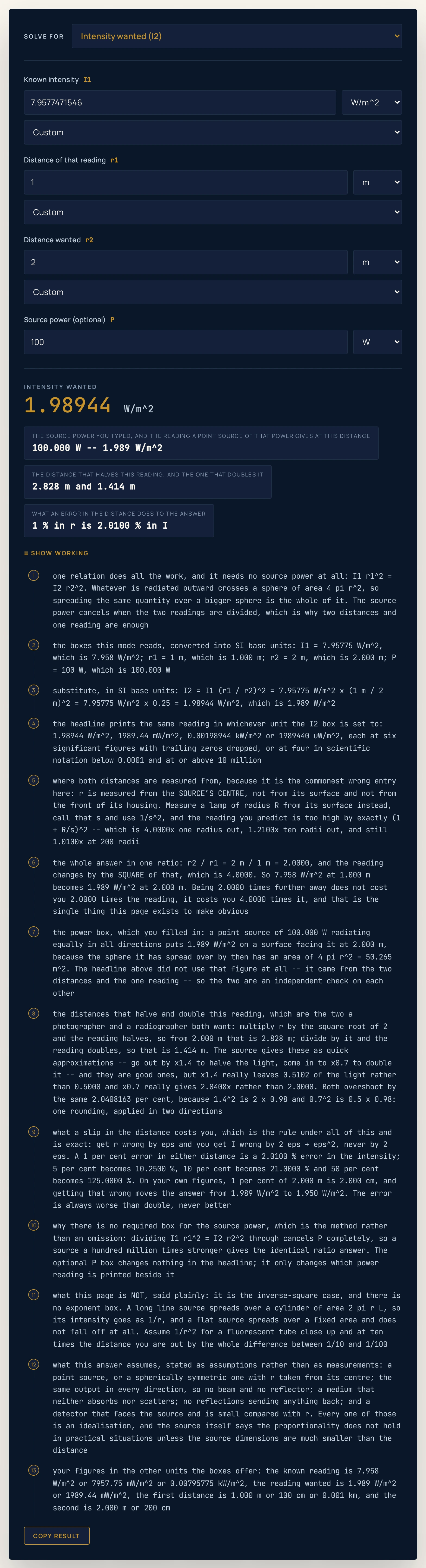
7.958 W/m^2 on a square metre at 1 m and 1.989 W/m^2 at 2 m — exactly a quarter. The headline came from the two distances alone; the 100.000 W beside it is the independent check.Where this arithmetic breaks down
The arithmetic here is exact to the last digit a double can hold. What goes wrong is physical, and one item on this list matters more than all the others.
- Measuring from the wrong place costs a factor of four
- This is the one to read. The law is exact in
rtaken from the centre of a spherically symmetric source. Takesfrom the surface instead and square that, and the reading you predict is too high by exactly(1 + R/s)²: 4.0000× one radius out, 1.4400× at five radii, 1.2100× at ten, 1.0201× at a hundred. The one per cent line sits at 200.4988 source radii, so a bench measurement is almost always over it. - An extended source is not a point source
- This is a different error from the one above, and the two corrections must never be applied to each other. The source’s own rule is that when the size of the light source is less than one-fifth of the distance to the subject, the calculation error is less than 1 per cent, and it adds the sharper warning that the proportionality does not hold in practical situations unless source dimensions are much smaller than the distance. That rule is quoted here and not extended, because working it out properly needs a model of the source this page does not have.
- A beam is not a point source
- The source is explicit: for non-isotropic radiators such as parabolic antennas, headlights and lasers, the effective origin is located far behind the beam aperture. Point this page at a torch or a laser and the distance you measured is not the
rthe relation means. No figure is offered for any beam, because nothing here sources a beam divergence. - The medium absorbs and scatters, and the model has neither
- The relation assumes there are no losses caused by absorption or scattering, which is the source’s own wording for an assumption rather than a finding. Real air, water, glass and shielding all take energy out on the way, so a real reading falls faster than
1/r². No coefficient is printed here for any of that; the gamma ray guide is where attenuation and shielding live. - Reflections put energy back across the sphere
- The law counts the energy crossing one sphere once. In a room, a reflected path crosses it twice, so a reading close to a wall or in a small space is higher than this page predicts and stops falling off entirely once the reflected field dominates. That is said in words and not in numbers, because nothing here sources a reflection coefficient.
- The wrong geometry gives the wrong exponent
- A reader who assumes
1/r²for a fluorescent tube at close range is out by the whole difference between1/rand1/r²— at ten times the distance, a tenth against a hundredth. There is no geometry box on this page by design, so if the source is long, flat or an echo, this is the wrong page and the shape of the spreading surface is the thing to fix first. - Rounding a distance and then squaring it
- The error in the reading is always worse than double the error in the distance, by exactly the square of it. One per cent becomes 2.0100, five per cent becomes 10.2500, ten per cent becomes 21.0000 and fifty per cent becomes 125.0000. That is why the two quick rules about 1.4 and 0.7 both overshoot by 2.0408163 per cent from a rounding of about one per cent in the distance.
- The detector has to face the source and be small
- The source defines the intensity as what passes through unit area directly facing the point source, so a tilted detector reads less and a detector comparable in size with
raverages over a range of distances. Neither is corrected for here, and the quantity itself — what it means and how it is defined — belongs to the polarisation of light guide rather than to this tool. - A clean answer can be a coincidence of the numbers
- The opening state falls by exactly 36 and the anchor by exactly 4 because their distance ratios are exactly 6 and exactly 2. Those are tidy because the inputs are tidy, not because the arithmetic is. Change 3 m to 3.1 m and every figure turns ragged while every identity still holds to the last digit.
- The calculator measures nothing — you supply the numbers
- Two distances and one reading go in, one relation is used, and the answer describes the situation you described. The case names on the buttons are shorthand for the figures behind them and are not claims about any particular lamp, speaker, antenna or emitter.
Where the inverse square law is actually used
- Moving a meter and predicting the new reading
- Load 48 W/m^2 at half a metre, read at three and the trade is on screen in one line:
1.33333 W/m^2, with4.243 m and 2.121 mbeside it for where it halves and doubles. One reading, one tape measure, and the second reading never needed the source at all. - Finding the distance that hits a target reading
- Point Solve for at the distance wanted and the question becomes the one a survey actually asks.
48 W/m^2at0.5 mreaches3 W/m^2at2 m, and the square root is what makes that feel gentle: every factor of one hundred in the reading is a factor of ten in the distance. - Backing out the power of a source you cannot open
- One reading and one distance give the total radiated power, provided the thing radiates equally in all directions.
1 W/m^2at1 mis12.566 W, and that number is the sphere area at one metre written in watts. The assumption is in the label because an inferred power without it is not a figure worth quoting. - Setting a lamp for a one-stop change
- The halving and doubling distances are a photographer’s whole working set. The exact factors are the square root of two and its reciprocal, and the familiar 1.4 and 0.7 are roundings of them that leave
0.5102and2.0408rather than a half and a double. Over one step that is invisible; over several it is not. - Checking a published fall-off claim
- Two readings and two distances are enough to test whether something really falls off as
1/r²: multiply each reading by its distance squared and the two products should match. If they do not, the source is not a point, the medium is absorbing, or the distances were measured from the wrong place. - Telling an intensity from a level
- If what you actually need is a sound level rather than an intensity, that is a logarithm away and it is a different tool: the decibel calculator takes an intensity and returns a level, and it has no distance field at all. Work the distance here first, then take the result across.
- Recognising the same law somewhere else
- Gravity and electrostatics are the two most famous instances of this shape, and each needs its own pair of quantities rather than two readings. The gravitational force calculator is the one to compare against: identical exponent, completely different inputs, and a constant that this page does not have because the ratio form cancels it.
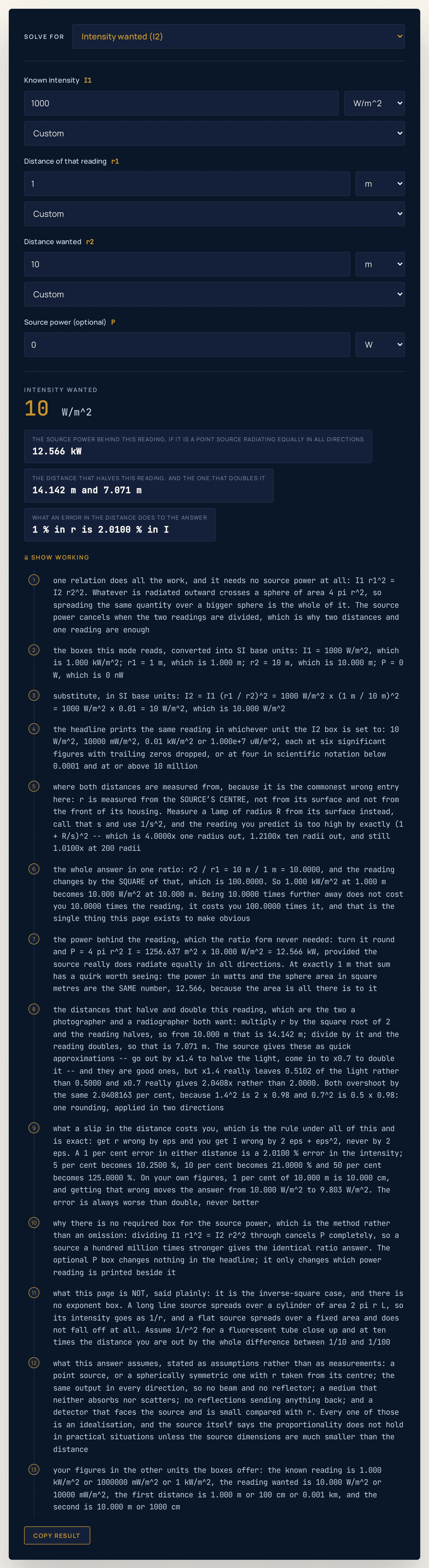
1000 W/m^2 at 1 m is 10 W/m^2 at 10 m. The power behind it reads 12.566 kW — a thousand times the 12.566 W of the one-watt case, because the power scales with the reading and not with the distance.Where to go next
For the argument this arithmetic supports — why the exponent is two, what the ratio form buys, what four different spreading surfaces do to it and why measuring from the wrong place costs a factor of four — read the inverse square law guide, which this tool is the calculating half of.
Four posts pick up the pieces this page uses but does not explain. The law of gravitation guide and the Coulomb law guide are the two instances with their own constants, the decibel formula guide is where a sound intensity becomes a level, and the physics formula sheet is the one-page reference.
Four tools sit next to this one. The gravitational force calculator and the Coulomb law calculator are the two instances, the decibel calculator turns an intensity into a level, and the Stefan-Boltzmann calculator gives the power a hot surface emits. The decibel simulator is the one live lab that moves a source and a listener.
The full physics lab library and the calculator index are open too.
Frequently asked questions
What does the inverse square law calculator work out?
It solves I1 times r1 squared equals I2 times r2 squared for any one of four quantities: either intensity, or either distance. Give it a reading you have, the distance it was taken at and the distance you want, and it returns the new reading, with the source power behind it, the distances that halve and double it, and what a one per cent slip in the distance would do to it.
Do I need to know the power of the source?
No, and that is the whole point of the ratio form. Dividing the relation through cancels the source power completely, so two distances and one reading are enough. A source a hundred million times stronger gives exactly the same ratio answer. The power box is there only if you happen to have a figure, and it changes the reading beside the answer rather than the answer itself.
Where exactly do I measure the distance from?
From the centre of the source, not from its surface and not from the front of its housing. That distinction is worth a factor of four at close range: measuring a lamp of radius R at a distance s from its surface and squaring that gives a prediction too high by exactly one plus R over s, all squared. One radius out from the surface that is 4.0000 times too high, ten radii out it is 1.2100 times, and it only drops under one per cent past about 200 radii.
Why does moving six times further away cost thirty-six times the reading?
Because the quantity spreads over a sphere, and a sphere of six times the radius has thirty-six times the surface area. The same energy crossing thirty-six times the area is thirty-six times thinner. That is the whole of the law, and it is why the page opens on 48 W/m^2 at 0.5 m becoming 1.33333 W/m^2 at 3 m.
Why is there no box for the exponent or the shape of the source?
Because this page is the inverse-square case. The exponent is not a property of the radiation, it is a property of the surface the energy spreads over: a sphere gives one over r squared, a cylinder around a long line source gives one over r, and a flat sheet gives no fall-off at all. Putting a geometry menu here would answer a different question from the one the page is named for, so the geometry slider lives in the companion simulator.
Why does the calculator refuse some entries?
Because the number it would return would be arithmetic rather than physics. Every intensity and every distance appears in a division or under a square root, so zero and negative figures are refused on the input rather than tidied up afterwards. Each box is also checked against its declared range and not merely against zero, since a positivity test lets infinity through: infinity is greater than zero, and an infinite distance returns a perfectly finite reading of nought.
How accurate are the quick rules about 1.4 and 0.7?
They are good approximations and the source calls them that, but they both overshoot by the same amount. Going out by a factor of 1.4 leaves 0.5102 of the light rather than 0.5000, and coming in to 0.7 gives 2.0408 times rather than 2.0000, because 1.4 squared is 2 times 0.98 and 0.7 squared is 0.5 times 0.98. One rounding of about one per cent in the distance becomes about two per cent in the light, in both directions.
What does the law assume about the medium?
That it neither absorbs nor scatters anything, that nothing reflects energy back across the sphere, that the source is the same in every direction, and that the detector faces the source and is small compared with the distance. The source states the no-loss assumption explicitly. Real air, real water and real shielding all take energy out of the beam, and this page prints no figure for any of that because it models none of it.
Does the law work for a laser or a spotlight?
Not as written. The source is explicit that for non-isotropic radiators such as parabolic antennas, headlights and lasers the effective origin lies far behind the beam aperture, so the distance you measure is not the r the law means. A collimated beam barely spreads at all over short ranges. No figure for any beam is given here, because nothing this page is built on sources a beam divergence.
Why does the answer change when I round the number I type back in?
Because the relation squares a ratio, and squaring magnifies a rounding. Rounding a distance by one per cent moves the intensity by 2.0100 per cent, and the excess over double is exactly the square of the error every time. If you want a clean round trip, read the headline at six significant figures and switch the Solve for menu rather than retyping a tidier figure.
References & formula source
- The relation solved on this page is the inverse-square law for a quantity radiated evenly outward from a point source in three-dimensional space. The surface area of a sphere of radius r is 4 pi r squared, so the intensity at that distance is the source power divided by it, and dividing two such readings cancels the power to leave I1 r1 squared equal to I2 r2 squared. Everything else here is that relation rearranged. It is stated rather than derived.
- The source for the law, its assumptions and its limits is the Wikipedia article on the inverse-square law, read on 10 November 2026. Four things are quoted from it rather than paraphrased: that the quantity is evenly radiated outward from a point source in three-dimensional space assuming there are no losses caused by absorption or scattering; that the proportionality does not hold in practical situations unless source dimensions are much smaller than the distance; that for non-isotropic radiators such as parabolic antennas, headlights and lasers the effective origin is located far behind the beam aperture; and the two photography rules about factors of 1.4 and 0.7, which the same article calls quick approximations.
- Those two photography factors are the source own roundings of the square root of 2 and the square root of one half, and the figures printed beside them here are what they really leave: 0.5102 of the light rather than 0.5000, and 2.0408 times rather than 2.0000. Both overshoot by the same 2.0408163 per cent, because 1.4 squared is 2 times 0.98 and 0.7 squared is 0.5 times 0.98. That is not an error in the source, which calls them approximations; it is the general rule of this page made concrete, that a rounding of a distance is roughly twice the rounding in the reading.
- Where the distance is measured from is worth a factor of four and is not in the source. For a spherically symmetric source of radius R the law is exact in r measured from the centre, so using a distance s taken from the surface and squaring it predicts a reading too high by exactly one plus R over s, all squared. That is 4.0000 times one radius out from the surface, 1.2100 times ten radii out, and the one per cent line sits at 200.4988 source radii. It is a different error from treating an extended source as a point source, and neither correction may be applied to the other.
- An independent reference script, written before this page existed and sharing no code with it, runs 3803 checks with 0 failures. It pins every figure quoted on this page, round-trips all four solve directions over 512 combinations of source power and the two distances to one part in ten million million, and asserts the exact identities the page leans on: that doubling the distance leaves exactly a quarter, that the intensity times the sphere area is exactly the source power, and that the ratio form reproduces the law without the source power ever being used.
- That same script pins the guard traps this page is built around as bare arithmetic, so the reason the guards are shaped the way they are survives even if the solvers change. Checking only that a figure is positive lets an infinite one through, because infinity is greater than zero, and an infinite distance then returns a perfectly finite reading of nought; checking only that the answer came out finite misses the pair of distances that underflows to exactly zero; and an unguarded ratio under a square root returns NaN for a negative reading, infinity for a zero one, and NaN again when both are zero. Every box here is therefore checked against the range printed under the widget, on the input rather than on the output.
- What this page assumes, stated as assumptions: a point source or a spherically symmetric one with r taken from its centre; the same output in every direction, so no beam and no reflector; a medium that neither absorbs nor scatters; no reflections; and a detector facing the source and small compared with the distance. None of those is a measurement, and the case names on the buttons are shorthand for the figures behind them rather than claims about any particular lamp, speaker or emitter.
- Every figure quoted in the prose and the tables above is either a string this calculator printed for the inputs named beside it, or a constant the cluster physics contract fixes, or a ratio the unit tests assert. Where a cell and the running widget ever part company, believe the widget. Anything this page declines to put a number on is declined because the model cannot produce one, not because the figure was omitted for brevity.
- Further reading: Inverse-square law — Wikipedia