Absolute zero is 0 K, the bottom of the temperature scale, and it sits at -273.15 °C. This free absolute zero calculator converts one temperature between kelvin, Celsius, Fahrenheit and Rankine, and turns it into the molecular figures that give the scale its meaning: the root-mean-square speed of the gas you name, the thermal energy kT and the mean kinetic energy per molecule.
Load a real temperature
Each button writes a temperature in degrees Celsius and a molar mass into the boxes above and lets the calculator do the rest. The confirmation line quotes the speed the calculator itself displays, not a stored answer.
Pick a temperature above, or type your own numbers.
What Is the Absolute Zero Calculator?
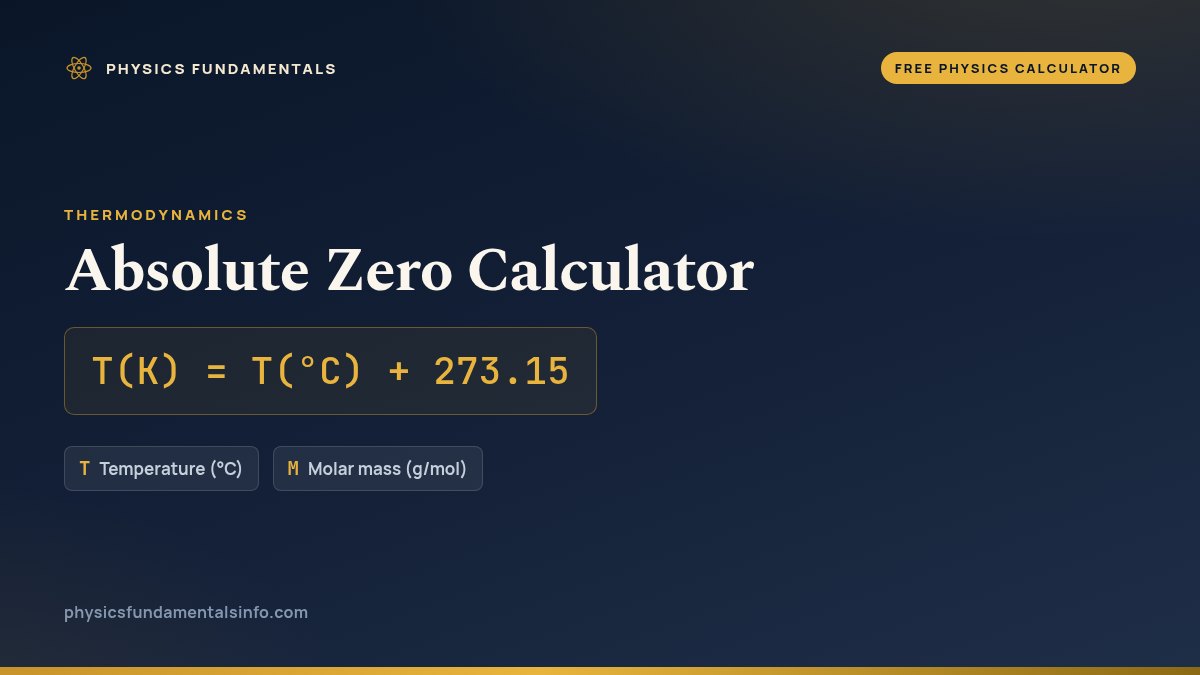
The absolute zero calculator is a free online tool built on the definition T(K) = T(°C) + 273.15, which puts absolute zero at -273.15 °C. Enter a temperature in Celsius, kelvin, Fahrenheit or Rankine together with the molar mass of a gas, and it returns the same temperature on all four scales alongside the root-mean-square molecular speed v_rms = sqrt(3·R·T / M), the thermal energy kT in millielectronvolts and the mean translational kinetic energy per molecule, with every step of the substitution shown.
| Symbol | Quantity | Default unit | Also accepts | Example value |
|---|---|---|---|---|
| T | Temperature | °C | K, °F, °R | 20 |
| M | Molar mass | g/mol | kg/mol | 28.013 |
How to use the absolute zero calculator
- Enter the temperature. Type a number in the Temperature box and choose its scale from the menu beside it: °C, K, °F or °R. The page opens on 20 °C, ordinary room temperature, and anything below absolute zero is refused with a line naming the floor of the scale.
- Enter the molar mass. The Molar mass box takes g/mol or kg/mol; the g/mol figure is the one printed on a periodic table or a gas cylinder. Nitrogen is 28.013, helium 4.0026, water vapour 18.015 and carbon dioxide 44.0095.
- Read the four scales. The first four extras repeat your temperature in kelvin, Celsius, Fahrenheit and Rankine, so the tool doubles as a four-way converter no matter which scale you typed in. Above absolute zero repeats the kelvin figure on purpose, because on that scale the reading and the gap above 0 K are the same number.
- Read the molecular figures. The headline result is the root-mean-square molecular speed; Thermal energy kT gives the energy scale in millielectronvolts and Mean kinetic energy (3/2)kT the mean translational energy of one molecule in joules, which is the kinetic energy formula applied to a single particle. Open Show working for the substitution.
The commonest slip is the unit menu on the temperature box. Typing 293 while °C is selected, when kelvin was meant, asks for 566.15 K and the rms speed jumps from 510.9 to 710 m/s. The second is reading the result as the average molecular speed: it is the root mean square, about 8.5 per cent higher.
Worked example: change one thing at a time
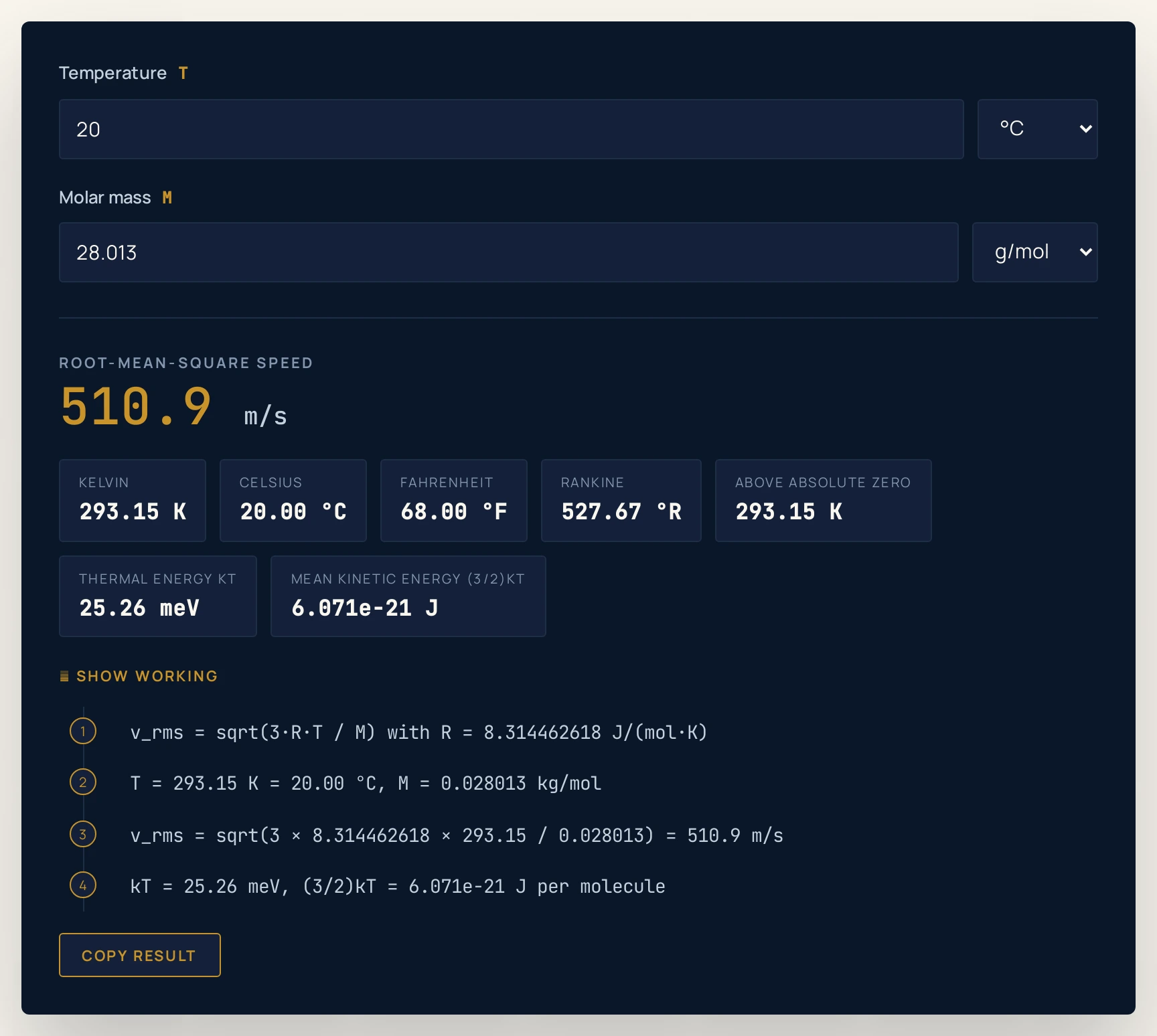
Start from the page defaults and move as little as possible per row. Every figure in the table is the string the calculator itself displays for those inputs, so if the table and the tool ever disagree, the tool is right.
| Step | Temperature entered | Molar mass | rms speed, m/s | Kelvin | Fahrenheit | Rankine | Thermal energy | Mean kinetic energy |
|---|---|---|---|---|---|---|---|---|
| Start (page defaults) | 20 °C | 28.013 g/mol | 510.9 | 293.15 K | 68.00 °F | 527.67 °R | 25.26 meV | 6.071e-21 J |
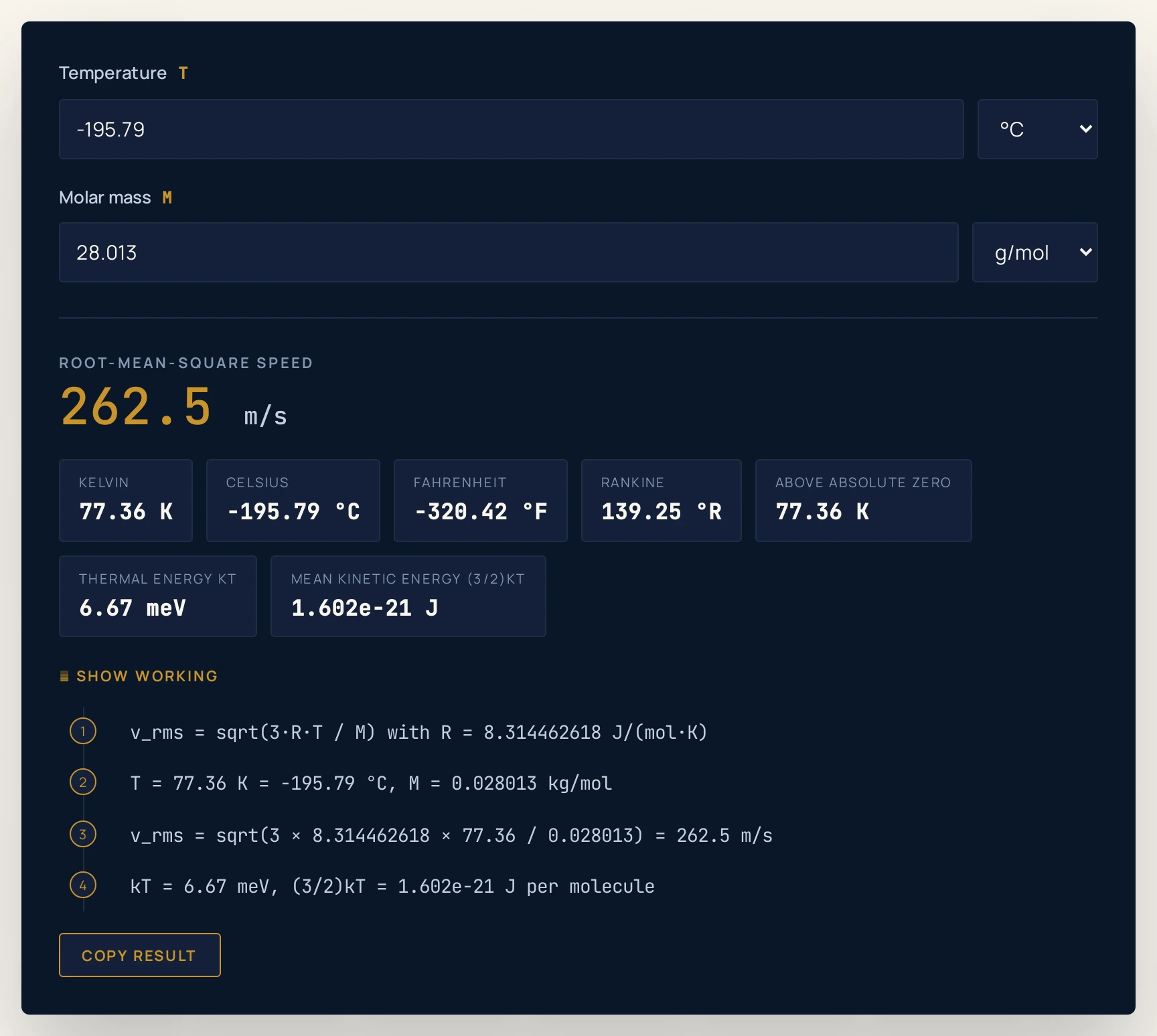
| Cool to liquid nitrogen | -195.79 °C | 28.013 g/mol | 262.5 | 77.36 K | -320.42 °F | 139.25 °R | 6.67 meV | 1.602e-21 J |
| All the way to absolute zero | -273.15 °C | 28.013 g/mol | 0 | 0.00 K | -459.67 °F | 0.00 °R | 0.00 meV | 0 J |
| Back to 20 °C, helium instead | 20 °C | 4.0026 g/mol | 1352 | 293.15 K | 68.00 °F | 527.67 °R | 25.26 meV | 6.071e-21 J |
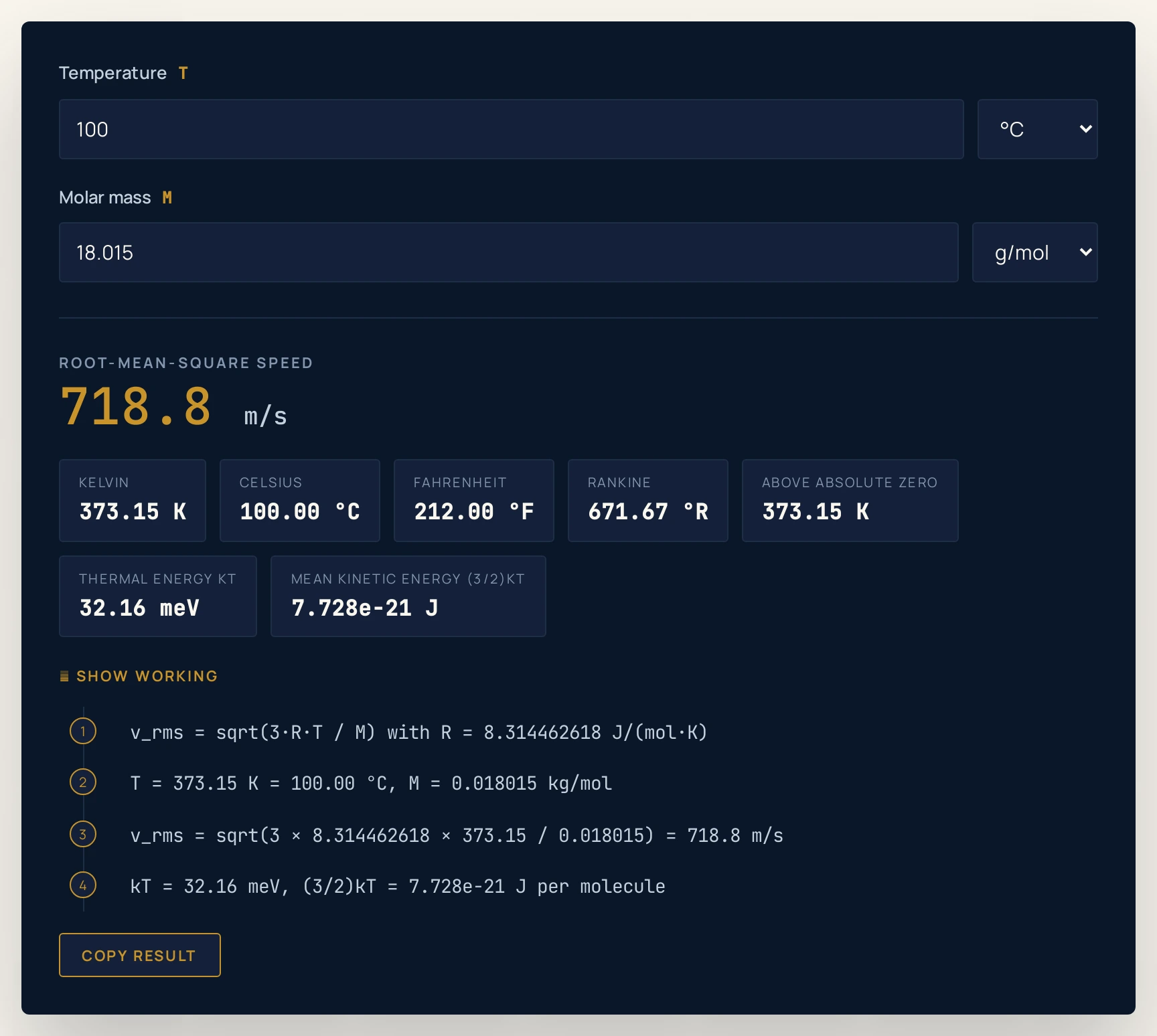
| Boiling water preset | 100 °C | 18.015 g/mol | 718.8 | 373.15 K | 212.00 °F | 671.67 °R | 32.16 meV | 7.728e-21 J |
| Dry ice preset | -78.46 °C | 44.0095 g/mol | 332.2 | 194.69 K | -109.23 °F | 350.44 °R | 16.78 meV | 4.032e-21 J |
| Helium at 300 K preset | 26.85 °C | 4.0026 g/mol | 1367 | 300.00 K | 80.33 °F | 540.00 °R | 25.85 meV | 6.213e-21 J |
Rows 1 to 3 hold the gas fixed and change only the temperature. Cooling nitrogen from 293.15 K to 77.36 K divides the absolute temperature by 3.79 and the speed by its square root, 1.95, which is why 510.9 m/s becomes 262.5; kT and the kinetic energy fall by the full factor of 3.79. Row 3 takes the same gas to 0 K, where every one of those figures is exactly zero — the same origin that the volume-against-temperature line runs into in the Charles law simulator.
Row 4 changes only the gas. Helium at the same 20 °C has an identical temperature on all four scales and an identical kT and kinetic energy, but its molar mass is seven times smaller, so its molecules move sqrt(7) = 2.65 times faster: 1352 m/s against 510.9. That is the one column a gas swap moves.
Rows 5 to 7 are the remaining presets, and they separate the two effects. Steam at 373.15 K is hotter than room air and lighter than nitrogen, so both influences push the same way and it reaches 718.8 m/s; the dry-ice row is colder and heavier, so both push the other way and it drops to 332.2 m/s.
Switching the temperature unit changes nothing physical. Enter 373.15 with K selected, 100 with °C, 212 with °F or 671.67 with °R and every extra and the speed come out the same, which is the quickest way to check a conversion you are unsure of. Try 0 K, -273.15 °C, -459.67 °F and 0 °R for the same reason.
Formula and symbol reference
Two definitions do all the work here: T(K) = T(°C) + 273.15 for the scales, and v_rms = sqrt(3·R·T / M) for the speed. The energy extras come from kT and mean KE = (3/2)·k·T, and the Fahrenheit and Rankine conversions are T(°F) = T(°C) × 9/5 + 32 and T(°R) = T(K) × 9/5. The speed and the two energies are the lines that insist on kelvin rather than Celsius, the same demand Charles's law makes when it holds a gas volume proportional to absolute temperature.
| Symbol | Meaning | SI unit | Typical range |
|---|---|---|---|
| T | Absolute temperature, the input; the calculator converts whichever scale you pick into kelvin before it does anything else | kelvin, K | 0 K at absolute zero, 2.725 K for the cosmic microwave background, 77.36 K where nitrogen boils, 273.15 K where water freezes, 373.15 K where it boils. |
| M | Molar mass of the gas, the second input | kilogram per mole, kg/mol | 4.0026 g/mol for helium, 18.015 for water vapour, 28.013 for nitrogen, 31.999 for oxygen, 44.0095 for carbon dioxide; dry air averages about 28.96. |
| v_rms | Root-mean-square molecular speed, the result: sqrt(3·R·T / M) | metre per second, m/s | 510.9 m/s for nitrogen at 20 °C, 262.5 m/s at the boiling point of nitrogen, 1352 m/s for helium at 20 °C, and exactly 0 at 0 K. |
| R | Molar gas constant, fixed by the 2019 SI redefinition | joule per mole per kelvin, J/(mol·K) | 8.314462618 J/(mol·K), exact. It is the Boltzmann constant multiplied by the Avogadro constant. |
| k | Boltzmann constant, the energy that corresponds to one kelvin | joule per kelvin, J/K | 1.380649e-23 J/K, exact, or 8.617333262e-5 eV/K, which is the form behind the kT extra in millielectronvolts. |
| kT | Thermal energy scale, reported as an extra in millielectronvolts | joule, J (printed here in meV) | 25.26 meV at 20 °C and 25.85 meV at 300 K; the mean translational kinetic energy per molecule is one and a half times it. |
The physics: what the extras are telling you
Absolute zero is where the thermal energy of a substance runs out; the guide to absolute zero and the kelvin scale tells the story of how that floor was found. What matters at this box is how the seven extras beneath the result hang together, because each one is a different way of stating the same input.
The first four are pure arithmetic. Kelvin and Rankine count upwards from absolute zero, so they never go negative, while Celsius and Fahrenheit start at arbitrary marks and can. Kelvin and Celsius share a degree size, Rankine and Fahrenheit share one that is five ninths as large, and every conversion the tool prints follows from those two facts.
Thermal energy kT is the bridge from the scale to the molecules, and a compact statement of the difference between heat and temperature: it is an energy per molecule fixed by the temperature alone, not the energy held in a sample. Multiplying the temperature by the Boltzmann constant turns kelvin into an energy, 25.26 meV at 20 °C, and the mean translational kinetic energy of one molecule is one and a half times that, 6.071e-21 J. Neither figure mentions the gas, which is why row 4 of the table leaves both untouched.
The molar mass only enters the last step. Setting (3/2)·k·T equal to (1/2)·m·v² and solving gives v_rms = sqrt(3·R·T / M), so the speed rises with the square root of the absolute temperature and falls with the square root of the molar mass. Doubling the kelvin reading multiplies the speed by 1.41; a gas seven times lighter is 2.65 times faster at the same temperature.
Where the model breaks down
The scale conversions are exact by definition and hold everywhere. It is the molecular half of the output that carries assumptions, and each one below has a recognisable symptom.
- Below the boiling point there is no gas left
- The rms speed assumes a gas. Ask for nitrogen at -223.15 °C, which is 50 K, and the tool prints 211 m/s, but at 1 atm nitrogen condenses at 77.36 K, so that is well inside the liquid and the figure describes an ideal gas that is no longer there. Treat any result below a gas's boiling point as an extrapolation.
- Symptom: a speed quoted for a substance you know is liquid or solid at that temperature.
- Nothing reaches 0 K
- The third of the laws of thermodynamics forbids cooling anything to absolute zero in a finite number of steps, because each stage takes out a smaller share of what is left. The calculator accepts 0 K as the arithmetic limit of the scale, and the zero row of the table is what the ideal-gas model predicts there, not a state anyone has produced.
- Zero-point motion survives
- At T = 0 the tool returns 0 m/s, 0.00 meV and 0 J because the classical model has no thermal energy left to share out. Real matter does not go still: quantum mechanics leaves every particle a zero-point motion it cannot lose, and helium stays liquid at 1 atm all the way down because of it. What ends at 0 K is the thermal part of the motion.
- The rms speed is not the average speed
- Molecules in a gas share out a broad distribution of speeds, and the calculator reports the root-mean-square value of it. The plain arithmetic mean is about 92 per cent of that figure and the most probable speed about 82 per cent, so for the default case the three are roughly 511, 471 and 417 m/s. Quote the right one for the problem you are solving.
- Only the translational energy is counted
- (3/2)kT is the mean kinetic energy of a molecule moving through space, and that is all the extra reports. A diatomic gas such as nitrogen also stores energy in rotation, which is why its molar heat capacity at room temperature is around (5/2)R rather than (3/2)R; the speed is unaffected, but the total energy per molecule is larger than the extra shows.
- Real gases are not ideal
- The relation between temperature and molecular speed assumes molecules with no volume and no attraction between them. At high pressure or within a few tens of kelvin of the condensation point that stops being true, and the ideal-gas picture that underlies both this calculator and the ideal gas law calculator begins to drift from measurement.
- Mixtures need an averaged molar mass
- The box takes one molar mass, so a mixture has to be entered as its average: dry air is about 28.96 g/mol, not 28.013. In a real mixture each species keeps its own rms speed at the shared temperature, the lighter ones moving faster, and a single averaged figure hides that spread.
Where it is actually used
- Cryogenics and liquefied gases
- Anyone working with liquid nitrogen or liquid helium quotes temperatures in kelvin, because the interesting range is only a few tens of kelvin wide and in Celsius every figure in it is a cumbersome negative. Type -195.79 °C to see 77.36 K, and the boiling point of helium at 4.22 K as -268.93 °C, which is the sort of conversion the four extras save you doing by hand. The hardware that has to reach those temperatures contracts on the way down, which is a job for the thermal expansion calculator rather than this one; its coefficients are room-temperature values that fall towards zero as a material cools, so over a cryogenic range they overstate the contraction.
- Electronics and thermal noise
- The kT extra is the number semiconductor engineers work in. At 300 K it reads 25.85 meV, and dividing by the elementary charge gives the thermal voltage of about 25.85 mV that sets the slope of a diode's current-voltage curve and the scale of Johnson noise in a resistor. Step the temperature from 20 °C to 100 °C and that figure climbs by more than a quarter, from 25.26 meV to 32.16 meV.
- Vacuum systems and gas handling
- How fast a gas leaks through a small hole, and how quickly a chamber pumps down, depend on the molecular speed rather than on the pressure alone. Helium's 1352 m/s at room temperature against nitrogen's 510.9 is one reason helium is the standard leak-test gas: through the same small hole it effuses about two and a half times as fast.
- Isotope separation and effusion
- Because the speed goes as the inverse square root of the molar mass, two isotopes of the same element move at very slightly different rates through a porous barrier. Enter two molar masses a per cent apart and the speeds differ by half a per cent, which is why enrichment by effusion needs the process repeated over and over.
- Choosing a rocket propellant
- Exhaust velocity scales with the same square root of temperature over molar mass, so a propellant that produces light molecules beats one that merely burns hot. Put 3000 K in the box with 2.016 g/mol for hydrogen and the tool returns 6092 m/s — the rms molecular speed, not an achievable exhaust velocity, but the ratio is the part that carries over. The same temperature with carbon dioxide's 44.0095 g/mol gives 1304, nearly five times slower.
- Defining the kelvin itself
- Since 2019 the kelvin has been defined by fixing the Boltzmann constant at exactly 1.380649e-23 J/K, which is what makes the conversion between temperature and energy in this tool a definition rather than a measurement. The same redefinition fixed the molar gas constant at 8.314462618 J/(mol·K), the value in the working steps.
Where to go next
For the definition itself, why the Celsius offset is 273.15 and how the extrapolation that found it works, read the guide Absolute Zero and the Kelvin Scale, and for the distinction the kT extra depends on, the article on heat versus temperature. To carry a kelvin figure forward, take it to the ideal gas law calculator or the Charles law calculator, both of which refuse anything but an absolute temperature. See a gas volume shrink towards that same zero in the Charles law simulator, or browse the library of physics simulations.
Frequently asked questions
Why is absolute zero -273.15 degrees Celsius?
Because that is where the Celsius scale sits relative to the true zero of temperature, and since 1954 the offset has been a definition rather than a measurement. The kelvin and the degree Celsius are the same size, so the two scales differ only by the constant 273.15, and the calculator applies exactly that when you switch the unit. The figure was originally arrived at by extrapolating the volume or pressure of a dilute gas down to zero.
Can absolute zero actually be reached?
No: the third law of thermodynamics says that no finite sequence of steps can cool anything to 0 K, because each stage of cooling removes a smaller share of the remaining energy than the last. Laboratories have come extraordinarily close using laser and evaporative cooling, and any specific record figure should be verified against a current source before you quote it. The calculator therefore accepts 0 K as an arithmetic limit, not as an achievable state.
Do molecules stop moving at absolute zero?
No, and this is the most common misreading of the result. At T = 0 the calculator returns 0 m/s because the ideal-gas model it uses has no energy left to distribute, but real matter keeps zero-point motion that quantum mechanics forbids it to lose. What vanishes at 0 K is the thermal part of the motion, the part that kT measures, not motion itself.
What is the difference between K, degrees Celsius, degrees Fahrenheit and degrees Rankine?
Kelvin and Rankine both start at absolute zero, so neither ever goes negative; Celsius and Fahrenheit start at arbitrary points and can. Kelvin and Celsius share a degree size, Rankine and Fahrenheit share a smaller one that is five ninths as large. That gives 0 K = -273.15 degrees Celsius = -459.67 degrees Fahrenheit = 0 degrees Rankine, and the calculator prints all four for whichever one you type.
Is the rms speed the same as the average molecular speed?
No. The root-mean-square speed is the square root of the mean of the squared speeds, so it weights fast molecules more heavily and comes out about 8.5 per cent above the plain arithmetic mean and about 22 per cent above the most probable speed. It is the one the calculator reports because it is the speed that carries the kinetic energy: (1/2)m times the rms speed squared is exactly the mean kinetic energy per molecule.
Why does the calculator refuse a temperature below 0 K?
Because there is nothing there to compute. A negative absolute temperature would put a negative number under the square root in the rms-speed formula and a negative value on the energy extras, none of which describes a real gas. Enter -300 degrees Celsius and the tool replaces the result with a line naming the floor of the scale rather than printing a meaningless figure.
References & formula source
- Halliday, Resnick & Walker — Fundamentals of Physics, Chapter 18 (Temperature, heat and the first law) and Chapter 19 (The kinetic theory of gases).
- Young & Freedman — University Physics, Chapters 17 and 18 (Temperature and heat; thermal properties of matter, including the rms speed).
- NIST — CODATA 2018 recommended values of the fundamental physical constants: the Boltzmann constant k, the molar gas constant R and the Avogadro constant, all exact since the 2019 redefinition.
- BIPM — The International System of Units (SI), 9th edition: the definition of the kelvin in terms of a fixed numerical value of the Boltzmann constant.
- Further reading: Absolute zero — Wikipedia