Carbon dating is a method for working out when a once-living thing died, by measuring how much carbon-14 it still holds. A living organism keeps its carbon-14 topped up from the atmosphere. That exchange stops at death, and the isotope decays with a half-life near 5,700 years, so the surviving fraction fixes the age.
A lump of charcoal from an old fire looks like any other lump of charcoal. Nothing about it announces its age. Yet a laboratory can take a few milligrams, count what is inside, and say roughly how long ago the tree that made it stopped growing.
The trick is that every living thing carries a faint radioactive label it cannot switch off. While the organism is alive, that label is topped up continuously. The moment it dies the topping-up stops, and the label starts to fade on a schedule that has not changed in tens of thousands of years.
What Is Carbon Dating?
Carbon dating is the measurement of the carbon-14 left in once-living material, read against the level that material started with, to estimate how long ago it died.
Notice what that sentence does not say. It does not say the method measures age. A laboratory measures a carbon-14 level; the age is what the decay law infers from that level, and the inference rests on assumptions you can state out loud and check.
In a research paper the method is called radiocarbon dating, and the two names mean the same thing. “Carbon dating” is the everyday name; “radiocarbon” is what appears on the report a laboratory sends back.
Three conditions have to hold before the method has anything at all to say.
- The carbon must have been in circulation with the atmosphere. Wood, charcoal, bone, seeds, textiles, leather, shell and peat all qualify, because a living thing builds itself out of the carbon moving around it. Granite does not, and neither does a bronze blade or a clay pot, though charcoal trapped in the clay might.
- That exchange must have stopped. For an organism, death is what stops it, and the stopping is the event the clock is timing — not the age of the object, but the moment the carbon stopped being refreshed.
- The starting level must be known. The arithmetic compares what is left with what was there at the start, and getting that starting level right is the hardest part of the whole business.
The Carbon Dating Formula and How to Read It
Every radioactive isotope thins out by the same law, and carbon-14 is no exception. Turn that law around, solve for time rather than for the amount left, and you get the equation a dating laboratory actually uses.
| Symbol | Quantity | Unit | Notes |
|---|---|---|---|
| t | elapsed time since death | years | reported as radiocarbon years before 1950, not as a calendar date |
| t½ | half-life of carbon-14 | years | three values are in circulation: 5,568, 5,700 and 5,730 years. Say which one you used |
| N0 | carbon-14 level at death | percent of the modern standard | the atmospheric level when the organism died; usually assumed to be 100 |
| N | carbon-14 level measured today | percent of the modern standard | what the instrument reports, written pMC |
| λ | decay constant | per year | λ = ln 2 / t½, which is 0.00012160 per year at 5,700 years |
| τ | mean lifetime | years | τ = t½ / ln 2 = 8,223.3617 years at 5,700 years; the constant that turns a percentage into years |
Run the same law forwards and it describes the fading itself, which is the form you meet first in a textbook:
The half-life is the only property of the isotope in either equation. Everything else is bookkeeping: divide the measured level by the starting level, take a logarithm, multiply by a constant.
You do not have to work that logarithm by hand. Our half-life calculator solves exactly this equation — set N0 = 100, set N to the measured percentage of modern carbon, type in the half-life you have chosen, and solve for elapsed time. Its own default is the 5,730-year value, so change that field if you want the 5,700-year figure used throughout this article: the 5,730-year and 5,568-year settings differ by 2.9095 %, the ratio 5730/5568, on every reading you put in.
The lab below lets you drive the same arithmetic by hand. You set what the instrument measured, what the atmosphere held when the organism died, and how precise the measurement was; the readouts report the radiocarbon age, its range, and what the same reading would give under the other two half-lives.
Two things are worth watching for. The uncertainty slider never moves the age itself, only the width of the bar around it — and switching half-life changes the age while leaving the measured fraction exactly where it was.
Where the Carbon-14 Comes From, and Why It Stops
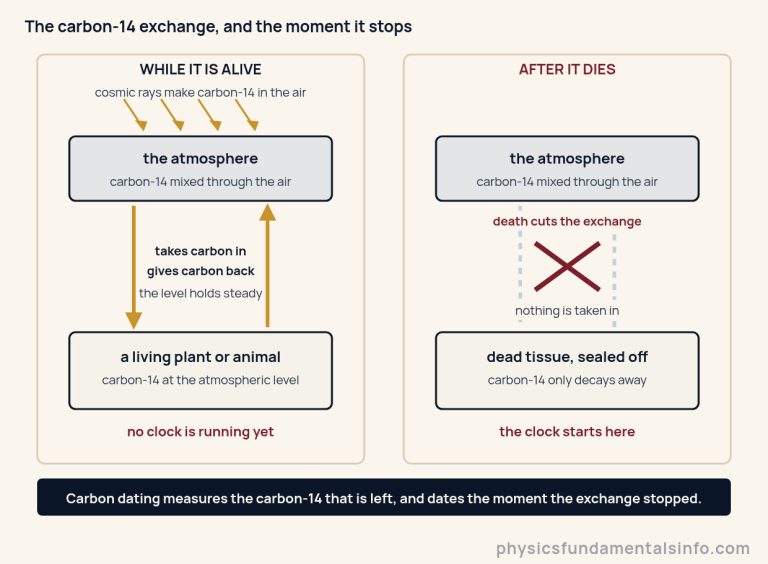
Where does the carbon-14 come from in the first place, and what exactly stops? Carbon-14 is manufactured high in the atmosphere. Cosmic rays produce neutrons there, and a neutron that has slowed down can strike a nitrogen-14 nucleus and knock a proton out of it. The nucleus keeps its mass number of 14 but loses a unit of charge, so it is now carbon rather than nitrogen.
That fresh carbon-14 oxidises, joins the vast reservoir of carbon dioxide in the air and mixes around the globe. Plants take it up when they photosynthesise. Animals take it up when they eat plants, or eat animals that ate plants. Every living thing therefore sits at roughly the same carbon-14 level as the air around it.
Carbon-14 is unstable, and it goes by beta-minus decay: a neutron inside the nucleus turns into a proton, emitting an electron and an antineutrino. The nucleus becomes nitrogen-14 again, which is where the carbon came from in the first place.
The decay leaves the daughter nucleus in its ground state, so no gamma rays come out of it. All a detector has to work with is one low-energy electron, and that constraint has shaped how carbon-14 has been measured ever since.
While the organism lives, decay and replacement balance each other and the level holds steady. Death breaks the balance. Nothing new comes in, decay carries on regardless, and from that moment the carbon-14 level falls along a curve that depends only on how long the organism has been dead.
Reading an Age From a Measurement
Laboratories do not report a raw count. They report percent modern carbon, written pMC: the sample’s carbon-14 level as a percentage of an agreed 1950 standard. Because it is a ratio, no activity constant and no absolute count ever needs to appear in the arithmetic.
A reading of 50.0 pMC means half the original carbon-14 has gone, which is one half-life. A reading of 25.0 pMC is two half-lives, 12.5 pMC is three, and so on down. Between those landmarks the logarithm does the work.
Plot the level on a logarithmic axis and something useful happens: the curve straightens out. Equal steps down the axis are equal steps in time, so the half-life ladder becomes a set of evenly spaced rungs rather than a curve that flattens out and becomes hard to read.
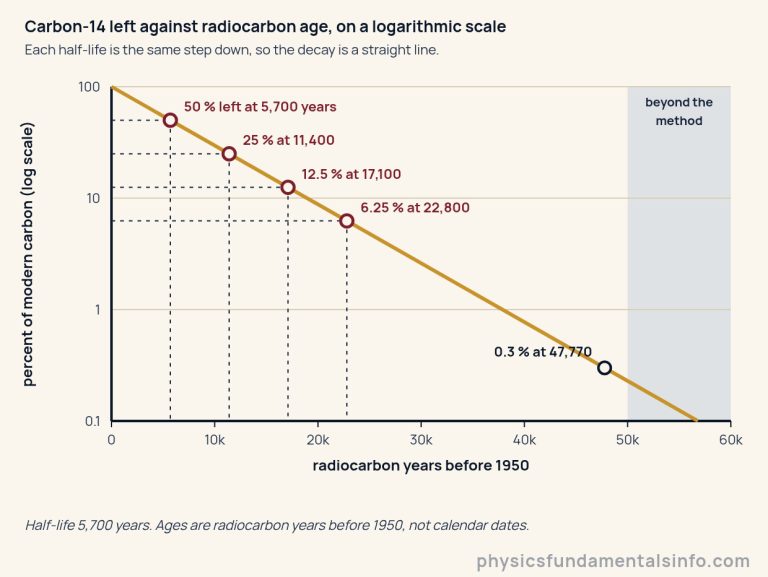
The table reads that same line off at nine levels, all at a half-life of 5,700 years and all assuming the organism started at the 1950 standard. Column three tells you how many half-lives deep a reading is, which is the quickest way to place it; column four carries the age itself, and it is the one to quote.
| Measured level (pMC) | Fraction left | Half-lives elapsed | Radiocarbon age (years BP) |
|---|---|---|---|
| 100 | 1.00000 | 0.0000 | 0 |
| 90 | 0.90000 | 0.1520 | 870 |
| 75 | 0.75000 | 0.4150 | 2,370 |
| 50 | 0.50000 | 1.0000 | 5,700 |
| 25 | 0.25000 | 2.0000 | 11,400 |
| 12.5 | 0.12500 | 3.0000 | 17,100 |
| 6.25 | 0.06250 | 4.0000 | 22,800 |
| 1 | 0.01000 | 6.6439 | 37,870 |
| 0.3 | 0.00300 | 8.3808 | 47,770 |
Every age in that last column is rounded to the nearest ten years, which is the convention for reported radiocarbon ages. Carry the unrounded figures through your own working and round once, at the end — rounding the number of half-lives first and then multiplying will shift the answer by a decade or more.
How the level is measured has changed. Early work counted the beta particles coming out of a sample and needed grams of material and days of counting. Accelerator mass spectrometry counts carbon-14 atoms directly, which is why a few milligrams now suffice.
The uncertainty behaves in a way most people find surprising. A measurement precise to ± 0.5 % of the reading gives ± 41 years at 5,700 years old, and the same ± 41 years at 37,870 years old. The error bar in years depends only on the relative precision and the mean lifetime, not on the age.
Why do old dates feel less precise, then? Because the relative precision itself gets worse. There is so little carbon-14 left in a very old sample that counting it well becomes genuinely hard, and it is that, not the arithmetic, that widens the bar.
Why Ages Are Given in Radiocarbon Years BP
A radiocarbon age is not a calendar age, and the difference is not a technicality. What the equation returns is a count of radiocarbon years before present, where “present” is fixed at 1950, and the count assumes the atmosphere always held the 1950 carbon-14 level.
It did not. Atmospheric carbon-14 has wandered, and it has wandered in both directions within living memory.
- Down, through the industrial period. Burning coal and oil releases carbon that is far too old to hold any carbon-14 at all, so the fossil carbon diluted the atmosphere. This is the Suess effect, and it makes wood grown in the early twentieth century read slightly older than it is.
- Up, and sharply, after 1950. Above-ground nuclear weapons testing roughly doubled atmospheric carbon-14 by the early 1960s. The level has been falling back ever since, which is why anything grown in the second half of the twentieth century can read as a negative radiocarbon age.
Because of that wandering, turning radiocarbon years into a calendar date needs a published calibration curve — a record built from material whose true age is known independently. This article does not carry one, and no page on this site converts a radiocarbon age into a calendar year.
So read a figure like “11,400 radiocarbon years BP” for what it is: the answer the decay equation gives, on a stated half-life, before calibration. It is a real, reproducible number. It is just not a date.
The Three Half-Lives, and Why Reported Ages Still Use 5,568 Years
Ask what the half-life of carbon-14 is and you will be given one of three answers, all of them defensible. The currently recommended value is about 5,700 years. An older and still widely quoted measurement, the Cambridge value, is 5,730 years — the default on our own half-life calculator. The original Libby value is 5,568 years.
Here is the part that surprises people: reported radiocarbon ages are still computed with the Libby figure, by convention, even though it is not the best measurement. That is deliberate. Keeping one agreed constant means an age published decades ago and an age published this year can be compared directly, and the calibration step absorbs the difference afterwards.
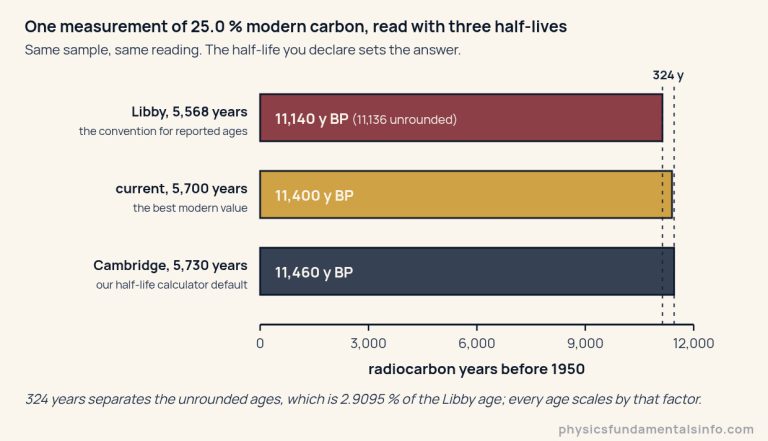
| Half-life | Name | What it is used for | Age from 25.0 pMC | Against the Libby age |
|---|---|---|---|---|
| 5,568 years | Libby | the convention for reported radiocarbon ages, kept so that old and new dates stay comparable | 11,140 (11,136 unrounded) | reference |
| 5,700 years | currently recommended | the best modern value, and the default in the lab above and everywhere in this article | 11,400 | + 2.3707 % |
| 5,730 years | Cambridge | common in textbooks, and the default on our half-life calculator | 11,460 | + 2.9095 % |
The last column is worked from the unrounded Libby age, because the reported ages have already been rounded to the nearest ten years: 11,400 / 11,136 = 1.023707, which is + 2.3707 %, and 11,460 / 11,136 = 1.0290948, which is + 2.9095 %. Take those ratios against the rounded 11,140 instead and you get 2.3339 % and 2.8725 %, which is why a percentage is only ever as good as the figure it was measured against.
None of the three is wrong, and the choice is not a matter of taste either. It is a declaration: every quoted radiocarbon age is meaningless until you say which half-life produced it. Problem 3 works the difference through in full.
How Far Back Can Carbon Dating Go?
Carbon dating reaches back about 50,000 years, and that ceiling is set by what a laboratory can measure rather than by anything in the equation. The exponential itself never reaches zero.
Follow the numbers down and you can see the wall coming. At 37,870 radiocarbon years a sample still holds 1 % of modern carbon. At 47,770 years it holds 0.3 %. By 51,100 years it is down to 0.2 %, and one slider step of 0.1 pMC between those two readings is worth more than three thousand years of age.
Down there, two things start to dominate. Laboratory equipment has its own faint background signal, and any modern carbon picked up during handling adds carbon-14 of its own. Neither can be separated from a genuine signal that is itself only a few tenths of a percent, and Problem 6 works out what even a one-percent trace does to a reading that faint.
So treat “about 50,000 years” as a working horizon rather than a sharp edge. Careful laboratories push a little past it on well-preserved material; ordinary samples fall short of it. There is no line in the physics where dating simply stops.
What Ruins a Date: Contamination and Reservoir Effects
Contamination is the great enemy of an old date, and it is brutally asymmetric. A trace of modern carbon in an ancient sample is a disaster; the same trace of ancient carbon in a young sample barely registers.
Work an example. A sample genuinely at 1.0 pMC, an age of 37,870 radiocarbon years, picks up 1 % modern carbon during collection. Its measured level becomes 1.99 pMC and its apparent age falls to 32,210 years — younger by 5,660 years, from a one-percent error.
Now do the same 1 % to a sample reading 50.0 pMC. It measures 50.5 pMC, and the age moves from 5,700 to 5,620 radiocarbon years: a shift of 80 years. Same contamination, same fraction, seventy times less damage.
Reservoir effects are a different problem, and they are not laboratory errors at all. Carbon in the deep ocean has been out of contact with the atmosphere for a long time, so marine organisms — and the animals that eat them — start life already depleted in carbon-14 and can read older than they really are.
The same thing happens in fresh water fed by old limestone, and near volcanic vents that breathe out carbon-free gas. The size of the offset varies with place and setting, and no single number covers it, so this article puts no figure on it.
Common Misconceptions About Carbon Dating
Four beliefs about this method are worth correcting, and the first is far and away the most common.
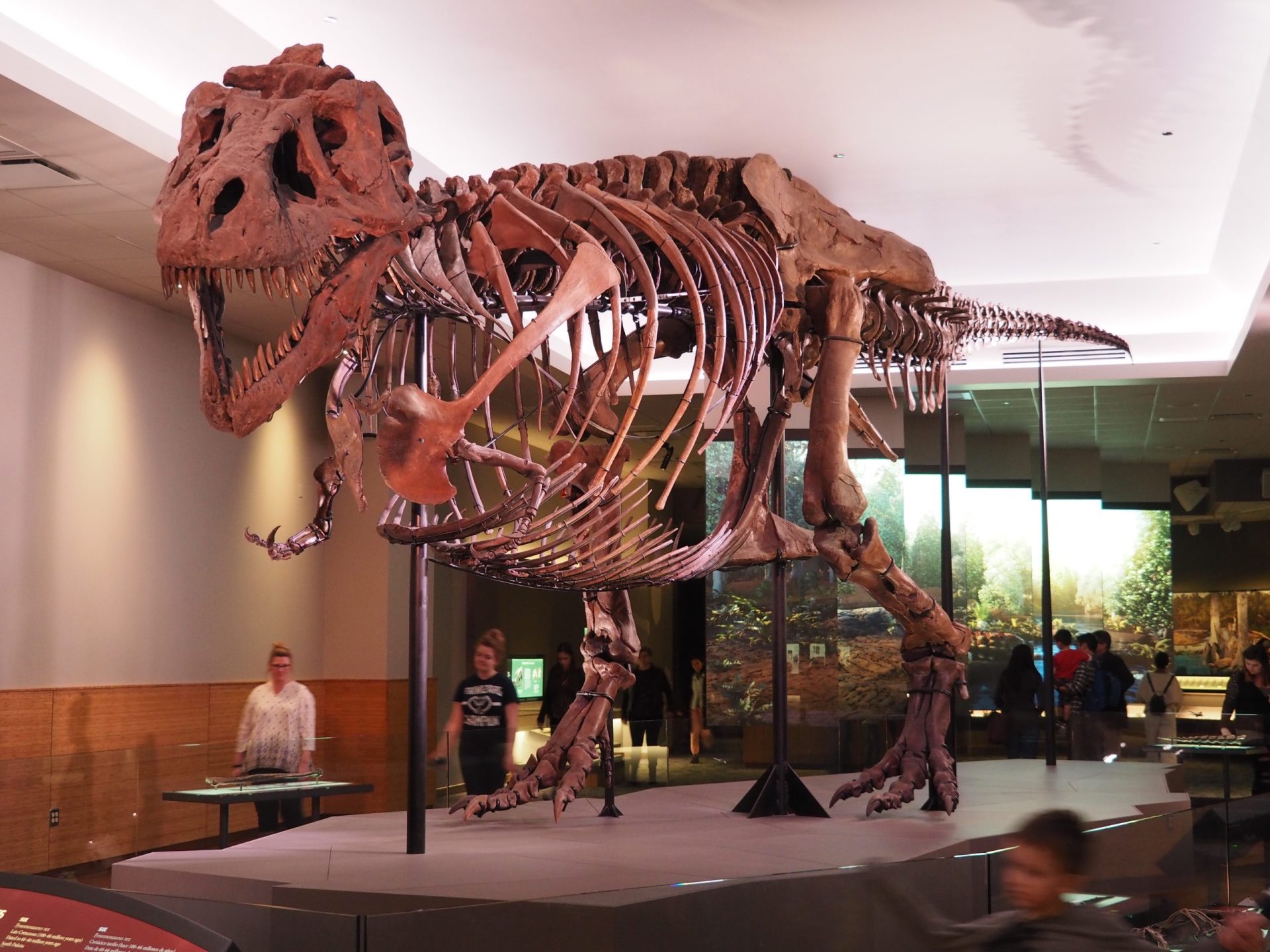
- “Carbon dating can date dinosaur bones.” It cannot. At 66 million years a fossil is about 11,600 carbon-14 half-lives past death, and nothing whatever is left to measure. Dinosaur fossils are dated from the rocks around them, using isotope systems whose half-lives run to hundreds of millions or billions of years.
- “Carbon dating works on rocks.” It does not. What the clock times is a parcel of carbon ceasing to exchange with the atmosphere: for an organism that moment is death, and for deep ocean water it is the moment the water left the surface. A granite boulder never exchanged carbon with the atmosphere in the first place, so for granite that moment never came and there is no clock in it to read.
- “A radiocarbon date is a calendar date.” It is not, until it has been calibrated. An uncalibrated age is a count of radiocarbon years before 1950, computed on a stated half-life.
- “The method measures how old something is.” It measures how much carbon-14 is left. The age is inferred from that measurement through a model, and the model can be wrong about the starting level even when the measurement is perfect.
What Carbon Dating Is Genuinely Used For
Strip away the myths and a solid list remains. Archaeology and museum conservation use it to place organic finds — charcoal, bone, textile, seed — in sequence. Forensic scientists use the post-1950 bomb rise to say whether recent remains grew before or after the testing era.
It also works as a tracer rather than as a date, and not only on carbon that was once inside an organism. Hydrologists use carbon-14 to estimate how long groundwater has been underground, oceanographers use it to follow deep circulation, and conservators use it to check whether a supposedly old organic material is in fact modern.