A radioactive decay chain is a sequence in which an unstable parent nuclide decays into a daughter that is itself radioactive, and so on until a stable nuclide ends it. The daughter’s activity starts at zero and climbs to a peak at the exact moment it equals the parent’s activity, then falls.
Point a counter at a freshly separated radioactive sample and something odd happens. The count rate does not simply fade the way the textbook curve promises — it climbs for a while first, tops out, and only then settles into the long decline.
Nothing is wrong with the counter. It is hearing a second nuclide: the daughter left behind by the first decay, which turns out to be unstable in its own right. That second nuclide is the whole subject of this page.
What Is a Radioactive Decay Chain?
A radioactive decay chain is a run of successive decays in which each unstable nuclide produces another unstable nuclide, until one of them lands on a stable species and the chain stops there.
Most exam questions quietly stop after one step, as though the daughter were inert. Uranium-238 is the famous counter-example: it runs fourteen steps before finishing as stable lead-206, and every one of those intermediates is made by the step above it and destroyed by the step below.
Three members are enough to show everything that matters, so that is the model used here. A radioactive parent, a radioactive daughter, a stable end product — label them 1, 2 and 3 and you have the whole cast.
One assumption does all the work: the daughter starts at zero. In the laboratory that means somebody separated the parent chemically and started a clock at that moment, which is why every time in this article is measured from a separation rather than from the birth of the sample.
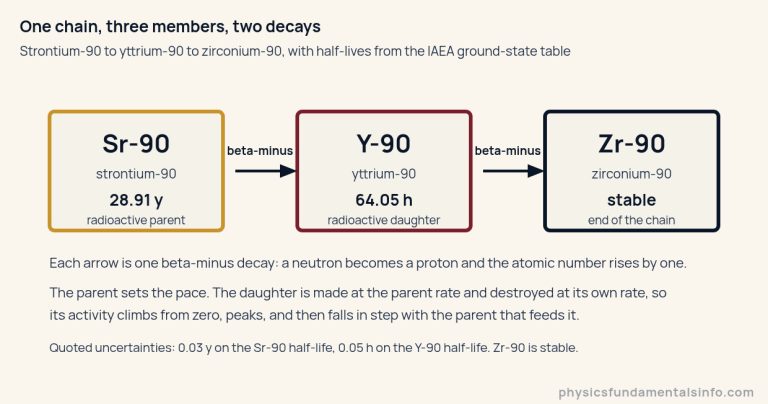
Strontium-90 is the simplest case to picture. It beta-decays to yttrium-90, which beta-decays again to zirconium-90, and zirconium-90 is stable, so there the chain stops after exactly two steps.
Both of those steps turn a neutron into a proton and push the element one place up the periodic table. Our guides to beta decay and to alpha, beta and gamma radiation cover what is physically leaving the nucleus; here the only question is how many decays per second each member is doing.
The Decay Chain Formula for the Daughter
You already know what the parent does. It thins out exponentially, governed by its own decay constant λ1 = ln 2 divided by its half-life — if that sentence needs unpacking, our guide to half-life in physics covers the decay constant, the mean lifetime, activity and the becquerel, and this page takes all five as read.
The daughter is harder, because it is being created and destroyed at the same time. Solving its population equation with none present at the start gives the Bateman result for two members.
That form is honest but awkward. Divide through to get the ratio of the two activities instead, and almost everything interesting about a chain falls out of a single expression.
Look at what has vanished. The starting quantity has cancelled, so the ratio depends on the two half-lives and the elapsed time and on nothing else — that is algebra, not a measurement. Feed measured half-lives and one activity into the decay chain calculator and it will return the daughter activity, the parent activity or the elapsed time, whichever you leave blank.
| Symbol | What it is | SI unit | Worth knowing |
|---|---|---|---|
| N0 | number of parent atoms at the separation | — | only sets the vertical scale; it cancels out of every ratio on this page |
| N2 | number of daughter atoms at time t | — | starts at zero by assumption, which is what “since separation” means |
| λ1 | decay constant of the parent | per second | ln 2 divided by the parent half-life T1 |
| λ2 | decay constant of the daughter | per second | ln 2 divided by the daughter half-life T2 |
| A1 | parent activity now | Bq | λ1N1, and the quantity you can actually measure |
| A2 | daughter activity now | Bq | λ2N2; this is what climbs to a peak and then falls |
| t | time since the daughter was last separated | s | not the age of the sample and not the date on the label |
There is one sharp edge in the first formula: if the two half-lives are equal, λ2 – λ1 is zero and the expression divides by zero. The fix is to factor that difference out, writing A2/A1 = λ2t f(x) with x = (λ2 – λ1)t and f(x) = (1 – e-x)/x.
Since f tends to 1 as x tends to zero, the equal-half-life case is then computed exactly rather than dodged. Worked problem 8 runs that case end to end.
The lab below draws both activities against time. Because the daughter’s activity can never climb above the parent’s starting activity, both curves fit on one shared vertical scale — so set the two half-lives and slide the clock forward, and what you see is a fair comparison rather than two curves stretched to different rulers.
Why the Daughter Climbs, Peaks, Then Follows
Two things happen to the daughter every second: some is made by the parent, and some of what exists decays away. Write that as a rate and the daughter’s population grows at λ1N1 – λ2N2, which is simply A1 – A2.
That single line explains the shape. Early on there is no daughter to speak of, so A2 is tiny, the difference is large and positive, and the stock of daughter atoms builds fast. As the stock grows, A2 grows with it and the gap narrows.
When the gap closes to nothing the growth stops. The daughter’s activity is at its maximum at precisely the instant the two activities are equal — not near it, exactly at it, which makes the peak a genuinely checkable prediction rather than a feature of a drawing.
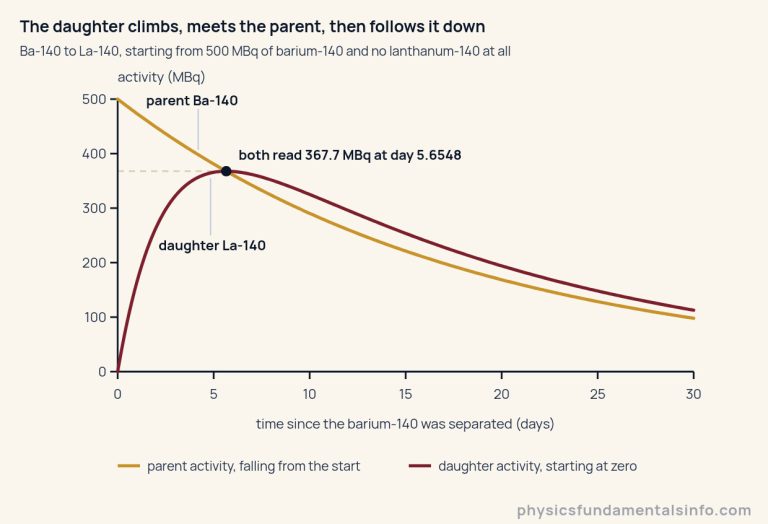
Past the peak, provided the parent is the longer-lived of the two, the daughter cannot decay on its own schedule, because it is being topped up by a parent that is itself shrinking. The pair lock into a fixed ratio, and from then on both curves fall at the parent’s rate — a short-lived daughter, decaying on a clock its own half-life has nothing to do with.
Watch the right-hand end of the graph above. The daughter holds a constant factor of 1.1516 above the parent from there on, so the visible gap between the curves keeps narrowing as both of them fall — a fixed ratio does not mean a fixed distance.
The Three Equilibrium Regimes
How the story ends depends entirely on which nuclide outlives the other. Three cases exhaust the possibilities, and the deciding quantity is the limiting ratio the pair settle onto, which works out to T1/(T1 – T2) whenever the parent is the longer-lived of the two.
| Regime | When it applies | Limiting ratio A2/A1 | What the daughter ends up doing |
|---|---|---|---|
| Secular equilibrium | parent at least 100 times longer-lived than the daughter, by convention | just above 1 — 1.000253 for strontium-90 feeding yttrium-90 | settles onto a near-constant activity and stays there for as long as the parent lasts |
| Transient equilibrium | parent longer-lived than the daughter, but by less than that | noticeably above 1 — 1.1516 for barium-140 feeding lanthanum-140 | peaks, then falls at the parent rate while staying a fixed factor above it |
| No equilibrium | daughter longer-lived than the parent | none at all | keeps climbing relative to the parent, and is still there long after the parent has gone |
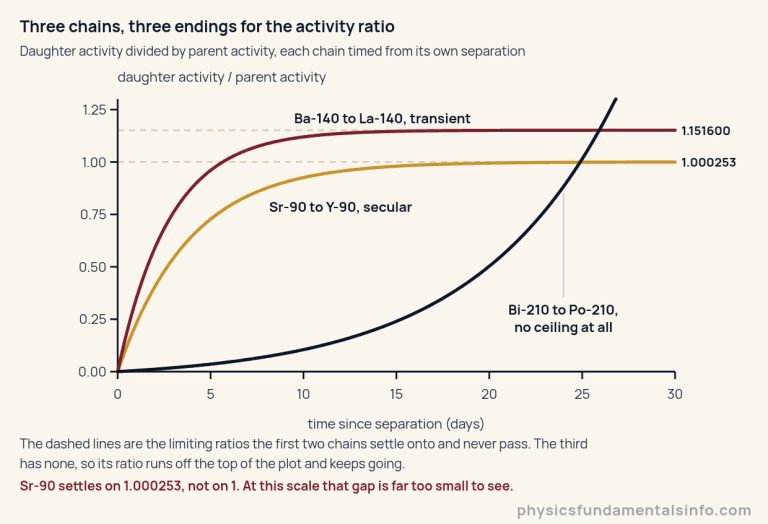
That factor of a hundred deserves a warning. It is a naming convention and nothing else — no physical boundary sits there, and a chain does not change behaviour as it crosses the line. The limiting ratio moves smoothly from one chain to the next, and only the label attached to it jumps.
So read the number, not the name. And be careful with one sentence you will meet almost everywhere: in secular equilibrium the two activities are routinely said to become equal, and they do not. Strontium-90 feeding yttrium-90 settles onto 1.000253, a hair above 1, and that tiny surplus is exactly what keeps the daughter supplied.
How long does settling take? Because the ratio approaches its ceiling as 1 – e-(λ2 – λ1)t, reaching 99 per cent of the way there takes ln(100) divided by that same difference — usually quoted as “about seven daughter half-lives”, and worked out properly in problem 5.
Three Real Decay Chains Side by Side
Nothing beats real nuclides for making the three regimes concrete. The half-lives below were pulled from the ground-state data behind the IAEA Live Chart of Nuclides, and every derived column is computed from them rather than copied from a textbook.
| Parent | T1 | Daughter | T2 | Stable end | T1/T2 | Regime | Limiting ratio | Daughter peaks at |
|---|---|---|---|---|---|---|---|---|
| Sr-90 | 28.91 y | Y-90 | 64.05 h | Zr-90 | 3957 | Secular | 1.000253 | 31.90 d |
| Ba-140 | 12.751 d | La-140 | 1.67858 d | Ce-140 | 7.5963 | Transient | 1.1516 | 5.6548 d |
| Bi-210 | 5.012 d | Po-210 | 138.376 d | Pb-206 | 0.03622 | None | none | 24.8944 d |
Read the precision honestly. The quoted uncertainties are 0.03 y on Sr-90, 0.05 h on Y-90, 0.004 d on Ba-140, 0.00021 d on La-140, 0.005 d on Bi-210 and 0.002 d on Po-210, and every derived column inherits them. Those columns are quoted to the precision the worked problems use, which in two or three cells runs a figure or two past what the uncertainties strictly support, so read the trailing digits as bookkeeping rather than as measurement.
Two footnotes on that table. Bismuth-210 also has an alpha branch, but at 0.000132 per cent of its decays it changes nothing here. And strontium-90’s peak time shifts in the sixth significant figure depending on whether you convert 28.91 years using a 365.25-day year or a 365.2422-day one, which is why it is quoted to four.
The third row is the interesting one. Polonium-210 outlives bismuth-210 by a factor of nearly twenty-eight, so the daughter never catches up in the ordinary sense — it simply accumulates, peaks almost five parent half-lives in, and is still sitting there when the parent has effectively vanished.
Common Misconceptions About Decay Chains
Every one of the five below comes from reading a number too generously, and a separate point about scope follows them. None is an exotic mistake.
- “In secular equilibrium the activities become equal.” They become constant in ratio, which is a different claim. Strontium-90 to yttrium-90 settles on 1.000253, not 1.000000, and that gap of one part in about four thousand is what feeds the daughter.
- “A hundred to one is where secular equilibrium starts.” It is where the word starts, not the physics. The limiting ratio is continuous across that line, so a chain at 99 to 1 and a chain at 101 to 1 behave almost identically while collecting different labels.
- “A stronger source changes the shape of the chain.” It cannot. The starting quantity cancels out of the ratio algebraically, so the regime, the limiting ratio and the peak time are fixed by the two half-lives alone and the source strength only sets the vertical scale.
- “The daughter always builds up towards equilibrium.” Only when the parent outlives it. Bismuth-210 feeding polonium-210 has no limiting ratio to build towards, and the ratio of the two activities climbs without ever flattening.
- “Total activity only ever falls.” Not at the start of a fresh chain. Take the barium-140 shipment of problem 3: the parent alone stood at 688.88 MBq at separation, and ten days later the pair together are putting out 847.87 MBq, because the daughter has arrived.
The scope point is simpler. This three-member model assumes one decay path, one radioactive daughter and no daughter present at the start; a branching parent, a longer natural series or an incomplete separation each break one of those assumptions and need more than the formula above.
Where Decay Chains Turn Up in Everyday Life
The places where a chain matters share a signature: a daughter whose activity is not what somebody assumed, because the clock started at a separation rather than at a birth.

- Radon in buildings. Radon-222 is not a primordial gas hanging around since the Earth formed — at 3.8235 days it would have gone long ago. It is manufactured continuously underground by radium-226, whose 1600-year half-life makes that pair as deeply secular as any pair in this article. The EPA calls radon a naturally occurring radioactive gas that can cause lung cancer and notes that testing is the only way to know your exposure.
- Radionuclide generators. Hold a long-lived parent on a column, wash the short-lived daughter off when you need it, and the daughter rebuilds from zero on a schedule the formula above predicts exactly. The strontium-90 row of the table is that cycle.
- Fresh fission products in transit. Barium-140 and lanthanum-140 come out of a reactor together, and what a consignment is actually emitting on arrival depends on how many days ago it left the separation plant, not on the number printed on the drum.
- Dating from two lines in one spectrum. Since the activity ratio depends on elapsed time and nothing else, measuring both lines gives the time since separation directly. Problem 7 works it through, including the case where the answer is honestly “no solution”.
- Shielding a fresh source. Radiation leaves a young chain from both members at once, so a shield designed around the parent figure alone will be undersized whenever the daughter has had time to grow.
How Decay Chains Fit With Half-Life, Dating and Reactors
This page sits one layer above the single-nuclide picture and one layer below the full natural series. If your daughter is stable, or you simply do not care what it does, you do not need any of this — the ordinary exponential and the half-life calculator are enough.
Radiometric dating is the same mathematics read backwards. Our article on carbon dating uses a parent whose daughter is stable nitrogen-14, which is why one measurement suffices there; on a chain with a radioactive daughter you get a second, independent clock in the ratio of the two activities.
Reactors are where most short chains on Earth are made. Fission fragments are neutron-rich, so they beta-decay in short runs of two or three steps before reaching stability — the barium-to-lanthanum pair in the table is one such run, and how a nuclear reactor works covers where those fragments come from.
To change the half-lives and watch the regime change with them, the decay chain simulator puts the parent curve, the daughter curve and the ratio on screen together.