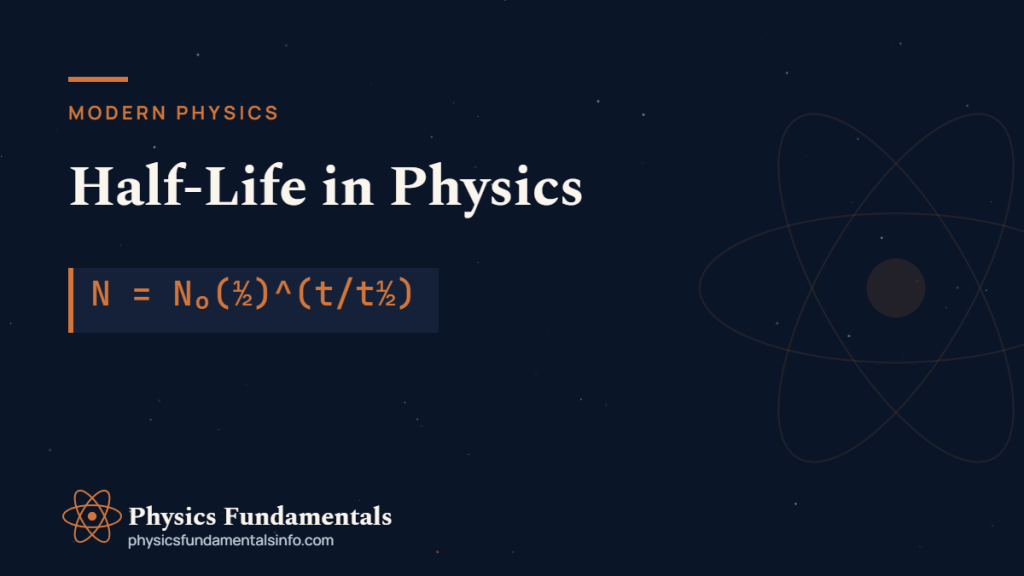
Half-life in physics is the time required for half the radioactive atoms in a sample to decay. It is written t½ and linked to the amount remaining by N = N0(½)^(t/t½). Half-life is fixed for each isotope, ranging from microseconds to billions of years, and is essentially unaffected by temperature, pressure, or chemistry.
Somewhere in your home, a smoke detector is quietly trusting a speck of americium that loses half its radioactivity roughly every 432 years. A hospital across town just injected a patient with a tracer that will be half gone before lunch. One single idea governs both.
That idea is half-life — nature’s most reliable stopwatch. It tells us how to date a 5,000-year-old axe, why some nuclear waste stays dangerous for millennia, and how a medical scan lights up a tumour. Master it once and a huge slice of nuclear physics suddenly clicks into place.
What Is Half-Life in Physics?
Picture an enormous crowd of identical, unstable atoms. Each one will eventually break apart — “decay” — but never on a schedule you can set. There is no fuse and no countdown; each atom simply carries a fixed probability of decaying in the next second.
Half-life is the time it takes for half of that crowd to decay. Start with a trillion atoms and one half-life later about 500 billion remain. Wait another half-life and roughly 250 billion are left — always half of whatever you had, never a fixed number subtracted each time.
More precisely, the half-life (symbol t½) of a radioactive isotope is the time for the number of undecayed nuclei, or the sample’s activity, to fall to one half of its starting value. Decay is random for any single atom yet astonishingly predictable for trillions, so half-life behaves as a rock-solid statistical average.
The key word is constant. A given isotope’s half-life never shifts: carbon-14 takes 5,730 years to halve whether the sample is hot, cold, crushed, or chemically locked into a molecule. That dependability is precisely what turns half-life into a usable clock. Georgia State University’s HyperPhysics defines it the same way — the time for half the radioactive nuclei in any sample to decay.
The Half-Life Formula
The core equation links how much is left to how many half-lives have gone by.
Every term has a clear meaning and unit:
- N — amount (or number of nuclei) remaining after time t; unit: same as N0 (atoms, moles, grams, or becquerels, Bq)
- N0 — the initial amount, present at t = 0; unit: atoms, mol, g, or Bq
- t — the elapsed time; unit: seconds (s), but any time unit works if t½ uses the same one
- t½ — the half-life of the isotope; unit: seconds (s)
- ½ — the halving factor (dimensionless)
Read the formula as a count of halvings. The exponent t/t½ is simply the number of half-lives that have passed; raise ½ to that power and you have the fraction left. After 3 half-lives, (½)3 = ⅛ remains — no calculator required.
The same physics can be written with the decay constant λ, which is often more convenient for activity and dating problems.
Here λ is the probability that any one nucleus decays per second (unit: s−1), e ≈ 2.718 is Euler’s number, and ln 2 ≈ 0.693. A large λ means impatient atoms and a short half-life; a tiny λ means a near-eternal isotope. The two forms are identical — one counts in half-lives, the other in e-foldings.
To turn the equation into a dating tool, rearrange it for time:
Measure how much is left as a fraction (N/N0), and this version hands you the elapsed time t directly. You can do the algebra by hand, or skip it and use our Half-Life Calculator to solve for the remaining amount, the time, or the half-life itself.
One more quantity travels with half-life: the mean lifetime, τ = 1/λ = t½/ln 2 ≈ 1.44 t½. It is the average time a single nucleus survives, and it always runs a little longer than the half-life.
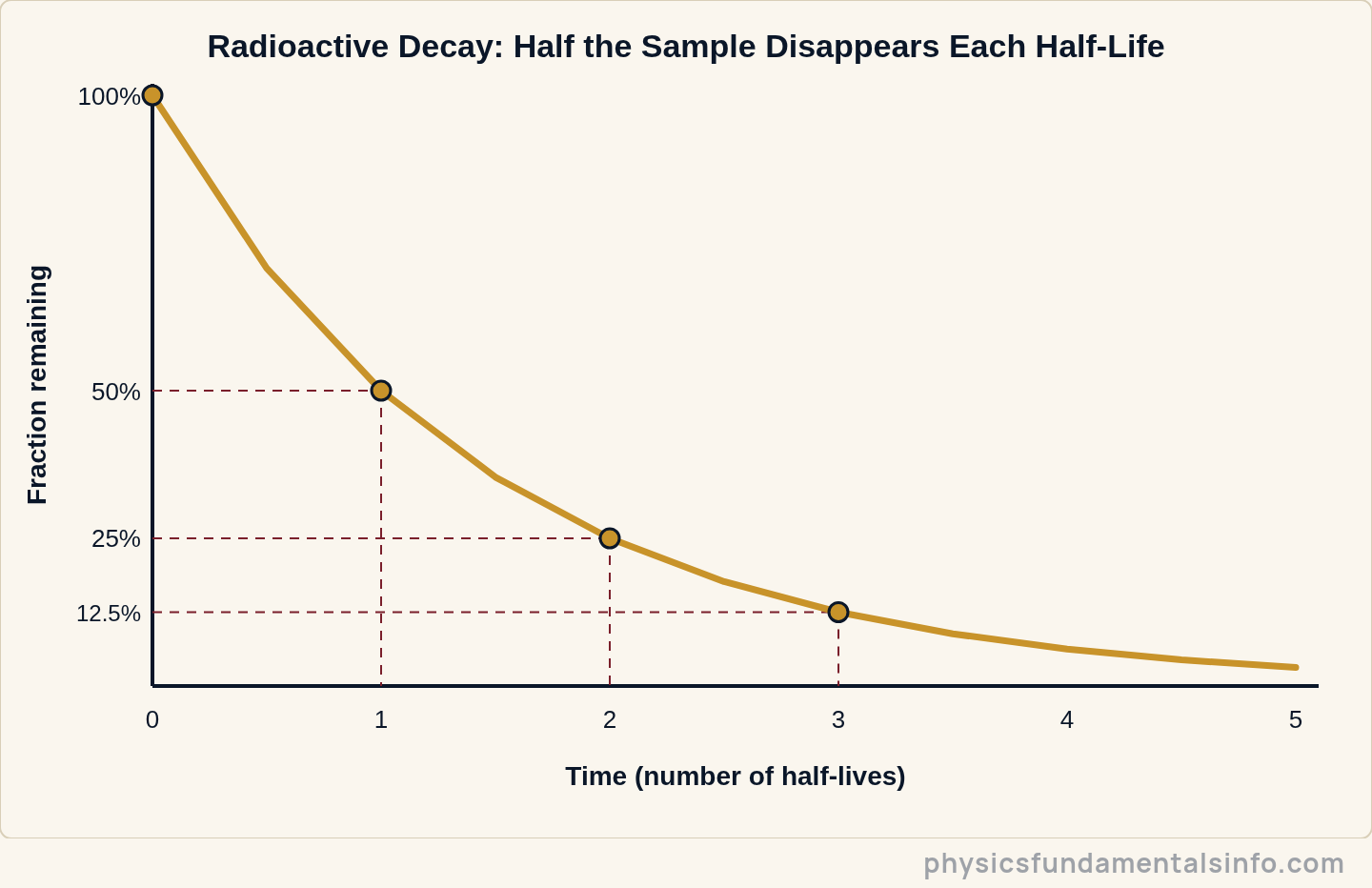
Figure 1: The exponential decay curve. Each half-life removes the same fraction, not the same amount, so the curve flattens and nears zero without ever touching it.
How Half-Life Works: Exponential Decay Step by Step
Why does halving keep producing a curve instead of a straight line? Because the number of decays in any second is proportional to how many unstable atoms are still present. More atoms, more decays; fewer atoms, fewer decays.

Written as a rate, that statement is dN/dt = −λN: the sample loses nuclei in proportion to how many it still holds. Solving this gives the exponential N = N0e^(−λt), and setting N = N0/2 pins the half-life to t½ = ln 2/λ.
It helps to walk through the logic in stages:
- Start with N0 nuclei. The decay rate at that instant is −λN0.
- As N falls, the rate falls with it — decay actually slows down over time.
- Equal time intervals therefore strip away equal fractions, never equal amounts.
- One half-life always removes exactly 50%, no matter where you sit on the curve.
This is the engine of the whole idea: decay is multiplicative. Going from 100% to 50% takes one half-life; so does crawling from 2% to 1%. The clock ticks at the same rate near the start and near the very end.

Figure 2: Gold atoms are still radioactive; faded atoms have already decayed. Halving 16 → 8 → 4 → 2 → 1 is the discrete twin of the smooth curve above.
For a single atom, decay is genuinely unpredictable — you can quote the odds but never the moment. In practice this never bites, because even a microgram holds quintillions of atoms, and the law of large numbers turns pure chance into a smooth, dependable curve. The same exponential law is laid out by LibreTexts for any radioisotope.
Half-Life Physics in the Real World
Radiocarbon dating
Living things constantly swap carbon with their surroundings, holding a steady trace of radioactive carbon-14. The moment an organism dies, that intake stops and its carbon-14 starts halving every 5,730 years.
Measure how much carbon-14 is left, and you can read off the time since death. The method reaches back roughly 50,000 years — about nine half-lives — before too little carbon-14 survives to measure reliably.
Nuclear medicine
Hospitals pick isotopes by their half-life. Technetium-99m, the workhorse of medical imaging, halves in about 6 hours: long enough to finish a scan, short enough to clear the body quickly afterwards.
Iodine-131 (t½ ≈ 8 days) lingers a little longer to treat thyroid conditions, with the dose timed around its decay. Match the half-life to the job and you minimise the radiation a patient absorbs.
Nuclear power and waste
The very same principle becomes a centuries-long headache for spent fuel. Some fission products fade within years, but isotopes such as plutonium-239 (t½ ≈ 24,100 years) hold their hazard for tens of thousands of years — which is why deep geological storage is engineered to outlast civilisations.
Dating the Earth — and the alarm on your ceiling
Uranium-238 halves every 4.5 billion years, close to the age of the Earth itself, so uranium-lead dating clocks the oldest rocks and meteorites. Closer to home, the americium-241 in a smoke alarm (t½ ≈ 432 years) decays steadily enough to give many years of reliable service.
| Isotope | Half-life | Main decay mode | Typical use |
|---|---|---|---|
| Technetium-99m | 6.0 hours | Gamma (isomeric) | Medical imaging |
| Radon-222 | 3.82 days | Alpha | Indoor air hazard |
| Iodine-131 | 8.02 days | Beta (β−) | Thyroid therapy |
| Cobalt-60 | 5.27 years | Beta + gamma | Cancer therapy, sterilisation |
| Carbon-14 | 5,730 years | Beta (β−) | Radiocarbon dating |
| Plutonium-239 | 24,100 years | Alpha | Reactor fuel |
| Potassium-40 | 1.25 billion years | Beta / electron capture | Rock dating |
| Uranium-238 | 4.47 billion years | Alpha | Earth & meteorite dating |
Half-lives span from hours to billions of years, yet every isotope obeys the identical exponential law.
Common Misconceptions About Half-Life
“After two half-lives, it’s all gone”
Two half-lives leave a quarter, not zero. Each period removes half of what remains, so the amount shrinks toward zero but never quite arrives — three half-lives leave an eighth, ten leave about a thousandth.
“Decay is steady, like a leaking tap”
A leak loses the same volume each minute; radioactive decay loses the same fraction. That is why the curve bends — the first half-life might destroy billions of atoms while a later one destroys only a handful, yet both take exactly the same time.
“Heating or compressing a sample speeds up decay”
For nearly all isotopes, half-life is set by the nucleus and shrugs off temperature, pressure, and chemical bonding — the very things that easily change chemical reaction rates. A few decay modes (electron capture and internal conversion) show vanishingly small shifts, but for school and exam purposes, treat half-life as a true constant.
“You can predict when a given atom will decay”
You cannot. Half-life gives the odds for the crowd, never a schedule for any single nucleus. One atom might decay in the next second or outlast you by a billion years — only the average is knowable.
How Half-Life Relates to Decay Constant, Activity and Energy
Activity and the becquerel
Activity is the number of decays per second, measured in becquerels (Bq). It equals A = λN, so activity tracks how many unstable atoms remain — and therefore it halves on exactly the same schedule as the sample. This is also why an old source is less active than a fresh one of the same isotope.
Decay constant and mean lifetime
Half-life, decay constant, and mean lifetime are three views of one clock, bound together by t½ = ln 2/λ and τ = 1/λ. Quote any single one and the other two follow immediately.
Mass, energy, and where the radiation comes from
Every decay releases energy because the products weigh fractionally less than the original nucleus. That missing mass reappears as the kinetic energy of the emitted particles, exactly as set out by Einstein’s mass–energy relation in our guide to special relativity.
The energy per atom is minuscule, but multiplied by the square of the speed of light it becomes the vast output of reactors and stars. It is the same accounting that underlies every form of energy in physics, from a falling apple to a fission core.
Worked Problems
Show Solution
Solution:
Step 1: Use N = N0(½)^n, where n is the number of half-lives.
Step 2: n = 3, so the fraction remaining is (½)3 = 1/8.
Step 3: N = 80 g × 1/8 = 10 g.
Answer: 10 g
Show Solution
Solution:
Step 1: Number of half-lives n = t / t½ = 24 / 8.02 = 2.99.
Step 2: N = N0(½)^n = 500 mg × (½)^2.99.
Step 3: (½)^2.99 = 0.126, so N = 500 mg × 0.126 ≈ 63 mg.
Answer: ≈ 63 mg (about one-eighth, since 24 days ≈ 3 half-lives)
Show Solution
Solution:
Step 1: λ = ln 2 / t½.
Step 2: In years, λ = 0.6931 / 5.27 = 0.1315 yr−1.
Step 3: Convert using 1 yr ≈ 3.156 × 10⁷ s: λ = 0.1315 / (3.156 × 10⁷) = 4.17 × 10⁻⁹ s−1.
Answer: λ ≈ 4.17 × 10⁻⁹ s−1
Show Solution
Solution:
Step 1: 25% = (½)2, so n = 2 half-lives have passed.
Step 2: t = n × t½ = 2 × 5,730 years.
Step 3: t = 11,460 years.
Answer: 11,460 years
Show Solution
Solution:
Step 1: Use t = t½ × ln(N0/N) / ln 2 with N/N0 = 0.30.
Step 2: ln(1/0.30) = ln(3.33) = 1.204; ln 2 = 0.693.
Step 3: t = 5,730 × 1.204 / 0.693 = 5,730 × 1.737 ≈ 9,950 years.
Answer: ≈ 9,950 years (between one and two half-lives, as expected)
Show Solution
Solution:
Step 1: Activity obeys the same law: A = A0(½)^(t/t½), with n = 18 / 6.0 = 3.
Step 2: A = 8.0 × 10⁴ Bq × (½)3 = 8.0 × 10⁴ / 8 = 1.0 × 10⁴ Bq.
Step 3: Initial atoms from A0 = λN0 → N0 = A0 / λ, with λ = ln 2 / (6.0 × 3600 s) = 0.6931 / 21,600 = 3.21 × 10⁻⁵ s−1.
Step 4: N0 = 8.0 × 10⁴ / (3.21 × 10⁻⁵) = 2.5 × 10⁹ atoms.
Answer: A = 1.0 × 10⁴ Bq; N0 ≈ 2.5 × 10⁹ atoms
Show Solution
Solution:
Step 1: Fraction remaining = 600 / 2,400 = 1/4.
Step 2: 1/4 = (½)2, so 2 half-lives elapsed in 12 hours.
Step 3: t½ = 12 hours / 2 = 6 hours.
Answer: 6 hours
Show Solution
Solution:
Step 1: Mean lifetime τ = t½ / ln 2 = 5,730 / 0.6931.
Step 2: τ = 8,267 years.
Step 3: After t = τ = 1/λ, the fraction is N/N0 = e^(−λτ) = e^(−1) = 0.368.
Answer: τ ≈ 8,267 years; about 36.8% remains after one mean lifetime