Vector notation is the set of written conventions that record both halves of a vector, its magnitude and its direction. Bold type or a small arrow marks the symbol as a vector. Component form, ordered-pair form and magnitude-and-direction form then state its value, and a hat marks a unit vector of length one.
An answer sheet says the force is 50 N. The next one says 30î + 40ĵ N. A third says 50 N at 53.13° above the horizontal, and all three are describing the same push on the same block.
Only the first has lost something, and what it lost is the direction. That is the whole job of vector notation: to carry the where along with the how much, in a form you can drop straight into a calculation. Get the forms and the conversions between them straight, and a whole family of sign errors stops happening.
What Is Vector Notation?
Vector notation is the agreed way of writing down a quantity that has both a size and a direction, so that neither is lost. It does two separate jobs, and keeping those jobs apart is the key to the entire topic.
The first job is marking. A bold symbol announces that a is a vector rather than an ordinary number, and in handwriting a small arrow drawn above the letter does the same work. Neither tells you a single number about the vector.
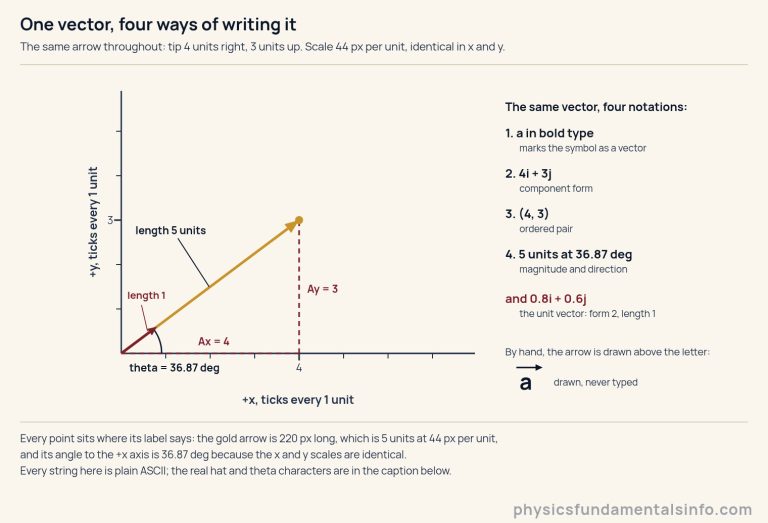
The second job is stating the value, and there are three standard ways to do it. Here is one vector — four units east, three units north — written every way this page will use.
| Way of writing it | The vector written that way | What the form is for |
|---|---|---|
| Bold symbol, or a drawn arrow | a in print; by hand, a with a small arrow above it | Marking the symbol as a vector. It states no value at all |
| Component form | 4î + 3ĵ | Algebra, with each axis handled on its own |
| Ordered pair | (4, 3) | Compactness, and it extends straight to (2, 3, 6) in three dimensions |
| Magnitude and direction | 5 units at θ = 36.87° | Matching what a dial, a protractor or a bearing actually gives you |
| The unit vector — component form with the size divided out | â = 0.8î + 0.6ĵ, which is one unit long | Direction on its own, when the size is being carried separately |
Four ways, then — and the count is honest only with the split spelled out. One of them marks the symbol; three of them state the value. The unit vector in the last row is not a fifth way: it is the second row with the length scaled to one.
Notice what this page is not about. It takes for granted that you know a vector has a direction and a scalar does not; if that distinction is the thing you actually need, our explainer on scalar and vector quantities does that job properly, and this page starts after it.
Why a Vector Symbol Is Bold, and What the Hat Means
Bold type marks a vector; a hat marks a unit vector. Those are two different claims about a symbol, and running them together is the commonest notation slip in first-year work.
Take the letter a. In bold, a is the vector itself, size and direction together. In plain type, a is only its magnitude — the length, with the direction discarded. The two look almost identical on the page and mean genuinely different things, which is why a typeface carries real information in physics writing.
Some books prefer to wrap the symbol in a pair of upright bars instead, the same bars that mean absolute value in arithmetic. Plain type and the bars say exactly the same thing: give me the length, throw the direction away. This page uses plain type.
By hand you cannot write bold convincingly, so the convention switches to a small arrow drawn above the letter. Arrow notation belongs to the blackboard and the exercise book; bold belongs to print. Figure 1 shows it drawn, above the letter and not beside it.
Now the hat, which is where the teaching usually goes wrong. A hat does not mean “vector”. It means “scaled to length exactly one”, so â is the direction of a with the size divided out, and it stays one unit long whatever a measured.
Hold the three apart and nothing here is confusing. Bold says vector; plain says magnitude; a hat says length one, and that last mark rides on top of the vector marking rather than replacing it, so â is itself a vector — one that is exactly one unit long, and plenty of books set it in bold as well. Our guide to physics symbols covers the wider print conventions this one sits inside — italic for quantities, upright for units, Δ for a change.
The Component Form Equation
Component form writes a vector as the sum of its pieces along the axes. The subscripted numbers are the components, and the two hatted letters say which way each component points.
Spelled out in plain characters — which is how you would type it into a message, an email or a spreadsheet — the hats become words:
The hats are there for a reason, and it is the reason from the last section. î and ĵ are unit vectors: each is exactly one unit long, and each points along one axis. So 4î is not the number four — it is “four of the thing that is one unit long pointing east”.
| Symbol | What it is | Unit |
|---|---|---|
| a (bold) | The vector itself: magnitude and direction together | Whatever the vector measures — metre (m), metre per second (m/s), newton (N) |
| ax | The x component: how far the vector reaches along x, carrying its own sign | Same as a |
| ay | The y component, with its own sign | Same as a |
| î | The unit vector along +x, one unit long | Dimensionless |
| ĵ | The unit vector along +y, one unit long | Dimensionless |
| a (plain) | The magnitude of a: its length, direction discarded. Never negative | Same as a |
| θ | The direction, measured anticlockwise from the +x axis | Degree (°) throughout this page; radian (rad) in SI |
| â | The unit vector of a: a with its size divided out | Dimensionless |
Why is this the form the algebra likes? Because the two axes stop talking to each other. Once a vector is in components, every equation you know can be applied to x and to y separately, as though they were two one-dimensional problems that happen to share a page.
That separation is also the reason the form exists at all: two vectors in component form are added one axis at a time, which our explainer on scalar and vector quantities works through in full, and this page will not repeat.
If you would rather have the arithmetic done for you, our Vector Addition Calculator will convert a single vector between the two forms: enter the magnitude and angle of vector A, leave vector B empty, and it reports the component pair. Be clear about what it hands back, though — it labels them “x-component” and “y-component” and writes its working as an addition, so you will not see î and ĵ in the output. No tool on this site prints unit-vector form yet.
Magnitude and Direction Form
Magnitude-and-direction form states a length and an angle: 5 units at θ = 36.87°, measured anticlockwise from the +x axis. Going to component form is one line of trigonometry per axis.
Run the headline vector both ways. From (4, 3), the length is sqrt(42 + 32) = sqrt(25) = 5 units and the angle is 36.87°. Coming back, 5 × cos 36.87° = 4.000 and 5 × sin 36.87° = 3.000, so the round trip closes.
Which form you reach for is usually decided by where the numbers came from. Instruments give you this one: a force meter reads a size, a protractor reads an angle, a compass reads a bearing. Algebra wants the other.
The Quadrant Trap: atan2, Not atan
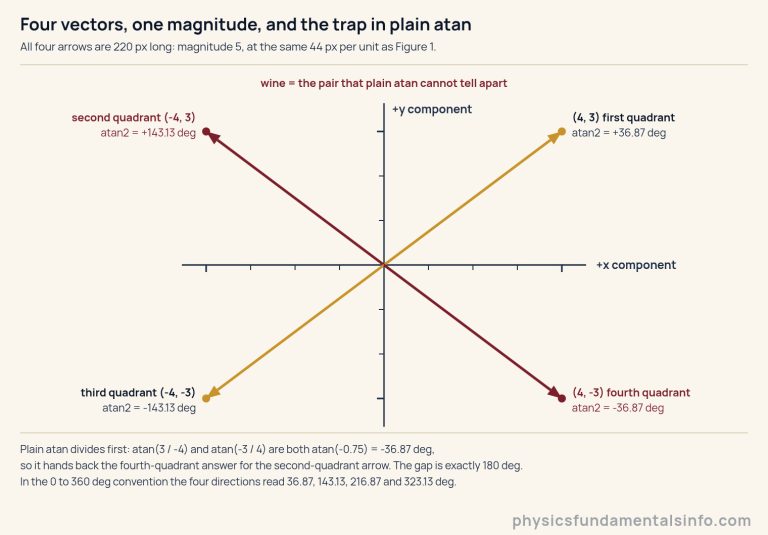
Use atan2(ay, ax) to recover the angle, never atan(ay / ax). The division in the second form happens before the function sees anything, and it destroys the one piece of information that says which quadrant you are in: which of the two components was negative.
All four vectors in the table below are built from the same two numbers, 4 and 3, with the four possible sign combinations. Every one of them has magnitude exactly 5. atan2 tells all four apart; plain atan returns only two numbers between them.
| Components | Quadrant | atan2(ay, ax) | Same angle, 0 to 360° | Plain atan(ay / ax) | Verdict |
|---|---|---|---|---|---|
| (4, 3) | First | 36.87° | 36.87° | 36.87° | Agrees |
| (-4, 3) | Second | 143.13° | 143.13° | -36.87° | Out by 180° |
| (-4, -3) | Third | -143.13° | 216.87° | 36.87° | Out by 180° |
| (4, -3) | Fourth | -36.87° | 323.13° | -36.87° | Agrees |
Look at the fifth column. atan(3 / -4) and atan(-3 / 4) are the same number, because both divisions give -0.75, and the function has no way to know whether the minus sign came from the top or the bottom. A second-quadrant vector and a fourth-quadrant one arrive at it looking identical.
Two reporting conventions are in use and both are fine. One is atan2’s own range, which runs from just above -180° up to and including +180°; the other is 0° to 360°. Pick one at the start of a problem and stay inside it.
Three consequences of that choice worth memorising: due west reports as +180° and never as -180°, because the interval is open at the bottom end; straight up is +90°; straight down is -90°, or 270° in the other convention.
The lab below was built for vector addition, but it shows this conversion live if you ignore the resultant and watch vector A on its own. Its sliders set A’s magnitude and angle; its readouts, labelled Ax and Ay to two decimal places, give the same vector as a component pair.
Drag the angle slider first, because the lab opens with vector A lying flat along the x axis and all of its length in Ax; the two components then trade size, one rising as the other falls, while the magnitude you set never moves. Now drag the magnitude slider and both components grow in proportion. That is one vector in two notations at once. Note that its angle slider steps in whole degrees and runs from 0° to 360°, so the lab reports directions in the 0-to-360 convention rather than the signed one.
How Do You Write a Three-Dimensional Vector?
In three dimensions a vector is written as an ordered triple, like d = (2, 3, 6), where the third slot is the z component. The ordered pair extends that cleanly because it was never anything but a list of components in axis order.
There is a third unit vector to go with î and ĵ, one unit long and pointing along z, written as k with a hat. This page keeps to triples rather than hat form in three dimensions, and the reason is a quirk of typesetting worth knowing. Unicode has a single ready-made character for î and for ĵ; it has none for a hatted k, which has to be assembled from a k plus a floating accent that many fonts simply do not carry.
So the hatted k is the one member of the trio that cannot be relied on to render at all. Spelling the convention out loses nothing: (2, 3, 6) and the hat form carry identical information, and the triple is what nearly every calculation uses anyway.
The magnitude gains one more square under the root. The direction now needs three numbers rather than one, and those three are the direction cosines: each component divided by the magnitude, which is the cosine of the angle between the vector and that axis.
| Ordered triple | Magnitude | Direction cosines (4 d.p.) | As exact fractions |
|---|---|---|---|
| (2, 3, 6) | 7 exactly | 0.2857, 0.4286, 0.8571 | 2/7, 3/7, 6/7 |
| (1, 2, 2) | 3 exactly | 0.3333, 0.6667, 0.6667 | 1/3, 2/3, 2/3 |
| (3, 4, 12) | 13 exactly | 0.2308, 0.3077, 0.9231 | 3/13, 4/13, 12/13 |
Those three triples are worth practising on precisely because their magnitudes come out as whole numbers. The direction cosines also carry one property worth checking, with one trap hiding inside it.
Here is the property: the squares of the three cosines always sum to exactly 1, because the squares of the components sum to the square of the magnitude by definition. And here is the trap — that only holds for the exact fractions. Square the four-figure values and 0.28572 + 0.42862 + 0.85712 comes to 0.99994286, and the shortfall is the rounding rather than the physics.
Where Vector Notation Is Actually Used
Component form does the algebra, magnitude-and-direction form does the measuring, and most real problems run between the two. Five places where the choice of notation is doing visible work:
- Forces on a diagram. Resolving a weight and a normal force onto axes is component form with pictures, which is the whole method behind a free-body diagram.
- Acceleration. Treating ax and ay separately is what makes projectile work tractable in the first place, and it is why acceleration in physics is written as a vector rather than a number.
- Speed against velocity. Plain v is the speed and bold v is the velocity, so the typeface is the whole difference between velocity and speed.
- Instruments and bearings. A dial hands you a magnitude and a compass hands you a direction, both in magnitude-and-direction form, which has to be converted before any algebra starts.
- Two frames at once. Comparing a velocity measured in one frame with the same velocity in another is a subtraction done in component form, and our relative velocity guide works that case through.
One practical warning about that fourth one. A compass bearing is measured clockwise from north, and the θ in every formula on this page is measured anticlockwise from east. They are different numbers for the same direction, and quietly swapping one for the other is a classic source of sign errors.
Common Mistakes in Vector Notation
“The magnitude is -12 N”
A magnitude is a length, so it is never negative. “A force of -12 N at 0°” is sloppy shorthand for 12 N at 180°, and the two give identical components, because adding 180° to a direction flips the sign of both of them. Write the positive number and let the angle carry the direction.
“A hat is how you mark any vector”
The hat means length one, and nothing else. Write â when you meant a and you have claimed the vector is one unit long — in a force problem, that is a claim the force is 1 N. Bold is what says “vector”.
“The zero vector points along x”
The zero vector has magnitude 0, no direction at all, and no unit vector. That last part is the one that bites in code: â is a divided by its own magnitude, so a zero vector makes the division undefined rather than quietly returning an angle of zero. Guard it before you divide.
“Degrees, radians — the calculator sorts it out”
Every angle in this article is in degrees. A calculator left in radian mode reads 36.87 as 36.87 radians, which is nearly six full turns, and returns sin 36.87 = -0.7373 instead of the +0.6000 you wanted. The component pair that follows is not slightly wrong; it is unrelated.
“(4, 3) means the same thing on anybody’s diagram”
It means 4 along x and 3 along y, against the axes that question drew. Rotate the axes and every component changes while the vector itself does not move at all. That is the one thing component form hides, and it is worth saying out loud: the components belong to the frame, the vector does not.