Surface tension is the force per unit length acting along a liquid’s surface, symbol γ, measured in newtons per metre (N/m). It arises because molecules at the surface have fewer neighbours pulling on them than molecules in the bulk, so the liquid contracts to the smallest possible surface area. Water measures about 0.073 N/m at 20 °C.
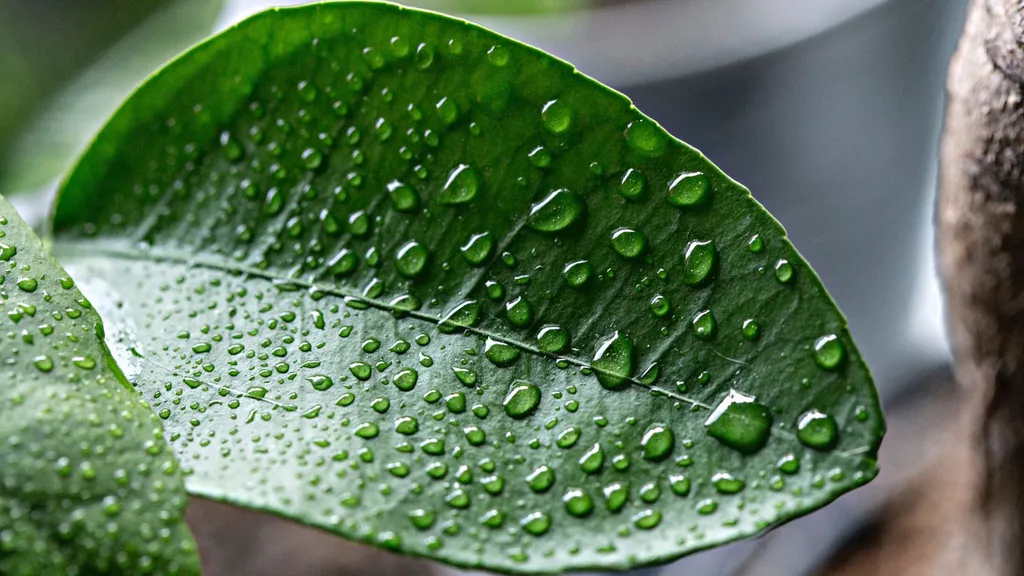
Wax a car, then run a hose over the bonnet. The water refuses to lie flat. It gathers itself into hundreds of little domes that shiver and roll off the edge, and no matter how much you pour on, it keeps doing it.
The same thing happens on a freshly waxed leaf, on a non-stick pan, on the back of a duck. Something is pulling the water in on itself — and that something has a number, a unit, and a formula you can use.
What Is Surface Tension?
Surface tension is the tendency of a liquid surface to shrink to the smallest area it can, caused by the unbalanced attraction on the molecules sitting at that surface. It is written as γ (gamma) and measured in newtons per metre.
Picture a molecule deep inside a glass of water. It is surrounded on every side, tugged left, right, up and down by identical neighbours. Every pull is matched by an opposite one, so it feels no net force at all.
Now move that molecule to the surface. Above it there is only air — a few thousand times less dense, with almost nothing to offer. Its sideways and downward neighbours still pull hard, but nothing pulls back up.
The result is a net inward tug on every molecule in that top layer. The surface behaves as though it were being squeezed from above, and the liquid responds the only way it can: by pulling itself into the shape with the least surface area available.
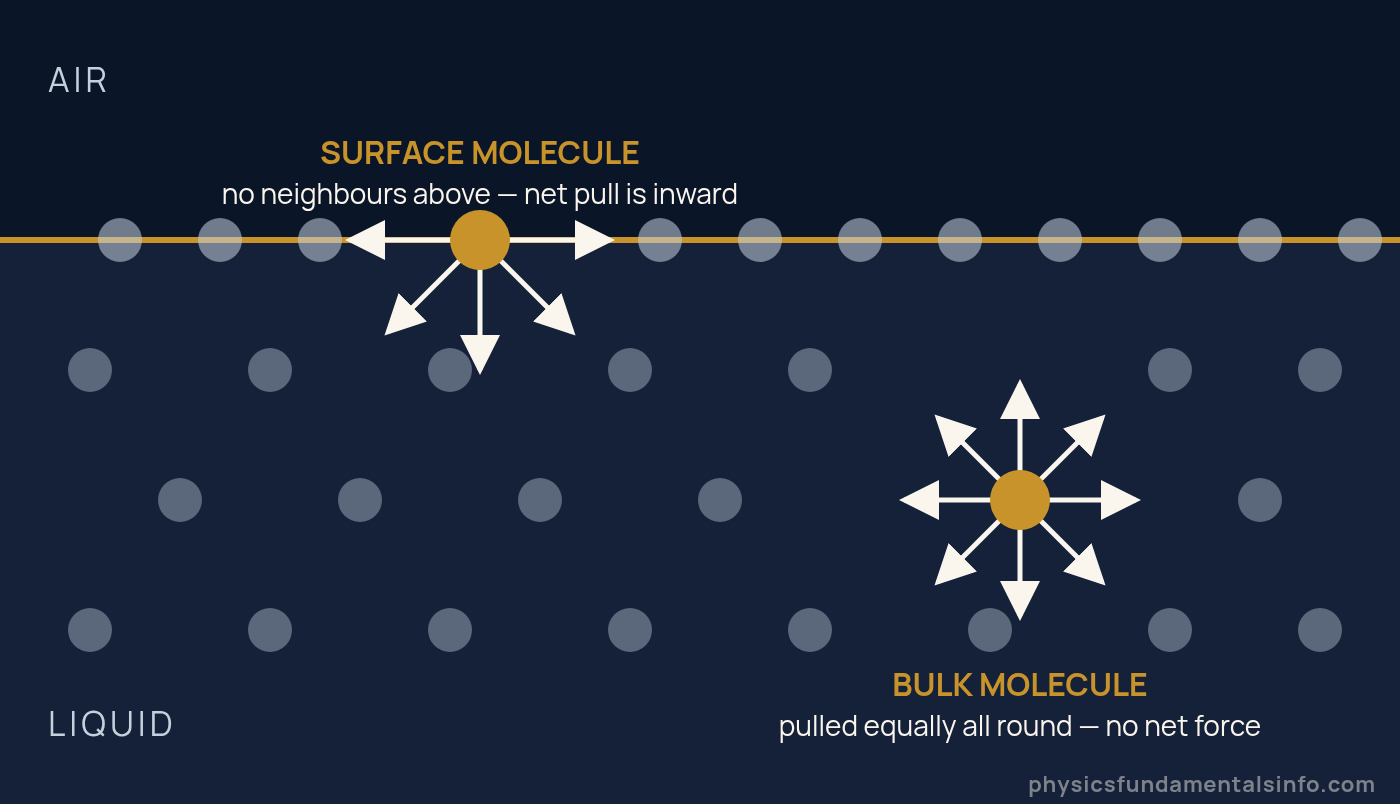
Surface tension originates in an accounting error: molecules at the surface are short of neighbours, so their pulls no longer cancel.
Why water is unusually strong
Water’s molecules are polar and lock together with hydrogen bonds, which are far stronger than the weak van der Waals attractions holding a typical oil together. That is why water sits at roughly 0.073 N/m while olive oil manages only 0.032 N/m.
Among everyday liquids, only liquid metals beat it. Mercury reaches about 0.485 N/m — nearly seven times water’s value, which is exactly why spilled mercury runs into perfect little balls.
The Surface Tension Formula
Surface tension is defined as the force acting perpendicular to a line drawn in the surface, divided by the length of that line.
| Symbol | Quantity | SI unit |
|---|---|---|
| γ | Surface tension | newton per metre (N/m) |
| F | Force acting along the surface | newton (N) |
| L | Length of the contact line | metre (m) |
The second, equally correct definition
Surface tension can also be written as the work needed to create one square metre of new surface. Both definitions describe the same physical quantity.
- W — work done to stretch the surface, in joules (J)
- ΔA — increase in surface area, in square metres (m2)
Check the units and the two forms collapse into one: N/m is identical to J/m2. So γ is simultaneously a force per length and an energy per area, and you can pick whichever version makes the problem easier.
The factor of 2 that costs marks
A soap film stretched across a wire frame has two surfaces — a front and a back — so the force pulling on a slider wire of length L is F = 2γL, not γL. Miss this and every film or bubble answer comes out exactly half-size.
A single liquid–air interface, such as the top of a beaker of water, has only one surface. In practice, ask yourself one question before writing anything down: how many surfaces is this?
Why Does Water Bead Up?
Water beads up when its molecules are more strongly attracted to each other than to the surface underneath, so the drop pulls itself into a dome instead of spreading out. On a waxed bonnet or a lotus leaf, cohesion wins; on clean glass, adhesion wins and the same drop flattens.
Cohesion is water sticking to water. Adhesion is water sticking to something else. The competition between them is measured by the contact angle, θ — the angle the liquid edge makes with the solid, measured through the liquid.

The same water, two different solids. The contact angle decides whether a drop domes or flattens.
Below about 90° the liquid wets the solid and spreads. Above 90° it beads. Wax and PTFE push water past 100°, which is why rain rolls off a treated windscreen instead of smearing across it.
So why a sphere, and not a cube?
Because a sphere holds a given volume inside the smallest possible surface area. Since every extra square metre of surface costs energy, the drop that minimises area also minimises energy — and that shape is a ball.
Gravity fights back, though, and it wins as soon as the drop gets big enough. The crossover happens at the capillary length — the square root of γ divided by ρg — which for water is about 2.7 mm.
That single number explains a lot of everyday life. Drops smaller than a few millimetres stay round and bouncy; a puddle a metre across is flat as a pancake, because gravity flattened it long ago.
Remove gravity and the limit disappears with it. On the International Space Station astronauts float water spheres the size of a fist, and NASA’s surface tension STEMonstration shows liquid clinging to cup walls so stubbornly that engineers had to design a special zero-gravity coffee cup.
Worth being precise, though: the surface tension itself has not changed. Hydrogen bonding works identically in orbit — what changed is the gravity competing with it, which pushes the capillary length far beyond anything you could fit inside a spacecraft.
Surface Tension of Common Liquids
Values are quoted against air at 20 °C. Note how narrow the everyday range is — apart from mercury, almost everything sits between 0.02 and 0.08 N/m.
| Liquid (at 20 °C) | γ in mN/m | γ in N/m | What you notice |
|---|---|---|---|
| Mercury | 485 | 0.485 | Rolls into near-perfect balls on almost any solid |
| Water | 72.8 | 0.0728 | Beads on wax, holds up insects, climbs narrow tubes |
| Glycerol | 63 | 0.063 | Syrupy to pour, yet weaker at the surface than water |
| Olive oil | 32 | 0.032 | Spreads into a film rather than doming up |
| Soapy water | 25 to 30 | 0.025 to 0.030 | Roughly a third of pure water, so beads collapse |
| Ethanol | 22.3 | 0.0223 | Wets glass so readily it creeps up a wine glass |
| Liquid nitrogen (77 K) | 8.9 | 0.0089 | Barely holds a drop together at all |
How temperature changes it
Heating a liquid always lowers its surface tension. Faster-moving molecules break their mutual grip more easily, so the surface costs less energy to create.
| Water temperature | γ in mN/m |
|---|---|
| 0 °C | 75.6 |
| 20 °C | 72.7 |
| 50 °C | 67.9 |
| 80 °C | 62.7 |
| 100 °C | 58.9 |
Push far enough and it vanishes entirely. At water’s critical point of 374 °C, liquid and vapour become indistinguishable — there is no interface left, so γ falls to zero.
Real-World Examples of Surface Tension
Surface tension is not a laboratory curiosity; it decides whether you can breathe, how rain falls, and why detergent works. Here are five places it does visible work.
1. Insects that walk on water
A water strider is denser than water and should sink. Instead its hydrophobic legs press dimples into the surface without breaking it, and the upward pull along each contact line carries its weight.
Squirt a drop of washing-up liquid nearby and the insect drops straight through. Nothing about the insect changed — the surface simply lost most of its tension.
2. Raindrops and the shape of falling water
Falling raindrops are not teardrop-shaped, whatever the weather graphics suggest. Small ones are near-spherical because surface tension pulls them into minimum area; larger ones flatten into a bun shape as air resistance pushes up from below.
3. Soap, detergent and the pepper trick
Soap molecules crowd into the surface and wedge water molecules apart, cutting γ from about 73 to roughly 25 mN/m. That is the entire reason detergent cleans: low-tension water can creep into fabric pores that clean water skips straight over.
Scatter pepper on water and touch the centre with a soapy finger. The pepper flees outwards, dragged by the higher-tension water still pulling from the rim.
4. The lungs you are using right now
Your lungs contain roughly 300 million alveoli, each a moist sac a fraction of a millimetre across. Surface tension in that lining tries to collapse every one of them, and the smaller the sac, the harder it pulls.
The body’s answer is pulmonary surfactant, a natural detergent that drops the tension sharply as an alveolus shrinks. Premature babies who have not yet produced enough of it develop respiratory distress syndrome — a physics problem with a clinical name.
5. Water climbing where it should not
Dip a narrow glass tube in water and the liquid climbs, unaided. Adhesion drags the edge up the wall, surface tension hauls the rest of the surface along behind it, and the column rises until its weight balances the pull.
The same effect moves water through soil, up a paper towel, and through the wick of an oil lamp.
Common Misconceptions About Surface Tension
Myth 1: there is a “skin” on the water
There is no skin, no membrane, no extra layer of anything. The molecules at the top of a glass of water are identical to the ones below them; they simply have fewer neighbours, and that asymmetry is the whole story.
The stretched-sheet analogy is useful but it breaks down fast. Stretch a rubber sheet and its tension rises; stretch a water surface and γ does not change at all, because fresh molecules just move up from the bulk to fill the gap.
Myth 2: floating objects are held up by surface tension alone
A floating needle is supported partly by the vertical component of surface tension along its contact line and partly by the buoyancy of the dimple it presses into the water. Both contribute, and neither is the whole answer.
This is also not floating in the sense of Archimedes’ principle, where a submerged object displaces its own weight. Stir the water and the needle sinks instantly — a genuinely buoyant object would not.
Myth 3: thick liquids have high surface tension
Viscosity and surface tension are unrelated properties, and glycerol proves it. Glycerol is around a thousand times more viscous than water yet has a lower surface tension: 63 mN/m against 72.8.
Viscosity resists flow inside the liquid. Surface tension resists the creation of new surface. A liquid can be high in one and low in the other.
Myth 4: soap destroys surface tension, and heating increases it
Soap reduces surface tension by roughly two thirds; it never removes it. Soapy water still has γ near 25 mN/m — quite enough to blow a bubble, which is precisely what soap films are famous for.
Heating works the other way from what most people guess: hotter water has less surface tension, falling from 72.7 mN/m at 20 °C to 58.9 at boiling. Hot water cleans better partly because it wets fabric more easily, not less.
How Surface Tension Relates to Pressure and Capillary Action
Surface tension links directly to two other quantities you will meet in fluids: the excess pressure trapped inside a curved surface, and the height a liquid climbs in a narrow tube.
Excess pressure inside drops and bubbles
Any curved liquid surface squeezes the fluid inside it, so a droplet sits at a higher pressure than its surroundings. This is the Young–Laplace result for a sphere.
A soap bubble is different, because a soap film has two surfaces — inner and outer. Double the interfaces, double the pressure jump.
- ΔP — pressure inside minus pressure outside, in pascals (Pa)
- R — radius of the drop or bubble, in metres (m)
Notice the R on the bottom: smaller means higher pressure. Blow two soap bubbles connected by a tube and the small one deflates into the large one, which surprises almost everyone the first time they see it.
Capillary rise
In a tube narrow enough for surface tension to matter, water climbs to a height set by the tube radius, the contact angle and the liquid’s density.
- h — height risen, in metres (m)
- θ — contact angle, in degrees or radians
- ρ — liquid density, in kilograms per cubic metre (kg/m3)
- g — gravitational field strength, 9.81 m/s2
- r — internal radius of the tube, in metres (m)
When θ exceeds 90°, cos θ turns negative and h comes out negative — the liquid is pushed down instead. That is exactly what mercury does in a glass tube, and the formula predicts it without any extra rules.
A note on the name
Surface tension is not the same as the tension force in a rope. Rope tension is a single force in newtons acting along a line; surface tension is a force per unit length spread across an entire surface, and its units differ accordingly.
Worked Problems
Show Solution
Solution:
Step 1: Surface tension is force per unit length of contact line, γ = F / L.
Step 2: A soap film has two surfaces, so the contact length is doubled: L = 2 × 0.060 m = 0.120 m.
Step 3: γ = (3.0 × 10⁻³ N) / (0.120 m) = 0.025 N/m.
Answer: γ = 0.025 N/m (25 mN/m)
Show Solution
Solution:
Step 1: For a single spherical liquid surface, ΔP = 2γ / R.
Step 2: Substitute with R = 1.0 mm = 1.0 × 10⁻³ m: ΔP = (2 × 0.0728 N/m) / (1.0 × 10⁻³ m).
Step 3: ΔP = 0.1456 / 0.001 = 145.6 Pa.
Answer: ΔP ≈ 146 Pa (about 0.14% of atmospheric pressure)
Show Solution
Solution:
Step 1: A soap bubble has two surfaces, so ΔP = 4γ / R.
Step 2: Substitute with R = 2.0 cm = 0.020 m: ΔP = (4 × 0.025 N/m) / (0.020 m).
Step 3: ΔP = 0.100 / 0.020 = 5.0 Pa.
Answer: ΔP = 5.0 Pa
Show Solution
Solution:
Step 1: Capillary rise is h = 2γ cos θ / (ρ g r), with cos 0° = 1.
Step 2: Substitute: h = (2 × 0.0728 N/m) / (1000 kg/m3 × 9.81 m/s2 × 2.0 × 10−4 m).
Step 3: h = 0.1456 / 1.962 = 0.0742 m.
Answer: h ≈ 7.4 cm
Show Solution
Solution:
Step 1: Volume is conserved, so each small drop has radius r = R / 1000^(1/3) = 2.0 mm / 10 = 0.20 mm.
Step 2: Original area A1 = 4πR2 = 4π(2.0 × 10⁻³)2 = 5.027 × 10⁻⁵ m2. New total area A2 = 1000 × 4πr2 = 1000 × 4π(2.0 × 10⁻⁴)2 = 5.027 × 10⁻⁴ m2.
Step 3: Energy required is W = γ ΔA = 0.0728 × (5.027 × 10−4 − 5.027 × 10⁻⁵) = 0.0728 × 4.524 × 10−4.
Answer: W ≈ 3.3 × 10⁻⁵ J
Show Solution
Solution:
Step 1: The surface pulls upward along the contact line on both sides of the needle, so F = γ × 2L.
Step 2: F = 0.0728 N/m × 2 × 0.040 m = 5.82 × 10⁻³ N.
Step 3: Setting F = mg gives m = 5.82 × 10⁻³ / 9.81 = 5.94 × 10⁻⁴ kg.
Answer: m ≈ 0.59 g. A typical steel sewing needle weighs well under this, which is why the trick works. Note this ignores the buoyancy of the dimple, so it is a conservative lower bound.
Show Solution
Solution:
Step 1: The capillary length is the scale where curvature pressure matches hydrostatic pressure: a = sqrt(γ / ρg).
Step 2: Substitute: a = sqrt(0.0728 / (1000 × 9.81)) = sqrt(7.421 × 10⁻⁶).
Step 3: a = 2.72 × 10⁻³ m.
Answer: a ≈ 2.7 mm. Below this size water bodies are pulled round by surface tension; above it, gravity flattens them into puddles.
Frequently Asked Questions
What is surface tension in simple terms?
What is the SI unit of surface tension?
Why does water bead up on some surfaces but not others?
Does soap increase or decrease surface tension?
Does surface tension increase with temperature?
Why can a needle float on water but a coin sinks?
Is surface tension the same as capillary action?
Key Takeaways
- Surface tension is force per unit length, γ = F / L, measured in N/m and equal to energy per unit area in J/m2.
- It exists because surface molecules are short of neighbours, so the liquid contracts to minimum area.
- Water measures 0.0728 N/m at 20 °C — high for a common liquid, thanks to hydrogen bonding.
- Films and bubbles have two surfaces: use F = 2γL and ΔP = 4γ/R, not the single-surface versions.
- Heating lowers surface tension; surfactants such as soap lower it sharply but never to zero.
- Above the capillary length of about 2.7 mm, gravity beats surface tension and water lies flat.
For an authoritative overview of surface tension in water and its environmental role, the USGS Water Science School is an excellent starting point. Readers ready for the fluid-dynamics treatment, including Bond and Weber numbers, can work through the MIT surface tension lecture notes.