The flow rate formula is Q = A v: the volume crossing a fixed section each second is the area open to the flow times the mean speed of the fluid. For a round pipe the area is pi d2/4, so a bore and a speed are all it takes — and because the area goes as the diameter squared, a pipe twice as wide at the same speed carries four times as much. This free flow rate calculator solves Q = A v for the rate, the bore or the mean speed, and prints the cross-sectional area, the mass flow rate, the same rate in four units and the time to fill 100 litres beside the answer. No pressure is computed anywhere on this page.
Load a real flow rate
Every button writes all four boxes in their default units, so whichever quantity the Solve for menu is pointing at, the remaining three already agree with it. The line underneath quotes back whatever the widget works out from that, so nothing in it is stored text.
Pick a pipe above, or type your own numbers.

What Is the Flow Rate Formula Calculator?
The flow rate formula calculator is a free online tool for the one relation that turns a pipe into a number: Q = A v, the volume crossing a fixed section each second. Give it any two of the volume flow rate, the internal diameter and the mean flow speed and it returns the third, in whichever of the four unit menus that box was set to. It takes a diameter rather than an area because a diameter is what a reader with a pipe in front of them actually has, and it forms the area itself as pi d2/4.
Four readings sit beside the answer. The first is that cross-sectional area, which is worth watching because it follows the square of the diameter: widen the bore by half and the area grows by more than double. The second is the mass flow rate, the density times the rate, which is the figure that matters wherever what is bought or burned is kilograms rather than litres. The third prints one rate in cubic metres per second, litres per second, litres per minute and cubic metres per hour at once, because a pump is sold in one of those and a meter reads in another. The fourth is how long that rate takes to pass one hundred litres, and its unit climbs from seconds to minutes to hours on its own.
All four are worked out from the complete state with the solved value substituted back, which is what makes them the same four readings whichever quantity you asked the page for. That matters most in the sizing mode: with Solve for pointed at the internal diameter there is no diameter among the inputs, so the area can only come from the answer. The fluid density is the one box that never leaves the form, because it is an input in every mode and is never one of the unknowns. It drives the mass flow rate alone: change it and the rate, the area, the speed and the fill time all stay exactly where they were.
Four entries are declined rather than answered, and every refusal is deliberate. A zero or negative diameter has no area behind it; a zero mean speed would need an infinitely wide pipe to carry a stated rate, and a negative one has no square root; a zero rate fixes no speed; and a zero or negative density is not a fluid. In each case the page says so in words instead of printing an infinity or a NaN.
What the page does not do, it says. Q = A v is kinematics: it counts volume past a point and is silent about what pushes it, so nothing here computes a pressure, a pressure drop, a head loss or a pumping power. Nothing here computes a Reynolds number, a friction factor or an open-channel discharge either, and no viscosity appears anywhere. The relation also assumes a round section and a density that does not change along the pipe, which for a gas means well below the speed of sound.
| Symbol | Quantity | Default unit | Also accepts | Example value |
|---|---|---|---|---|
| Q | Volume flow rate | L/s | L/min, m3/s, m3/h | 11.7810 |
| d | Internal diameter | mm | cm, m, in | 100 |
| v | Mean flow speed | m/s | cm/s, km/h, ft/s | 1.5 |
| rho | Fluid density | kg/m3 | g/cm3 | 998.2 |
How to use the flow rate formula calculator
- Choose the unknown. The Solve for menu opens on Volume flow rate, and the other two choices are Internal diameter and Mean flow speed. Any two of the three fix the third, so whichever you pick vanishes from the boxes and the rest become your inputs.
- Type the internal diameter. It takes mm, cm, m or in and opens on 100 mm. Type the inside bore: a nominal size or an outside diameter will be wrong by more than you expect, because the area follows the square.
- Type the mean flow speed. It takes m/s, cm/s, km/h or ft/s and opens on 1.50 m/s. This is the average across the section, not a reading from the middle of the pipe.
- Type the fluid density. It takes kg/m3 or g/cm3, opens on 998.2 kg/m3 and is an input in every mode, so it never leaves the form. It drives the mass flow rate chip and nothing else, which is why the headline does not move when you change it.
- Read the answer. The headline always carries four significant figures, with trailing zeros dropped, in the unit that box was showing. Set the unit while the quantity is still an input and then point Solve for back at it.
- Read the area chip first. It is
pi d2/4, and at the defaults it reads0.00785398 m2. Double the bore in the box and this chip quadruples — which is the single most-missed step in the whole topic. - Read the mass flow rate chip. At the defaults it reads
11.7598 kg/s. Change only the density box and this is the only figure on the page that moves:0.0141843 kg/sfor air and14.8558 kg/sfor glycerine at the very same rate. - Read the unit ladder chip. It restates the headline on purpose, as
0.0117810 m3/s = 11.7810 L/s = 706.858 L/min = 42.4115 m3/h. One pipe, one flow, four ways of selling it. - Read the fill time chip. It is one hundred litres divided by the rate,
8.48826 sat the defaults, and its unit climbs to minutes and then hours on its own as the rate falls. - Open Show working. The steps list your figures in SI, form the area, rearrange the relation, and then give the unit ladder, the mass flow rate, the fill time and what the same rate would do at half and at double the bore.
This page exists for the one step that turns a pipe into a number: the area. The flow rate formula guide is the prose half of it, with the unit table, the worked problems and the misconceptions set out in full. The pressure needed to drive the flow is a different question and a different page: Bernoulli's principle is where the pressure side of the story lives, and nothing on this calculator computes one.
Three mistakes account for most wrong answers here. The first is typing a nominal or outside diameter instead of the bore; the second is halving a diameter and expecting the speed to double, when it quadruples. The third is a rate typed in litres per minute while the box is still set to litres per second — a factor of sixty, and the reason the unit ladder chip is printed at all.
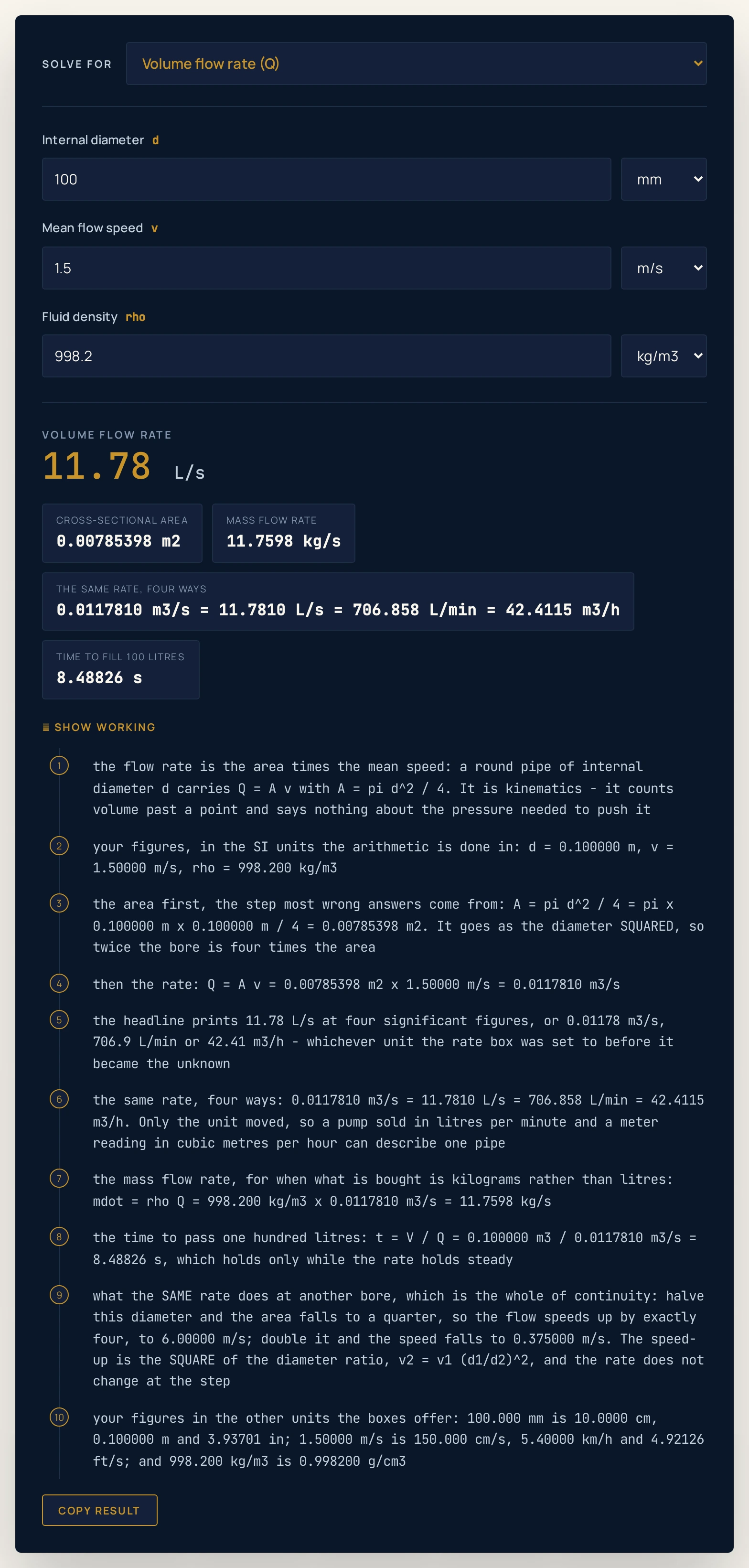
11.78 L/s. The area chip is the one to watch: every answer on the page is built on that 0.00785398 m2, and it is the figure that goes as the square of the diameter.Worked example: change one thing at a time
The table starts at the defaults, moves the unknown through all three quantities, then changes only the speed, only the bore and only the fluid, walks every unit menu, runs the two back-solves a reader actually needs, and finally reaches the entries the calculator declines. Rows 1 to 3 are one pipe solved three ways. Every answer and chip cell was read out of the running widget rather than worked out by hand, so where a cell and the tool ever part company, believe the tool.
| Step | Solving for | What you type | Headline answer | Cross-sectional area | Mass flow rate | Time to fill 100 litres |
|---|---|---|---|---|---|---|
| The page as it opens | Volume flow rate | 100 mm at 1.50 m/s, water | 11.78 L/s | 0.00785398 m2 | 11.7598 kg/s | 8.48826 s |
| The same state, solved for the speed | Mean flow speed | 11.7810 L/s through 100 mm | 1.5 m/s | 0.00785398 m2 | 11.7598 kg/s | 8.48824 s |
| The same state, solved for the bore | Internal diameter | 11.7810 L/s at 1.50 m/s | 100 mm | 0.00785400 m2 | 11.7598 kg/s | 8.48824 s |
| Double the speed, same bore | Volume flow rate | 3.00 m/s instead of 1.50 m/s | 23.56 L/s | 0.00785398 m2 | 23.5195 kg/s | 4.24413 s |
| Double the bore, same speed | Volume flow rate | 200 mm instead of 100 mm | 47.12 L/s | 0.0314159 m2 | 47.0391 kg/s | 2.12207 s |
| Half the bore, same speed | Volume flow rate | 50 mm instead of 100 mm | 2.945 L/s | 0.00196350 m2 | 2.93994 kg/s | 33.9531 s |
| Change only the fluid, to air | Volume flow rate | 1.204 kg/m3 instead of 998.2 | 11.78 L/s | 0.00785398 m2 | 0.0141843 kg/s | 8.48826 s |
| Change only the fluid, to SAE 30 oil | Volume flow rate | 876 kg/m3 instead of 998.2 | 11.78 L/s | 0.00785398 m2 | 10.3201 kg/s | 8.48826 s |
| Change only the fluid, to glycerine | Volume flow rate | 1261 kg/m3 instead of 998.2 | 11.78 L/s | 0.00785398 m2 | 14.8558 kg/s | 8.48826 s |
| The rate box set to m3/s | Volume flow rate | the same pipe, rate box in m3/s | 0.01178 m3/s | 0.00785398 m2 | 11.7598 kg/s | 8.48826 s |
| The rate box set to L/min | Volume flow rate | the same pipe, rate box in L/min | 706.9 L/min | 0.00785398 m2 | 11.7598 kg/s | 8.48826 s |
| The rate box set to m3/h | Volume flow rate | the same pipe, rate box in m3/h | 42.41 m3/h | 0.00785398 m2 | 11.7598 kg/s | 8.48826 s |
| The bore typed in centimetres | Volume flow rate | 10 cm instead of 100 mm | 11.78 L/s | 0.00785398 m2 | 11.7598 kg/s | 8.48826 s |
| The bore typed in metres | Volume flow rate | 0.1 m instead of 100 mm | 11.78 L/s | 0.00785398 m2 | 11.7598 kg/s | 8.48826 s |
| The bore typed in inches | Volume flow rate | 3.93700787 in instead of 100 mm | 11.78 L/s | 0.00785398 m2 | 11.7598 kg/s | 8.48826 s |
| The speed typed in cm/s | Volume flow rate | 150 cm/s instead of 1.50 m/s | 11.78 L/s | 0.00785398 m2 | 11.7598 kg/s | 8.48826 s |
| The speed typed in km/h | Volume flow rate | 5.4 km/h instead of 1.50 m/s | 11.78 L/s | 0.00785398 m2 | 11.7598 kg/s | 8.48826 s |
| The speed typed in ft/s | Volume flow rate | 4.92125984 ft/s instead of 1.50 m/s | 11.78 L/s | 0.00785398 m2 | 11.7598 kg/s | 8.48826 s |
| The density typed in g/cm3 | Volume flow rate | 0.9982 g/cm3 instead of 998.2 kg/m3 | 11.78 L/s | 0.00785398 m2 | 11.7598 kg/s | 8.48826 s |
| Size the bore for a design speed | Internal diameter | 12 L/s at 1.8 m/s | 92.13 mm | 0.00666667 m2 | 11.9784 kg/s | 8.33333 s |
| Back-solve a measured rate | Mean flow speed | 0.30 L/s through 25 mm | 0.6112 m/s | 0.000490874 m2 | 0.299460 kg/s | 5.55556 min |
| A 300 mm air duct | Volume flow rate | 300 mm at 6.00 m/s, air | 424.1 L/s | 0.0706858 m2 | 0.510634 kg/s | 0.235785 s |
| A 10 mm bore at a crawl | Volume flow rate | 10 mm at 0.10 m/s | 0.007854 L/s | 0.0000785398 m2 | 0.00783984 kg/s | 3.53678 h |
| A zero diameter is declined | Volume flow rate | 0 mm | no answer | - | - | - |
| A negative diameter is declined | Volume flow rate | -100 mm | no answer | - | - | - |
| A zero speed is declined | Internal diameter | 11.7810 L/s at 0 m/s | no answer | - | - | - |
| A negative speed is declined | Internal diameter | 11.7810 L/s at -1.50 m/s | no answer | - | - | - |
| A zero rate is declined | Mean flow speed | 0 L/s through 100 mm | no answer | - | - | - |
| A zero density is declined | Volume flow rate | 0 kg/m3 | no answer | - | - | - |
Rows 1 to 3 are one pipe with the Solve for menu in each of its three positions, and the mass flow rate chip is identical down all three because the chips describe the state rather than the mode. That is not free: they are worked out from the answer substituted back into the state, so the mode in which the bore is the unknown still has a bore to take an area of.
Rows 2 and 3 also show the one rounded figure on the page. Because pi d2/4 drags pi into the rate, 100 mm at 1.50 m/s is 0.0117809725 m3/s and never a terminating decimal, so the rate box opens on its six-figure value. Back-solving from those six figures returns 100 mm and 1.5 m/s, and the sixth figure of the area and fill cells moves by two units — a relative difference of 2.34 parts in a million, below anything a pipe can be built to.
Rows 4 to 6 are the scaling worth memorising. Doubling the speed doubles the rate, from 11.78 L/s to 23.56 L/s; doubling the bore quadruples it to 47.12 L/s; halving the bore cuts it to a quarter, 2.945 L/s. The fill time moves the other way: 4.24413 s at double the speed, 2.12207 s at double the bore and 33.9531 s at half of it, against 8.48826 s at the defaults.
Rows 7 to 9 change only the fluid, and only the mass flow column moves: 0.0141843 kg/s for air, 10.3201 kg/s for SAE 30 oil and 14.8558 kg/s for glycerine against water at 11.7598 kg/s. That span is a factor of over a thousand across the same pipe at the same rate, which is why anything paid for by the kilogram is not quoted in litres. The density calculator is where a density comes from if you only have a mass and a volume.
Rows 10 to 19 change nothing but the units, and every one of them returns the same pipe. One rate reads 11.78 L/s, 0.01178 m3/s, 706.9 L/min and 42.41 m3/h; the bore typed as 10 cm, 0.1 m or 3.93700787 in is the same 100 mm; and the density typed as 0.9982 g/cm3 is the same water. Those are the round trips through the multipliers people most often invert.
Rows 20 and 21 are the two back-solves worth doing. Twelve litres a second at a design speed of 1.8 m/s wants a 92.13 mm bore, which no catalogue sells, so the next size up will run slower than 1.8 m/s rather than faster. And 0.30 L/s measured through a 25 mm pipe is moving at 0.6112 m/s — a figure worth having before you ask the Reynolds number calculator whether that flow is laminar or turbulent.
Rows 22 and 23 stretch the page. A 300 mm air duct at 6 m/s moves 424.1 L/s and only 0.510634 kg/s of air; a 10 mm bore at 0.10 m/s moves 0.007854 L/s and takes 3.53678 h to pass a hundred litres, which is the fill chip climbing two rungs on its own.
Rows 24 to 29 sit outside the domain and are declined there rather than answered. A zero or negative bore has no area behind it, a zero speed would need an infinitely wide pipe to carry a stated rate, a negative speed has no square root, a zero rate has no speed, and a zero density is not a fluid. In each case the widget says so in words instead of printing an infinity.
Formula and symbol reference
One definition does all the work here. In one second a steady flow sweeps a cylinder of fluid past any fixed section: that cylinder is as wide as the pipe and as long as the distance the fluid travels in that second, so its volume is the area times the speed. That is Q = A v, and the units check out directly — m2 times m/s is m3/s.
For a round pipe the area is A = pi d2/4, taken as an absolute step rather than as a ratio, which is why this page asks for a diameter rather than an area. Rearranged, the same definition gives v = Q/A and d = sqrt(4Q / (pi v)), and those are the three modes of the Solve for menu.
Two readings follow without any new physics. The mass flow rate is mdot = rho Q, so kilograms per second are proportional to the rate at a fixed fluid — and the density formula guide is where that density comes from. The time to pass a volume is t = V/Q, which is exact while the rate holds steady and wrong the moment it does not.
One warning about the letter. Q on this page is a volume per second; the same letter stands for a quantity of heat in Fourier's law of heat conduction, where the flow being counted is energy in watts. Same symbol, different quantity, and nothing on this page is a heat.
| Symbol | Meaning | SI unit | Values used on this page |
|---|---|---|---|
| Q | Volume flow rate — the volume of fluid that crosses a fixed section each second. A volume per second on this page, never a quantity of heat | cubic metre per second | Boxes take L/s, L/min, m3/s or m3/h: 11.7810 L/s is the default, which is 706.858 L/min, 0.0117810 m3/s and 42.4115 m3/h. |
| A | Cross-sectional area of the bore, open to the flow. A chip rather than a box, because a diameter is what a reader has | square metre | Not a box: 0.00785398 m2 at the default 100 mm, 0.00196350 m2 at 50 mm, 0.0314159 m2 at 200 mm. |
| d | Internal diameter of a round pipe. The inside bore, not the nominal size and not the outside diameter | metre; millimetres on this page | Boxes take mm, cm, m or in: 100 mm is the default, which is 10 cm, 0.1 m and 3.93700787 in. |
| v | Mean flow speed across the whole section, which is the rate divided by the area. An average, not a reading taken at one point | metre per second | Boxes take m/s, cm/s, km/h or ft/s: 1.50 m/s is the default, which is 150 cm/s, 5.4 km/h and 4.92125984 ft/s. |
| rho | Fluid density. An input in every mode and never one of the three solve targets, and used by the mass flow rate chip alone | kilogram per cubic metre | Boxes take kg/m3 or g/cm3: 998.2 kg/m3 is the default, with air 1.204, SAE 30 oil 876 and glycerine 1261. |
| mdot | Mass flow rate, the density times the volume flow rate. The kilograms per second the same pipe carries | kilogram per second | A chip: 11.7598 kg/s at the defaults, 0.0141843 kg/s for air and 14.8558 kg/s for glycerine at the same rate. |
| t | Time for a volume to pass at a steady rate, the volume divided by the rate | second | A chip, fixed at one hundred litres: 8.48826 s at the defaults, 5.55556 min at 0.30 L/s, 3.53678 h at 0.007854 L/s. |
The physics: one rate, every bore
Put a step in a pipe and nothing accumulates at it, so the same volume per second has to leave as arrives. That is all continuity says: A1 v1 = A2 v2, one rate at every station. The rate is the thing that does not change at a step, and the speed is the thing that must.
Because the area follows the square of the diameter, the trade is v2 = v1 (d1/d2)^2. At the defaults the calculator says so in its own working: the same 11.78 L/s that moves at 1.50 m/s through 100 mm moves at 6.00000 m/s through 50 mm and at 0.375000 m/s through 200 mm. Four times faster, four times slower, exactly reciprocally.
That reciprocity is why the area chip earns its place at the top of the row. Halve a bore and most people halve the speed; the area has fallen to a quarter, so the speed rises by four. The pipe-flow regime lab is a good place to see what a four-fold speed change does to the character of the flow, which is a different question from how much is flowing.
The density box is deliberately separate from all of this. Volume conservation knows nothing about what the fluid is made of, so the rate, the area and the speed are untouched by the density box — while the mass flow rate chip is proportional to it, from 0.0141843 kg/s for air to 14.8558 kg/s for glycerine at the same 11.78 L/s. One chip moves and three stand still, and that separation is worth seeing rather than being told.
What the relation never tells you is the cost. Q = A v is kinematics: it will happily describe a rate through a bore that no pump on earth could drive, because it carries no pressure, no viscosity and no energy. That is the honest boundary of this tool, and the Bernoulli equation calculator is the one to reach for when the question becomes what it costs.
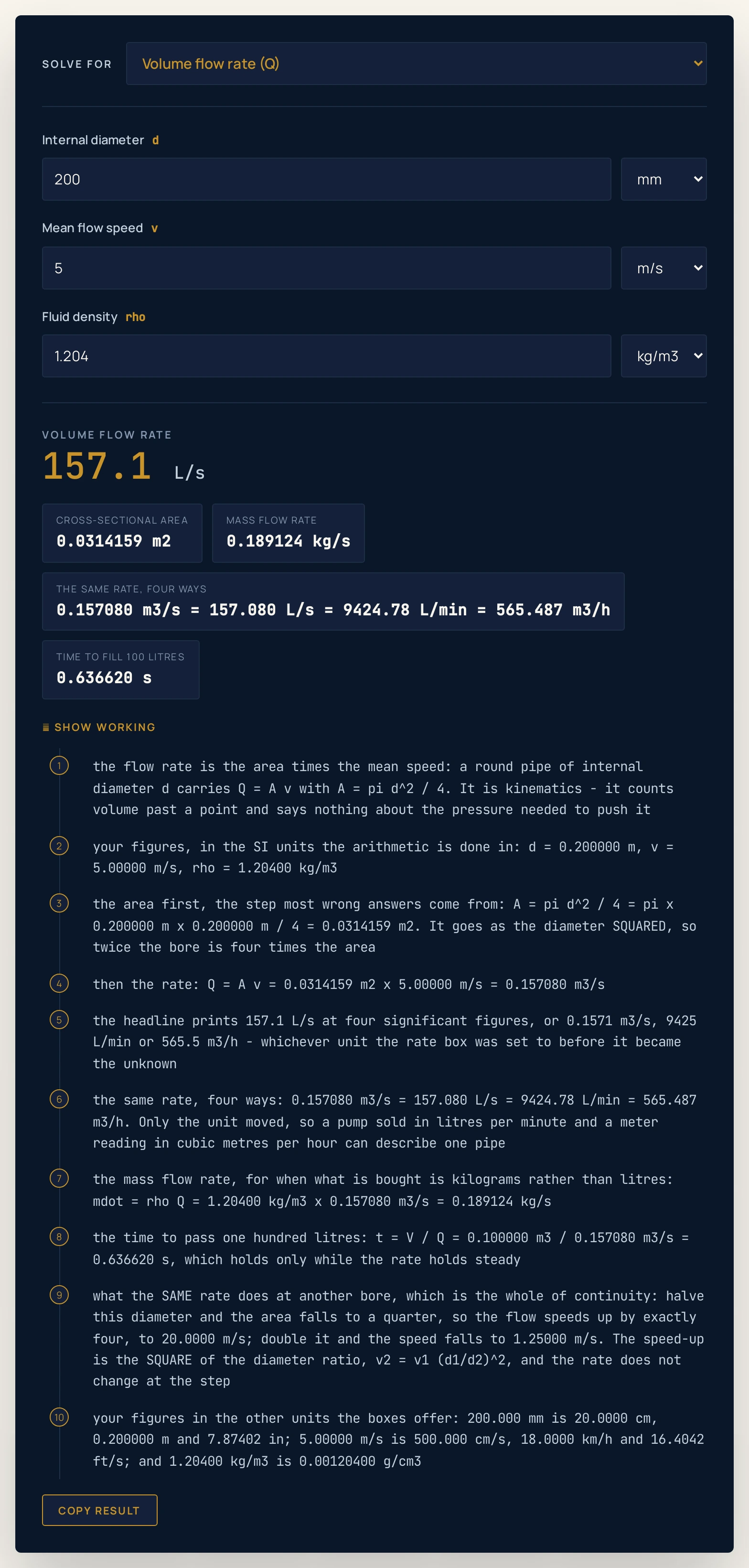
157.1 L/s — thirteen times the default pipe — while carrying only 0.189124 kg/s, under a sixtieth of the default pipe's mass flow.Where the flow rate formula breaks down
The arithmetic here is exact to the last digit a double can hold. What fails is a mean being read as a maximum, a bore being guessed, a density that moves along the pipe, and a rate being asked to predict a pressure it knows nothing about.
- It is kinematics, so it says nothing about the pressure needed
- Every answer here is arithmetically correct and some are physically absurd: the page will put
1570.80 L/sthrough a 500 mm pipe at 8 m/s without asking what drives it. A rate is only available if something can supply the energy to push it through the resistance of the pipe, and that calculation is not on this page. The guide to Bernoulli and pressure in a moving fluid is where that side belongs. - Where viscosity and a pressure drop set the rate, a different law applies
- In a long narrow tube under a steady pressure difference it is the viscosity that fixes how much flows, and the relation that gives the rate is Poiseuille law, not this one.
Q = A vis still true there — it is a definition — but it cannot predict the rate, only describe it once the speed is known. The viscosity guide names that law and works it; this page does not. - One rate at every station needs a density that does not change
- Volume conservation is the incompressible statement. For a liquid that is close enough to exact for any practical pipe, but for a gas it holds only while the pressure and the temperature barely move along the duct — in practice, well below the speed of sound, which this site publishes as 343 m/s in air and 1480 m/s in water. Above that, volume in and volume out are simply different numbers, and nothing on this page applies.
- The speed box is a mean, and a real pipe has no single speed
- Fluid near the wall moves slower than fluid in the middle, so the one number
Q = A vis defined with is an average across the section. Reading a probe on the centreline and typing that in will overstate the rate. The Reynolds number guide is where the difference between a mean and a local speed is set out properly. - The bore is the inside bore, and it is squared
- A nominal pipe size is a label, not a measurement, and an outside diameter includes the wall. Because the area goes as the square, a bore 5 per cent out gives a rate about 10 per cent out, and the error is in the answer rather than in the input you can see. Measure the inside, or take it from the pipe schedule you are actually buying.
- A fill time assumes the rate never changed
- The fill chip is one hundred litres divided by whatever rate is on screen, which is exact arithmetic about a hypothetical steady flow. Tanks fill against a rising head, pumps ride up their own curves and valves get throttled, so a real fill takes longer than the chip says. Treat it as the best case and the floor on the time, not the time.
- This page is for a round section, and nothing else
A = pi d2/4is the area of a circle. A rectangular duct, a part-full pipe or an open channel has a different area, and the last of those is a different relation entirely — the Manning equation calculator is the open-channel tool. For a non-circular duct that is genuinely full, work out the area yourself and use the mean-speed mode on an equivalent circular bore.- A hyphen or a refusal is an answer, not a fault
- A zero or negative diameter, a zero or negative speed in the sizing mode, a zero rate in the speed mode and a zero or negative density are all declined in words rather than answered with an infinity or a NaN. The density is refused in every mode, because it is an input in every mode and the mass flow chip would otherwise be meaningless.
- The calculator measures nothing — you supply the numbers
- Two quantities and a density go in, one definition is rearranged, and the answer describes the pipe you described. The preset names are shorthand for the four figures behind them and are not claims about any particular installation. Nothing here is a Reynolds number, a friction factor, a head loss or a pumping power.
Where the flow rate formula is actually used
- Sizing a pipe for a duty
- Point Solve for at the internal diameter and the question inverts: a rate you must carry and a mean speed you are willing to accept give the bore that delivers it. The size the bore for 12 litres per second preset is that calculation, and it lands on
92.13 mm— a size nobody sells, which is exactly why the next step is to check the speed at the size you can buy. - Turning a meter reading into a speed
- Point Solve for at the mean flow speed and a rate off a meter becomes the speed in the pipe. That is the number velocity limits are written against, and it is also the input every flow-regime question needs before it can start.
- Checking a pump against the pipe it is on
- A pump is sold in litres per minute or cubic metres per hour and a pipe is specified in millimetres, so the two are never in the same units. The unit ladder chip puts one rate in all four at once: at the defaults,
11.7810 L/sis also706.858 L/minand42.4115 m3/h. - Working in kilograms rather than litres
- Load the air in a 200 mm duct preset and the headline climbs to
157.1 L/swhile the mass chip falls to0.189124 kg/s. Anything metered, charged or burned by mass needs that second figure, and it is the density box alone that decides it. - Estimating a fill or a drain
- The fill chip answers the question most people actually arrive with. At the default pipe a hundred litres takes
8.48826 s; through the 15 mm kitchen pipe preset it takes9.43140 min, and the same hundred litres through a 10 mm bore at a crawl takes3.53678 h. - Comparing two bores on the same duty
- Load the 500 mm water main preset against the domestic 15 mm pipe preset:
392.699 L/sagainst0.176715 L/s. The bore grew by a factor of about 33 and the speed only doubled, yet the rate grew by a factor of over two thousand — the square in the area doing most of the work. - Catching a unit mistake before it becomes a purchase
- The commonest error in this arithmetic is a diameter in the wrong unit, and it shows up as a factor of a thousand in the area. Typing the bore three ways — 100 mm, 10 cm, 0.1 m — and seeing the same
11.78 L/scome back each time is a thirty-second check that the number in front of you is the number you meant.
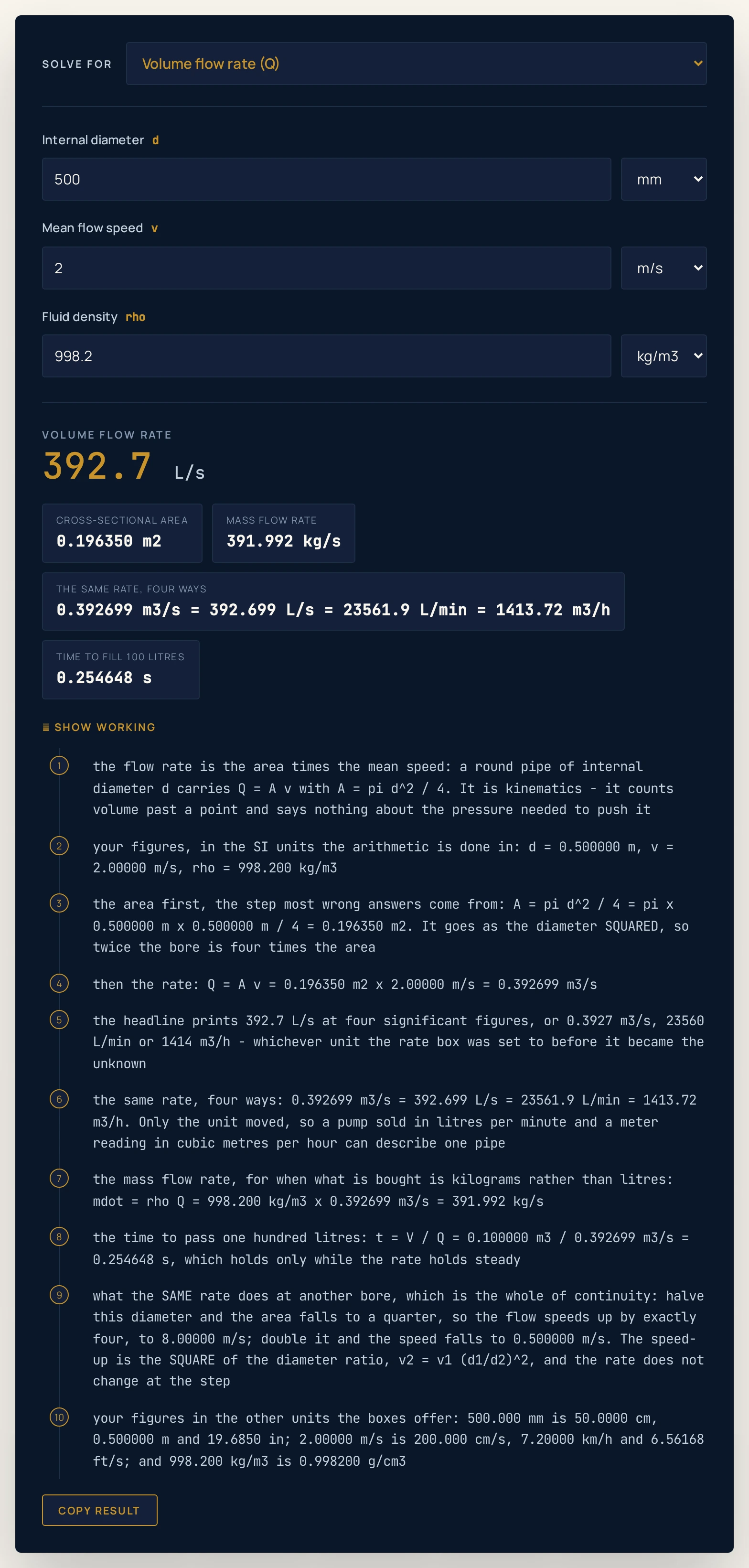
392.7 L/s against 11.78 L/s — and a hundred litres now passes in 0.254648 s.Where to go next
For what the flow rate formula is, the full unit table, the worked problems and the misconceptions, read the flow rate formula guide, which this tool is the arithmetic half of. Bernoulli's principle is the pressure side of the same pipe, the Reynolds number guide says whether the flow is laminar or turbulent, the viscosity guide is where a pressure drop and a viscosity set the rate instead, and the density formula guide is where the mass flow chip gets its density. The guide to pressure in physics and the Pascal law and hydraulics guide are the other two things an area does, and Fourier's law is where the other Q lives.
Four tools sit next to this one. The Reynolds number calculator takes the mean speed straight from here; the Bernoulli equation calculator answers the pressure question; the Manning equation calculator is the open-channel case; and the density calculator supplies a density. The hydraulic cylinder force calculator uses the same pi d2/4 on a piston instead of a pipe, and the pressure calculator is force over area.
The Bernoulli principle simulator, the Reynolds number simulator and the viscosity simulator are the neighbouring labs. The full physics lab library and calculator index are open too.
Frequently asked questions
What does the flow rate formula calculator work out?
It solves Q = A v with A = pi d^2 / 4 for any one of three quantities: the volume flow rate, the internal diameter of a round pipe, or the mean flow speed. Beside the answer it prints the cross-sectional area, the mass flow rate, the same rate in four units, and how long that rate takes to pass one hundred litres.
Which of the three boxes should I point Solve for at?
Point it at the flow rate when you know the bore and the speed, which is the forward question. Point it at the mean flow speed when a meter has given you a rate through a pipe that already exists. Point it at the internal diameter when you know the rate you must carry and the speed you are willing to run at, which is the sizing question.
Why does the rate box open on 11.7810 litres per second?
Because that is what a 100 mm bore at 1.50 m/s really carries, and pi makes it a decimal that never ends. The area is 0.00785398 m2, so the rate is 0.0117809725 m3/s, and the box opens on the six-figure rounding of it. Back-solving from that figure still returns 100.000 mm and 1.50000 m/s, so the four defaults are one state.
Why does the calculator ask for a fluid density?
Only to work out the mass flow rate chip. The volume rate, the area and the speed are all independent of what the fluid is: a cubic metre a second of air and a cubic metre a second of glycerine are the same flow rate. A zero or negative density is refused rather than answered, because it is not a fluid and the mass chip would be meaningless.
Is the speed in the box the fastest speed in the pipe?
No. Q = A v is defined with v as the MEAN speed across the whole cross-section, which is the rate divided by the area. The fluid in a real pipe does not all move at one speed, so the figure in the box is an average and not the reading a probe on the centreline would give. Use the mean whenever you use this relation.
Why will it not give me a diameter when the speed is zero?
Because a stated rate at no speed needs an infinitely wide pipe, which is not an answer. The page declines it rather than printing an infinity. A negative speed is declined for the same kind of reason: the square root of a negative area has no meaning, and a flow running the other way is still a positive speed in the opposite direction.
Which unit does the headline answer come out in?
Whichever unit that box was showing before it became the unknown. The engine converts every input to SI, does the arithmetic there, and converts the answer back, so the units you choose never change the physics. Set the unit while the quantity is still an input, then point Solve for at it, and read the unit ladder chip for the other three.
Does this calculator work out the pressure needed to drive the flow?
No, and that is deliberate. Q = A v is kinematics: it counts volume past a point and is silent about what pushes it. A pressure needs the energy balance along the pipe or, where viscosity rules, a law that relates a pressure drop to a rate. Nothing on this page computes a pressure, a head loss or a pumping power.
References & formula source
- The relation this page solves is the definition of volumetric flow rate for a uniform flow through a plane cross-section: the rate is the area of the section times the component of the mean velocity normal to it, Q = A v. It is stated here rather than derived, and for a round pipe the area is taken as pi times the diameter squared over four.
- The symbol Q is a VOLUME per second throughout this page, in cubic metres per second. The same letter is used on this site for a heat flow in watts, on the Fourier law page, and the two are different quantities that happen to share a letter. Nothing on this page is a heat, an energy or a power.
- The mass flow rate is the density times the volume flow rate, which holds when the density is uniform across the section. The four densities named on this page - water 998.2, air 1.204, SAE 30 oil 876 and glycerine 1261, all in kg/m3 - are the values this site already publishes for those fluids on its Reynolds number pages, reused here so that neighbouring tools agree rather than carrying two sets of numbers for the same liquid. The water and air figures are for 20 C and the SAE 30 oil figure is for 40 C; type a measured density when you have one.
- One rate at every station along a pipe is the incompressible continuity statement, A1 v1 = A2 v2, from which v2 = v1 (d1/d2)^2 follows for round sections. It assumes a density that does not change along the pipe. For a gas that is a good assumption only well below the speed of sound, which this site publishes as 343 m/s in air and 1480 m/s in water; near or beyond it the volume rate is no longer the same at both ends and nothing on this page applies.
- The mean speed is the rate divided by the area, by definition. Real pipe flow is not uniform across the section, so the figure in the speed box is an average rather than a local reading, and a velocity measured at one point is not it. Use a measured mean, or accept the average that this relation is defined in terms of.
- Nothing on this page computes a pressure, a pressure drop, a head loss, a pumping power, a Reynolds number, a friction factor, an entrance length or an open-channel discharge, and no viscosity appears anywhere. Those belong to other pages, and this one links to them rather than repeating them. Where viscosity and a pressure drop are what fix the rate, it is Poiseuille law that applies and not this relation.
- The time to fill a volume is that volume divided by the rate, which holds only while the rate holds steady. A tank filling against a rising head, a pump riding up its own curve or a valve being throttled all break that assumption, so treat a fill time from this page as the steady-rate case and verify anything you mean to rely on.
- Every figure quoted in the prose and tables above is either a string this calculator printed for the inputs named beside it, a density stated on this page, or a ratio checked against an independent reference written before this page existed and sharing no code with it, which runs 472 checks with 0 failures. Where a cell and the running widget ever part company, believe the widget.
- Further reading: Volumetric flow rate — Wikipedia