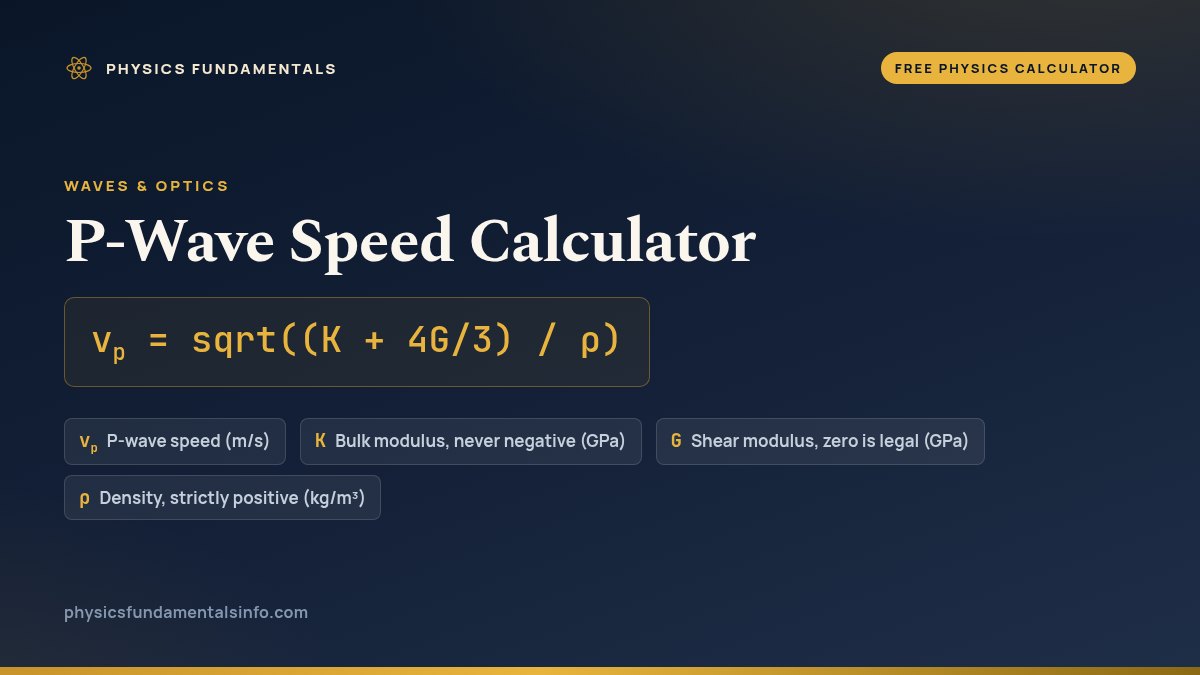
A P-wave is the faster of the two body waves a solid can carry, and its speed is set by three properties of the material: the bulk modulus K, the shear modulus G and the density ρ, combined as vp = sqrt((K + 4G/3) / ρ). The one thing to get right is the 4G/3: a compression cannot pass through a solid without distorting it as well as compressing it, so the shear stiffness resists the wave too — drop that term and the answer is several per cent low. This free calculator solves the relation for the speed, either modulus or the density, prints the S-wave speed and the ratio beside it, and shows every step.
Load a real case
Each button writes the bulk modulus, the shear modulus and the density into the three boxes, so the answer changes the moment you press it. The line underneath quotes back whatever the widget then works out, so nothing in it is stored text. All five sets of figures are stated givens chosen to make a point, not measurements of any named material.
Pick a case above, or type your own figures.
What Is the P-Wave Speed Calculator?
The P-wave speed calculator is a free online tool for how fast a P-wave — the faster of the two body waves a solid can carry — travels through a material: vp = sqrt((K + 4G/3) / ρ), in metres per second. Give it the bulk modulus K, the shear modulus G and the density ρ and it returns the speed; point the Solve for menu at any one of those three instead and it runs the same relation in that direction.
The term to get right is the 4G/3, and that single term is what this page exists to explain. A plane wave front leaves the material no room to spread: everything level with a compressed patch is squeezed in the same instant and holds it in, so the patch loses length along the path without gaining width across it — and resisting that change of shape is the second stiffness the wave must overcome. Drop the term and you get a plausible wrong answer: at the page's own opening figures of 50 GPa, 30 GPa and 2700 kg/m3, sqrt((K + G) / ρ) gives 5443.31 m/s instead of 5773.50, short by 330.19 m/s or 5.72 per cent.
A shear modulus of zero is a legal, meaningful entry here, not an error. It is the fluid case, and the honest reading is that the S-wave ceases to exist rather than slowing down: the S-wave chip reads an exact 0.00 and the speed-ratio chip reads "no S-wave" instead of an infinity, while the P-wave speed merely drops from 5773.50 to 4303.31 m/s. A shear modulus just above zero keeps both chips finite, so only the endpoint itself refuses.
The P-wave is always the faster of the two, and the page can show why rather than assert it. Its numerator is K + 4G/3 and the S-wave's is only G, so for any positive shear modulus the P-wave wins; the lowest the speed ratio can ever fall is the exact value sqrt(4/3), 1.1547, which the last preset puts on screen by setting the bulk modulus to zero. At the opening figures the ratio is sqrt(3), 1.7321 — but only because those figures make Poisson ratio exactly 0.25, which is a condition and not a fact about rock.
Some combinations have no answer and the page refuses them rather than inventing one. A speed slower than the shear modulus alone would give needs a negative bulk modulus, which is not a solid; two zero moduli describe no medium at all rather than a speed of zero; and a density of zero or less is refused for the same reason. The boundaries themselves are solvable and deliberately so: enter exactly 3849.00 m/s with G = 30 GPa and ρ = 2700 kg/m3 and the bulk modulus comes back as 0.00 GPa.
Both modulus boxes open in GPa and are a factor of 1e9 inside the formula, which is the step most often skipped by hand; the density is in kg/m3 and every speed on the page is in m/s. Every figure the page prints is a string its own engine produced, and the three material properties are always stated givens — no density or modulus on this page is attributed to a named rock, because none is measured or cited here. The only measured figures quoted are P-wave velocities, from the reference at the foot of the page.
What the page does not do is worth naming as plainly as what it does. It has no frequency and no wavelength box, so the relation between a speed and those two belongs elsewhere; it has no time or distance input, so it cannot turn a gap between two arrivals into a distance; and it describes one uniform, isotropic material rather than real layered, cracked, directional ground, which is where its own limits section begins.
| Symbol | Quantity | Default unit | Also accepts | Example value |
|---|---|---|---|---|
| vp | P-wave speed | m/s | km/s | 6000 |
| K | Bulk modulus, never negative | GPa | MPa, Pa | 50 |
| G | Shear modulus, zero is legal | GPa | MPa, Pa | 30 |
| ρ | Density, strictly positive | kg/m³ | g/cm³ | 2700 |
How to use the P-wave speed calculator
- Enter the two moduli in GPa, not in pascals. Both boxes open in GPa, because that is how elastic properties are tabulated, and the menus also offer MPa and Pa. Inside the formula everything is in pascals, which is a factor of
1e9the calculator applies for you — by hand it is the step most often skipped. - Pick what to solve for. The page opens on the speed. The Solve for menu also rearranges the relation for the bulk modulus, the shear modulus and the density; whichever you choose becomes the headline and the other three become your input boxes. Switching the menu clears every box, so set it first and type afterwards.
- Enter the bulk modulus. The default is
50GPa. Zero is accepted and means something: the material resists a change of shape but not a change of volume, which puts the speed ratio on its exact floor. A negative modulus is refused. - Enter the shear modulus. The default is
30GPa. Zero is accepted here too and is the most interesting entry on the page — it is the fluid case, and the S-wave vanishes rather than slowing down. - Enter the density. The box opens on
2700kg/m3, and the menu offers g/cm3 if that is how your problem states it. It must be strictly positive. All three of these figures are stated givens on this page, never properties attributed to a named rock. - Read the headline. It is the quantity you asked for to six significant figures, with trailing zeros dropped — so the defaults read
5773.5rather than 5773.50. Solving for the speed the unit beside it ism/s, and the working repeats the same figure in km/s because that is how the geophysical literature quotes it. - Read the four chips. S-wave speed is
sqrt(G / ρ), a different formula. Speed ratio is the P-wave speed divided by it. P-wave modulus is theK + 4G/3the formula really uses. Poisson ratio fixes the speed ratio on its own. - Open Show working. The steps restate the unit trap, give the rearranged relation, list your figures in GPa and in pascals, work out
4G/3and the P-wave modulus as separate lines, substitute every number and then check the answer by putting it back. - Expect a refusal where no answer exists. A speed slower than the shear modulus alone would give has no bulk modulus behind it, and the panel says so rather than printing a negative one. Two zero moduli are refused as well: that is no medium, not a speed of zero.
Two neighbouring quantities are worth separating from this one before you start. This page says nothing about frequency or wavelength — for that relation use the wave speed calculator instead. And the symbol for the bulk modulus is not settled across physics: some texts, including our guide to how sound waves travel, write it as B rather than K, and the two are the same quantity.
The other elastic modulus a reader usually arrives with is Young's modulus, which is a third quantity again and is measured from a tensile test rather than from a wave — the Young's modulus calculator does that one. If you want the reasoning in prose, with the same figures worked through by hand, the P-wave guide argues the shear term out and sets eight problems on it.
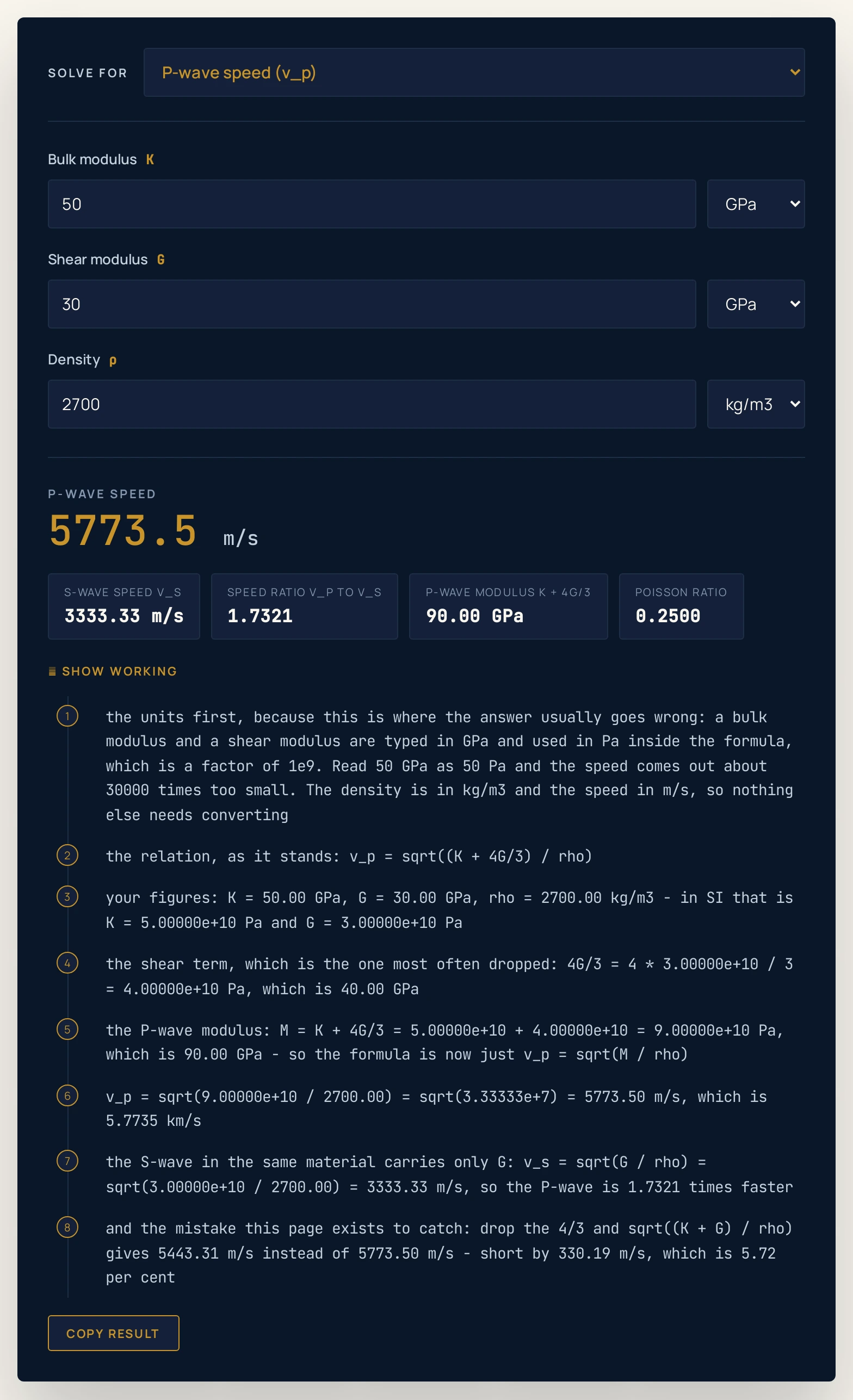
K = 50 GPa, G = 30 GPa and ρ = 2700 kg/m3. These three were chosen because every result is exact: K + 4G/3 is exactly 90 GPa, the ratio is exactly sqrt(3) and ν is exactly 1/4.Worked example: change one thing at a time
The table holds the bulk modulus at 50 GPa and the density at 2700 kg/m3 and sweeps the shear modulus from nothing to 50 GPa. Every Headline and chip cell was read out of the running widget rather than worked out by hand. Where a cell and the tool ever part company, believe the tool.
| Shear modulus (GPa) | P-wave modulus (GPa) | Headline speed (m/s) | S-wave chip (m/s) | Speed ratio chip | Poisson ratio chip |
|---|---|---|---|---|---|
| 0 | 50.00 | 4303.31 | 0.00 | no S-wave | 0.5000 |
| 5 | 56.67 | 4581.23 | 1360.83 | 3.3665 | 0.4516 |
| 10 | 63.33 | 4843.22 | 1924.50 | 2.5166 | 0.4063 |
| 20 | 76.67 | 5328.7 | 2721.66 | 1.9579 | 0.3235 |
| 30 | 90.00 | 5773.5 | 3333.33 | 1.7321 | 0.2500 |
| 40 | 103.33 | 6186.4 | 3849.00 | 1.6073 | 0.1842 |
| 50 | 116.67 | 6573.42 | 4303.31 | 1.5275 | 0.1250 |
Three things move together down that table and one moves against them. Both speeds rise with the shear modulus at every step, the speed ratio falls towards 1.5275, and Poisson ratio falls from 0.5000 to 0.1250 — so a material that resists a change of shape more strongly is not just faster, it is differently proportioned. The top row is the only one where the ratio has no value at all.
Two repeats in that table are arithmetic, not a copy-and-paste slip. 4303.31 appears as the headline at G = 0 and as the S-wave chip at G = 50, and 3849.00 appears as the S-wave chip at G = 40 and as the headline when the bulk modulus is set to zero instead.
Switching the Solve for menu runs the same rows backwards. From a speed of 6000 m/s with G = 30 GPa and ρ = 2700 kg/m3 the bulk-modulus mode returns 57.2 GPa; from the same speed with K = 50 GPa the shear-modulus mode returns 35.4 GPa; and from that speed with both moduli given, the density mode returns 2500 kg/m3.
Formula and symbol reference
| Symbol | What it is | Unit | On this page |
|---|---|---|---|
| vp | The P-wave speed: the quantity this page is named after, and the faster of the two body waves a solid can carry | m/s | Box menu reads m/s or km/s. Headline 5773.5 at the defaults, 4303.31 with no shear stiffness, 3849 with no bulk stiffness. Default 6000 when it is an input. |
| K | The bulk modulus: how hard the material is to change in volume. Never negative; 0 is legal |
GPa | Box menu reads GPa, MPa or Pa, and GPa is a factor of 1e9 inside the formula. 50 GPa is the default. |
| G | The shear modulus: how hard the material is to change in shape. Never negative; 0 is legal and is the fluid case |
GPa | Same menu as K. 30 GPa is the default; 0 drops the speed to 4303.31 m/s and removes the S-wave entirely. |
| ρ | The density of the material. Strictly positive, because a wave needs something to travel through | kg/m3 | Box menu reads kg/m3 or g/cm3. 2700 kg/m3 is the default, which is 2.7 g/cm3. |
| M = K + 4G/3 | The P-wave modulus: the single stiffness the formula actually uses, so that it reads vp = sqrt(M / ρ) | GPa | A chip beside the answer, never an input: 90.00 GPa at the defaults, of which 40.00 GPa is the shear term. |
| vs | The S-wave speed, sqrt(G / ρ) — a different formula, carrying only the shear modulus | m/s | A chip beside the answer: 3333.33 m/s at the defaults, and an exact 0.00 when G is zero. |
| ν | Poisson ratio, (3K − 2G) / (2(3K + G)). It fixes the speed ratio on its own | dimensionless | A chip beside the answer: 0.2500 at the defaults, 0.5000 when G is zero, -1.0000 when K is zero. |
The physics: why shear stiffness speeds up a compression wave
A P-wave is a compression running through the material, so the obvious stiffness for it to meet is the bulk modulus — the resistance to being squeezed smaller. That alone would give sqrt(K / ρ), which at the page defaults is 4303.31 m/s. The real answer is 5773.5 m/s, and every metre per second between those two figures is the shear term.
The reason is geometry. A compression arrives everywhere along the flat front in one moment, so a small patch of the material has nothing to expand into and is squashed from a cube into a thinner slab of the same cross-section rather than into a smaller cube. Deforming something out of its own shape, and not merely into a smaller copy of itself, is what the shear modulus charges for — which is why the working prints 4G/3 on a line of its own before it adds K.
That is also why the P-wave always wins the race. Its numerator is K + 4G/3 and the S-wave's is only G, and since 4G/3 already exceeds G for any positive shear modulus while K is never negative, the P-wave numerator is always the larger. The lowest the ratio can fall is the exact value sqrt(4/3) = 1.1547, which the last preset puts on screen by setting the bulk modulus to zero.
What the shear modulus physically is gets its clearest treatment on this site in torsion rather than in waves, where it is the stiffness that resists a twist: the polar moment of inertia guide is the honest place to send that question. The broader framing — that every wave speed is a stiffness divided by an inertia under a square root — is set out in the guide to wave speed in different media, and this formula is one instance of it with two stiffnesses instead of one.
The S-wave speed, and the one number that fixes the ratio
The S-wave speed is vs = sqrt(G / ρ), which is a genuinely different formula rather than a mode of the one above: the bulk modulus is not in it at all. It is printed as a chip beside every answer, so the two speeds are always on screen together — 3333.33 m/s against 5773.5 m/s at the defaults, a ratio of 1.7321.
That ratio is sqrt(3) exactly, and it is worth saying precisely why, because it is easy to quote as a fact about rock when it is not. The ratio is fixed by Poisson ratio alone, through vp/vs = sqrt((2 − 2ν) / (1 − 2ν)), and the default figures make ν exactly 0.25 — which is the only reason sqrt(3) appears. Change the shear modulus and the ratio moves with it, as the table above shows.
Because the S-wave formula is a one-liner, the shear modulus can also be recovered from a measured S-wave speed without this page's main solve: G = ρvs2. An S-wave measured at 3600 m/s in material of stated density 3000 kg/m3 needs G = 38.88 GPa — and you can check that against the widget directly: type that shear modulus and that density, and the S-wave chip reads 3600.00 m/s back. The solve-for-G mode runs the other route, from a P-wave speed and a bulk modulus, and its working prints both so the two can be compared.
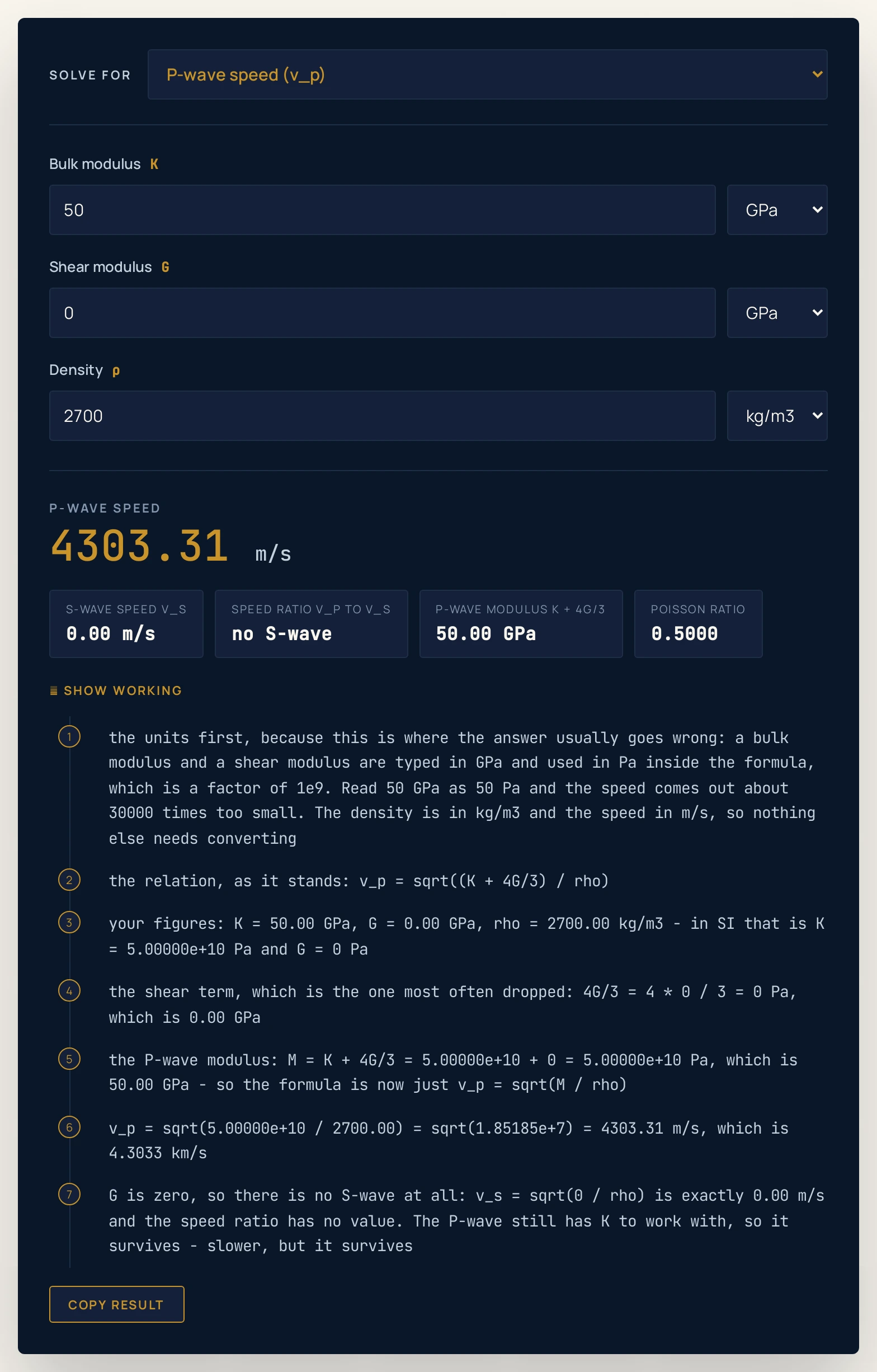
G = 0 the S-wave chip is an exact 0.00 and the ratio chip reads no S-wave rather than an infinity, while the P-wave speed merely drops to 4303.31 m/s — a factor of sqrt(5/9). Poisson ratio is exactly 0.5000, the incompressible limit.Where the P-wave speed calculator breaks down
- It assumes one uniform, isotropic material
- The relation multiplies one stiffness by one density, so it describes a single material that is the same in every direction. Real ground is layered, cracked, fluid-filled and faster along the bedding than across it, so a speed measured over a real path is an average over all of that. This page gives the speed of a material, never of a structure.
- The two moduli are inputs, not something this page measures
- Nothing here works out
KorGfrom a composition, a mineral or a depth, and no figure on this page is a measured property of a named rock. Where a measured number is quoted it is a velocity, from the reference below. That is also the honest way round the inversion runs in practice: a velocity is what gets measured, and a modulus is what gets inferred from it. - It has no frequency, no distance and no attenuation
- There is no time input of any kind, so the page says nothing about how a pulse spreads, loses amplitude or changes shape as it travels. It also has nothing to say about an arrival-time difference: working a distance out from the gap between two arrivals is a different calculation, set out in the guide to transverse and longitudinal waves, which is also where the distinction between the two wave types is covered properly.
- The refusals, and why each one is right
- A speed slower than
sqrt((4G/3) / ρ)would need a negative bulk modulus, and a speed slower thansqrt(K / ρ)would need a negative shear modulus; neither is a solid, so both are refused instead of printed. Both moduli at zero is refused too, because that is the absence of a medium rather than a speed of zero. Sit exactly on a boundary, though, and it is answered rather than refused:3849.00m/s atG= 30 GPa andρ= 2700 kg/m3 returns a bulk modulus of0.00GPa, not an error. - Three different formulas are easy to confuse
- This one is for a body wave in a bulk solid. A sound wave in a gas has no shear stiffness to help it, which is why its speed comes from the gas law instead — the speed of sound calculator and the speed of sound guide cover that case. The speed quoted for a long thin rod is a third formula again, built on Young's modulus, and none of the three may be substituted for another.
Where P-wave speeds are actually used
- Turning a measured velocity into a stiffness
- In practice the speed is what gets measured and the modulus is what gets inferred, which is what the Solve for menu is for. Against the measured granite velocities quoted in the reference below, 5800 to 6100 m/s, the
Kmode at a stated density of 2700 kg/m3 and no shear term implies a P-wave modulus of90.83to100.47GPa. The round-number case this page opens on, withM= 90.00 GPa, gives 5773.50 m/s — 26.50 m/s, or 0.46 per cent, below the bottom of that measured band. - Why a warning arrives before the shaking
- Both body waves leave together and the P-wave pulls ahead, so the first arrival is the gentler one. At the page's opening figures the gap is
12.68seconds over 100 km, which is the ratio chip turned into time. The amplitude side of that story, and why the later arrival is the damaging one, is in the amplitude guide. - Reading the inside of the Earth
- Converted into the unit the boxes use, the reference below has the crust under
6000.00m/s (6.0 km/s), the lower mantle at13500.00m/s (13.5 km/s) and the inner core at11000.00m/s (11.0 km/s). Reaching 13500 m/s at a stated density of 2700 kg/m3 would need a P-wave modulus of about492GPa, which is 5.47 times this page's opening case — so the deep Earth is not the same material under more pressure, it is a different material. - Checking an answer before checking its arithmetic
- Any P-wave speed below
sqrt((4G/3) / ρ)is wrong before you look at the working, and any speed ratio below 1.1547 is wrong too, whatever the material — that is what the P-wave modulus and Speed ratio chips are for. A speed quoted in km/s where m/s was meant is the other half of the same check, and is a factor of a thousand. - Seeing stiffness and inertia compete
- Watching the two speeds move as the shear modulus changes is more convincing than any table, and the same tug of war between stiffness and inertia drives every other wave speed on the site. The wave speed simulator runs it as a wave crossing from one medium into another, and the speed of sound simulator runs the gas version where there is no shear stiffness at all.
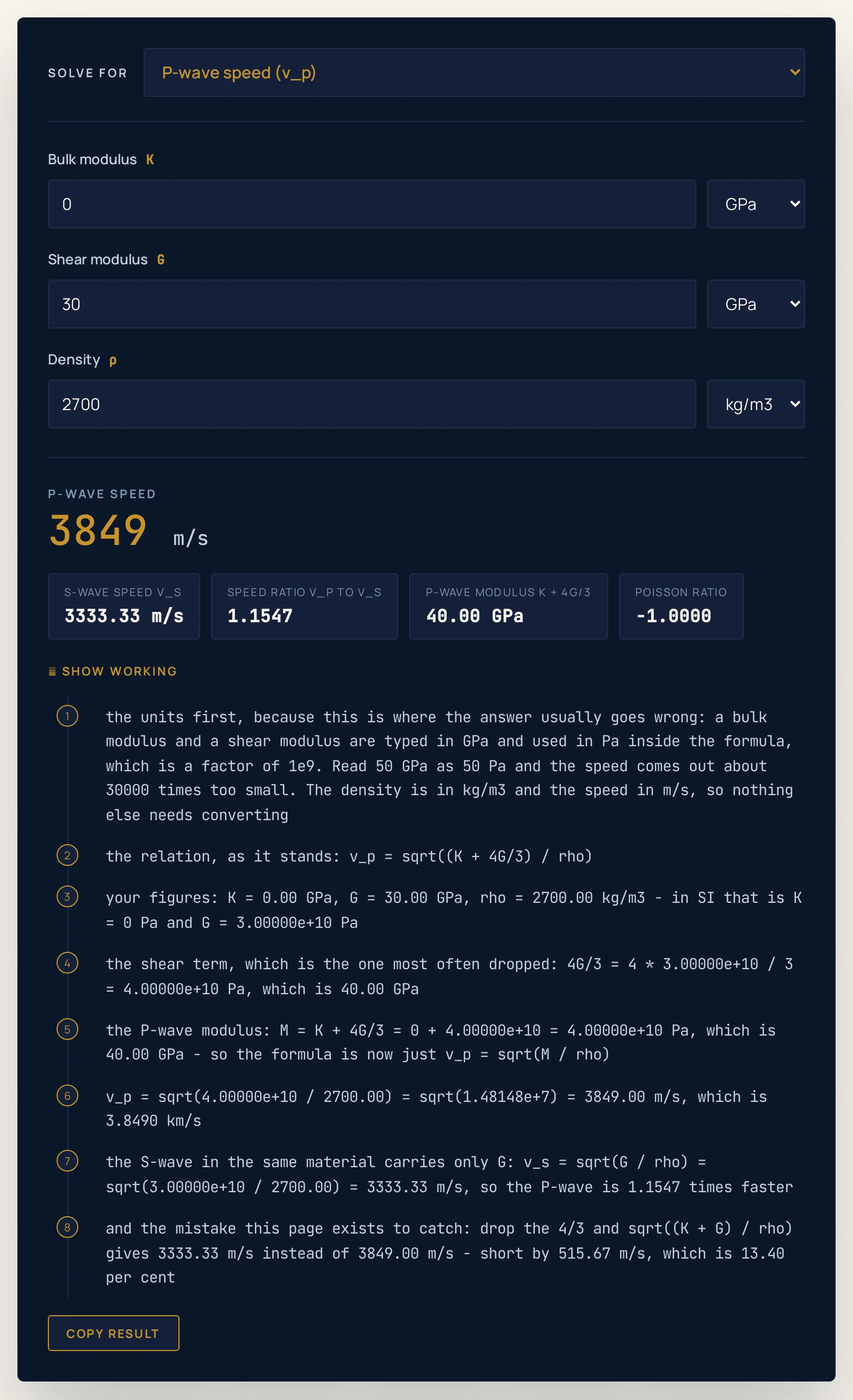
K = 0 the speed ratio sits on its exact floor, sqrt(4/3) = 1.1547, and Poisson ratio reads -1.0000 — the theoretical lower bound, where no real material sits.Where to go next
For the definition, the shear term argued out in prose and a full set of worked problems, read the P-wave guide, which this tool is the arithmetic half of. The guide to transverse and longitudinal waves covers what separates the two body waves and how to get a distance out of their arrival-time gap, the guide to how sound waves travel covers the fluid case this formula reduces to when the shear modulus is zero, and the physics symbols guide sorts out the letters.
Four tools sit beside this one. The speed of sound calculator handles the gas case; the wave speed calculator relates a speed to a frequency and a wavelength; the Young's modulus calculator measures the third elastic modulus from a tensile test; and the polar moment of inertia simulator is where the shear modulus shows up as a twist. The full physics lab library and the calculator index are open too.
Frequently asked questions
What does the P-wave speed calculator work out?
It works out how fast a P-wave travels through a solid, from v_p = sqrt((K + 4G/3)/rho). K is the bulk modulus and G the shear modulus, both entered in GPa, and rho is the density in kg/m³. The same relation is rearranged three more ways, so you can enter any three of the four quantities and read the fourth.
What is the formula for P-wave velocity?
It is v_p = sqrt((K + 4G/3)/rho), for an isotropic, homogeneous solid. The combination K + 4G/3 is called the P-wave modulus and is usually written M, which makes the formula simply v_p = sqrt(M/rho). Real ground is layered and directional rather than uniform, so the formula gives the speed of one material and not of a whole structure.
Why is the shear modulus in a compression wave formula at all?
Because a compression changes the proportions of a solid as well as its volume. The front is flat, so the squeezed region is penned in by material being squeezed at the same time, and it gets shorter along the path while staying as wide across it. Resisting that distortion is what the shear modulus does, so a liquid of the same bulk modulus and density carries the wave more slowly.
Why do P-waves always arrive before S-waves?
Because the P-wave carries K + 4G/3 under the square root and the S-wave carries only G. For any positive shear modulus 4G/3 is already larger than G, and the bulk modulus is never negative, so the P-wave numerator always wins. The lowest the speed ratio can ever fall is sqrt(4/3), which is 1.1547, reached when the bulk modulus is zero.
What happens to the calculation when the shear modulus is zero?
The S-wave speed becomes exactly zero and the speed ratio has no value, while the P-wave speed stays finite and simply drops. At the page defaults it falls from 5773.50 m/s to 4303.31 m/s, a factor of sqrt(5/9). The honest reading is that the S-wave has ceased to exist rather than slowed down, which is why the ratio chip refuses instead of printing a very large number.
Why is the speed ratio exactly the square root of 3 at the defaults?
Because the default figures make Poisson ratio exactly 0.25, and the ratio of the two speeds is fixed by that one number: sqrt((2 - 2nu)/(1 - 2nu)). Put nu = 0.25 in and it returns sqrt(3), which is 1.7321. It is a consequence of that specific Poisson ratio and not a general fact about rock, so the condition has to travel with the result.
Do I enter the moduli in GPa or in pascals?
Either, because both boxes carry a unit menu, but they open in GPa since that is how elastic properties are tabulated. Inside the formula everything is in pascals, and the calculator does that conversion itself. By hand it is the step most often skipped, and skipping it is a factor of a thousand million.
Why does the calculator sometimes refuse to give an answer?
Because some combinations genuinely have none, and printing a number for them would be worse than saying so. A P-wave speed slower than the shear modulus alone would give needs a negative bulk modulus, which is not a solid, so the panel refuses rather than printing a negative figure. Two zero moduli are refused too, since that describes no medium at all, and a zero or negative density is refused for the same reason.
Is this the same thing as the speed of sound?
It is the same idea in a different medium, and the formula is different because the medium is. A gas has no shear stiffness at all, so its sound speed comes from the gas law rather than from a shear modulus. The thin-rod speed quoted for a metal bar is a third, separate formula, so none of the three should be substituted for another.
References & formula source
- The P-wave speed through an isotropic, homogeneous solid is computed on this page as v_p = sqrt((K + 4G/3)/rho), with K the bulk modulus, G the shear modulus and rho the density. The combination K + 4G/3 is the P-wave modulus, written M, so the relation is equivalently v_p = sqrt(M/rho). The S-wave speed quoted beside the answer is a different formula, v_s = sqrt(G/rho).
- Moduli are entered in GPa and used in Pa: the GPa option on both modulus boxes is a factor of 1e9, decided once for this page so that nothing inside the formula is ever in anything but SI base units. Speeds are in m/s everywhere on this page, and every km/s figure is printed beside the m/s figure it converts.
- A shear modulus of zero is treated as a legal, meaningful input rather than an error. It is the fluid case: the S-wave speed is exactly zero, the speed ratio has no value and is refused rather than reported as an infinity, and the P-wave speed remains finite. A shear modulus just above zero stays finite on approach, so only the endpoint itself refuses.
- A bulk modulus or a shear modulus that would come out negative is refused, never printed. The boundary is solvable: a P-wave speed exactly at sqrt((4G/3)/rho) returns a bulk modulus of 0.00 GPa, and a negative residue smaller than one part in ten thousand of the term it was subtracted from is treated as the rounding of the entered speed and snapped to an exact zero. Both moduli being zero is refused as well, since that is no medium at all rather than a speed of zero.
- Poisson ratio is computed as (3K - 2G) / (2(3K + G)) and shown beside the answer. The identity that links it to the two speeds, v_p/v_s = sqrt((2 - 2nu)/(1 - 2nu)), is quoted on this page as a condition and not as a general property of rock: the square root of 3 appears only when Poisson ratio is exactly 0.25.
- Density, bulk modulus and shear modulus are stated givens everywhere on this page and are never presented as properties of a named rock, because no measurement of them is made or cited here. The only measured material figures quoted are P-wave velocities, taken from the reference linked below: granite 5800 to 6100 m/s, consolidated sandstone 5800 m/s, limestone 5800 to 6400 m/s, dolomite 6400 to 7300 m/s, gabbro 7200 m/s, shale 1800 to 4900 m/s, together with its Earth-interior figures of less than 6.0 km/s (6000.00 m/s) in the crust, 13.5 km/s (13500.00 m/s) in the lower mantle and 11.0 km/s (11000.00 m/s) through the inner core.
- Every cell of the worked table, and every chip reading quoted beside an answer, is a string this calculator printed for the inputs named with it. The other figures in the prose and in the figure captions are either measured velocities named above or reference figures fixed once for this topic and quoted here rather than re-derived: the 12.68 second gap over 100 km, the 492 GPa the lower mantle would need, the 5.47 times, the 26.50 m/s and 0.46 per cent granite comparison, and the 330.19 m/s and 5.72 per cent that dropping the shear term costs. This page has no time input and no distance input, so the arrival gap is not a figure it could print itself. Nothing here is a measurement made on this site.
- This page computes a speed in one uniform material and nothing else. It does not locate an epicentre, work a distance out from an arrival-time difference, relate a speed to a frequency and a wavelength, or model a layered or directional structure.
- Halliday, Resnick and Walker, Fundamentals of Physics, chapters on waves and on elasticity (stress, strain and the elastic moduli).
- Young and Freedman, University Physics with Modern Physics, chapters on mechanical waves and on the elastic properties of materials.
- Further reading: P-wave — Wikipedia