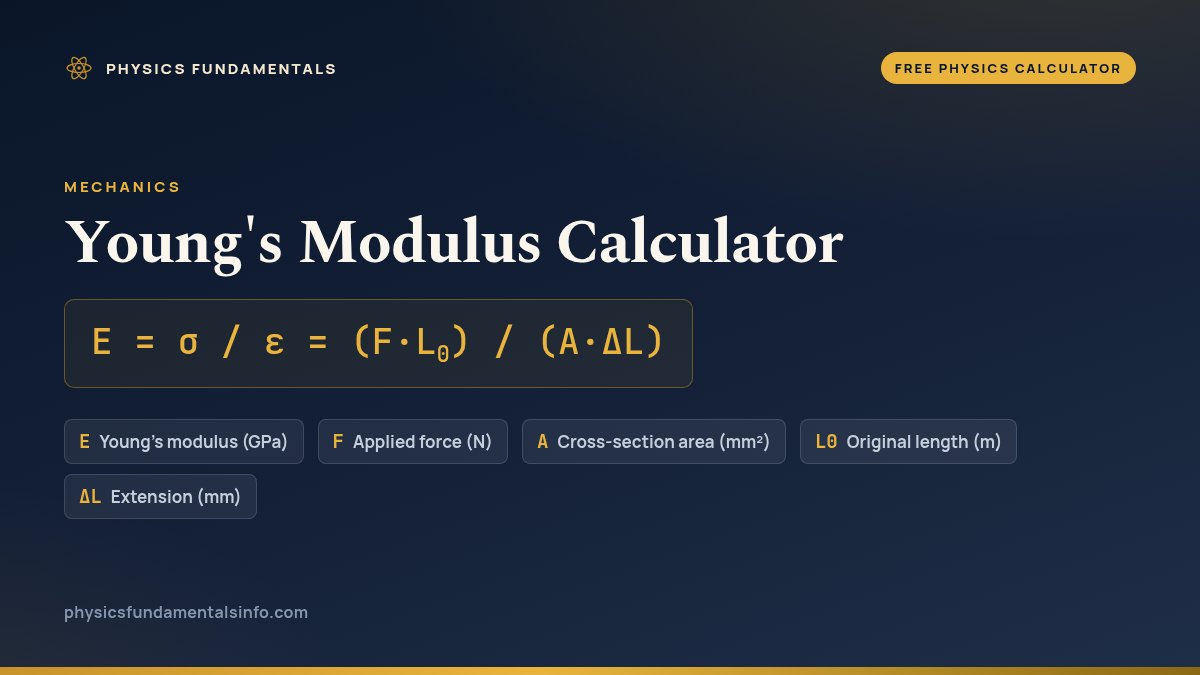
Young’s modulus (modulus of elasticity): the stiffness of a material, equal to tensile stress divided by tensile strain, E = (F·L0)/(A·ΔL). This free calculator solves for the modulus, the applied force or the extension, converts your units automatically, and shows the stress and strain at every step.
What Is the Young's Modulus Calculator?
The Young's modulus calculator is a free online tool built on the formula E = σ / ε = (F·L0) / (A·ΔL). Enter the values you already know, in whichever units suit you, and it solves for young's modulus, force or extension and shows every step of the substitution. Young's Modulus is modulus of elasticity from stress and strain — E = stress/strain.
| Symbol | Quantity | Default unit | Also accepts | Example value |
|---|---|---|---|---|
| E | Young's modulus | GPa | MPa, kPa, Pa | — |
| F | Applied force | N | kN, MN | 1000 |
| A | Cross-section area | mm² | cm², m² | 1 |
| L0 | Original length | m | cm, mm | 1 |
| ΔL | Extension | mm | cm, m | 1 |
How to calculate Young's modulus
Young’s modulus tells you how stiff a material is — how hard you have to pull to stretch it by a given fraction. To calculate it, divide the stress by the strain. Stress is the applied force spread over the cross-sectional area, σ = F/A, in pascals. Strain is the fractional stretch, ε = ΔL/L0, a pure number. Their ratio is the modulus: E = σ/ε = (F·L0)/(A·ΔL).
There are three steps. First, decide whether you want the modulus, the force or the extension, and select it in the calculator’s Solve for menu. Second, enter the values you know: the applied force, the cross-sectional area (square millimetres are convenient for wires), the original length, and the measured extension. Third, read the answer with the worked steps, which show the stress, the strain and their ratio with units.
The most common mistake is mixing up area and length units or forgetting that engineering areas are tiny — a 2 mm-diameter wire has a cross-section of only about 3.14 mm² = 3.14×10⁻⁶ m². Because stress divides force by that small area, a modest load produces a large stress. This calculator converts millimetres and square millimetres to SI for you, so you can enter values in the units you measured.
Young’s modulus is the material-level cousin of Hooke’s law: a bar of cross-section A and length L0 behaves like a spring of stiffness k = EA/L0. For the object-level stiffness see the spring constant calculator; for the stress term on its own see the pressure calculator, and for definitions the physics glossary.
Worked example
A steel wire 2.0 m long with a cross-section of 1.0 mm² (1.0×10⁻⁶ m²) stretches by 2.0 mm under a 200 N load. The stress is σ = F/A = 200 / 1.0×10-6 = 2.0×10⁸ Pa. The strain is ε = ΔL/L0 = 0.002 / 2.0 = 1.0×10⁻³. So E = σ/ε = 2.0×10⁸ / 1.0×10-3 = 2.0×10¹¹ Pa = 200 GPa — exactly the accepted modulus of steel.
Why it matters
Young’s modulus is the number every structural engineer reaches for first. It sets how much a beam sags, how far a cable stretches, how a bracket deflects under load, and how a component stores elastic energy before it yields. Comparing moduli — steel at 200 GPa, aluminium at 70 GPa, bone near 15 GPa, rubber at a few MPa — is how designers pick the right material for stiffness-critical parts.
Frequently asked questions
What is Young’s modulus?
Young’s modulus (E), also called the modulus of elasticity, measures a material’s stiffness in tension or compression. It is the ratio of tensile stress to tensile strain in the elastic region: E = stress / strain = (F/A) / (ΔL/L0). A high modulus means the material barely stretches under load; steel is about 200 GPa, aluminium about 70 GPa, and rubber only a few megapascals.
What are the units of Young’s modulus?
Because strain is a pure ratio with no units, Young’s modulus has the same units as stress: pascals (Pa), where 1 Pa = 1 N/m². Engineering values are large, so they are usually quoted in gigapascals (1 GPa = 10^9 Pa) or megapascals (1 MPa = 10^6 Pa). This calculator accepts and returns any of these.
What is the difference between stress, strain and Young’s modulus?
Stress is the force spread over the cross-sectional area, σ = F/A, measured in pascals. Strain is the fractional change in length, ε = ΔL/L0, and has no units. Young’s modulus is the constant of proportionality that links them, E = σ/ε, and is a fixed property of the material rather than of the particular sample.
How is Young’s modulus related to Hooke’s law?
Young’s modulus is the material-level form of Hooke’s law. For a spring, Hooke’s law is F = kx with a stiffness k that depends on the object’s shape. For a uniform bar, k = EA/L0, so the same behaviour is captured by E, a property of the material alone. See the Hooke’s law and spring constant calculators for the object-level version.
What is the elastic limit and does this calculator assume it?
Young’s modulus only applies while a material is elastic — where stress and strain stay proportional and it returns to its original length when unloaded. Beyond the elastic limit the material yields and the linear relation breaks down. This calculator assumes you are within the elastic region, which is the standard assumption for the modulus of elasticity.
References & formula source
- Halliday, Resnick & Walker — Fundamentals of Physics, Chapter 12 (Elasticity: stress, strain and the moduli).
- Young & Freedman — University Physics with Modern Physics, §11.4 (Stress, Strain and Elastic Moduli).
- Gere & Goodno — Mechanics of Materials, Chapter 1 (Tension, Compression and Young’s modulus).
- Further reading: Young's modulus — Wikipedia