A decay chain is what happens when the daughter of a decay is radioactive too: a parent decays into it, it decays into something stable, and its activity climbs from nothing rather than falling. This free decay chain calculator solves that three-member chain three ways — for the daughter activity now, for the parent activity now, or for the time since the two were last separated. Beside the answer it prints the activity ratio, the limiting ratio the chain is heading for, which of the three equilibrium regimes applies and when the daughter activity peaks.
Load a real chain
Each button puts the Solve for menu on the unknown that case is asking about, sets every unit menu the case names, and fills the remaining boxes. Whatever the widget then works out is read back into the line underneath, so nothing there is stored text. The half-lives are the published ground-state values for those nuclides.
Pick a case above, or type your own numbers.
What Is the Decay Chain Calculator?
The decay chain calculator is a free online tool for the second nuclide in a chain: a parent decays into a daughter that is radioactive too, and the daughter decays into a stable end product. Enter both half-lives, the time since the daughter was last separated and the parent activity you measure now, and it returns the daughter activity from A2/A1 = L2/(L2 - L1) × (1 - e-(L2-L1)t), where each L is ln2 divided by that member's half-life. Move the Solve for menu and it runs backwards instead, recovering the parent activity from the daughter line or dating the sample from the ratio of the two. Beside the answer it prints both decay constants, the activity ratio, the limiting ratio the chain is heading for, which of the three equilibrium regimes applies, when the daughter activity peaks, the parent activity that reading implies at separation and the total activity of the pair.
| Symbol | Quantity | Default unit | Also accepts | Example value |
|---|---|---|---|---|
| T1 | Parent half-life | d | s, min, h, y | 12.751 |
| T2 | Daughter half-life | d | s, min, h, y | 1.67858 |
| t | Time since separation | d | s, min, h, y | 10 |
| A1 | Parent activity now | MBq | Bq, kBq, GBq | 400 |
| A2 | Daughter activity now | MBq | Bq, kBq, GBq | 447.8732 |
How to use the decay chain calculator
- Choose the unknown. The Solve for menu opens on Daughter activity now. The other two choices are Parent activity now and Time since separation, and whichever you pick vanishes from the boxes below.
- Type the two half-lives. Parent half-life and Daughter half-life are always inputs, because neither can be recovered from the other figures. Each box carries its own menu for s, min, h, d and y, so a published half-life goes in as it stands.
- Say how long ago the daughter was separated. Time since separation means the time since the sample last held no daughter at all — a chemical separation, a fresh elution, a freshly made fission product. That is the assumption the whole model rests on, and it is why the daughter activity starts at zero.
- Enter the parent activity you actually measure. Parent activity now is the reading today, not the activity at separation. Boxes take Bq, kBq, MBq or GBq, and the working lines restate whatever you type in megabecquerels.
- Read the answer and the chips. The headline is the quantity you asked for, with its unit printed beside it, carrying up to seven significant figures with trailing zeros trimmed. The chips carry both decay constants, the activity ratio, the limiting ratio, the regime, the peak time, the implied parent activity at separation and the total activity.
- Check the implied source before you trust anything else. That chip runs the parent activity back to the moment of separation, and it is the one number on the page that can tell you an input is wrong. A vial that implies thousands of megabecquerels when it left the laboratory is a vial whose elapsed time does not belong to that parent.
- Read the ratio chip for what it is. Solving for the daughter activity, the ratio chip and the answer are the same arithmetic printed twice, since the answer was computed as that ratio times the parent activity. It describes the state rather than confirming it, and the check that can actually fail is running the page backwards to recover the time you started from.
- Open Show working. The steps restate the equation, list your figures in seconds and megabecquerels whatever the menus say, and end on the answer. Seeing a half-life typed in years come back as a number of seconds in that second line is the fastest way to see what the conversion did.
This page starts where a single-nuclide tool stops. If the daughter of your decay is stable, or you simply do not care what it does, the half-life calculator asks for four numbers instead of five and will not make you name a second half-life you do not have. For what a half-life and a decay constant are in the first place, the guide to half-life in physics covers both, and this page assumes it.
The one thing worth getting straight before you type is the meaning of the time box. It is not the age of the parent, and it is not the time since the source was made. It is the time since the daughter was last stripped out, which for a generator is the last elution and for a fresh fission product is the moment it was chemically separated.
Two mistakes account for most wrong answers here, and both are about what was typed rather than how. The first is putting the activity at separation into the parent activity box: that box wants the reading now, and using the older, larger figure inflates the daughter activity by exactly the factor the parent has decayed by. The second is a half-life quoted in years entered as though a year were a fixed number of seconds, which it is not — this page uses 365.25 days, and a source quoting 365.2422 will differ in the sixth digit.
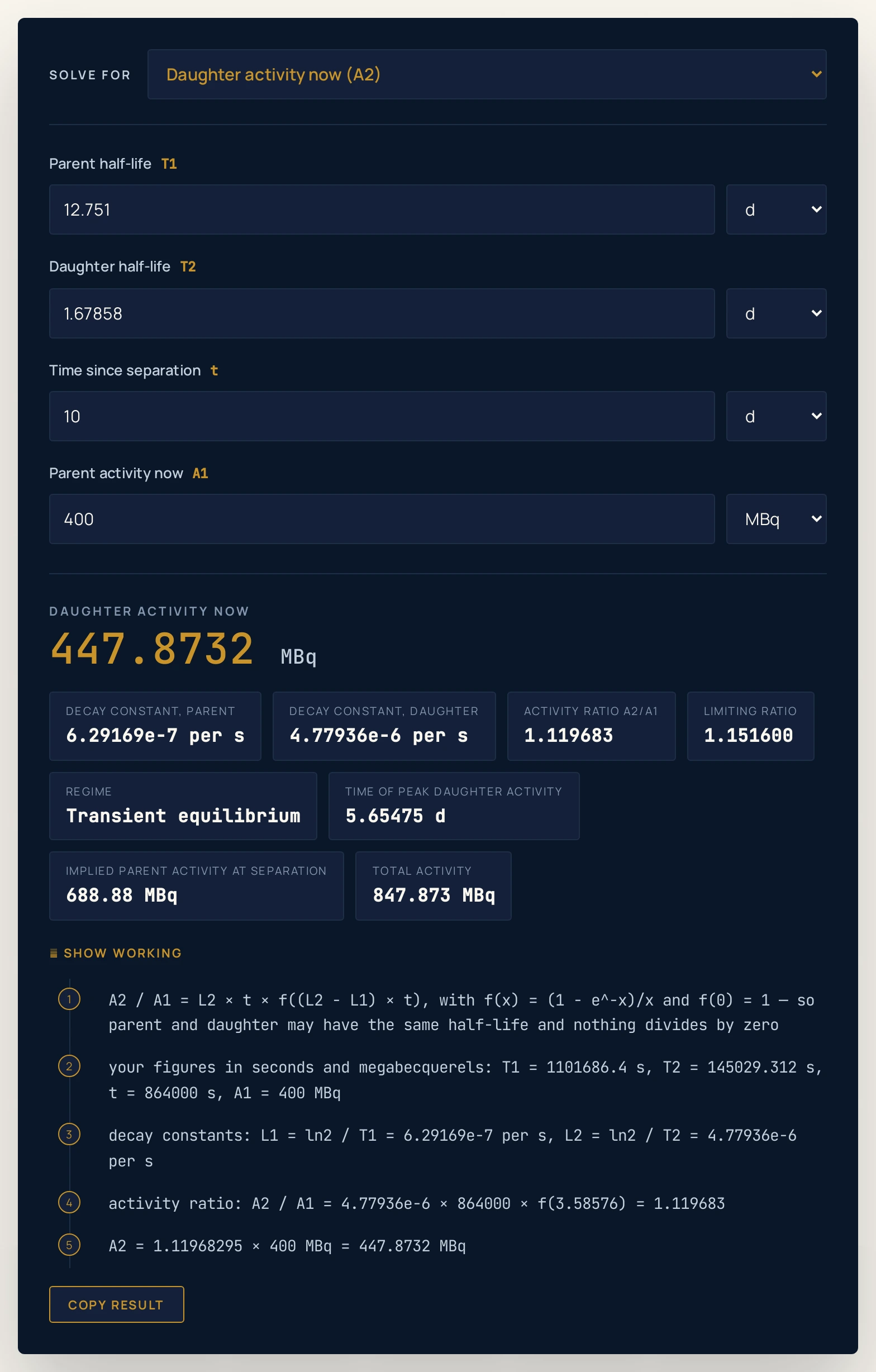
1.119683 ratio chip and the 447.8732 MBq headline are the same arithmetic printed twice — the answer was computed as that ratio times the 400 MBq parent line, so their agreeing confirms nothing.Worked example: change one thing at a time
The table starts at the defaults and moves one thing at a time: which quantity is the unknown, then the age of the sample, then the chain itself, then the unit the figures are typed in. Every Result cell was read out of the running widget rather than worked out by hand, so where a cell and the tool ever part company, believe the tool. The input column is simply what you type, in the order the boxes appear.
| Step | Solving for | Chain | What you type | Result | Regime chip |
|---|---|---|---|---|---|
| The page as it opens | Daughter activity now | Ba-140 to La-140 | 12.751 d, 1.67858 d, 10 d, 400 MBq | 447.8732 MBq | Transient equilibrium |
| Feed that answer back | Time since separation | Ba-140 to La-140 | 12.751 d, 1.67858 d, 400 MBq, 447.8732 MBq | 10 d | Transient equilibrium |
| and again, for the parent | Parent activity now | Ba-140 to La-140 | 12.751 d, 1.67858 d, 10 d, 447.8732 MBq | 400 MBq | Transient equilibrium |
| One day old instead | Daughter activity now | Ba-140 to La-140 | 12.751 d, 1.67858 d, 1 d, 400 MBq | 138.8046 MBq | Transient equilibrium |
| A ratio above the ceiling | Time since separation | Ba-140 to La-140 | 12.751 d, 1.67858 d, 400 MBq, 480 MBq | no answer | — |
| The secular chain | Daughter activity now | Sr-90 to Y-90 | 28.91 y, 64.05 h, 30 d, 100 MBq | 99.98388 MBq | Secular equilibrium |
| The same chain one day in | Daughter activity now | Sr-90 to Y-90 | 28.91 y, 64.05 h, 1 d, 100 MBq | 22.87453 MBq | Secular equilibrium |
| The inverted chain | Daughter activity now | Bi-210 to Po-210 | 5.012 d, 138.376 d, 20 d, 250 MBq | 125.7 MBq | No equilibrium |
| One parent half-life in | Daughter activity now | Bi-210 to Po-210 | 5.012 d, 138.376 d, 5.012 d, 250 MBq | 8.929455 MBq | No equilibrium |
| Equal half-lives | Daughter activity now | a made-up pair | 20 d, 20 d, 20 d, 500 MBq | 346.5736 MBq | No equilibrium |
| Nothing separated yet | Daughter activity now | Ba-140 to La-140 | 12.751 d, 1.67858 d, 0 d, 400 MBq | 0 MBq | Transient equilibrium |
| The same state in seconds | Daughter activity now | Ba-140 to La-140 | 12.751 d, 145029.312 s, 10 d, 400 MBq | 447.8732 MBq | Transient equilibrium |
| A half-life of zero | Daughter activity now | Ba-140 to nothing | 12.751 d, 0 d, 10 d, 400 MBq | no answer | — |
Rows 1 to 3 are the demonstration this page exists for. One state is read three different ways — for the daughter activity, then for the time, then for the parent activity — and each answer returns the figure the row before it started from. Three unknowns, one relation, and no arrangement more fundamental than another.
That round trip is the genuine check on this page, and it is worth saying why the ratio chip is not. In row 1 the answer is the ratio times the parent activity, so the two agreeing is the definition restated. Row 2 does different arithmetic in the other direction and still lands on 10 d, which is a claim that can fail.
Rows 4 and 5 are the two sides of the time mode. Drop the age from 10 d to 1 d and the daughter has not had time to build, so the answer falls to 138.8046 MBq. Feed the tool a daughter line of 480 MBq against the same 400 MBq parent and it refuses, because that ratio of 1.200000 is above this chain's ceiling of 1.151600 and no elapsed time produces it.
Rows 6 and 7 move to a chain where the parent barely changes over the whole measurement. Thirty days after separation the daughter has all but caught up, at 99.98388 MBq against a 100 MBq parent, and the limiting-ratio chip reads 1.000253. One day in it is only 22.87453 MBq, which is the same equilibrium seen before it arrives.
Rows 8 and 9 turn the chain upside down, with a daughter that outlives its parent by a factor of nearly twenty-eight. The regime chip reads No equilibrium and the limiting-ratio chip reads none, because there is nothing for the ratio to settle onto. The guide to radioactive decay chains follows that case through to the point where the parent has gone and the daughter is still there.
Row 10 is the degenerate case most implementations get wrong. Parent and daughter with the same half-life would make the textbook form divide by zero, and this page answers 346.5736 MBq from a 500 MBq parent, which is 0.693147 times it — the natural logarithm of two, because after exactly one half-life the ratio is the decay constant times the elapsed time.
Rows 11 to 13 are the edges. At an age of zero the daughter activity is zero and the page says so rather than refusing, because nothing separated yet is a real state. Typing the daughter half-life as 145029.312 s instead of 1.67858 d is the same physical chain and returns the same 447.8732 MBq; a half-life of zero is not a nuclide at all and is refused.
Formula and symbol reference
The calculator uses one relation in three arrangements. The ratio of the two activities is A2/A1 = L2 t f((L2 - L1)t) with f(x) = (1 - e-x)/x, which is the textbook L2/(L2 - L1) (1 - e-(L2-L1)t) with the difference of the two decay constants factored out of the denominator. From there the daughter activity is that ratio times the parent activity, the parent activity is the daughter activity divided by it, and the time is -ln(1 - R(L2-L1)/L2)/(L2-L1).
Writing it that way is not cosmetic. f(x) tends to 1 as x tends to zero, so the case where the two half-lives are equal is computed exactly instead of being caught by a tolerance, and the difference of the decay constants never appears underneath anything. That is the whole reason row 10 of the table above has an answer at all.
| Symbol | Meaning | SI unit | Values used on this page |
|---|---|---|---|
| T1 | The half-life of the parent, the first member of the chain. Always an input: nothing else on the page can produce it | second, s | Boxes take s, min, h, d or y: 12.751 d by default, 28.91 y for Sr-90, 5.012 d for Bi-210, 20 d for the equal-half-life row. |
| T2 | The half-life of the daughter, the second member. Also always an input, and the quantity the whole shape of the chain turns on | second, s | Boxes take s, min, h, d or y: 1.67858 d by default, 64.05 h for Y-90, 138.376 d for Po-210, 145029.312 s for the row typed in seconds. |
| t | The time since the daughter was last separated, so that the sample started with the parent alone. This is what "since separation" means and it is the assumption the whole model rests on | second, s | Boxes take s, min, h, d or y: 10 d by default, 30 d and 1 d on the Sr-90 presets, 20 d on the inverted chain, 0 d in the row where nothing has happened yet. |
| A1 | The parent activity measured now, not the activity at separation. The chips restate what that implies the source was when it was separated | becquerel, Bq | Boxes take Bq, kBq, MBq or GBq: 400 MBq by default, 100 MBq on the Sr-90 presets, 250 MBq on the inverted chain. |
| A2 | The daughter activity now, and the quantity the page opens on as the unknown. As an input it is the second line you read off a spectrum | becquerel, Bq | Boxes take Bq, kBq, MBq or GBq: 447.8732 MBq by default, 480 MBq in the row that is refused, 8.929455 MBq on the oldest Bi-210 case. |
| L1, L2 | The two decay constants, written with an L on this page and with a Greek lambda in most textbooks. Each is ln2 divided by that member's half-life, and both are printed as chips | per second, 1/s | Computed, never typed: 6.29169e-7 per s and 4.77936e-6 per s on the opening state. |
The physics: why two activities fix one age
A spectrum taken from a fresh chain gives two lines, and neither of them on its own can date the sample. Both depend on how much parent was there at separation, and that is the one quantity nobody measured. Their ratio does not: in A2/A1 = L2 t f((L2 - L1)t) the source strength has cancelled, leaving the two half-lives and the elapsed time, so the parent activity you type sets the scale of the answer and nothing else.
That is why the parent box asks for the reading you take today rather than the activity at separation. Measured against today's parent line the ratio only ever increases with age, so the inversion is single-valued: one ratio, one elapsed time. Referred back to the source as it stood at separation the daughter rises and then falls, so most values along it belong to two different ages and the tool would have to choose one.
Because the ratio only moves one way, solving for the time is an inversion rather than a search. Show working prints the closed form, t = -ln(1 - R(L2-L1)/L2)/(L2-L1) with R the measured ratio, and the quantity inside that logarithm carries the whole of the age: it is the remaining exponential e-(L2-L1)t, which reads 0.0277154386 when the opening state is dated from its ratio.
The peak-time chip earns a second job in this mode. The ratio passes through 1 at that instant, so a measured ratio below 1 belongs to a sample younger than the chip's figure and a ratio above it to an older one. On the opening chain the ratio of 1.119683 sits above 1 against a peak at 5.65475 d, and the time mode returns 10 d.
As a sample ages that remaining exponential shrinks and the ratio closes on its ceiling, and the digits that carry the age shrink with it. The page stops answering once the exponential drops below a part in a thousand million, because by then two widely different ages give the same measurable ratio. That cut-off is not a limitation of this arithmetic; it is where a ratio stops being a clock at all.
The regime chip is a label on that ceiling rather than a second fact about the chain. Treat the three names for what they are, a naming convention and nothing more: the limiting ratio runs continuously from 1.000253 on Sr-90 to Y-90 up through 1.151600 on Ba-140 to La-140, and the chip swaps its wording partway along a run in which nothing else changes. What the time mode consults is the ceiling, never the name beside it.
That ceiling also settles a claim about chains you will meet everywhere, and it is the reason the ratio chip carries six decimal places. In secular equilibrium the two activities are usually said to become equal, and they do not: the Sr-90 to Y-90 ceiling is 1.000253 rather than 1.000000, and after thirty days that preset stands at 0.999839, still short of it. Printed to three decimal places those two figures would be the same number, and a month of climbing toward that ceiling would have nowhere to show.
Where the daughter outlives the parent there is no ceiling to reach, so the time mode never runs short of ratio and a different check has to do the work. The implied-source chip is that check: twenty days of a 5.012 d parent behind a 250 MBq reading implies 3973.53 MBq at separation, which is the figure to look at before the headline.
None of this brings in a constant that a single nuclide does not already have. Each decay constant on the chips is ln2 divided by one half-life, exactly as for the lone isotope in the half-life simulator, and a chain's whole character comes from having two of them instead of one. The arithmetic never asks what either step emits either — the guide to alpha, beta and gamma radiation covers what actually leaves the nucleus on the way down.
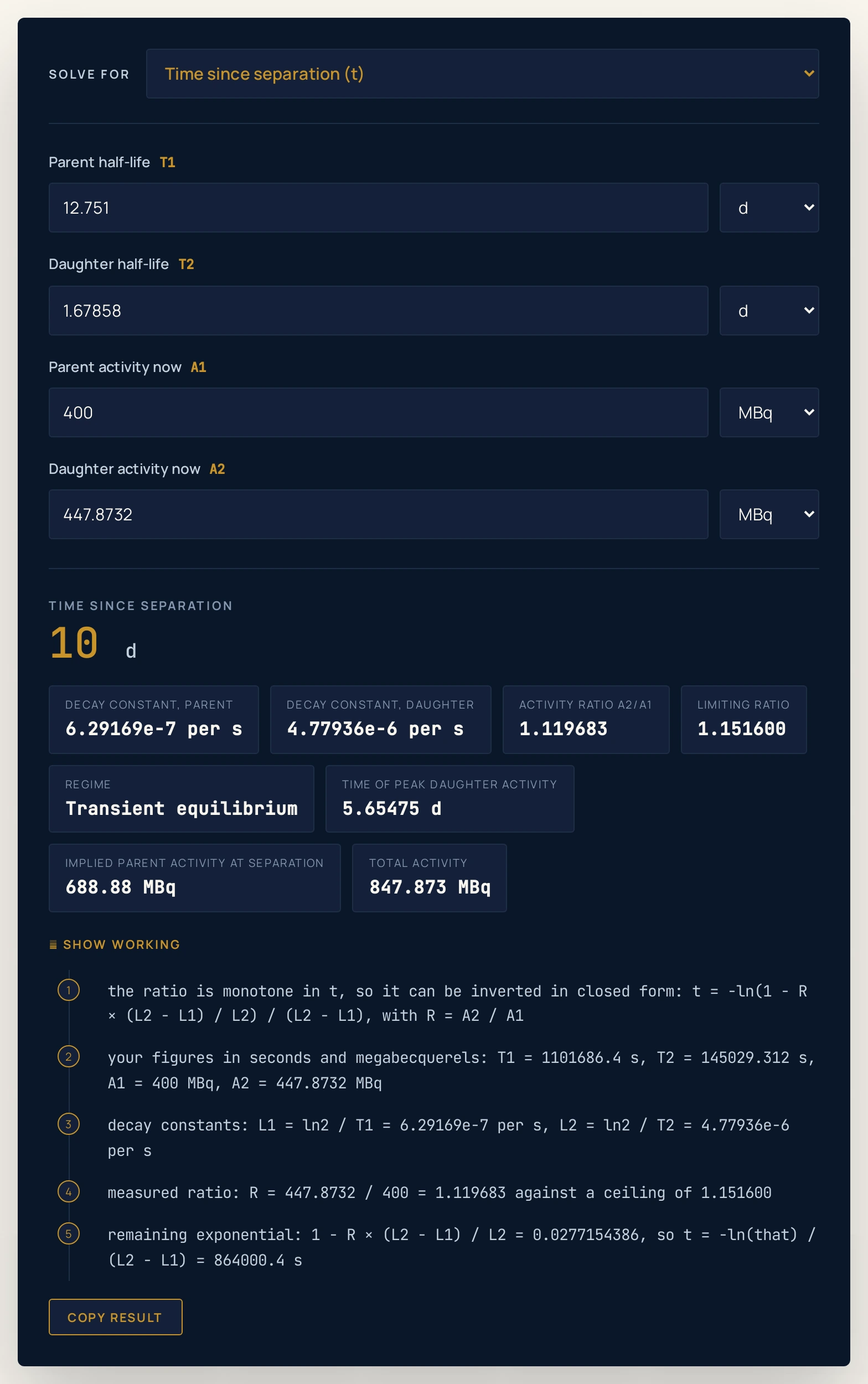
1.119683 — the same state as the opening screen, run backwards through different arithmetic.Where the decay chain calculator breaks down
The arithmetic is short and hard to get wrong. What fails is the model being pressed onto a sample it does not describe, or an expectation the equation was never making.
- The daughter was not really at zero
- Every figure here assumes the sample held no daughter at the moment the clock started, which is what a chemical separation leaves behind. A partial separation, a second parent feeding the same daughter, or a sample that was never separated at all breaks that, and the answer comes back too low.
- Symptom: a measured daughter line stronger than the page allows, often above the limiting ratio.
- The chain is longer than three members
- This page models a parent, one radioactive daughter and a stable end product. A natural series runs through many more, and every extra member adds its own term to the general Bateman solution. Two consecutive members of such a series can still be handled here, provided nothing else is feeding the daughter.
- The parent decays two ways at once
- A nuclide with more than one decay mode sends only part of its atoms down the branch you are modelling, so the daughter is produced at a fraction of the parent activity rather than all of it. This page has no branching ratio, and using it on a branched parent will overstate the daughter.
- The activity at separation typed where the activity now belongs
- The quietest error on the page, because it gives a perfectly plausible number. The parent activity box wants today's reading; the older figure is larger by exactly the factor the parent has decayed by, and the daughter activity comes out larger by the same factor. The implied-source chip is there to catch it.
- A half-life quoted in years is not a fixed number of seconds
- The y menu on this page uses 365.25 days, the same value the site's other time-based calculators use. A source that quotes a half-life against the 365.2422-day year will differ from this page in the sixth significant figure of anything derived from it, including the peak time. It changes no answer at the precision a measurement carries, but it is why two tables of the same nuclide can disagree in their last digit.
- A ratio sitting on its ceiling carries no time
- Solving for the time is refused once the measured ratio is within about a part in a thousand million of the limiting ratio, which happens after about thirty to thirty-five daughter half-lives depending on the chain — 29.90 of them on Sr-90 to Y-90 and 34.43 on Ba-140 to La-140. Past that point the elapsed time genuinely is not in the ratio any more, for anyone. Refusing is the honest answer; a number would be confident and wrong.
- Counting statistics are not modelled at all
- This is a deterministic calculation over a smooth exponential, and a real measurement is a count with a spread on it. Near the peak the ratio changes slowly with time, so a small uncertainty in the two activities becomes a large uncertainty in the age — the tool returns a single figure and says nothing about how well determined it is.
- Rounded figures in, rounded figures out
- Every number printed is rounded and the arithmetic behind it is not, so multiplying two figures from the screen together need not reproduce a third to its last digit. The substitution line in Show working carries the ratio to nine figures for that reason; the chip above it rounds the same number to six decimal places.
- A unit menu left on the wrong option
- The shared engine hides a quantity's unit menu while that quantity is the unknown, but it still renders the answer through whatever the menu was last set to. Set the unit first, then choose the unknown, and reload the page if you are ever unsure — a reload puts every menu back to days and megabecquerels.
Where decay chains are actually used
- Radionuclide generators
- A long-lived parent is held on a column and the short-lived daughter is washed off it as needed, then builds back up from nothing. The Sr-90 generator presets are that cycle: a day after elution the daughter is at 22.87453 MBq against a 100 MBq parent, and a month later it has reached 99.98388 MBq.
- Dating a sample from two lines in one spectrum
- Because the ratio of the two activities depends on the elapsed time and on nothing else, measuring both lines dates the separation. The Date the shipment from its ratio preset does exactly that, and it is the reason the parent activity box asks for the reading now rather than the activity at separation.
- Fresh fission products in transport and storage
- Ba-140 and its daughter La-140 are a standard pair out of a reactor, and a consignment's daughter activity depends on how long ago it left the separation plant. The nuclear reactor simulator shows where such products come from; this page works out what one of them is doing by the time it arrives.
- Radon and its short-lived daughters indoors
- Radon-222, at 3.8235 d, is made continuously underground by radium-226 at 1600 y, a pair far past the hundred-times line the regime chip uses, so the supply is topped up for as long as the parent lasts. Indoors the shorter clock is the interesting one: the gas's own short-lived daughters start again from nothing after every change of air, which is the from-zero climb this page computes. Ventilation then acts as a removal term alongside decay, and this page carries no such term.
- Shielding and dose estimates for a mixed source
- The total activity chip matters here: the radiation leaving a fresh chain comes from both members, and on the opening state the pair together are more active than the parent alone. Planning a shield against the parent figure only will underestimate what has to be stopped.
- Checking a supplier's calibration date
- A vial arrives with an activity and a reference date on it, and the daughter it contains depends on when the two were separated rather than on when the label was printed. Running the measured pair through the time mode and comparing the answer with the paperwork is a direct check.
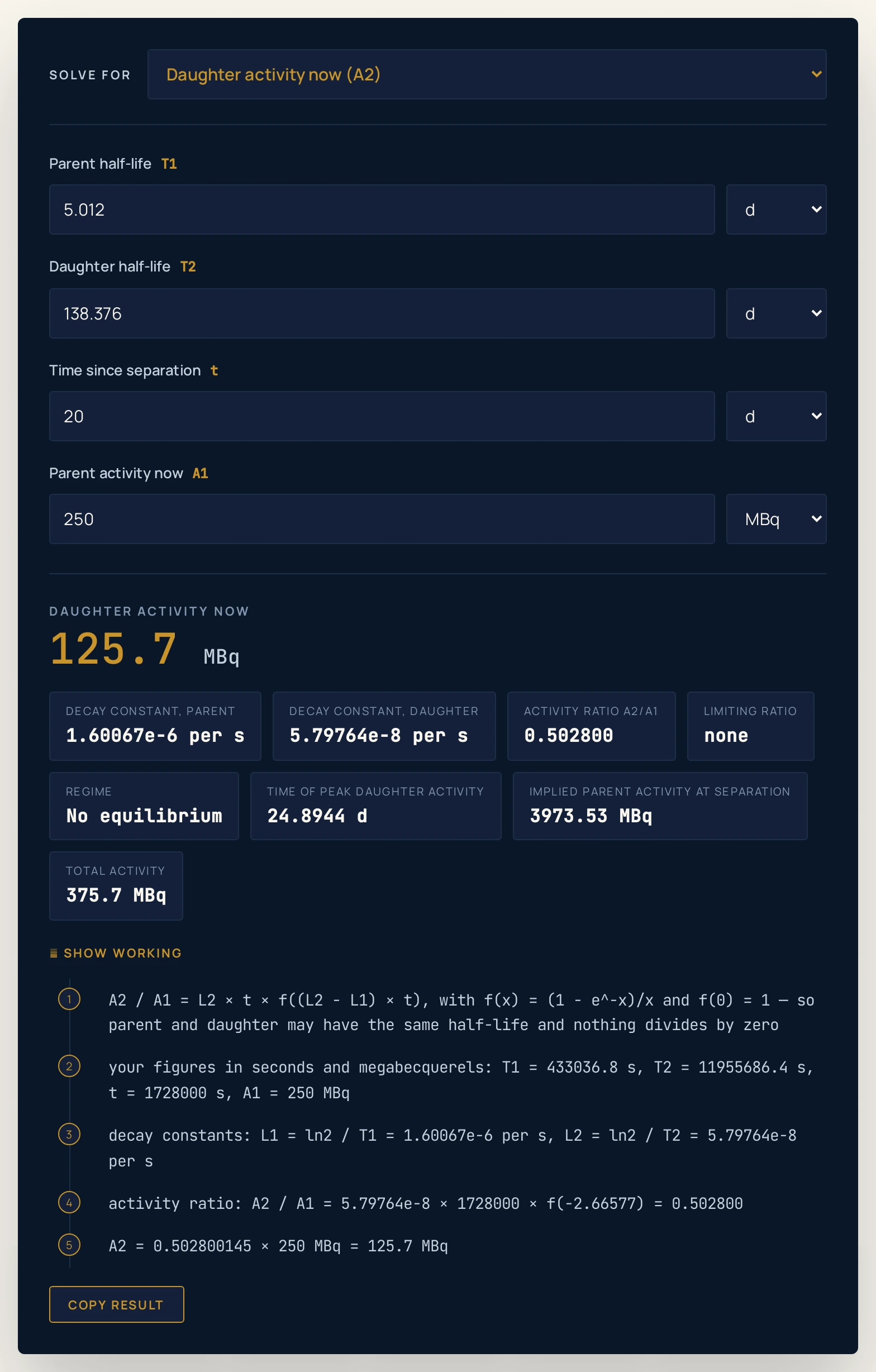
none and the regime chip reads No equilibrium — and the implied source of 3973.53 MBq is the chip earning its place, warning that 20 d is nearly four half-lives of this parent.Where to go next
For the method in full, with eight worked problems of rising difficulty and the diagrams that go with them, read Radioactive Decay Chains Explained. For the single-nuclide background this page assumes, What Is Half-Life in Physics? is the place to start, and the half-life calculator is the right tool when the daughter is stable or simply beside the point. Take the energy released by one of these decays to the beta decay energy calculator, and the whole physics lab library is open beside them if you would rather watch a chain than type one.
Frequently asked questions
What does the decay chain calculator actually calculate?
It works with three members: a parent, the radioactive daughter it decays into, and a stable end product. Given both half-lives and the time since the daughter was last separated, it returns the ratio of the daughter activity to the parent activity, and from that whichever of the three unknowns you asked for. The stable third member takes no part in the arithmetic; it is simply where the atoms end up.
Why does the parent activity box say "now" rather than "at separation"?
Because the reading now is what you actually have, and because it makes solving for the time a closed form. The ratio of the daughter activity to the parent activity climbs steadily and never turns round, so one ratio means one elapsed time. Measured against the activity at separation instead, the daughter rises and then falls, and the same value would answer to two different times.
What is the limiting ratio, and why does it sometimes say none?
It is the value the activity ratio approaches as the sample ages, and it exists only when the daughter is the shorter-lived of the two. On Ba-140 to La-140 it is 1.151600 and on Sr-90 to Y-90 it is 1.000253. When the daughter outlives the parent there is no such value at all, the ratio simply keeps growing, and the chip prints the word none rather than a large number standing in for one.
Why did solving for the time say there is no valid solution?
Almost always because the ratio you typed is at or above the ceiling for that pair of half-lives, and no elapsed time can produce it. On Ba-140 to La-140 the ceiling is 1.151600, so a measured ratio of 1.200000 is refused outright. The refusal is information: either a half-life is wrong, or something other than this chain is feeding one of the two lines.
And if the ratio is just below the ceiling?
The tool still refuses once the ratio is within about a part in a thousand million of the ceiling, because by then the elapsed time is genuinely no longer carried by it. On Sr-90 to Y-90 that cut-off falls at roughly thirty daughter half-lives, and on Ba-140 to La-140 at about thirty-four. A number returned past that point would be confident and wrong, which is worse than nothing.
Do the three equilibrium names mean anything exact?
The names are a convention, not a physical boundary. A parent at least a hundred times longer-lived than its daughter is called secular, anything shorter but still longer-lived than the daughter is called transient, and a parent that decays faster than its daughter reaches no equilibrium at all. The limiting ratio beside the name is the figure that actually matters, and it moves smoothly through the hundred-times line without noticing it.
Is it true that the two activities become equal in secular equilibrium?
No, and this page prints enough digits to show it. Sr-90 to Y-90 settles on a limiting ratio of 1.000253, not 1.000000, and the gap is what keeps the daughter fed. The rule of thumb that the activities are equal is a rounding of that figure, useful in a survey and wrong at the fourth decimal place a detector can reach.
What happens if the parent and the daughter have the same half-life?
It answers, and the answer is exact rather than approximate. The page never divides by the difference of the two decay constants, so nothing blows up: the ratio becomes the decay constant times the elapsed time, and after one half-life it is 0.693147. The limiting ratio chip prints none, because a chain like that never settles.
Why do the numbers in Show working not always multiply out exactly?
Because every figure printed is rounded and the arithmetic behind it is not. The substitution line carries the ratio to nine figures for exactly this reason, so that multiplying it by the parent activity really does reproduce the answer; the chip rounds the same number to six decimal places. Comparing the shorter chip figure with the headline instead can leave you a digit out, which is a fact about decimals rather than about the physics.
Can I use this for a long natural series such as uranium to lead?
Not directly, because this page models three members and a natural series runs through many more. It is the right tool for any two consecutive members of such a series taken on their own, provided nothing else is feeding the daughter. For the full chain you need the general Bateman solution with a term for every member.
References & formula source
- Bateman (1910) - The solution of a system of differential equations occurring in the theory of radioactive transformations, Proceedings of the Cambridge Philosophical Society 15, 423.
- Krane - Introductory Nuclear Physics, the chapter on radioactive decay and series decay.
- Knoll - Radiation Detection and Measurement, the sections on radionuclide generators and on transient and secular equilibrium.
- Lilley - Nuclear Physics: Principles and Applications, the treatment of serial decay chains.
- IAEA Nuclear Data Services, Livechart ground-state data set: the half-lives used by the presets on this page, retrieved 20 September 2026.
- Every figure quoted in the text above is a string this calculator printed for the inputs named beside it, and no number here describes a particular vial, shipment or sample. Check anything you intend to rely on against your own counting data and the nuclide tables your laboratory works to.
- Further reading: Decay chain — Wikipedia