Atomic structure, in this lab, is three whole numbers: how many protons, neutrons and electrons an atom holds. Two rules turn those counts into most of what the panel prints, A = Z + N for the mass number and charge = Z - electrons in units of e. Drag the sliders and the lab names the element, the isotope and the ion you have built, checks the nuclide against NIST's natural-abundance table, and redraws the shell diagram, the periodic table and the isotope bars to match.
Build an Atom: Atomic Structure
Choose the protons, neutrons and electrons of any atom or ion from hydrogen to calcium. Protons fix the element, A = Z + N gives the mass number, and charge = Z - electrons. Natural abundances and atomic masses come from the NIST isotope tables.
Load a real atom
Each button writes all three sliders in one go and leaves the simulation to do the rest. The line underneath is copied out of the lab's own readouts once they have updated, so it can only repeat what the lab is showing.
Pick an atom above, or drag the sliders yourself.
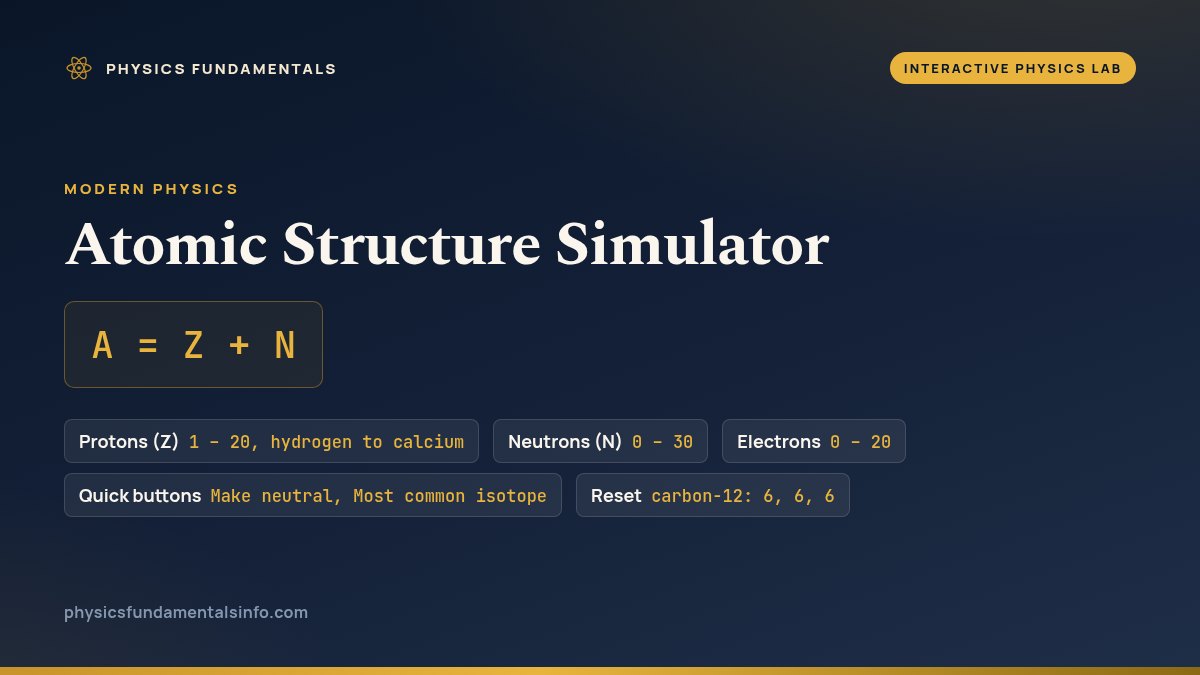
What Is the Atomic Structure Simulator?
The atomic structure simulator is a free interactive physics lab that runs in your browser — nothing to install and no sign-up. Pick 1 to 20 protons, 0 to 30 neutrons and 0 to 20 electrons, and the panel names the element, adds up the mass number A = Z + N, works out the net charge as Z minus the electrons and fills the electron shells. It also looks the nuclide up in NIST's natural-abundance table, while a shell diagram, a mini periodic table and one bar per natural isotope redraw beside it.
| Control | Range | Step |
|---|---|---|
| Protons (Z) | 1 – 20, hydrogen to calcium | 1 |
| Neutrons (N) | 0 – 30 | 1 |
| Electrons | 0 – 20 | 1 |
| Quick buttons | Make neutral, Most common isotope | buttons |
| Reset | carbon-12: 6, 6, 6 | button |
How to use the atomic structure simulator
- Pick the element with the proton slider. Drag Protons (Z) anywhere from 1 to 20, or press the − and + buttons beside it to move one particle at a time. Element names what you have made, the line beneath gives Z, the period and the group, and that element's cell in the mini periodic table turns gold.
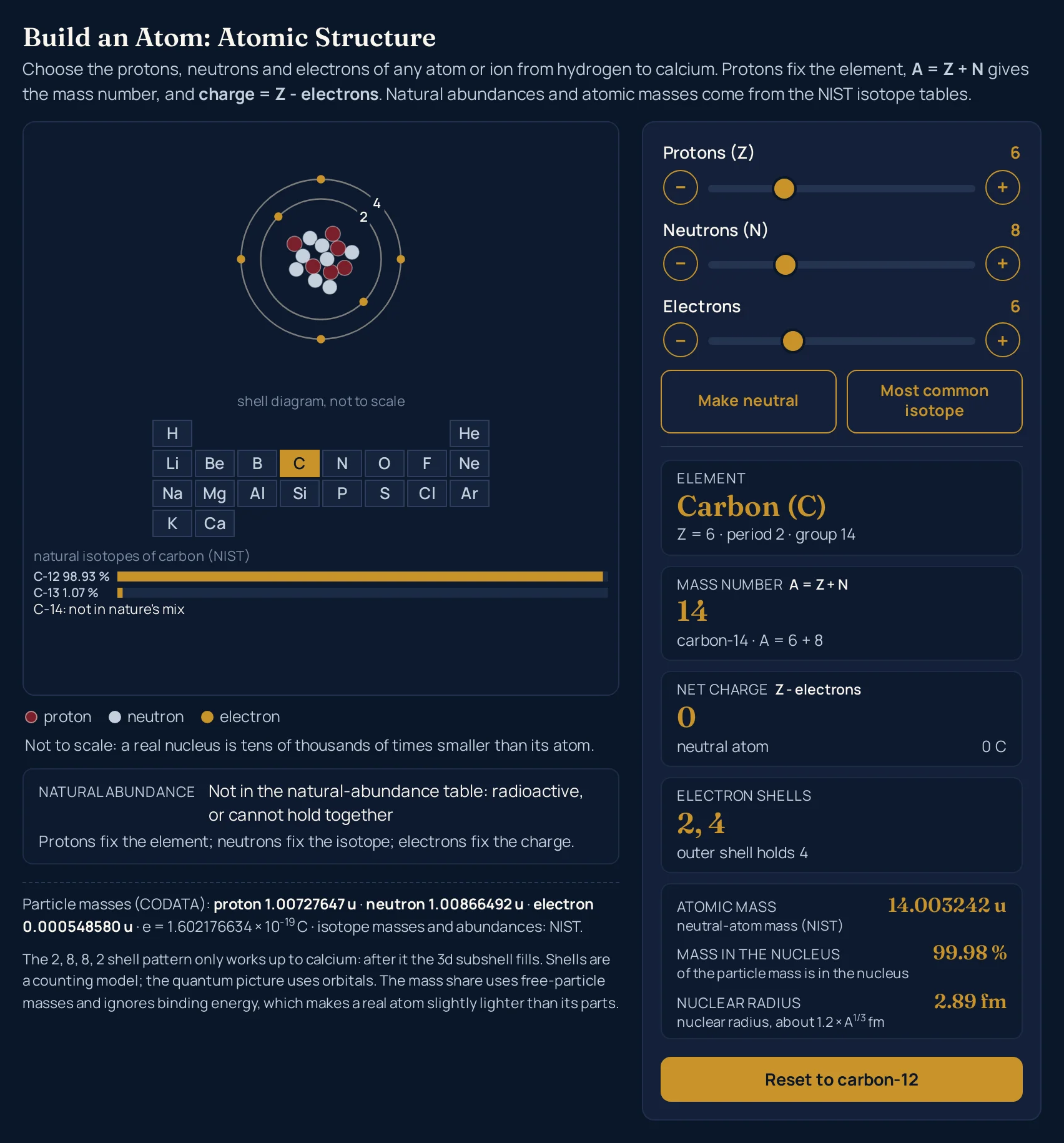
- Choose the isotope with the neutron slider. Neutrons (N) runs from 0 to 30. Mass number shows A with its sum spelled out underneath, carbon-12 · A = 6 + 6 after Reset, and the nucleus on the canvas gains or loses a pale neutron while the element line stays put.
- Set the charge with the electron slider. Electrons runs from 0 to 20. Net charge prints Z minus the electrons as a signed whole number, names the result (for example positive ion: 1 electron short) and repeats it in coulombs to four significant figures, while Electron shells lists how the electrons fill 2, 8, 8, 2 and how many sit in the outer shell.
- Use the two shortcuts. Make neutral sets the electrons equal to the protons. Most common isotope moves only the neutron slider, to the isotope NIST lists as most abundant for that element. Reset to carbon-12 at the foot of the panel returns all three sliders to 6.
- Read the NIST lines. Natural abundance gives this isotope's share of the element's atoms, or says it has no entry in the table, which is the lab's line for a nuclide that is radioactive or cannot hold together; what an unstable nucleus then throws out is the subject of types of radiation. Atomic mass gives NIST's neutral-atom mass to six decimal places, or not tabulated where NIST lists none.
- Read the nucleus lines. Mass in the nucleus gives the protons' and neutrons' share of the particle mass to two decimal places, and prints exactly 100 % only when there are no electrons at all. Nuclear radius gives 1.2 × A1/3 fm to three significant figures.
- Watch the picture follow you. Particles that arrive fade in and particles that leave fade out over about half a second, and each shell carries its electron count. The right-hand column shows one bar per natural isotope of the element, with the bar for your isotope outlined, and the sentence under the canvas changes to a warning when the atom you have built is unrealistic.
Worked example: change one thing at a time
Start from Reset to carbon-12 and move a single slider per row. Every cell below is a string the running lab printed at that setting, so if a cell and your screen ever disagree, believe the screen. Row 4 goes back to the row 1 atom and adds a proton there, rather than taking two neutrons off carbon-14.
| Step | Protons, neutrons, electrons | Element | Mass number | Net charge | Electron shells | Natural abundance | Atomic mass |
|---|---|---|---|---|---|---|---|
| Start: Reset to carbon-12 | 6, 6, 6 | Carbon (C) | carbon-12 · A = 6 + 6 | 0 · neutral atom | 2, 4 | In nature: 98.93 % of carbon atoms | 12.000000 u |
| Add a neutron | 6, 7, 6 | Carbon (C) | carbon-13 · A = 6 + 7 | 0 · neutral atom | 2, 4 | In nature: 1.07 % of carbon atoms | 13.003355 u |
| Add another neutron | 6, 8, 6 | Carbon (C) | carbon-14 · A = 6 + 8 | 0 · neutral atom | 2, 4 | Not in the natural-abundance table: radioactive, or cannot hold together | 14.003242 u |
| From row 1, add a proton instead | 7, 6, 6 | Nitrogen (N) | nitrogen-13 · A = 7 + 6 | +1 · positive ion: 1 electron short | 2, 4 | Not in the natural-abundance table: radioactive, or cannot hold together | not tabulated |
| Add an electron | 7, 6, 7 | Nitrogen (N) | nitrogen-13 · A = 7 + 6 | 0 · neutral atom | 2, 5 | Not in the natural-abundance table: radioactive, or cannot hold together | not tabulated |
| Add a neutron | 7, 7, 7 | Nitrogen (N) | nitrogen-14 · A = 7 + 7 | 0 · neutral atom | 2, 5 | In nature: 99.636 % of nitrogen atoms | 14.003074 u |
Rows 1 to 3 move only the neutron slider, and the element column never budges from Carbon (C) while the charge holds at 0. What changes is everything that belongs to the nucleus: A steps from 12 to 14, the NIST mass from 12.000000 u to 14.003242 u, the nuclear radius from 2.75 fm through 2.82 fm to 2.89 fm, and the abundance from 98.93 % to 1.07 % to no entry. Neutrons decide the isotope and nothing else.
Row 4 adds one proton to the row 1 atom, and the name changes at once to Nitrogen (N), group 15. The electrons are still six, so the shells still read 2, 4 and the charge becomes +1, a positive ion one electron short. The proton slider sets the element, and the charge follows from it only because the electrons stayed behind.
Rows 5 and 6 finish the job one particle at a time. An extra electron cancels the charge and turns the shells to 2, 5, with the isotope and mass lines untouched; an extra neutron then turns nitrogen-13 into nitrogen-14, which NIST lists at 99.636 % with a mass of 14.003074 u. Electrons decide the charge and the shells, and never the element or the isotope.
Rows 3 and 6 make a quick test of what A means. Both read a mass number of 14 and a nuclear radius of 2.89 fm, yet one is carbon and the other nitrogen, and their NIST masses differ in the fourth decimal place, 14.003242 u against 14.003074 u. A head-count of nucleons fixes the size of the nucleus in this lab, but not which element it belongs to; beta decay is the process that moves a real nucleus between two such twins, leaving A alone while Z shifts by one.
Formula and symbol reference
The panel runs on two counting rules, A = Z + N and charge = Z - ne, with the charge in coulombs being that count times e. The mass share is (Z mp + N mn) / (Z mp + N mn + ne me) and the radius R = 1.2 fm × A1/3; the abundance and atomic mass are looked up in NIST's table rather than calculated. Ranges marked “in this lab” are the simulator's own readouts at the slider ends; the table holds no energies, and the energy of a level in a one-electron atom is the Bohr model calculator's job.
| Symbol | Meaning | SI unit | In this lab |
|---|---|---|---|
| Z | Proton number, also called the atomic number; the only count that decides the element | none (a count) | 1 to 20 in this lab, hydrogen to calcium, in steps of 1; 6 after Reset. |
| N | Neutron number, the uncharged particles in the nucleus | none (a count) | 0 to 30 in this lab, in steps of 1; 6 after Reset. |
| ne | Number of electrons, the slider labelled Electrons | none (a count) | 0 to 20 in this lab, in steps of 1; 6 after Reset. |
| A | Mass number, Z + N: how many nucleons the nucleus holds | none (a count) | 1 (hydrogen-1) up to 50 (calcium-50) in this lab. |
| Charge | Net charge in units of e, Z − ne, shown as a signed whole number | none (a multiple of e) | From -19 (one proton, 20 electrons) to +20 (calcium with none) at the slider ends; 0 for every neutral atom. |
| q | The same net charge in coulombs, (Z − ne) × e, to four significant figures | coulomb, C | 0 C when neutral; +1.602 × 10⁻¹⁹ C for Na+, up to +3.204 × 10⁻¹⁸ C for a bare calcium nucleus. |
| e | Size of the charge on one proton or one electron, the step every charge readout moves in | coulomb, C | A fixed value, printed on the lab's constants line with the particle masses: 1.602176634 × 10⁻¹⁹ C. |
| mp, mn, me | Free proton, neutron and electron masses (CODATA), used only for the mass share | unified atomic mass unit, u (accepted for use with the SI) | 1.00727647 u, 1.00866492 u and 0.000548580 u, as printed on that same constants line. |
| Share | Mass in the nucleus: (Z mp + N mn) as a percentage of all the particle mass, binding ignored | none (per cent) | Two decimal places: 99.95 % for hydrogen-1, 99.97 % for carbon-12, and exactly 100 % only when no electrons are left. |
| R | Nuclear radius, about 1.2 fm × A1/3 | metre, m (shown in femtometres, 1 fm = 10-15 m) | 1.20 fm at A = 1 up to 4.42 fm at A = 50 in this lab, to three significant figures; the rule is least reliable for the lightest nuclei, such as hydrogen-1. |
| Atomic mass | NIST's mass for the neutral atom of that isotope | unified atomic mass unit, u | Six decimal places, from 1.007825 u for hydrogen-1; not tabulated where NIST lists no mass, as for nitrogen-13. |
The physics: what the three numbers decide
The proton count is the nucleus's positive charge in units of e, and that charge is what gives an element its chemistry, so the lab keys the name, period, group, periodic-table cell and NIST row to the proton slider alone. Neither of the other two sliders can alter the first line of the panel. Try it with any atom: sweep the neutrons from 0 to 30 or the electrons from 0 to 20 and the Element readout never changes.
A proton and an electron carry charges of exactly the same size and opposite sign, which is why an atom with equal numbers of each reads 0 C and the words neutral atom. Chemistry moves electrons, not protons: the energies involved in a reaction are far too small to disturb a nucleus, so real ions are atoms that have gained or lost electrons around an unchanged core. That is the choice the electron slider gives you.
Almost all of the mass sits in the nucleus because a proton outweighs an electron by a factor of about 1836, and a neutron is slightly heavier still. The Mass in the nucleus readout makes that concrete: every preset above except the alpha particle reads 99.97 % or 99.98 %, and taking one electron off sodium-23 only nudges it from the first figure to the second.
Protons repel each other electrically, so a nucleus of protons alone would fly apart. What holds it is the strong nuclear force, which reaches only as far as the nearest nucleons; a neutron feels that pull but carries no charge, so each one strengthens the glue without adding to the push. Set neutrons to 0 on anything heavier than hydrogen and the note line reads Every nucleus heavier than hydrogen-1 needs neutrons to hold together. Most common isotope shows the balance shifting: it gives carbon 6 neutrons and calcium 20, equal to their protons, but chlorine 18 for its 17 protons.
The electrons fill shells in the order 2, 8, 8, 2, and for a neutral atom the shell list lines up with the line under the element name; this lab counts those shells without ever giving one an energy, which is what the Bohr model simulator adds when it moves a single electron between two levels and prints the photon that comes out. Sodium-23 reads 2, 8, 1 beside period 3 · group 1: three shells, one outer electron. Remove that electron and the shells read 2, 8 while the period stays at 3, because the period and group belong to the element, not to the ion you have made from it.
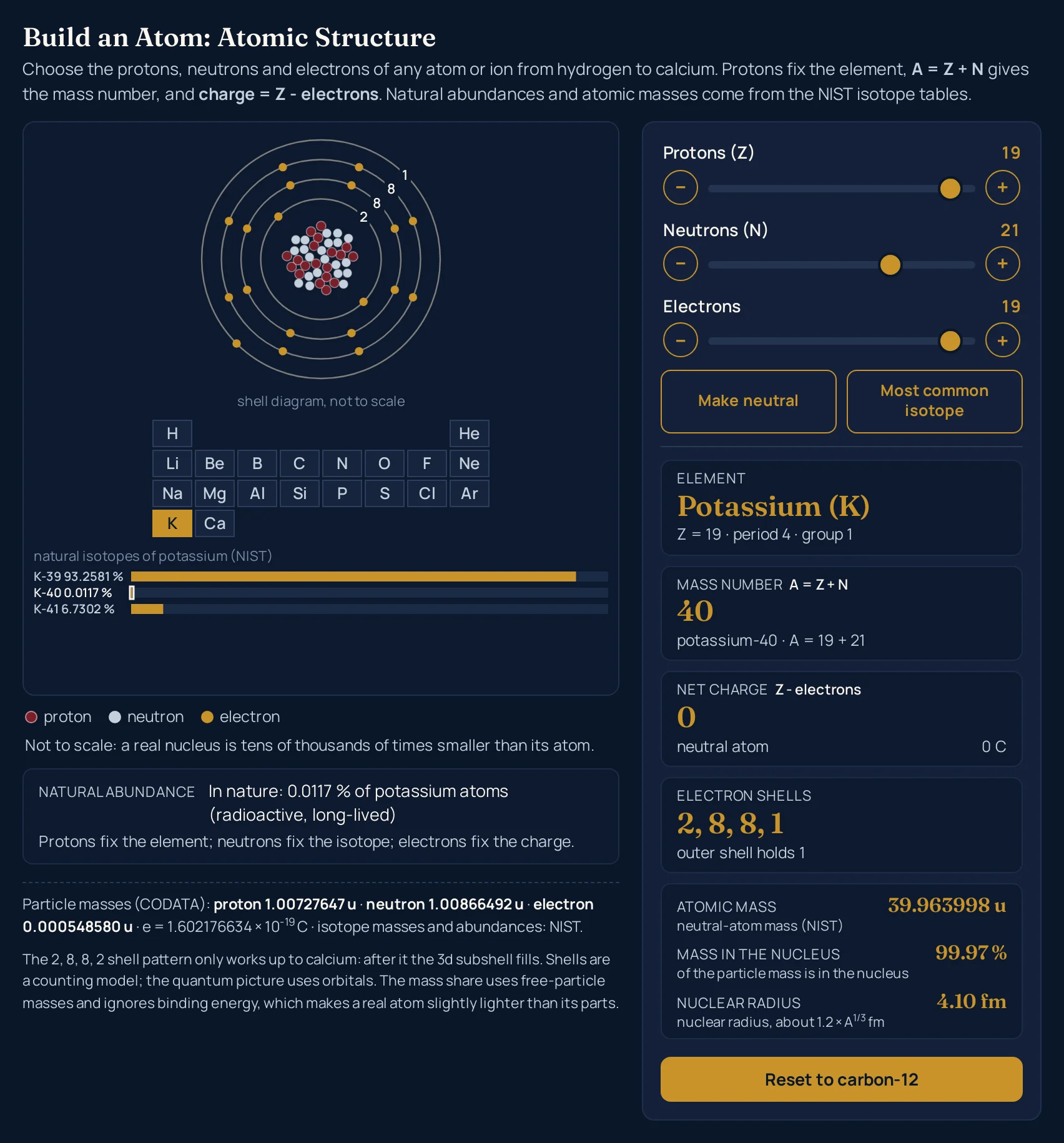
Where the shell picture breaks down
The counting rules behind A and the charge are exact. The picture built on top of them simplifies, and each item below says where, and what the lab does about it.
- Shells are a counting model, not orbits
- The gold dots sit on circles so that you can count them, but electrons do not travel round the nucleus on tracks: the Bohr model drew them on exactly such tracks and still predicts hydrogen's line spectrum accurately, which is a lesson in how a picture can be wrong while its numbers are right. Quantum mechanics describes each one as an orbital, a cloud giving the chance of finding it in each place, and the shells are groups of such states with similar energy.
- The pattern stops at calcium
- Filling 2, 8, 8, 2 works for the first 20 elements only, which is why the proton slider ends at 20. From scandium on, the next electrons go into an inner subshell before the fourth shell is complete, and a plain shell list is no longer enough.
- Symptom: the rule still fills 2, 8, 8, 2 if you load 20 electrons onto a light nucleus, an ion no real atom forms; the note line flags it.
- Nothing is drawn to scale
- The legend under the canvas says so plainly. A real nucleus is only a few femtometres in radius, as the Nuclear radius readout shows, and the atom around it is tens of thousands of times wider, so at true scale the nucleus would shrink below a single pixel.
- The mass share ignores binding
- Mass in the nucleus adds up free-particle masses. A bound nucleus weighs less than its separate parts, and you can see it in the lab: add up six of each CODATA mass printed on the lab's constants line and the total is larger than the 12.000000 u on the Atomic mass line. Read the share as a statement about the particles, not about a weighed atom.
- Abundances are a representative mix
- The percentages are NIST's values for a typical terrestrial sample, taken from Atomic Weights and Isotopic Compositions for All Elements. Real samples from different rocks, waters or organisms vary a little, so a measured share can differ slightly from the one the lab prints.
- “Cannot hold together” is about the table, not a lifetime
- The lab gives every nuclide missing from NIST's list the same line, so carbon-14, tritium and hydrogen-31 all read alike. It holds no half-lives or decay modes, and the only stability flag beyond the table is the potassium-40 note. That note does not make potassium-40 the only natural nuclide that decays: calcium-48, which the lab lists in nature without a flag, also decays, though extraordinarily slowly. Treat any lifetime as something to verify before use.
- The lab's own limits
- Charge in coulombs prints to four significant figures, mass share to two decimal places, radius to three significant figures and atomic mass to six decimal places. A very light ion can therefore read 100.00 % with an electron still present, while plain 100 % is kept for a bare nucleus. Magnesium-25 prints as 10 %, following the stored value, and every count moves in whole steps.
Where atomic structure is actually used
- Radiocarbon dating
- Load the Carbon-14 preset and the lab finds no natural-abundance entry, because carbon-14 is radioactive: the trace in the air is constantly being formed and constantly decaying, so there is no fixed share to tabulate. Its decay is what makes it a clock. Living things take it in while they are alive, and after death the amount left in a sample keeps falling at a known rate, which the half-life simulator shows happening.
- Isotopes in medicine
- Hospitals use radioactive isotopes for imaging and treatment, and they have to be made in reactors and accelerators. Most of the useful ones have short half-lives: none has survived in nature, and a fresh batch has to be used soon after it is made, often within hours or days. In the lab such nuclides show the no-entry line, which is a quick reminder of why they have to be manufactured rather than extracted.
- Mass spectrometry
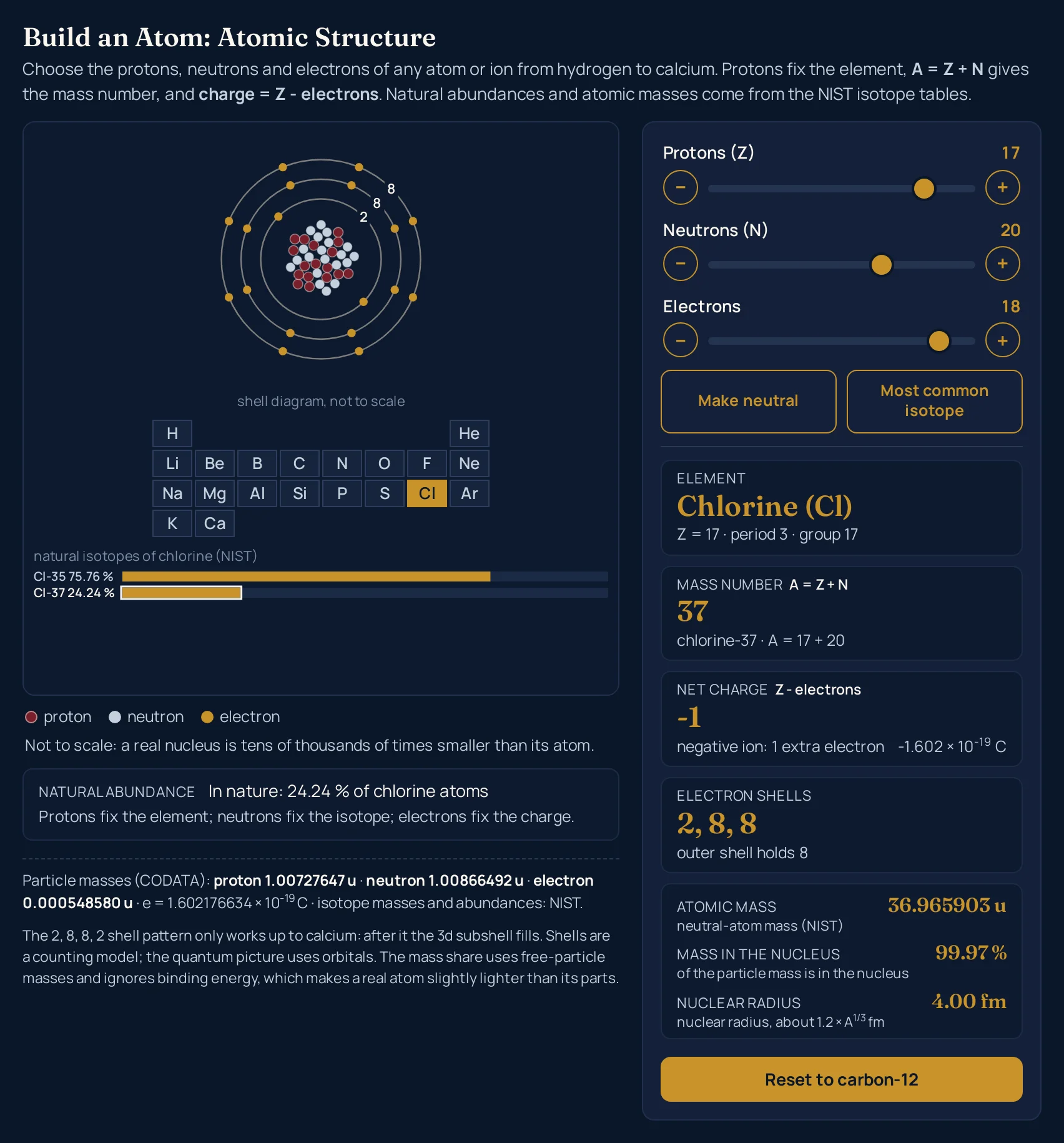
- A mass spectrometer sorts ions by mass-to-charge ratio, and chlorine gives it two separate signals because it comes in two isotopes. Step the neutron slider between 18 and 20 with 17 protons and the lab moves between them, 75.76 % and 24.24 %, with the element line fixed on Chlorine (Cl).
- Salts and batteries
- Table salt is built from sodium and chloride ions. Load Sodium ion Na+ and then the chloride preset: one reads shells 2, 8 and the other 2, 8, 8, both complete. A lithium-ion cell works by moving lithium ions, which you can build here with 3 protons, 4 neutrons and 2 electrons.
- The layout of the periodic table
- The mini periodic table on the canvas puts hydrogen and helium in the first row, then eight columns, because the rows follow the shells. Walk the proton slider up with Make neutral pressed after each step and the gold cell moves to a new row exactly when a new shell opens.
- Atomic masses on every periodic table
- The lab prints the mass of one isotope at a time, 34.968853 u for chlorine-35 and 36.965903 u for chlorine-37. The single figure printed on a periodic table is those masses averaged using the natural shares shown on the bars; the lab never prints that average, and how the average atomic mass on a periodic table is worked out takes chlorine's two masses and shares through that arithmetic.
Where to go next
The full explanation, with the particle table, isotopes and ions and a graded set of problems, is in the article Atomic Structure: Protons, Neutrons and Electrons. The allowed energies of the electron levels, which the Bohr model postulates rather than explains, are the subject of the Bohr model guide, which you can then explore in the Bohr model simulator or work through by hand with the Bohr model calculator. For what an unstable nucleus emits, read types of radiation, or browse the whole library of physics simulations.
Frequently asked questions
What does the atomic structure simulator show?
It shows what an atom becomes once you choose how many protons, neutrons and electrons it has. The readouts name the element and the isotope, print the net charge in units of e and in coulombs, list the electron shells and look the nuclide up in NIST's natural-abundance table. Alongside them, the nucleus, the shells, a mini periodic table and the isotope bars are redrawn to match.
Why does the element stay the same when I move the neutron slider?
Because only the proton count decides the element, and the three sliders never write to one another. Step carbon from 6 to 8 neutrons and the Element readout holds at Carbon (C) while the mass number climbs from 12 to 14, the radius from 2.75 fm to 2.89 fm and the abundance falls from 98.93 % to no entry at all. Neutrons choose the isotope, not the element.
Why does carbon-14 say it is not in the natural-abundance table?
Because NIST gives carbon-14 no share of natural carbon, and the lab reports exactly what that table holds. Every nuclide without an entry gets the same line, Not in the natural-abundance table: radioactive, or cannot hold together. It describes the table, not a lifetime: a nuclide that lasts for ages and one that falls apart at once read alike. For decay over time, use the half-life simulator.
Why does the mass in the nucleus hardly change when I add or remove electrons?
Because an electron has about 1/1836 of a proton's mass, so a few more or fewer barely move the total. Sodium-23 reads 99.97 % as a neutral atom and 99.98 % as Na+ with one electron gone. Removing every electron gives exactly 100 %, the figure the lab keeps for a bare nucleus such as the alpha particle.
Why can I give an atom far more electrons than protons?
Because the electron slider is independent of the proton slider, so the lab lets you explore beyond what chemistry allows. It still counts the charge and fills the shells, but once the extra electrons outnumber the protons by more than three, the note under the canvas changes to Real negative ions rarely carry more than 3 extra electrons. Oxygen with 12 electrons, for instance, reads -4 with that warning.
What does the Most common isotope button do?
It moves only the neutron slider, to the isotope that NIST lists as the most abundant for the element you have chosen. Protons and electrons stay where they were. It lands on 0 neutrons for hydrogen, 6 for carbon, 18 for chlorine and 20 for calcium, so the Natural abundance readout jumps to the largest share available, 75.76 % in the case of chlorine.
Is the atom in the drawing to scale?
No. The canvas caption says shell diagram, not to scale, and the legend under it explains why: drawn in true proportion, the nucleus would vanish next to the shells. Each shell also sits at the same radius whatever the element, so the circles show the shell order rather than a real size. Use the Nuclear radius readout for the size of the nucleus, a few femtometres.
Why does the shell list stop at 2, 8, 8, 2?
Because that simple filling order only holds up to 20 electrons, which is why the sliders end at calcium. Beyond it the next electrons start an inner subshell before the fourth shell fills, and a plain list of shell counts no longer describes the atom well. The lab's own hint says the pattern works only up to calcium and that shells are a counting model.
References & formula source
- NIST Physical Measurement Laboratory, Atomic Weights and Isotopic Compositions for All Elements: isotopic compositions and relative atomic masses for hydrogen to calcium.
- NIST, CODATA Internationally Recommended Values of the Fundamental Physical Constants: the proton, neutron and electron masses and the elementary charge.
- Halliday, Resnick and Walker, Fundamentals of Physics: the chapters on the atom and on nuclear physics.
- Young and Freedman, University Physics: the chapters on atomic structure and on nuclear physics.
- Further reading: Atom — Wikipedia