Dynamic vs kinematic viscosity is a choice between one measured property and the same property divided by density. Dynamic viscosity is a fluid’s resistance to shear itself, measured in pascal seconds; kinematic viscosity is that resistance divided by the fluid’s density, measured in square metres per second. One is fundamental, the other derived.
The datasheet in front of you says 75.0 cSt. The formula in front of you wants Pa·s. Both numbers describe the same liquid, and neither turns into the other until you supply one more piece of information.
That missing piece is the density, and getting it right is the whole of this page. Dynamic viscosity is what an instrument reports when it shears a fluid; kinematic viscosity is that report divided by the density. Which of the two you need is settled by the formula you are about to use, not by preference.
Dynamic vs Kinematic Viscosity: What Is Measured, What Is Derived
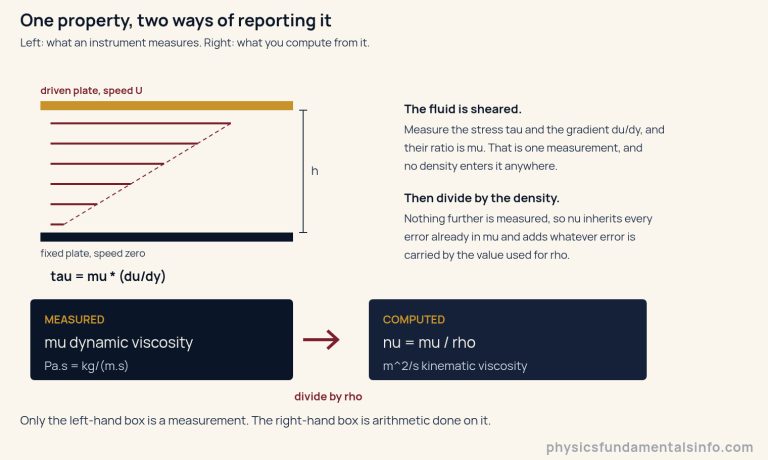
One of the two is measured and the other is arithmetic done on it. Dynamic viscosity is the constant relating the shear stress inside a fluid to the velocity gradient that produced it; kinematic viscosity is that constant divided by the fluid’s density.
NASA Glenn’s beginner’s guide to viscosity states the first half in a line: the proportionality constant between shear stress and the velocity gradient is the coefficient of dynamic viscosity. The same page defines the second half as that coefficient divided by the density, and gives its units as length squared per second. Nothing else is needed to tell the two apart.
- μ — dynamic viscosity, in pascal seconds (Pa·s), which is the same thing as kg/(m·s). Also called absolute viscosity.
- ρ — the density of the fluid, in kg/m³, taken at the same temperature as μ.
- ν — kinematic viscosity, in m²/s. Also called momentum diffusivity, for a reason the dimensions give away later on.
Two naming traps sit in that list, and both cost marks. Dynamic viscosity is written η on plenty of pages — our own terminal velocity guide uses η in Stokes’ law — so η and μ are the same quantity under two symbols. And ν is not a velocity: it differs from v by one stroke, and the units settle any argument, since m²/s is not m/s.
Say it once and the rest of the page follows. These are not two kinds of viscosity. There is one property a fluid has, and two conventions for reporting it — with the density left in, or with the density divided out.
What viscosity actually is, where it comes from inside a liquid, and how it behaves across real materials are all settled in our viscosity guide. This page takes all of that as read and goes straight to the choice between the two numbers.
The Two Units, and Why the Conversion Needs No Unit Factors
Because the practical units were picked to make a unit factor unnecessary. One centipoise is exactly one millipascal second, and one centistokes is exactly one square millimetre per second, so moving between cP and cSt is a division by a dimensionless number and nothing else.
Four equivalences carry the whole of it, and every one of them is exact by definition rather than measured:
- 1 P = 0.1 Pa·s
- 1 cP = 1 mPa·s = 1 × 10⁻³ Pa·s
- 1 St = 1 × 10⁻⁴ m²/s
- 1 cSt = 1 × 10⁻⁶ m²/s = 1 mm²/s
Feed those last two into ν = μ/ρ and the powers of ten cancel against each other, leaving a division by the specific gravity — the density expressed as a multiple of 1000 kg/m³, and therefore a pure number with no units at all.
Read it in either direction. A datasheet quoting centistokes becomes centipoise by multiplying by the specific gravity; a laboratory result in centipoise becomes centistokes by dividing. If you would rather not do it by hand, our Viscosity Converter runs the same relation in SI and solves it for the dynamic viscosity, the kinematic viscosity or the density itself.
Keep the two statements of the conversion apart, because blurring them is the commonest slip on this topic. In SI you divide by the density, in kg/m³. In cP and cSt you divide by the specific gravity, which is that density over 1000. Divide a centipoise figure by 1100 rather than by 1.100 and the answer is out by the same factor of 1000 that defines the specific gravity in the first place.
Watch One Number Move the Other
The simulator below is the one place on this site where you can set a dynamic viscosity by hand and watch the kinematic value track it. It is titled “Viscosity & Shear Stress” and it belongs to our viscosity guide rather than to this page, so four of its five readouts are about shear rather than about the conversion.
Four sliders drive it: Dynamic viscosity μ, Plate speed U, Gap h and Plate area A. The three preset buttons — Water, Olive oil and Glycerine — only set the viscosity slider, to 0.001, 0.084 and 1.412 Pa·s. Drag μ alone and watch which readouts move.
Four of the five follow it: the shear stress, the viscous force, the power and the kinematic viscosity. The Shear rate does not budge, because it is only the plate speed divided by the gap and the fluid never enters it.
That split is the lesson. Three of the four that moved are force-side quantities, and not one of them asks you for a density; the fourth, Kinematic viscosity, is the only readout on the whole panel that does. It carries its own equation chip, ν = μ ÷ ρ, and it tracks the slider in exact proportion for a reason worth being blunt about.
The simulator says so itself, on its own panel: “Density is held at 1000 kg/m³ and is used only for ν.” With ρ fixed, ν cannot do anything but follow μ. Fuller instructions for the controls sit on its own landing page, the Viscosity Simulator.
That pinned density is the most useful thing on the panel, provided you read it honestly. For the Water preset the pinned density is nearly right, so the readout is nearly water’s kinematic viscosity: the simulator prints 1.000e-6 m²/s, with 1.000 cSt at 1000 kg/m³ underneath. Leave the exponent in that form; it is written that way on purpose.
For Olive oil and Glycerine it is not. Those presets change μ and leave ρ at 1000, so the figure the simulator prints is μ divided by 1000 and not those fluids’ kinematic viscosity at all. How far out it is has an exact answer, and the last section of this page gives it.
Here is the whole readout set at the boot state, with the viscosity slider at its floor, the plate at 1.00 m/s, a 2.0 mm gap and a 0.25 m² plate. Both the digits and the relations below are the panel’s own, with one respelling: the panel sets the shear-rate unit as a superscript, and this page writes it 1/s.
| Readout | Relation | Value at boot | Needs the density? |
|---|---|---|---|
| Shear rate | du/dy = U ÷ h | 500.0 1/s | no |
| Shear stress | τ = μ × (du/dy) | 0.5000 Pa | no |
| Viscous force | F = τ × A | 0.1250 N | no |
| Power dissipated | P = F × U | 0.1250 W | no |
| Kinematic viscosity | ν = μ ÷ ρ | 1.000e-6 m²/s | yes |
Read the last column downwards and the page’s argument is already made. Four quantities a fluid engineer actually wants — a rate, a stress, a force, a power — need no density at all. Only the fifth does, and the fifth is the one that gets quoted on datasheets.
Why Water Is the Worst Fluid to Learn This From
Water’s two numbers agree to three significant figures and part company in the fourth, which is far enough to fool a reader and not far enough to be true. At 20 °C water’s dynamic viscosity is 1.0016 mPa·s, which is 1.0016 cP. Wikipedia’s water data page gives its density at that same temperature as 998.2071 kg/m³, so the specific gravity is 998.2071 / 1000 = 0.99821 and the kinematic viscosity is 1.0016 / 0.99821 = 1.0034 cSt.
Divide the two figures into each other and the fourth digit explains itself: 1.0016 / 1.0034 = 0.99821, which is water’s specific gravity exactly. That is the identity the last section of this page turns into a table, landing here on the one fluid every textbook anchors on. Hand the same 1.0016 cP to the simulator’s pinned 1000 kg/m³ instead and it comes back as 1.0016 cSt — and that, not water, is where the famous four-figure coincidence comes from.
So “about 1 cP and about 1 cSt” sticks in the memory as though the two were interchangeable, and nothing deep is going on. The cause is that water’s specific gravity sits very close to 1, so the division barely moves the number — but it does move it. The quantities underneath are still as different as they were: one is kg/(m·s), the other m²/s, and no amount of numerical agreement makes a stress-per-unit-gradient into a diffusivity.
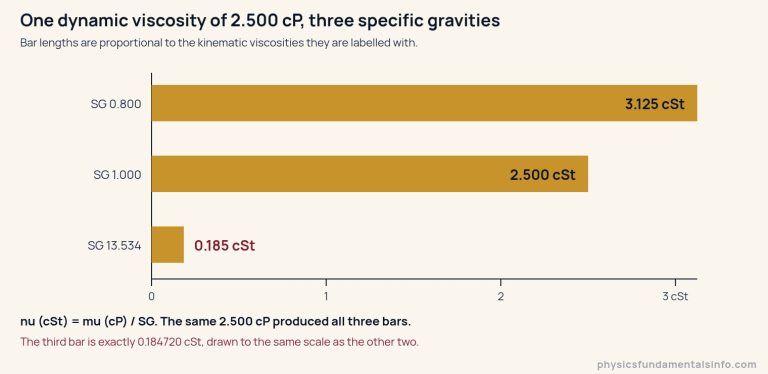
A practical consequence follows for anyone revising. Learn the conversion on water and you will never once catch yourself forgetting the density step, because on water forgetting it costs nothing. Learn it on Figure 2’s bottom bar instead, where the same 2.500 cP reports as 0.184720 cSt, and the step becomes impossible to skip.
Which Number Does Your Formula Want?
Whichever one your formula already divides by density: if the expression contains a density you can cancel against the viscosity, it wants the kinematic value, and if it is asking for a force or a stress, it wants the dynamic one. That single rule settles almost every case you will meet.
The cleanest proof of it is the Reynolds number, the dimensionless ratio of inertial to viscous effects in a flow. NASA Glenn’s guide to viscosity prints both of its forms on one page, which is the whole argument in two lines.
They are the same expression, because ν is μ/ρ. But look at what each one asks you to supply. The left form wants two fluid properties and the right form wants one, and that is the only reason the Reynolds number is conventionally written on ν at all.
Three cases, all at the simulator’s pinned density of 1000 kg/m³ so that ν is simply μ/1000, with the third taking μ from the Olive oil preset:
| V (m/s) | L (m) | μ (Pa·s) | ν = μ/1000 (m²/s) | ρVL/μ | VL/ν |
|---|---|---|---|---|---|
| 1.0 | 0.10 | 0.001 | 1.000e-6 | 100000 | 100000 |
| 2.5 | 0.050 | 0.001 | 1.000e-6 | 125000 | 125000 |
| 0.40 | 0.025 | 0.084 | 8.400e-5 | 119.048 | 119.048 |
Same number, every row. Choosing the wrong form costs you nothing in accuracy and everything in effort, since one of them makes you go and find a density first.
The dimensional check, which cannot be misremembered
If the rule ever deserts you mid-problem, the dimensions will not. Dynamic viscosity in kg/(m·s) has dimensions [M L-1 T-1]; kinematic viscosity in m²/s has dimensions [L2 T-1], with no mass in them anywhere.
That is decisive, and our guide to dimensional analysis explains why. A force or a stress carries mass, so ν cannot produce one on its own — every force written on ν has a density standing beside it, putting the mass back. What ν shares its units with is thermal diffusivity, also in m²/s, and that family resemblance is the whole reason for its other name, momentum diffusivity.
So the decision list reads like this:
- Reynolds number — wants ν. It already divides by the density, so the kinematic form saves you a lookup.
- Groundwater flow — wants ν. Hydraulic conductivity is K = kρg/μ, and μ is νρ, so the density cancels top and bottom and leaves K = k g / ν: one fluid number instead of two. Our Darcy’s law guide writes the same relation the other way up, k = Kμ/(ρg), where μ divided by ρ is ν — the same statement, rearranged.
- Stokes drag — wants μ. The settling speed in our terminal velocity guide divides by the dynamic viscosity, written η there, because a drag force needs the mass dimension.
- Shear stress on a surface — wants μ. Stress is force per area; ν has no mass to give it.
Why Datasheets Quote One and Laboratories Measure the Other
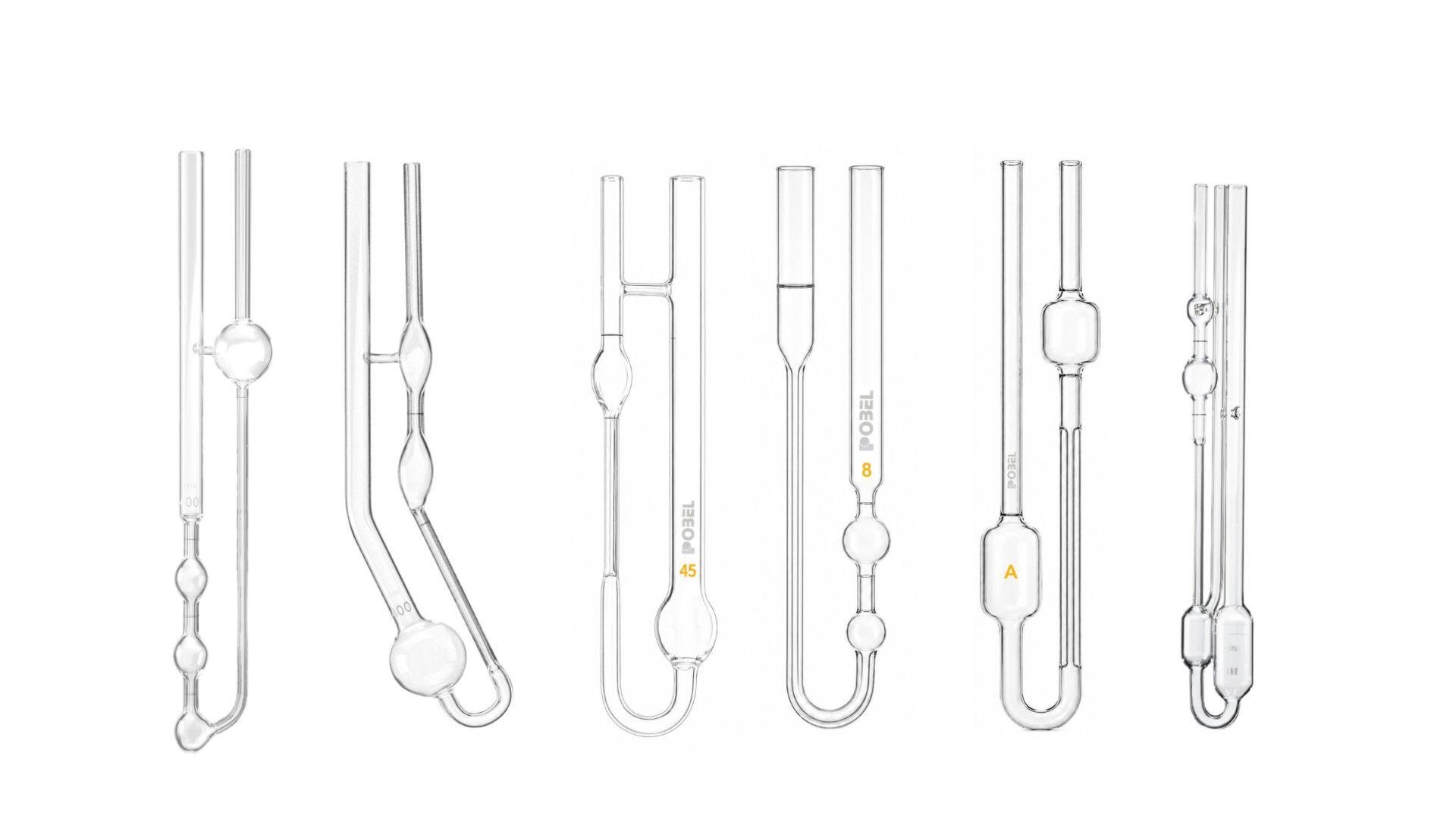
The instrument decides, not the fluid, and in one case the cancellation is worth following algebraically. Gravity drives a glass capillary, so the pressure pushing the liquid along the tube is set by its density, while the resistance holding it back is set by its dynamic viscosity. The density therefore enters once on top and once underneath and drops out, which leaves the stopwatch reading proportional to μ/ρ and not to μ.
That cancellation is the whole reason two units survive side by side. A capillary result is kinematic because the density left the arithmetic by itself, not because anybody preferred the kinematic convention; a torque-reading instrument never admits a density in the first place, so its result is dynamic. Neither number is a matter of taste.
Keep one consequence in view. If the number you are handed came off a capillary, the density needed to convert it was never part of the measurement — which is the subject of the next section.
The Density You Divide By Is Where It Goes Wrong
Substitute a density you have not checked and the answer moves by exactly the specific gravity — not approximately, and not by some error that shrinks as the numbers get nicer. The relationship is an identity, and it holds for every fluid.
Which makes the size of the mistake easy to read off, with no arithmetic beyond the specific gravity itself:
| Specific gravity SG | ν at ρ = 1000, over the true ν | So the assumed value is |
|---|---|---|
| 0.900 | 0.9000 | 10.0% low |
| 0.998 — water at 20 °C | 0.9980 | 0.2% low |
| 1.000 | 1.0000 | exact |
| 1.100 — the fluid in problem 1 | 1.1000 | 10.0% high |
| 1.261 | 1.2610 | 26.1% high |
That second row is water, which makes the trap concrete rather than hypothetical: the pinned density turns water’s 1.0016 cP into 1.0016 cSt, two parts in a thousand short of the 1.0034 cSt it really has. Only the SG 1.000 row escapes, and no real fluid sits there; water is the closest any common liquid comes, and it still misses. At the bottom row the substitution costs more than a quarter of the answer.
A figure without a temperature is not a figure
Both μ and ρ shift with temperature, which means the conversion is only valid when both of them were taken at the same temperature. NASA Glenn says as much of a gas: the dynamic viscosity coefficient is constant with pressure, but its value depends on the temperature.
This is not pedantry about significant figures. It is why NIST maintains reference values and correlations for the viscosity of fluids at all: so that instruments can be calibrated and models checked against stated conditions rather than against remembered numbers.
Why a whole table of viscosities still cannot be converted
Here is how real that constraint is. Every table header on Wikipedia’s list of viscosities reads “Viscosity”, with its unit given as Pa·s, mPa·s or µPa·s. All of it is dynamic. There is no density column and no kinematic column anywhere on the page.
So the single comparison that page supports, at 20 °C, is a dynamic one: mercury at 1.526 mPa·s against water at 1.0016 mPa·s gives a ratio of 1.5236, and that ratio is the end of what the table can be asked for. Converting it into a kinematic ratio needs a density for each fluid at the same temperature; this page has water’s, from the water data page named earlier, and has no source at all for mercury’s. One missing density is enough to stop the sentence, which is the whole point of the section.
One last caveat, and it belongs to someone else’s page. For a non-Newtonian fluid μ is not a single number at all, so ν has no single value either, and both have to be quoted with the shear rate they were measured at — our viscosity guide covers the Newtonian and non-Newtonian distinction properly.