Atmospheric pressure is the force per unit area that the weight of the air above a surface exerts on it. The standard sea-level value is 101,325 pascals, equal to 1 atm, 1013.25 hPa or 760 mm Hg, and it falls with altitude because less air remains overhead. A barometer reads it as the height of a liquid column.
Right now the air is pressing on every square centimetre of your skin with a force of about 10 newtons, roughly the weight of a bag of sugar on each fingernail-sized patch. Add that up over your whole body and the total comes to well over ten tonnes. You feel none of it, because the fluids and gases inside you push back with exactly the same pressure.
That invisible load is atmospheric pressure, and it shapes far more than physics homework. It lifts a drink up a straw, sets the temperature at which your pasta water boils, makes your ears pop on a mountain road and drives every weather map you have ever looked at. Understanding it starts with one plain idea: air has weight.
What Is Atmospheric Pressure?
Atmospheric pressure is the pressure exerted by the weight of the column of air above a given point, measured as force per unit area. The column reaches from that point to the top of the atmosphere, and everything in it, nitrogen, oxygen, argon and water vapour alike, is pulled downward by gravity. A surface at the bottom carries the whole stack.
Picture a pile of books. The book at the bottom bears the weight of every book above it, and lifting one off the top makes the load lighter. Air behaves the same way, with one twist: it is a fluid, so the pressure at any point pushes in every direction, not only downward.
The standard value at sea level is 101,325 Pa, defined as one standard atmosphere (1 atm). Real readings drift a few per cent either side of that with the weather, and they fall steadily as you climb. On the summit of Everest the atmosphere delivers less than a third of its sea-level push.
Why a gas has weight at all
A cubic metre of sea-level air has a mass of 1.225 kg, a little more than a bag of sugar. That sounds trivial until you remember how tall the atmosphere is. Stack tens of kilometres of thinning air on top of one square metre and the total mass comes to just over ten tonnes, which is exactly what a force of 101,325 N on each square metre means.
The Atmospheric Pressure Formula
Two formulas cover almost every atmospheric pressure question you will meet. The first is the hydrostatic relation that lets a barometer report pressure as the height of a liquid column:
The second describes how pressure falls with altitude through the lower atmosphere. It comes from the International Standard Atmosphere (ISA), a reference model in which the air cools at a fixed rate with height:
With the standard constants the exponent g M / (R L) works out to 5.2559, and the bracket is simply T / T0, where T = T0 – L h is the air temperature at height h. You can run the full standard-atmosphere model, both layers, for any altitude up to 20 km, or invert it to find altitude from a measured pressure, with the Atmospheric Pressure Calculator, which prints every step of the working.
Variables and SI units
- P: atmospheric pressure at the point of interest, in pascals (Pa); 1 Pa = 1 N/m².
- ρ (rho): density of the barometer liquid, in kg/m³ (mercury 13,595 kg/m³, water 1,000 kg/m³).
- g: gravitational field strength, fixed at 9.80665 m/s² in the standard atmosphere; 9.81 m/s² is fine for exam work.
- h: height of the liquid column, or altitude above sea level in the barometric formula, in metres (m).
- P0: sea-level pressure, 101,325 Pa on a standard day.
- T0: sea-level temperature, 288.15 K (15 °C).
- L: temperature lapse rate, 0.0065 K/m (6.5 °C per kilometre).
- M: molar mass of dry air, 0.0289644 kg/mol.
- R: universal gas constant, 8.31432 J/(mol·K) in the 1976 standard.
Those constants are not a textbook convenience. They are fixed by the U.S. Standard Atmosphere, 1976, the reference model that aviation and meteorology still use to turn a pressure into an altitude. The formula holds up to 11,000 m, the tropopause; above that the model treats the air as isothermal at -56.5 °C and the fall becomes a pure exponential.
How Atmospheric Pressure Works
Start with a thin horizontal slab of air, one metre square and a few metres thick. The slab is not falling, so the pressure pushing up on its underside must exceed the pressure pushing down on its top by exactly the slab’s weight per square metre. Step upward through the atmosphere slab by slab and the pressure drops by ρ g Δh each time.
For water that is the end of the story, because water density barely changes and the drop is a straight line of 9.8 kPa per metre. Air refuses to be so tidy. Squeeze a gas and its density rises, so the air near the ground, which carries the most weight, is also the densest, and each metre of climb near sea level removes more pressure than a metre higher up.
The ideal-gas law supplies the missing link, ρ = P M / (R T), and feeding it into the slab argument bends the straight line into a decaying curve. If the temperature were constant the curve would be a perfect exponential, halving every 5.8 km or so. The real troposphere cools by 6.5 °C per kilometre, which brings the first halving sooner, at about 5.5 km, and produces the power-law form with the exponent 5.2559.
Three quick sanity checks
Near sea level, pressure falls by about 12 hPa per 100 m of climb, or 1 hPa for every 8 m. By 5,500 m you have left half of the atmosphere’s mass below you. By 11 km, where airliners cruise, only 22 per cent of sea-level pressure remains, which is why the cabin has to be pressurised.
Drag the altitude slider in the lab above and watch the mercury column shorten as the pressure readout falls. Then nudge the sea-level pressure and notice that the percentage of sea level does not move, because the ratio P / P0 depends on height alone.
How Does Atmospheric Pressure Change With Altitude?
Atmospheric pressure decreases with altitude at a slowing rate: it drops about 11.5 kPa in the first kilometre, has roughly halved by 5,500 m, and is down to 5.5 kPa, about one-twentieth of the sea-level value, at 20 km.
The table lists the standard-atmosphere values at altitudes people actually ask about. The mm Hg column is the height of a mercury barometer column at that altitude, and the final column is the share of sea-level pressure that remains.
| Altitude | Place | Pressure (Pa) | kPa | atm | mm Hg | % of sea level |
|---|---|---|---|---|---|---|
| 0 m | Sea level | 101,325 | 101.3 | 1.000 | 760.0 | 100.0 |
| 1,000 m | Typical hill station | 89,875 | 89.9 | 0.887 | 674.1 | 88.7 |
| 1,610 m | Denver | 83,421 | 83.4 | 0.823 | 625.7 | 82.3 |
| 2,000 m | Alpine ski resort | 79,495 | 79.5 | 0.785 | 596.3 | 78.5 |
| 5,000 m | High Himalayan pass | 54,020 | 54.0 | 0.533 | 405.2 | 53.3 |
| 5,895 m | Kilimanjaro summit | 47,864 | 47.9 | 0.472 | 359.0 | 47.2 |
| 8,849 m | Everest summit | 31,439 | 31.4 | 0.310 | 235.8 | 31.0 |
| 11,000 m | Airliner cruise, tropopause | 22,632 | 22.6 | 0.223 | 169.8 | 22.3 |
| 20,000 m | Lower stratosphere | 5,475 | 5.5 | 0.054 | 41.1 | 5.4 |
Two features of the table deserve a pause. The drop is steepest at the bottom: the first 2,000 m removes more than a fifth of the pressure, yet the 9,000 m between 11 km and 20 km removes only another 17 percentage points. And real days differ from the standard: a summer air column is warmer and less dense, so the pressure at a given altitude sits a little higher than the table says.
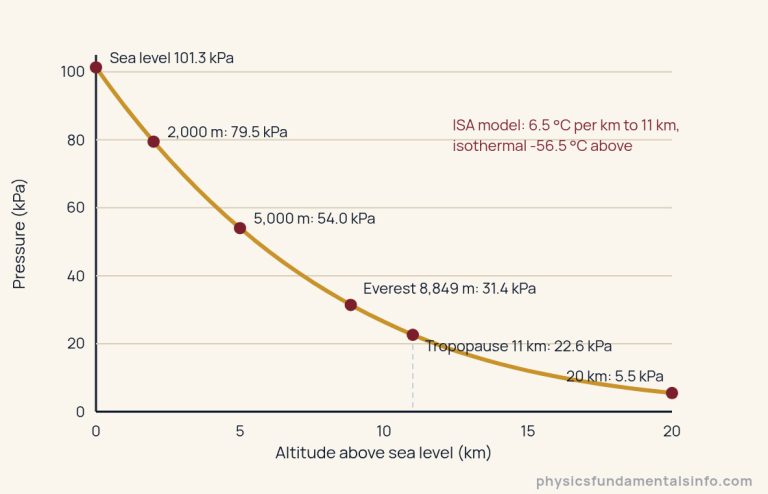
NASA’s Glenn Research Center publishes a compact Earth atmosphere model with the same troposphere and lower-stratosphere equations in metric units, a handy cross-check if you build your own spreadsheet from the formula above.
How Is Atmospheric Pressure Measured?
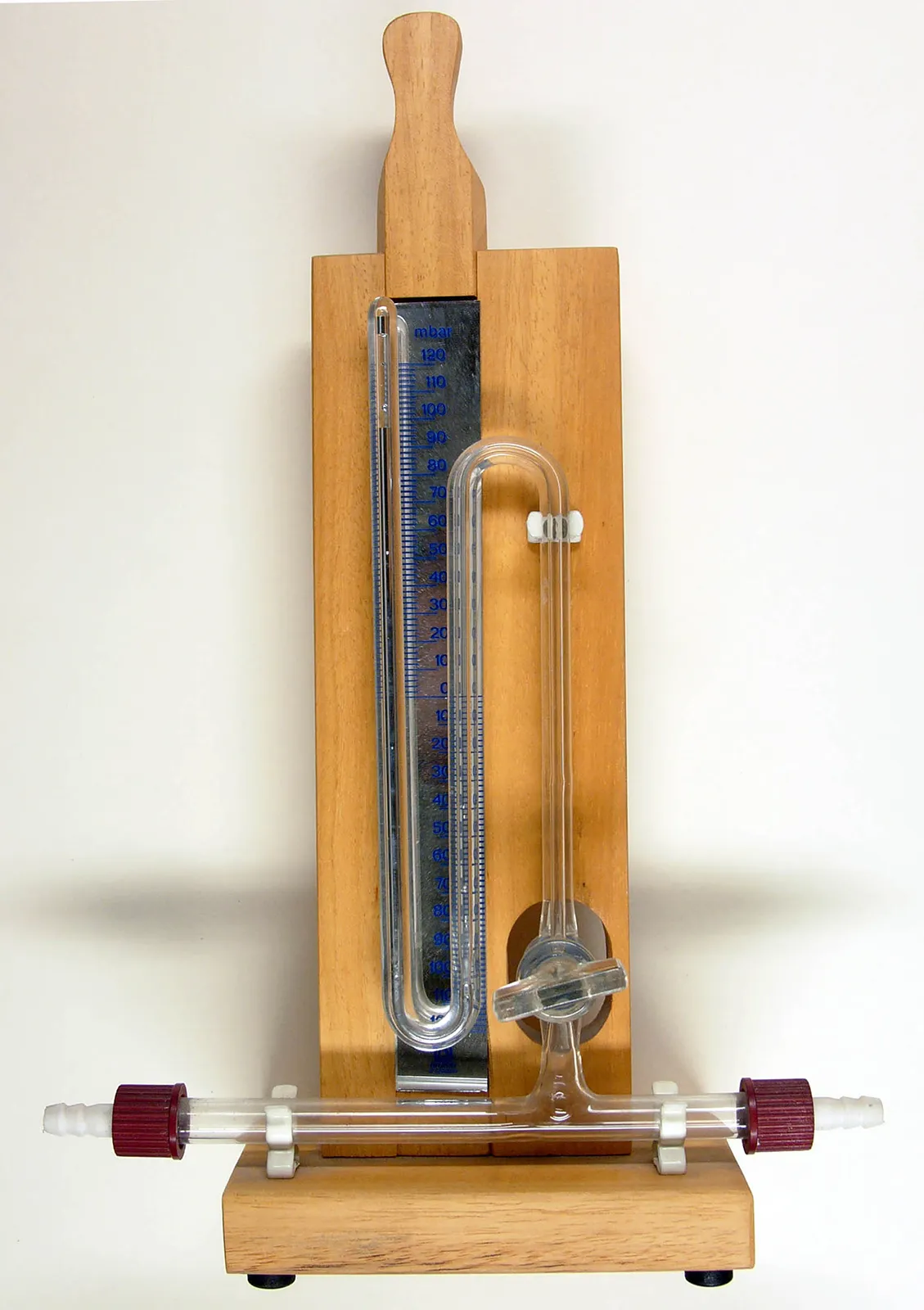
Atmospheric pressure is measured with a barometer, an instrument that balances the push of the air against either a column of liquid or the flex of a sealed, partly evacuated capsule.
The classic version is Evangelista Torricelli’s mercury barometer of 1643. Fill a glass tube, closed at one end, with mercury, invert it into a dish of mercury, and the column drops until its own weight per unit area matches the atmospheric pressure on the dish. At sea level it settles at 760 mm, leaving a near-perfect vacuum in the space above the metal.
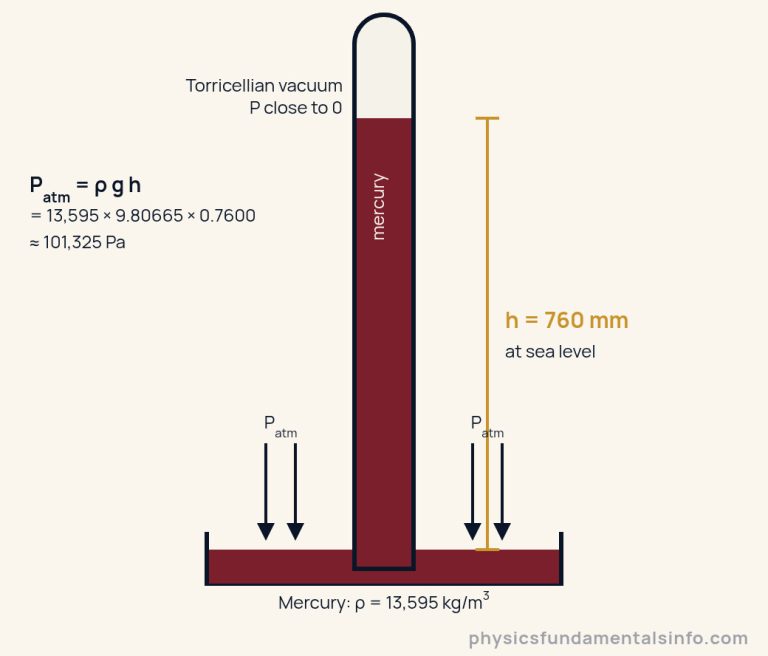
Why mercury? Its density of 13,595 kg/m³ keeps the column to 76 cm. A water barometer would need to be 10.33 m tall to do the same job, which is also the limit on how high a suction pump can raise water, a puzzle that troubled well-diggers long before Torricelli explained it.
Modern instruments swap the liquid for an aneroid capsule, a sealed metal box with most of the air removed that flexes as the outside pressure changes, or for a silicon diaphragm whose deflection is read electrically. The chip in your phone that counts floors climbed is a barometer of this last kind. Weather services report the result in hectopascals, reduced to sea level so that stations at different heights can be compared, a convention the NOAA JetStream school explains in its introduction to air pressure.
Units of atmospheric pressure
One standard atmosphere can be written in a surprising number of ways, and every field has its favourite. The table converts the same 101,325 Pa into the units you will meet on weather charts, in aviation, in engineering and in older textbooks.
| Unit | One standard atmosphere | Where you meet it |
|---|---|---|
| pascal (Pa) | 101,325 Pa | SI unit, physics exams |
| kilopascal (kPa) | 101.325 kPa | Engineering tables |
| hectopascal (hPa) = millibar (mbar) | 1013.25 hPa | Weather forecasts, altimeter settings |
| standard atmosphere (atm) | 1 atm | Chemistry, gas-law problems |
| millimetre of mercury (mm Hg, torr) | 760 mm Hg | Barometers, blood pressure, vacuum work |
| inch of mercury (inHg) | 29.92 inHg | US weather reports, aviation |
| pound per square inch (psi) | 14.70 psi | Tyres, plumbing, US engineering |
| metre of water | 10.33 m | Pumps, diving, hydraulics |
Real-World Examples of Atmospheric Pressure
Drinking through a straw
Sucking on a straw does not pull the drink up. It lowers the pressure inside your mouth, and the full atmospheric pressure on the surface of the drink pushes liquid up the straw to fill the gap. That is why no straw, however strong your lungs, can lift water more than 10.33 m.
Cooking at altitude
Water boils when its vapour pressure equals the pressure of the air above it. At 2,000 m the air presses down with only 79.5 kPa, so water boils at roughly 93 °C; on the summit of Everest, at 31.4 kPa, it boils near 70 °C, too cool to cook rice properly. A pressure cooker plays the trick in reverse, raising the pressure to lift the boiling point.
Ears popping in an aircraft
Airliner cabins are pressurised, but only to the equivalent of about 2,400 m, or roughly 75 kPa. As cabin pressure falls during the climb, the air trapped in your middle ear pushes outward on the eardrum until the Eustachian tube opens and equalises it. That release is the pop.
Weather systems
The highs and lows on a weather map are differences in sea-level atmospheric pressure of only a few per cent, usually between about 950 and 1,050 hPa. Air flows from high to low, and that flow, bent by the Earth’s rotation, is wind. The most intense tropical cyclones have recorded central pressures below 900 hPa.
The Magdeburg hemispheres
In 1654 Otto von Guericke fitted two copper hemispheres together, pumped out the air, and showed that teams of horses could not pull them apart. Nothing held them together but the atmosphere pressing on the outside, the same 101 kN per square metre that acts on you.
Common Misconceptions About Atmospheric Pressure
Misconception 1: air pressure only pushes downward
Pressure in a fluid at rest acts equally in every direction. The atmosphere pushes up on the underside of a table with the same 101 kPa it pushes down on the top, which is why the table is not crushed. Only a difference between two pressures ever produces a net force.
Misconception 2: a vacuum sucks
There is no such force as suction. A vacuum cleaner, a straw or a suction cup simply lowers the pressure on one side of something, and the untouched atmosphere on the other side does the pushing. Torricelli’s mercury is held up by the air on the dish, not pulled up by the empty space above it.
Misconception 3: pressure falls in a straight line with height
A common student slip is to apply P = ρ g h to the whole atmosphere using sea-level density. That would empty the atmosphere at about 8.4 km, yet Everest, at 8,849 m, still has 31 per cent of sea-level pressure. Air thins as it decompresses, so the curve flattens and never quite reaches zero.
Misconception 4: we would notice ten tonnes on our shoulders
You carry it, but you do not feel it, because the pressure inside your body equals the pressure outside. Blood, tissue fluid and the air in your lungs all sit at atmospheric pressure, so there is no net force on any surface. Change the outside pressure quickly, in a fast lift or a dive, and you feel the imbalance at once.
How Atmospheric Pressure Relates to Other Fluid Concepts
Atmospheric pressure is the everyday face of the general definition of pressure in physics, P = F / A, a force spread over an area. Everything in this article follows from applying that definition to a column of air.
The weight of the column depends on its density, and the density formula shows that sea-level air, at 1.225 kg/m³, is about 800 times less dense than water. Because air is a gas, that density is not fixed: the ideal gas law ties it to pressure and temperature, and Boyle’s law explains why a balloon released at the surface swells as it climbs into thinner air.
That thinning links atmospheric pressure to buoyancy. Archimedes’ principle works in air as well as in water, which is why a helium balloon rises until the surrounding air becomes too thin to support it. And wherever pressure differs between two places, air moves; Bernoulli’s principle describes how that moving air trades pressure for speed over a wing or through a gale.