Electric current is the rate at which charge passes a point: I = Q/t, in amperes — one coulomb per second. Drag the two sliders below to set the charge and the time, and watch the dot stream, the current readout and the electron count respond together.
Electric Current: I = Q / t
Current is the rate charge flows past a point. Set how much charge Q crosses the wire and how long it takes t — the dot stream past the marked cross-section speeds up and slows down with the current.
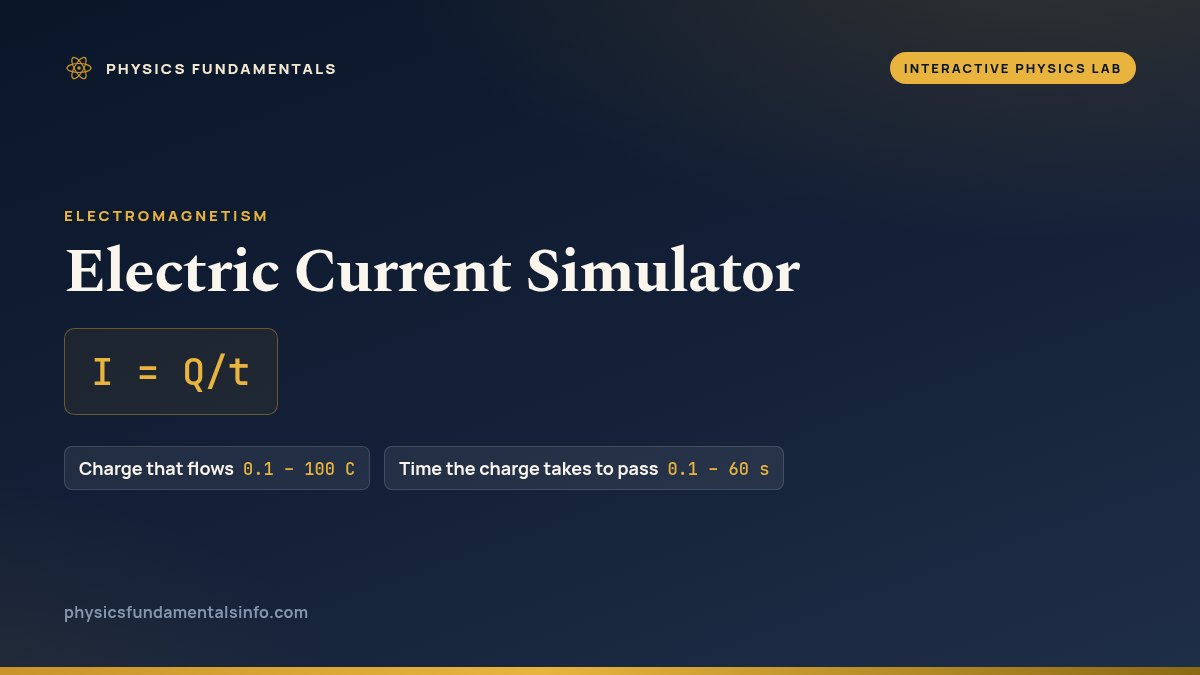
What Is the Electric Current Simulator?
The electric current simulator is a free interactive physics lab that runs in your browser — nothing to install and no sign-up. Slide the charge and time to see current I = Q/t and the electron count update. It reports current as you drag the sliders.
| Control | Range | Step |
|---|---|---|
| Charge that flows | 0.1 – 100 C | 0.1 |
| Time the charge takes to pass | 0.1 – 60 s | 0.1 |
What the Two Sliders Teach About I = Q/t
The charge slider sets how much charge Q crosses the wire's marked cross-section, and the time slider sets how long the crossing takes. The big readout divides one by the other in real time — I = Q/t — so every slider position is a small worked example. Push Q up with t fixed and the current climbs in proportion; the dot stream through the wire quickens to match. The same arithmetic, with the rearrangements for charge and time, runs in the electric current calculator.
The live electron count is the humbling part: N = Q/e turns even a modest charge into billions of billions of electrons. Ten coulombs is about 6.24 × 10^19 of them, each carrying a scarcely believable 1.602 × 10^-19 coulombs. The count sits beside a second figure — electrons per second, I/e — which is the current re-expressed as raw traffic past the plane.
Now hold Q fixed and stretch the time instead. The electron count does not move — the same charge still makes the trip — but the flow visibly thins and the current readout falls. That contrast is the misconception this lab exists to correct: a bigger current is faster charge delivery, not "more electrons existing". Current is a rate, like litres per minute through a pipe, and the cross-section plane in the canvas is exactly the point where the counting happens.
Where the ideal I = Q/t breaks down
The first crack is hidden in plain sight: this sim computes an average. Current is really the instantaneous rate I = dQ/dt, and dividing a total charge by a total time recovers that only if the flow was steady throughout. Set Q to 10 C and t to 5 s and the readout says 2.00 A; set Q to 100 C and t to 50 s and it still says 2.00 A, even though ten times as many electrons crossed the plane (6.24 × 10^20 against 6.24 × 10^19). Averages throw away everything about when the charge moved. Mains AC is the extreme case: over a whole number of cycles the net charge transferred is zero, so I = Q/t reports 0 A for a kettle that is merrily boiling. That is why alternating currents are quoted as RMS values instead.
The second is the animation itself. The dots speed up when you raise the current because that is the honest way to picture a rate, but their pace is not the speed of real electrons. In a 1 mm² copper wire carrying about 3 A the conduction electrons drift at roughly 0.2 mm per second — slower than a snail. The lamp still lights the instant you flip the switch, because the electric field that sets every electron in the wire drifting propagates at close to light speed. Charge delivery is slow; the instruction to deliver is nearly instantaneous.
Third, the electron count is smoother than nature. N = Q/e returns a tidy decimal, but charge comes in whole electrons, and at small enough currents that graininess stops being a technicality. This sim cannot approach it: even at its quietest setting, 0.1 C over 60 s, the readout shows 1.04 × 10^16 electrons per second. Drop to a picoamp and only about six million electrons arrive each second — few enough that their random arrival times appear as shot noise, a fluctuation with no cause but counting statistics.
Finally, the picture assumes one carrier moving one way through a uniform wire. In a metal that is fair. In an electrolyte or inside a battery, positive and negative ions drift in opposite directions and both add to the current; in a semiconductor, positive holes carry much of it. Conventional current also points opposite to the electron flow, a convention older than the electron itself. And at high frequency the current abandons the middle of the conductor for its surface, so the charge crossing the plane the canvas draws is no longer spread evenly across it.
Where this is actually used
The battery in your pocket is rated in charge, not current. A 5000 mAh phone battery is a statement about Q: 5 A for 3600 s, or 18,000 C — 180 times the sim's whole charge slider. Rearranging I = Q/t gives the runtime: at a 500 mA draw, t = 18,000/0.5 = 36,000 s, exactly 10 hours. That is why milliamp-hours advertise a battery honestly: amperes alone give the rate and say nothing about how long it lasts.
Electroplating charges you by the coulomb. How much metal a plating bath deposits depends on total charge, not current, because each ion needs a fixed number of electrons to become an atom. Copper is divalent, so plating one gram takes about 3,040 C. Run the bath at the sim's default 2.00 A and that gram takes 1,518 s — a little over 25 minutes. Halve the current and it takes twice as long; the coating is identical. Plating shops therefore meter amp-hours, which is Q in different units.
Lightning is the same charge on a different clock. A cloud-to-ground flash transfers on the order of 15 C. Put that into the sim at its slowest setting — Q = 15 C, t = 60 s — and the readout gives a domestic 250 mA from 9.36 × 10^19 electrons. Deliver that same 15 C in half a millisecond instead and the average current becomes 30,000 A. Nothing about the charge changed; only t did. Squeezing the denominator is the business of the flash, and of every capacitor discharge, camera strobe and spot welder.
Frequently asked questions
How does this electric current simulator work?
It solves I = Q/t live: you set how much charge Q flows and how long it takes t, and the readout returns the current in amperes together with the electron count. The dot stream in the wire is a visual sample whose speed scales with the current, so a bigger I literally looks like faster delivery past the marked cross-section.
What does the electron count show?
It is N = Q/e — the number of electrons making up the charge you chose, using the elementary charge e = 1.602 x 10^-19 C. Even the minimum 0.1 C is over six hundred million billion electrons, which is why the sim displays the count in scientific notation. It depends only on Q, so stretching the time leaves it untouched.
Why does the current fall when I increase the time?
Because the same charge spread over more seconds is a lower rate, and current is a rate: I = Q/t. Hold Q at 10 C and drag t from 5 s to 50 s — the current drops from 2 A to 0.2 A and the dot flow visibly thins, even though exactly the same number of electrons makes the trip.
What units does the simulator use?
Coulombs for charge, seconds for time and amperes for the current — one ampere is one coulomb per second, so the three lock together through I = Q/t. Small results switch to milliamperes for readability, and the electron figures are dimensionless counts shown in scientific notation.
Is this the same as Ohm's law?
No. This lab uses the charge-flow definition of current, I = Q/t, which involves no circuit at all — just charge and time. Ohm's law, V = IR, predicts how much current a given voltage pushes through a given resistance. Use this sim to understand what current is, and an Ohm's law tool to find its value in a circuit.
References & formula source
- Young & Freedman — University Physics with Modern Physics, chapter on Current, Resistance and Electromotive Force.
- Halliday, Resnick & Walker — Fundamentals of Physics, chapter on Current and Resistance.
- NIST — SI Redefinition, "Ampere: The Future" (nist.gov).
- Further reading: Electric current — Wikipedia