Thermal convection is heat carried by the bulk movement of a fluid, and the rate at which a surface hands heat to the fluid washing it is Q = h · A · (Ts − Tinf) — Newton's law of cooling. The quantity that does the work is h, the convective heat transfer coefficient in W/(m2·K): the identity of the fluid and the briskness of its flow are both buried inside that single number, and it is the one figure a reader usually has to estimate. Note the slug: this page is convection at a surface, while /calculators/thermal-conduction is conduction through a slab of known thickness — one letter apart, two different formulas. This free calculator solves the relation for the heat rate, the coefficient, the area or either temperature, names the band h belongs in, and shows every step.
Load a real case
Each button writes the coefficient, the area and the two temperatures into the four boxes, so the answer changes the moment you press it. The line underneath quotes back whatever the widget then works out, so nothing in it is stored text. All five sets of figures are stated givens chosen to make a point, not measurements of any named object.
Pick a case above, or type your own figures.
What Is the Thermal Convection Calculator?
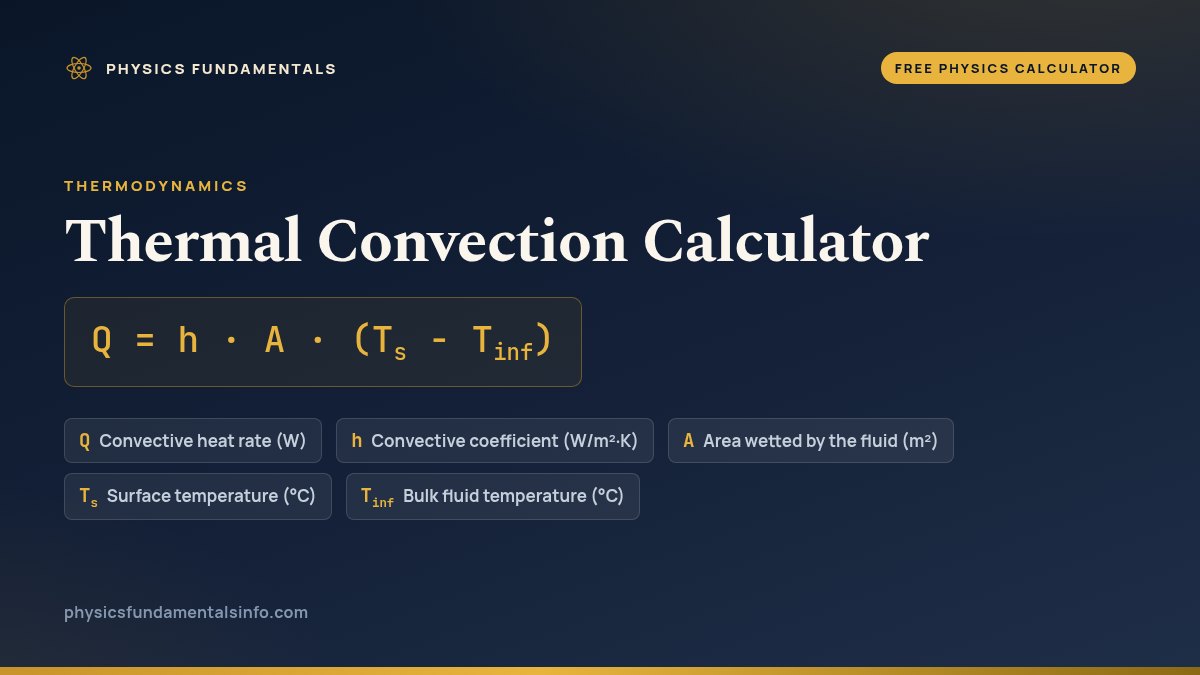
The thermal convection calculator is a free online tool for the rate at which a surface hands heat to the fluid moving past it: Q = h · A · (Ts − Tinf), in watts. Give it the convective heat transfer coefficient h, the wetted area A and the two temperatures, and it returns the heat rate; point the Solve for menu at any one of those four instead and it runs the same relation in that direction.
Read the slug before you read the formula. This page is convection — Newton's law of cooling, at a surface washed by a fluid. /calculators/thermal-conduction is conduction, Fourier's law through a solid slab of known thickness, and the two addresses differ by a single letter. If your problem gives you a thickness and a conductivity rather than a coefficient, you are on the wrong one of the two.
The quantity that does all the work here is h, and it is not a constant. Its size is set by how fast the fluid is moving and by which fluid it is — neither of which this formula carries — so this page gives it as indicative, order-of-magnitude bands rather than as a looked-up number: still air about 2 to 25, moving air about 10 to 200, water about 50 to 10000 W/(m²·K). A chip beside the answer names which of those bands your figure falls in, and because the bands overlap, two names at once is a real answer rather than a fudge.
In natural convection h grows with the temperature difference, which makes the formula only approximately linear. Take the temperature difference on a 0.30 m isothermal plate in air up eightfold, from 10 K to 80 K, and the heat rate at 1 m² climbs not eight times but 13.356 times, from 33.2 W to 443 W — because h drifts from 3.32 to 5.54 W/(m²·K), a factor of 1.670, while you do it. Anyone who treats the coefficient as a looked-up constant is wrong by that gap, and the five-quarters power rule that nearly describes it is an asymptote, not an identity.
Both temperature boxes carry one scale on purpose, and nothing on this page adds 273.15. The formula uses only the difference between the two temperatures, so a surface at 60 °C into a fluid at 20 °C gives exactly the same heat rate as 333.15 K into 293.15 K — both pairs differ by 40. A kelvin figure may therefore be typed straight in, provided both boxes use it; a half-converted pair would be wrong by 273.15 and the page would have no way to tell.
A negative heat rate is kept and labelled rather than hidden. It means the fluid is the warmer of the two and the surface is gaining heat: at h = 25 W/(m²·K) over 1.5 m², a surface at 20 °C in a fluid at 60 °C reads −1500 W. The chip labelled direction of heat flow turns that sign into words, so it cannot be read as a slip.
Some states have no answer and the page refuses them rather than inventing one. With the two temperatures equal the heat rate is an exact 0 W, which is a result — but asking the same state for h or for the area puts that zero difference in a denominator, and the panel says so instead of printing an infinity. An area of zero and a result below absolute zero are refused the same way. A coefficient of zero is not: no convection at all is a real state rather than a missing one, so that case returns an honest 0 W and the band chip says exactly that.
What the page does not do is worth naming as plainly as what it does. It has no time input, so it says nothing about how long an object takes to cool or about the shape of that approach; it carries no U-value and no multi-layer wall; and it does not work h out from a geometry or a flow speed, because that is the hardest part of the problem and hiding it behind three boxes would be worse than asking for it. It also assumes the fluid is moving at all: a wide layer of still air heated from below does not convect until the Rayleigh number passes about 1708, and until then heat crosses it by conduction only.
| Symbol | Quantity | Default unit | Also accepts | Example value |
|---|---|---|---|---|
| Q | Convective heat rate | W | kW | 1500 |
| h | Convective coefficient | W/m²·K | kW/m²·K | 25 |
| A | Area wetted by the fluid | m² | cm² | 1.5 |
| Ts | Surface temperature | °C | — | 60 |
| Tinf | Bulk fluid temperature | °C | — | 20 |
How to use the thermal convection calculator
- Check which mechanism you need first. This page is Newton's law of cooling at a surface,
Q = hA(Ts − Tinf). If your problem hands you a thickness and a conductivity instead of a coefficient, you want the thermal conduction calculator — one letter away in the address bar, and a different formula. - Pick what to solve for. The page opens on the heat rate. The Solve for menu also rearranges the relation for
h, the area, the surface temperature and the fluid temperature; whichever you choose becomes the headline and the other four become your input boxes. Switching the menu refills every box with this page's defaults, which are a consistent set. - Enter the coefficient. The default is
25W/(m2·K), and the box menu also offers the kilowatt optionkW/m2·K. This is the input most often guessed, so a chip names the indicative band it falls in instead of implying there is one correct value. - Enter the wetted area. The box opens on
1.5m2, with cm2 on the menu. Use the area actually touched by the moving fluid, not the whole outside of the object, and keep it strictly positive — zero area is no surface at all. - Enter the two temperatures in °C. The defaults are
60for the surface and20for the fluid. Both boxes carry one scale deliberately: the formula uses only the difference, so kelvin figures work provided both boxes use them, and nothing here adds 273.15. - Read the headline. It is the quantity you asked for to six significant figures with trailing zeros dropped — the defaults read
1500W. A minus sign is kept rather than hidden: it means the fluid is the warmer of the two and the surface is gaining heat. - Read the four chips. Surface minus fluid temperature is the difference in kelvin. Heat flux per square metre is the rate divided by the area. Direction of heat flow puts the sign into words. Indicative band for h names which bands the coefficient fits, and they overlap, so two names at once is a real answer.
- Open Show working. The steps restate the scale trap, give the rearranged relation, list your figures, work the temperature difference out on its own line, substitute every number and then check the answer by putting it back.
- Expect a refusal where the difference is zero. Equal temperatures give an exact
0W in the heat-rate direction, which is an answer. Ask the same state forhor the area and the difference is now a denominator: the panel refuses rather than printing an infinity.
Two neighbouring quantities are worth separating from this one before you start. The chip labelled heat flux is this page's heat rate divided by its area, and if that is the quantity you actually want on its own, the heat flux calculator does it directly. And below the onset of convection, a still fluid layer passes heat by conduction only, which is Fourier's law rather than anything on this page.
If you want the mechanism argued out in prose, with the threshold and the worked problems, read the thermal convection guide, which this tool is the arithmetic half of. For how convection sits beside the other two ways heat moves, the guide to conduction, convection and radiation is the comparison page, and it is where the three-way contrast belongs rather than here.
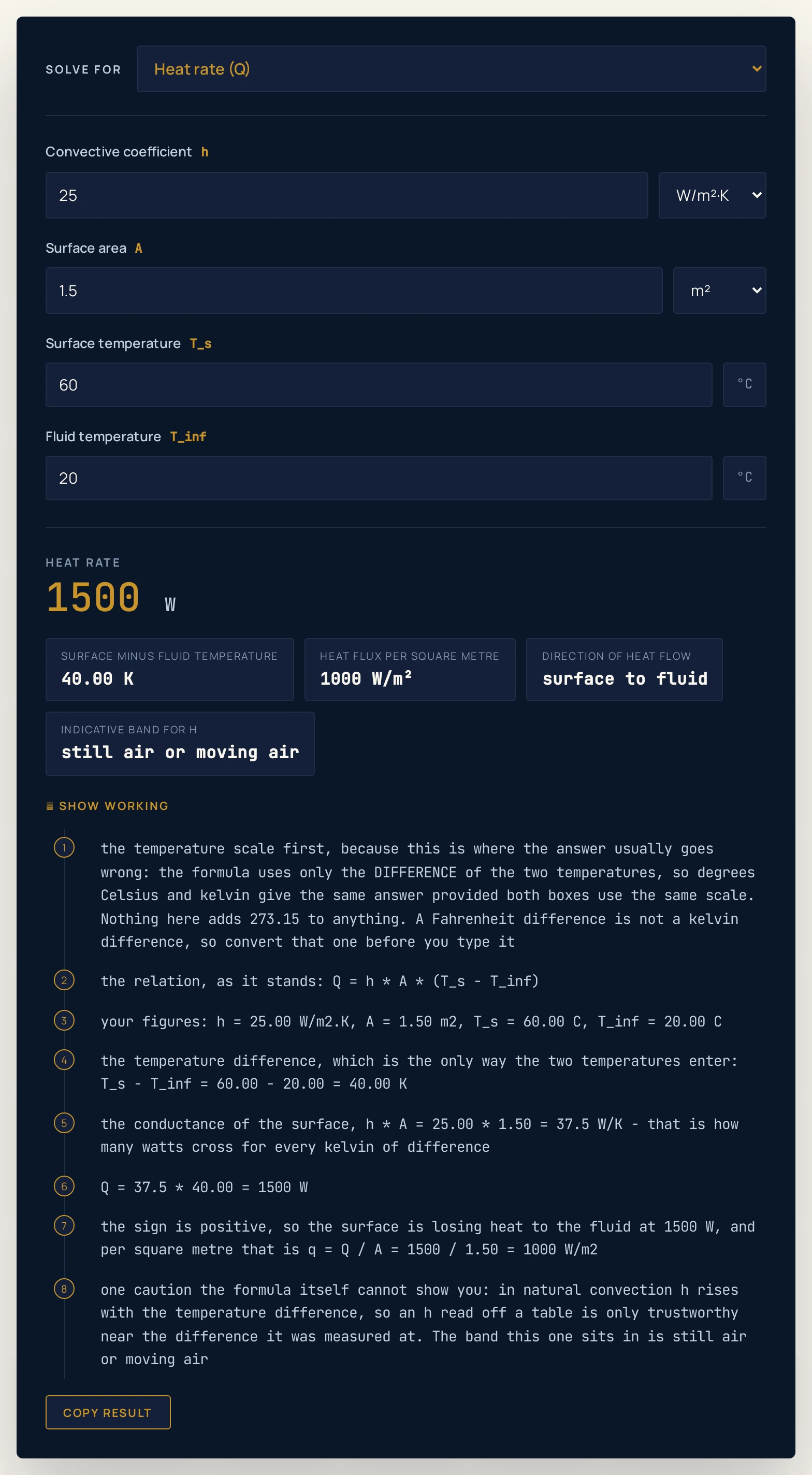
h = 25 W/(m2·K), A = 1.5 m2, Ts = 60 °C and Tinf = 20 °C. These were chosen because the arithmetic is exact: a 40 K difference, 37.5 W/K of conductance and a round 1500 W.Worked example: change one thing at a time
The table holds the coefficient at 25 W/(m2·K) and the area at 1.5 m2, keeps the fluid at 20 °C, and moves the surface temperature alone. Every headline and chip cell was read out of the running widget rather than worked out by hand. Where a cell and the tool ever part company, believe the tool.
| Surface temperature | Difference chip | Headline heat rate | Flux chip | Direction chip |
|---|---|---|---|---|
| 20 | 0.00 K | 0 | 0 W/m² | no net transfer |
| 25 | 5.00 K | 187.5 | 125 W/m² | surface to fluid |
| 30 | 10.00 K | 375 | 250 W/m² | surface to fluid |
| 40 | 20.00 K | 750 | 500 W/m² | surface to fluid |
| 50 | 30.00 K | 1125 | 750 W/m² | surface to fluid |
| 60 | 40.00 K | 1500 | 1000 W/m² | surface to fluid |
| 0 | -20.00 K | -750 | -500 W/m² | fluid to surface |
Three things are worth reading off that table. The heat rate is exactly proportional to the difference while h is held fixed, so doubling 20 K to 40 K doubles 750 W to 1500 W. The first row is the only one where the answer is an exact zero, and the last row is the only one where the direction chip changes its mind.
That strict proportionality is also the table's limitation, and it is worth saying plainly. It holds because h was typed in once and never updated, which is what every substitution into this formula quietly assumes. In real natural convection the coefficient grows with the difference, so the right-hand end of a table like this understates the heat rate.
Switching the Solve for menu runs the same row backwards. From 1500 W with A = 1.5 m2, 60 °C and 20 °C the coefficient mode returns 25 W/(m2·K); from the same heat rate with h = 25 the area mode returns 1.5 m2; and with both given, the two temperature modes return 60 °C and 20 °C.
Formula and symbol reference
| Symbol | What it is | Unit | On this page |
|---|---|---|---|
| Q | The convective heat rate: watts, not joules. Negative means the surface is gaining heat | W | Box menu reads W or kW. Headline 1500 at the defaults, -1500 with the two temperatures swapped, an exact 0 when they are equal. Default 1500 when it is an input. |
| h | The convective heat transfer coefficient: how many watts cross each square metre for each kelvin of difference | W/(m2·K) | Box menu reads W/m2·K or kW/m2·K. 25 is the default. Indicative bands only: still air about 2 to 25, moving air about 10 to 200, water about 50 to 10000. |
| A | The area of the surface actually in contact with the moving fluid. Strictly positive | m2 | Box menu reads m2 or cm2. 1.5 m2 is the default, which is 15000 cm2. |
| Ts | The temperature of the surface itself, not of the body behind it | °C | One scale only, on purpose. 60 °C is the default; a kelvin figure may be typed straight in provided the fluid box matches it. |
| Tinf | The temperature of the bulk fluid, far enough away to be unaffected by the surface | °C | 20 °C is the default. The subscript is short for infinity — the conventional mark for far from the surface, which is where this temperature must be measured. |
| ΔT = Ts − Tinf | The temperature difference: the only way the two temperatures enter the formula | K | A chip beside the answer, never an input: 40.00 K at the defaults. A kelvin and a degree Celsius are the same size, so a difference needs no conversion. |
| q = Q / A | The heat flux: the same heat rate expressed per square metre of surface | W/m2 | A chip beside the answer: 1000 W/m2 at the defaults, 35000 W/m2 in the water case. |
The physics: what h is hiding, and why it is not one number
Written out, Q = hAΔT looks like a law. It is closer to a definition: everything difficult about the problem — how fast the fluid moves, how thick the sluggish layer against the surface is, whether the flow is smooth or churning — has been collected into the single coefficient h. The formula is exact once you know h, and knowing h is the whole task.
That matters most in natural convection, where the fluid moves only because the heat has made it buoyant. Raise the temperature difference and you do not merely multiply the driving term: you also speed the fluid up, which thins the layer against the surface and raises h itself. So the heat rate grows faster than the difference does.
The size of that effect is worth a number. For an isothermal vertical plate 0.30 m tall in air, raising the difference from 10 K to 80 K raises h from 3.32 to 5.54 W/(m2·K) — a factor of 1.670 — and so raises the heat rate at 1 m2 from 33.2 W to 443 W. That is 13.356 times, where a fixed h would have predicted 8. The heat rate grows roughly as the five-quarters power of the difference rather than in proportion to it, and roughly is the honest word: the correlation behind those figures is only asymptotically a power law.
Force the fluid along with a pump or a fan and the picture changes, because the speed no longer comes from the heat. That is the useful half of the natural-versus-forced distinction: a pumped flow is much closer to the constant h the formula appears to promise. The forced-flow side of the story, where the transition to churning flow is set by the speed rather than the temperature, is the Reynolds number simulator's ground rather than this page's.
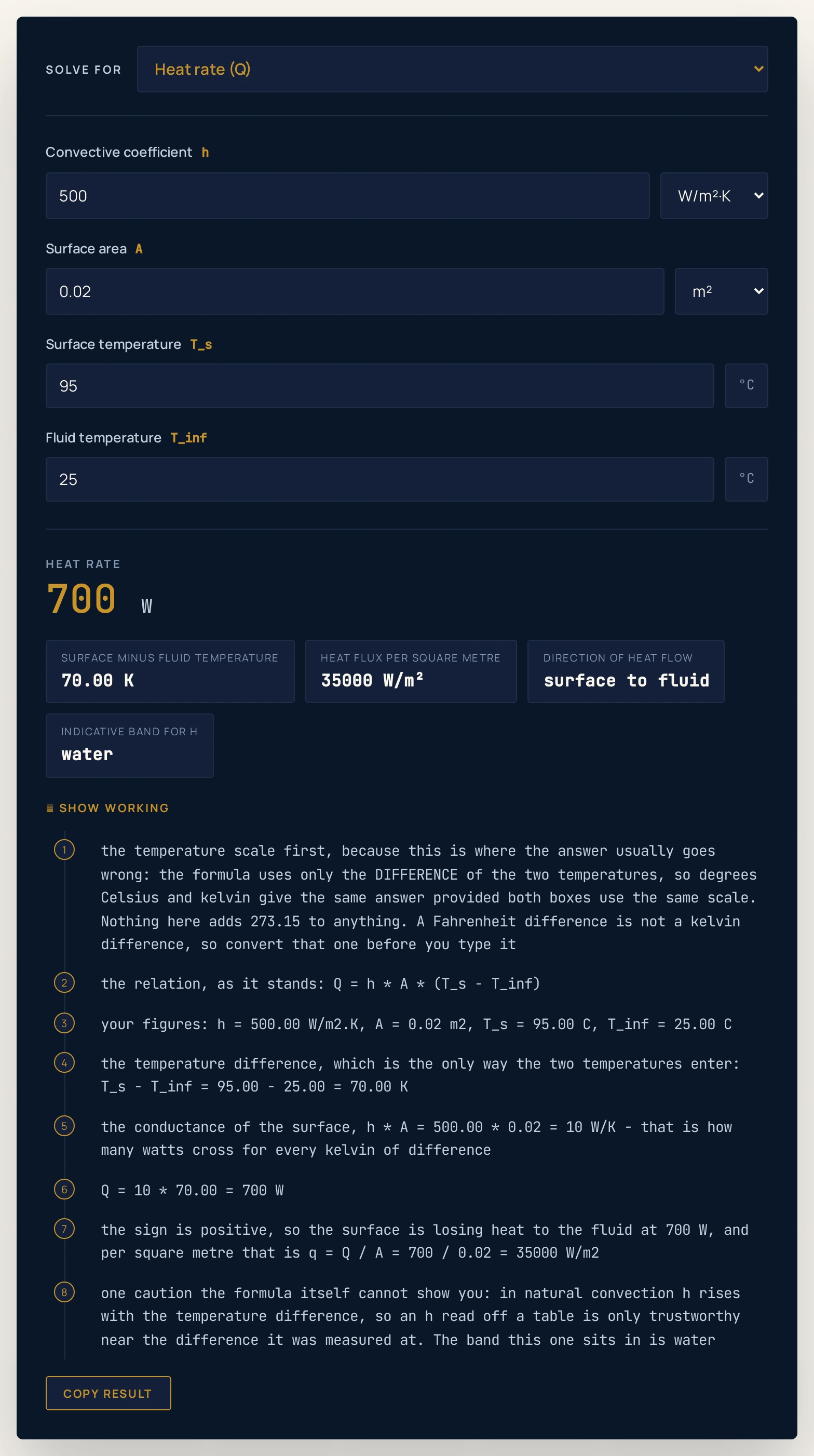
water because 500 is above the moving-air band entirely.Where the thermal convection calculator breaks down
- It takes
has a given, andhis the hard part - Nothing on this page works the coefficient out from a geometry, a fluid or a flow speed; it is an input, and the chip beside the answer can only tell you which order-of-magnitude band your figure sits in. Published tables for those bands disagree with one another by orders of magnitude, so treat any single tabulated value as a starting estimate. Where a reader needs the coefficient built up from the fluid and the temperature difference instead of assumed, the thermal convection guide is where that is done.
- A fluid layer heated from below may not be convecting at all
- Below a threshold the fluid simply does not move, and then this formula describes nothing: heat crosses by conduction. For a wide horizontal layer between rigid plates the Rayleigh number must exceed about 1708, which for 15 K across a still-air gap means a height of about 10.4 mm — narrower than that and the gap conducts only, at 39.5 W/m2 for a 10 mm gap. Water at the same 15 K convects down to about 2.01 mm, which is the one-line reason an air gap insulates and a water gap does not.
- Linear in the difference is an assumption, not a result
- Every row of the worked table above is exactly proportional to the temperature difference because the coefficient was held fixed by hand. In natural convection it is not fixed, and the vertical-plate figures quoted above show an eightfold difference producing 13.356 times the heat rate rather than 8 times. The further apart the two temperatures, the more a single
hunderstates the answer. - It is a surface relation, not a wall
- The two temperatures are the surface and the bulk fluid, so the answer is the rate at one face and nothing more. Heat crossing the solid behind that face is a different formula entirely — the thermal conduction calculator does Fourier's law through a slab of known thickness, and the two pages are one letter apart in the address bar. Putting the two in series, which is how a real wall behaves, is neither page's job.
- Nothing here happens over time
- There is no time input of any kind, so the answer is a rate in watts at one instant and one state. How long a hot object takes to cool, how quickly it approaches the fluid temperature and the exponential shape of that approach are a separate calculation with a separate formula. The flux side of the same reading — watts per square metre rather than watts — is the heat flux calculator's quantity, and this page prints it only as a chip.
Where thermal convection is actually used
- Turning a measured heat rate into a coefficient
- In practice the rate and the two temperatures are what get measured and
his what gets inferred, which is what the Solve for menu is really for. Measure 150 W off a 0.25 m2 plate sitting 60 K above its air and the coefficient mode returns10W/(m2·K), which the band chip places in still or barely moving air. That is the honest direction of the inference: the rate is the observation and the coefficient is the conclusion. - Sizing a surface for a heat rate you already know
- Given a rate to shed and a coefficient you can defend, the area mode answers how much surface it takes. At
h= 25 W/(m2·K) and a 40 K difference, 1500 W needs1.5m2. Halve the coefficient, as a still room rather than a draughty one would, and the same rate needs twice the area — which is why fins exist. - Choosing the fluid rather than the temperature
- Swapping air for water is the largest single lever in the formula, and the Water instead of air preset is there to show it: 500 against 25 W/(m2·K) for the same relation. That is why a water jacket cools an engine and a fan alone would not, and why the flux chip reaches 35000 W/m2 on an area of 0.02 m2. The three mechanisms side by side, with the coefficient on a slider, are in the heat transfer simulator.
- Checking a sign before checking the arithmetic
- A negative heat rate is not a slip, and reading it as one is a common way to lose an answer: it means the fluid is the warmer of the two. The Direction of heat flow chip exists so that the sign cannot be misread, and the Swapped preset puts the case on screen deliberately. A rate and a difference that disagree in sign while the area is being solved for, on the other hand, is a genuine impossibility and is refused.
- Knowing when to stop using this formula
- Two states make the relation the wrong tool rather than an imprecise one: a fluid that is not moving at all, where conduction is the whole story, and a temperature range wide enough that a single coefficient cannot cover it. Both have a number attached rather than a feeling — the Rayleigh threshold of 1708 for the first, and the 13.356-against-8 comparison for the second. Everything else about how the two quantities relate is in the guide to heat against temperature.
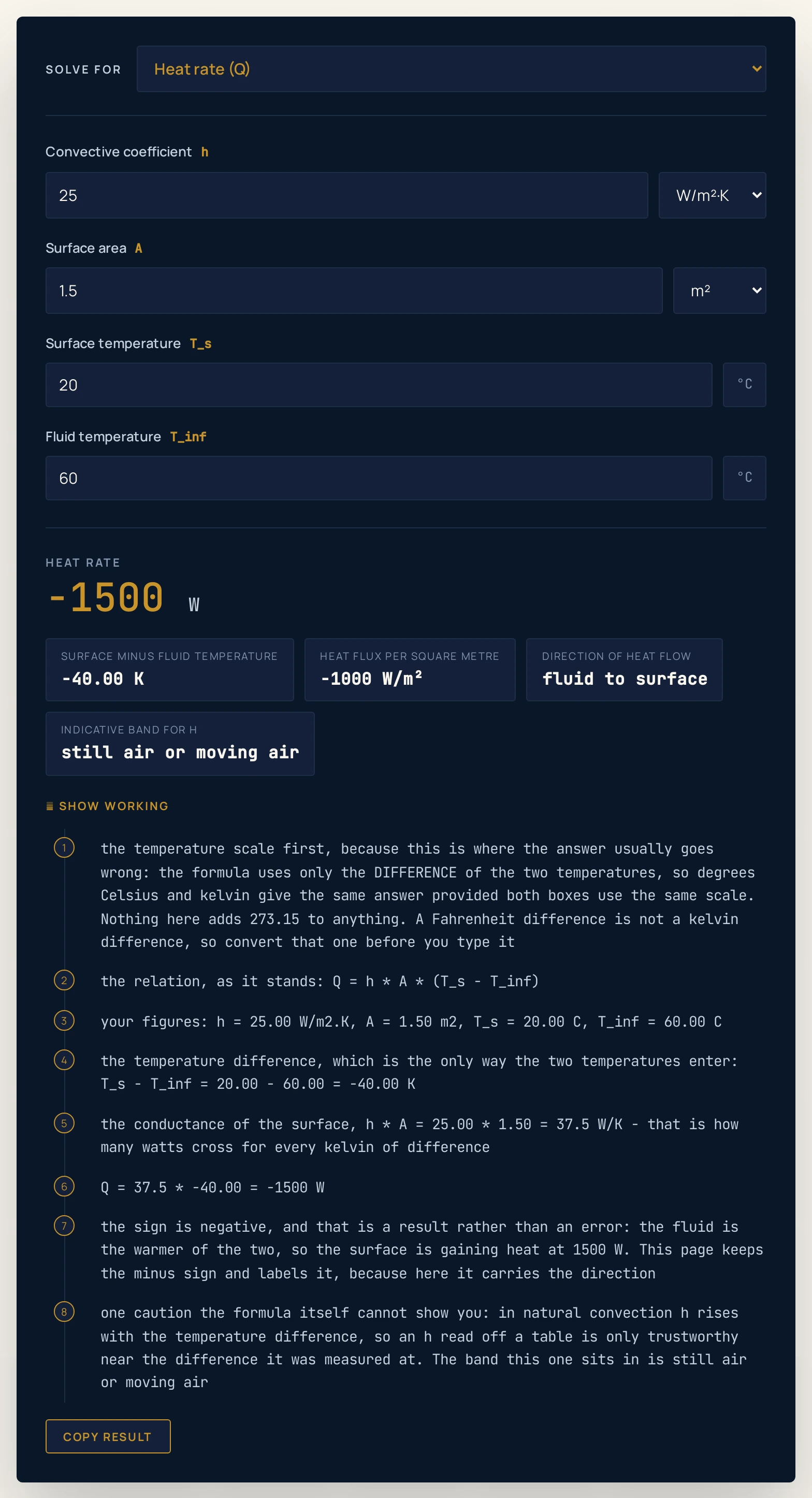
-1500 W, and the direction chip reads fluid to surface: the surface is gaining heat. The sign is the answer here, which is why it is not hidden behind a magnitude.Where to go next
For the definition, the threshold argued out in prose and a full set of worked problems, read the thermal convection guide, which this tool is the arithmetic half of. The guide to conduction, convection and radiation sets the three mechanisms side by side, the Fourier's law guide covers the conduction case a still layer falls back on, and the heat flux guide covers the per-square-metre reading this page prints as a chip.
Five tools sit beside this one. The thermal conduction calculator does Fourier's law through a slab; the heat flux calculator does watts per square metre on its own; the thermal diffusivity calculator does how fast a temperature change spreads; the heat transfer simulator puts all three mechanisms on one screen; and the Fourier's law simulator runs the conduction half interactively. The full physics lab library and the calculator index are open too.
Frequently asked questions
What does the thermal convection calculator work out?
It works out the convective heat rate between a surface and the fluid washing it, from Q = hA(Ts - Tinf), where h is the convective heat transfer coefficient in W/(m²·K), A is the wetted area in square metres and the two temperatures are in degrees Celsius. The same relation is rearranged four more ways, so you can enter any four of the five quantities and read the fifth. The answer is a rate in watts, not an amount of energy in joules.
What is the formula for convective heat transfer?
It is Q = hA(Ts - Tinf), usually called Newton's law of cooling. Q is the heat rate in watts, h the convective heat transfer coefficient in W/(m²·K), A the area in contact with the fluid and Ts - Tinf the temperature difference between the surface and the bulk fluid. It is a definition of h as much as a prediction of Q, which is why h is where all the awkward physics of the flow ends up.
What are the units of the convective heat transfer coefficient h?
Watts per square metre per kelvin, written W/(m²·K). Read the unit as the answer to a question: how many watts cross each square metre for each kelvin of temperature difference. Because a kelvin and a degree Celsius are the same size, the unit is unchanged whether the difference is quoted in one or the other.
Do I enter the temperatures in Celsius or in kelvin?
Either, as long as both boxes use the same scale, because the formula only ever uses the difference between them. A surface at 60 and a fluid at 20 degrees Celsius gives exactly the same heat rate as 333.15 and 293.15 kelvin, since both pairs differ by 40. The boxes are labelled in degrees Celsius and nothing on this page adds 273.15, so a mixed pair would be wrong by that amount and the page would have no way to tell.
What is the difference between natural and forced convection?
In natural convection the fluid moves because the heat itself makes it buoyant; in forced convection a pump or a fan moves it regardless. The formula on this page is the same for both, but the value of h is not: forcing the fluid along raises it, often by an order of magnitude. The deeper consequence is that natural-convection h depends on the temperature difference, while a pumped flow is much closer to the constant the formula appears to assume.
Why is the convective heat transfer coefficient not just a constant?
Because in natural convection the fluid speed is produced by the temperature difference, so raising the difference drives a brisker flow, and that brisker flow leaves a thinner sluggish layer for the heat to cross. On a 0.30 m vertical plate in air, raising the difference from 10 K to 80 K raises h by a factor of 1.670 and the heat rate by a factor of 13.356 rather than the factor of 8 a constant h would predict. That is why this page gives h as indicative bands and says what it is doing.
Can the calculator return a negative heat rate?
Yes, and it is a result rather than an error. A negative Q means the fluid is warmer than the surface, so the heat is flowing from the fluid into the surface: at h = 25, A = 1.5 m², a surface at 20 and a fluid at 60 degrees Celsius the answer is -1500 W. The chip beside the answer turns that sign into words so it cannot be misread.
How hot does a fluid have to get before convection starts at all?
For a fluid layer heated from below there is a genuine threshold, and below it nothing moves: the Rayleigh number has to exceed about 1708, and heat crosses by conduction alone until it does. With 15 K across a still-air gap that means a gap narrower than about 10.4 mm cannot convect at all. The same 15 K in water convects down to about 2.01 mm, which is why an air gap insulates and a water gap does not.
Why does this calculator not work out h for me?
Because working h out needs the geometry, the fluid properties and the flow regime, and a page that invented one from three boxes would be hiding the hardest part of the problem. What this page does instead is take h as a stated input, name the band it belongs to, and solve the relation in any of its five directions. The simulator linked from this page is where the coefficient itself is built up from the fluid and the temperature difference.
References & formula source
- The convective heat rate on this page is computed as Q = h · A · (Ts − Tinf), Newton's law of cooling, with h the convective heat transfer coefficient in W/(m²·K), A the area of the surface in contact with the fluid in m² and Ts and Tinf the surface and bulk-fluid temperatures. Q is a rate in watts, never an amount of energy in joules. This is the surface relation only: it is not Fourier's law through a solid slab, which is /calculators/thermal-conduction.
- The two temperatures are entered in degrees Celsius and the formula uses only their difference, so the same figures in kelvin give an identical answer provided both are converted. Nothing on this page adds 273.15 to a temperature. The single appearance of that constant is as a floor: the two temperature directions refuse to print a result below absolute zero rather than printing it.
- A negative heat rate is kept and labelled on this page rather than reported as a magnitude, because in Newton's law the sign carries the direction: it means the surface is gaining heat from a warmer fluid. That is a deliberate exception to the convention used for a heated fluid layer elsewhere in this topic, where the flux is reported as a magnitude with a direction word; the two are different quantities and are not unified.
- Values of h are given as indicative, order-of-magnitude bands and never as point values: still air about 2 to 25, moving air about 10 to 200 and water about 50 to 10000 W/(m²·K). Published tables for these bands disagree with one another by orders of magnitude, so a figure taken from any one of them is a starting estimate rather than a measurement. No h on this page is attributed to a named object.
- For natural convection h is itself a function of the temperature difference, so the relation is only approximately linear in ΔT. The quantitative illustration quoted on this page is for an isothermal vertical plate of height 0.30 m in air at 20 °C, evaluated with the Churchill–Chu laminar correlation Nu = 0.68 + 0.670·Ra^(1/4) / [1 + (0.492/Pr)^(9/16)]^(4/9): raising ΔT from 10 K to 80 K raises h from 3.32 to 5.54 W/(m²·K) and Q at A = 1 m² from 33.2 to 443 W, which is 1.670 times and 13.356 times. The heat rate grows roughly as ΔT^(5/4), but not exactly: the additive 0.68 term makes that power law asymptotic, so the measured ratios are quoted and the idealised ones are not.
- The onset figures quoted in the limits section are for a wide horizontal fluid layer heated from below, where the critical Rayleigh number is 1708 for two rigid plates. With 15 K across a still-air gap the layer begins to convect at a height of about 10.4 mm, and below that heat crosses by conduction alone at 39.5 W/m² for a 10 mm gap; water at the same 15 K convects down to about 2.01 mm. Those figures come from the property table this topic uses throughout, assembled from values this site already ships, and the vertical-plate correlation above is a different geometry and is never mixed with them in one statement.
- Every cell of the worked table, and every chip reading quoted beside an answer, is a string this calculator printed for the inputs named with it. The three anchor cases — h = 25 W/(m²·K) with A = 1.5 m² at 60 °C into 20 °C giving 1500 W, h = 10 with A = 0.25 m² at 80 °C into 20 °C giving 150 W, and h = 500 with A = 0.02 m² at 95 °C into 25 °C giving 700 W — are stated givens chosen to make a point and round-trip in all five directions, not measurements of any named object.
- This page computes a steady convective rate at one surface and nothing else. It has no time input, so it says nothing about how long a body takes to cool, about a time constant or about an exponential approach to equilibrium. It carries no U-value and no multi-layer wall, and it does not work the coefficient h out from a geometry or a flow speed.
- Halliday, Resnick and Walker, Fundamentals of Physics, chapter on temperature, heat and the first law of thermodynamics (the heat-transfer mechanisms).
- Young and Freedman, University Physics with Modern Physics, chapter on temperature and heat (conduction, convection and radiation).
- Further reading: Newton's law of cooling — Wikipedia