The turning effect on a motor’s coil is four numbers multiplied together and then one sine: τ = N·B·I·A·sin(θ), in newton metres. This free motor torque calculator runs that relation in five directions — point Solve for at the torque, the turns, the field, the current or the coil area — with θ measured from the coil normal, the line at right angles to the flat of the coil. Beside the answer it prints the peak the coil could reach, the average over a half turn, the flux through the same coil at the same angle, and the fraction of the peak you are getting. It is the torque on the coil at one instant, not a motor’s shaft output.
The angle is measured from the coil normal, not from the coil’s face. The normal is the line at right angles to the flat of the coil, and it is the same angle the magnetic flux calculator uses — so at 90 degrees the torque is at its largest and the flux through the coil is zero, while at 0 degrees the torque is zero and the flux is at its largest. Enter the angle to the coil’s face by mistake and you have entered its complement, which puts a cosine where the sine belongs. The coil area multiplies by 1e-4 for cm2, not by 0.01: an area is a length squared, so 3 cm2 is 3e-4 m2 and a multiplier copied off a length field is wrong by a factor of a hundred. Each mode reads five boxes and the angle is always one of them: the torque is worked from the turns, the field, the current and the area, and each of those four is worked back from the torque. The turns, the field and the area must be finite and greater than zero, and the answer is checked as well as the entry — 1e-320 T is a positive number, but a torque divided by it is not a number at all. The current is the one box that may be negative, and that is the commutator: reversing the current reverses the torque, so a negative current returns a negative torque rather than a refusal. At 0 and 180 degrees the four backwards modes have no answer at all — every number of turns gives zero torque there, so there is nothing unique to return, and the page declines instead of printing a guess.
Load a real case
Every button writes all six boxes at once, so whichever quantity the Solve for menu is pointing at, the remaining five already describe the same coil. The line underneath quotes back whatever the widget works out from that, so nothing in it is stored text. These are illustrative configurations chosen to span six decades of torque, not the specification of any real product.
Pick a coil above, or type your own numbers.
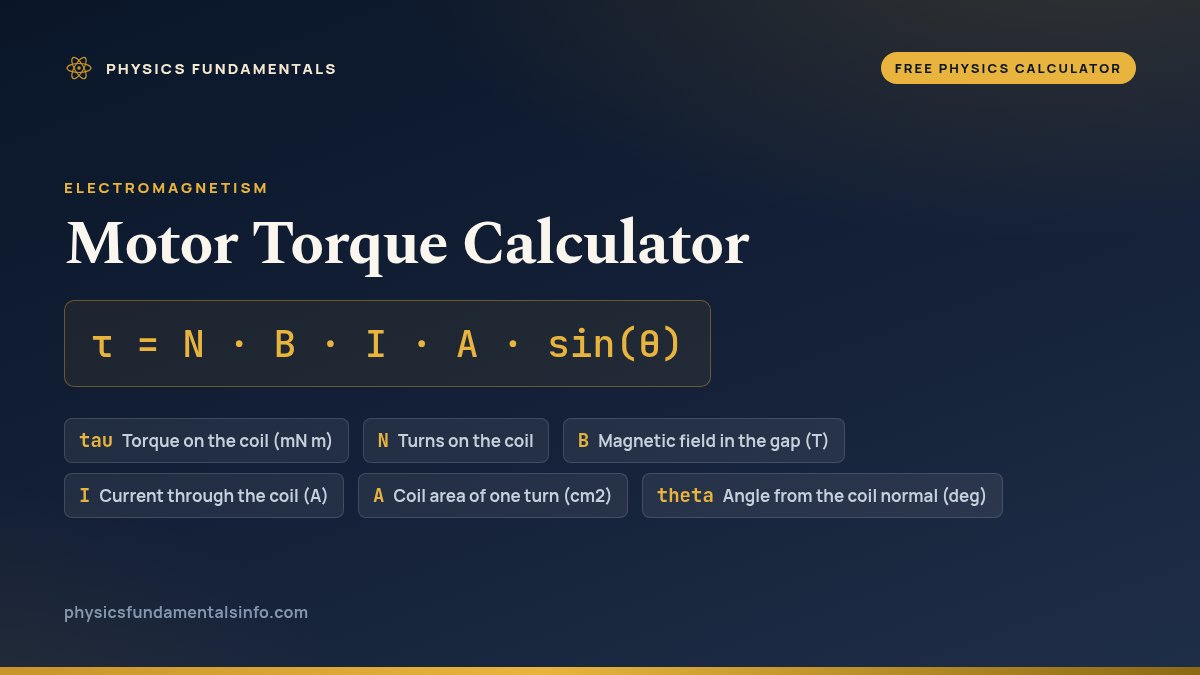
What Is the Motor Torque Calculator?
The motor torque calculator is a free online tool for the turning effect a uniform magnetic field has on a flat current-carrying coil: τ = N·B·I·A·sin(θ), in newton metres. Give it the turns on the coil, the field, the current, the area of one turn and the angle, and it returns the torque; point the Solve for menu at any one of those four factors instead and it runs the same relation in that direction. Beside the answer it prints the peak torque the coil could reach, the average over a half turn, the flux through the same coil at the same angle, and the fraction of the peak the answer represents.
The angle is measured between the field and the coil normal, which is the line at right angles to the flat of the coil, and that is the single most common slip on this formula. A coil lying along the field is at 90 degrees, where the sine is 1 and the torque is at its largest. A coil facing the field square on is at 0 degrees, where the sine is 0 and the torque is exactly zero however large the current is. Measured to the coil face instead you have entered the complement, which puts a cosine where the sine belongs.
The same angle, read through a cosine instead, gives the flux through that coil — so the torque is largest exactly where the flux is zero. That pairing is why the page prints the flux beside the torque rather than leaving the two on separate tools: at 90 degrees the torque is the whole of N·B·I·A and the flux is nothing at all, and at 0 degrees the two have swapped places. Squaring each against its own maximum and adding gives 1 at every angle, which the cluster reference script checks at all 361 whole degrees.
The two angles where the torque vanishes are the dead points, and they are the reason an electric motor has a commutator at all. A coil that arrives at a dead point with its current unchanged has nothing to turn with, and its average torque over a whole turn is zero. Reverse the current every half turn and the average becomes 2/π of the peak — 0.6366197723675814, or 63.6620 per cent — which is the number the extra part buys.
The page opens on one coil at the drive point: 100 turns, 0.1 T, 0.5 A, an area of 3 cm2 and an angle of 90 degrees, which gives 1.5 mN m. At 90 degrees the sine is exactly 1, so the opening answer is exactly N·B·I·A and the formula is visible in it. All six boxes describe the same coil, because the engine rebuilds every box from its opening value whenever the Solve for menu changes.
The coil area is a length squared, so its unit conversions run twice as far as a length’s. One square centimetre is a ten-thousandth of a square metre and not a hundredth, and one square millimetre is a millionth: 3 cm2 is 3e-4 m2 and 300 mm2, all three of which this page accepts and treats as one area. A multiplier copied across from a length field is wrong by a factor of a hundred, which is why the unit menu on that box is the part worth checking twice. The area wanted is the area of ONE turn, because the turns are already counted in the box beside it.
Every box is checked for being a finite number rather than merely for having the right sign, and the answer is checked as well as the entry. An infinity is greater than zero, and a field of 1e-320 tesla is a finite positive number while a torque divided by it is not a number at all, so a guard on the input alone would let an infinity through into a finite-looking answer. The turns, the field and the coil area must be finite and greater than zero in every mode that reads them.
The current is the one deliberate exception, and it may be negative. Reversing the current is exactly what a commutator does, so a negative current returns a torque of the same size with the opposite sign rather than a refusal, and that sign is the useful part. The four backwards modes return sizes, so those do decline a negative entry. The product N·I·A is carried beside the answer as one reading, the coil moment N I A, which is why those three factors always travel together.
At 0 and 180 degrees the four backwards modes have no answer at all, and the page declines rather than guessing. Every number of turns gives zero torque at a dead point, so a required torque of zero is satisfied by every coil and a required torque of anything else by none; dividing by the sine would be dividing by exactly zero. The angle itself is never a solve target either, and that is a decision rather than a gap: inverting a sine is double-valued, a torque produced at 30 degrees is produced again at 150, and a coil passes through both on every turn.
What the page does not compute, stated as omissions rather than as assumptions that happen to hold: a speed, an acceleration, a power, a revolution rate or a motor’s shaft output. The answer is the torque on the coil at ONE INSTANT, and turning that into a motion needs a load and a moment of inertia that appear nowhere here. Where the field comes from is outside the model as well — it is an input, supplied either by permanent magnets or by field coils — and so is the direction of the turn, which has its own rule.
The arithmetic assumes a uniform field, a flat coil of negligible thickness, a steady current and no losses. A real machine shapes the field in its gap so the turning effect stays near its peak through much of the turn, which a flat sine cannot describe; a spinning coil generates an opposing emf that cuts the current the supply actually delivers; and real brushes have resistance, arc as they cross a segment and wear. Each of those is an idealisation, and each is named on the page rather than left implicit.
| Symbol | Quantity | Default unit | Also accepts | Example value |
|---|---|---|---|---|
| tau | Torque on the coil | mN m | N m, N cm | 1.5 |
| N | Turns on the coil | — | — | 100 |
| B | Magnetic field in the gap | T | mT, G | 0.1 |
| I | Current through the coil | A | mA, uA | 0.5 |
| A | Coil area of one turn | cm2 | mm2, m2 | 3 |
| theta | Angle from the coil normal | deg | rad | 90 |
How to use the motor torque calculator
- Measure the angle from the coil normal. The normal is the line at right angles to the flat of the coil, and
θis the angle between it and the field. A coil lying along the field is at90degrees and gives the largest torque; a coil square to the field is at0and gives none. - Choose the unknown. The Solve for menu opens on Torque, and the other four choices are Turns on the coil, Magnetic field, Current and Coil area. Switching it returns every box to its opening value, so set the menu first and type second.
- Enter the turns and the area of one turn. The turns box is a plain count with no unit. The area box is the area of a single turn, because the turns are already counted in the box beside it — a hundred turns of a
3cm2 coil isN = 100andA = 3, neverA = 300. - Check the unit on the area box before you trust the answer. An area is a length squared, so
cm2multiplies by1e-4andmm2by1e-6. Copy a multiplier off a length field and you are out by a factor of a hundred. - Enter the field and the current. The field takes
T,mTorG, where one gauss is1e-4T. The current takesA,mAoruA, and it is the only box that accepts a negative number. - Enter the angle. It opens at
90degrees and accepts anything up to a full turn, in degrees or radians. It is an input in every mode and never a solve target, which is a decision explained further down. - Read the answer. The headline carries four significant figures, trailing zeros dropped, in whichever unit that box’s own menu is set to. The torque box opens in
mN m, so the opening answer reads1.5 mN m. - Read the peak and the mean beside it. The second reading is the size of
N B I Awith no sine in it, the ceiling no answer can pass in size; the third is the average over a half turn with the current reversed each half turn, which is2/πof that peak. Both are sizes and both carry ten significant figures. - Read the flux and the fraction of peak. The fourth reading is
Φ = B·A·cos(θ)for the same coil at the same angle; the fifth issin(θ)itself. When one of those two is at an extreme the other is at zero. - Open Show working. The steps state the angle convention, name the boxes the mode read and convert them to SI, substitute, give the dead point and the
2/πmean, print the same coil as a flux, and close on what the number is not.
This page exists for the one step that turns a current into a turning effect, and for the angle that decides how much of it you get. The electric motor parts guide is the prose half of it, where each part of the machine is tied to a factor in the formula and the problems are worked. The sideways push on each individual side of the coil is the F = BIL force, which the magnetic field guide sets out and this page does not repeat.
Three mistakes account for most wrong answers here. The first is measuring θ to the coil’s face rather than to its normal, which swaps the sine for a cosine — the magnetic flux calculator is the tool that genuinely wants the cosine, on the identical angle. The second is entering the total area of every turn instead of one. The third is reading the answer as a shaft rating rather than as the torque on the coil at one instant.
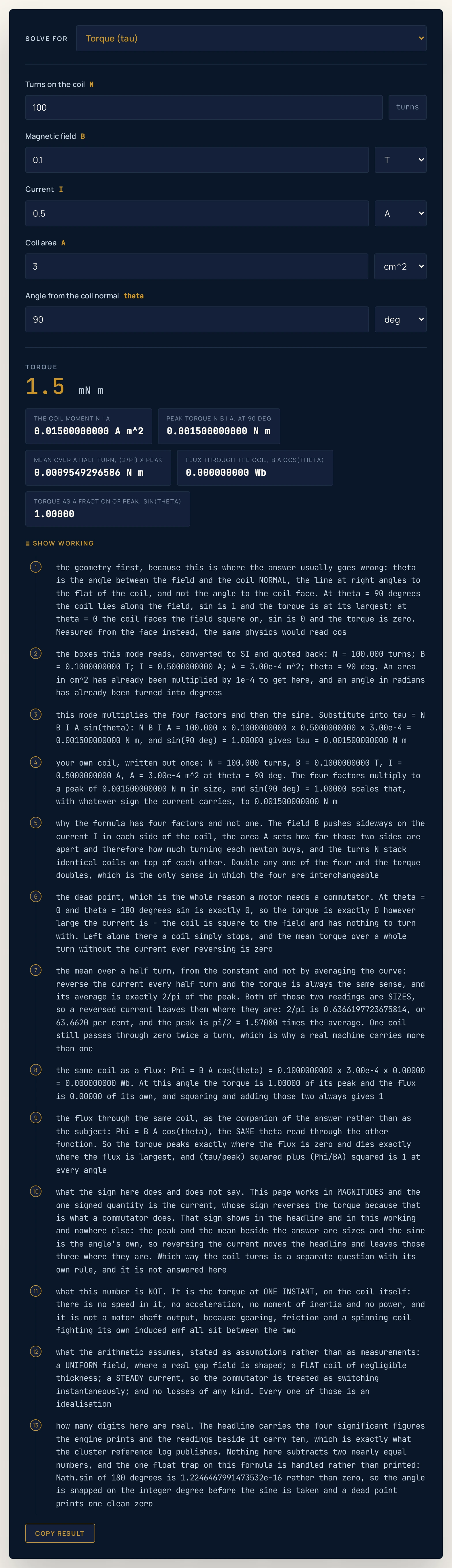
1.5 mN m, while the peak reading carries the full 0.001500000000 N m — and the two are the same number, because at 90 degrees the sine is exactly 1. The flux reading beside it is 0.000000000 Wb: maximum torque, zero flux, one angle.Worked example: change one thing at a time
The table starts at the opening coil, moves the angle alone through the drive point, the half-way case and both dead points, then reverses the current, then changes the coil. It ends on the four backwards modes and the entries the calculator declines. Every answer, peak and flux cell was taken from the running widget rather than worked out by hand, and where a cell and the tool ever part company, believe the tool.
| Step | Solving for | What you type | Headline answer | Peak torque | Flux through the coil |
|---|---|---|---|---|---|
| The page as it opens: the hobby coil at the drive point | Torque | N = 100, B = 0.1 T, I = 0.5 A, A = 3 cm2, theta = 90 | 1.5 mN m | 0.001500000000 N m | 0.000000000 Wb |
| Change ONE thing: the angle, to 30 degrees, where the sine is a half | Torque | theta = 30 | 0.75 mN m | 0.001500000000 N m | 0.00002598076211 Wb |
| Change ONE thing: the angle, to the dead point | Torque | theta = 0 | 0 mN m | 0.001500000000 N m | 0.00003000000000 Wb |
| The other dead point, half a turn on | Torque | theta = 180 | 0 mN m | 0.001500000000 N m | -0.00003000000000 Wb |
| Reverse the current, which is what the commutator does | Torque | I = -0.5 A, theta = 90 | -1.5 mN m | 0.001500000000 N m | 0.000000000 Wb |
| The same area typed in square metres instead of square centimetres | Torque | A = 0.0003 m2, theta = 90 | 1.5 mN m | 0.001500000000 N m | 0.000000000 Wb |
| The same area again, typed in square millimetres | Torque | A = 300 mm2, theta = 90 | 1.5 mN m | 0.001500000000 N m | 0.000000000 Wb |
| A different coil: the classroom demo coil at 60 degrees | Torque | N = 20, B = 0.05 T, I = 2 A, A = 100 cm2, theta = 60 | 17.32 mN m | 0.02000000000 N m | 0.0002500000000 Wb |
| A bigger one: the power tool coil at 45 degrees | Torque | N = 50, B = 0.35 T, I = 15 A, A = 12 cm2, theta = 45 | 222.7 mN m | 0.3150000000 N m | 0.0002969848481 Wb |
| A tiny one: the galvanometer coil at full-scale current | Torque | N = 200, B = 0.2 T, I = 0.0001 A, A = 2 cm2, theta = 90 | 0.0008 mN m | 8.000000000e-7 N m | 0.000000000 Wb |
| The exactness anchor: one of each, so every factor is 1 | Torque | N = 1, B = 1 T, I = 1 A, A = 10000 cm2, theta = 90 | 1000 mN m | 1.000000000 N m | 0.000000000 Wb |
| Backwards: how many turns would reach 1.5 mN m at the drive point | Turns on the coil | tau = 1.5 mN m, B = 0.1 T, I = 0.5 A, A = 3 cm2, theta = 90 | 100 turns | 0.001500000000 N m | 0.000000000 Wb |
| Backwards: what field would reach it with 100 turns | Magnetic field | tau = 1.5 mN m, N = 100, I = 0.5 A, A = 3 cm2, theta = 90 | 0.1 T | 0.001500000000 N m | 0.000000000 Wb |
| Backwards: what current would reach it | Current | tau = 1.5 mN m, N = 100, B = 0.1 T, A = 3 cm2, theta = 90 | 0.5 A | 0.001500000000 N m | 0.000000000 Wb |
| Backwards: how large a coil would reach it | Coil area | tau = 1.5 mN m, N = 100, B = 0.1 T, I = 0.5 A, theta = 90 | 3 cm^2 | 0.001500000000 N m | 0.000000000 Wb |
| Backwards at 30 degrees, where twice the coil is needed | Turns on the coil | tau = 1.5 mN m, B = 0.1 T, I = 0.5 A, A = 3 cm2, theta = 30 | 200 turns | 0.003000000000 N m | 0.00002598076211 Wb |
| Backwards at the dead point has no unique answer | Turns on the coil | tau = 1.5 mN m, theta = 0 | no answer | - | - |
| Backwards at the other dead point, the same refusal | Magnetic field | tau = 1.5 mN m, theta = 180 | no answer | - | - |
| A field small enough to make the answer an infinity is declined on the OUTPUT | Turns on the coil | tau = 1.5 mN m, B = 1e-320 T, theta = 90 | no answer | - | - |
| Zero turns is declined | Torque | N = 0, theta = 90 | no answer | - | - |
| A negative coil area is declined | Torque | A = -3 cm2, theta = 90 | no answer | - | - |
Rows 1 to 4 are one coil with only the angle moving, and the peak column never moves with it: the peak is the four factors multiplied, so it describes the coil rather than its position. Row 2 is the half-way case: the sine of 30 degrees is a half, so the reading is half the peak to every digit printed. Rows 3 and 4 are the two dead points, where the torque is a clean 0 and the flux is at its largest size.
Row 5 is the commutator in one line: reverse the current and the torque comes back the same size with the opposite sign, while the peak column holds its figure, because that reading is a size. Rows 6 and 7 are the same coil with its area typed in all three units, which is the check worth doing before trusting any figure on this page — 3 cm2, 0.0003 m2 and 300 mm2 are one area.
Rows 8 to 11 change the coil instead of the angle, across more than six decades of torque, and row 11 is the one to read twice: with every factor set to 1 the answer is exactly 1.000000000 N m, which is the state where the formula is completely transparent. Rows 12 to 16 run the four backwards modes on that same opening state, and row 16 shows the price of the angle — at 30 degrees the same torque needs 200 turns instead of 100, and the peak reading doubles with them.
Rows 17 to 21 are the refusals, and the first two are the ones that matter. At a dead point there is no unique coil to find, because every coil gives zero torque there, so the page declines instead of dividing by zero. Row 19 is declined on the answer rather than on the entry: 1e-320 T is a positive number, but a torque divided by it is not a number at all.
Formula and symbol reference
One relation does the work: τ = N·B·I·A·sin(θ), which rearranges to N = τ/(B·I·A·sin θ) and to the matching forms for B, I and A. The product N·I·A is printed beside the answer as the coil moment N I A, which is why those three factors always travel together: double the turns and halve the area and the torque does not move. The newton metre is the same unit of turning effect that the torque calculator and the torque guide use for a force on a lever arm.
The unit column below is the one place a reader can go wrong without noticing. A length’s cm multiplies by 1e-2, but an area’s cm2 multiplies by 1e-4, because both of its lengths shrink at once. The angle is held in degrees internally and a radian entry is converted to degrees before the sine is taken, so the two dead points and the two drive points stay exact.
Two rows in the table are not boxes. peak is the same four factors with the sine left out, and mean is what the coil averages over a half turn once the current is reversed each half turn. Both appear in the readings beside the answer; neither appears in the widget, and neither depends on the angle at all.
| Symbol | Meaning | Unit | Values used on this page |
|---|---|---|---|
| tau | Torque on the coil: the turning effect the field has on it, at one instant | N m (menu: N m, mN m, N cm) | Opens on 1.5 mN m, which is 0.001500000000 N m. The buttons above the widget reach 8.000000000e-7 and 1.000000000 N m. |
| N | Turns on the coil: how many times the wire goes round, each one carrying the same current | a plain count | Opens on 100. The presets use 1, 20, 50, 100 and 200 turns. |
| B | Magnetic field in the gap the coil turns in, supplied rather than predicted here | T (menu: T, mT, G) | Opens on 0.1 T. The presets reach 0.05, 0.2, 0.35 and 1 T. One gauss is 1e-4 T. |
| I | Current through the coil. The one box that may be negative, because a commutator reverses it | A (menu: A, mA, uA) | Opens on 0.5 A. The presets reach 1e-4, 1, 2 and 15 A. |
| A | Area of one turn of the coil, not of all the turns added together | m2 (menu: mm2, cm2, m2) | Opens on 3 cm2, which is 3e-4 m2 and 300 mm2. The unit coil’s 1 m2 is 10000 cm2. |
| theta | Angle between the field and the coil normal, the line at right angles to the flat of the coil | deg (menu: deg, rad) | Opens on 90, the drive point. 0 and 180 are the dead points; the table above also uses 30, 45 and 60. |
| peak | The same four factors with no sine at all, taken as a size: the largest torque this coil can make, and the ceiling no answer can pass in size | N m | A reading, not a box: 0.001500000000 N m on the opening coil, 0.3150000000 N m on the power tool coil. |
| mean | The average over a half turn once the current is reversed each half turn, which is 2/π of the peak | N m | A reading: 0.0009549296586 N m on the opening coil. The ratio 2/π is 0.6366197723675814, or 63.6620 per cent. |
The physics: one angle, two trig functions
The field pushes sideways on the current in each side of the coil. Those two pushes act on opposite sides of the shaft, so instead of moving the coil along they turn it, and the area of the coil is what sets how far apart the two forces are. Stack N identical turns and each one adds the same amount, which is where the N comes from.
The angle decides how much of that push does any turning. At 90 degrees the whole of it is working, and the torque is simply N·B·I·A. At 0 degrees both pushes lie in the plane of the coil, pulling its two sides apart along one and the same line, so there is no leverage at all and the torque is exactly zero no matter how large the current is.
That same angle reads the flux through the coil as Φ = B·A·cos(θ) — the identical θ, through the other function. So the two cross: the torque is largest exactly where the flux is zero, and zero exactly where the flux is largest. Squaring each of them against its own maximum and adding gives 1 at every angle, which the cluster reference script checks at all 361 whole degrees.
There is a deeper way to say the same thing: the torque is the current times the rate at which the flux through the coil changes with angle. That is why the peak sits where the flux crosses zero, because a cosine changes fastest where it passes through nothing. The magnetic flux guide is where the flux side of that pairing is set out, and this page only borrows it.
The last piece is what the dead point costs. A coil that reaches 0 degrees and keeps its current stops there, and over a whole turn its average torque is zero. Reverse the current every half turn instead and the average becomes 2/π of the peak — 63.6620 per cent — which is the number the commutator buys and the reason the part exists at all.
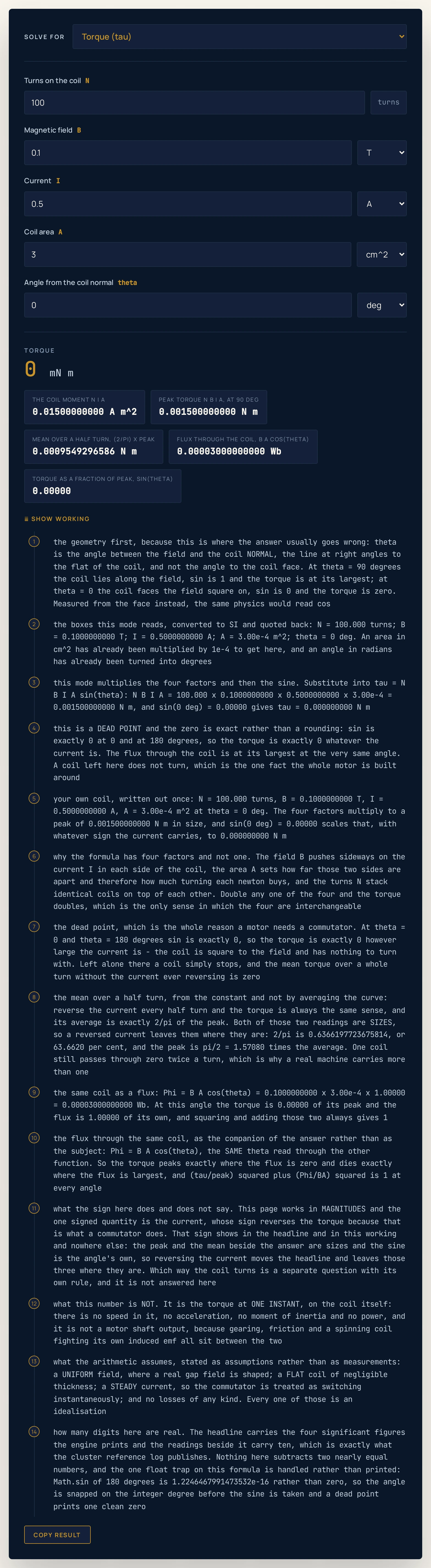
0 mN m — not 1.22e-16, because the angle is snapped on the whole degree before the sine is taken — while the peak reading has not moved, since the peak describes the coil and not its position. The flux is now at its largest, 0.00003000000000 Wb, which is exactly where the torque is at its smallest.Where this arithmetic breaks down
Every step here is a multiplication or a single division with nothing to accumulate, and the one floating-point trap on this formula is handled rather than printed: the sine of 180 degrees comes out of binary arithmetic as 1.2246467991473532e-16 instead of zero, so the angle is snapped on the whole degree before the sine is taken. What goes wrong is physical, or it is the angle convention, and the first two items are the ones worth reading.
- The angle is to the normal, and that is the usual slip
- This is the one to read. Measure
θto the coil’s face instead of its normal and you have entered its complement, so a sine does a cosine’s job and the answer is wrong everywhere except at45degrees. The convention is the same one the magnetic flux calculator states, deliberately, so that one angle serves both. - A real gap field is not uniform
- The formula assumes the same field everywhere across the coil. A real machine shapes the field in its gap so that the turning effect stays near its peak through much of the turn, which is precisely what a flat uniform field cannot do. Treat the sine here as the textbook idealisation rather than as the curve a particular motor follows.
- It is one instant, not a motion
- The answer is the torque the coil makes at the angle you typed. It predicts no speed, no acceleration and no power, because that needs the load and the moment of inertia the coil is turning, neither of which appears anywhere on this page. Nothing here may be read as a rating.
- A spinning coil fights itself
- A moving coil generates an emf of its own that opposes the supply and so cuts the current actually flowing, which means
Iis not the constant this page treats it as once the machine is running — the electromagnetic induction guide is where that effect belongs, and running this same machine backwards is how a generator works. It is named here and developed nowhere. - Magnitudes only
- This page returns sizes. The one signed quantity is the current, whose sign reverses the torque because that is a commutator’s whole job, and the sign of the answer in that case says only that the turning effect has reversed with it. Which way a given coil actually turns is a separate question with its own rule, and the guide to the direction rule is where it is settled.
- Where
Bcomes from is not modelled - The field is an input, not a prediction. In a real machine it is supplied either by permanent magnets or by field coils fed with their own current, and the electromagnet guide is where the second of those is explained. Nothing on this page works out a field from a current, or from a core, or from a material.
- The commutator is treated as instantaneous
- Reversing the current is modelled here as a sign change that costs nothing. Real brushes have resistance, they arc as they cross from one segment to the next, and they wear out, which is the whole reason brushless machines exist. None of that is in the arithmetic.
- The angle cannot be solved for, on purpose
- Inverting a sine is double-valued: a torque produced at
30degrees is produced again at150, and a coil passes through both on every turn. A box that returned one of the two would be wrong half the time, so the angle is an input in every mode and the page says so rather than guessing. - The calculator measures nothing — you supply the numbers
- Four factors and an angle go in, one relation is applied, and the answer describes the coil you described. The seven preset coils are illustrative configurations chosen to span six decades of torque; the inputs are our choice and only the torque is computed, so none of them is the specification of a real product.
Where the motor torque calculator is actually used
- Putting a number on a coil you have the dimensions of
- Enter the turns, the field, the current and the area of one turn and read the torque at the angle you care about. The peak reading beside it is the ceiling, so you can see at a glance how much of the coil’s capability the angle is costing you. That is the whole calculation a parts list cannot do.
- Sizing a coil backwards from a torque you need
- Point Solve for at the turns, type the torque you want and read how many turns would reach it. The answer is not rounded to a whole turn, so read it as the smallest coil that would do and round up. The same mode run at
30degrees instead of90shows the price of a bad angle immediately. - Seeing why a coil stalls at the dead point
- Load Dead point - zero torque and the headline is a clean
0while the flux reading is at its largest. Nothing is wrong: at that angle the forces have no leverage. It is the single fact a motor is designed around, and the reason the current has to be reversed at all. - Checking what reversing the current does
- Type a negative current and the torque comes back the same size with the opposite sign, which is the commutator in one line. The mean reading beside it is what that reversal buys over a half turn:
2/π, or63.6620per cent of the peak, against an average of zero if the current never reverses at all. - Working with a moving-coil instrument instead of a motor
- Load Galvanometer coil and the same relation gives
8.000000000e-7N m from a tenth of a milliampere, because the turns and the field are doing the work that a large current would otherwise have to. The relation is the same one; only the scale has changed. A loudspeaker coil is the same idea again. - Teaching the formula with nothing to hide behind
- Load Unit coil - 1 of each and every factor is
1, so the answer is1.000000000N m and each reading can be read straight off the formula. Then click through to the magnetic flux simulator to watch the companion cosine do the opposite thing on the same angle.
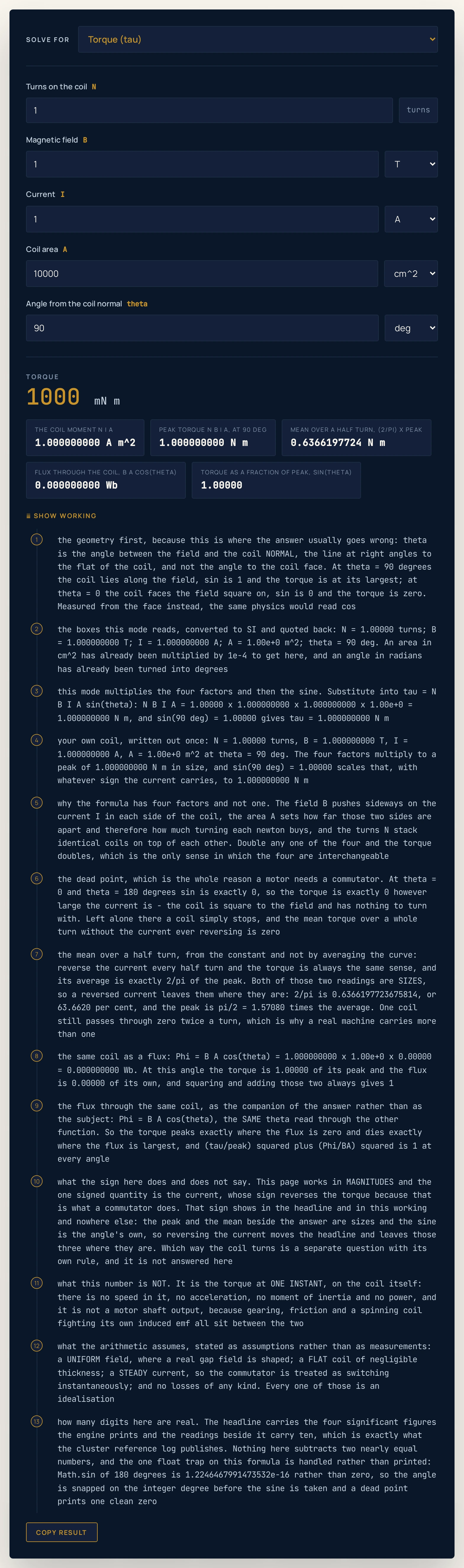
1.000000000 N m and the mean over a half turn is 0.6366197724 N m, which is 2/π itself. The area box shows the unit coil’s square metre in the opening unit, 10000 cm2 — the 1e-4 seen from the other end. The headline reads 1000 mN m because the torque box opens in millinewton metres.Where to go next
For the argument this arithmetic supports — the five parts of the machine, a reason for each one, the dead point and the mean over a half turn, with the problems worked — read the electric motor parts guide, which this tool is the calculating half of.
Four posts pick up the pieces this page uses but does not explain. The magnetic field guide is where the sideways force on a current-carrying wire comes from, the magnetic flux guide is the cosine companion of this page’s sine, the electromagnet guide is where a field coil gets its field, and the torque guide is the newton metre away from any magnetism at all.
Three tools sit next to this one. The magnetic flux calculator takes the same angle and returns webers, the torque calculator does the mechanical form with a force and a lever arm, and the Faraday’s law calculator runs the same coil backwards into an induced emf.
The full physics lab library and the calculator index are open too.
Frequently asked questions
What does the motor torque calculator work out?
It runs the torque on a flat coil in a uniform field in five directions: the torque itself from the turns, the field, the current, the coil area and the angle, and each of those four factors back from a required torque. Beside the answer it prints the peak torque the coil could reach, the mean over a half turn, the flux through the same coil at the same angle, and the fraction of the peak the answer represents. It computes no speed, no power and no shaft output.
Is the angle measured to the coil or to the field?
Neither, strictly: it is measured between the field and the coil normal, which is the line at right angles to the flat of the coil. That makes the torque largest at ninety degrees, where the coil lies along the field, and zero at nought degrees, where the coil faces the field square on. It is the same angle the magnetic flux calculator on this site uses, which is why one of them carries a sine and the other a cosine. Measure to the coil face by mistake and a sine is doing a cosine's job, so the answer is wrong everywhere except at forty-five degrees, where the two functions happen to agree.
Why is the torque zero when the coil is square to the field?
Because at that angle the two forces on the coil are pulling it apart rather than round. The sides still carry current and the field still pushes on them, but both pushes lie in the plane of the coil and pull its two sides apart along one and the same line, so they have nothing to turn the shaft with and the sine is zero with them. This is the dead point, and it is exactly why a motor needs a commutator: the flux through the coil is at its largest here while the torque is at its smallest.
Can I solve for the angle?
No, and that is a decision rather than a missing feature. Inverting a sine is double-valued, so a given torque is produced at an angle and at its supplement alike, and a coil passes through both of them on every turn. A box that quietly returned one of the two would be wrong half the time. If you need the angle, enter candidate angles in the angle box and compare the torques.
Why does the calculator refuse to solve backwards at zero and a hundred and eighty degrees?
Because at those angles there is no unique answer to find. The torque is zero there whatever the turns, the field, the current and the area are, so a required torque of zero is satisfied by every coil and a required torque of anything else is satisfied by none. Dividing by the sine would be dividing by exactly zero, so the page declines rather than printing an infinity or a silently wrong number.
Why does a negative current give a negative torque instead of an error?
Because reversing the current is what a commutator does, so a negative current is a real state rather than a mistake. The current box is therefore checked for being a finite number rather than for being positive, and the forward mode returns a torque of the same size with the opposite sign. The four backwards modes return sizes, so they do refuse a negative entry. Which way the coil turns is a separate question that this page does not answer.
Why is the coil area multiplied by a ten-thousandth for square centimetres?
Because an area is a length squared and both lengths shrink. A centimetre is a hundredth of a metre, so a square centimetre is a hundredth of a hundredth of a square metre, which is one ten-thousandth. Copy the multiplier across from a length field and the answer is wrong by a factor of a hundred. The same rule makes a square millimetre a millionth of a square metre.
Is this the torque a motor delivers at its shaft?
No. It is the torque on the coil, at one instant, with a uniform field and a steady current assumed, and nothing between the coil and the outside world is modelled. A real machine loses some of it to friction and gearing, its gap field is shaped rather than uniform, and a spinning coil generates an opposing emf that cuts the current the supply actually delivers. Treat the figure as the ceiling the magnetic part of the problem sets, not as a rating.
What are the preset buttons based on?
They are illustrative coil configurations chosen to span more than six decades of torque, from eight hundred nanonewton metres to one newton metre. The inputs are our choice and only the torque is computed, so none of them is the specification of any real product. The unit coil, with one turn, one tesla, one ampere and one square metre, is there because it is the state where the formula is completely transparent.
References & formula source
- The relation solved on this page is the torque on a flat current-carrying coil in a uniform magnetic field, tau equals N times B times I times A times the sine of theta, with theta measured between the field and the coil normal. The peak torque is the same product without the sine, the mean over a half turn with the current reversed each half turn is two over pi of that peak, and the flux through the same coil at the same angle is B times A times the cosine of theta. Everything else on this page is one of those rearranged, or a quantity derived from the coil they describe.
- The source is the OpenStax University Physics Volume 2 section on force and torque on a current loop, read on 14 November 2026. Four things are taken from it rather than paraphrased: that motors are the most common application of magnetic force on current-carrying wires; that for a rectangular loop the net torque simplifies to minus I A B times the sine of theta along one axis; that a closed current loop is commonly referred to as a magnetic dipole and the product I A is known as its magnetic dipole moment, which for N turns of wire becomes N I A; and that the torque is the size of the cross product of that moment with the field, which is the moment times B times the sine of theta.
- Composing those last two statements gives the form this page solves. The source writes the single-loop torque with the current and the area in it and writes the N-turn moment separately; putting the second into the first produces N B I A times the sine of theta, which is a one-step composition of two equations on the same source page rather than a new claim. Nothing here says or implies that the source omitted the turns count or got a sign wrong: its minus sign and its axis are a statement about direction, and this page works in magnitudes and says so.
- The same source states that the reversal of the current in a motor is done with commutators and brushes, that the commutator is set to reverse the current flow at set points to keep continual motion in the motor, that the brushes press against the commutator to make electrical contact during the spinning motion, and that once the loop area is aligned with the field the current direction is reversed so that there is a continual torque. It also makes a design claim about a basic commutator using three contact areas so that the loop is never left at a dead spot of zero instantaneous torque. That claim is paraphrased here and in the guide this page links, never quoted.
- An independent reference script, written before this calculator existed and sharing no code with it, runs 76 checks with 0 failures and prints every figure this cluster quotes. It asserts that the squares of the torque and the flux, each divided by its own maximum, add to 1 at all 361 integer angles with a worst error of 2.220 parts in ten thousand million million; that the torque equals the current times the rate at which the flux linkage changes with angle, with a worst relative error of 1.669 parts in a thousand million over 35 angles; and that the round trip from a torque back to each of the four factors returns the original value for all five preset coils, twenty round trips in all.
- The same script measured the two traps this page is built around rather than assuming them. The sine of a hundred and eighty degrees is 1.2246467991473532e-16 in binary floating point rather than zero, which at the precision this page prints is visible at exactly two of the 361 integer angles, so the angle is snapped on the integer degree before the sine is taken; without that snap the backwards modes would not detect the dead point at all, because a residue of that size is not equal to zero. And an isFinite and positive guard on the inputs alone is not enough, because a field of 1e-320 tesla is a finite positive number while a torque divided by it is an infinity, so every mode checks its answer as well as its entries.
- The seven preset coils are stated configurations rather than measurements, chosen to span a factor of 1.25 million in peak torque, from 8.000e-7 newton metres to 1.000 newton metre. None of them is the specification of a particular motor, drill, galvanometer or loudspeaker: the turns, the field, the current, the area and the angle are our choice and only the torque is a computation. The preset names are shorthand for the configuration behind the button and are deliberately generic for that reason.
- Every figure quoted in the prose and the tables above is either a string this calculator printed for the inputs named beside it, or a constant the cluster physics contract fixes, or a ratio the unit tests assert. Where a cell and the running widget ever part company, believe the widget. This page computes; it measures nothing.
- Further reading: Electric motor — Wikipedia