Hydraulic cylinder force: a hydraulic or pneumatic cylinder produces a push force equal to the fluid pressure multiplied by the piston area, F = P·A, with the area set by the bore diameter. This free calculator solves for the force, the pressure or the bore, and shows every step.
What Is the Hydraulic Cylinder Force Calculator?
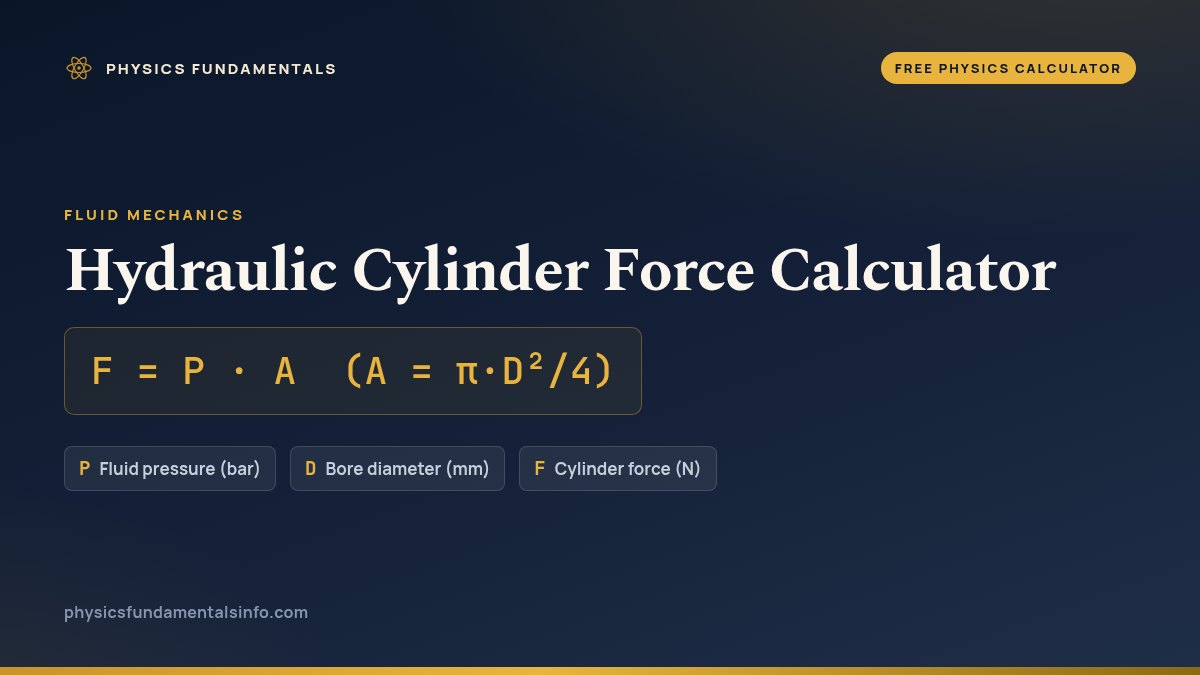
The hydraulic cylinder force calculator is a free online tool built on the formula F = P · A (A = π·D²/4). Enter the values you already know, in whichever units suit you, and it solves for cylinder force, pressure or bore diameter and shows every step of the substitution. Push force of a hydraulic or pneumatic cylinder from pressure and bore.
| Symbol | Quantity | Default unit | Also accepts | Example value |
|---|---|---|---|---|
| P | Fluid pressure | bar | psi, kPa, MPa, Pa | 100 |
| D | Bore diameter | mm | cm, in, m | 50 |
| F | Cylinder force | N | kN, MN, lbf | — |
How to calculate cylinder force
A hydraulic or pneumatic cylinder turns fluid pressure into a straight-line push. The piston area is A = πD2/4 from the bore diameter D, and the extend (push) force is F = P·A. Enter the fluid pressure (bar, psi, kPa or MPa) and the bore, and read the force. The same formula works for pneumatic (air) and hydraulic (oil) cylinders — only the working pressure differs.
There are three steps. First, choose whether you want the force, the pressure or the bore in the Solve for menu. Second, enter the values you know in whatever units your gauge or drawing uses; the tool converts them to SI internally. Third, read the answer with the worked steps, which show the piston area, the force with your numbers substituted in, and the result with units. Because force scales with the square of the bore, a modest increase in diameter buys a large jump in output force.
Under the hood this is just pressure acting over an area, the same principle behind Pascal's law and hydraulic force multiplication. For a definition of the terms used here, see the physics glossary.
Worked example
Consider a cylinder with a 50 mm bore fed at 100 bar (1.0×10⁷ Pa). The piston area is A = π(0.05)2/4 = 1.963×10⁻³ m2, so the push force is F = P·A = 1.0×107 × 1.963×10-3 ≈ 19 600 N — about 19.6 kN of push. Double the bore to 100 mm and the area quadruples, so the same 100 bar would deliver roughly 78 kN.
Why it matters
Cylinder force sizing underpins presses, jacks, excavator arms, brakes and factory automation. Hydraulics reach very high forces because oil runs at 100–350 bar, while pneumatics use gentler ~6–10 bar air. Note that the retract (pull) stroke is weaker because the rod reduces the effective area to an annulus. For the broader trade of force against distance in any machine, see the mechanical advantage calculator.
Frequently asked questions
What is the formula for cylinder force?
F = P x A, with piston area A = pi x D^2 / 4 from the bore diameter. Multiply the fluid pressure by the full piston area to get the extend (push) force of a hydraulic or pneumatic cylinder.
Why is the pull force less than the push force?
On the rod side, the rod blocks part of the piston, so the effective area is the bore area minus the rod area (an annulus). Less area at the same pressure means less force, so the retract stroke is weaker. This tool gives the full-bore push force.
How do I convert bar to psi?
1 bar is about 14.5 psi, and 1 bar = 100000 Pa (10^5 Pa). The calculator accepts pressure in bar, psi, kPa or MPa and converts it for you, so you can enter whichever unit your gauge shows.
What is the difference between pneumatic and hydraulic force?
The formula is identical, but hydraulic systems run at far higher pressure (100–350 bar) than pneumatic ones (about 6–10 bar), so they produce much larger forces. Hydraulics use oil; pneumatics use compressed air.
How do I size a cylinder for a required force?
Rearrange to D = sqrt(4F / (pi x P)) and pick the next standard bore above that. Select “Bore diameter” in the calculator’s “Solve for” menu, enter your required force and available pressure, and it performs this rearrangement automatically.
References & formula source
- Young & Freedman — University Physics with Modern Physics, §14.1–14.2 (Pressure in a Fluid).
- Esposito — Fluid Power with Applications (cylinder force and sizing).
- Halliday, Resnick & Walker — Fundamentals of Physics, Chapter 14 (Fluids; Pascal's principle).
- Further reading: Hydraulic cylinder — Wikipedia