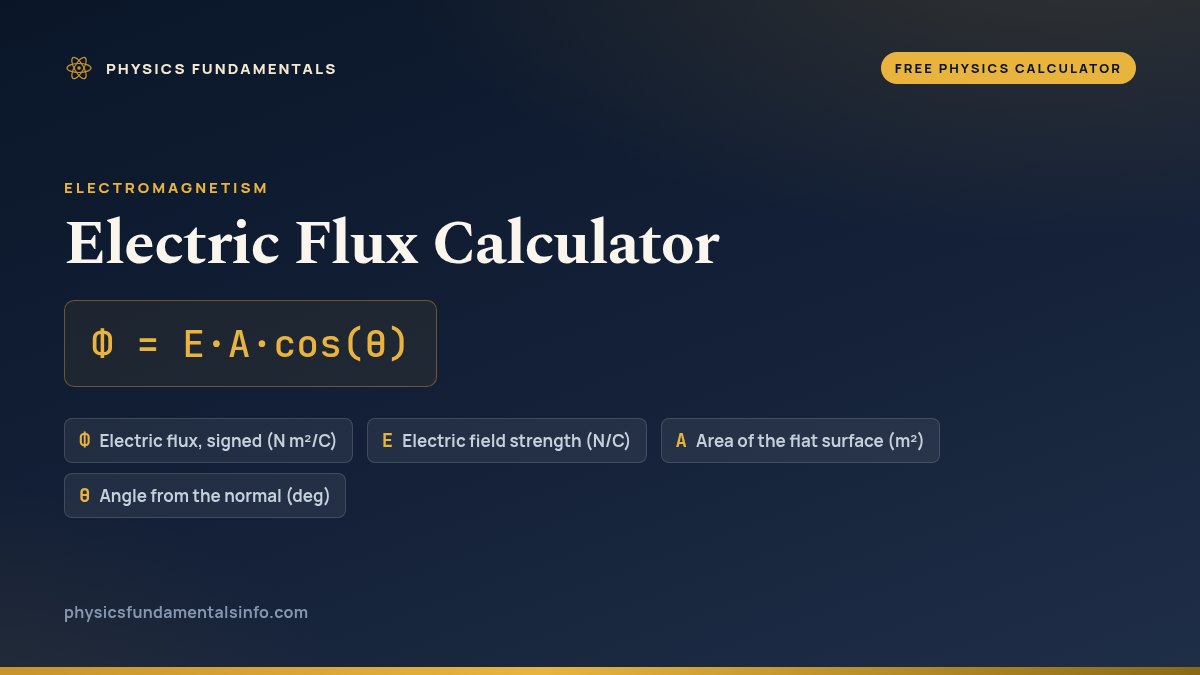
Electric flux is how much electric field passes through a surface, and for a flat surface in a uniform field it is ΦE = E A cos θ, measured in N m2/C. The one thing to get right is θ: it is the angle between the field and the normal to the surface — the line at right angles to it — so a panel lying square across the field is at 0 degrees and takes the whole flux. This free calculator solves that relation for the flux, the field strength, the area or the angle, keeps the sign throughout, and shows every step.
Load a real case
Each button writes the field strength, the area and the tilt into the three boxes, so the answer changes the moment you press it. The line underneath quotes back whatever the widget then works out, so nothing in it is stored text. All five hold the same panel in the same field and change only the tilt, which is why the cosine reads straight off as a percentage.
Pick a case above, or type your own figures.
What Is the Electric Flux Calculator?
The electric flux calculator is a free online tool for the amount of electric field passing through a flat surface in a uniform field: ΦE = E A cos θ, in newton square metres per coulomb, N m2/C — identically the volt metre, with no conversion factor between the two names. Give it the field strength, the surface area and the angle from the normal and it returns the flux; point the Solve for menu at any one of those three instead and it runs the same relation in that direction.
The angle is measured from the normal to the surface, never from the surface itself, and that single distinction is what this page exists to get right. The normal is the line at right angles to the surface, so a panel lying square across the field is at 0 degrees and takes the whole flux. A field described as 30 degrees from the surface is 60 degrees from the normal, and at the page's own opening figures of 500 N/C through 0.2 m2 that matters: type the 30 and the headline reads 86.6, type the 60 it really is and it reads 50.
The sign is part of every answer here and no mode discards it. Past 90 degrees from the normal the cosine is negative, so the flux is negative, and the angle mode run backwards from a negative flux returns the obtuse angle rather than its acute twin. A tool that handed back a magnitude would throw away the one thing separating a field entering a surface from a field leaving it.
Some combinations have no answer and the page refuses them rather than inventing one. No field strength and no area put a flux through a surface that grazes the field, and no angle gives a flux larger in size than E times A, because a cosine cannot exceed 1. The boundary itself is solvable and deliberately so: against a maximum of 100, a flux of exactly 100 returns 0 degrees and exactly -100 returns 180.
A grazing surface returns an exact zero rather than the tiny leftover a computed cosine of 90 degrees carries, because the cosine is snapped to 1, 0 or -1 at the multiples of 90 degrees, where that is its exact value. A negative area is refused everywhere, since a surface of negative area is not a thing.
Close the surface up and the geometry stops mattering altogether: the net flux out of any closed surface is the enclosed charge divided by the permittivity of free space, 8.8541878128e-12 F/m, so 1 nC enclosed gives 112.94 N m2/C in a sphere, a cube or a crumpled bag. That is Gauss's law, and it is on the page as its own section — with the sphere whose radius cancels and the cube whose faces cancel worked through there in full — rather than as a fifth solve mode, because it is a different formula with different inputs.
What the page does not do is a list of missing boxes rather than of hidden assumptions. There is no charge box and no radius box in the four-way solve, so a field from a charge and a distance, or the area of a sphere, has to be worked out before you arrive; and the arithmetic takes one uniform field across one flat surface, which is where the page's own limits section begins.
| Symbol | Quantity | Default unit | Also accepts | Example value |
|---|---|---|---|---|
| Φ | Electric flux, signed | N m²/C | V m, kN m²/C | 86.60 |
| E | Electric field strength | N/C | V/m, kN/C, MN/C | 500 |
| A | Area of the flat surface | m² | cm² | 0.2 |
| θ | Angle from the normal | deg | — | 30 |
How to use the electric flux calculator
- Measure the angle from the normal, not from the surface.
θis the angle between the field and the line at right angles to the surface. A panel lying square across the field is0degrees, not 90. Read the angle off the surface by mistake and you have entered the complement, which replaces the cosine with the sine. - Pick what to solve for. The page opens on the flux. The Solve for menu also rearranges the same relation for the field strength, the surface area and the angle from the normal; whichever you choose becomes the headline and the other three become your input boxes.
- Enter the field strength. Boxes take N/C, V/m, kN/C or MN/C, and the default is
500N/C. N/C and V/m are one unit under two names, so switching between those two changes nothing. - Enter the area in square metres. The box opens on
0.2m2, and the menu offers cm2 if that is how your problem states it. There is no radius box, so work a circle's or a sphere's area out first. - Enter the angle in degrees. Anything from
0to180means something:0is square on,90grazes, and past 90 the flux reverses sign. Decimals are accepted, so35.5is fine. - Read the headline. It is the quantity you asked for to four significant figures, with trailing zeros dropped — so a 30 degree tilt at the defaults reads
86.6rather than86.60. Solving for the flux the unit beside it isN m2/C, and the minus sign, when there is one, is part of the answer. - Read the three chips. Phi at theta = 0 is the most this surface could take square on, so it shows at a glance what the tilt has cost. cos theta is the fraction that survives. The third is the SI unit written both of its ways.
- Open Show working. The steps restate the geometry, give the rearranged relation, list your figures in SI units, work out the cosine and the facing area, substitute every number and name the sense of the flux.
- Expect a refusal where no answer exists. A grazing surface has no field strength and no area that would give it a flux, and no angle produces a flux bigger in size than the field times the area. The panel says so instead of printing something.
This page takes the field as given and never works one out for you. If your problem starts from a charge and a distance instead, the electric field calculator produces the E you then bring here, and the electric field guide covers what that field actually is. Where a problem wants the reasoning rather than the arithmetic, the electric flux guide argues the geometry out in prose and works each case through by hand.
Two mistakes account for most wrong answers here, and the angle is the first of them. The second is leaving the area in square centimetres while the field is in N/C, which is a factor of 10,000 and the reason the area box carries a unit menu. A third expectation is worth heading off: nothing on this page changes with time, so it will tell you nothing about a current.
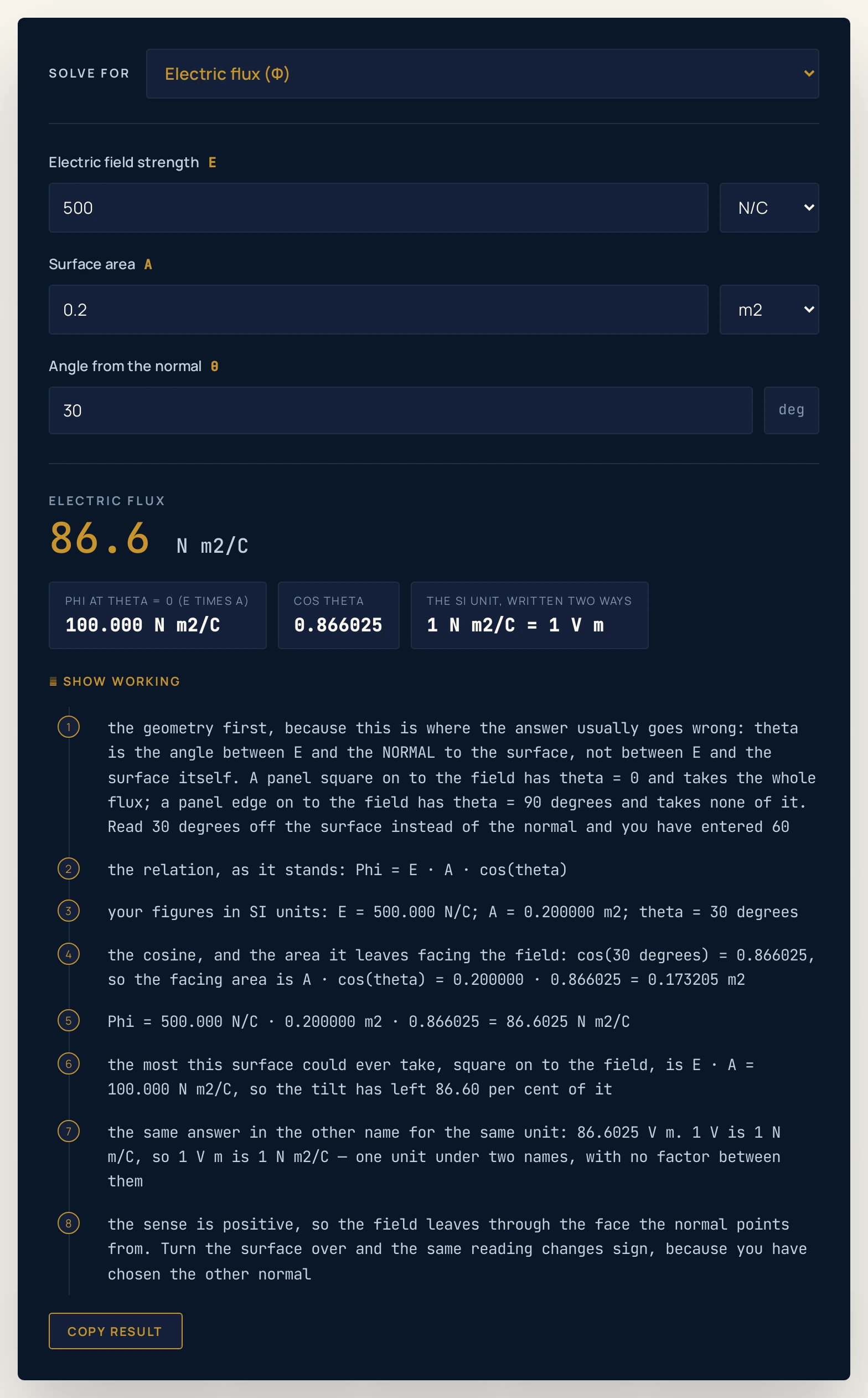
E A is exactly 100 here, the cosine reads straight off as the percentage of the flux that survives the tilt.Worked example: change one thing at a time
The table holds one panel in one field — E = 500 N/C through A = 0.2 m2, so E A is exactly 100 — and sweeps the tilt from square on to fully reversed. Every Headline and chip cell was read out of the running widget rather than worked out by hand. Where a cell and the tool ever part company, believe the tool.
| Angle from the normal (deg) | Cosine of the angle | Flux in the working | Headline |
|---|---|---|---|
| 0 | 1.000000 | 100.000 | 100 |
| 30 | 0.866025 | 86.6025 | 86.6 |
| 45 | 0.707107 | 70.7107 | 70.71 |
| 60 | 0.500000 | 50.0000 | 50 |
| 90 | 0.000000 | 0 | 0 |
| 120 | -0.500000 | -50.0000 | -50 |
| 180 | -1.000000 | -100.000 | -100 |
The sweep is symmetric about 90 degrees and that is the whole sign convention in one line. At 90 degrees the reading is an exact 0, not a tiny leftover, and beyond it every flux is the mirror image of the one before with a minus sign attached. Flip the panel right over to 180 degrees and you recover the same size of flux entering rather than leaving.
Switching the Solve for menu runs the same row backwards. From a flux of 86.60 with E = 500 N/C and θ = 30 degrees the area mode returns 0.2 m2; from the same flux with A = 0.2 m2 the field mode returns 500 N/C. Feed the angle mode -50.00 instead and it returns 120 degrees, not 60 — the minus sign is information and the solve keeps it.
Formula and symbol reference
| Symbol | What it is | Unit | On this page |
|---|---|---|---|
| ΦE | The electric flux: a signed total through the whole surface, and the quantity this page is named after | N m2/C | Box menu reads N m2/C, V m or kN m2/C. Headline 86.6 at the defaults, 100 square on, -50 once tilted past 90 degrees. |
| E | The electric field strength: the field at a point, and an input here rather than something this page works out from a charge | N/C | Box menu reads N/C, V/m, kN/C or MN/C. 500 N/C is the default. A newton per coulomb is a volt per metre. |
| A | The area of the flat surface the field passes through. Its true area, not the area facing the field. Never negative | m2 | Box menu reads m2 or cm2. 0.2 m2 is the default, which is 2000 cm2. |
| θ | The angle between E and the normal to the surface. Not the angle to the surface itself, which is its complement | degree | Always in degrees, 0 to 180. 0 is square on, 60 halves the flux, 90 grazes and gives none, 180 is fully reversed. |
| A cos θ | The area facing the field: the shadow the surface casts across the field, and the only part of it the flux counts | m2 | A working value printed in the steps, never an input: 0.2 m2 at 0 degrees falls to 0.1 m2 at 60 and 0 at 90. |
| Qenc | The charge enclosed by a closed surface. It belongs to Gauss's law below, not to the four-way solve above, and there is no box for it | coulomb (C) | Worked in the section below: 1 nC encloses to 112.94 N m2/C. |
| ε0 | The permittivity of free space, a constant rather than an entry | F/m | 8.8541878128e-12 F/m (CODATA 2018). |
The physics: why only the facing area counts
A flux is a count of how much field crosses a surface, so what matters is not the whole area but the part of it the field actually meets. Tilt a panel and its shadow across the field shrinks, and that shadow has area A cos θ. The cosine is therefore geometry rather than a correction factor bolted on afterwards.
That is also why the angle has to be taken from the normal. The normal is the line the shadow is measured against, so θ = 0 is a panel facing the field squarely and keeping all of it. Measure from the surface plane instead and you have the other angle of the same pair — the one the shadow grows with rather than shrinks with.
The sign follows the same logic. Choosing a normal is choosing which face you call the front, and once you have, a field leaving through that face is positive and one entering it is negative. Nothing about the field has changed when the reading goes negative — only which way you decided to look.
Gauss's law: the flux through a closed surface
Close the surface up and something remarkable happens: the shape stops mattering entirely. The net flux out of any closed surface is Φ = Qenc / ε0, with ε0 = 8.8541878128e-12 F/m. The four-way solve above is for one flat surface, so this is a second relation rather than another mode of it — and it needs no area, no angle and no field strength at all.
An enclosed charge of 1 nC gives 112.94 N m2/C, whether it sits in a sphere, a cube or a crumpled bag. Run it the other way and a net outward flux of 500 N m2/C means an enclosed charge of 4.4271e-9 C. The charge that produces that field is the subject of the electric charge guide.
| Charge enclosed | Net flux out |
|---|---|
| 1 nC | 112.94 |
| 2 nC | 225.88 |
| −2 nC (net inward) | −225.88 |
| one elementary charge, 1.602176634e-19 C | 1.8095e-8 |
| none | exactly 0 |
The reason the radius cancels is worth seeing rather than taking on trust. Put 1 nC at the centre of a sphere and go from r = 0.10 m to r = 0.50 m: the field falls from 898.7552 N/C to 35.95021 N/C, exactly 25 times smaller, while the area grows from 0.1256637 m2 to 3.141593 m2, exactly 25 times larger. The product is 112.9409 N m2/C at both radii, and that cancellation is Gauss's law. The inverse-square field it rests on comes from Coulomb's law.
A cube in a uniform field makes the same point from the other side. With 500 N/C along one axis and a side of 0.40 m, the front face takes +80.00 N m2/C, the back face takes −80.00, the four side faces graze at 90 degrees and take 0.00 each, and the net is exactly zero — because the cube encloses no charge. Put 1 nC inside that same cube and the net becomes 112.94 N m2/C.
Where the electric flux calculator breaks down
- A field that is not uniform across the surface
- The relation multiplies one field by one area, so it assumes the same
Eeverywhere on the surface. Close to a point charge, near an edge or inside a gradient, that is false and the answer is only as good as the average you fed it. The honest version is an integral over the surface, which this page does not do. - A surface that is not flat
- A curved surface has a normal that changes direction from point to point, so there is no single
θto enter. For a closed curved surface use Gauss's law above instead, which needs no geometry at all. For an open curved one, break it into flat patches and add the fluxes. - The refusals, and why each one is right
- Solving for the field strength or the area with
θ= 90 degrees has no answer, because no field however strong puts a flux through a grazing surface. Asking for an angle that gives a flux larger in size thanE Ahas no answer either, since the cosine cannot exceed 1. The boundary itself is fine: exactly+100here returns 0 degrees and exactly-100returns 180. - Flux is not a force and not a potential
- A flux is a scalar count of field crossing a surface, which is a different thing from the energy per unit charge at a point. The electric potential guide covers the other scalar built from
E, and the two are easy to confuse because both are single numbers. Nothing on this page computes a potential, a force or an energy. - The symbol is overloaded
- The same Greek letter is used for several unrelated quantities across physics, which is why this page writes the subscript form in the symbol table. If you met it somewhere else and are not sure which one you have, the physics symbols guide sorts them out. On this page it always means an electric flux in
N m2/C.
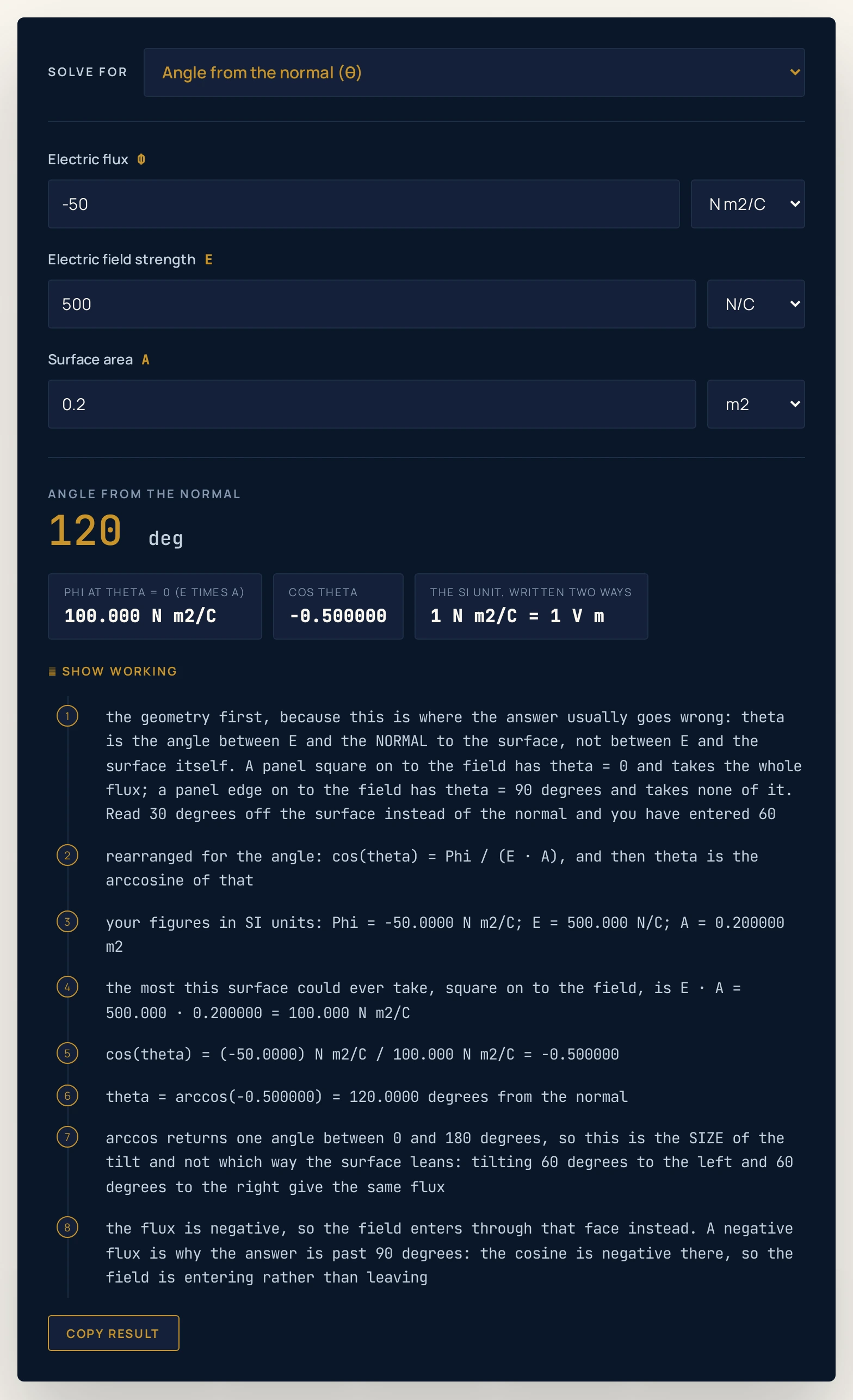
−50.00 N m2/C comes back as 120 degrees rather than 60, because the sign says the field is entering the face and that only happens past 90 degrees.Where electric flux is actually used
- Getting from a field to a flux at all
- Most problems hand you a field, because that is what a charge or a plate produces, and then ask for something that needs a flux. Produce the field first — the electric field calculator does it from a charge and a distance — then bring it here with the area and the tilt. That two-step is most of what this page gets used for.
- Checking an answer before checking its arithmetic
- Any flux larger in size than the field times the area is wrong before you look at the working, because the cosine cannot exceed 1 — that is what the Phi at theta = 0 chip is for. A flux quoted in N/C, or a field quoted in N m2/C, is the other half of the same check.
- Finding an enclosed charge from a measured flux
- Gauss's law runs backwards as readily as forwards, which is how a net flux becomes a charge you never measured directly. Nothing about the surface enters the calculation, so the awkward shape of a real enclosure costs you nothing. That is the single most useful consequence of the law.
- Aligning a sensor, or accounting for one that is not aligned
- A probe that responds to a field through a face loses the cosine of any misalignment. At small angles that loss is small, which the table above makes concrete: 30 degrees still keeps 86.60 per cent of the flux, but 60 degrees keeps only half. The cosine is forgiving near zero and brutal near 90.
- Seeing the sweep rather than trusting it
- Watching the flux fall to nothing at 90 degrees and come back negative beyond it is more convincing than any table. The electric field simulator shows the field lines themselves, and the magnetic half of the same geometry — the same
cos θ, a different quantity and a different unit — is in the magnetic flux guide. Electric field lines start and end on charges; magnetic ones do not, which is why only the electric law has a charge term in it.
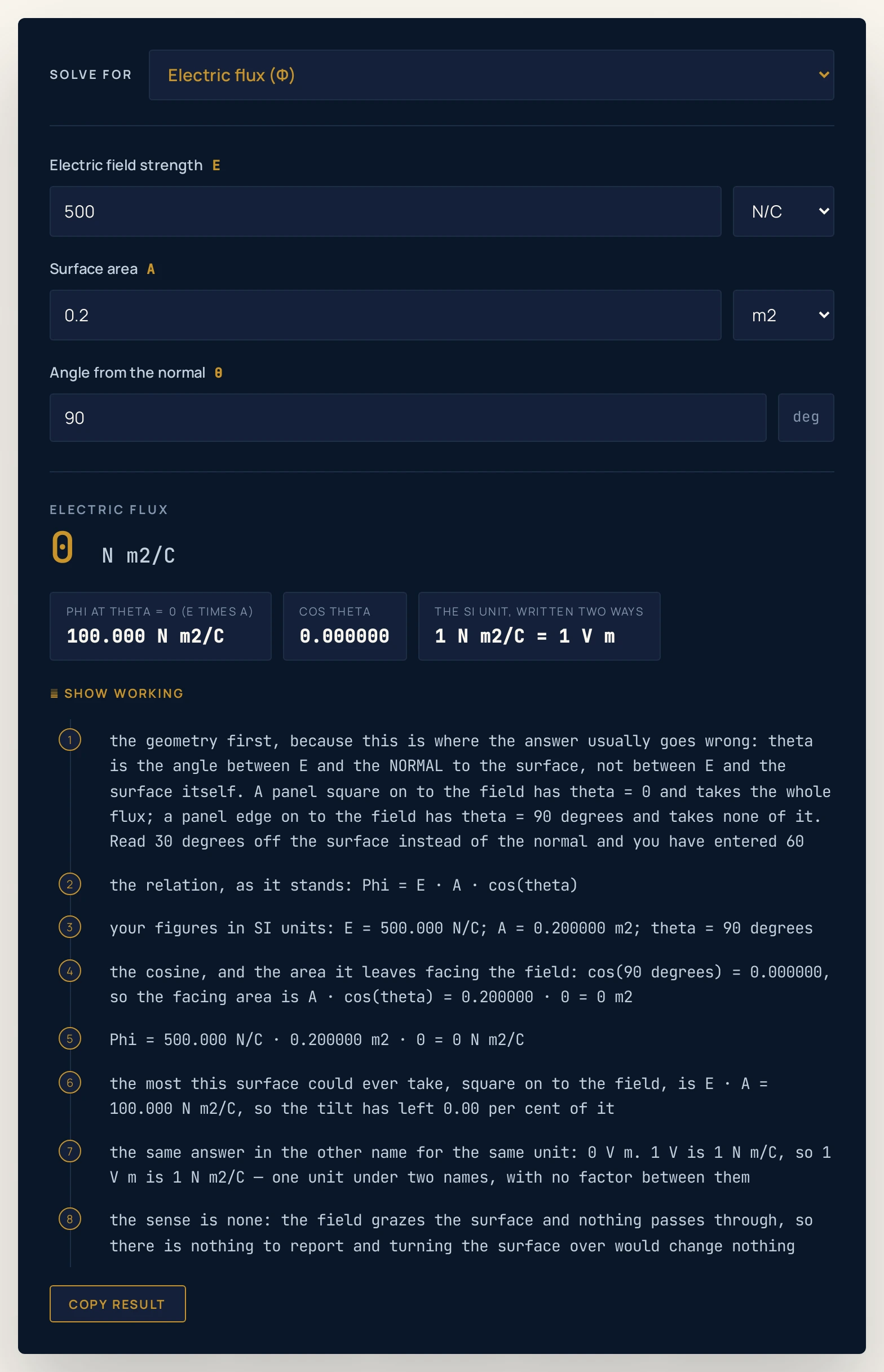
0 and the cos theta chip reads 0.000000 — not a leftover like 6.1e-15, which is what a naive cosine would print here.Where to go next
For the definition, the angle trap in prose and the full set of worked problems, read the electric flux guide, which this tool is the arithmetic half of. The electric field guide covers the E this page takes as given, the electric charge guide covers the source of that field, and the capacitance guide is where a flux between plates starts doing work.
Four tools sit beside this one. The electric field calculator gives the field strength you bring here; the magnetic flux calculator runs the same cos θ geometry on the magnetic side; the electric field simulator draws the field lines; and the magnetic flux simulator tilts a loop for the comparison. The full physics lab library and the calculator index are open too.
Frequently asked questions
What does the electric flux calculator work out?
It works out the electric flux through one flat surface in a uniform field, from Phi = E times A times the cosine of theta. E is the field strength in newtons per coulomb, A is the area in square metres, and theta is the angle between the field and the normal to that surface. The same relation is rearranged three more ways, so you can enter any three of the four quantities and read the fourth.
What is the SI unit of electric flux?
The newton square metre per coulomb, written N·m²/C. It is identically the volt metre, because 1 volt is 1 joule per coulomb, which is 1 newton metre per coulomb. Those are two names for one unit and there is no conversion factor between them, which is why the flux box offers both at the same scale.
Why is the angle measured from the normal and not from the surface?
Because what matters is how much of the surface the field actually crosses, and that is the shadow the surface casts on a plane at right angles to the field. That shadow has area A times the cosine of the angle between the field and the normal. Measuring from the surface instead gives you the complement, so the sine appears where the cosine belongs.
Can electric flux be negative?
Yes, and this calculator keeps the sign in every mode. Past 90 degrees the cosine is negative, so the field is entering through the face the normal points from rather than leaving it, and the reading goes with it. The sign is a bookkeeping choice about which face you called the front, not a property of the field.
Is electric flux a vector or a scalar?
It is a scalar: one signed number, with no direction of its own. The direction information has already been used up in the cosine, which compares the field direction with the surface normal. That is why a flux can be added face by face over a closed surface and why the total is just a sum.
What is the electric flux through a closed surface?
It is the enclosed charge divided by the permittivity of free space, and nothing else about the surface matters. That is Gauss's law, and it holds for any closed surface of any shape and any size. An enclosed charge of 1 nC gives 112.94 N·m²/C whether the surface is a sphere, a cube or something irregular.
What happens when the surface is edge on to the field?
The flux is zero: at 90 degrees from the normal the field runs along the surface instead of through it, so nothing passes through and the cosine is 0. The calculator returns an exact zero there rather than a tiny leftover number, because the cosine of 90 degrees really is exactly zero. The field strength is unchanged at that moment, which is the clearest sign that a field and a flux are different quantities.
Why does the calculator sometimes refuse to give an answer?
Because some combinations genuinely have none, and printing a number for them would be worse than saying so. No field strength and no area recover a flux through a grazing surface, since the cosine is zero and nothing divided by zero is either of them. And no angle gives a flux larger in size than the field times the area, because the cosine can never exceed 1.
References & formula source
- Electric flux through a flat surface in a uniform field is computed on this page as Phi = E A cos(theta), with theta the angle between the field and the NORMAL to the surface. The SI unit is the newton square metre per coulomb, N·m²/C, which is identically the volt metre: 1 V = 1 J/C = 1 N m/C, so 1 V m = 1 N·m²/C. That is a unit identity, not a conversion, and no factor between them is offered anywhere on this page.
- Electric flux is SIGNED here, in every mode and every working step. A positive reading means the field leaves through the face the chosen normal points from and a negative one means it enters there; the sign follows the choice of normal and is a convention rather than a property of the field. Reversing that choice reverses the sign of every flux on this page without changing any physics.
- The cosine of an angle given in degrees is taken exactly at the multiples of 90 degrees, where the true value is exactly 1, 0 or -1. Math.cos(90 * Math.PI / 180) in double-precision arithmetic is 6.123233995736766e-17 rather than 0, which would make a grazing surface at this page's defaults report 6.123e-15 N·m²/C instead of an exact zero. Every other angle is handed straight to the library cosine, and an angle entered outside 0 to 180 degrees is folded onto that range first because the cosine is an even function.
- The guard that refuses a field strength or an area through a grazing surface tests the size of the cosine itself at 1e-12, never the product of the field and the cosine. At 90 degrees that product is about 3e-14 at this page's defaults, which clears a threshold set on the product and returns a very large finite number instead of a refusal.
- Gauss's law appears on this page as Phi = Q_enc / eps0 with eps0 = 8.8541878128e-12 F/m (CODATA 2018 value of the vacuum electric permittivity). The Coulomb constant k is derived from it as 1/(4 pi eps0) and is never typed as a separate number, so the two cannot drift apart.
- Every figure quoted in the prose, in the worked table and in the figure captions is a string this calculator printed for the inputs named beside it, or a constant named above. Nothing here is a measurement made on this site.
- This page computes a flux through a surface and nothing else. It does not compute a force, a potential, a capacitance or a field from a charge distribution, and it has no time input of any kind.
- Halliday, Resnick and Walker, Fundamentals of Physics, chapter "Gauss' Law", sections on flux and electric flux.
- Young and Freedman, University Physics with Modern Physics, chapter "Gauss's Law", sections on electric flux and flux of a uniform electric field.
- Further reading: Electric flux — Wikipedia