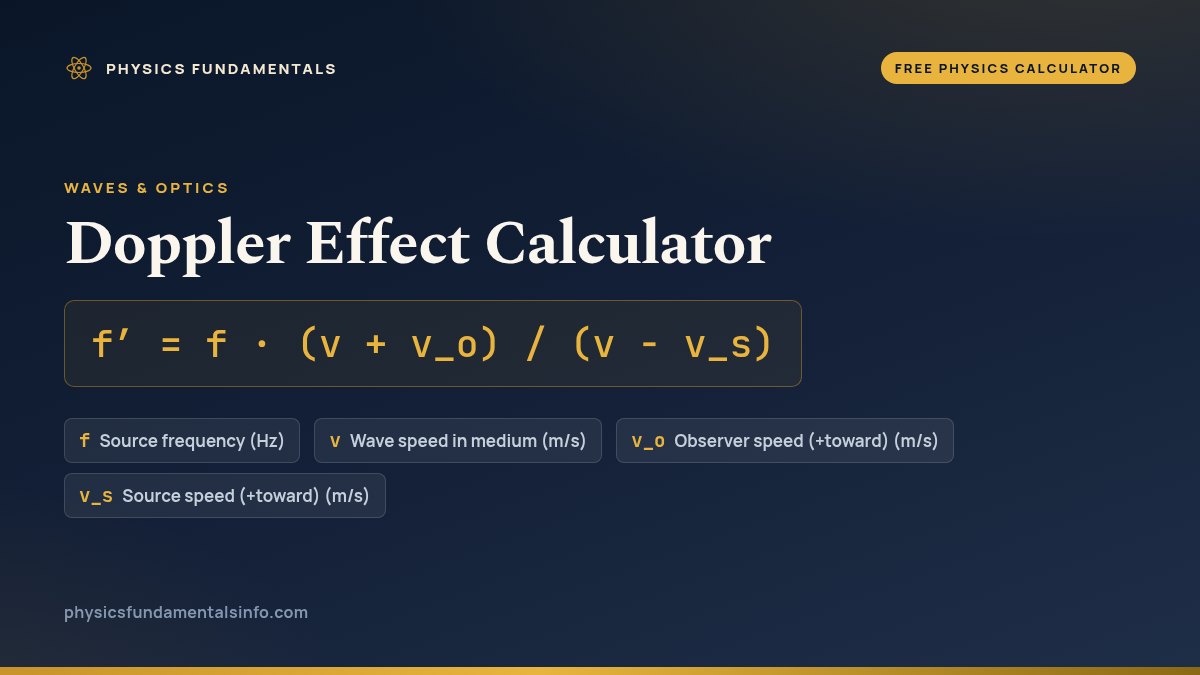
The Doppler effect: relative motion between a wave source and an observer raises or lowers the observed frequency — f’ = f·(v + v_o)/(v − v_s). This free calculator takes the source frequency and the speeds of the source and observer and returns the observed frequency, the frequency shift and the pitch change, with every step of the working shown.
What Is the Doppler Effect Calculator?
The Doppler effect calculator is a free online tool built on the formula f’ = f · (v + v_o) / (v − v_s). Enter the values you already know, in whichever units suit you, and it solves for observed frequency, speeds and shows every step of the substitution. Doppler Effect is frequency shift from a moving source or observer.
| Symbol | Quantity | Default unit | Also accepts | Example value |
|---|---|---|---|---|
| f | Source frequency | Hz | kHz, MHz | 700 |
| v | Wave speed in medium | m/s | — | 343 |
| v_o | Observer speed (+toward) | m/s | — | 0 |
| v_s | Source speed (+toward) | m/s | — | 30 |
How to calculate the Doppler shift
Relative motion between a wave source and an observer compresses or stretches the waves, raising or lowering the observed frequency — the rising-then-falling pitch of a passing siren; our guide to the Doppler effect walks through the intuition in more depth. For light, the same effect gives the redshift of receding galaxies and the basis of police radar. The observed frequency is f’ = f·(v + v_o)/(v − v_s), where f is the emitted frequency, v the wave speed in the medium, v_o the observer speed and v_s the source speed.
There are three steps. First, enter the source frequency f in hertz, kilohertz or megahertz. Second, set the wave speed v — pick the preset for sound in air (343 m/s), sound in water (1480 m/s) or light in vacuum (2.998×10⁸ m/s), or type your own — and note that this is the speed of the wave through the medium, not the speed of anything moving. Third, enter the observer speed v_o and the source speed v_s and read the answer with the worked steps, which show the formula, your numbers substituted in, and the observed frequency.
Sign convention used here: enter a speed as positive when that body is moving toward the other, and negative when moving away. With that rule, positive speeds always push the observed frequency up. An approaching source raises the pitch because its waves bunch together in front of it; a receding source lowers the pitch because its waves stretch out behind it. The calculator reports the shift and labels the result Higher (approaching) or Lower (receding) so the direction is never ambiguous.
One limit is worth knowing: if the source speed equals the wave speed, the denominator v − v_s goes to zero and the frequency would diverge — the sonic-boom (Mach 1) limit, where the source outruns its own waves. The calculator guards against this and returns an error. The Doppler effect rests on the basic wave relationship v = f·λ; to explore that, see the wave speed calculator, or look up a term in the physics glossary.
Worked example
A siren emits f = 700 Hz and approaches a stationary observer at v_s = 30 m/s through still air, where the wave speed is v = 343 m/s (observer speed v_o = 0). The observed frequency is f’ = f·(v + v_o)/(v − v_s) = 700 × 343 / (343 − 30) ≈ 767 Hz — a shift of about +67 Hz, so the pitch is higher because the source is approaching. Once the siren has passed and is receding, flip the sign of v_s to −30 m/s and the formula gives 700 × 343 / (343 + 30) ≈ 644 Hz, a lower pitch — exactly the drop you hear as the vehicle goes by.
Why it matters
The Doppler effect underpins police and weather radar, sonar, medical Doppler ultrasound that measures blood-flow velocity, and speed cameras. In astronomy the optical version reveals the redshift of receding galaxies and the orbital wobble of stars hosting exoplanets. Anywhere a frequency shift encodes relative motion, the Doppler formula is the link between the shift you measure and the speed you want.
Frequently asked questions
What is the Doppler effect?
The Doppler effect is the change in the observed frequency of a wave when the source and the observer move relative to each other. Motion toward the other party compresses the waves and raises the frequency (a higher pitch, or a blueshift for light); motion apart stretches them and lowers it (a lower pitch, or a redshift). The classic example is the falling pitch of a siren as an ambulance passes you.
What is the Doppler effect formula and sign convention?
This calculator uses f’ = f·(v + v_o) / (v − v_s), where f is the emitted frequency, v is the wave speed in the medium, v_o is the observer speed and v_s is the source speed. The sign convention here is simple: enter a speed as positive when that body is moving toward the other, and negative when moving away. Positive speeds therefore raise the observed frequency, matching the f·(v ± v_o)/(v ∓ v_s) form.
Why does an approaching source sound higher than a receding one?
An approaching source chases its own waves, so each successive crest is emitted a little closer to you than the last. The crests bunch up, the wavelength shortens and more of them reach your ear per second — a higher frequency. Once the source has passed and is receding, each crest is emitted farther away, the waves stretch out, and you hear a lower pitch. That sudden drop as a vehicle goes by is the audible signature of the Doppler effect.
Does this calculator work for light as well as sound?
It gives the classical (non-relativistic) Doppler shift, which is an excellent approximation for light only when the relative speed is far below the speed of light — select the 'Light (vacuum)' preset for v = 2.998×10^8 m/s. For sources moving at an appreciable fraction of c, such as distant galaxies, the full relativistic Doppler formula (with the Lorentz factor) is needed instead, because time dilation also affects the measured frequency. For everyday acoustics, radar and ultrasound, the classical formula used here is exact enough.
What happens if the source moves at the speed of the wave?
If the source speed equals the wave speed in the medium, the denominator (v − v_s) becomes zero and the predicted frequency diverges — physically, the source is keeping pace with its own wavefronts, which pile up into a shock front. For sound this is the sonic-boom limit at Mach 1. The calculator detects this case and returns an error rather than an infinite result.
References & formula source
- Young & Freedman — University Physics with Modern Physics, §16.8 (The Doppler Effect).
- Halliday, Resnick & Walker — Fundamentals of Physics, Chapter 17 (Waves — II: The Doppler Effect).
- Serway & Jewett — Physics for Scientists and Engineers, §17.4 (The Doppler Effect).
- Further reading: Doppler effect — Wikipedia