Entropy change: entropy change measures how much the disorder of a system changes when heat flows in or out, ΔS = Q/T for a reversible transfer at constant temperature. This free calculator solves for the entropy change, the heat, or the temperature, and shows every step.
What Is the Entropy Change Calculator?
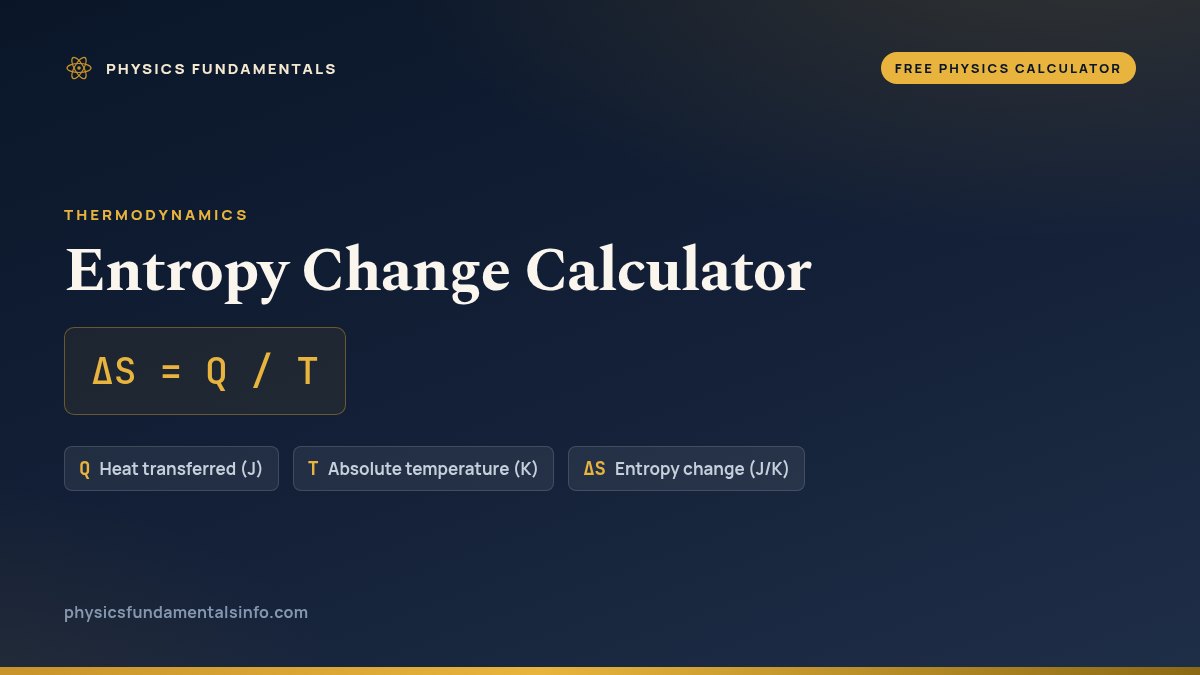
The entropy change calculator is a free online tool built on the formula ΔS = Q / T. Enter the values you already know, in whichever units suit you, and it solves for entropy change, heat or temperature and shows every step of the substitution. Entropy change for reversible heat transfer at constant temperature.
| Symbol | Quantity | Default unit | Also accepts | Example value |
|---|---|---|---|---|
| Q | Heat transferred | J | kJ, MJ | 1000 |
| T | Absolute temperature | K | °C, °F | 300 |
| ΔS | Entropy change | J/K | kJ/K | — |
How to calculate entropy change
For a reversible heat transfer at a constant absolute temperature, the entropy change is simply the heat divided by the temperature: ΔS = Q / T. To use the formula, enter the heat Q — positive if the system absorbs heat, negative if it releases heat — and the temperature in kelvin. The calculator accepts °C and °F and converts them to absolute temperature for you. The result is an entropy change in joules per kelvin.
There are three steps. First, decide whether you want the entropy change, the heat, or the temperature, and select it in the calculator’s Solve for menu. Second, enter the two values you know, taking care with the sign of Q. Third, read the answer with the worked steps, which show the formula, your numbers substituted in, and the result with units. Because the law divides by temperature, an absolute (kelvin) value is essential — a Celsius figure would give a meaningless answer.
This constant-temperature form is exact for reversible transfers such as heat exchange with a large reservoir or heat added during a phase change. If the temperature itself changes while heat flows, you must integrate instead. Related quantities appear in the Carnot efficiency calculator, which uses the same reservoir temperatures, and the specific heat calculator, which gives the heat Q you feed in here. For the term itself, see the physics glossary.
Worked example
A system absorbs Q = 1000 J of heat reversibly at a constant temperature of T = 300 K. Its entropy change is ΔS = Q/T = 1000/300 ≈ +3.33 J/K. The positive sign shows the system has become more disordered. If the same 1000 J of heat were released instead of absorbed, Q would be negative and ΔS would be −3.33 J/K, meaning the system became more ordered as heat left it.
Why it matters
Entropy is the heart of the second law of thermodynamics — heat flows so that the total entropy of an isolated system never decreases. This single principle sets the efficiency ceiling of every engine and refrigerator, explains why some processes are irreversible and cannot run backwards, and underpins phase changes and chemical spontaneity. The entropy released or absorbed during melting and boiling, for example, is exactly the latent heat divided by the transition temperature.
Frequently asked questions
What is entropy change?
Entropy change is the change in a system’s disorder that results from heat flow, deltaS = Q/T for a reversible process at constant temperature, measured in joules per kelvin (J/K). A positive value means the system has become more disordered.
Why must temperature be in kelvin?
Entropy uses absolute temperature, so the temperature must be measured from absolute zero. Dividing the heat by a Celsius value would be meaningless because the Celsius zero point is arbitrary. Convert first with K = degC + 273.15; this calculator does it for you when you enter °C or °F.
When is entropy change positive or negative?
The entropy change is positive when a system absorbs heat (Q > 0) and becomes more disordered, and negative when it releases heat (Q < 0) and becomes more ordered. The sign of ΔS simply follows the sign of the heat Q at a fixed positive temperature.
What if the temperature changes during the process?
Then the simple ΔS = Q/T no longer applies, because T is not constant. Instead you integrate: for heating a substance, deltaS = m x c x ln(T2/T1), where m is the mass, c the specific heat and T2, T1 the final and initial absolute temperatures. The Q/T form is exact only at constant temperature.
How does entropy relate to the second law?
The second law of thermodynamics states that the total entropy of an isolated system never decreases. A reversible process keeps the total entropy constant, while every real, irreversible process increases it. Entropy change is therefore the quantity that fixes the direction of spontaneous processes.
References & formula source
- Halliday, Resnick & Walker — Fundamentals of Physics, Chapter 20 (Entropy and the Second Law).
- Young & Freedman — University Physics with Modern Physics, §20.7-20.8 (Entropy).
- Atkins & de Paula — Physical Chemistry, Chapter 3 (The Second Law).
- Further reading: Entropy — Wikipedia