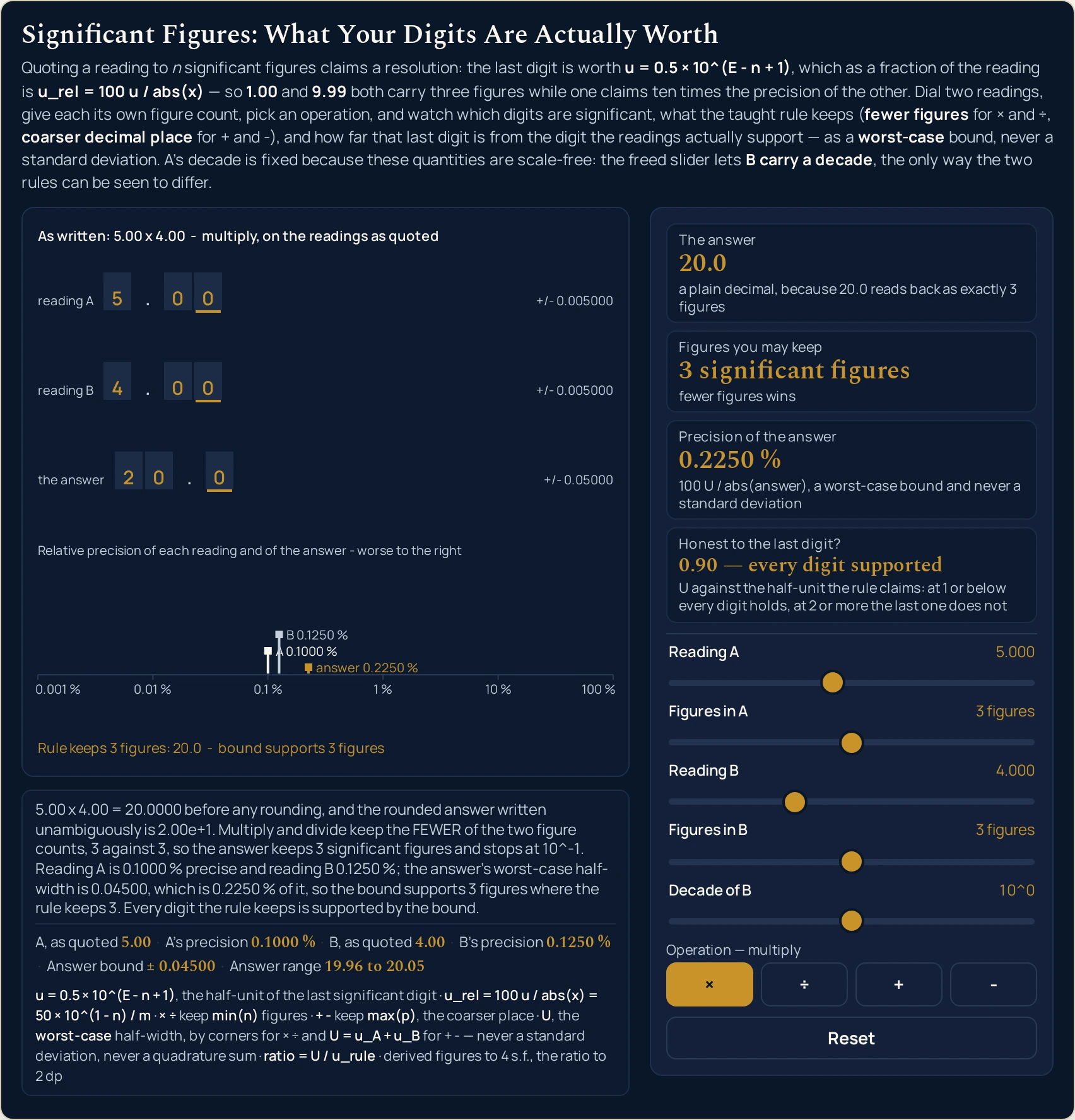
The significant figures simulator is a free interactive lab with two readings in it and nothing else. One slider sets reading A, a second says how many figures A is quoted to, two more do the same for reading B, and a fifth gives B a power of ten of its own. Pick ×, ÷, + or -, and four cards answer at once: the answer the rule allows, the figures you may keep, what that answer is worth as a percentage, and whether its last digit is honest. On arrival they read 20.0, 3 significant figures, 0.2250 % and 0.90 — every digit supported.
The fourth card is the one worth dragging for. A figure count is a proxy for a precision and it is a coarse one, so the last preset puts 1.00 against 9.99 — both quoted to three figures — and the card climbs to 10.99 — last digit not supported. The rule hands you three figures there; the worst-case bound supports one.
Significant Figures: What Your Digits Are Actually Worth
Quoting a reading to n significant figures claims a resolution: the last digit is worth u = 0.5 × 10^(E - n + 1), which as a fraction of the reading is u_rel = 100 u / abs(x) — so 1.00 and 9.99 both carry three figures while one claims 9.99 times the precision of the other. Dial two readings, give each its own figure count, pick an operation, and watch which digits are significant, what the taught rule keeps (fewer figures for × and ÷, coarser decimal place for + and -), and how far that last digit is from the digit the readings actually support — as a worst-case bound, never a standard deviation. A's decade is fixed because these quantities are scale-free: the freed slider lets B carry a decade, the only way a correctly quoted reading can contribute nothing to the sum.
Load a real reading in one click
Each button presses one operation button and writes the five sliders, which is exactly what your own hand would do; nothing here recomputes any figure. They are in the simulation’s own order, and that order runs from the rule behaving itself to the rule failing badly.
The first two are multiplication, at three figures against three and then three against two. Buttons three to six walk through division and the two additive cases, where the rule counts decimal places instead of figures and can hand the answer more figures than an input carries. The last two are the ones to sit with: a subtraction of near-equal readings, and the leading 1 that costs the rule two figures.
Pick one of the eight cases above, or drag the five sliders yourself.
What Is the Significant Figures Simulator?
The significant figures simulator is a free interactive physics lab that runs in your browser, with nothing to install and no sign-up. Two measured readings go in, each with a figure count of its own, and one of four operations joins them. What comes back is not only the answer the taught rule allows but what that answer is worth, as a percentage and as a verdict on its last digit.
Four reading cards carry the panel. The answer gives the rounded result, Figures you may keep gives the count the rule hands you, Precision of the answer turns the worst-case bound into a percentage and Honest to the last digit? prices the two against each other. On the opening setting they read 20.0, 3 significant figures, 0.2250 % and 0.90 — every digit supported.
A sub-line under each card says which branch fired, so no choice the lab makes is silent. Under the second card it reads fewer figures wins for multiply and divide and coarser decimal place wins for add and subtract. Under the fourth it reads U against the half-unit the rule claims: at 1 or below every digit holds, at 2 or more the last one does not, which is the whole scale the verdict is read on.
Five sliders drive it. Two set the readings between 1.000 and 9.999 a thousandth at a time, two give each reading its own figure count from one to five, and the fifth multiplies reading B by a power of ten from 10^-3 to 10^3. Four buttons pick the operation as a one-of-four group, opening on multiply with the line above them reading Operation — multiply, and Reset returns every one of them to the opening state.
Reading A has no decade slider, and that is a decision rather than a shortcut. A figure count on a given leading mantissa buys the same relative precision in every decade, so letting A roam would change no percentage the panel prints. Spending the fifth control on B instead buys the one state the panel could not otherwise reach: a reading quoted perfectly well that is still too small to alter any digit of the answer.
A wrapping strip of six more readings sits under the drawing. It gives each reading as the figure count actually writes it and what that written form is worth: at the opening state A, as quoted 5.00 at 0.1000 %, B, as quoted 4.00 at 0.1250 %, an Answer bound of ± 0.04500 and an Answer range of 19.96 to 20.05.
That pair of percentages is the sharpest thing in the strip, because a figure count hides a factor of up to ten. Put 1.00 against 9.99 with three figures each and the two cells read 0.5000 % and 0.05005 %, which is a factor of 9.99 on a count that never changed. The answer inherits the worse of them, which is why improving the better reading buys almost nothing.
The fourth card is what this lab is for. The taught rule is not conservative: it can hand you a last digit the two readings do not pay for, and the ratio on that card is how far out it is. On those same 1.00 and 9.99 readings the rule keeps 3 significant figures and the card climbs to 10.99 — last digit not supported, the largest ratio any of the eight preset buttons reaches.
Eight presets on the landing page write the five sliders and press the operation for you, running from the rule behaving to the rule failing. They cover a division that overreaches at 2.15 — last digit not supported, a sum that comes back at 11.0 with more figures than one of its readings carries, a three-figure reading of 0.00990 that changes no digit of the sum at all, and a subtraction of near-equal readings that returns an answer 100.0 % precise. Not one of them describes a real instrument.
The answer card switches to the scientific form whenever a plain decimal would not read back as the count being claimed. Multiply 5.00 by 4.0 and the rule keeps two figures, but a written 20 counts anywhere from one figure to two, so the card prints 2.0e+1 over the sub-line the e form, because the plain 20 would read as 1 to 2 figures and not 2. Exponents are written with a caret throughout, here and in the drawing.
The drawing is four horizontal bands and nothing in it moves. A caption gives the arithmetic as the two readings are written; three digit strips draw reading A, reading B and the answer as rows of digit cells with the significant digits in gold, a greyed placeholder zero, a tick under the last significant digit and the half-unit it is worth at the end of the row; a logarithmic axis places all three relative precisions on one scale anchored on the decades; and a closing caption carries the rounded answer, the count the rule keeps and the count the bound supports.
No pixel in that scene is a measurement and no figure should be read off the length of anything. What the drawing guarantees is a correspondence: the gold cells in a strip always number the figures the captions claim for it, and the tick always sits under the last of them. A quoted zero is drawn with no gold cell and no tick, because a written zero has no significant figures, and every figure in the scene is also in the panel beside it.
Every bound here is a worst case and is labelled as one wherever it appears. Quoting a reading to a figure count asserts a resolution rather than a distribution, so the two half-units are combined by corners for multiply and divide and by addition for add and subtract, never in quadrature. Nothing in this lab is a standard deviation, no interval carries a probability, and the verdict is decided on the unrounded ratio and printed beside it rounded to two decimals, so two states can print the same ratio and mean different things.
What the lab cannot do, it says. The five sliders cannot reach a reading of zero, a figure count below one, a fractional count or a divisor of zero, so no refusal is demonstrable here and those belong to the matching calculator, where both figures are typed. One degenerate state is reachable and is printed rather than hidden: subtract two identical readings and the count reads 0 significant figures while the precision card reads undefined rather than a number or an error.
| Control | Range | Step, default and what it moves |
|---|---|---|
| Reading A | 1.000 to 9.999 | step 0.001; opens at 5.000, which at three figures is quoted 5.00. Its decade is fixed, and that costs the lab nothing because a figure count buys the same relative precision in every decade - it is what frees the fifth slider for reading B. The slider shows the dialled value and the strip under the drawing shows the quoted one |
| Figures in A | 1 to 5 figures | step 1; opens at 3. This is the claim about resolution that everything else on the panel is priced against. A count above the digits the slider supplies is allowed rather than clamped: 5.000 at five figures is quoted 5.0000 with a half-unit of 0.00005, because quoting a measurement to a count is an assertion and the lab prices the assertion |
| Reading B | 1.000 to 9.999 | step 0.001; opens at 4.000, quoted 4.00 at three figures. With the decade slider behind it, it spans 0.001 to 9999, and at the top of that span the strip quotes it 1.00e+4 rather than as a plain integer, because a written 9999 would not read back as the count being claimed |
| Figures in B | 1 to 5 figures | step 1; opens at 3. It is a separate slider from A's on purpose, because two instruments rarely entitle you to the same count, and it is the coarser of the two claims that both rules answer to. Dropping it alone from 3 to 2 is what turns the opening 20.0 into 2.0e+1; raising it from 2 to 3 is what turns 9.9 into 9.90 and makes the verdict worse rather than better |
| Decade of B | seven powers of ten | step 1, from 10^-3 to 10^3, opening at 10^0. It is the only control that moves a quantity between decades, and it is there instead of a second decade slider for A because a reading can only be too small to change a digit of the sum when it sits a decade or more below the one it is added to. At 10^-3 a B dialled to 9.900 is quoted 0.00990 and changes no digit of the sum |
| Operation | four buttons | multiply, divide, add and subtract as a one-of-four group with aria-pressed, opening on multiply. The line above them reads Operation - multiply and relabels itself for each. The rule that applies is a property of the operation and not of the numbers, so the second card's sub-line switches between fewer figures wins and coarser decimal place wins at a button press |
| Reset | one button | it restores 5.000 at three figures, 4.000 at three figures, a decade of 10^0 and the multiply operation. Those are the lab's own defaults and the first preset, so the panel opens on a state this cluster's independent reference owns rather than on an arbitrary one |
How to use the significant figures physics simulator
- Read the four cards before you touch anything. They are at the top of the panel, above the sliders, and they are already answering for two readings quoted
5.00and4.00: The answer20.0, Figures you may keep3 significant figures, Precision of the answer0.2250 %and Honest to the last digit?0.90 — every digit supported. - Read the sub-line under the second card, because it names the rule that fired. It says
fewer figures winswhile an operation of × or ÷ is pressed andcoarser decimal place winsfor + or -. Those two are different rules, not two wordings of one. - Drag Figures in B from 3 down to 2 and watch the first card change form. It stops printing a plain decimal and prints
2.0e+1, with the sub-linethe e form, because the plain 20 would read as 1 to 2 figures and not 2. The precision card moves with it, from0.2250 %to1.350 %. - Press + and read the same two cards again. The rule name changes to
coarser decimal place wins, the answer becomes9.0at2 significant figures, and the fourth card leaves the supported band for the first time:1.10 — last digit marginal. - Now raise Figures in B back to 3 and watch a sum gain a figure. With Reading B at
4.900the answer goes from9.9to9.90and the count from2 significant figuresto3— while the verdict gets worse, from1.10 — last digit marginalto2.00 — last digit not supported. - Use Decade of B, the fifth slider, to watch a perfectly good reading stop counting. It reads
10^0on arrival and runs from10^-3to10^3. At10^-3a B dialled to9.900is quoted0.00990, and adding it to A changes no digit of the answer at all. - Read the wrapping strip under the drawing, which carries six more readings. At the opening state it gives A, as quoted
5.00, A’s precision0.1000 %, B, as quoted4.00, B’s precision0.1250 %, Answer bound± 0.04500and Answer range19.96 to 20.05. - Read the sentence strip above it, then press Reset. At the opening state it reads:
5.00 x 4.00 = 20.0000 before any rounding, and the rounded answer written unambiguously is 2.00e+1. Multiply and divide keep the FEWER of the two figure counts, 3 against 3, so the answer keeps 3 significant figures and stops at 10^-1.Reset puts all five sliders and the operation back to that state.
Dragging is the right way to find out which readings a control is allowed to move, and a poor way to hit an exact figure — the reading sliders step a thousandth at a time and the figure counts a whole figure. When you already have a value in front of you and want the half-unit, the percentage, or the figure count a target precision would need, the significant figures calculator takes typed input and runs the question in either direction. The written guide to significant figures in physics is where the counting rules themselves are set out, with the zero cases and the eight worked problems.
One thing this panel will not decide for you is how many figures your own instrument entitles you to claim, and that choice is upstream of every number on the screen. The sliders take the claim you make and price it; they cannot tell you whether the claim was reasonable. Settle that first, then come back and see what the arithmetic does to it.
Worked example: change one thing at a time
Nothing in the two tables below was worked out here. Each row is a setting the lab was put into through its own sliders and then read back from, cell by cell, so every string in them is the panel’s own. The first table moves one control per row; the second is the eight preset buttons in the order they appear above.
One: six rows, and only one control moves between any two of them
Reading A never moves: it sits at 5.000 quoted to three figures in all six rows. Everything that happens below is done by Figures in B, Reading B and the operation buttons, one change at a time.
| What moved | The answer | Figures you may keep | Which rule fired | Precision of the answer | Honest to the last digit? |
|---|---|---|---|---|---|
the state it opens in: 5.000 at 3 figures, 4.000 at 3 figures, multiply |
20.0 | 3 significant figures | fewer figures wins | 0.2250 % | 0.90 — every digit supported |
| Figures in B, 3 down to 2 | 2.0e+1 | 2 significant figures | fewer figures wins | 1.350 % | 0.54 — every digit supported |
| the operation, multiply becomes add | 9.0 | 2 significant figures | coarser decimal place wins | 0.6111 % | 1.10 — last digit marginal |
Reading B, 4.000 up to 4.900 |
9.9 | 2 significant figures | coarser decimal place wins | 0.5556 % | 1.10 — last digit marginal |
| Figures in B, 2 back up to 3 | 9.90 | 3 significant figures | coarser decimal place wins | 0.1010 % | 2.00 — last digit not supported |
| the operation, add becomes subtract | 0.10 | 2 significant figures | coarser decimal place wins | 10.00 % | 2.00 — last digit not supported |
Read the fifth column down, because it is the one a figure count hides. It runs 0.2250 %, 1.350 %, 0.6111 %, 0.5556 %, 0.1010 %, 10.00 %. The last step is one button press and it costs two decades of precision; nothing else in the table comes close to it.
Now read the third column against the sixth. Row five keeps more figures than row four — 3 significant figures against 2 — and is less honest for it, moving from 1.10 — last digit marginal to 2.00 — last digit not supported. The count went up and the claim behind it got worse.
The fourth column is the point of having both rules on one panel. It says fewer figures wins for the first two rows and coarser decimal place wins for the last four, and the switch happens at a button press rather than at a change of reading. The rule that applies is a property of the operation, not of the numbers. The habit of rounding once at the end rather than at every step belongs to the guide to unit conversions in physics, which owns that half of it.
Two: the eight presets, and what each one is for
These are the buttons above with the readings they produce. The readings column gives the written forms from the strip under the drawing rather than the slider positions, because the written form is what the figure count applies to.
| Case | Readings as quoted | The answer | Figures you may keep | Which rule fired | Precision of the answer | Honest to the last digit? |
|---|---|---|---|---|---|---|
| Three times three | 5.00 and 4.00 | 20.0 | 3 significant figures | fewer figures wins | 0.2250 % | 0.90 — every digit supported |
| Three times two | 5.00 and 4.0 | 2.0e+1 | 2 significant figures | fewer figures wins | 1.350 % | 0.54 — every digit supported |
| Divide | 8.413 and 2.00 | 4.21 | 3 significant figures | fewer figures wins | 0.2559 % | 2.15 — last digit not supported |
| Add | 5.00 and 4.9 | 9.9 | 2 significant figures | coarser decimal place wins | 0.5556 % | 1.10 — last digit marginal |
| Adding gains one | 1.0 and 9.999 | 11.0 | 3 significant figures | coarser decimal place wins | 0.4591 % | 1.01 — last digit marginal |
| Too small to matter | 1.0 and 0.00990 | 1.0 | 2 significant figures | coarser decimal place wins | 4.951 % | 1.00 — last digit marginal |
| Near-equal, taken away | 5.00 and 4.99 | 0.01 | 1 significant figure | coarser decimal place wins | 100.0 % | 2.00 — last digit not supported |
| The leading 1 | 1.00 and 9.99 | 9.99 | 3 significant figures | fewer figures wins | 0.5501 % | 10.99 — last digit not supported |
Rows one and two differ by one figure in one reading and nothing else. The answer changes form rather than value, from 20.0 to 2.0e+1, because a plain 20 would not read back as exactly two figures. Both rows are in the supported band, at 0.90 and 0.54.
Row three is the first overreach, and it is a plain division. The rule keeps 3 significant figures and prints 4.21, while the bound behind it supports two: 2.15 — last digit not supported. Nothing exotic was dialled in to get there.
Rows five and six are the two additive surprises, and only the second of them needs B’s decade slider. In row five, with B still in A’s own decade, a reading quoted to two figures plus one quoted to four gives 11.0 at 3 significant figures, which is more than one input carries. In row six a three-figure reading of 0.00990 changes no digit of the sum at all, and the answer is the same 1.0 that A gives alone.
Rows seven and eight are the two the rest of the page is about. The subtraction takes two readings each about a tenth of a per cent precise — 0.1000 % and 0.1002 % — and returns one that is 100.0 % precise. The leading 1 keeps three figures and earns 10.99 — last digit not supported, which is the largest ratio any of the eight reaches.
Formula and symbol reference
The lab prints its own definitions in a fixed line under the drawing. Written out the same way: the half-unit of a quote is half a unit in the column it stops at; the relative precision is that half-unit over the reading as a percentage; multiply and divide keep the fewer figure count while add and subtract keep the coarser decimal place; the worst-case half-width comes from the corners or from a sum of half-units; and the honesty ratio is that half-width against the half-unit the rule claims.
Eleven rows follow and only five of them are something you drag. The rest are cards, cells of the strip under the drawing, or quantities the panel names without giving you a control for. For the sliders the last column gives the end stops and the step; for everything else it gives the strings the lab printed and the span it printed them over.
One row is worth reading before the table. Decade of B is the only control that moves a quantity between decades, and it is there instead of a second decade slider for A because a reading can only be too small to change a digit of the sum when it sits a decade or more below the reading it is added to. The powers of ten it steps through are handled as named prefixes on a real unit by the SI prefix converter, which is the other way to meet the same ladder.
| Symbol or reading | Meaning | Unit | In this lab |
|---|---|---|---|
| Reading A | The first measured value, as the slider sets it. Its decade is fixed: A always lies in a single decade, which is what frees the fifth slider for B | none: the lab is unit-free, and a ratio of two readings would be too | 1.000 to 9.999, in steps of 0.001, opening at 5.000. The slider shows the dialled value and the strip under the drawing shows the quoted one, so at 3 figures 5.000 is quoted 5.00 and at 5 figures it is quoted 5.0000. |
| Figures in A | How many significant figures A is quoted to — the claim about resolution that everything else on the panel is priced against | figures | 1 to 5, in steps of 1, opening at 3. A count above the digits the slider supplies is allowed, not clamped: 5.000 at 5 figures is quoted 5.0000 and its half-unit is 0.00005. |
| Reading B | The second measured value, before its decade is applied. Together with the decade slider it is the only quantity on the panel that can leave A’s decade | none | 1.000 to 9.999, in steps of 0.001, opening at 4.000. With the decade slider it spans 0.001 to 9999, and at the top of that span the strip quotes it 1.00e+4 rather than as a plain integer. |
| Figures in B | How many significant figures B is quoted to. It is a separate slider from A’s on purpose: two instruments rarely entitle you to the same count, and it is the coarser of the two claims that both rules answer to | figures | 1 to 5, in steps of 1, opening at 3. Dropping it alone from 3 to 2 is what turns the opening 20.0 into 2.0e+1; raising it from 2 to 3 is what turns 9.9 into 9.90. |
| Decade of B | The power of ten B is multiplied by — the one control that can take the two readings into different decades, which is what lets a correctly quoted reading be seen to count for nothing rather than described as counting for nothing | not a physical quantity | 10^-3 to 10^3, in steps of 1, opening at 10^0. At 10^-3 a B dialled to 9.900 reads 0.009900 on the slider and is quoted 0.00990; at 10^3 a B of 9.999 reads 9999. |
| u | The half-unit of the last significant digit — half a unit in the column the quote stops at, which is what quoting to a figure count admits either way | the same as the reading, so none here | printed at the right-hand end of each digit strip in the drawing. It runs from 0.5000 at one figure on a reading of 1 down to 5.000e-5 at five figures on 9.999, a span of four decades across the two sliders. |
| u_rel | Relative precision — 100 u / abs(x) as a percentage. This is the reading that changes a decision, because the figure count on its own hides a factor of up to ten |
per cent | in the strip as A’s precision and B’s precision, to four significant figures. From 50.00 % at one figure on a reading of 1 to 5.001e-4 % at five figures on 9.999, which is the branch that switches the card to the e form. |
| p | The place of the last digit the rule keeps, written as a power of ten. It is what the additive rule compares, where the multiplicative rule compares figure counts instead | not a physical quantity | named in the sentence strip rather than given a card. The opening state stops at 10^-1; the near-equal subtraction stops at 10^-2 and has only one figure left to show for it. |
| U | The worst-case half-width of the answer — by corners for multiply and divide, and the sum of the two half-units for add and subtract. A bound, never a standard deviation and never a quadrature sum | the same as the answer, so none here | in the strip as Answer bound, to four significant figures, with Answer range giving the two ends. The opening state reads ± 0.04500 and 19.96 to 20.05. |
| ratio | The honesty ratio — U against the half-unit the rule’s own last digit claims. At 1 or below every digit kept holds; at 2 or more the last one does not |
not a physical quantity | the fourth card, to two decimal places with the verdict beside it. Three of the values the eight presets print, as examples rather than the ends of a range: 0.54 on the three-against-two multiplication, 1.01 on the sum that gains a figure, and 10.99 on the leading-1 preset, the largest of the eight. Settings off the preset row can print below the first of those, and can also print above the third. |
| Operation | Which of the two propagation rules fires. Multiply and divide keep the fewer figure count; add and subtract keep the coarser decimal place, which is a different rule and not a restatement | not a physical quantity | four buttons as a one-of-four group, opening on multiply, with the line above them reading Operation — multiply and relabelling itself for each. Reset returns all five sliders and the operation to the opening state. |
If you read one row twice, make it u_rel. It is the only quantity on the panel that tells you what a figure count is worth, and it is the reason the lab prints percentages at all rather than just counting digits for you.
The physics: the rule counts digits, the bound prices them
The first claim the panel lets you test is that a figure count is not a precision. Set both readings to three figures and the strip under the drawing prints two different percentages for them, because the half-unit is fixed by the column the quote stops at while the reading it is divided by is not. Inside one decade that proxy is wrong by up to a factor of ten, which is the whole of the leading-1 preset.
The second claim is that the two propagation rules really are two rules. Multiplication and division compare figure counts and keep the fewer; addition and subtraction compare decimal places and keep the coarser. Inside one decade both rules pick the same place on the two readings, and the counts still part company as soon as the sum carries into the decade above — which is the 11.0 row of the preset table, reached with B at 10^0. What the fifth slider buys is a different case: move B three decades down and a perfectly good three-figure reading stops affecting the answer at all.
The third claim is the awkward one, and the fourth card is arranged around it. The rule is not conservative: it hands you a last digit that the inputs may not support, and the ratio on that card is how far out it is. Two of the eight presets are conservative and three sit above 1.5, so neither verdict can be mistaken for the normal case.
The rules the panel applies are not this site’s invention. Read them at the source: OpenStax, University Physics Volume 1, section 1.6 — Significant Figures. The references list below says which parts of this page are that source’s and which are the page’s own.
None of this is the quantum limit on what can be measured, and the lab does not borrow its authority. What the bound here describes is the resolution the person quoting the reading claimed, which is an arithmetic consequence of how they wrote it down; the guide to the Heisenberg uncertainty principle is where the physical limit is set out, and nothing on this page computes or implies it.
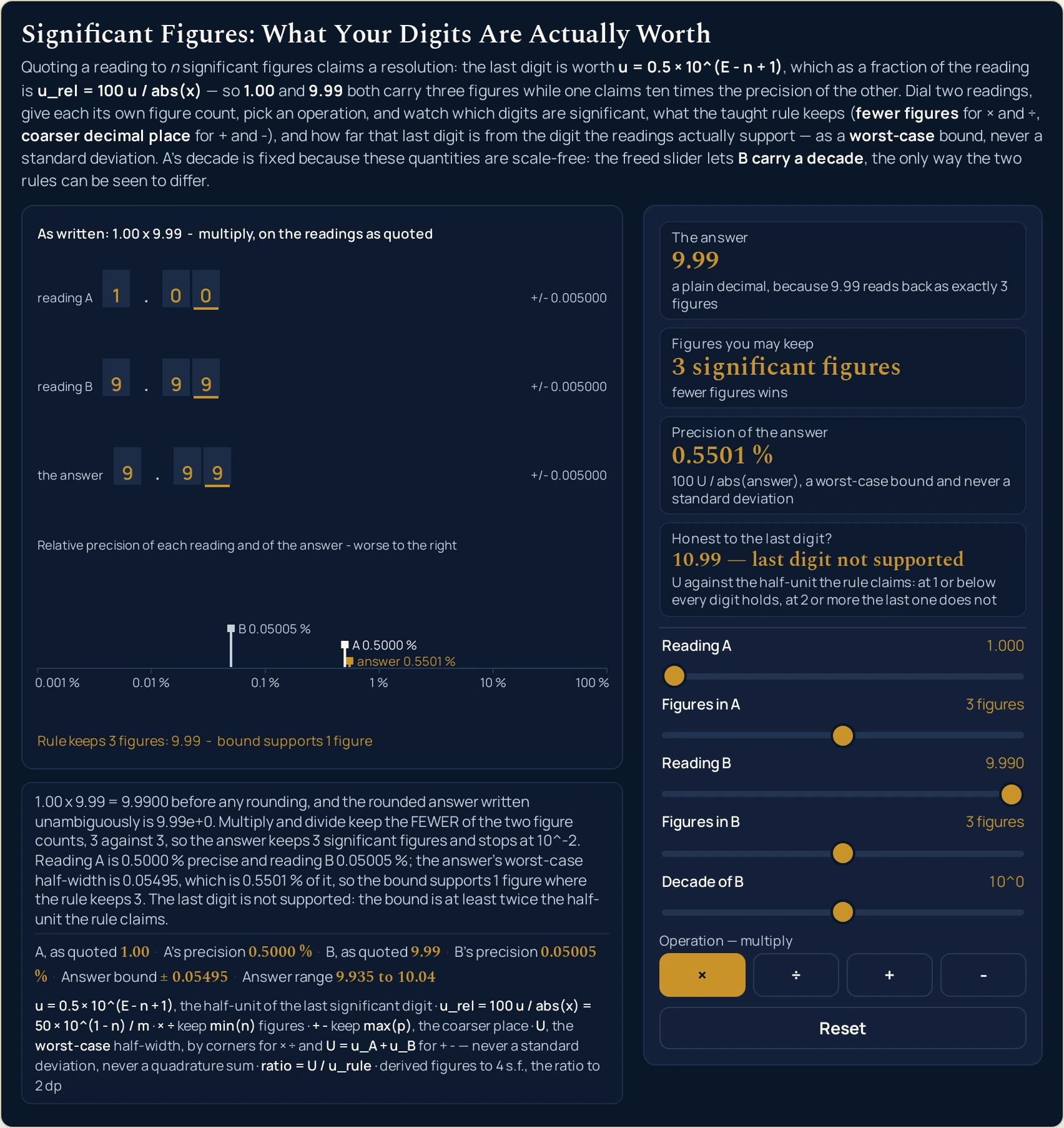
1.00 than on 9.99, and the axis is where you see it: two markers one decade apart at an identical figure count. The rule still hands over 3 significant figures; the drawn caption underneath says the bound supports one. At 10.99 this is the largest ratio any of the eight presets reaches.Where the significant figures simulator breaks down
Every slider position this lab can reach is answered, and the arithmetic is not where it can let you down. What it cannot do is show you a refusal, and what it chooses not to do is give reading A a decade. Nine limits sit under the readings on this page; three are decisions the panel makes on purpose and six are bounds on what a panel of this shape can show at all.
- Most of the refusals this topic has are unreachable here, and the lab does not pretend otherwise
- The five sliders cannot produce a reading of zero, a figure count below one, a fractional figure count or a divisor of zero, and a validly quoted interval can never straddle zero, so even the division guard has no reachable input. Those refusals are real and they matter — a written zero has no significant figures at all, which is a genuine asymmetry in the rule — but they belong to the significant figures calculator, where you type the figures yourself and it says why it will not answer. The guards exist in this lab too and were driven directly in testing; they simply have no input you can reach.
- Reading A has no decade, so the lab cannot show you a scale effect that is not there
- A always lies in one decade. That costs nothing, because a figure count on a given leading mantissa buys the same relative precision in any decade, and it buys the fifth slider: only a difference of decades between the two readings can leave a correctly quoted reading changing no digit of the sum at all. What it does mean is that you cannot use this panel to explore a quantity whose size is the question. A later reader who wants A to roam should know the omission is deliberate.
- A figure count above the digits the slider supplies is allowed, not clamped
- Set reading A to
5.000and Figures in A to 5 and the strip quotes it5.0000, with a half-unit of0.00005and a relative precision of0.001000 %. That is not the lab inventing precision: quoting a measurement to a figure count is an assertion about resolution, and the panel takes the assertion at face value and then prices it. If the claim is unreasonable, the fourth card is where you will see it. - The exact tie is reachable, it is not a preset, and software will disagree with it
- Put both readings at
5.000with one figure each and multiply. The product is an exact tie, the lab rounds it the way the taught rule does and prints3e+1with a ratio of exactly1.00 — every digit supported, and the range runs20.25 to 30.25. A tool that rounds the stored double instead can give2e+1for the same question, because the two routes genuinely differ on a tie. It is left off the preset row for that reason: it needs the paragraph, and the written guide is where the argument belongs. - Two states can print the same ratio and mean different things
- The verdict is decided on the unrounded ratio and printed next to the ratio rounded to two decimal places. The exact tie just above is a multiplication whose ratio is exactly one, and it prints
1.00 — every digit supported; the sixth preset, the reading too small to matter, is an addition whose ratio is a shade over one, and it prints1.00 — last digit marginalbeside the same two digits. Read the words rather than the digits, and never quote the boundary as being "at 1.00 as displayed". - One state says nothing, and it says so rather than printing a number
- Subtract two identical readings and the answer is exactly zero. The precision card then reads
undefinedrather than a figure, an infinity or an error, the figure count reads0 significant figures, and the answer strip is drawn with no gold cell and no tick under it. The bound is still real, which is the honest part: the answer is zero to within a stated half-width, and that half-width is still in the strip. - The bound is a worst case, so it is wider than a statistical treatment would give
- Everything here combines by corners and by addition, because a figure count asserts a resolution rather than a distribution. A root-sum-of-squares combination is the statistical question and is deliberately not this lab’s subject, so no interval on this page carries a probability and nothing on it is a standard deviation. If your readings are repeated measurements with scatter, this is the wrong tool for them and the bound it prints will be pessimistic.
- No digit cell is a measurement, and no pixel count means anything
- The scene is drawn to whatever width the canvas has, so the same reading occupies a different number of pixels on a phone and on a desktop, and the drawing promises no fixed width per digit. What it does guarantee is the correspondence: the gold cells in a strip always number the figures the captions claim, and the tick always sits under the last of them. The exact figures are in the four cards and the strip underneath, which is where to read them from.
- Nothing here is a constant, and nothing here is a quantum limit
- Every reading on the panel is a slider position chosen to divide cleanly, not a published value, and no manufacturer, model or instrument specification is named anywhere in this cluster. Constants do differ from one another in how precisely they are known, which matters when one of them ends up in your arithmetic, and the guide to physics constants is where those figures live; none is printed or implied here. The limit a quantum measurement carries is a different subject again and is not this bound.
Where significant figures are actually used
- Deciding how many digits of an answer to write down
- This is the everyday use and the panel is the fastest way to feel it. Dial your two readings and their figure counts, press the operation, and the first two cards give the answer and the count the rule allows. Then look at the fourth card before you write it: if it reads
last digit not supported, the digit you were about to publish is not one your readings paid for. - Finding out which of two readings is holding the answer back
- Put both readings on the panel and compare the two precision cells in the strip. On the leading-
1preset they read0.5000 %and0.05005 %at an identical three figures — 9.99 to one, not the round ten it looks like — and the answer inherits the worse of them. Improving the better reading buys you nothing; it is the coarser one that sets the answer, and the axis in the drawing puts the three markers on one scale so you can see which. - Spotting a subtraction that has destroyed your precision
- Dial
5.000against4.990, each quoted to three figures and each about a tenth of a per cent precise, then press -. The answer reads0.01at1 significant figureand100.0 %, and the range starts at0, which means the two readings may have been identical. Any difference of two nearly equal measurements has this problem, and the panel is the quickest demonstration that the rule cannot rescue it. - Checking that a quoted precision and a quoted figure count agree
- If somebody hands you both a figure count and a percentage, the two have to be consistent. Dial the reading and the count here and compare the precision cell with what you were told: a percentage better than the count can buy means a digit has been dropped somewhere, and one much worse means the count was never the limiting thing. The panel will not tell you which, but it will tell you the two cannot both be right.
- Keeping a guard digit through a conversion instead of rounding twice
- Most readings get converted before anybody argues about their digits, and rounding at each step throws away more than rounding once at the end. Carry the extra digit, do the arithmetic, and use this panel on the final pair to decide where to stop. The unit conversions lab is where the conversion itself is drawn, and this one is where its answer gets its figure count.
- Showing a class why the rule is a convention and not a theorem
- The habit of trusting the digit count is very hard to shift by being told. Press the leading-
1preset, read3 significant figureson one card and10.99 — last digit not supportedon another, then press the first preset and watch the same rule behave perfectly. Three minutes of that does more than a paragraph, which is why the ratio is on the panel at all.
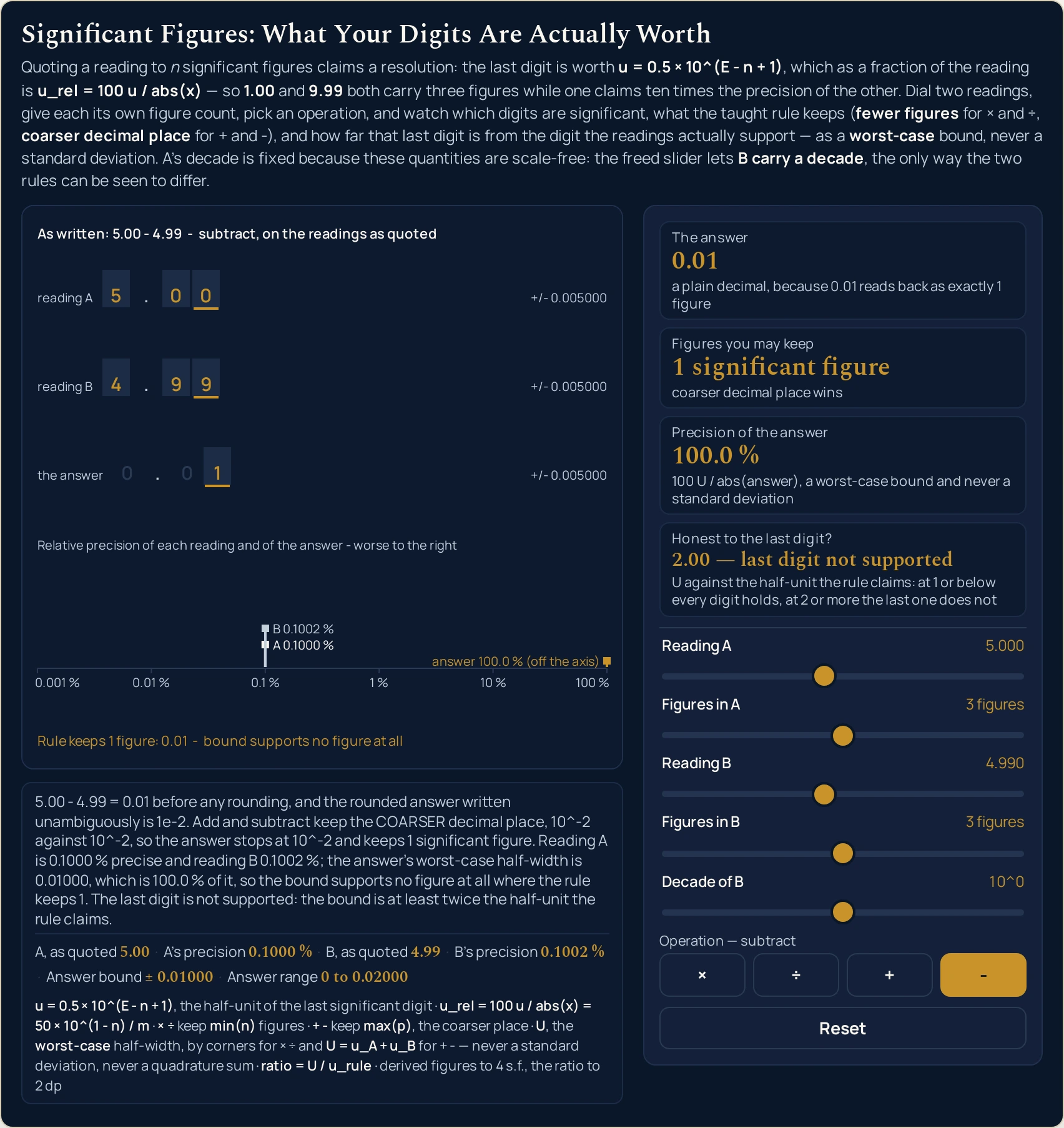
100.0 %, and its range begins at 0 — so on these quotes the two readings may have been identical. The drawn caption is blunter than the card: the bound supports no figure at all.Where to go next
A panel can show you what a figure count is worth, and that is the end of what a panel is for. Significant figures in physics is where the subject itself is written out: what counts as a significant figure, the four zero cases, why a bare integer is ambiguous, and eight worked problems with every step shown. The calculator that takes typed figures heads the related tools below.
Three guides sit either side of this one. The guide to SI units in physics and the guide to unit conversions are the two pages a reading passes through before its digits are counted, and the guide to physics constants is where a quantity arrives with a precision already attached to it.
Two more are about what you do with the answer. The physics formulas reference is where the arithmetic this panel prices usually comes from, and the guide to solving physics problems is where deciding what to write down sits in a longer method.
On the tool side there are the SI units lab, the unit conversions lab, the physics constants lab and the dimensional analysis lab, with the dimensional scaling calculator for the typed version of the last of those. Beyond them there is the simulation library, an index of calculators, and the blog for everything written out at length.
Frequently asked questions
Why can reading A not carry a decade of its own?
Because it would teach nothing, and the slider is worth more elsewhere. A figure count buys the same relative precision in every decade, so moving A from 5.00 to 5000 changes no percentage on the panel. Spending that control on B instead is what makes the reading too small to matter reachable at all: a correctly quoted reading contributes nothing to a sum only when it sits a decade or more below the one it is added to.
Why does the sentence strip use a letter x where the buttons use a proper sign?
Because the strip is built from the same symbol table the drawing is, and canvas text has no font to fall back on. If the webfont failed to load, a real multiplication sign painted onto the canvas would become an unreadable box that no automated check could see, since it is only pixels by then. So every operator in the drawing and in that strip is plain keyboard text, while the buttons above keep the real signs.
The fourth card shows a ratio of 1.00 twice and gives two different verdicts. Why?
Because the verdict is decided on the unrounded ratio and printed beside the ratio rounded to two decimals. Multiply 5.000 by 5.000 with one figure each and the card reads 1.00 - every digit supported. Load the sixth preset, which adds 1.0 to 0.00990, and it reads 1.00 - last digit marginal. The first ratio is exactly one and the second a shade above it, so read the words and not the digits.
Why does the answer sometimes come back in the e form instead of as a decimal?
Because a plain decimal is only printed when it reads back as the figure count being claimed. Multiply 5.00 by 4.0 and the rule keeps two figures, but writing that as 20 would read as one or two figures and not definitely two, so the card prints 2.0e+1 instead. Its sub-line says which branch fired and why, every time, so the choice is never silent.
Can I ask for more figures than the slider actually supplies?
Yes, and it is not a bug to be clamped. Set reading A to 5.000 and its figure count to 5 and the strip under the drawing quotes it as 5.0000, with a half-unit of 0.00005. You are asserting a resolution, which is exactly what quoting a measurement to a figure count is. The lab takes the claim at face value and then prices it, which is the honest response to it.
Why will this lab not show me an answer it refuses to give?
Because the five sliders cannot reach a refusable state. No slider produces a reading of zero, a figure count below one, a fractional figure count or a divisor of zero, and a validly quoted interval can never straddle zero, so the division guard has no reachable input either. Those refusals are real and they live in the matching calculator, where you type both figures yourself.
What happens on the one state where a reading says nothing at all?
Subtract two identical readings and the lab prints it rather than hiding it. The answer card reads 0 with the sub-line the two readings cancel exactly, so no digit of the answer is significant, the figure count reads 0 significant figures, and the precision card reads undefined rather than a number or an error. The bound is still real, and the answer strip is drawn with no gold cell and no tick.
References & formula source
- Everything the four cards assert about which digits survive an operation is textbook material rather than a house convention. Source: OpenStax, University Physics Volume 1, section 1.6 "Significant Figures" - for the rules themselves. The honesty ratio this lab prints beside them is not from that source: it is this page's own comparison of the worst-case bound against the half-unit the kept count claims, and it is labelled as such wherever it appears.
- Every reading on this panel comes out of five slider positions and one of four operations. A reading and a figure count fix the written form of the quote; the half-unit is half a unit in the column that form stops at; and the relative precision is that half-unit over the reading, as a percentage. The rule then gives the answer its figure count, from the fewer of the two counts for multiply and divide and from the coarser of the two decimal places for add and subtract. The worst-case half-width comes from the four corners or from the sum of the two half-units, and the honesty ratio is that half-width against the half-unit the rule's own last digit claims.
- Every arithmetic step in this lab is exact decimal arithmetic rather than a double, and that is the one implementation fact a reader of this page should know. In IEEE double arithmetic 5.00 minus 4.99 comes out as 0.009999999999999787, whose decade is minus three rather than minus two. Every significant-figure quantity on the panel is defined from that decade, so a double-based version of this lab would report its own decisive scene as zero significant figures and round the answer to 0 instead of 0.01. The two reading sliders are therefore held as whole thousandths and added, subtracted and multiplied as integers, and the independent reference written for this cluster runs 471 checks with 0 failures against that arithmetic.
- The bound this lab prints is a worst-case half-width and is labelled as one everywhere it appears, including on the card that carries it and in its own sub-line. Quoting a reading to a figure count asserts a resolution rather than a distribution, so the two bounds are combined by corners and by addition, never in quadrature and never as a root-sum-of-squares. Nothing on this page is a standard deviation, nothing here is an error bar in the statistical sense, and no probability is attached to any interval shown.
- The honesty ratio is decided on the unrounded value and printed rounded to two decimal places, so two states can print the same ratio and carry different verdicts. Multiplying 5.000 by 5.000 at one figure each gives a ratio of exactly one and prints 1.00 beside every digit supported, while the reading-too-small-to-matter preset adds 1.0 to 0.00990 for a ratio a shade over one and prints 1.00 beside last digit marginal. The operation matters as much as the two readings do, which is why the card prints the words as well as the number and why the boundary is not "at 1.00 as displayed".
- Reading A has no decade slider and that is a decision with a reason rather than a simplification. A figure count on a given leading mantissa buys the same relative precision in every decade, so letting A roam across decades would change no percentage the panel prints. Spending that control on reading B instead buys a case no pair of readings inside a single decade can produce: a correctly quoted reading too small to change any digit of the sum. That is not the same thing as making the two propagation rules differ. They already part company inside one decade whenever the sum carries, and the adding preset does it with B at a decade of 10^0: 1.0 quoted to two figures plus 9.999 quoted to four gives 11.0 at 3 significant figures, while the fewer of the two counts is two.
- Not one reading in this lab describes a real instrument. The presets are slider positions chosen because they divide cleanly and because they each isolate one claim, and no manufacturer, model, standard, published specification or measured instrument resolution is named anywhere in this cluster. A figure count is a claim the person quoting it is making, so treat any precision you intend to act on as unverified until it has been checked on the instrument in front of you.
- No constant is taught here and no constant's value or uncertainty is printed anywhere on this page. That constants differ from each other in precision is true and is relevant, and it is stated in one sentence with a link to the page that owns the subject; the figures themselves belong there and not here. Nothing on this page is a quantum limit either, and the inequality that governs one is nowhere in this cluster.
- Every figure quoted on this page is a string the simulation printed, read back out of the running lab in a browser at the slider positions named beside it. Twenty settings were driven that way through the sim's own range inputs with a real input event dispatched on each, two frames were waited, and all twenty read back unchanged; the eight presets reproduced the sim report string for string. No printed value was reused to make another and nothing here was worked out by hand.
- The drawing claims no pixel scale and no figure should be read off the length of anything in it. What the scene guarantees instead is a correspondence: the number of gold digit cells in a strip always equals the figure count the captions claim for that strip, the tick always sits under the last significant digit, and the three markers on the precision axis are placed on one shared logarithmic scale anchored on the decades. The exact figures live in the four cards and the strip beneath the drawing, and those are what to quote.
- The caption bands shorten on a narrow canvas and each one picks the longest wording that fits, so the sentence drawn under the scene is shorter in a narrow column than on a wide screen. Below 132 by 150 pixels nothing can be drawn to scale and be read, so the scene states its two figures in words and draws no cell and no axis at all. Nothing a reader needs is ever only in a band: every figure in the drawing is also in the panel beside it.
- Two engines were compared reading by reading rather than assumed to agree: slider positions were put side by side in Chrome and in Firefox at four widths and every readout compared per width, all identical, with desktop heights differing by one pixel. There is a hole in that, and it is Safari. The WebKit build on this machine will not start without system access it has not been given, so Safari was never exercised and nothing on this page is evidence about it.