Writing a number to n significant figures is a claim about resolution: the last digit you wrote is the first one you are unsure of, so the quote admits half a unit either way in that digit's column. This free significant figures calculator puts a price on that claim. It returns the half-unit itself, the same thing as a percentage of the value, and — run the other way — how many figures a precision you have in mind would actually take.
The percentage is the reading that changes a decision, because the count on its own hides a factor of up to ten. 1.00 and 9.99 both carry three figures and both claim a half-unit of 0.005, yet one is 0.5000 % precise and the other 0.05005 %. None of the readings named in the presets is an instrument specification; every figure here is an arithmetic exercise with stated givens.
Load a real case
Every button sets the Solve for menu first and then writes all four boxes, so whichever quantity the menu is pointing at, the rest already agree with it. The last two are there to be declined: a written zero has no significant figures to price, and a target precision of 100 per cent cannot be met by any count. The line underneath quotes back whatever the widget worked out, so nothing in it is stored text.
Pick a case above, or type your own numbers.
What Is the Significant Figures Calculator?
The significant figures calculator is a free online tool that puts a number on something a digit count only hints at. Quoting a measurement to n significant figures is a claim that the last digit you wrote is the first one you are unsure of, so the quote admits half a unit either way in that digit's column. That half-unit is u = 0.5 × 10^(E - n + 1), where E = floor(log10 abs(x)) is the decade of the value, and dividing it by the value turns it into a percentage you can compare across measurements of wildly different sizes.
Three positions of the Solve for menu answer three different questions. The relative precision is the one the menu opens on, and it is the reading that changes a decision; the half-unit in last place is the figure you carry into arithmetic, in whatever unit the value was measured in; and the significant figures position runs the whole thing backwards, taking a precision you have in mind and returning how many digits it takes to claim it. The target is always explicit, so the engine's own menu is the only mode control on the page.
Neither the quoted-value box nor the half-unit box carries a unit, and that is the physics rather than a gap. The half-unit and the value sit in the same fraction, so whatever was measured cancels before the percentage is worked out, and a reading in millimetres and a reading in kilopascals with the same digits give the identical answer. The half-unit comes back in whatever unit the value went in as. The relative-precision box does carry a unit and it has two settings, per cent and parts per million, so a tolerance written either way is the same entry.
Seven readings sit beside every answer, and all seven are worked out from the complete state with the solved quantity substituted back, which is what makes them the same seven whichever direction you asked for. They are the relative precision, the half-unit, the value written back at the count being claimed, the worst-case interval, the number of decimal places kept, and what one more figure would buy and one fewer would cost. Those last two always differ from the answer by a factor of exactly ten, in each direction, and that is the whole reason a figure count is a coarse instrument.
The decimal-place reading is allowed to be negative, which looks like an error and is not. A quote of two figures on a value in the thousands stops two columns short of the units digit, so there are minus two decimal places kept, and the half-unit is fifty rather than a fraction. That is the same statement as the e form the page prints beside it, and it is the clearest sign that a figure count is a statement about a column rather than about digits after a point.
The third mode returns a continuous figure count, and you round it up. The relation between a precision and a count is smooth while the count itself is not, so inverting it gives a real number such as 3.602 figures, and you cannot write 3.602 digits. Rounding up is exact rather than cautious: an independent reference written for this page before the page existed proves over a whole sweep of values and targets that the next whole count above always meets the target and the one below never does. Read the first reading rather than the headline, because the headline shows the raw count to four significant figures and a raw count just above two prints there as a bare 2 when the answer is three.
Because the count moves in whole steps and each step is worth a factor of ten, the precisions a figure count can express are not spread evenly. Three figures buys anything from 0.5000 per cent at the bottom of a decade to 0.05005 per cent at the top, and the count alone cannot tell you which you have - which is why this page reports the percentage beside the count rather than leaving you with the count. Each count's range ends exactly where the next begins, so the curves tile the line with no gaps and no overlaps, and the relative precision of a real quote never reaches 100 per cent however few figures you write.
The page prints its own derived figures to four significant figures with trailing zeros kept, which is the site convention, and it puts them through the same display rule it teaches. A plain decimal is printed only where that decimal counts the figures being claimed; otherwise the e form is used, written as 2.500e+3 rather than with a raised exponent. That is why a half-unit of fifty reads 50.00 and a value of 2500 reads 2.500e+3 in the readings: as written, 2500 counts anywhere from two figures to four, so printing it plainly would be this page teaching a rule and then breaking it in its own output.
Some entries are declined rather than answered, and one of them is the most interesting thing on the page. A quoted value of zero has no significant figures at all on the counting rule, so its half-unit claim is undefined rather than zero and its relative precision is undefined rather than an infinity - and yet writing 0.0 does assert a resolution, which is a real wrinkle in the rule rather than a limitation of the tool. A figure count below one or with a fractional part is refused where the count is an input, because figures are whole things. A target precision of zero or less, or of 100 per cent or more, is refused in the third mode; a target just under 100 is accepted, so the boundary is strict. And a count so large that the half-unit underflows the arithmetic is declined too, rather than reported as a precision of zero.
No reading named anywhere on this page is an instrument specification. The plate thickness, the micrometer reading and the pressure readings in the presets are arithmetic exercises with stated givens, chosen because they produce clean arithmetic and because between them they cover all four zero cases, and no manufacturer, model, standard or measured instrument figure appears in any of them. If you need the real resolution of a real instrument, verify it against that instrument before you use it.
Every interval the page prints is a worst-case bound and the page says so wherever it prints one. Quoting figures asserts a resolution, so the ends of the interval are the extremes the quote admits rather than one spread of a distribution; these bounds do not combine the way statistical uncertainties do, and nothing here adds two of them in quadrature. What the page also does not do, it says. It prices one quote rather than a calculation, so there is no propagation of two quoted numbers through a multiplication or a sum - those are two different rules and they belong to the guide and the simulator this tool sits beside. There is no value or uncertainty for any physical constant and no bracket notation for one, no exact unit-conversion factor, no quantum uncertainty relation and no general problem-solving framework. The page prices a figure count, inverts that pricing, and stops.
| Symbol | Quantity | Default unit | Also accepts | Example value |
|---|---|---|---|---|
| x | Quoted value | — | — | 2500 |
| n | Significant figures | figures | — | 4 |
| u_rel | Relative precision | % | ppm | 0.02 |
| u | Half-unit in last place | — | — | 0.5 |
How to use the significant figures calculator
- Choose the unknown. The Solve for menu opens on Relative precision, and the other two choices are the half-unit in the last place and the number of significant figures a target precision needs. The box a mode does not read is hidden while that mode is showing.
- Type the quoted value. It opens on
2500and it is the one box every mode reads. No unit is asked for, because the percentage is the same whatever you measured in — the same digits on a length and on a pressure give the identical answer. - Type the figure count, or the precision you want. The count opens on
4and has to be a whole number of at least one. In the third mode you give a target precision instead, in per cent or in parts per million. - Read the headline. Four significant figures with trailing zeros dropped by the engine. At the opening boxes it reads
0.02 %, which the working and the readings print as0.02000 %. - Read the half-unit, the written value and the interval. They are
0.5000,2.500e+3and2.500e+3 ± 0.5000at the opening boxes. The interval is a worst-case bound rather than a standard deviation, and it is labelled that way. - Read what one figure either way is worth. The last two readings are
0.002000 %and0.2000 %at the opening boxes. They differ from the answer by exactly a factor of ten in each direction, which is the whole reason the count is a coarse instrument. - Switch per cent to parts per million. The relative-precision box carries a two-entry unit menu and the engine converts for you, so
0.02in per cent and200in ppm are the same entry. - Switch the menu to the figure count. Choose Significant figures and the answer comes back continuous —
3.602for a target of0.05 %on2.50— and you round it up, to four. Read the first reading rather than the headline: the headline shows the raw count to four figures, so a raw2.00043prints there as2when the answer is three. - Open Show working. The decade, the place of the last digit, the half-unit and the percentage appear line by line, then the closed form that skips the decade. Every line is produced from the full-precision figures and formatted once.
This page is the arithmetic, and the guide to significant figures in physics is where the method is set out with eight worked problems, the counting rules for all four zero cases, and the two propagation rules that are not the same rule. The digits you type usually arrive from somewhere else: the SI units guide is where a reading gets its unit in the first place, and the SI prefix converter moves one between prefixes without changing how many figures it carries.
Three mistakes account for most wrong answers here. The first is reading the count as a precision: 1.00 and 9.99 carry the same three figures and differ in precision by a factor of 9.99, which is why this page reports the percentage beside the count. The second is dropping a trailing zero that was written on purpose — 0.04070 is four figures and 0.0407 is three, and the difference is a factor of ten in the claim.
The third is rounding on the way through instead of once at the end. The unit conversions guide sets that rule out properly for a chain of conversions, and the unit conversions lab is where you can watch a chain run. Nothing on this page converts anything: it prices the digits you already have.
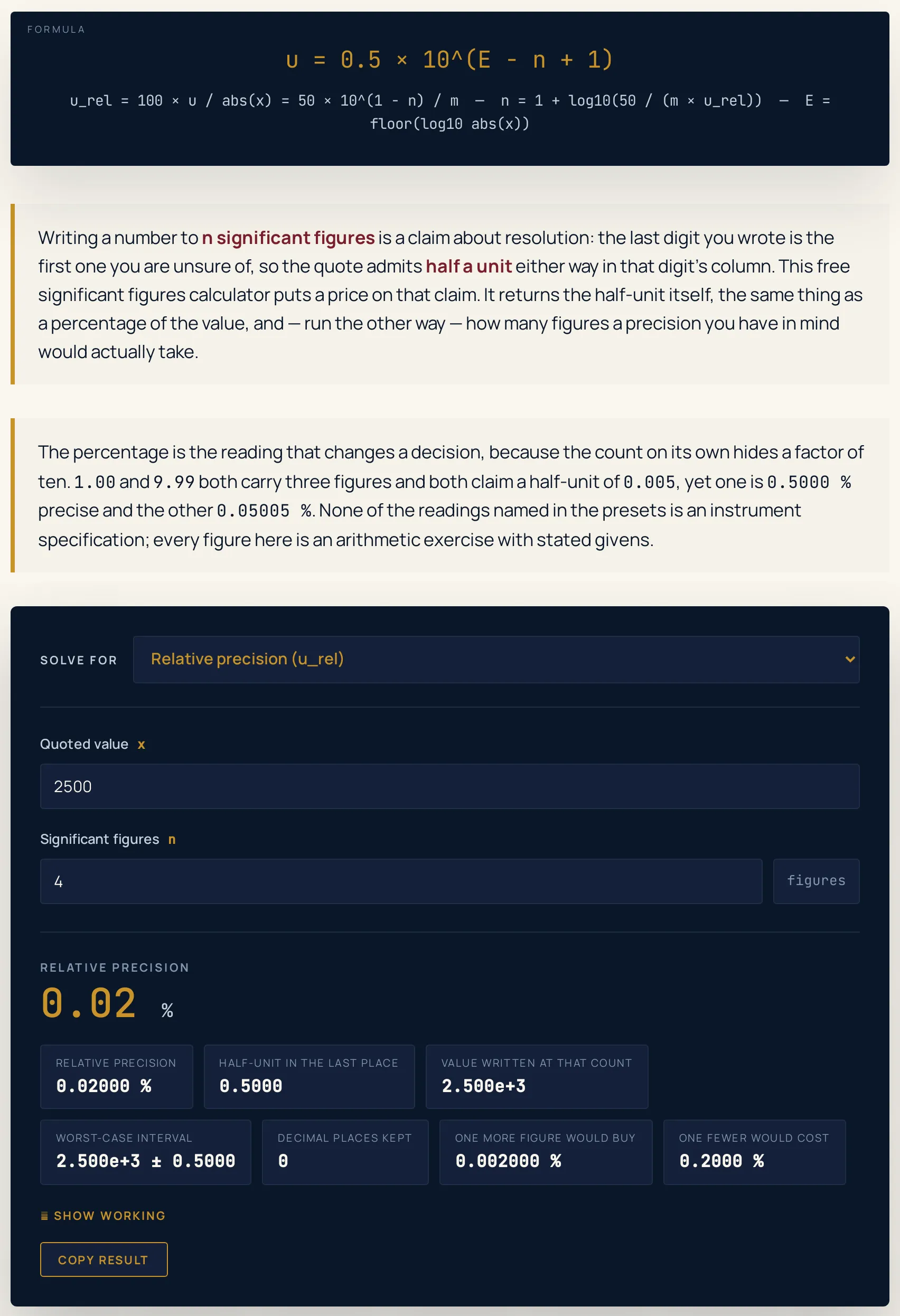
2500 quoted to 4 figures claims 0.02 %, with a half-unit of 0.5000 and a worst-case interval of 2.500e+3 ± 0.5000. One more figure would buy 0.002000 % and one fewer would cost 0.2000 % — a factor of ten each way.Worked example: change one thing at a time
The first table starts at the opening boxes and then changes one thing at a time: the same value read at three counts, the same count on two different mantissas, the four zero cases, a negative value, and finally the entries the calculator declines. Every answer and reading cell was read out of the running widget rather than worked out by hand, so where a cell and the tool ever part company, believe the tool.
| Case | Solving for | What you type | Headline answer | Relative precision | Half-unit | Worst-case interval | Decimal places |
|---|---|---|---|---|---|---|---|
| 1. The opening boxes | Relative precision | 2500 at 4 figures |
0.02 % |
0.02000 % |
0.5000 |
2.500e+3 ± 0.5000 |
0 |
| 2. The same value read as three figures | Relative precision | 2500 at 3 figures |
0.2 % |
0.2000 % |
5.000 |
2.50e+3 ± 5.000 |
-1 |
| 3. ... and as two | Relative precision | 2500 at 2 figures |
2 % |
2.000 % |
50.00 |
2.5e+3 ± 50.00 |
-2 |
| 4. Three figures starting with a 1 | Relative precision | 1.00 at 3 figures |
0.5 % |
0.5000 % |
0.005000 |
1.00 ± 0.005000 |
2 |
| 5. The same three figures starting with a 9 | Relative precision | 9.99 at 3 figures |
0.05005 % |
0.05005 % |
0.005000 |
9.99 ± 0.005000 |
2 |
| 6. A micrometer reading with a trailing zero | Half-unit | 0.04070 at 4 figures |
5.000e-6 |
0.01229 % |
5.000e-6 |
0.04070 ± 5.000e-6 |
5 |
| 7. Drop that trailing zero and it is three figures | Half-unit | 0.0407 at 3 figures |
5.000e-5 |
0.1229 % |
5.000e-5 |
0.0407 ± 5.000e-5 |
4 |
| 8. A captive zero, which is significant | Half-unit | 10.053 at 5 figures |
0.0005 |
0.004974 % |
0.0005000 |
10.053 ± 0.0005000 |
3 |
| 9. Leading zeros, which are placeholders | Half-unit | 0.053 at 2 figures |
0.0005 |
0.9434 % |
0.0005000 |
0.053 ± 0.0005000 |
3 |
| 10. The ambiguous case, resolved to two figures | Relative precision | 20 at 2 figures |
2.5 % |
2.500 % |
0.5000 |
2.0e+1 ± 0.5000 |
0 |
| 11. ... and resolved to three | Relative precision | 20 at 3 figures |
0.25 % |
0.2500 % |
0.05000 |
20.0 ± 0.05000 |
1 |
| 12. One figure, the coarsest count there is | Relative precision | 9.99 at 1 figure |
5.005 % |
5.005 % |
0.5000 |
1e+1 ± 0.5000 |
0 |
| 13. A negative value: the sign is not a digit | Relative precision | -0.04070 at 4 figures |
0.01229 % |
0.01229 % |
5.000e-6 |
-0.04070 ± 5.000e-6 |
5 |
| 14. A quoted zero | Relative precision | 0 at 3 figures |
declined | declined | declined | declined | declined |
| 15. Zero figures | Relative precision | 2500 at 0 figures |
declined | declined | declined | declined | declined |
| 16. A fractional figure count | Relative precision | 2500 at 2.5 figures |
declined | declined | declined | declined | declined |
| 17. A count the arithmetic cannot hold | Half-unit | 2500 at 400 figures |
declined | declined | declined | declined | declined |
Rows 1 to 3 are one value read three ways, and they are the clearest thing on the page. The digits never change; only the claim does. Each figure dropped multiplies the half-unit by ten and the percentage with it, from 0.02000 % to 0.2000 % to 2.000 %.
Notice what rows 1 to 3 print in the interval column: 2.500e+3, 2.50e+3 and 2.5e+3. Written plainly, all three would read 2500, which counts anywhere from two figures to four, so the plain form would hide the very thing the row is about. The e form is the only way to write a trailing zero that means something.
Rows 4 and 5 are this page's own result. Both quotes carry three figures, both claim a half-unit of 0.005000, and they are 0.5000 % and 0.05005 % precise — a factor of 9.99 apart for the same number of digits. A reader who only counts digits cannot see that, and it is the difference between a measurement that settles a question and one that does not.
Rows 6 to 9 are the four zero cases. A trailing zero after a decimal point counts, so 0.04070 is four figures; drop it and row 7 is three figures and ten times coarser. A captive zero counts too, so 10.053 is five; leading zeros never do, so 0.053 is two.
Rows 10 and 11 are two resolutions written out. 20 as written does not say how many of its digits are being claimed, so the only honest way to use it is to state the count you meant — and every count you add or drop moves the answer by a factor of ten. Resolved to two figures it is 2.500 % precise; resolved to three, 0.2500 %. The interval column is where the resolution becomes visible: row 10 writes back 2.0e+1 and row 11 writes back 20.0, which is the string a three-figure claim needs. The physics formulas reference is where that habit matters most, because a formula fed an ambiguous figure returns an ambiguous answer.
Row 12 is the coarsest count there is, one figure, at 5.005 %. Row 13 shows that a sign is not a digit: -0.04070 carries the same four figures and the same 0.01229 % as the positive reading.
Rows 14 to 17 sit outside the domain and are declined there rather than answered. Row 14 is the interesting one: a written zero has no significant figures, so there is no last place to take half a unit of, and the answer is undefined rather than 0. Writing 0.0 does assert a resolution and still counts as no figures — a real wrinkle in the rule, not a limitation of the tool.
Rows 15 and 16 refuse a count below one and a fractional count, because figures are whole things and interpolating between two counts would interpolate between precisions a factor of ten apart. Row 17 is refused by the arithmetic rather than by the rule: 400 figures is a legal whole number, and then the half-unit underflows a double to zero, so the page declines instead of printing a precision of 0 that is simply false.
The second table is the menu's third position, which is the half of this page that answers the question a reader usually arrives with: not what my digits are worth, but how many I need. The count that comes back is continuous and you round it up, and the two columns beside it show what that count delivers and what one fewer would have delivered.
Read the Rounded up column, not the headline. The headline shows the raw count to four significant figures with trailing zeros dropped, so a raw count of 2.00043 prints there as 2 figures while the answer is three. The working prints the raw count to six figures beside it for exactly that reason, and the first reading beside the answer carries the rounded-up count on its own.
| Case | Quoted value | Target precision | Headline answer | Rounded up | What that delivers | What one fewer delivers | Half-unit |
|---|---|---|---|---|---|---|---|
| 1. The opening boxes, run backwards | 2500 |
0.02 % |
4 figures |
4 |
0.02000 % |
0.2000 % |
0.5000 |
| 2. A target of 0.05 % on a value starting 2.50 | 2.50 |
0.05 % |
3.602 figures |
4 |
0.02000 % |
0.2000 % |
0.0005000 |
| 3. The sharp edge: 0.5 % on a value starting 9.99 | 9.99 |
0.5 % |
2 figures |
3 |
0.05005 % |
0.5005 % |
0.005000 |
| 4. Relax that target to 0.51 % and two will do | 9.99 |
0.51 % |
1.992 figures |
2 |
0.5005 % |
5.005 % |
0.05000 |
| 5. The same 0.5 % on a value starting 1.00 | 1.00 |
0.5 % |
3 figures |
3 |
0.5000 % |
5.000 % |
0.005000 |
| 6. The target typed in parts per million instead | 2500 |
200 ppm |
4 figures |
4 |
0.02000 % |
0.2000 % |
0.5000 |
| 7. A coarse target one figure already beats | 5 |
99.5 % |
0.002177 figures |
1 |
10.00 % |
one figure is the floor | 0.5000 |
| 8. A target of zero | 2500 |
0 % |
declined | declined | declined | declined | declined |
| 9. A target of 100 % or more | 2500 |
100 % |
declined | declined | declined | declined | declined |
| 10. A negative target | 2500 |
-1 % |
declined | declined | declined | declined | declined |
| 11. A quoted zero, whatever the target | 0 |
1 % |
declined | declined | declined | declined | declined |
Row 2 is the row to read twice. A target of 0.05 % on a value starting 2.50 computes as 3.602 figures, so you write four. Four deliver 0.02000 % and three deliver 0.2000 %, so three miss the target by a factor of four while four beat it by a factor of 2.5 — and there is nothing in between to settle for.
Rows 3 and 4 are the sharpest illustration of that on the page. 0.5 % on a value starting 9.99 computes as 2.00043 figures, which rounds up to three, because two figures there deliver 0.5005 % and that is a miss. Relax the target by one hundredth of a percentage point, to 0.51 %, and the raw count falls to 1.992, so the same value needs only two.
Row 5 closes the round trip on the decade effect from the other side. The same 0.5 % target on a value starting 1.00 comes out at exactly three figures, where the value starting 9.99 needed three as well — but there the three buy 0.05005 %, a factor of 9.99 more precision than you asked for. The count is a decade-wide dial and the mantissa decides where inside the decade you land.
Row 6 types the same target as row 1 in parts per million instead of per cent and gets the same answer, because the engine converts the entry rather than the physics. Row 7 is a target so coarse that one figure already beats it: 99.5 % is accepted, because the refusal boundary is a strict 100 per cent, and the last reading says in words that one figure is the floor rather than reporting that you need less than one.
Rows 8 to 11 are refused. A target of zero or less is not a target; a target at or above 100 per cent cannot be met by any count, because the relative precision of a real quote never reaches 100 per cent; and a quoted zero is refused here for the same reason it is refused in the first table.
Formula and symbol reference
One relation does all the work. A quote of n significant figures stops at the place p = E - n + 1, where E = floor(log10 abs(x)) is the decade of the value, and it admits half a unit of that place: u = 0.5 × 10^(E - n + 1). Divide that by the value and you have the relative precision, u_rel = 100 × u / abs(x).
Written as a closed form the decade drops out entirely: u_rel = 50 × 10^(1 - n) / m, where m = abs(x) / 10^E is the mantissa between 1 and 10. That is the most useful line on the page. The count sets the decade of the answer and the mantissa sets everything else, which is why the same count is worth up to ten times more on a value starting 9 than on one starting 1.
Invert it and you have the third mode: n = 1 + log10(50 / (m × u_rel)). The count that comes out is continuous and you round it up, and the decimal-place count is just dp = -p = n - 1 - E, which can legitimately be negative when a quote stops short of the units column.
Two neighbouring quantities look like this one and are not. The precision of a published constant is the physics constants guide's material, and this page prints no constant's value or uncertainty; the physics constants lab is where that precision is explored. The quantum limit on what can be measured at all belongs to the Heisenberg uncertainty principle guide, and a quote's resolution is a statement about how a number was written rather than about nature.
| Symbol | Meaning | Unit | Values used on this page |
|---|---|---|---|
| x | Quoted value — the number as it was written down. The one box every mode reads, and the only one that is never a solve target | whatever you measured in; the box asks for no unit, because the percentage cancels it | Opens on 2500. Presets also use 1.00, 9.99, 0.04070, 10.053, 0.053, 20 and 2.50. A quoted 0 is declined; a negative value is fine. |
| n | Significant figures — how many digits the quote carries. An input in the first two modes and the answer in the third | figures; a whole number of at least one | Opens on 4. Presets also use 1, 2, 3 and 5. 0 and 2.5 are declined where it is an input. |
| u_rel | Relative precision — the half-unit as a percentage of the value. The quantity the page opens solving for, and the target you type in the third mode | per cent by default; parts per million as the second entry | A result: 0.02000 % at the opening boxes, 0.5000 % on 1.00 at three figures, 0.05005 % on 9.99 at the same three. As a target: 0.05 %, 0.5 %, 0.51 %, 200 ppm. |
| u | Half-unit in the last place — half a unit of the last digit you wrote. A solve target, and the only box this page never reads as an input | the same unit as the quoted value | A result: 0.5000 at the opening boxes, 5.000e-6 for the micrometer reading, 50.00 for the same 2500 read as two figures. |
| E | Decade — floor(log10 abs(x)), read off the written exponent rather than through log10. Every other quantity here is defined from it | none; a whole number, and it can be negative | A step reading: 3 for 2500, 0 for 9.99, -2 for 0.04070. |
| m | Mantissa — abs(x) / 10^E, which always lands between 1 and 10. The reason two quotes with the same figure count can differ in precision by almost a factor of ten | none; a pure number from 1 up to but not including 10 | A step reading: 2.500 for 2500, 1.000 for 1.00, 9.990 for 9.99, 4.070 for 0.04070. |
| p | Place — E - n + 1, the column the last significant digit sits in. The half-unit is half a unit of this column | none; a whole number, and it can be negative | A step reading: 0 for 2500 at four figures, -2 for 9.99 at three, -5 for 0.04070 at four. |
| dp | Decimal places kept — minus the place, which is how many digits sit after the point. A NEGATIVE count is real and means the quote stops short of the units column | none; a whole number, and it can be negative | A reading: 0 at the opening boxes, -2 for 2500 at two figures, 5 for the micrometer reading. |
The physics: why a figure count is a coarse instrument
The count can only move in whole steps, and each step is worth a factor of ten. So the precisions a figure count can express are not spread evenly: they come in decades, and inside each decade the mantissa stretches the answer across a further factor of almost ten. Three figures buys anything from 0.5000 % at the bottom of a decade to 0.05005 % at the top, and the count alone cannot tell you which you have.
That is also why each count's range ends exactly where the next begins. Three figures at the bottom of a decade — a value starting 1.00 — claims 0.5000 %, and two figures at the top of one claims 0.5005 % on 9.99. The closer the leading digits run to ten, the closer that gets to the same 0.5 %, so the curves tile the line with no gaps and no overlaps.
One consequence is worth stating because it is easy to get backwards. The relative precision of a real quote never reaches 100 per cent, however few figures you write: one figure on a value starting 1 is a 50 per cent claim, and that is the coarsest there is. So a quoted interval can never straddle zero, which is why the calculator refuses a target precision of 100 per cent rather than reporting an enormous figure count.
The other consequence is the one this page exists for. If the precision you need falls between what two counts deliver, the count is not the dial to turn — you need a better reading, or you need to say the precision outright instead of implying it through digits. Published constants are quoted with an explicit uncertainty for exactly that reason, and they differ from one another in precision by many orders of magnitude; their figures live in the physics constants guide rather than here.
The counting convention behind all of this — which digits of a written number count, and why a bare integer ending in zeros is ambiguous about how many of them do — is the standard one, and you can read it at OpenStax, University Physics Volume 1, section 1.6. The closed form and its inversion are this page’s own working from that definition, as the references list records.
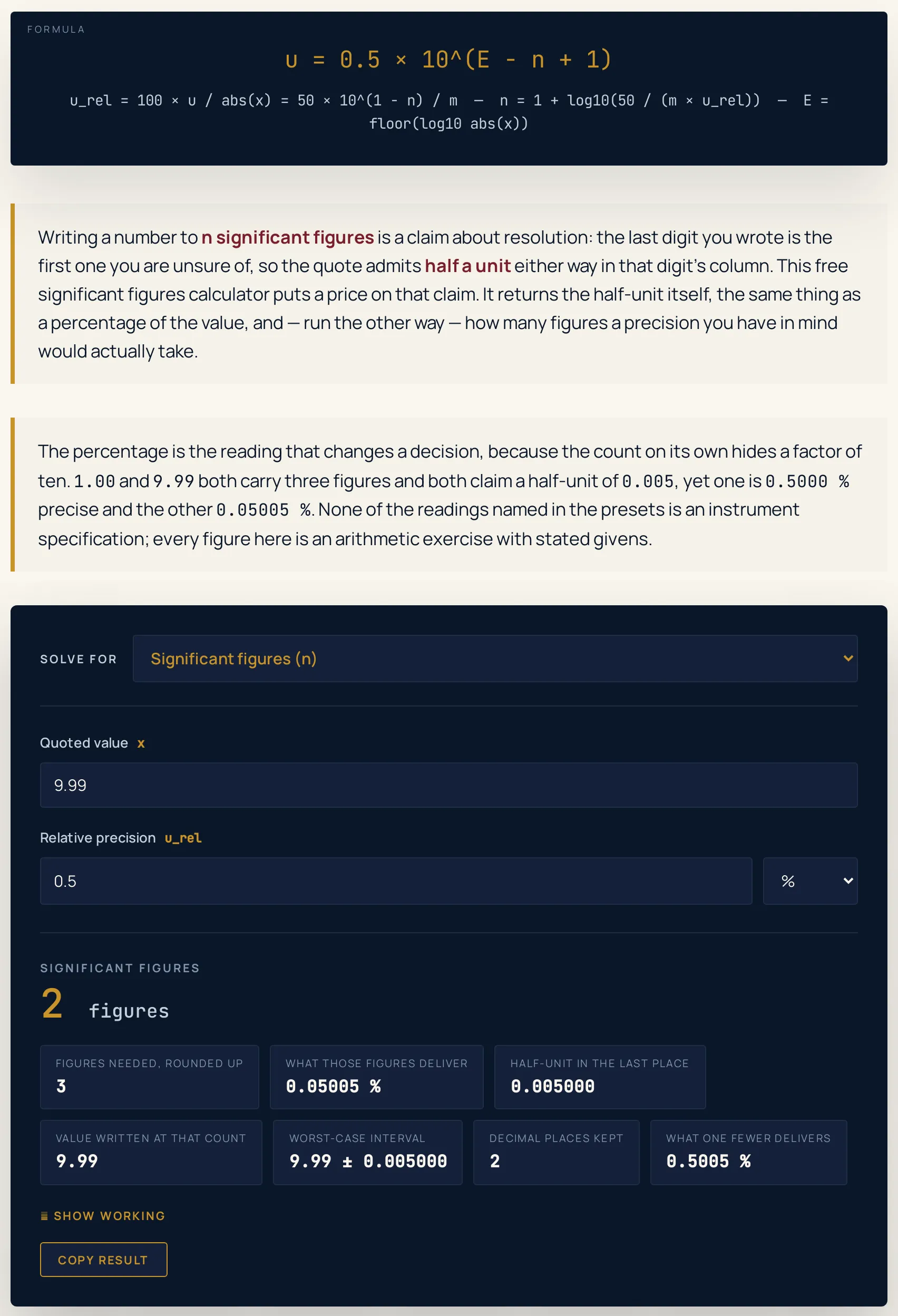
0.5 % on a value starting 9.99 computes as 2 figures in the headline and three once rounded up. Two figures there deliver 0.5005 %, which misses the target, and a miss is a miss however small.Where the significant figures calculator breaks down
The arithmetic here is exact to the last digit a double can hold, and there is no measured constant in it to be uncertain about. What goes wrong is everything around the count: whether the digits on the page are the digits that were measured, whether the rule is the right tool for the question, and whether a resolution was ever the thing worth knowing.
- It cannot tell you how many figures your reading really carries
- The count is something you supply, and getting it right means reading the number as it was written rather than as a calculator stored it. A bare integer ending in zero is the common trap:
20could be one figure or two and nothing in the digits settles it. If you type a count the writing does not support, every reading on the page is confidently wrong. - A resolution is not a standard deviation
- Every interval here is a worst-case bound: the quote admits anything inside the last digit's own column, with no distribution behind it. That means these bounds do not combine the way statistical uncertainties do, and nothing on this page adds them in quadrature. If your figures come from repeated measurements with a spread, that is a different calculation and this is not the tool for it.
- It prices one quote, not a calculation
- Multiplying or adding two quoted numbers has its own rules, and they are not the same rule as each other: a product keeps the smaller figure count while a sum keeps the coarser decimal place. This page deliberately stops at one value. The significant figures guide is where both propagation rules are worked through, and where you can see a sum end up with more figures than an input carries.
- Rounding the written digits and rounding the stored double can disagree
- The rule is taught on the digits you wrote, and a binary double is not those digits. Rounding
0.045to one figure gives0.05on the digits, because the tie breaks away from zero, and0.04through a calculator's own rounding, because the stored value sits just below0.045. This page rounds on the written decimal digits in integer arithmetic for exactly that reason, so your marking scheme and your calculator can honestly disagree on an apparent tie. - A very large figure count runs out of double
- Somewhere past three hundred figures the half-unit underflows a double to zero, and the page declines rather than printing a precision of
0that is simply false. On the opening value of2500the last count it will answer is325and the first it declines is326; the exact boundary moves with the decade of the value. That is a limit of the arithmetic rather than of the rule, and no real measurement comes anywhere near it. - It says nothing about whether the measurement was any good
- Resolution and accuracy are different things, and this page only knows about the first. A reading written to six figures can be six figures of a systematically wrong number, and the calculator has no way to see that. Checking an answer against an independent route is the habit that catches it, and that is the guide to solving physics problems's territory rather than this page's.
Where significant figures are actually used
- Deciding how many digits to write in an answer
- This is the question a figure count exists for, and the calculator answers it from the direction that matters: type the precision the reading supports and read off the count. Writing more digits than that claims a resolution you do not have; writing fewer throws away precision you paid for.
- Comparing two measurements of different sizes
- A half-unit of
0.5means nothing until you know what it is half a unit of. The percentage reading is what makes two quotes comparable, and it is why a2500read to four figures and a0.04070read to four are not equally precise at all:0.02000 %against0.01229 %. - Choosing the resolution a measurement needs
- Run the third mode before you measure rather than after. If you need
0.05 %on a reading that will start with a 2, you need four figures, and that tells you what the reading has to resolve. The answer depends on the leading digits, which is why the mode asks for a value rather than only a target. - Working in prefixes without changing the claim
- Moving a value between SI prefixes shifts the decade and leaves the figure count alone, so the relative precision does not move at all. The SI prefix converter does that shift, and the SI units lab is where the prefixes themselves are laid out; this page is what tells you the claim survived the move.
- Scaling a quantity by a power law
- When a result depends on an input raised to a power, the input's relative precision is multiplied by that power on its way through. The dimensional scaling calculator does the scaling itself, and the percentage reading here is the figure you carry into it.
- Reading a figure count out of a published quote
- Tables of measured values are written to a deliberate number of figures, and the number chosen is a claim you can price. Constants are the extreme case and are quoted with explicit uncertainties instead; the physics constants lab is where those are explored, and none of their figures appears here.
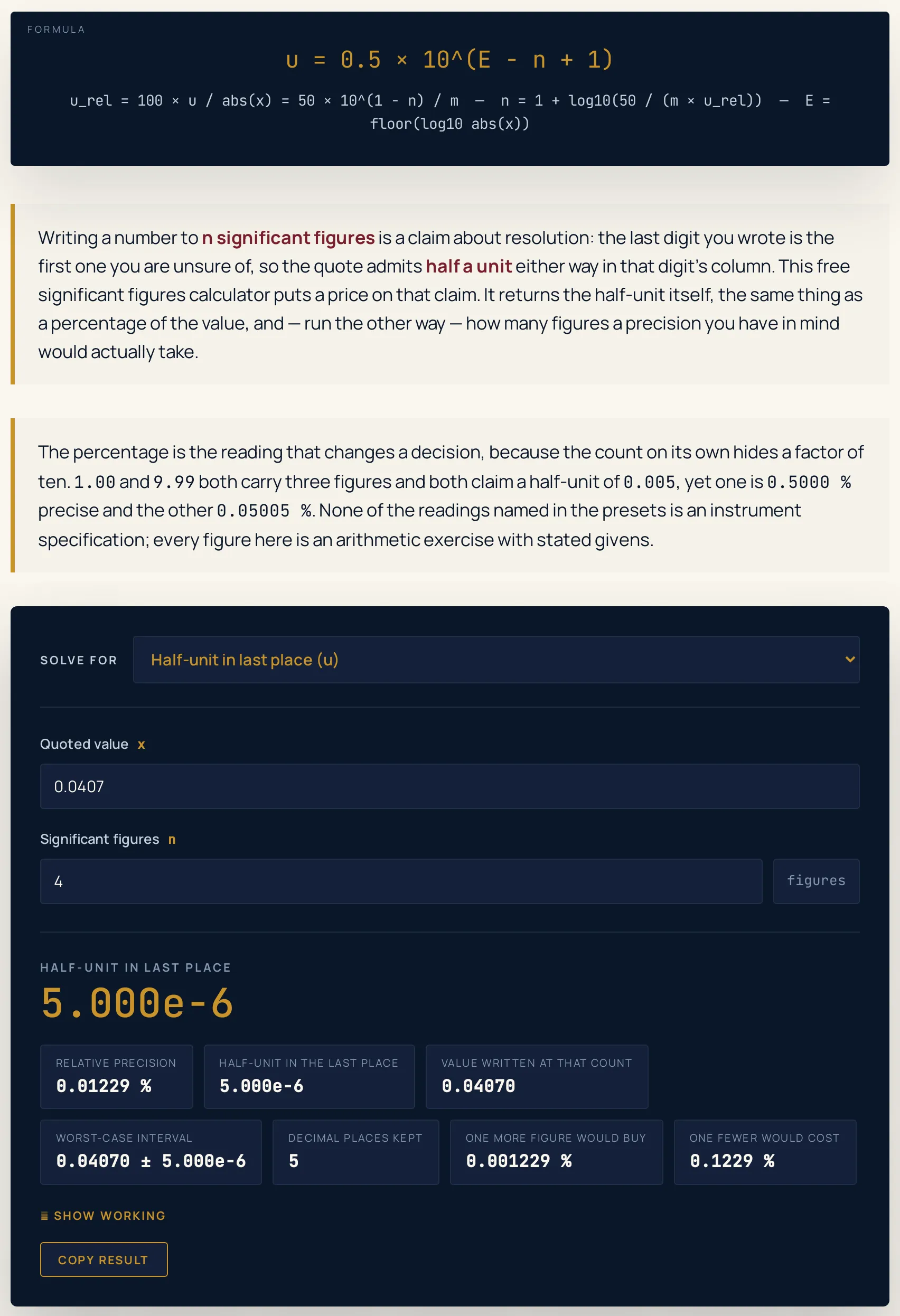
0.04070 as a stated given: the trailing zero after the point counts, so this is four figures and a half-unit of 5.000e-6. Notice that the number box shows 0.0407 — a numeric input cannot hold a written trailing zero, which is exactly why the count is a box of its own, and why the readings write the value back as 0.04070. Drop that zero from the count and the same reading is three figures and 0.1229 %.Where to go next
For the method rather than the arithmetic — eight worked problems, the counting rules for all four zero cases, the two propagation rules and the subtraction that destroys figures — read the guide to significant figures in physics, which this tool is the calculating half of. The SI units guide and the unit conversions guide are the two pages this one hands off to in both directions.
Three more guides pick up what this page leaves out. The physics constants guide owns the precision of published constants and their uncertainties, the Heisenberg uncertainty principle guide owns the quantum limit that a quote's resolution is not, and the guide to solving physics problems is where checking an answer three ways belongs.
Frequently asked questions
What does the significant figures calculator work out?
It prices a figure count in three directions. Give it a quoted value and a number of significant figures and it returns the relative precision that quote claims as a percentage, or the half-unit in the last place you wrote; give it a target precision instead and it returns how many figures you need. Beside every answer it prints the percentage, the half-unit, the worst-case interval, the decimal places kept and what one figure either way is worth.
Why does the quoted-value box have no unit?
Because the relative precision of a quote does not depend on what was measured or on how big it was. The half-unit and the value sit in the same fraction, so the unit cancels before the percentage is worked out, and the same digits in any decade give the same answer. A reading of 2.50 and a reading of 2500 with the same leading digits are both 0.2000 per cent precise at three figures. The half-unit itself comes back in whatever unit you typed the value in, so the box does not need to know which that was.
Why do 1.00 and 9.99 have the same figure count but different precision?
Because the count fixes the decade of the half-unit and the leading digits fix the rest. Both numbers carry three significant figures and both claim a half-unit of 0.005, but 0.005 is 0.5000 per cent of 1.00 and only 0.05005 per cent of 9.99 - a factor of 9.99 between them for the same number of digits. That is the single most useful thing on this page: a figure count is a proxy for a precision, and inside one decade the proxy is wrong by up to a factor of ten. It is why the calculator reports the percentage rather than leaving you with the count.
Why does the figure count come back as a decimal, and why round it up?
Because the relation between a precision and a count is continuous while the count itself is not. Inverting the closed form gives a real number - 3.602 figures for a target of 0.05 per cent on a value starting 2.50 - and you cannot write 3.602 digits. Rounding up is exact rather than cautious: the next whole count above always meets the target and the one below never does, which the independent reference this page is checked against verifies over a whole sweep of values and targets. Four figures there deliver 0.02000 per cent and three deliver only 0.2000 per cent, so there is nothing in between to settle for.
The calculator says 0.5 per cent on 9.99 needs three figures, not two. Why?
Because two figures on that value deliver 0.5005 per cent, which is just over the 0.5 per cent you asked for. The inversion gives 2.00043 figures, so the ceiling is three, and the margin that pushes it there is five ten-thousandths of a percentage point. A miss is a miss, so the page rounds up rather than reporting that two will nearly do. Relax the target to 0.51 per cent and the same value needs only two, which is the sharpest illustration on the page of how coarse a dial the figure count is.
Why will the calculator not accept a quoted value of zero?
Because a written zero has no significant figures at all, so there is nothing for the rule to price. The half-unit claim is undefined rather than zero and the relative precision is undefined rather than an infinity, and the page says so instead of printing a figure. The asymmetry is worth noticing: writing 0.0 does assert a resolution - you are claiming the true value is within half of a tenth of zero - and yet it counts as no significant figures on the counting rule. That is a real wrinkle in the rule rather than a limitation of the tool.
Why is a figure count of 2.5 refused?
Because figures are whole things: you either wrote a digit or you did not. The calculator declines a fractional count in the two modes where the count is an input rather than quietly interpolating between two precisions that differ by a factor of ten. A count below one is refused for the same reason, because a quote with no digits in it is not a quote. The third mode is the one place a fractional count is meaningful, and there it is an output you round up.
Why does the page write 2500 as 2.500e+3 in its own readings?
Because 2500 as written does not say how many figures it carries - the trailing zeros could be significant or could be placeholders, so it counts anywhere from two figures to four. A page that teaches that rule and then prints its own answers in a form the rule calls ambiguous would be breaking its own lesson in its own readings. So every plain decimal here is printed only when it counts the figures being claimed, and the e form is used when it would not. The e form is written 2.500e+3 rather than with a raised exponent, because the site fonts have no coverage of superscript digits.
Is the interval a standard deviation or an error bar?
Neither. Quoting n figures asserts a resolution, which is a bound: the true value lies anywhere inside that last digit's own column, and the ends of the interval are the extremes the quote admits. It is not a spread with a distribution behind it, so it does not combine with another bound the way standard deviations do. Combining uncertainties in quadrature is a statistical question and a different calculation from this one, and nothing on this page does it.
Should I round at every step or only at the end?
Only at the end. Keep the full figure through the working and round once, on the final answer, because a number you have already shortened carries its rounding into every line that uses it. This calculator does the same thing: every reading is formatted once from the full-precision value behind it, and no step string feeds a figure it just printed into the next. The unit conversions guide is where that rule is set out properly for a chain of conversions.
Are the plate, micrometer and pressure figures real instrument specifications?
No. Every figure on this page is an arithmetic exercise with stated givens, and none of them describes any manufacturer, model, standard or measured instrument. The readings were chosen because they produce clean arithmetic and because they cover the four zero cases, not because anything was measured. If you need the real resolution of a real instrument, verify it against that instrument before you use it.
What is deliberately not on this page?
There is no value or uncertainty for any physical constant and no bracket notation for one; the physics constants guide owns that material, and this page only notes that published constants differ in precision. There are no exact unit-conversion factors, no quantum uncertainty relation and no general problem-solving framework, each of which belongs to its own guide. The page prices a figure count, inverts that pricing, and stops.
References & formula source
- The counting rules and the two propagation rules this page is built on are the standard treatment of significant figures. Source: OpenStax, University Physics Volume 1, section 1.6 "Significant Figures", for the rules only - that the last digit written is the first with some uncertainty, how to count the digits of a written number, that zeros are significant except where they serve only as placeholders, and that a bare integer ending in zeros is ambiguous about how many of them count. No figure on this page is taken from it and none of its own worked examples is reused.
- The closed form u_rel = 50 times 10^(1 - n) / m, the inversion n = 1 + log10(50 / (m times u_rel)) and the spread of up to a factor of ten inside one decade are this page's own working from the definitions, not a citation. They follow from u = 0.5 times 10^(E - n + 1) and nothing else.
- Every figure quoted in the prose and the tables above is either a string this calculator printed for the inputs named beside it, harvested from the running widget rather than worked out by hand, or a figure from an independent reference written for this cluster before this page existed, which runs 471 checks with 0 failures. Where a table cell and the running widget ever part company, believe the widget.
- No value or uncertainty for any physical constant appears on this page, and no instrument is given a resolution as a fact. The plate thickness, the micrometer reading and the pressure readings are arithmetic exercises with stated givens; verify any real instrument against the instrument itself before relying on a figure.