Significant figures physics is the practice of keeping only the digits that a measurement’s own resolution supports, the last of them being the first digit you are unsure of. Multiplying or dividing keeps the fewer significant figures; adding or subtracting keeps the coarser decimal place. A figure count is a coarse stand-in for precision, never the precision itself.
Write 5.00 and 4.99 on a page and subtract one from the other. Three digits each went in, and 0.01 came out carrying one. Nothing failed there — the subtraction simply spent them.
That is the half a counting rule never mentions. Learning which digits to count takes five minutes; knowing what they are worth, and spotting the moment the rule hands you a digit your readings cannot support, is the part that changes an answer. This page does both, and then works eight problems.
Significant Figures in Physics: What Is a Significant Figure?
A significant figure is one of the digits of a measurement that its own resolution supports, and the last of them is the first digit you are not sure of.
Read a scale and you write down every mark you can see, plus one digit you estimate. Write 9.99 and you are claiming that the first two digits are solid, that the last 9 is your best reading of the gap between marks, and that nothing after it is worth saying. Everything in this topic follows from that one habit.
So a figure count is a claim about a written number rather than about the quantity it measures. The unit does the other job, and how a reading gets its unit in the first place is a separate step that this page assumes you already have.
Two consequences arrive straight away. A digit you did not measure may not be written down, and a digit you did measure may not be thrown away — which is why a trailing zero is sometimes a real measurement and sometimes only spacing.
How to Count the Figures in a Written Number
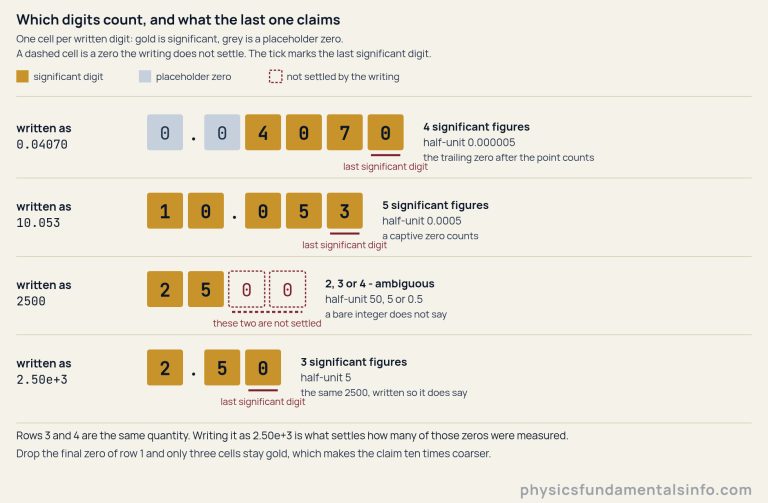
Count from the written string, left to right, starting at the first digit that is not a zero and stopping at the last digit written down. The only difficulty is the zeros, and there are exactly four cases.
- Leading zeros never count. In 0.053 they only position the decimal point, so that reading has two significant figures.
- Captive zeros always count. A zero with digits on both sides was measured like any other digit, so 10.053 has five.
- Trailing zeros after a decimal point count. Nobody writes one by accident, so 0.04070 has four and 5.0000 has five.
- Trailing zeros in a bare integer are ambiguous. Written as it stands, 2500 could be two, three or four figures, and the writing gives you no way to tell.
Once you have the count, the place of that last digit is fixed, and so is the claim it makes. Take the decade of the value, step back by the figure count, and allow half a unit of whatever place you land in.
- x — the value as written, in whatever unit the measurement carries (m, A, Pa, and so on). Significant figures are unit-free: the count never changes when the unit does.
- n — the significant figure count. A whole number, 1 or more, with no unit.
- E — the decade of the value, the whole-number power of ten just below it. No unit.
- m — the leading mantissa, abs(x) divided by 10^E, so it always sits between 1 and 10. No unit.
- p — the place of the last significant digit, as a power of ten. No unit, and legitimately negative.
- u — the half-unit of that place: the resolution the quote claims, in the same unit as x.
- dp — the decimal places the quote carries, which is just -p, and which can also be negative.
Work the half-unit and the percentage by hand the first few times, until the two steps become automatic. Then hand a written value and its figure count to the Significant Figures Calculator, which prices a quote both ways round and will also tell you how many figures a target precision needs. The table below prices eight written forms, and it is the one block here that answers the counting question on its own.
| Written as | Significant figures | Why | Half-unit | Relative precision |
|---|---|---|---|---|
| 0.053 | 2 | leading zeros are placeholders | 0.0005 | 0.9434 % |
| 10.053 | 5 | a captive zero counts | 0.0005 | 0.004974 % |
| 0.04070 | 4 | the final zero sits after the point | 0.000005 | 0.01229 % |
| 2.50e+3 | 3 | the notation states the count outright | 5 | 0.2000 % |
| 9.99 | 3 | three plain digits, no zeros to judge | 0.005 | 0.05005 % |
| 1.00 | 3 | the same count as 9.99, a factor of 9.99 less precise | 0.005 | 0.5000 % |
| 5.0000 | 5 | four trailing zeros, all written on purpose | 0.00005 | 0.001000 % |
| 2500 | 2, 3 or 4 — ambiguous | a bare integer never says which zeros were measured | 50, 5 or 0.5 | 2.000 %, 0.2000 % or 0.02000 % |
The last row is the one worth staring at. One written form, three readings, and a hundredfold spread in what it claims — so a bare integer ending in zeros is not a measurement until somebody says which zeros count. Scientific notation fixes it permanently, because it writes the significant digits and the decade in separate places.
One asymmetry in the rule is worth naming rather than hiding. A written zero has no significant figures at all, by the counting rule above, yet writing 0.0 plainly does assert a resolution. The honest move is to give the bound separately instead of pricing the digits: zero, to within whatever the readings allow.
OpenStax’s University Physics states the counting rule the same way — start at the first measured value on the left and count through the last digit written on the right — and settles the zeros in one line: zeros are significant except when they serve only as placeholders. It also keeps the two propagation rules of the next section firmly apart, which is the most useful thing a textbook can do here.
The simulator below is this arithmetic with the readings under your hand. Dial two measured values, give each its own figure count, choose one of the four operations, and watch two things at once: which digits of each reading are significant, and how far the answer’s last kept digit is from the digit the two readings actually support.
The Two Rules Are Different Rules
Multiplication and division keep the smaller of the two figure counts. Addition and subtraction keep the coarser decimal place instead, which is a different question with a different answer.
Treating the two as one rule is the commonest mistake in this topic. Why does the multiplication rule work at all? Because relative half-widths add: a product’s bound, as a percentage, is exactly the sum of the two inputs’ percentages, and keeping the worse input’s figure count is a rough way of honouring the larger percentage while ignoring the smaller.
Addition behaves differently because the places line up rather than the percentages. Add 1.0 and 9.999: the exact sum is 10.999, the coarser place is the first decimal, so the answer is 11.0 — three significant figures out of a reading that only carried two.
That gained figure is real, not an artefact. The bound on the sum is 0.05 plus 0.0005, which is 0.0505, and a quote to the first decimal claims 0.05 — so two of the three digits are supported outright and the third is marginal. A product could never do this: the multiplication rule can only ever take figures away.
What a Figure Count Is Worth: The Precision Formula
A figure count sets the decade of the precision, and the leading digits decide where inside that decade you land — which means one count can be worth anything across a factor of ten.
- u_rel — the relative precision the quote claims, as a percentage. It depends on the figure count and the mantissa only, never on the decade.
- U — the half-width of the bound the inputs actually support, in the unit of the answer. A worst case, not a standard deviation.
- u_rule — the half-unit of the place the rule’s answer stops at, in the same unit.
- ratio — U divided by u_rule. No unit. One is the break-even point, and two is where the last digit has nothing left behind it.
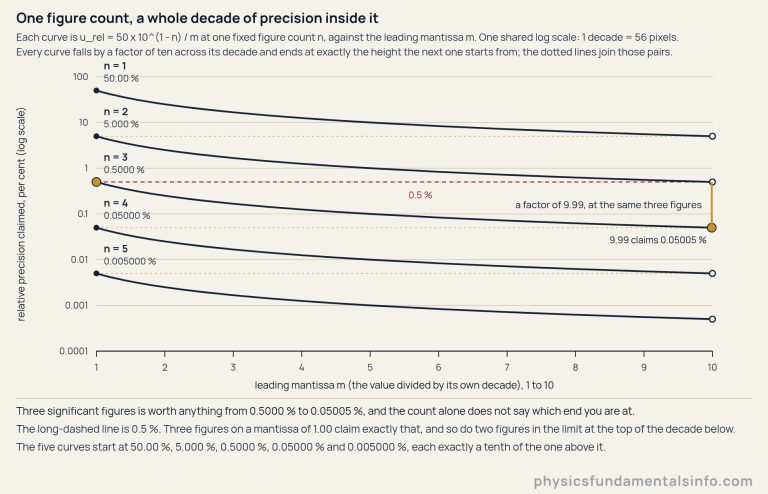
Put numbers on it. Three figures on a value whose leading digits are 1.00 claims 0.5000 %. The same three figures on 9.99 claim 0.05005 %. One count, a factor of 9.99 in what it buys.
Now the scene that defeats three wrong intuitions at once. Multiply 1.00 by 9.99, both quoted to three figures, and the rule keeps three and hands you 9.99.
Follow the bound instead. 0.5000 % plus 0.05005 % is 0.55005 % — carried to five figures here so the next step reproduces — and 0.55005 % of 9.99 is a half-width of 0.05495, as a worst case. The rule’s third digit claims a half-unit of 0.005, so the honesty ratio is 0.05495 divided by 0.005, which is 10.99.
Read that as two whole figures. A half-width of 0.05495 is larger even than the 0.05 a one-decimal quote would claim, so the only honest answer is 1e+1 — one figure where the rule gave three. Multiplying by something written 1.00 is not multiplying by 1.
Swap the leading 1 for a leading 9 and the same count behaves. 9.99 times 9.99 is 99.8001, three figures gives 99.8, and the bound is 0.05005 % plus 0.05005 %, or 0.1001 %, which on 99.8001 is a half-width of 0.0999. Against the 0.05 that three figures claims there, the ratio is 1.998 — five and a half times better behaved, at the identical figure count.
That second identity is exact for a product and only a floor for a quotient. Division widens the bound, because the smallest allowed divisor sits under the largest allowed numerator: the corners (x + u_x) / (y – u_y) and (x – u_x) / (y + u_y) give that same sum of percentages divided by 1 – u_y^2 / y^2. Take the corners for a division, then, and keep the sum for a product.
That ratio is the one check worth running on an answer the rule has given you. At or below 1 every digit the rule kept is supported; between 1 and 2 the last digit is marginal; at 2 or above it is not supported at all. Eight cases, two readings each, show how widely one rule can land.
| Readings, as quoted | Operation | The rule’s answer | Figures | Honesty ratio | Verdict |
|---|---|---|---|---|---|
| 5.00 and 4.00 | × | 20.0 | 3 | 0.90 | every digit supported |
| 5.00 and 4.0 | × | 2.0e+1 | 2 | 0.54 | every digit supported |
| 8.413 and 2.00 | / | 4.21 | 3 | 2.15 | last digit not supported |
| 5.00 and 4.9 | + | 9.9 | 2 | 1.10 | last digit marginal |
| 1.0 and 9.999 | + | 11.0 | 3 | 1.01 | last digit marginal |
| 1.0 and 0.00990 | + | 1.0 | 2 | 1.00 | last digit marginal |
| 5.00 and 4.99 | – | 0.01 | 1 | 2.00 | last digit not supported |
| 1.00 and 9.99 | × | 9.99 | 3 | 10.99 | last digit not supported |
Two of the eight are conservative and three are badly over 1.5, so neither verdict is “the rule”. The ratio column is rounded to two decimal places while the verdict is read off the unrounded value, which is why row six shows 1.00 and still reads marginal: its true ratio is 1.0001, a hair over the line.
Published constants are the standing illustration of why a digit count is not the whole story. They differ from one another in precision by many orders of magnitude and are quoted with an explicit uncertainty rather than left to a digit count — the guide to physics constants carries that material, and no constant’s value or uncertainty appears on this page.
One housekeeping note, since a page about digits should not exempt itself. Every relative precision and half-width printed here is given to four significant figures, which is this site’s convention, and the honesty ratio to two decimal places. Where one of those figures carries an extra digit, it is flagged where it happens, for the reason flagged there.
Where the Rules Go Wrong
The rules fail in three recognisable places: a subtraction of two near-equal readings, a reading too small to reach the answer, and an apparent tie that your calculator and your marking scheme round in opposite directions.
Subtracting two near-equal readings
Take 5.00 minus 4.99. Each reading is around 0.1 % precise, and the answer, 0.01, is 100 % precise — one subtraction has cost a factor of exactly 1000. The rule gives one figure; the bound supports none at all, because the lower end of it is exactly zero and the two readings may be identical.
No version of the rule can rescue that, and this is where the arithmetic has to be believed over the recipe. A difference can leave the bound large compared with the result: the half-widths add while the values cancel, so the percentage can grow without limit.
The exact-cancellation case is instructive rather than broken. Subtract 5.00 from 5.00 and the answer is 0 with no significant figures, and no relative precision at all — but the absolute bound is still real at plus or minus 0.01, so the honest statement is “zero, to within 0.01”.
A reading too small to matter
Add 1.0 and 0.00990 and the exact sum is 1.0099, which the coarser place rounds straight back to 1.0. The second reading’s three carefully written figures bought exactly none of the answer.
The relative precisions say the same thing twice over: the sum comes out 4.951 % precise against 5.000 % for the coarser reading on its own. Measuring the small quantity better would not move either figure. In practice this is the moment to improve the coarse reading or to stop measuring the fine one.
An apparent tie, rounded two ways
Round 0.045 to one figure. The taught rule looks at the written digits, sees a 5, and rounds away from zero to 0.05. Ask software to do it from the stored binary value and you can get 0.04, because the double nearest 0.045 sits just below it.
This is not a rare curiosity. The same split appears at 0.615, where the digits give 0.62 and the double gives 0.61, and at 1.005, where the digits give 1.01 and the double gives 1.00. On a value that is not a tie, such as 10.999 or 999.9, both routes agree — so the tie is the cause.
The tie also reaches into the answer itself. Multiply 5 by 5, one figure each, and the exact product is 25; one figure of it is a tie, so the taught rule gives 30, written 3e+1 to show the single figure. The bound runs from 20.25 to 30.25, the honesty ratio is exactly 1, and that one figure is 20 % precise: a one-in-five answer, which is worth saying out loud.
How Many Figures Should You Keep?
Decide the precision you need, then keep the smallest figure count that delivers it, rounding the continuous answer up.
The count that comes back is not a whole number, and rounding up is exact advice rather than caution: the ceiling is always enough, and one figure fewer is never enough. There is nothing to be gained by rounding down and nothing lost by rounding up except digits.
The edge can be sharp. A target of 0.5 % on a value whose leading digits are 9.99 computes as 2.00043 figures, which ceils to three. That count is printed to six figures on purpose: at four it would read 2.000 and hide the very thing that decides the answer.
Two figures on 9.99 deliver 0.5005 %, and a miss by five ten-thousandths of a percentage point is still a miss. Relax the target to 0.51 % and the count falls to 1.992, so two figures will do.
Then write the answer so the count can be read back off it. A plain decimal is fine when it round-trips: 20 to three figures is 20.0, and nobody can misread that. Two figures has to be written 2.0e+1, because the plain 20 counts as one or two and hides the very thing you decided.
One habit carries all of this: keep full precision through the working and round once, at the end — the unit conversions guide sets that rule out for a chain of conversions, which is where it costs the most.
And one boundary, because the words are similar. None of this is the quantum limit on what can be measured at all: a figure count is a statement about how a number was written, while the Heisenberg uncertainty principle is a statement about nature, and the two are not the same bound.
Worked Problems
Every reading below is a written string taken as given, and nothing here measures or specifies any instrument. Checking what an answer’s last digit is worth is one step inside a wider method, and the guide to solving physics problems is where the rest of that method lives.