Two different quantities are both called the wave number, and they share one unit symbol. A physicist’s is k = 2π/λ, which counts radians of phase per metre; a spectroscopist’s is 1/λ, which counts cycles per unit length and is nearly always quoted per cm. This free wave number calculator keeps the two in separate boxes and runs the relation in four directions — point Solve for at k, at the wavelength, at the cycles wavenumber or at the phase over a distance. Beside the answer it prints the same wave counted both ways and the fixed ratio between them, which is 200π once a centimetre is involved and 2π when both are per metre.
Say which wave number you want before you read the answer. Wave number (angular) is k = 2 pi / lambda and counts radians of phase per metre; Wavenumber (cycles) is 1 / lambda and counts cycles, and it is the one spectroscopy quotes per cm. For one and the same wave the first number is 200 pi times the second whenever the second is in per cm, and 2 pi times it when both are per metre. The per cm multiplier is 100, not 0.01: a reciprocal centimetre multiplies up to the SI per metre, where a length’s centimetre divides down — copy the multiplier off a wavelength row and the answer is wrong by 1e4. Each mode reads one box and ignores the rest: k and Wavenumber (cycles) are worked from the wavelength, the wavelength is worked from k, and the phase is worked from k and the distance. The wavelength and both wave numbers must be finite and greater than zero, and the answer must come back finite and greater than zero too — 1e-320 is a positive number but 2 pi / 1e-320 is not a number at all, so the output is checked as well as the entry. The distance is the one box that may be zero or negative: no distance means no phase, and a negative distance runs backwards along the wave and returns a negative phase.
Load a real case
Every button writes all five boxes at once, so whichever quantity the Solve for menu is pointing at, the remaining four already describe the same wave. The line underneath quotes back whatever the widget works out from that, so nothing in it is stored text.
Pick a wave above, or type your own numbers.
What Is the Wave Number Calculator?
The wave number calculator is a free online tool for two definitions that share one unit symbol: k = 2π/λ, which counts radians of phase per metre, and 1/λ, which counts cycles per unit length and is nearly always quoted per cm. Give it a wavelength and it returns both, together with the phase a stated distance along the wave buys. Point the Solve for menu at the angular wave number, the wavelength, the cycles wavenumber or the phase and it runs the same wave in that direction.
Which wave number a figure means is not recorded by its unit symbol, and that is the problem this page exists for. A radian is a ratio of two lengths, so it carries no dimension of its own, and both quantities are written in inverse metres. A university textbook defines k as two pi over the wavelength and gives it inverse metres; a standards body publishes a constant in the same inverse metres and footnotes that the full description of that unit is cycles or periods per metre. Neither is wrong, and a figure quoted without saying which count it is, is unusable.
For one and the same wave the two numbers differ by 200 pi once a centimetre is involved, and by 2 pi when both are per metre. That is 628.3185307179587, which is 6.283185307179586 multiplied by exactly 100. The 2 pi is the radian convention and the 100 is the centimetre, and separating those two is the single most useful thing the page does. People expect a factor of 2 pi and are then wrong by a further factor of a hundred, because the spectroscopic figure is almost always quoted per cm while the angular one keeps the metre.
The page opens on a wavelength of 10 mm, which is one centimetre, and that is the one wavelength where both conventions give a round number: the cycles wavenumber is exactly 1 per cm and the angular wave number is exactly 200 pi, or 628.3185307 radians per metre. The opening distance is 2.5 mm, a quarter of that wavelength, so the phase is exactly a right angle. All five boxes describe one wave, because the engine rebuilds every box from its opening value whenever the Solve for menu changes.
A wavenumber is a reciprocal length, so its unit conversions run the opposite way to a wavelength. One per centimetre is one hundred per metre, because one centimetre is one hundredth of a metre, and the same rule makes one radian per centimetre a hundred radians per metre and one radian per millimetre a thousand. A multiplier copied across from a length row is wrong by a factor of ten thousand rather than a hundred, which is why the unit menus on this page are the part worth checking twice.
Beside the answer the page prints four readings, all worked out from the complete wave with the solved value substituted back rather than from the boxes. The first gives the same wave counted in cycles, in per cm and per m at seven significant figures; at a wavelength of ten micrometres it reads 1000.000 per cm, which is the figure this site already quotes in its infrared guide. The second prints the two conversion constants themselves rather than a result, because the ratio does not depend on the wavelength and dividing the two displayed numbers would hide that. The third gives the phase in radians, degrees and cycles at once, and the fourth gives the distance in wavelengths and the distance a single radian of phase costs.
Every box is checked for being a finite number rather than merely for having the right sign, and the answer is checked as well as the entry. An infinity is greater than zero, and a wavelength of 1e-320 is a finite positive number while two pi divided by it is not a number at all, so a guard on the input alone would let an infinity through into a finite-looking answer. The wavelength and both wave numbers must be finite and greater than zero in every mode that reads them.
The distance box is the one deliberate exception, and it may be zero or negative. No distance along the wave means no phase gained, so zero returns zero rather than a refusal, and a negative distance runs backwards along the wave and returns a negative phase with the sign as the useful part. That is the honest answer in both cases, and a guard that demanded a positive distance would be a defect rather than a safeguard.
What the page does not compute, stated as omissions rather than as assumptions that happen to hold: a frequency, a wave speed, a photon energy, an infrared band name or a colour. A wave number describes the wave in space alone, so turning it into a frequency needs a speed and the speed depends on the medium. The phase reading is one wave advancing along one direction, with no second wave in it, no resultant amplitude and no intensity, so it is not a path difference between two routes to the same point.
The arithmetic assumes one wavelength, a non-dispersive and lossless medium and a plane wave. A real pulse is a sum of wavelengths and therefore a band of wave numbers rather than one value; in a dispersive medium the crests and the envelope of a pulse travel at different speeds; in an absorbing medium the wave number is complex and the figure here is only its real part; and in two or three dimensions the wave number has a direction that a single number cannot carry. Each of those is an idealisation, and each is named on the page rather than left implicit.
| Symbol | Quantity | Default unit | Also accepts | Example value |
|---|---|---|---|---|
| lambda | Wavelength | mm | nm, um, m | 10 |
| k | Wave number (angular) | rad/m | rad/mm, rad/cm | 628.3185307 |
| nu | Wavenumber (cycles) | per cm | per m | 1 |
| dx | Distance along the wave | mm | nm, um, m | 2.5 |
| dphi | Phase advance over that distance | rad | deg, cycles | 1.570796327 |
How to use the wave number calculator
- Decide which wave number you want.
Wave number (angular)is2π/λin radians per metre;Wavenumber (cycles)is1/λin cycles per unit length. Both are correct, both get writtenm-1, and the page will not guess which one your source meant. - Choose the unknown. The Solve for menu opens on Wave number (angular), and the other three choices are Wavelength, Wavenumber (cycles) and Phase advance over that distance. Switching the menu returns every box to its opening value, so set the menu first and type second.
- Type the wavelength. This is the box both wave-number modes read, with nm, um, mm and m on the menu beside it. It opens on
10mm, which is 1 cm — the one wavelength where both conventions give a round number. - Check the unit on a wave-number box before you trust it. A reciprocal length inverts the conversion:
per cmis 100 timesper m, not a hundredth of it, and the same rule makesrad/cma hundredrad/m. Get that backwards and the answer is out by1e4. - Type the distance along the wave. It opens on
2.5mm, a quarter of the opening wavelength, and it is an input in every mode rather than a solve target. It is the only box that accepts0or a negative number. - Read the answer. The headline carries four significant figures, trailing zeros dropped, in whichever unit that box’s own menu is set to. It switches to scientific notation below
0.0001and at or above ten million, which is where green light lands in radians per metre. - Read the same wave counted the other way. The first reading gives the cycles wavenumber in
per cmandper mat seven significant figures. At a wavelength of 10 um it reads1000.000 per cm, which is the same figure the infrared radiation guide already quotes for that wavelength. - Read the fixed ratio. The second reading prints the two conversion constants themselves —
628.3185307from a per cm figure and6.283185307from a per m figure — rather than a result. It never changes, because it does not depend on the wavelength at all. - Read the phase, and the distance in wavelengths. The third reading gives the phase in radians, degrees and cycles at once; the fourth gives the distance as a fraction of a wavelength and the distance a single radian costs. A quarter wavelength is
90degrees on every wave there is. - Open Show working. The steps name the box the mode read, substitute in SI, split the
200πinto the2πof the radian and the100of the centimetre, write your wave out both ways, work the phase, say what the phase is not, and close on what the arithmetic assumes.
This page exists for the one step that turns a wavelength into a rate of phase, and then says which of the two standard wave numbers that rate is. The wave number guide is the prose half of it, where the two conventions are separated, the 200π is derived and the problems are worked. The wavelength that goes into the first box comes from somewhere, and the wavelength formula guide is where that somewhere is set out.
Three mistakes account for most wrong answers here. The first is putting a per cm figure straight into the rad/m box, which is out by 200π. The second is inverting the per cm multiplier, which is out by 1e4. The third is reading the phase reading as if it were a path difference between two waves, which it is not — the wave interference calculator is the tool for that question.
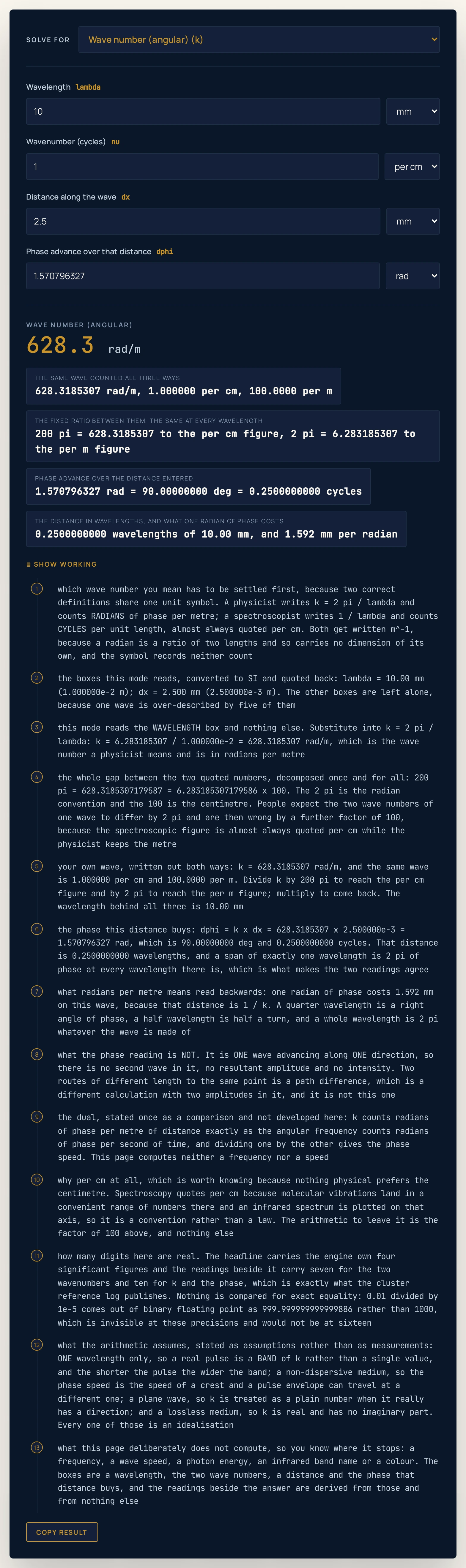
628.3 rad/m, while the first reading carries the full 628.3185307 rad/m, 1.000000 per cm, 100.0000 per m — the one wavelength where both conventions read a round number. The quarter-wave distance gives exactly 90.00000000 deg.Worked example: change one thing at a time
The table starts at the opening wave, runs the unknown through all four modes on that one state, then changes exactly one thing at a time: the wavelength, then the distance. It ends on the boundary cases and the entries the calculator declines. Every answer and reading cell was taken from the running widget rather than worked out by hand, and where a cell and the tool ever part company, believe the tool.
| Step | Solving for | What you type | Headline answer | The same wave in cycles | Phase over the distance |
|---|---|---|---|---|---|
| The page as it opens: a wavelength of 10 mm, the anchor | Wave number (angular) | lambda = 10 mm, dx = 2.5 mm | 628.3 rad/m | 628.3185307 rad/m, 1.000000 per cm, 100.0000 per m | 1.570796327 rad = 90.00000000 deg = 0.2500000000 cycles |
| The same wave, solved for the wavelength instead | Wavelength | k = 628.3185307 rad/m, dx = 2.5 mm | 10 mm | 628.3185307 rad/m, 1.000000 per cm, 100.0000 per m | 1.570796327 rad = 90.00000000 deg = 0.2500000000 cycles |
| The same wave, solved for the cycles wavenumber | Wavenumber (cycles) | lambda = 10 mm, dx = 2.5 mm | 1 per cm | 628.3185307 rad/m, 1.000000 per cm, 100.0000 per m | 1.570796327 rad = 90.00000000 deg = 0.2500000000 cycles |
| The same wave, solved for the phase over 2.5 mm | Phase advance over that distance | k = 628.3185307 rad/m, dx = 2.5 mm | 1.571 rad | 628.3185307 rad/m, 1.000000 per cm, 100.0000 per m | 1.570796327 rad = 90.00000000 deg = 0.2500000000 cycles |
| Change ONE thing: green light instead, 500 nm | Wave number (angular) | lambda = 500 nm, dx = 125 nm | 1.257e+7 rad/m | 12566370.61 rad/m, 20000.00 per cm, 2000000 per m | 1.570796327 rad = 90.00000000 deg = 0.2500000000 cycles |
| Change ONE thing: thermal infrared, 10 um -- the figure the infrared guide prints | Wave number (angular) | lambda = 10 um, dx = 2.5 um | 628300 rad/m | 628318.5307 rad/m, 1000.000 per cm, 100000.0 per m | 1.570796327 rad = 90.00000000 deg = 0.2500000000 cycles |
| The same 10 um wave, asked for the per cm figure instead | Wavenumber (cycles) | lambda = 10 um, dx = 2.5 um | 1000 per cm | 628318.5307 rad/m, 1000.000 per cm, 100000.0 per m | 1.570796327 rad = 90.00000000 deg = 0.2500000000 cycles |
| Not light at all: 1 kHz in air, where 343 m/s is a stated convention | Wave number (angular) | lambda = 343 mm, dx = 1000 mm | 18.32 rad/m | 18.31832451 rad/m, 0.02915452 per cm, 2.915452 per m | 18.31832451 rad = 1049.562682 deg = 2.915451895 cycles |
| The same sound wave, asked for the phase over a whole metre | Phase advance over that distance | k = 18.3183245107 rad/m, dx = 1 m | 18.32 rad | 18.31832451 rad/m, 0.02915452 per cm, 2.915452 per m | 18.31832451 rad = 1049.562682 deg = 2.915451895 cycles |
| FM radio, 3 m: where the per cm figure stops being convenient | Wave number (angular) | lambda = 3 m, dx = 0.75 m | 2.094 rad/m | 2.094395102 rad/m, 0.003333333 per cm, 0.3333333 per m | 1.570796327 rad = 90.00000000 deg = 0.2500000000 cycles |
| The 10 um wave from the other end: its wavelength back from its rad/m figure | Wavelength | k = 628318.530718 rad/m, dx = 2.5 um | 0.01 mm | 628318.5307 rad/m, 1000.000 per cm, 100000.0 per m | 1.570796327 rad = 90.00000000 deg = 0.2500000000 cycles |
| The same wave number typed in rad/mm instead of rad/m | Wavelength | k = 0.628318530718 rad/mm, dx = 2.5 mm | 10 mm | 628.3185307 rad/m, 1.000000 per cm, 100.0000 per m | 1.570796327 rad = 90.00000000 deg = 0.2500000000 cycles |
| Change ONE thing: the distance, to a whole wavelength | Phase advance over that distance | k = 628.3185307 rad/m, dx = 10 mm | 6.283 rad | 628.3185307 rad/m, 1.000000 per cm, 100.0000 per m | 6.283185307 rad = 360.0000000 deg = 1.000000000 cycles |
| Change ONE thing: the distance, to zero | Phase advance over that distance | k = 628.3185307 rad/m, dx = 0 mm | 0 rad | 628.3185307 rad/m, 1.000000 per cm, 100.0000 per m | 0.000000000 rad = 0.000000000 deg = 0.000000000 cycles |
| A NEGATIVE distance runs backwards along the wave | Phase advance over that distance | k = 628.3185307 rad/m, dx = -2.5 mm | -1.571 rad | 628.3185307 rad/m, 1.000000 per cm, 100.0000 per m | -1.570796327 rad = -90.00000000 deg = -0.2500000000 cycles |
| A wavelength of zero is declined | Wave number (angular) | lambda = 0 mm, dx = 2.5 mm | no answer | - | - |
| A negative wavelength is declined | Wave number (angular) | lambda = -10 mm, dx = 2.5 mm | no answer | - | - |
| A wavelength small enough to make k an infinity is declined on the OUTPUT | Wave number (angular) | lambda = 1e-320 m, dx = 2.5 mm | no answer | - | - |
| A wave number of zero is declined | Wavelength | k = 0 rad/m, dx = 2.5 mm | no answer | - | - |
Rows 1 to 4 are one wave — a wavelength of 10 mm with a distance of 2.5 mm — with the Solve for menu in each of its four positions. Both reading columns are identical down all four rows, because the readings describe the wave rather than the mode. Note the headline against the reading beside it: the headline carries the engine’s four significant figures, so row 1 prints 628.3 rad/m while the reading carries the full 628.3185307 rad/m.
Rows 5 to 10 change one thing at a time, the wavelength, across eight orders of magnitude. Row 6 is the one to check against another page: at 10 um the reading gives 1000.000 per cm, the same figure the infrared radiation guide prints, and 628318.5307 rad/m beside it, which that guide has no way to produce. Row 8 is the only non-light wave on the page, and its distance is a whole metre rather than a quarter wavelength, so its phase is 18.31832451 rad — nearly three full cycles.
Rows 11 and 12 arrive at the same wave through different unit menus, which is the check worth doing before trusting any figure: 0.628318530718 rad/mm and 628.3185307 rad/m are one number. Rows 13 to 15 move the distance only — a whole wavelength is exactly 360.0000000 degrees, zero is 0 rather than a refusal, and a negative distance returns a negative phase. Rows 16 to 19 are the refusals, and row 18 is the one that matters: a wavelength of 1e-320 is a positive number, so it is declined on the output rather than on the entry.
Formula and symbol reference
One definition does the work: k = 2π/λ, which rearranges to λ = 2π/k. The companion definition is 1/λ, the same wave counted in whole cycles rather than in radians, and the phase over a distance is Δφ = k·Δx. Nothing here is derived from anything else on the page; the two wave numbers are definitions and the phase relation follows from one of them.
The unit column below is the one place a reader can go wrong without noticing. A wavelength’s mm multiplies by 1e-3; a wave number’s rad/mm multiplies by 1000, because a reciprocal length runs the other way. The wavelength formula guide sets out the length units themselves, and the infrared radiation calculator is the sibling tool that carries the identical per cm rule on its own wavenumber field.
Three rows in the table are not boxes. 200π is the constant ratio between the two conventions when one of them is per cm, 1/k is the distance a single radian of phase costs, and the phase in degrees and cycles is the same number as the phase in radians in two other units. All three appear in the readings beside the answer; none of them appears in the widget.
| Symbol | Meaning | Unit | Values used on this page |
|---|---|---|---|
| lambda | Wavelength: the distance over which the wave repeats once, and the input both wave-number modes read | m (menu: nm, um, mm, m) | Opens on 10 mm, which is the anchor wavelength of 1 cm. The buttons above the widget also write 500 nm, 10 um, 343 mm and 3 m. Any finite value greater than zero is accepted. |
| k | Angular wave number: radians of phase per metre, k = 2π/λ. This is the one a mechanics or optics textbook calls the wave number |
rad/m (menu: rad/m, rad/mm, rad/cm) | Opens on 628.3185307 rad/m, which is 200π. The presets reach 12566370.61, 628318.5307, 18.31832451 and 2.094395102 rad/m. |
| nu | Cycles wavenumber: cycles per unit length, 1/λ. This is the one a spectrum is plotted in, and it is quoted per cm far more often than per m |
per cm (menu: per cm, per m) | Opens on 1 per cm, which is 100 per m. The presets reach 20000.00, 1000.000, 0.02915452 and 0.003333333 per cm. |
| dx | Distance travelled along the wave, over which the phase advance is worked out. An input in every mode and never a solve target | m (menu: nm, um, mm, m) | Opens on 2.5 mm, a quarter of the opening wavelength. The only box that may be 0 or negative. |
| dphi | Phase advance over that distance, Δφ = k·Δx. One whole wavelength of travel is always 2π |
rad (menu: rad, deg, cycles) | Opens on 1.570796327 rad, which is π/2, 90 degrees and a quarter of a cycle. |
| 200π | The ratio of the angular wave number to the per cm wavenumber, for every wavelength without exception. Printed from the constant, never by dividing the two readings | dimensionless | A constant: 628.3185307179587, which is 6.283185307179586 × 100 — the radian and the centimetre. |
| 1 / k | The distance one radian of phase costs, which is what radians per metre means read backwards | m | A derived quantity, printed in the fourth reading: 1.592 mm on the opening wave, 54.59 mm for 1 kHz in air. |
The physics: one wave, two counts, one unit symbol
A sinusoidal wave gains phase in proportion to how far along it you look. Write that wave as y = A sin(kx - ωt) and k is the constant of proportionality between distance and phase, so it has to be 2π per wavelength. That is the whole content of k = 2π/λ: a wavelength is one full turn, and k is how much of a turn each metre buys.
Count the same wave in whole cycles instead of radians and the 2π disappears, leaving 1/λ. Both numbers describe the same wave and both are written m-1, because a radian is a ratio of two lengths and carries no dimension of its own. The unit symbol is dimensionally right either way and simply does not record which count is meant.
That is not an error anywhere; it is a gap in what a unit symbol can say. A university textbook defines k as 2π/λ and gives it inverse metres. A standards body publishes a constant in the same inverse metres and footnotes that the full description of that unit is cycles or periods per metre. Both statements are correct, and the only safe habit is to say which count you mean every time you quote a figure.
Put a centimetre into it and a second factor appears. The spectroscopic figure is nearly always quoted per cm while the angular one keeps the metre, so the two numbers for one wave differ by 200π — that is 628.3185307179587, which is 6.283185307179586 multiplied by exactly 100. The 2π is the convention and the 100 is the unit, and separating those two is the single most useful thing on this page.
The last piece is what a wave number buys you. Multiply it by a distance and you get phase: Δφ = k·Δx, so a quarter wavelength is a right angle and a whole wavelength is 2π on every wave there is. The simple harmonic motion guide does the same job for time, where the angular frequency counts radians per second instead; dividing one by the other gives the phase speed, and the wave speed guide is where that speed comes from.
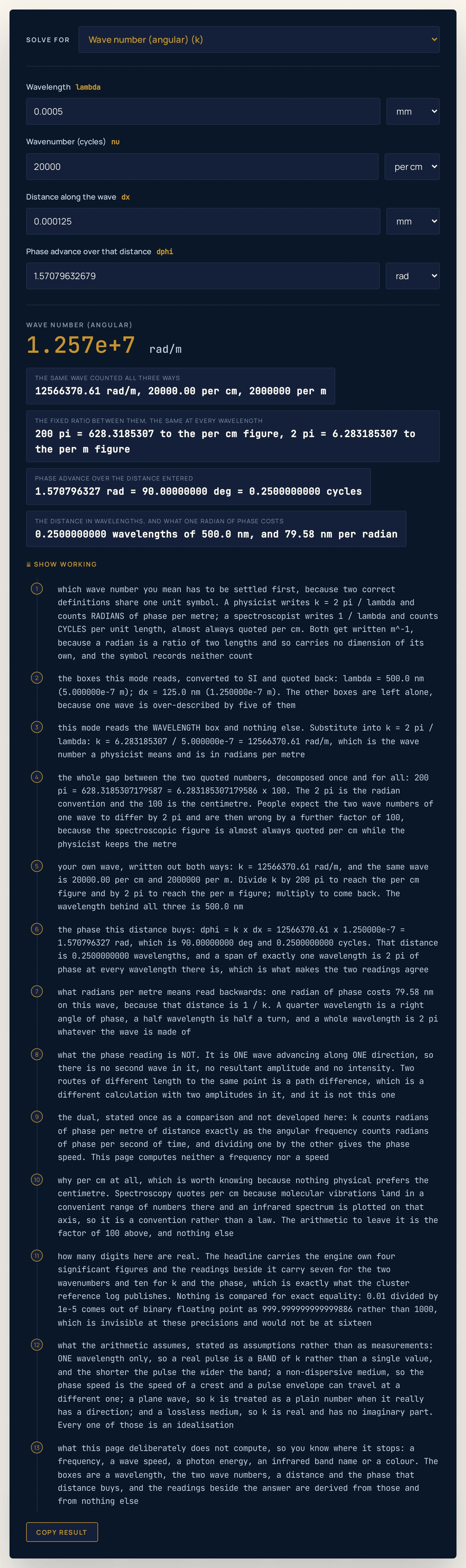
12566370.61 rad/m, 20000.00 per cm and the headline switches to 1.257e+7 rad/m. The ratio reading underneath has not moved, because it is printed from the constants and does not depend on the wavelength. One radian of phase now costs 79.58 nm.Where this arithmetic breaks down
Every step here is a single division or multiplication with nothing to accumulate, and the one floating-point residue the reference script found sits in the division that forms a reciprocal rather than in any wavelength. That division returns 999.999999999999886 where 1000 is exact, and across the nine round decades the script swept, not one printed string came out wrong. What goes wrong is physical, or it is the unit symbol, and the first two items are the ones worth reading.
- The unit symbol does not say which wave number it is
- This is the one to read. A figure quoted in inverse metres may be counting radians or counting cycles, and the symbol is correct either way because a radian is dimensionless. The two differ by
2πin the same length unit and by200πonce one of them is per cm. Neither convention is wrong; a figure quoted without saying which one it is, is unusable. - Per cm is a convention, not a law
- Nothing physical prefers the centimetre. Spectroscopy quotes per cm because molecular vibrations land in a convenient range of numbers there, and an infrared spectrum is plotted on that axis — the infrared radiation guide is where that axis is used in anger. The arithmetic to leave the convention is the factor of 100 and nothing more.
- One wavelength only, so a real pulse has a band of wave numbers
- Everything here assumes a single wavelength. A real pulse is a sum of wavelengths, so it has a band of
krather than one value, and the shorter the pulse in space the wider that band. A single number from this page describes a pulse only as an average, and it says nothing about how wide the band around it is. - Phase speed is not signal speed
- Dividing an angular frequency by
kgives the speed of a crest. In a dispersive medium, where the speed depends on the wavelength, the envelope of a pulse travels at a different speed from the crests inside it, and the two can differ by a lot. This page computes neither, and names the distinction only so a reader does not assume there is one speed. - The wave number has a direction and this page does not
- Treating
kas a plain number assumes a plane wave travelling along one axis. In general it is a vector pointing the way the wave goes, and its size is the number this page returns. For a wave crossing a boundary at an angle, or for anything in two or three dimensions, the direction is the part that matters and the size alone is not enough. - A lossy medium gives the wave number an imaginary part
- Everything here assumes no attenuation, which makes
ka real number. In an absorbing medium it is complex: the real part is still radians of phase per metre and the imaginary part is how fast the amplitude dies away. A figure from this page is then the real part only, and it tells you nothing about the decay. - One wave, one direction, no interference
- The phase reading is one wave advancing along one path. It has no second wave in it, no resultant amplitude and no intensity, so it cannot answer whether two routes arrive in step. That is a path difference and a different calculation; the wave interference calculator is where two amplitudes and a path difference belong.
- The calculator computes nothing about frequency or speed
- A wave number describes the wave in space alone, so it cannot be turned into a frequency without a speed, and the speed depends on the medium. The wave speed calculator is where
v = fλlives. The preset names mention a frequency or a medium only as context for the wavelength behind the button. - The calculator measures nothing — you supply the numbers
- One wavelength or one wave number and one distance go in, two definitions are applied, and the answer describes the wave you described. The wavelengths on the buttons are stated figures, and the 343 m/s behind the sound preset is the conventional speed of sound in air near 20 degrees Celsius rather than anything measured here.
Where the wave number calculator is actually used
- Reading a figure someone else quoted in inverse metres
- Put the figure into the box that matches the count it was meant in, and read the other one off. If the source says radians or writes
2π/λ, it is the angular box; if it says cycles, or the figure came off a spectrum axis, it is the cycles box. The second reading then tells you the factor you would have been out by. - Converting a spectrum axis into radians per metre
- Load Thermal infrared - 10 um and the two readings sit side by side:
1000.000 per cmand628318.5307 rad/m. That is the conversion a reader coming from the infrared radiation calculator needs, because that tool does the cycles convention exclusively and cannot produce a figure in radians per metre. - Working out how much phase a path adds
- Type the wave number and the distance and read the phase in radians, degrees and cycles at once. A quarter wavelength is 90 degrees, a half is 180, and the fourth reading gives the distance in wavelengths so the answer can be sanity-checked at a glance. It is one wave along one path, and nothing more.
- Checking a substitution into a travelling-wave expression
- An expression like
A sin(kx - ωt)needskin radians per metre andxin metres, and a figure lifted from a spectrum would be wrong by200πbefore anything else happened. Solving forkfrom the wavelength is the safe route, and the working shows the substitution in SI so the units can be checked. - Teaching the difference between a convention and a unit
- Load Microwave - 1 cm and the two numbers are
1.000000 per cmand628.3185307 rad/mfor one and the same wave. The ratio chip then splits that into the2πof the radian and the100of the centimetre, which is the lesson in one line. - Seeing that the ratio is not a property of the wave
- Click through all five buttons and the first reading changes by eight orders of magnitude while the second never moves at all. That is the point of printing the ratio from the constants rather than from the two numbers above it: it is a statement about the two definitions and not about any particular wave.
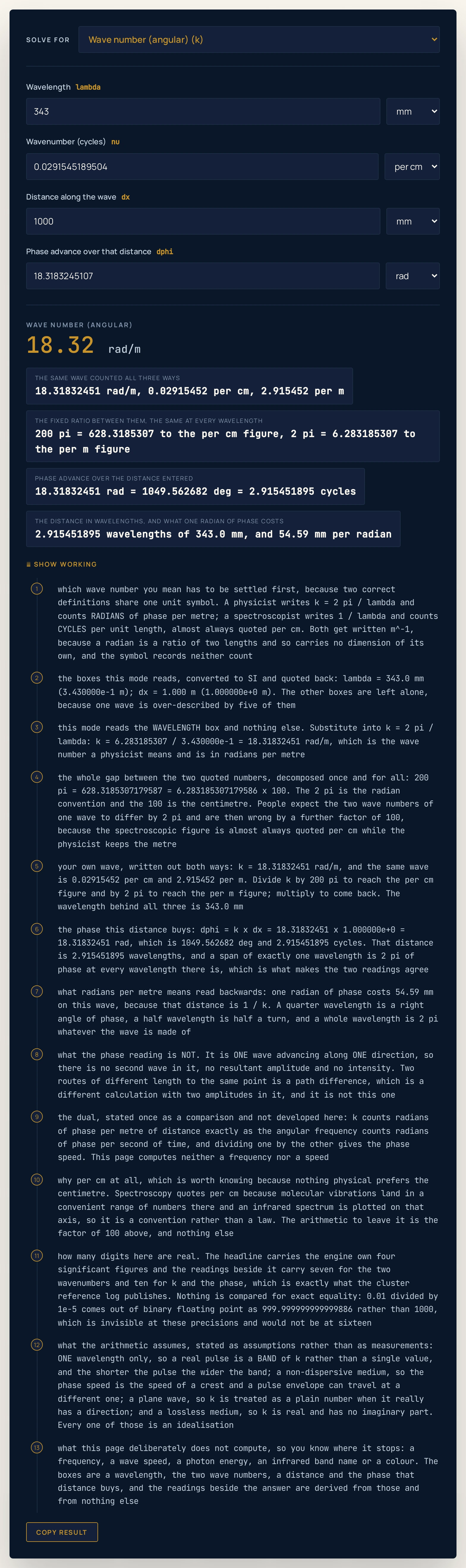
18.31832451 rad — 2.915451895 cycles, nearly three full turns. The per cm figure, 0.02915452, is where that convention stops being convenient.Where to go next
For the argument this arithmetic supports — the two conventions set out side by side, the 200π derived rather than asserted, the Rydberg constant read both ways and the problems worked — read the wave number guide, which this tool is the calculating half of.
Four posts pick up the pieces this page uses but does not explain. The wavelength formula guide is where the wavelength itself comes from, the wave speed guide is where the speed that turns a wave number into a frequency comes from, the infrared radiation guide is the per cm axis in use, and the wave interference guide is where a path difference between two waves belongs.
Three tools sit next to this one. The wave speed calculator adds the frequency and the speed, the infrared radiation calculator takes the per cm figure on to a photon energy and a band name, and the interference of waves simulator shows what two waves do when their phases differ.
The full physics lab library and the calculator index are open too.
Frequently asked questions
What does the wave number calculator work out?
It runs one wave in four directions: the angular wave number k from a wavelength, the wavelength back from k, the cycles wavenumber in per cm or per m from the same wavelength, and the phase a stated distance along the wave buys. Beside the answer it prints the same wave counted in cycles, the fixed ratio between the two conventions, the phase in radians, degrees and cycles, and the distance that one radian of phase costs. It does not compute a frequency, a wave speed or a photon energy.
Which wave number does this calculator mean, two pi over lambda or one over lambda?
Both, in separate boxes, because both are standard and both are correct. The box labelled wave number (angular) is two pi over the wavelength and counts radians of phase per metre, which is the definition a mechanics or optics textbook gives. The box labelled wavenumber (cycles) is one over the wavelength and counts cycles per unit length, which is what spectroscopy quotes and almost always in per cm. The page never guesses which one you meant; you pick the box.
Why do the two wave numbers differ by two hundred pi rather than by two pi?
Because two different things are happening at once and only one of them is the radian. The factor of two pi is the convention, radians against cycles. The factor of one hundred is the unit, a centimetre against a metre, and it is there because the spectroscopic figure is nearly always quoted per cm while the angular one keeps the metre. Two hundred pi is 628.3185307179587, which is 6.283185307179586 multiplied by exactly one hundred.
Why is the per cm multiplier one hundred and not one hundredth?
Because a wavenumber is a reciprocal length, and reciprocals invert the conversion. One centimetre is one hundredth of a metre, so one per centimetre is one hundred per metre. Copying the multiplier across from a wavelength row gives an answer wrong by a factor of ten thousand rather than one hundred, since the error lands on the wrong side of a reciprocal and then gets squared in effect. The same rule puts rad per cm at one hundred rad per metre.
What does the phase reading actually tell me?
It tells you how far round the cycle one wave has turned after travelling the distance you entered, and nothing else. The arithmetic is the wave number times the distance, so a quarter of a wavelength is a right angle, a half is half a turn and a whole wavelength is two pi on every wave there is. It is one wave moving in one direction: there is no second wave in it, no resultant amplitude and no intensity, so it is not a path difference between two routes.
Why does a distance of zero give an answer of zero instead of a refusal?
Because zero is the correct answer there. No distance along the wave means no phase gained, which is a real state rather than an impossible one, so the distance box is checked for being a finite number rather than for being positive. A negative distance is accepted for the same reason: it runs backwards along the wave and returns a negative phase, and the sign is the useful part. Every other box on the page must be finite and greater than zero.
Can this calculator give me the frequency or the speed of the wave?
No, and that is deliberate rather than an omission. A wave number is a property of the wave in space alone, so turning it into a frequency needs a speed, which is a separate piece of physics and a separate tool. The wave speed calculator on this site does v equals f times lambda; this page does the spatial half and stops there. The one sentence of overlap is that k counts radians per metre of distance in the same way the angular frequency counts radians per second of time.
How many of the printed digits are trustworthy?
The headline carries four significant figures and the readings beside it carry seven for the two wavenumbers and ten for k and the phase, which are the precisions the cluster reference log publishes. Those are safe here because nothing on this page subtracts two nearly equal numbers. The only floating-point artefact in the arithmetic is in the division that makes a reciprocal, where 0.01 divided by 1e-5 comes out as 999.999999999999886 rather than 1000, and that is invisible at seven figures and at ten.
References & formula source
- The relation solved on this page is the definition of the wave number of a plane sinusoidal wave, not a derived law. Writing one wave as y equals A times the sine of k x minus omega t makes k the rate at which phase grows with distance, so k is two pi over the wavelength and its unit counts radians per metre. The cycles wavenumber is the same wave counted in whole cycles instead of radians, so it is one over the wavelength. Everything else here is one of those two rearranged, or a quantity derived from the wave they describe.
- The first source is the OpenStax University Physics Volume 1 section on the mathematics of waves, read on 13 November 2026. Three things are taken from it rather than paraphrased: that the phase angle grows in proportion to position as two pi over lambda times x; that the value two pi over lambda is defined as the wave number, that its symbol is k, and that it has units of inverse meters; and that the travelling wave is then written as A times the sine of k x minus omega t, with the angular frequency recalled as two pi over the period.
- The second source is the NIST CODATA page for the Rydberg constant, read on 13 November 2026. Two things are taken from it: the value 10973731.568157 per metre with a standard uncertainty of 0.000012 per metre and a relative standard uncertainty of 1.1 parts in a million million; and NIST's own footnote on that unit, that the full description of the unit is cycles or periods per meter. Read as a wavelength the same constant gives 91.1267051 nanometres, and multiplied by two pi it gives 68949988.95397687 radians per metre, which is the identical constant expressed as an angular wave number.
- Those two sources are the whole point of this page and neither of them is being corrected. OpenStax gives a radians-per-metre quantity the symbol for inverse metres, and NIST gives a cycles-per-metre quantity the same symbol and says in a footnote which one it counts. A radian is a ratio of two lengths and therefore carries no dimension, so both are dimensionally right and the symbol simply does not record which count is meant. Any reading of this page that has one of them wrong is a misreading.
- An independent reference script, written before this calculator existed and sharing no code with it, runs 37 checks with 0 failures and prints every figure this cluster quotes. It asserts that the ratio of the angular wave number to the per cm wavenumber is two hundred pi at all 801 wavelengths its grid reaches, with a worst relative error of 1.809 parts in ten thousand million million; that the round trip from a wavelength to k and back is good to 1.754 parts in ten thousand million million; and that a span of one wavelength is exactly two pi of phase for every one of the five preset waves.
- The same script measured two things this page is built around rather than assuming them. An isFinite and positive guard on the INPUT alone leaked 97 times over 576 calls, because 1e-320 is a finite positive number while two pi divided by it is an infinity, and an infinity is not a not-a-number, so every branch here guards its output as well. And the floating-point residue in a reciprocal lives in the division rather than in any power of ten: 0.01 divided by 1e-5 is 999.999999999999886 whether the input was rounded first or not, and at the seven significant figures this page prints it, and at six, none of the nine round decades prints a wrong string.
- The wavelengths behind the five preset buttons are stated values rather than measurements this page makes. 299792458 metres per second is exact by the 2019 SI definition of the metre, and the 343 metres per second behind the one-kilohertz sound preset is the conventional speed of sound in air near twenty degrees Celsius that this site already uses elsewhere; it is a convention and is labelled as one. The preset names are shorthand for the wavelengths behind them and are not claims about any particular source, instrument or spectrum.
- Every figure quoted in the prose and the tables above is either a string this calculator printed for the inputs named beside it, or a constant the cluster physics contract fixes, or a ratio the unit tests assert. Where a cell and the running widget ever part company, believe the widget. This page computes; it measures nothing.
- Further reading: Wavenumber — Wikipedia