The field inside a ring-shaped coil needs three numbers and no geometry: the turns, the current and how far out from the ring axis you are measuring. Multiply mu0 / (2 · pi) by the ampere-turns, divide by that distance, and you have it. This free toroid calculator runs the relation in all four directions and prints the same field in gauss, the turns per metre the winding works out to, and the field at twice that distance. Point Solve for at the field, the turns, the current or the distance.
Measure r from the ring axis — the centre of the hole — not from the nearest wire and not around the ring. The boxes accept 1 to 100000 turns, 1e-6 to 1000 A, 1e-4 to 10 m and 1e-12 to 10 T; anything outside those is declined rather than answered, because the number it would return is arithmetic rather than physics.
Load a real case
Every button writes all four boxes in their default units, so whichever quantity the Solve for menu is pointing at, the remaining three already agree with it. The line underneath quotes back whatever the widget works out from that, so nothing in it is stored text.
Pick a case above, or type your own numbers.
What Is the Toroid Calculator?
The toroid calculator is a free online tool for the magnetic field inside an air-cored ring-shaped coil: B = mu0 N I / (2 pi r), in tesla. Give it any three of the field, the number of complete turns, the winding current and the distance from the ring axis, and it returns the fourth in whichever unit that box was set to, with every step of the substitution.
The distance is measured from the axis of the ring, which is the centre of the hole. It is not the ring own radius and it is not the gap between the measuring point and the nearest wire, and getting that wrong is the commonest reason an answer here comes out wrong. A core whose hole has a radius of 3 centimetres and whose outer edge sits at 5 centimetres accepts any distance between those two figures, and the field is different at every one of them.
Only the product of the turns and the current ever matters. Two hundred turns at 5 amps, five hundred at 2 amps, a thousand at 1 amp and two and a half thousand at 0.4 amps are all a thousand ampere-turns, and all four give exactly the same field at the same distance from the axis. That is because the circle the calculation is built on knows the winding only through how much current crosses the surface it bounds.
Three readings sit beside the headline, all worked out from the complete state with the solved value substituted back rather than from the boxes. They are the same field in gauss, the turns per metre the same winding works out to at that radius, and the field at twice that distance. The last of those is always exactly half the answer, because the field goes as one over the distance from the axis, and it is the real field out there only while the core still reaches that far.
Every box is checked against a declared range and not merely against zero, which is a correctness point rather than a convenience. Solving for a distance from a field of 1e-300 tesla satisfies any test for being greater than zero and returns a perfectly finite answer of around 2e+296 metres, which is not a ring; so the field is accepted between 1e-12 and 10 tesla, the turns between 1 and 100000, the current between 1e-6 and 1000 amps and the distance between 1e-4 and 10 metres. Anything outside those is declined in words rather than answered.
What this page leaves out is as deliberate as what it does. There is no cross-section box, no ring-height box, no permeability box and no inductance: the core geometry decides which radii exist rather than what the field is at a radius that does exist, everything here is air-cored so a ferrite or iron ring multiplies every field by its own relative permeability, and no average field across a core is claimed. The winding is idealised as a smooth, perfectly symmetric current sheet, which is what makes the field exactly zero outside the ring in the model and not in a real component.
| Symbol | Quantity | Default unit | Also accepts | Example value |
|---|---|---|---|---|
| B | Magnetic field | mT | T, uT, nT, G | 5 |
| N | Number of turns | turns | — | 500 |
| I | Winding current | A | mA | 2 |
| r | Distance from the ring axis | cm | mm, m | 4 |
How to use the toroid calculator
- Choose the unknown. The Solve for menu opens on Magnetic field, and the other three choices are Number of turns, Winding current and Distance from the ring axis.
- Type the number of turns. A plain count from 1 to 100000, opening on 500, with presets at 10, 500 and 2000. Wire gauge and winding pitch do not enter the arithmetic at all.
- Type the winding current. It takes A or mA and opens on 2 A, with presets at 0.05, 2 and 10 A. The box accepts 1e-6 to 1000 A.
- Type the distance from the ring axis. It takes cm, mm or m and opens on 4 cm. This is measured from the centre of the hole — not the ring's own radius and not the gap to the nearest wire.
- Read the answer. The headline carries the answer to six significant figures, trailing zeros dropped, in the unit that box was showing, and it switches to scientific notation below 0.0001 and at or above 10 million. Set the unit first, point Solve for at the target second and type your figures last — switching the target wipes every box back to its default and only the unit menus survive it.
- Read the gauss reading. The same field in the unit most magnet datasheets still use. One tesla is exactly ten thousand gauss, so it is a change of unit rather than of quantity.
- Read the turns per metre. How closely the winding is spaced along the circle you asked about, which is the one number that connects a ring to a straight coil.
- Read the field at twice the radius. Always exactly half the answer, because the field goes as one over the distance. It is the real field out there only if the core reaches that far.
- Open Show working. The steps give the relation, the boxes in SI base units, the substitution, what the distance is measured from, the ampere-turns, the gauss conversion, the turns per metre, the cost of doubling the distance, the assumptions and every unit conversion.
- Try the inverse modes. Solve for the turns to size a winding, for the current to see whether a coil is buildable, or for the distance to find where a field has fallen to a given value.
This page exists for the one step that turns a winding into a field. The toroid guide is the prose half of it, where the argument about the field outside the ring is made and the problems are worked. What the current in the winding actually is, as charge per second, belongs to the electric current guide instead.
Two mistakes account for most wrong answers here. The first is entering the ring's own radius, or the distance to the nearest wire, where the distance from the axis belongs. The second is expecting the cross-section to matter: the shape of the core decides which radii exist, not what the field is at a radius that does exist.
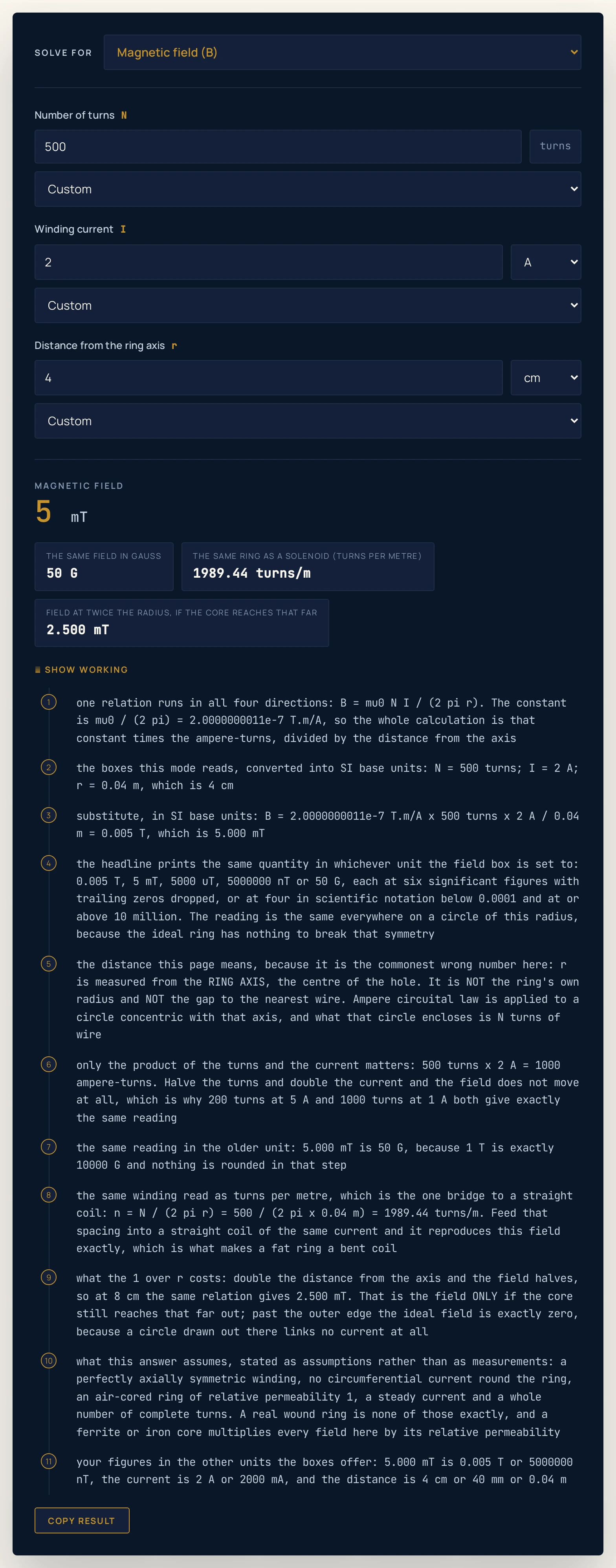
5 mT, and the middle reading is the bridge worth knowing — the same winding is 1989.44 turns/m at that radius, which is the quantity the solenoid guide works in.Worked example: change one thing at a time
The table starts at the defaults, moves the unknown through all four modes, then loads the real cases, shows three different windings giving one field, walks every unit menu, and finally reaches the entries the calculator declines. Every answer and reading cell was taken from the running widget rather than worked out by hand. Where a cell and the tool ever part company, believe the tool.
| Step | Solving for | What you type | Headline answer | Same field in gauss | Turns per metre | Field at twice the radius |
|---|---|---|---|---|---|---|
| The page as it opens | Magnetic field | N = 500, I = 2 A, r = 4 cm | 5 mT | 50 G | 1989.44 turns/m | 2.500 mT |
| The same state, solved for the turns | Number of turns | B = 5 mT, I = 2 A, r = 4 cm | 500 turns | 50 G | 1989.44 turns/m | 2.500 mT |
| The same state, solved for the current | Winding current | B = 5 mT, N = 500, r = 4 cm | 2 A | 50 G | 1989.44 turns/m | 2.500 mT |
| The same state, solved for the distance | Distance from the ring axis | B = 5 mT, N = 500, I = 2 A | 4 cm | 50 G | 1989.44 turns/m | 2.500 mT |
| Probe the inner edge, where it is strongest | Magnetic field | N = 500, I = 2 A, r = 3 cm | 6.66667 mT | 66.6667 G | 2652.58 turns/m | 3.333 mT |
| The same core at the outer edge | Magnetic field | N = 500, I = 2 A, r = 5 cm | 4 mT | 40 G | 1591.55 turns/m | 2.000 mT |
| A ferrite bead on a signal lead | Magnetic field | N = 10, I = 0.05 A, r = 0.75 cm | 0.0133333 mT | 0.133333 G | 212.207 turns/m | 6.667 uT |
| A big core at the top of the current ladder | Magnetic field | N = 2000, I = 10 A, r = 6.5 cm | 61.5385 mT | 615.385 G | 4897.08 turns/m | 30.769 mT |
| Five times the turns, a fifth of the current | Magnetic field | N = 2500, I = 0.4 A, r = 4 cm | 5 mT | 50 G | 9947.18 turns/m | 2.500 mT |
| Two hundred turns at five amps | Magnetic field | N = 200, I = 5 A, r = 4 cm | 5 mT | 50 G | 795.775 turns/m | 2.500 mT |
| A thousand turns at one amp | Magnetic field | N = 1000, I = 1 A, r = 4 cm | 5 mT | 50 G | 3978.87 turns/m | 2.500 mT |
| Twice as far from the axis, half the field | Magnetic field | N = 500, I = 2 A, r = 8 cm | 2.5 mT | 25 G | 994.718 turns/m | 1.250 mT |
| A single turn, to see the scale | Magnetic field | N = 1, I = 2 A, r = 4 cm | 0.01 mT | 0.1 G | 3.97887 turns/m | 5.000 uT |
| The top of the turns box at heavy current | Magnetic field | N = 100000, I = 10 A, r = 4 cm | 5000 mT | 50000 G | 397887 turns/m | 2.500 T |
| The turns a measured field needs | Number of turns | B = 10 mT, I = 1 A, r = 2 cm | 1000 turns | 100 G | 7957.75 turns/m | 5.000 mT |
| The current a measured field needs | Winding current | B = 20 mT, N = 250, r = 2.5 cm | 10 A | 200 G | 1591.55 turns/m | 10.000 mT |
| Where the field has fallen to 4 mT | Distance from the ring axis | B = 4 mT, N = 500, I = 2 A | 5 cm | 40 G | 1591.55 turns/m | 2.000 mT |
| The bead, solved for its turns | Number of turns | B = 0.013333333 mT, I = 0.05 A, r = 0.75 cm | 10 turns | 0.133333 G | 212.207 turns/m | 6.667 uT |
| The field typed in gauss | Number of turns | B = 50 G, I = 2 A, r = 4 cm | 500 turns | 50 G | 1989.44 turns/m | 2.500 mT |
| The field typed in microtesla | Number of turns | B = 13.333333 uT, I = 0.05 A, r = 0.75 cm | 10 turns | 0.133333 G | 212.207 turns/m | 6.667 uT |
| The current typed in milliamps | Magnetic field | N = 10, I = 50 mA, r = 0.75 cm | 0.0133333 mT | 0.133333 G | 212.207 turns/m | 6.667 uT |
| The distance typed in millimetres | Magnetic field | N = 500, I = 2 A, r = 40 mm | 5 mT | 50 G | 1989.44 turns/m | 2.500 mT |
| The distance typed in metres | Magnetic field | N = 500, I = 2 A, r = 0.04 m | 5 mT | 50 G | 1989.44 turns/m | 2.500 mT |
| The field box set to tesla | Magnetic field | N = 500, I = 2 A, r = 4 cm, field box in T | 0.005 T | 50 G | 1989.44 turns/m | 2.500 mT |
| A weaker field sits further out | Distance from the ring axis | B = 1 mT, N = 500, I = 2 A | 20 cm | 10 G | 397.887 turns/m | 500.000 uT |
| Zero turns is declined | Magnetic field | N = 0, I = 2 A, r = 4 cm | no answer | - | - | - |
| A negative current is declined | Magnetic field | N = 500, I = -2 A, r = 4 cm | no answer | - | - | - |
| A distance of zero is declined | Magnetic field | N = 500, I = 2 A, r = 0 cm | no answer | - | - | - |
| More than 100000 turns is declined | Magnetic field | N = 100001, I = 2 A, r = 4 cm | no answer | - | - | - |
| A field of 100 T is declined | Number of turns | B = 100000 mT, I = 2 A, r = 4 cm | no answer | - | - | - |
| An absurdly weak field is declined | Distance from the ring axis | B = 1e-13 T, N = 500, I = 2 A | no answer | - | - | - |
Rows 1 to 4 are one state — 500 turns at 2 A read 4 cm from the axis — with the Solve for menu in each of its four positions. All three reading columns are identical down all four rows, because the readings describe the state rather than the mode. That is not free: they are worked out from the answer substituted back, so the mode in which the turns are the unknown still has a turns count to take a turns-per-metre figure from.
Rows 5 and 6 are the two edges of the same core, and their ratio is the cleanest check on the page. 6.66667 mT divided by 4 mT is 5 over 3, which is exactly the outer radius divided by the inner one — and it stays 5 over 3 whatever you do to the turns and the current, because the non-uniformity is pure geometry.
Rows 9 to 11 are the point of the whole page. Five hundred turns at 2 A, 2500 at 0.4 A, 200 at 5 A and 1000 at 1 A all read 5 mT at the same radius, because all four are a thousand ampere-turns. Only the turns-per-metre column moves, because that one does depend on how many turns there actually are.
Rows 12 and 13 are the two scalings. Doubling the distance from 4 cm to 8 cm halves the field from 5 mT to 2.5 mT, which is the reading row 1 already printed in its third column. Dropping from 500 turns to a single turn divides the field by 500, giving 0.01 mT.
Rows 15 to 18 run the three inverse modes, and row 17 is the one worth trying. Ask where the field has fallen to 4 mT on the opening winding and the answer is 5 cm, which is the outer edge of the reference core — the same pair of numbers as row 6, read from the other end. Rows 19 to 24 change nothing but the units: 50 G, 13.333333 uT, 50 mA, 40 mm and 0.04 m all reproduce the figures they came from, and the field box set to tesla prints the same answer as 0.005 T.
Rows 26 to 31 are the refusals: zero turns, a negative current, a distance of zero, more turns than the box accepts, a field above 10 T, and a field so weak that the distance it implies is no longer a ring. In every one of them the answer is words rather than an infinity or a NaN. If what you wanted was the flux through a loop in a field that is already uniform, the magnetic flux calculator is the tool for that instead.
Formula and symbol reference
One relation does all the work: B = mu0 · N · I / (2 · pi · r), for any distance r from the axis that lies between the inner and outer edges of the core. Everything else on this page is that relation rearranged, or a quantity derived from the state it describes.
The combination that makes it a one-line calculation is mu0 / (2 · pi) = 2.0000000011 × 10⁻⁷ T·m/A, so the field is that constant times the ampere-turns over the distance. Reading it backwards gives N = B · r · 2 · pi / (mu0 · I), I = B · r · 2 · pi / (mu0 · N) and r = mu0 · N · I / (2 · pi · B). The straight-coil form of the same question, which asks for turns per metre instead of a distance from an axis, is the magnetic field calculator.
There is deliberately no box for the core cross-section, the ring height or the permeability. The first two decide which radii exist rather than what the field is at a radius that does exist, and the third is fixed at 1 because everything here is air-cored — a ferrite or iron core multiplies every field on this page by its own relative permeability. Where cores and coils are the subject, that is the electromagnet guide.
| Symbol | Meaning | SI unit | Values used on this page |
|---|---|---|---|
| B | Magnetic field inside the core, at the distance you asked about. Constant in magnitude all the way round a circle of that radius, and running round the ring rather than across it | tesla | Boxes take mT, T, uT, nT or G: 5 mT is the default, which is 0.005 T and 50 G. The box accepts 1e-12 to 10 T. |
| N | Number of complete turns of wire round the ring, as a plain count. The field is exactly proportional to it, and nothing about the wire gauge or the winding pitch enters the relation | dimensionless | A plain count from 1 to 100000: 500 is the default, with presets at 10, 500 and 2000. |
| I | Current in the wire. The field is exactly proportional to it too, which is why only the product with the turns ever matters | ampere | Boxes take A or mA: 2 A is the default, which is 2000 mA, with presets at 0.05, 2 and 10 A. The box accepts 1e-6 to 1000 A. |
| r | Distance from the RING AXIS — the centre of the hole — out to the point you are asking about. Not the ring's own radius, and not the gap to the nearest wire. The field goes as one over it | metre | Boxes take cm, mm or m: 4 cm is the default, which is 40 mm and 0.04 m, with presets at 3, 4 and 5 cm. The box accepts 1e-4 to 10 m. |
| mu0 | The magnetic constant, spelled as a word here because CSS uppercases every label on the widget and that destroys a Greek letter. A measured quantity since the 2019 revision of the SI, not a defined one | newton per ampere squared | Fixed at 1.25663706212e-6 N/A² (CODATA 2018), and never varied on this page. |
| mu0 / (2 pi) | The combination the whole page leans on, because it turns the relation into one multiplication and one division | tesla metre per ampere | Printed as 2.0000000011e-7 T·m/A in every step; the arithmetic carries the unrounded quotient. |
| N · I | Ampere-turns: the only way the turns and the current ever appear. The circle you measure on knows the winding only through this product | ampere | A derived quantity: 1000 ampere-turns on the defaults, reached as 500 x 2, 200 x 5, 1000 x 1 or 2500 x 0.4. |
| n | Turns per metre the same winding works out to at that radius, N / (2 pi r). The one quantity that connects a ring to a straight coil | per metre | A reading beside the answer: 1989.44 turns/m on the defaults, 2652.58 at the inner edge, 212.207 on the bead. |
The physics: why three numbers are enough
Draw a circle round the axis of the ring, inside the core. The winding is idealised as a smooth current sheet with perfect axial symmetry, so the field has the same magnitude everywhere on that circle and runs along it. That is what makes the loop integral of the field simply the field times the circumference.
What the circle encloses is the wire, N times over, each turn carrying I. So the enclosed current is N · I and nothing else, which is why the calculator needs no geometry: the circumference supplies the 2 · pi · r and the winding supplies the ampere-turns. Everything the field depends on is in those two numbers.
That also fixes the one-over-distance behaviour exactly. The enclosed current does not change as the circle grows, but the circumference does, so the field has to fall in step with it. Doubling the distance from the axis halves the field, which is the third reading beside every answer.
The same fact read the other way gives the bridge to a straight coil. The winding has N / (2 · pi · r) turns per metre along that circle, and a straight coil of that spacing carrying the same current has exactly this field — so a ring fat enough that the distance barely changes across it really is a long coil bent round. What a field like this then does to a charge moving through it is a separate question, and it belongs to the magnetic field guide.
Outside the ring the ideal answer is exactly zero, because a circle drawn in the hole or beyond the outer edge encloses no current at all. That is a property of the idealised winding and not a measurement of a real one, which is why this calculator asks for a distance it assumes is inside the core and says so rather than drawing a boundary it cannot know about.
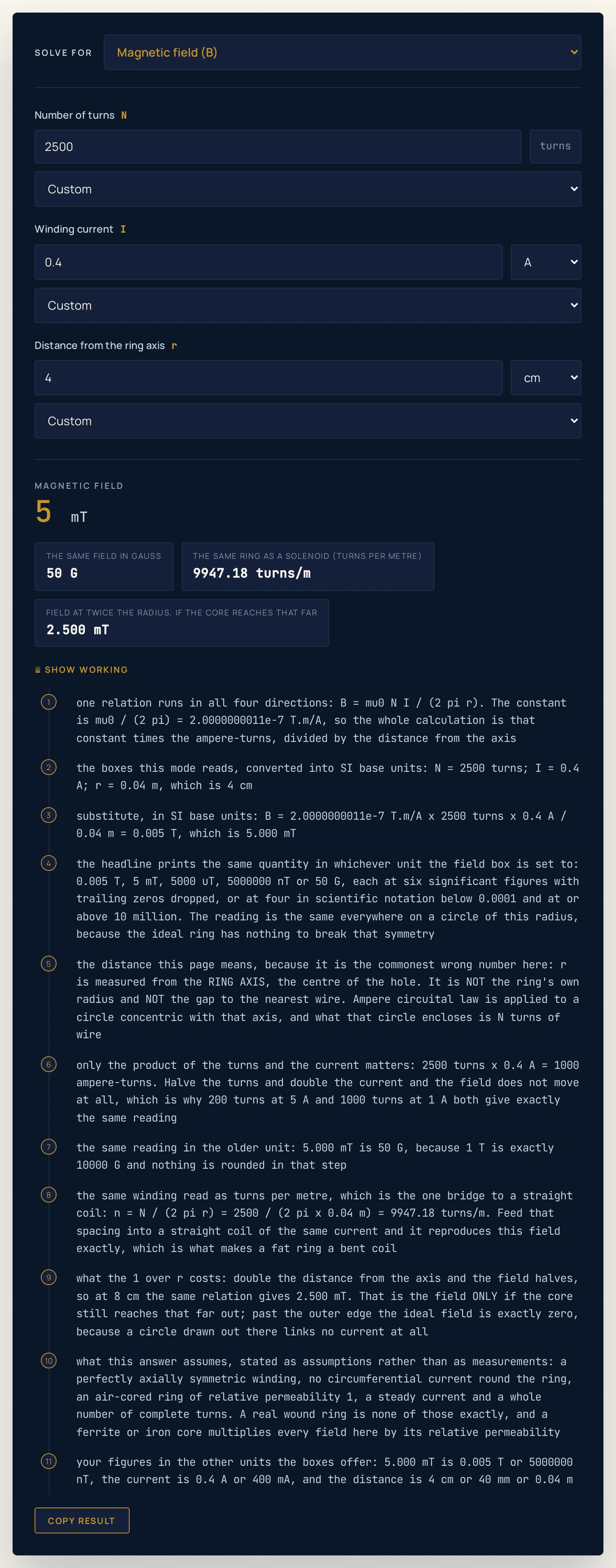
5 mT, because it is the identical thousand ampere-turns. Only the 9947.18 turns/m reading has moved — and that is the quantity the solenoid simulator is driven by.Where the ideal toroid breaks down
The arithmetic here is exact to the last digit a double can hold. What goes wrong is physical: a winding treated as a smooth, perfectly symmetric sheet, a core with no material in it, and a single distance standing in for a whole cross-section.
- A real winding is not axially symmetric close in
- Looking out from the axis, a real winding is sometimes on the inside of the core and sometimes on the outside, so the field near the wires is not the smooth circle this relation assumes. The source the cluster works from puts the recovery distance at several times the winding spacing: further out than that, a real toroid does look symmetric. Nothing on this page corrects for it, and no figure for the size of the correction is printed.
- A real winding always carries one loop round the ring
- However many times the wire encircles the core and however thin it is, the winding also goes once round the plane of the ring, and that loop has a field of its own. This is the second condition the ideal result needs and the second one a real ring breaks. The honest claim is that leakage can be made low, not that it is absent, and the practical consequence is less interference rather than none.
- Zero outside belongs to the ideal case only
- The exactly zero field outside the ring is a property of the model. It follows from the two assumptions above, so a sentence that uses the word exactly has to say which case it is talking about. This calculator never asks about a point outside the core, which is why it has no boundary to report.
- One distance is not a cross-section
- The field is different at every radius across the core, so quoting a single figure for the field in a ring is already an approximation. The mid-radius value understates the average across a rectangular cross-section by a little over 2 per cent on the cluster reference core, and by more than 15 per cent on a ring whose outer radius is four times its inner one. This page prints the field at the radius you asked for and makes no claim about the average.
- Air-cored throughout
- Relative permeability is 1 everywhere on this page, so a ferrite or laminated-iron ring is a different number: every field here multiplies by the core's own relative permeability. No value for that is published or assumed anywhere on this page, and applying it is a separate step.
- Steady currents only
- Everything here is magnetostatics: one current, not changing. A current that varies in time brings in effects this relation knows nothing about, and none of them are modelled, estimated or hinted at by any reading on the page.
- The turns are a whole number, and the answer may not be
- Solving for the turns returns whatever the field and the current ask for, which is usually not an integer. The working prints the rounded figure beside the unrounded one and works out what rounding costs for your own answer, in per cent. On any winding of more than a few hundred turns that cost is far smaller than the tolerance of a ring you could actually build.
- A clean answer can be a coincidence of the numbers
- The opening state reads
5 mTexactly, and that is becausemu0 / (2 · pi)happens to be2.0times ten to the minus seven to ten figures and 500 times 2 divided by 0.04 happens to be 25000. It is an accident of the chosen figures and not a law. Change any box and the roundness disappears. - The field box is range-checked, not merely checked for sign
- Solving for the distance from a field of 1e-300 tesla returns a perfectly finite answer of about 2e+296 metres, which passes any test for being greater than zero. That is why every box here is checked against its declared range, and why the page declines rather than printing a figure that is arithmetic rather than physics.
- The calculator measures nothing — you supply the numbers
- Three quantities go in, one relation is used, and the answer describes the ring you described. The case names are shorthand for the four figures behind them and are not claims about any particular component, core or sample.
Where this field is actually used
- Sizing a winding for a field you need
- Point Solve for at the turns and the question becomes the one a build actually asks: you know the field you want, the current you can supply and the radius you have, and you want the turns. At
10 mTon 1 A at 2 cm the answer is1000 turns, and the working prints the rounded figure beside it because a winding is a whole number. - Deciding between many turns and a heavy current
- Because only the ampere-turns matter, the two are interchangeable, and the current mode is where you find out which is cheaper.
20 mTat 2.5 cm needs10 Athrough 250 turns, or a tenth of that through ten times as many. The turns-per-metre reading is what tells you whether the winding will physically fit. - Reading a field measurement back into a distance
- Point Solve for at the distance and a probe reading becomes a position. On the opening winding a reading of
4 mTplaces you at5 cmfrom the axis, and5 mTplaces you at4 cm. That is a useful consistency check on where a probe actually sat. - Judging how uniform a core is before trusting one figure
- Enter the inner radius, then the outer radius, with the turns and current unchanged. The reference core gives
6.66667 mTand4 mT, a spread of two thirds, and a ring with four times the radius ratio is far worse. A narrow annulus is nearly uniform and a wide one is not, which is the arithmetic behind making a core fat rather than wide. - Working in gauss when the datasheet does
- Core and magnet datasheets are still quoted in gauss far more often than in tesla, and the first reading beside the answer saves the conversion.
5 mTis50 Gand61.5385 mTis615.385 G. The step in the working says the conversion is exact, so nothing is lost by moving between them. - Checking a ferrite bead rather than a transformer
- Load a ferrite bead on a signal lead and the same relation drops 375-fold, to
0.0133333 mTon ten turns at 50 mA — the headline stays in mT because that is the unit the field box is set to, and step 3 of the working prints the identical field as13.333 uT. The field a small suppression component produces is tiny, and seeing that in the same units as a mains core is the quickest way to get the scale right. The real bead has a ferrite core, so its field is larger by that core relative permeability. - Recognising the same relation somewhere else
- One over the distance from a line, times a current, is the field of a long straight wire — and the ring is exactly that law with
Nwires worth of linked current instead of one. Once you see that, the two formulas stop being two things to remember. Where this field appears as flux through something, the magnetic flux calculator takes it from there.
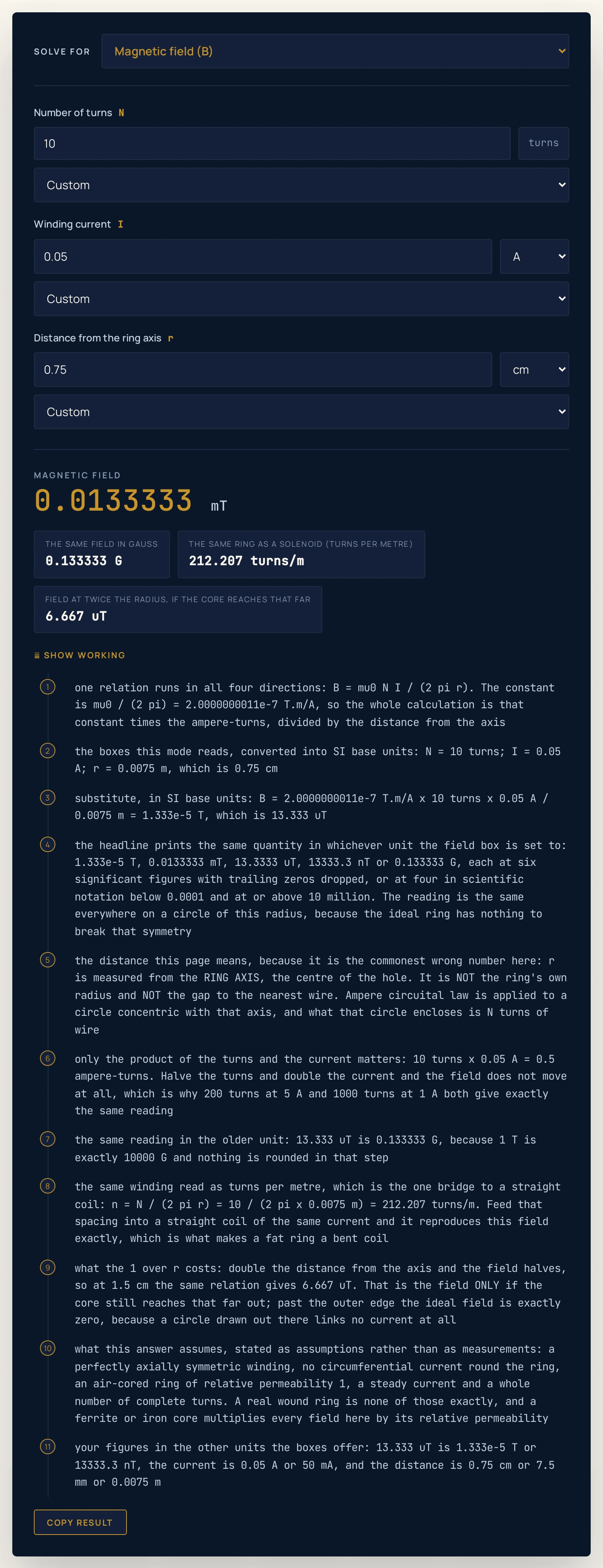
0.0133333 mT — about 0.133333 G. The headline and the 13.333 uT in step 3 of the working are one field in two units, and the guide quotes the microtesla form. About 375 times weaker than the mains core, from the same relation and the same constant.Where to go next
For the argument this arithmetic supports, the three tests of the field inside a ring and the problems worked through, read the toroid guide, which this tool is the calculating half of. The solenoid guide is the straight-coil case this one is the bent version of, and the magnetic field guide is what a field like this does to a moving charge.
Four more posts pick up the pieces this page uses but does not explain. The electric current guide is what the current in the winding is, the electromagnet guide is where cores and coils are the subject, the magnetic flux guide is the flux this field carries through a surface, and the right-hand rule guide is which way round the ring it runs.
Three tools sit next to this one. The magnetic field calculator is the straight-coil form, the magnetic flux calculator takes a uniform field through a loop, and the electric current calculator gives the current from charge and time. The solenoid simulator and the electromagnet simulator are the interactive versions of the first two cases.
The full physics lab library and the calculator index are open too.
Frequently asked questions
What does the toroid calculator work out?
It solves B = mu0 N I / (2 pi r) for any one of four quantities: the magnetic field inside the ring, the number of turns, the winding current, or the distance from the ring axis at which the field has that value. Beside the answer it prints the same field in gauss, the turns per metre the same winding works out to, and the field at twice that distance.
Is r the radius of the ring itself?
No, and this is the single most common wrong entry on the page. The distance is measured from the axis of the ring, which is the centre of the hole, out to the point you are asking about. It is neither the ring's own radius nor the gap to the nearest wire, so a ring whose hole is 3 cm in radius and whose outer edge is at 5 cm takes any r between those two.
Why does the answer only depend on the turns times the current?
Because the only thing the circle you measure on knows about the winding is how much current crosses the surface it bounds, and that is N times I. Two hundred turns at 5 amps, five hundred turns at 2 amps and a thousand turns at 1 amp are all a thousand ampere-turns, and all three give exactly the same field at the same radius. Entering those three states is the fastest way to confirm the arithmetic is right.
Why is the field stronger at the inner edge than at the outer edge?
Because the field goes as one over the distance from the axis, and the inner edge is closer to it. The ratio is pure geometry: the inner-edge field divided by the outer-edge field is the outer radius divided by the inner one, whatever the turns and the current are. On the reference core used by the presets that ratio is 5 over 3, so the inner edge reads about 67 per cent more than the outer edge.
What does the turns per metre reading mean?
It is how closely spaced the winding is, measured along the circle of the radius you asked about, and it is the only quantity that connects a ring to a straight coil. Feed that spacing and the same current into a straight coil and it reproduces the ring field at that radius exactly. That is the sense in which a fat ring really is a long coil bent into a circle.
Does this calculator work for an iron or ferrite core?
Not directly. Everything here is air-cored, with a relative permeability of one throughout, and a ferrite or iron core multiplies every field on the page by its own relative permeability. No permeability figure is published here and none is assumed, so a cored ring needs that factor applied separately.
Why does the calculator refuse some combinations?
Because each box has a declared range and an entry outside it would produce arithmetic rather than physics. The turns run from 1 to 100000, the current from 1e-6 to 1000 amps, the distance from 1e-4 to 10 metres and the field from 1e-12 to 10 tesla. Solving for a distance from a field of 1e-300 tesla returns a finite answer of around 2e+296 metres, which is why every box is range-checked rather than merely checked for being positive.
What is the field outside the ring?
For the ideal ring it is exactly zero, because a circle drawn in the hole or outside the outer edge links no current at all. That is a statement about the idealised winding rather than about a real one, and a real wound ring always leaks some field. The companion guide makes that argument properly, with the source that states both of the conditions a real winding breaks.
How accurate is the constant the page uses?
The page uses the CODATA 2018 value of mu0, which is 1.25663706212e-6 newtons per ampere squared, and divides it by two pi to get 2.0000000011e-7 tesla metres per amp. Since the 2019 redefinition of the SI that constant is measured rather than defined, so four pi times ten to the minus seven is no longer its exact value. The two agree to nine significant figures, which is far beyond anything printed here.
Why is there no box for the ring cross-section?
Because the field at a given distance from the axis does not depend on the cross-section at all. The shape and height of the core decide which radii exist, not what the field is at a radius that does exist, so this page asks for one distance rather than a geometry. That also means it cannot tell you whether the distance you typed is inside your particular core.
References & formula source
- The relation solved on this page is Ampere circuital law applied to a circle concentric with the axis of a ring-shaped coil. With the winding idealised as a smooth, axially symmetric current sheet carrying no net current round the plane of the ring, the loop integral of the field is the field times two pi r, the enclosed current is N times I, and the field is therefore mu0 N I divided by two pi r for any radius between the inner and outer edges of the core. It is stated here rather than derived. A circle in the hole or outside the outer edge encloses no current, so the ideal field there is exactly zero.
- The constant is the CODATA 2018 value of the magnetic constant, 1.25663706212e-6 newtons per ampere squared, divided by two pi to give 2.0000000011e-7 tesla metres per amp. Since the 2019 revision of the SI that quantity is measured rather than defined, so four pi times ten to the minus seven is no longer its exact value; the two agree to nine significant figures, and nothing on this page is printed to anything like that precision. No string here calls the older expression exact.
- An independent reference script, written before this page existed and sharing no code with it, runs 244739 checks with 0 failures. It pins the four solve modes of this calculator, round-trips 1920 states through all three inverse directions to one part in ten thousand million, asserts that the field scales exactly as the turns and exactly as the current, and checks that the ratio of the fields at the inner and outer edges is exactly the ratio of those two radii. It also pins the two guard traps this page is built around as bare arithmetic, so the reason the guards are shaped the way they are survives in the log even if the solvers change.
- Those two traps are the reason the tool declines some entries instead of answering them, and they are worth knowing because the wrong answers they produce look perfectly ordinary. Checking only that a figure is positive lets an infinite one through, and checking only that the answer came out finite misses the cases that quietly return zero; asking for the distance at which a field of 1e-300 tesla sits returns a flawless, finite 2e+296 metres, which is not a ring. Every box here is therefore checked against the range printed under the widget rather than merely against zero, so a refusal is a statement about the physics rather than a failure of the arithmetic.
- Everything here is air-cored, with a relative permeability of one throughout. A ferrite or laminated-iron core multiplies every field on this page by its own relative permeability, and no figure for that multiplier is published or assumed here. The winding is also idealised: a real winding is not axially symmetric close in, and it always carries one loop of current round the plane of the ring however thin the wire, so the ideal zero outside the ring is a property of the model and not a measurement.
- Every figure quoted in the prose and the tables above is either a string this calculator printed for the inputs named beside it, or a constant the cluster physics contract fixes, or a ratio the unit tests assert. Where a cell and the running widget ever part company, believe the widget. Anything this page declines to put a number on is declined because the model cannot produce one, not because the figure was omitted for brevity.
- Further reading: Toroidal inductors and transformers — Wikipedia