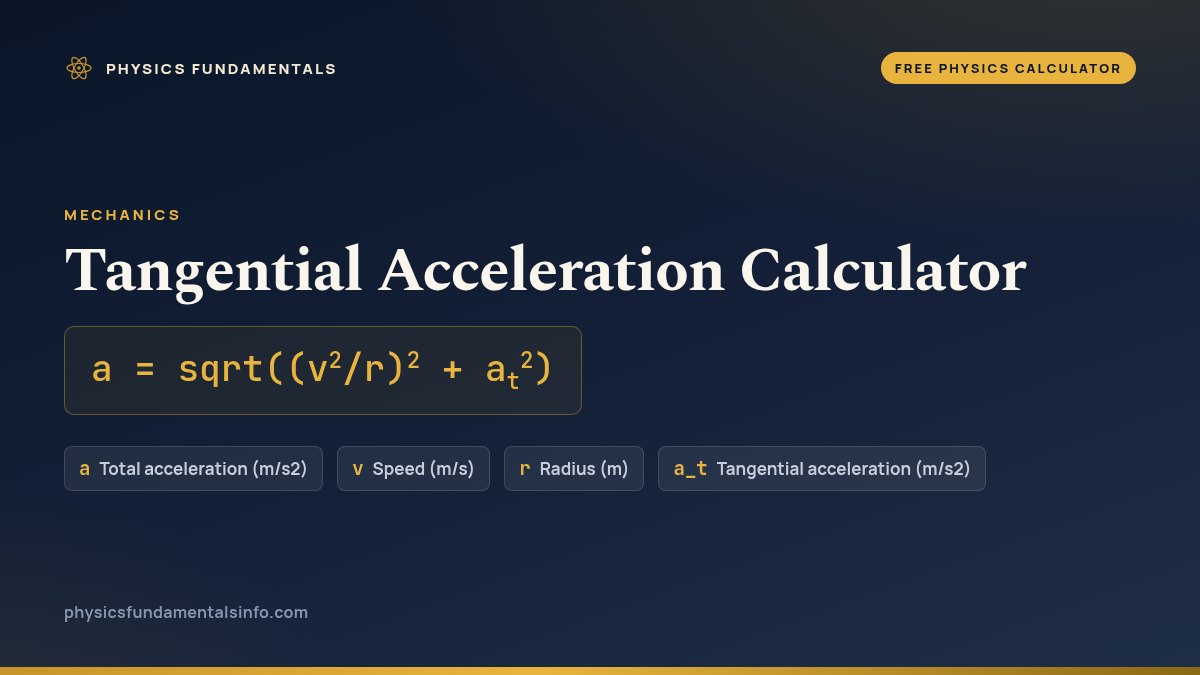
Tangential acceleration is the rate at which speed changes along the direction of travel, and it is the term a = v2/r has nowhere to put. This free tangential acceleration calculator solves a = sqrt((v2/r)2 + at2) four ways — for the total acceleration itself, or for the tangential acceleration, the speed or the radius behind it. Beside the answer it prints the centripetal part, the angle the result leans off the inward radius, the total in multiples of gravity, the angular velocity, the angular acceleration and the grip coefficient the manoeuvre would need.
Load a real case
Each button puts the Solve for menu on the unknown that case is asking about, sets every unit menu it names, and fills the remaining boxes. Whatever the widget then works out is read back into the line underneath, so nothing there is stored text. Every case is named after the manoeuvre rather than a surface or a vehicle, because nothing on this page measures either.
Pick a case above, or type your own numbers.
What Is the Tangential Acceleration Calculator?
The tangential acceleration calculator is a free online tool for the whole acceleration of something going round a bend while its speed is changing, in metres per second squared. Type the speed, the radius and the tangential acceleration into a = sqrt((v2/r)2 + at2), or point the Solve for menu at whichever of those four quantities is the one you are missing. Show working sets out every step with your figures restated in SI base units and every operand unrounded, the preset buttons fill the boxes for a named manoeuvre in one click, and the three reverse modes decline rather than invent an answer where the relation has none.
| Symbol | Quantity | Default unit | Also accepts | Example value |
|---|---|---|---|---|
| a | Total acceleration | m/s2 | g | 6.4031242 |
| v | Speed | m/s | km/h | 15 |
| r | Radius | m | km | 45 |
| a_t | Tangential acceleration | m/s2 | g | -4 |
How to use the tangential acceleration calculator
- Choose the unknown. The Solve for menu opens on Total acceleration. The other three choices are Tangential acceleration, Speed and Radius, and whichever you pick vanishes from the boxes below.
- Type the speed. Speed is how fast the object is going along its path at this instant, in m/s or km/h. Zero is a legitimate entry rather than an error, and it is the entry that makes this page differ most sharply from every other circular-motion tool here.
- Type the radius. Radius is the radius of the bend, in m or km, and it is held constant across the whole calculation. Halving it doubles the inward part at the same speed, because that part is the speed squared divided by it.
- Type the tangential acceleration. Tangential acceleration is how fast the speed itself is changing, in m/s2 or multiples of g. Negative is braking and positive is speeding up, and this is the box that makes the page different from every other circular-motion tool on the site.
- Read the answer and the chips. The headline is the quantity you asked for, to four significant figures. The chips give the centripetal acceleration, the angle off the radius, the total acceleration in g, the angular velocity, the angular acceleration and the grip coefficient needed.
- Compare the answer with the centripetal chip. On the opening case the chip reads 5.000 m/s2 against an answer of 6.403 m/s2, so the braking has added 1.403 m/s2 to the whole. Load Pulling away from rest and the chip reads 0.000 m/s2 against 2.5 m/s2, which is the comparison this page exists for.
- Watch the angle off the radius. It is 0.0 deg when the speed is steady, 90.0 deg at a standing start, and it passes 45 deg when the two components are equal. It restates the two components rather than adding a third fact to them.
- Open Show working. The steps restate the relation, list your figures in SI base units whatever the menus say, and then print the inward part and the along-the-path part separately. Seeing 54 km/h come back as 15 m/s in that second line is the quickest way to see what the conversion did.
This page starts exactly where a constant-speed tool stops. For the definition of centripetal acceleration, the symbol table, the three equivalent forms and four worked problems on them, the guide to circular motion physics covers all of it and this page assumes it. The circular motion calculator is the right tool whenever the speed really is steady, and it has no box for a tangential acceleration because it does not need one.
That guide already tells the reader that braking hard in a corner is how you lose grip, and it is right. What it does not give is the formula, the angle or the numbers behind that sentence, which is what this page adds. Nothing here corrects it; the two are the same bend on either side of one assumption.
Two mistakes account for most wrong answers, and both are about which acceleration was typed. The first is putting the total into the Tangential acceleration box, which double-counts the inward part and inflates the answer; the centripetal acceleration chip tells you what the inward part actually was. The second is a speed typed in kilometres per hour while the menu still reads metres per second, which the second line of Show working will always catch.
A third is subtler, because the box takes the figure without complaint. If what you have is a force rather than an acceleration, the guide to centripetal force sets out the difference between the two, and the centripetal force calculator is the tool that multiplies by the mass.
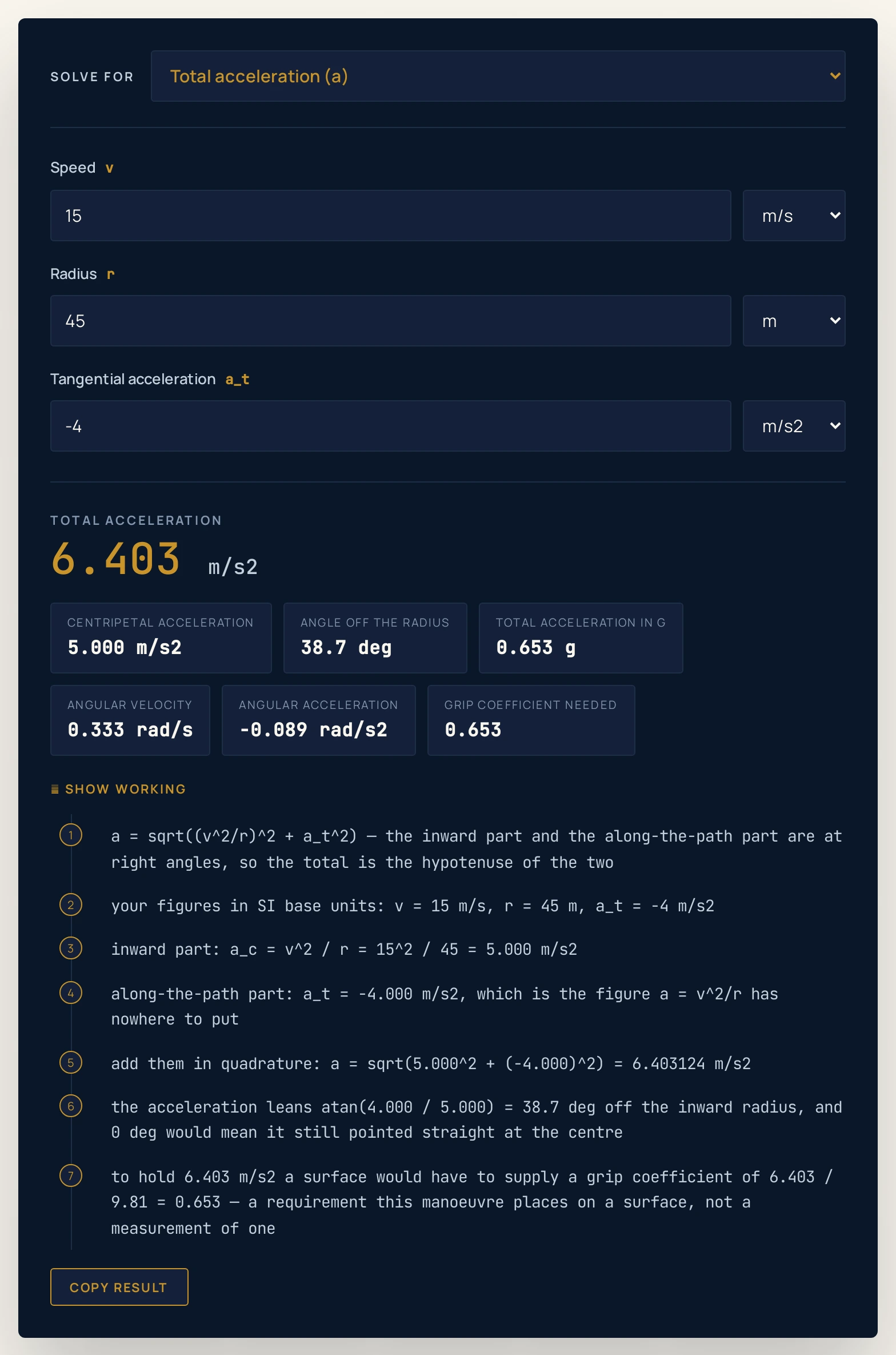
5.000 m/s2 chip is the part a constant-speed formula can see and the 6.403 m/s2 headline is the whole acceleration — the gap between them is what the braking added, and the two chips reading 0.653 are one quotient printed twice, not two findings.Worked example: change one thing at a time
The table starts at the defaults and moves one thing at a time: which quantity is the unknown, then the sign of the tangential acceleration, then the speed, then the unit the figures are typed in, and finally the entries the calculator declines. Every Result, Centripetal acceleration and Angle cell was read out of the running widget rather than worked out by hand, so where a cell and the tool ever part company, believe the tool.
| Step | Solving for | What you type | Result | Centripetal acceleration | Angle off the radius |
|---|---|---|---|---|---|
| The page as it opens | Total acceleration | 15 m/s, 45 m, -4 m/s2 | 6.403 m/s2 | 5.000 m/s2 | 38.7 deg |
| Feed that answer back | Tangential acceleration | 6.4031242 m/s2, 15 m/s, 45 m | 4 m/s2 | 5.000 m/s2 | 38.7 deg |
| and again, for the speed | Speed | 6.4031242 m/s2, 45 m, -4 m/s2 | 15 m/s | 5.000 m/s2 | 38.7 deg |
| and for the radius | Radius | 6.4031242 m/s2, 15 m/s, -4 m/s2 | 45 m | 5.000 m/s2 | 38.7 deg |
| Take the braking away | Total acceleration | 15 m/s, 45 m, 0 m/s2 | 5 m/s2 | 5.000 m/s2 | 0.0 deg |
| Accelerate instead of braking | Total acceleration | 15 m/s, 45 m, 4 m/s2 | 6.403 m/s2 | 5.000 m/s2 | 38.7 deg |
| Power out of a wider entry | Total acceleration | 20 m/s, 45 m, 3 m/s2 | 9.381 m/s2 | 8.889 m/s2 | 18.6 deg |
| The case v^2/r returns zero for | Total acceleration | 0 m/s, 20 m, 2.5 m/s2 | 2.5 m/s2 | 0.000 m/s2 | 90.0 deg |
| Neither moving nor changing | Total acceleration | 0 m/s, 45 m, 0 m/s2 | 0 m/s2 | 0.000 m/s2 | undefined |
| A total below the inward part | Tangential acceleration | 3 m/s2, 15 m/s, 45 m | no answer | — | — |
| A total equal to the along part | Radius | 4 m/s2, 15 m/s, -4 m/s2 | no answer | — | — |
| A hair above it | Radius | 4.0001 m/s2, 15 m/s, -4 m/s2 | 7955 m | 0.028 m/s2 | 89.6 deg |
| Speed typed in km/h | Total acceleration | 54 km/h, 45 m, -4 m/s2 | 6.403 m/s2 | 5.000 m/s2 | 38.7 deg |
| Radius typed in km | Total acceleration | 15 m/s, 0.045 km, -4 m/s2 | 6.403 m/s2 | 5.000 m/s2 | 38.7 deg |
| Tangential typed in g | Total acceleration | 15 m/s, 45 m, 0.5 g | 7.004 m/s2 | 5.000 m/s2 | 44.5 deg |
| A radius of zero | Total acceleration | 15 m/s, 0 m, -4 m/s2 | no answer | — | — |
| A standing object, for a radius | Radius | 4 m/s2, 0 m/s, -2 m/s2 | no answer | — | — |
Rows 1 to 4 are one state read four different ways. The total gives back the size of the braking, then the speed, then the radius, and each answer returns the figure the row above it started from. Four unknowns, one relation, and no arrangement more fundamental than another.
That round trip is the genuine check on this page, and it is worth saying why the centripetal column is not. The headline and that chip are related by the definition of the headline, so their agreeing is the relation restated. Rows 2 to 4 do different arithmetic in the other direction and still land on 4 m/s2, 15 m/s and 45 m, which is a claim that can fail.
Rows 5 and 6 are the sign test. Take the braking away and the total falls to the inward part exactly, which is a definition rather than a discovery; put the same 4 m/s2 back with the opposite sign and the total returns to 6.403 m/s2 and the angle to 38.7 deg. Braking and accelerating cost the same here, so nothing on this page may imply that braking is the more expensive of the two.
Rows 8 and 9 are the two cases a constant-speed formula cannot express. At a standing start the inward part really is 0.000 m/s2, and the whole 2.5 m/s2 points along the path at 90.0 deg off the radius. With nothing moving and nothing changing there is no direction at all, so the angle chip prints undefined rather than a plausible 0.0 deg.
Rows 10 to 12 are the domain. A total smaller than the inward part it already contains is refused, and so is a total exactly equal to the tangential figure, because recovering a radius from that means dividing by zero. Lift the total a hair above it and an answer reappears at 7955 m, which is how fast that radius runs away as the two close up.
Rows 13 to 17 are the edges. 54 km/h, 0.045 km and 0.5 g come back as the same answers their SI equivalents give, a radius of zero is declined rather than answered, and a stationary object is declined when you ask it for a radius, because no bend can be recovered from something that is not going round one.
Formula and symbol reference
The calculator uses one relation in four arrangements. The total is a = sqrt((v2/r)2 + at2), so the tangential term is at = sqrt(a2 - (v2/r)2), the speed is v = sqrt(r sqrt(a2 - at2)) and the radius is r = v2 / sqrt(a2 - at2).
Three of those four carry a domain condition, because a square root cannot take a negative number. The tangential mode needs a total at least as large as the inward part, the speed mode needs a total at least as large as the tangential part, and the radius mode needs the total strictly larger than the tangential part, since it divides by the difference. Outside those conditions the calculator declines rather than inventing a figure.
| Symbol | Meaning | SI unit | Values used on this page |
|---|---|---|---|
| a | Total acceleration: the whole acceleration the object actually has, the hypotenuse of the inward part and the along-the-path part. The quantity this page opens on, and the one no other circular-motion tool here can form | metre per second squared, m/s2 | Boxes take m/s2 or g: 6.403 on the opening case, 5.000 with the braking taken away, 2.5 pulling away from rest, 9.381 powering out of a wider entry. |
| v | Speed along the path at this instant. Squared and divided by the radius it gives the inward part, so it is the input the inward part is most sensitive to | metre per second, m/s | Boxes take m/s or km/h: 15 on the opening case, 20 powering out, 0 pulling away from rest, 54 km/h in the unit row. |
| r | Radius of the bend being followed, held constant across the calculation. Halving it doubles the inward part at the same speed | metre, m | Boxes take m or km: 45 throughout the braking and powering cases, 20 pulling away from rest, 0.045 km in the unit row. |
| a_t | Tangential acceleration: the rate at which the speed itself is changing, along the direction of travel. Negative is braking and positive is speeding up, and it is the box no other circular-motion calculator on this site has | metre per second squared, m/s2 | Boxes take m/s2 or g: -4 on the opening case, 0 with the braking taken away, 3 powering out, 2.5 pulling away from rest, 0.5 g in the unit row. |
| a_c | Centripetal acceleration, v^2/r, the inward part. Printed as a chip rather than typed, and it is what a constant-speed calculator returns on its own | metre per second squared, m/s2 | Computed, never typed: 5.000 m/s2 on the opening case and on every 15 m/s case at 45 m, 8.889 powering out, 0.000 at a standing start. |
| phi | Angle off the inward radius, atan of the along-the-path part over the inward part. Zero when the speed is steady and ninety degrees when nothing is moving yet | degree, deg | Computed, never typed: 38.7 deg on the opening case, 0.0 with the braking taken away, 90.0 pulling away from rest, undefined when neither the speed nor the tangential acceleration is anything but zero. |
The physics: why the two parts add in quadrature, not end to end
An object on a circular path at a steady speed is accelerating inward, and that inward acceleration is the speed squared divided by the radius. Let the speed change as well and a second acceleration appears along the direction of travel, at right angles to the first. The object now has two accelerations at once, and what it actually feels is their vector sum.
Because they are perpendicular, they combine as the two shorter sides of a right-angled triangle rather than end to end. The total is sqrt(ac2 + at2) and it leans atan(at / ac) away from the inward radius. That lean is the whole difference between this page and a constant-speed one: the answer no longer aims at the centre of the bend.
Quadrature is what makes the first slice of speed change almost free. With the inward part fixed at 7.000 m/s2, adding 0.500 m/s2 along the path raises the total to 7.0178 m/s2, which is 0.255 per cent larger; adding a full 1.000 m/s2 raises it to 7.0711 m/s2, which is 1.015 per cent larger. Push on to 5.000 m/s2 and the total reaches 8.6023 m/s2, 22.890 per cent larger, so the cost climbs steeply once the two components become comparable.
There is an exact moment when the two components are equal: it happens when the speed reaches sqrt(at r), taking the size of the tangential term, and there the lean is exactly 45 deg and the total is exactly the square root of two times either component. On the opening case, a 45 m bend with 4.000 m/s2 of braking, that speed is 13.416 m/s. On the standing-start case, a 20 m bend with 2.500 m/s2, it is 7.071 m/s.
Neither of those is a universal constant, and it matters that no page treats them as one. That crossover speed moves with both the radius and the tangential acceleration, so "the speed at which the turn takes over" is not a number that exists. It also does not depend on the speed the object started at, which is why it is a property of the bend and the manoeuvre rather than of the journey.
The sign of the tangential term never reaches the answer, because the relation squares it. Braking at 4.000 m/s2 and accelerating at 4.000 m/s2 give an identical total and an identical angle, so the two cost exactly the same in this model. That is also why solving backwards for the tangential acceleration returns a magnitude: the square has already destroyed the information, and no rearrangement can put it back.
The last two chips are one quotient wearing two names. The total acceleration in g and the grip coefficient needed are both the total divided by 9.81, so they will always print the same digits; the first reads that number as a multiple of gravity and the second as the coefficient a level surface would have to supply. Their agreeing is arithmetic and never a check, and the second is a requirement placed on a surface rather than anything measured about one.
The angular chips are the same family seen from the rotation side: the angular velocity is the speed divided by the radius and the angular acceleration is the tangential term divided by the radius. The guide to the angular velocity formula works that pair out in detail, and the angular velocity calculator handles the rotation rate on its own. Those substitutions are algebra, so their agreeing with the metric chips is not the tool checking itself.
Where the bend itself is tilted rather than flat, the geometry changes and part of the turning is done by the bank rather than by grip; the banked curve calculator covers that case and assumes a steady speed throughout. This page assumes a level path and a constant radius, which is what makes the two components perpendicular in the first place.
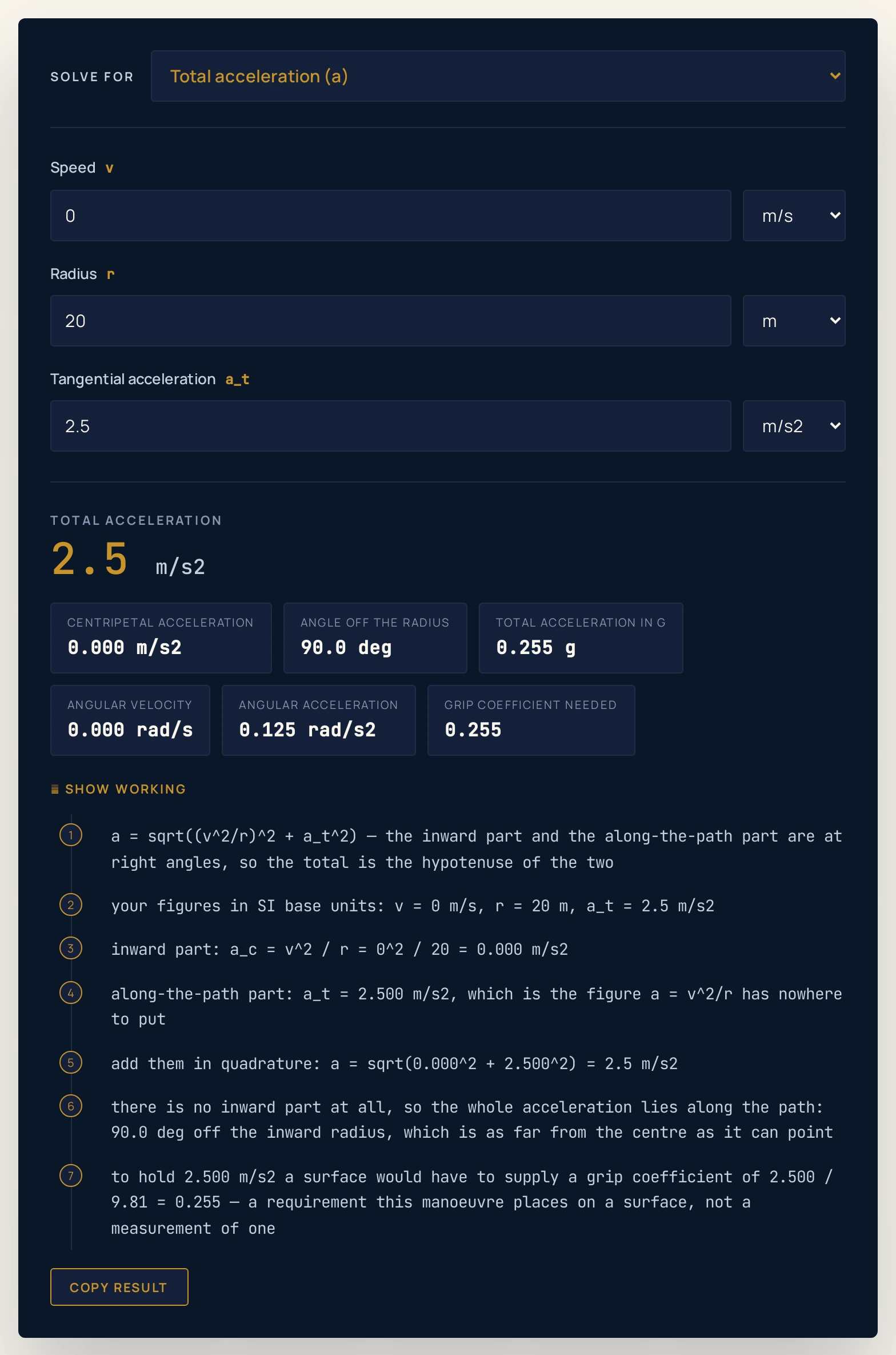
0.000 m/s2, so a = v2/r is telling the exact truth about the component it describes — the whole 2.5 m/s2 lies along the path instead, at 90.0 deg off the radius.Where the tangential acceleration calculator breaks down
The arithmetic is short and hard to get wrong. What fails is the relation being pressed onto a motion it does not describe, or a figure being carried somewhere it does not belong.
- Every reading is an instantaneous snapshot
- The four boxes describe one moment, not a journey. Tangential acceleration is the rate at which the speed is changing at this instant, and nothing on this page carries it forward: enter a braking figure and the Speed box does not fall. If you want to know where the object ends up, work the speed forward yourself and re-enter it, or treat the answer as one frame out of many.
- The radius is constant, so this is not a corner that tightens
- One Radius box covers the whole calculation, which makes this a circular arc rather than a transition curve, a clothoid or a bend that closes up part way through. A path whose radius is itself changing has a third effect these boxes cannot hold. Run such a path as several passes, each with its own radius, and read the answers as a sequence.
- Solving for the tangential acceleration loses the sign
- Put a total into the box and the answer that comes back is a size, never a direction. The relation squares the tangential term, so braking at 4.000 m/s2 and accelerating at 4.000 m/s2 produce exactly the same total and exactly the same angle, and nothing in that total records which of them happened. It is a real limit of what a total acceleration knows rather than a shortcut taken here, and the working line says so when that mode runs.
- Braking and accelerating cost the same in this model
- Because the sign never reaches the answer, the two are indistinguishable to the equation, and no reading on this page can tell them apart. Where braking mid-bend really is the classic mistake, the reason is when drivers do it and how much of it they do, not that the physics charges more for it. Do not read a larger total as evidence that braking is the worse of the two.
- The grip coefficient is a requirement, not a measurement
- The grip coefficient needed chip divides the total by 9.81 and reports the coefficient a level surface would have to supply for the manoeuvre to be possible. It describes the manoeuvre you typed and nothing else: it is not a property of any road, any tyre or any vehicle, and comparing it with a figure quoted for a named surface would be comparing a demand with a claim. Nothing on this page measures a surface, and no surface is named anywhere on it.
- Two of the chips are one quotient printed twice
- The total acceleration in g and the grip coefficient needed are both the total divided by 9.81, so they always carry identical digits. Two labels, one number, and their agreeing confirms nothing at all. The same applies to the headline and the centripetal acceleration chip, which are related by the definition of the headline, and to the angle reaching 45 deg, which is the same statement as the two components being equal.
- A level, flat path is assumed throughout
- The two components are perpendicular because the path is taken to lie in a horizontal plane with the bend's centre in that plane. On a banked, cambered or sloping path the geometry changes, gravity acquires a component along or across the path, and the grip chip stops being the right comparison. That case is a different calculation and this page will answer it without warning you that you have asked the wrong question.
- Three modes carry a domain condition, and one of them is strict
- Solving for the tangential acceleration needs a total at least as large as the inward part; solving for the speed needs a total at least as large as the tangential part; solving for the radius needs the total strictly larger, because it divides by the difference. Outside those conditions the calculator declines rather than printing a figure, and a total only a fraction above the tangential term returns a very large radius that moves very fast, so treat those answers as sensitive rather than precise.
- A stationary object has no radius to recover
- With Speed at zero the inward part is zero at every radius, so no radius fits and the Radius mode declines rather than returning nought. The other three modes are perfectly happy with a stationary object: the total is then the whole of the tangential term, at ninety degrees off the radius. It is only running the question backwards to a radius that has no answer.
- Rounded figures in, rounded figures out
- The headline carries four significant figures and the chips three decimals, except the angle off the radius, which carries one, while the arithmetic behind all of them is unrounded, so a printed component need not reproduce the printed total in its last digit. Show working is the place to look instead: it repeats the answer to as many as seven significant figures and prints every operand unrounded, so each line there can be checked exactly as it stands. Typing a rounded total back in as an input has the matching effect, which is why the presets that run backwards carry a seven-decimal figure rather than the three the chips display.
- The calculator measures nothing — you supply every figure
- Four boxes, converted to SI base units and put through one relation: that is the whole of what happens here, so an answer can only be as sound as the numbers typed above it. A headline describes your inputs and not any vehicle, surface or journey, and the presets are there to show the relation working rather than to report anything real. Verify anything you mean to rely on against your own data before you quote it.
Where tangential acceleration is actually used
- Sizing what a manoeuvre asks of a surface
- Turning and changing speed draw on the same budget of acceleration, so the honest question is not how hard the bend is or how hard the braking is but what the two together demand. Enter the speed, the radius and the braking rate, and the grip coefficient needed chip states that demand as a single number. It is a requirement to compare against whatever figure you have for the surface in front of you, and the comparison is yours to make rather than this page's.
- Designing transitions on rail and road alignments
- A curve entered at a steady speed asks for one acceleration; a curve entered while still slowing asks for that one and another at right angles to it. Alignment work therefore has to know the total rather than the inward part alone, and this page gives it in one reading. The constant radius here is the simplification to watch: a real transition changes its radius as well, so treat each answer as one point along it.
- Planning the speed of a machine tool or robot along a curved path
- A cutter or an end effector ramping its feed rate along an arc has exactly this pair of accelerations, and the limit that matters is the total rather than either one. Solving for the Speed answers the practical question directly: given the acceleration the machine may have and the rate at which the feed is ramping, how fast can it take that arc? The acceleration calculator handles the ramp on a straight path, where there is no inward part to add.
- Recovering the bend from a measurement
- If you have the total acceleration and know what the speed and the speed change were, the radius that produced them is the answer with the menu on Radius. That is what the Powering out, back to the radius case sets up: a total of 9.3814895 m/s2 at 20 m/s with 3 m/s2 along the path returns 45 m. The same mode turns a recorded acceleration trace into the arc it was taken on.
- Reading the angle before quoting a direction
- Saying that the acceleration on a bend "points at the centre" is only true while the speed is steady, and the angle off the radius chip is how far that claim is out. At 38.7 deg the acceleration is nowhere near the centre, and at a standing start it is at right angles to it. Quote the angle alongside the magnitude whenever the speed is not constant, because the magnitude on its own no longer says which way anything is pointing.
- Checking whether a constant-speed answer is good enough
- Arguing about whether a speed is steady enough gets nowhere; the calculator turns it into a subtraction. Put the real speed change into the Tangential acceleration box and compare the headline with the centripetal acceleration chip beside it. On the opening case that is 6.403 m/s2 against 5.000 m/s2, so the constant-speed figure is short by about 28 per cent of itself; halve the braking and the gap shrinks far faster than the braking does.
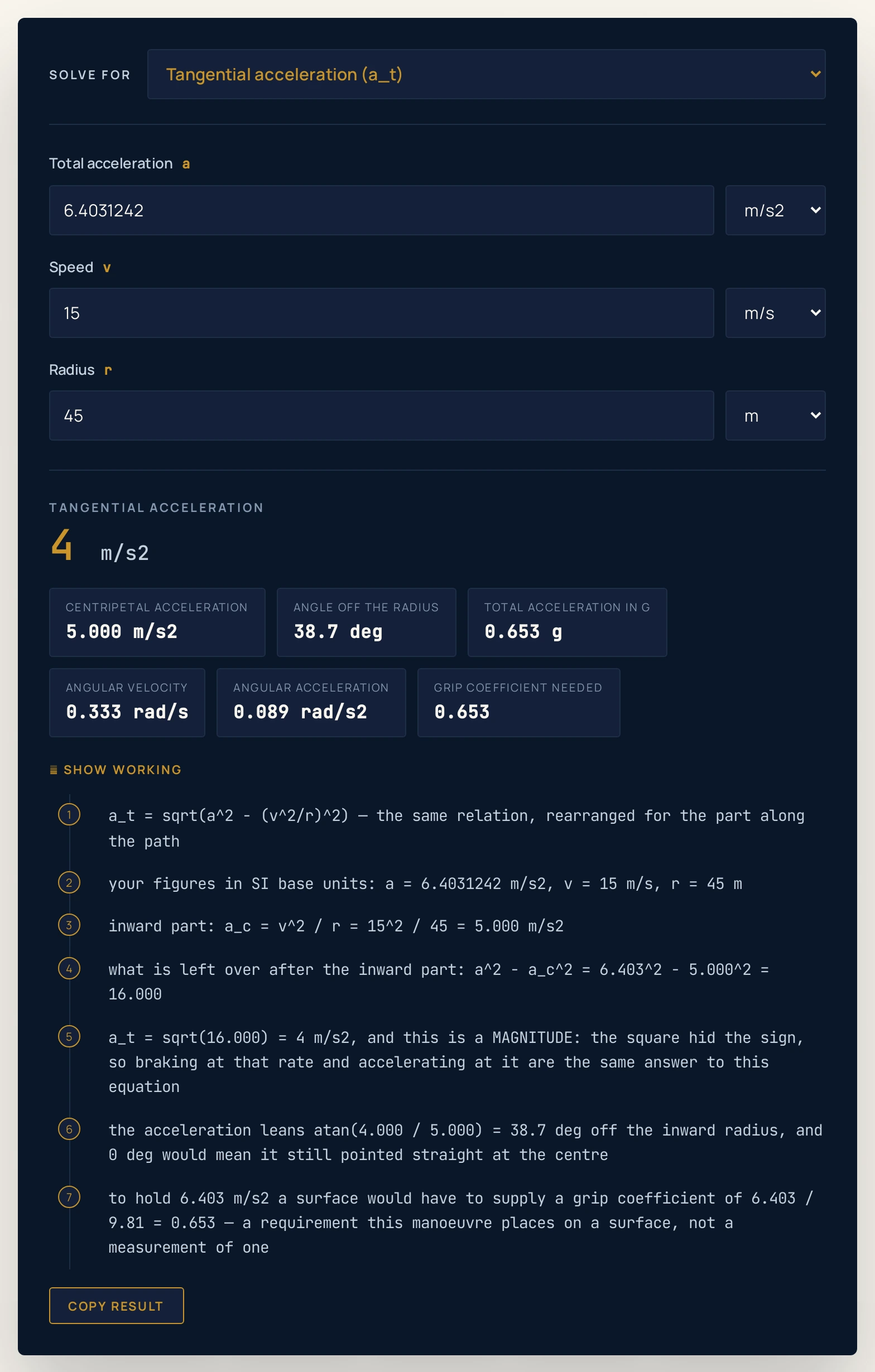
6.4031242 m/s2 at 15 m/s round a 45 m bend returns 4 m/s2. It comes back positive because the square hid the sign, so the case that produced it was braking and this answer cannot tell you that.Where to go next
For the method in full, with worked problems and the diagrams that go with them, read Tangential Acceleration: What a = v2/r Leaves Out When the Speed Changes. For the uniform world this page sits just outside — the definition, the symbol table and the three equivalent forms — Circular Motion Physics: Formula, Examples and Uses is the place to go, with the circular motion calculator beside it.
Two more are worth a bookmark. What Is Centripetal Force? separates the force from the acceleration, and the banked curve calculator covers the bend that does part of the turning for you. The whole physics lab library is open too, and the site search will find anything this page has not.
Frequently asked questions
What does the tangential acceleration calculator work out?
It works out the whole acceleration of something going round a bend while its speed is changing. Enter the speed, the radius and the tangential acceleration and it returns a = sqrt((v^2/r)^2 + a_t^2), along with the centripetal part, the angle the result leans off the inward radius, the total in multiples of gravity, the angular velocity, the angular acceleration and the grip coefficient a surface would have to supply. Move the Solve for menu and the same relation runs backwards, recovering the tangential acceleration, the speed or the radius behind a total you already know.
What is tangential acceleration?
Tangential acceleration is the part of an object's acceleration that lies along its direction of travel, which is to say how quickly its speed is changing, in metres per second squared. On a circular path it is at right angles to the centripetal acceleration, which points inward at the centre of the bend. A steady speed round a bend means the tangential acceleration is zero and the whole acceleration is the inward part; any braking or accelerating adds a second component and the total stops pointing at the centre.
Does a = v^2/r stop being correct when the speed changes?
No. It is the radial component of the acceleration and it stays exactly right about that component, whatever the speed is doing; what it is not is the whole acceleration once the speed is changing, because there is then a second component along the path that the formula has nowhere to put. This page keeps the same v^2/r and adds the missing term rather than replacing it.
Why does the calculator give the tangential acceleration without a sign?
Because the relation squares it, and the square of a negative number is the square of its positive twin. Solving backwards for the tangential acceleration therefore returns a magnitude, and braking at that rate and accelerating at it are the same answer to this equation. That is not an approximation but a real limit of the information a total acceleration carries, and it is why the Solve for a_t mode labels its result as a size rather than a direction.
Why does adding a small tangential acceleration barely change the total?
Because perpendicular quantities add in quadrature, not end to end. On an inward part of 7.000 m/s2, adding 1.000 m/s2 along the path raises the total to 7.0711 m/s2, which is one per cent larger, while adding 5.000 m/s2 raises it to 8.6023 m/s2, which is nearly twenty-three per cent larger. The first slice is almost free and the later ones are not, which is a property of the square root rather than anything about tyres or roads.
What is the angle off the radius telling me?
It is how far the total acceleration has swung away from pointing straight at the centre of the bend. Zero degrees means the speed is steady and the acceleration is purely inward; ninety degrees means there is no inward part at all, which happens at a standing start. Forty-five degrees means the two components are exactly equal, and that is a restatement of the two components rather than an independent finding about them.
What is the grip coefficient needed chip?
It is the total acceleration divided by 9.81, which is the coefficient a level surface would have to supply for the manoeuvre to be possible at all. It is a requirement this manoeuvre places on a surface and never a measurement of one, so it should not be compared with a figure quoted for any particular road, tyre or vehicle. It is also the same quotient as the total acceleration in g chip, printed a second time under a different reading.
Why is the angle undefined when nothing is moving?
Because with no speed and no change of speed there is no acceleration at all, and a direction that does not exist cannot be reported. JavaScript would hand back zero degrees for that case, which is a plausible-looking lie, so the chip prints the word undefined instead. Set either the speed or the tangential acceleration to something other than zero and a real angle appears.
What units does the calculator take?
The total acceleration and the tangential acceleration take metres per second squared or multiples of standard gravity, the speed takes metres per second or kilometres per hour, and the radius takes metres or kilometres. Everything is converted to SI base units before any arithmetic happens, and the second line of Show working restates your figures in those units. The value of standard gravity used on this page is 9.81 m/s2.
Why does solving for the radius refuse some numbers the other modes accept?
Because that mode divides by the inward part it has just worked out, and a total acceleration exactly equal to the tangential acceleration leaves an inward part of zero. There is then no radius that fits rather than an infinitely large one worth printing, so the calculator declines instead. Raise the total a fraction above the tangential figure and it answers again, with a radius that grows very fast as the two close up.
References & formula source
- Young & Freedman, University Physics with Modern Physics, the sections on motion in a circle and on the dynamics of circular motion, where the acceleration of a particle on a curved path is resolved into a component along the path and a component towards the centre.
- Halliday, Resnick & Walker, Fundamentals of Physics, the chapters on motion in two dimensions and on force and motion, for non-uniform circular motion and for the tangential and radial components of an acceleration.
- The grip coefficient needed chip uses the standard idealisation in which one budget of acceleration is shared between turning and changing speed. That is a model rather than a measurement: no coefficient anywhere on this page describes a real surface, tyre or vehicle, and none should be quoted as if it did.
- Every figure quoted in the text above is a string this calculator printed for the inputs named beside it, or a constant the page states. Standard gravity is taken as 9.81 m/s2 throughout, and the same value is used by the total acceleration in g chip and the grip coefficient needed chip.
- Further reading: Circular motion#Non-uniform circular motion — Wikipedia