Electronvolt (eV): the energy a charge of one electron gains crossing a potential difference of one volt, E = qV. This free tool converts an accelerating voltage into energy in electronvolts and joules, or works back to the voltage, and shows every step.
What Is the Volt to eV Calculator?
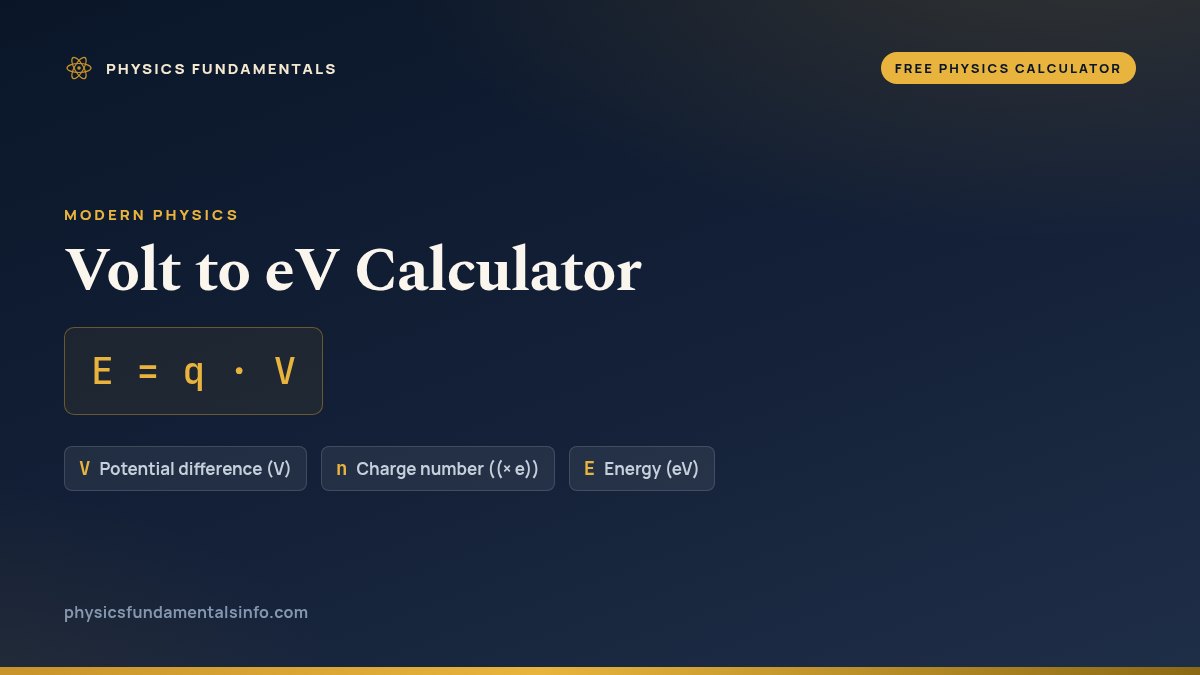
The volt to eV calculator is a free online tool built on the formula E = q · V. Enter the values you already know, in whichever units suit you, and it solves for energy in eV/joules, or accelerating voltage and shows every step of the substitution. Volt to eV is convert accelerating voltage to electronvolts and joules, E = qV.
| Symbol | Quantity | Default unit | Also accepts | Example value |
|---|---|---|---|---|
| V | Potential difference | V | kV, MV | 1000 |
| n | Charge number | (× e) | — | 1 |
| E | Energy | eV | keV, MeV, GeV, J | — |
How to convert volts to electronvolts
The energy a charge gains crossing a potential difference is E = qV. For a single elementary charge, the energy in electronvolts is numerically equal to the voltage in volts, so an electron accelerated through 1000 V gains 1000 eV. This one-to-one match is what makes the electronvolt so handy for charged particles.
Using the calculator is straightforward. Set the charge number n (1 for an electron or proton, 2 for an alpha particle), enter the voltage, and read the energy in eV, keV, MeV, GeV or joules. To get the energy in joules, multiply the eV value by 1.602176634×10⁻¹⁹, the elementary charge in coulombs. The worked steps show the formula, your numbers substituted in, and the result with units.
The same tool runs in reverse: choose to solve for the voltage and enter an energy, and it divides by n · e to return the accelerating voltage that would produce it. For the energy carried by light rather than a charged particle, see the photon energy calculator; for the voltage itself, see the potential difference calculator or the physics glossary.
Worked example
An electron (n = 1) accelerated through 1000 V gains E = 1000 eV = 1 keV = 1.602×10⁻¹⁶ J. Across a 12 V battery the same electron gains just 12 eV — a reminder of how small everyday voltages are on the atomic scale. An alpha particle (n = 2) sent through the same 1000 V picks up twice as much, 2000 eV, because it carries two elementary charges.
Why it matters
The electronvolt is the natural energy unit of atomic, nuclear and particle physics. Hydrogen's ionization energy is 13.6 eV, silicon's band gap is about 1.1 eV, X-ray tubes run at tens of keV, and accelerators reach GeV to TeV. Working in electronvolts keeps these numbers convenient instead of writing tiny fractions of a joule. The same idea sets the energy scale of the photoelectric effect, where a few electronvolts of photon energy free electrons from a metal.
Frequently asked questions
What is an electronvolt?
An electronvolt (eV) is the energy one elementary charge gains moving through a potential difference of one volt. It is a tiny unit of energy: 1 eV = 1.602176634 x 10^-19 J. Because it is matched to a single electron charge crossing one volt, it is far more convenient than the joule for atomic and particle physics.
Why does V volts give V electronvolts?
Because for a single electron charge the energy E = qV, measured in electronvolts, is numerically equal to the voltage in volts. The charge unit (one elementary charge) and the energy unit (the electronvolt) are matched by definition, so an electron accelerated through 1000 V gains exactly 1000 eV.
How do I convert eV to joules?
Multiply the number of electronvolts by 1.602176634 x 10^-19, the elementary charge in coulombs. For example 1 keV = 1000 eV = 1.602 x 10^-16 J, and 1 MeV = 1.602 x 10^-13 J. To go back from joules to eV, divide by the same factor.
What about particles with more than one charge?
The energy scales with the charge number n. An alpha particle carries two elementary charges (n = 2), so it gains twice the electronvolts of an electron for the same voltage — an alpha through 1000 V gains 2000 eV. Set n in the calculator to match the particle.
What do keV, MeV and GeV mean?
They are the electronvolt scaled by kilo (10^3), mega (10^6) and giga (10^9). X-ray tubes work at keV energies, nuclear decays release MeV-scale energies, and particle colliders reach GeV and TeV, where 1 TeV is a trillion electronvolts.
References & formula source
- Halliday, Resnick & Walker — Fundamentals of Physics, Chapter 24 (Electric Potential).
- Young & Freedman — University Physics with Modern Physics, §23.2 (Electric Potential Energy).
- NIST CODATA — elementary charge e = 1.602176634 x 10^-19 C (exact, SI 2019).
- Further reading: Electronvolt — Wikipedia