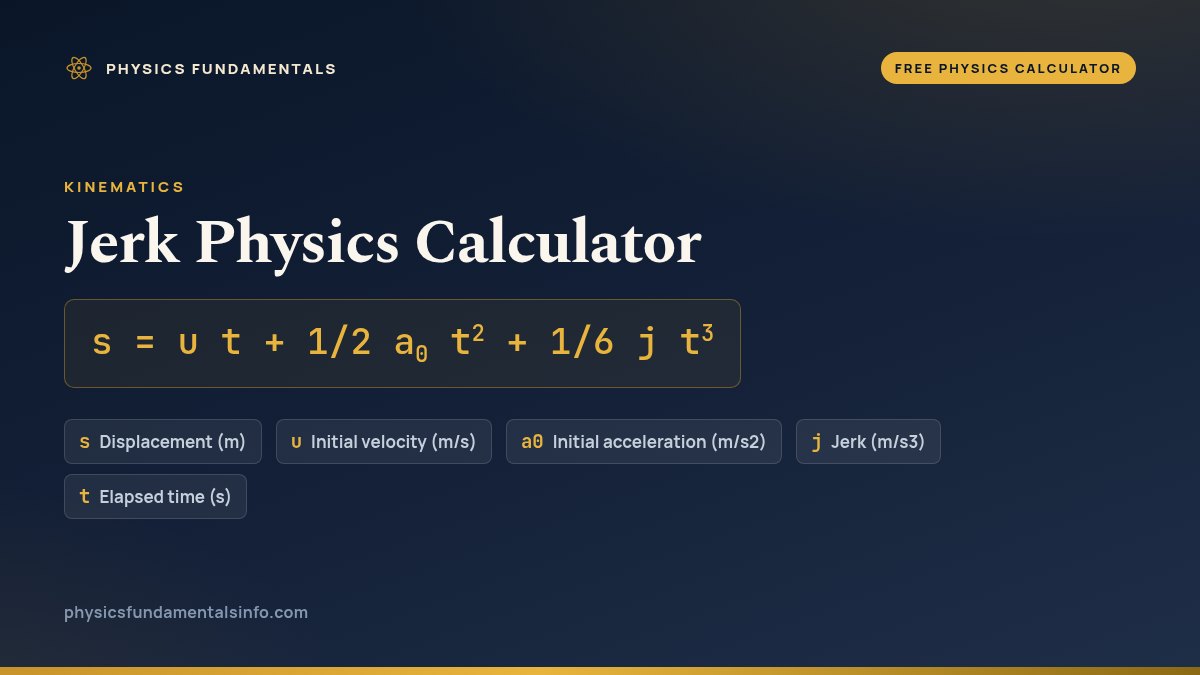
Jerk is the rate at which an acceleration is changing, measured in metres per second cubed, and it is what the familiar displacement formula has nowhere to put. This free jerk physics calculator solves s = u t + 1/2 a0 t^2 + 1/6 j t^3 four ways — for the displacement itself, or for the jerk, the initial acceleration or the initial velocity behind it. Beside the answer it prints the final velocity, the final acceleration, the mean acceleration, what a constant-acceleration equation would have said, the term that equation drops and the trapezium estimate.
Load a real case
Each button puts the Solve for menu on the unknown that case is asking about, sets every unit menu the case names, and fills the remaining boxes. Whatever the widget then works out is read back into the line underneath, so nothing there is stored text. A jerk taken from a published figure is what earns the three lift buttons their plain names; the other three run on invented numbers picked to make a point rather than measured off any real vehicle, and the "-like" in each of those names is there to say so.
Pick a case above, or type your own numbers.
What Is the Jerk Physics Calculator?
The jerk physics calculator is a free online tool for how far something travels while its acceleration is still changing, jerk being the rate at which an acceleration changes, in metres per second cubed. Enter the initial velocity, the initial acceleration, the jerk and the elapsed time for s = u t + 1/2 a0 t2 + 1/6 j t3 in metres, or move the Solve for menu and the same relation runs backwards for the jerk, the initial acceleration or the initial velocity behind a displacement you already know. Beside the answer it prints the final velocity, the final acceleration, the mean acceleration, the trapezium estimate, what a constant-acceleration equation would have given and the term that equation drops, 1/6 j t3.
| Symbol | Quantity | Default unit | Also accepts | Example value |
|---|---|---|---|---|
| s | Displacement | m | km | 40 |
| u | Initial velocity | m/s | km/h | 0 |
| a0 | Initial acceleration | m/s2 | g | 3 |
| j | Jerk | m/s3 | — | 1.5 |
| t | Elapsed time | s | min | 4 |
How to use the jerk physics calculator
- Choose the unknown. The Solve for menu opens on Displacement. The other three choices are Jerk, Initial acceleration and Initial velocity, and whichever you pick vanishes from the boxes below.
- Type the initial velocity. Initial velocity is how fast the body was already going when the clock started, in m/s or km/h. Leave it at zero for anything starting from rest; its term is the only one that grows in simple proportion to the time.
- Type the initial acceleration. Initial acceleration is the acceleration at the very start, in m/s2 or multiples of g, and it is the single figure a constant-acceleration equation would use for the whole interval. Setting it to zero means the body is not yet pulling at all.
- Type the jerk. Jerk is how fast that acceleration is changing, in m/s3, and it is the box that makes this page different from every other kinematics tool here. Positive values make the acceleration climb through the interval and negative ones bring it back down.
- Set the elapsed time. Elapsed time is the length of the interval the jerk is held over, in s or min, and it is an input in every mode rather than an answer. It is also the most powerful box on the page, because the term the constant-acceleration formula drops grows as the cube of it.
- Read the answer and the chips. The headline is the quantity you asked for, to four significant figures. The chips give the final velocity, the final acceleration, the mean acceleration, what SUVAT would have said, the term SUVAT drops and the trapezium estimate.
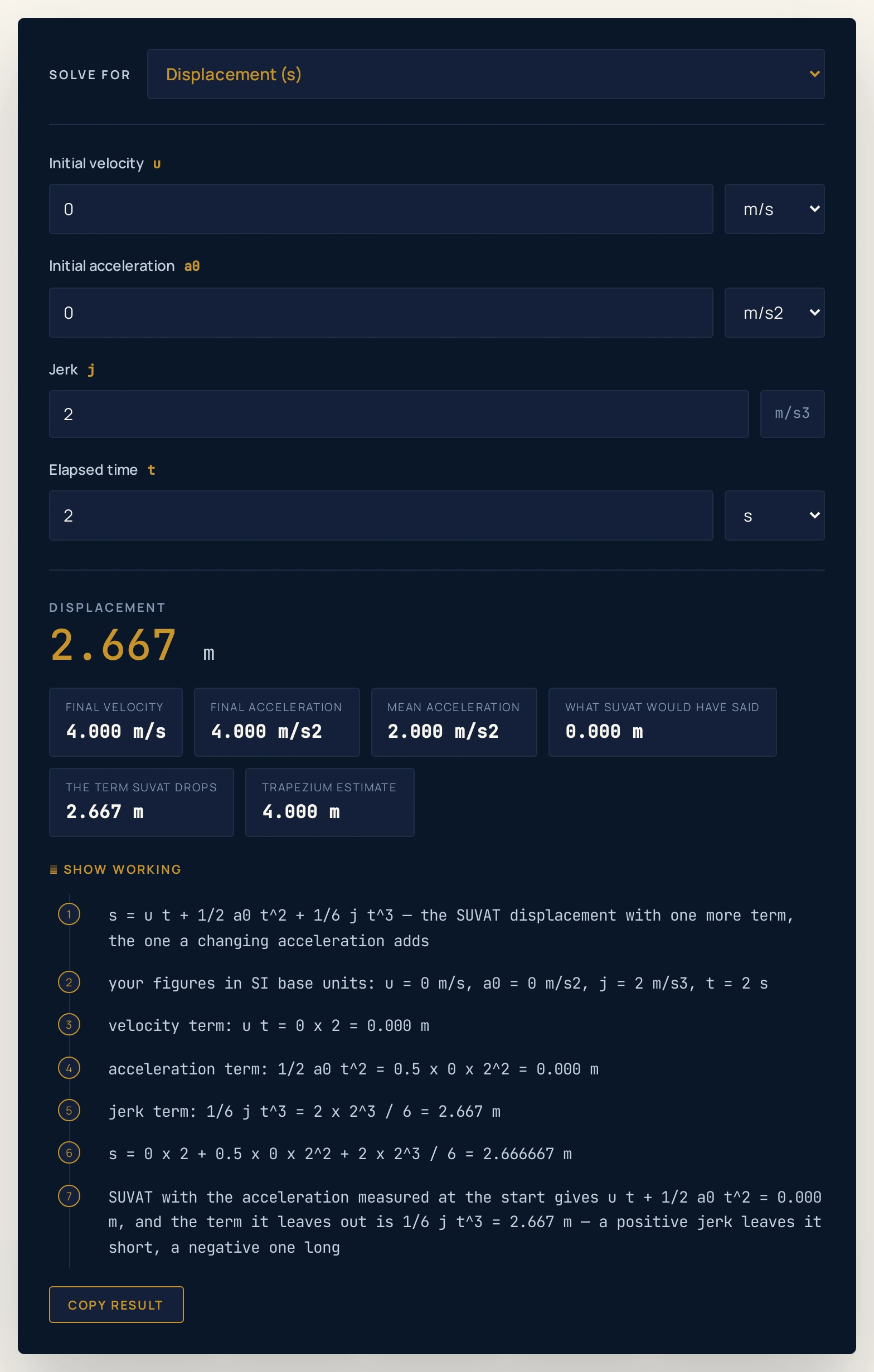
- Compare the answer with the SUVAT chip. On the opening case the chip reads 24.000 m against an answer of 40 m, so a constant-acceleration equation misses 16.000 m of the forty. Load Lift, acceptable jerk and the chip reads 0.000 m against 2.667 m, which is the comparison this page exists for.
- Open Show working. The steps restate the relation, list your figures in SI base units whatever the menus say, and then print the three terms separately. Seeing 1 min come back as 60 s in that second line is the quickest way to see what the conversion did.
This page starts where a constant-acceleration tool stops. For the five equations themselves, the symbol table and the rule that the acceleration must hold still, the guide to the SUVAT equations covers all of it and this page assumes it. The SUVAT calculator is the right tool whenever that rule holds, and it has no box for a jerk because it does not need one.
That guide also gives the correct practical fix when an acceleration changes: split the motion into stages that each hold their own. Nothing here contradicts it, and for a stepped or irregular acceleration it is still the right answer. What this page adds is the one case where no splitting is needed, because the acceleration ramps at a steady rate and the whole interval closes in a single term.
Two mistakes account for most wrong answers here, and both are about which acceleration was typed. The first is entering the acceleration measured at the end of the interval in the Initial acceleration box, which overshoots rather than undershoots; the final acceleration chip tells you what that figure should have been. The second is a time typed in minutes while the menu still reads seconds, which the second line of Show working will always catch.
A third is subtler, because the box takes the figure without complaint. If the acceleration you have is an average between two velocities rather than the value it started at, the guide to acceleration in physics sets out the difference, and the acceleration calculator is the tool that works that average out.
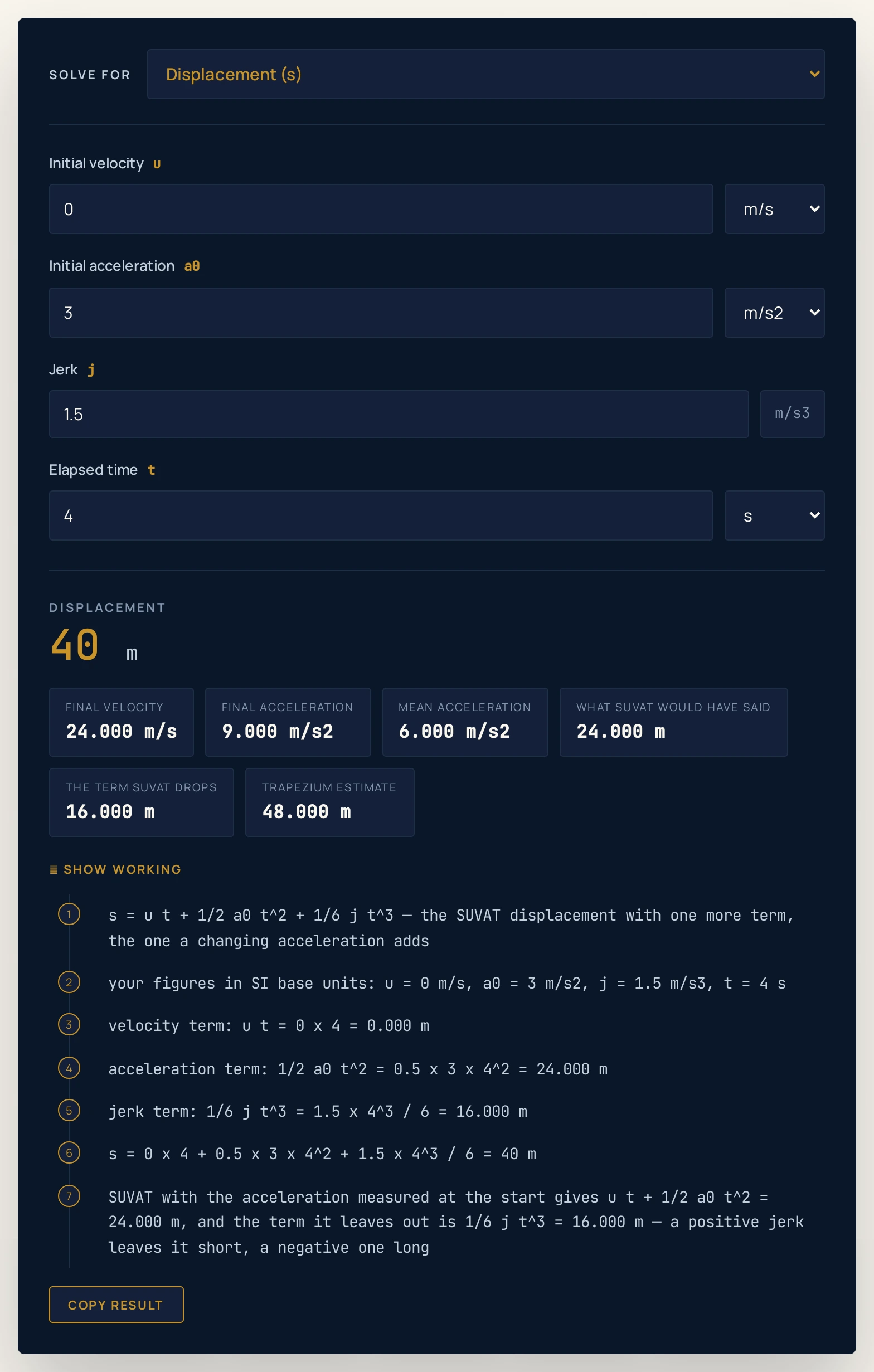
16.000 m chip and the gap between the 40 m answer and the 24.000 m SUVAT chip are the same subtraction printed twice — a convenience, not a second check on either.Worked example: change one thing at a time
The table starts at the defaults and moves one thing at a time: which quantity is the unknown, then the case, then the jerk, then the time, then the unit the figures are typed in. Every Result cell was read out of the running widget rather than worked out by hand, so where a cell and the tool ever part company, believe the tool. The input column is simply what you type, in the order the boxes appear.
| Step | Solving for | Case | What you type | Result | What SUVAT would have said |
|---|---|---|---|---|---|
| The page as it opens | Displacement | Car pulling away-like | 0 m/s, 3 m/s2, 1.5 m/s3, 4 s | 40 m | 24.000 m |
| Feed that answer back | Jerk | Car pulling away-like | 40 m, 0 m/s, 3 m/s2, 4 s | 1.5 m/s3 | 24.000 m |
| and again, for the start | Initial acceleration | Car pulling away-like | 40 m, 0 m/s, 1.5 m/s3, 4 s | 3 m/s2 | 24.000 m |
| and for the velocity | Initial velocity | Car pulling away-like | 40 m, 3 m/s2, 1.5 m/s3, 4 s | 0 m/s | 24.000 m |
| A lift on the rated jerk | Displacement | Lift, acceptable jerk | 0 m/s, 0 m/s2, 2 m/s3, 2 s | 2.667 m | 0.000 m |
| The hospital figure instead | Displacement | Lift, hospital limit | 0 m/s, 0 m/s2, 0.7 m/s3, 2 s | 0.9333 m | 0.000 m |
| The rated intolerable jerk | Displacement | Lift, intolerable jerk | 0 m/s, 0 m/s2, 6 m/s3, 2 s | 8 m | 0.000 m |
| That last one, backwards | Jerk | Lift, intolerable jerk | 8 m, 0 m/s, 0 m/s2, 2 s | 6 m/s3 | 0.000 m |
| A negative jerk instead | Displacement | Ramp onto a cruise-like | 5 m/s, 2 m/s2, -0.5 m/s3, 4 s | 30.67 m | 36.000 m |
| Braking, back to the velocity | Initial velocity | Braking to a stop-like | 53.33333 m, -2 m/s2, -1 m/s3, 4 s | 20 m/s | 64.000 m |
| Set the jerk to zero | Displacement | Car pulling away-like | 0 m/s, 3 m/s2, 0 m/s3, 4 s | 24 m | 24.000 m |
| Double the time | Displacement | Car pulling away-like | 0 m/s, 3 m/s2, 1.5 m/s3, 8 s | 224 m | 96.000 m |
| Velocity typed in km/h | Displacement | a steady 72 km/h | 72 km/h, 0 m/s2, 0 m/s3, 4 s | 80 m | 80.000 m |
| Acceleration typed in g | Displacement | one g, no jerk | 0 m/s, 1 g, 0 m/s3, 2 s | 19.61 m | 19.613 m |
| Time typed in minutes | Displacement | Lift, acceptable jerk | 0 m/s, 0 m/s2, 2 m/s3, 1 min | 72000 m | 0.000 m |
| A time of zero | Displacement | nothing at all | 0 m/s, 3 m/s2, 1.5 m/s3, 0 s | no answer | — |
Rows 1 to 4 are one state read four different ways. Each answer returns the figure the row above it started from, so the displacement gives back the jerk, then the initial acceleration, then the initial velocity. Four unknowns, one relation, and no arrangement more fundamental than another.
That round trip is the genuine check on this page, and it is worth saying why the last column is not. In row 1 the answer is the SUVAT figure plus the dropped term, so the two agreeing is the relation restated. Rows 2 to 4 do different arithmetic in the other direction and still land on 1.5 m/s3, 3 m/s2 and 0 m/s, which is a claim that can fail.
Rows 5 to 7 are the demonstration this page exists for, and they are not a contrived case. All three start from rest with no acceleration either, so both terms a constant-acceleration equation keeps are zero and it predicts the lift never moves. The lift has in fact risen 2.667 m, 0.9333 m and 8 m; state that in metres, because dividing by the 0.000 m in the last column is a division by zero rather than a percentage.
Those three rows share an initial velocity, an initial acceleration and a time and differ only in the jerk, so their displacements stand in exactly the ratio of their jerks. That is arithmetic rather than a finding, and it is worth noticing only because it makes the third term's role obvious. Row 8 runs the last of them backwards and recovers 6 m/s3 from the 8 m it produced.
Rows 9 and 10 turn the sign around. A negative jerk brings the acceleration down through the interval, so the constant-acceleration figure overshoots instead: 36.000 m against a true 30.67 m for the cruise-like ramp. Row 10 recovers 20 m/s from a braking-like case in which both the acceleration and the jerk are negative.
Rows 11 and 12 are the two ends of the argument. Set the jerk to zero and the answer falls to the SUVAT figure exactly, which is a definition rather than a discovery; double the time and the dropped term climbs from 16.000 m to 128.000 m, which is eight times as much for twice the clock. Rows 13 to 16 are the edges — 72 km/h and 1 g come back as the same answers their SI equivalents give, one minute of the rated acceptable jerk reaches 72000 m, and a time of zero is refused rather than answered.
Formula and symbol reference
The calculator uses one relation in four arrangements. The displacement is s = u t + 1/2 a0 t2 + 1/6 j t3, so the jerk is j = 6 (s - u t - 1/2 a0 t2) / t3, the initial acceleration is a0 = 2 (s - u t - 1/6 j t3) / t2 and the initial velocity is u = (s - 1/2 a0 t2 - 1/6 j t3) / t.
Each of those four appears linearly, which is why each has exactly one answer and why all four are on the Solve for menu. The elapsed time does not: it appears as a cubic, and a cubic has up to three real roots with no honest way for a calculator to choose between them. That is the reason the time is an input in every mode, and it is a limitation worth stating rather than hiding.
| Symbol | Meaning | SI unit | Values used on this page |
|---|---|---|---|
| s | Displacement over the interval: how far the body has moved from where it started, and the quantity this page opens on. It is a signed figure, not a distance travelled | metre, m | Boxes take m or km: 40 m on the opening case, 2.667 m for the lift at the rated acceptable jerk, 53.33333 m typed back in to recover the braking velocity. |
| u | Initial velocity: how fast the body was already moving when the clock started. Its term grows only in proportion to the time, which is why it dominates over a short interval | metre per second, m/s | Boxes take m/s or km/h: 0 for the three lift cases and the opening one, 5 m/s for the cruise-like ramp, 20 m/s for the braking-like case, 72 km/h in the unit row. |
| a0 | Initial acceleration: the acceleration at the very start of the interval, which is the single figure SUVAT would hold constant across all of it | metre per second squared, m/s2 | Boxes take m/s2 or g: 3 on the opening case, 0 for the three lift cases, 2 for the cruise-like ramp, -2 for the braking-like case, 1 g in the unit row. |
| j | Jerk, the rate at which the acceleration itself is changing. Constant across the interval here, and the one box no other kinematics calculator on this site has | metre per second cubed, m/s3 | One fixed unit, m/s3: 2, 0.7 and 6 for the three lift cases, 1.5 on the opening case, -0.5 and -1 for the two cases that ease off. |
| t | Elapsed time: the length of the interval the jerk is held over. The one box that is never the unknown, because recovering it would mean solving a cubic with up to three real roots | second, s | Boxes take s or min: 4 s on the opening case, 2 s throughout the lift cases, 8 s in the row that doubles it, 1 min in the unit row. |
| v | Final velocity, u + a0 t + 1/2 j t^2. Printed as a chip rather than typed, and on the cruise-like ramp it is the reading that shows the acceleration has just reached zero | metre per second, m/s | Computed, never typed: 24.000 m/s on the opening case, 4.000, 1.400 and 12.000 m/s for the three lift cases, 9.000 m/s for the cruise-like ramp. |
The physics: the one term a constant acceleration has nowhere to put
Write the position as a series about the start of the interval and the first term is the initial velocity times the time, the second is half the initial acceleration times the time squared, and the third is a sixth of the jerk times the time cubed. A constant-acceleration equation keeps the first two and has no third. That is not a flaw in it; it is what "constant acceleration" means.
When the jerk really is constant, that third term is not an approximation either. The series stops there, because the fourth derivative of the position is zero, so s = u t + 1/2 a0 t2 + 1/6 j t3 is exact for this motion rather than a better estimate of it. The chips beside the answer are then exact too, which is why the final acceleration chip reads a flat 0.000 m/s2 on the cruise-like ramp.
Three terms, three different growth rates — that is the whole of the practical argument. The velocity term grows as the time, the acceleration term as its square, and the dropped term as its cube. Over a short interval the third is negligible; double the interval and it multiplies by exactly eight, which the table above shows as 16.000 m becoming 128.000 m.
There is an exact moment when the dropped term catches the one a constant-acceleration equation keeps: the jerk term equals the acceleration term at t = 3 a0 / j. On the opening case that is 6 s, and the calculator is set to 4 s, which is why the 16.000 m chip is already two thirds of the 24.000 m one. The companion crossover with the velocity term is at t = sqrt(6 u / j).
Neither of those is a universal constant, and it matters that no page treats them as one. Each depends on the other two figures you typed, so "the time when SUVAT stops working" is not a number that exists. The honest statement is that for these inputs the two terms are equal at that moment, and you can watch the 16.000 m chip pass the 24.000 m one by typing a larger time.
The trapezium estimate chip is there because it is the repair most people reach for and it is not safe here. Half the sum of the starting and finishing velocities, times the time, is exactly what a constant-acceleration equation gives if you feed it the mean acceleration chip — one formula wearing two names — and both are long by a twelfth of the jerk times the time cubed. The reason is visible on a velocity-against-time graph: when the acceleration ramps, that line is a parabola, and a trapezium cannot measure the area under a parabola.
That area is the displacement, which is the method the guide to motion graphs already teaches and which remains correct here. It is only the straight-line shortcut for evaluating it that breaks, and the motion graphs simulator is the place to see the straight version of that line before this page bends it.
Where the jerk physics calculator breaks down
The arithmetic is short and hard to get wrong. What fails is the relation being pressed onto a motion it does not describe, or a published figure being carried somewhere it does not belong.
- Constant jerk is itself an idealisation
- The Jerk box holds one number for the whole of Elapsed time, and in real motion that number moves as well. Past the cubic term the page computes there is a quartic one, the fourth derivative of position divided by twenty-four and multiplied by the time to the fourth power, and no box here will take it. So every answer is one term further on than a constant-acceleration result rather than a final one, exact only where the jerk you typed really does hold steady, and the longer the interval you ask for the further out it will sit.
- One set of boxes covers one ramp
- The five fields describe a single interval over which one jerk applies, so a journey that changes character part way through is not one sum on this page. Run it as two or three passes: read the final velocity and final acceleration chips off the first stage, type them in as the second stage's starting figures, and add the displacements yourself. All the page spares you is the splitting a steadily ramping acceleration would otherwise need.
- The model is one-dimensional
- There is one Displacement box and no direction to go with it, so the answer is a signed position change along one line and not a distance covered. Something that travels out and returns is entitled to a small figure here. Motion that also turns has a jerk with components these boxes cannot hold, and nothing on the page will warn you that you have typed one.
- The published rail figures are lateral, not longitudinal
- A high-speed rail design range of 0.2 to 0.6 m/s3 describes the jerk caused by track curvature changing under a train, which acts across the direction of travel. This page's model runs along the direction of travel, so those numbers belong in the conversation as the magnitude engineers design to and not in the jerk box.
- The lift figures are rated jerks, not ride profiles
- Press Lift, intolerable jerk and that rated figure, held across the whole two seconds the case asks for, arrives at 12 m/s2 and 12 m/s — around forty-three kilometres an hour straight up, which is not what any lift in service does. A real machine spends a fraction of a second ramping its acceleration and then keeps it there, so for most of a ride the honest entry in the Jerk box would be zero. Take what the three lift buttons return as the arithmetic of a rated jerk held far longer than anybody holds it.
- No standard sets a jerk limit for lifts
- ISO 8100-34 is a measuring standard rather than a limiting one: what it fixes is the method by which a lift's ride quality is recorded — jerk among acceleration, vibration and noise — and it does not specify acceptable levels, or unacceptable ones either. So the 2, 6 and 0.7 m/s3 the preset buttons drop into the Jerk box are reported passenger ratings and one hospital recommendation, with nothing official beneath them. This page can tell you what any of the three does over your interval; it cannot tell you whether a standard permits it.
- Two of the chips are the same subtraction, and two are the same formula
- The term SUVAT drops and the gap between the answer and the SUVAT chip are one calculation printed twice, so their agreeing confirms nothing. The trapezium estimate and a constant-acceleration equation fed the mean acceleration chip are likewise one formula under two names. Watching the answer drop onto the SUVAT figure once the jerk is set to zero is a definition, not a test.
- The elapsed time is never the answer
- Ask how long something took and the relation becomes a cubic with up to three real roots, more than one of which can be physically sensible. Rather than choose one silently, this page leaves the time as an input in all four modes. If you need it, sweep the time box and watch the displacement chip cross the figure you are aiming at.
- Rounded figures in, rounded figures out
- The headline carries four significant figures and the chips three decimals, while the arithmetic behind both is unrounded, so the printed terms need not agree with the printed total in their last digit. Show working is the place to look instead: it repeats the answer to as many as seven significant figures and pads none of them, so the hospital case reads 0.9333333 there against a headline of 0.9333, while the opening case prints a plain 40 in both places. Typing a rounded displacement back in as an input has the matching effect, and the jerk that comes out sits a little off the one the case began with.
- The calculator measures nothing — you supply every figure
- Five boxes, converted to SI base units and put through one relation: that is the whole of what happens here, so an answer can only be as sound as the numbers typed above it. A headline describes your inputs and not any lift, vehicle or journey, and the presets are there to show the relation working rather than to report a real machine. Verify anything you mean to rely on against your own data before you quote it.
Where jerk is actually used
- Judging lift ride quality
- Passenger comfort in a lift is governed by how quickly the acceleration changes rather than by how large it gets, which is why jerk has its own reported figures at all: a vertical jerk of 2 m/s3 is reported as acceptable to most passengers and 6 m/s3 as intolerable, with 0.7 m/s3 recommended for hospitals. Load the three lift cases to see what each of those does to two seconds of travel: 2.667 m, 8 m and 0.9333 m respectively.
- Shaping transition curves on rail and road
- A curve that begins abruptly forces a step change in sideways acceleration, so track and carriageway alignments use a transition whose curvature builds gradually and whose design target is a jerk rather than an acceleration. Published design ranges for high-speed rail run from 0.2 to 0.6 m/s3, measured across the direction of travel rather than along it, so they set the magnitude engineers work to rather than a number to type into this page.
- Turning a measured acceleration ramp into a jerk
- If you know how far something moved and what it started from, the jerk that produced it is the answer this page gives with the Solve for menu on Jerk. That is exactly what the Lift, hospital limit, back to the jerk case sets up: a rise of 0.9333333 m in two seconds from rest returns 0.7 m/s3. The same mode turns a recorded stopping distance into the rate at which the braking was eased off.
- Sizing the error before trusting a constant-acceleration answer
- Arguing about whether an acceleration is constant enough gets nowhere; the calculator turns it into a subtraction. Put the interval you actually care about in Elapsed time and read the term SUVAT drops beside the headline, because that chip is the whole of what a constant-acceleration equation would miss, in metres. On the opening case it prints 16.000 m against an answer of 40 m, so the shortcut is out by well over a third; shorten the interval and the chip falls away far faster than the answer does.
- Recovering the state a stage began in
- A journey broken into stages leaves you knowing where each stage ended but not always what it began with. With the menu on Initial velocity or Initial acceleration, the same relation runs backwards and hands that starting figure back, which is what the two cases named "back to the start" and "back to the velocity" demonstrate. Both are ordinary uses of the tool rather than special cases.
- Reading the final acceleration chip before quoting an acceleration
- When the acceleration is ramping there is no single value of it, so a figure quoted without saying when it was measured is ambiguous. The chips give you all three at once: the value you typed at the start, the final acceleration at the end of the interval, and the mean acceleration between them. On the opening case those are 3, 9.000 and 6.000 m/s2, and quoting the wrong one of the three is the commonest way to get a wrong answer out of a right equation.
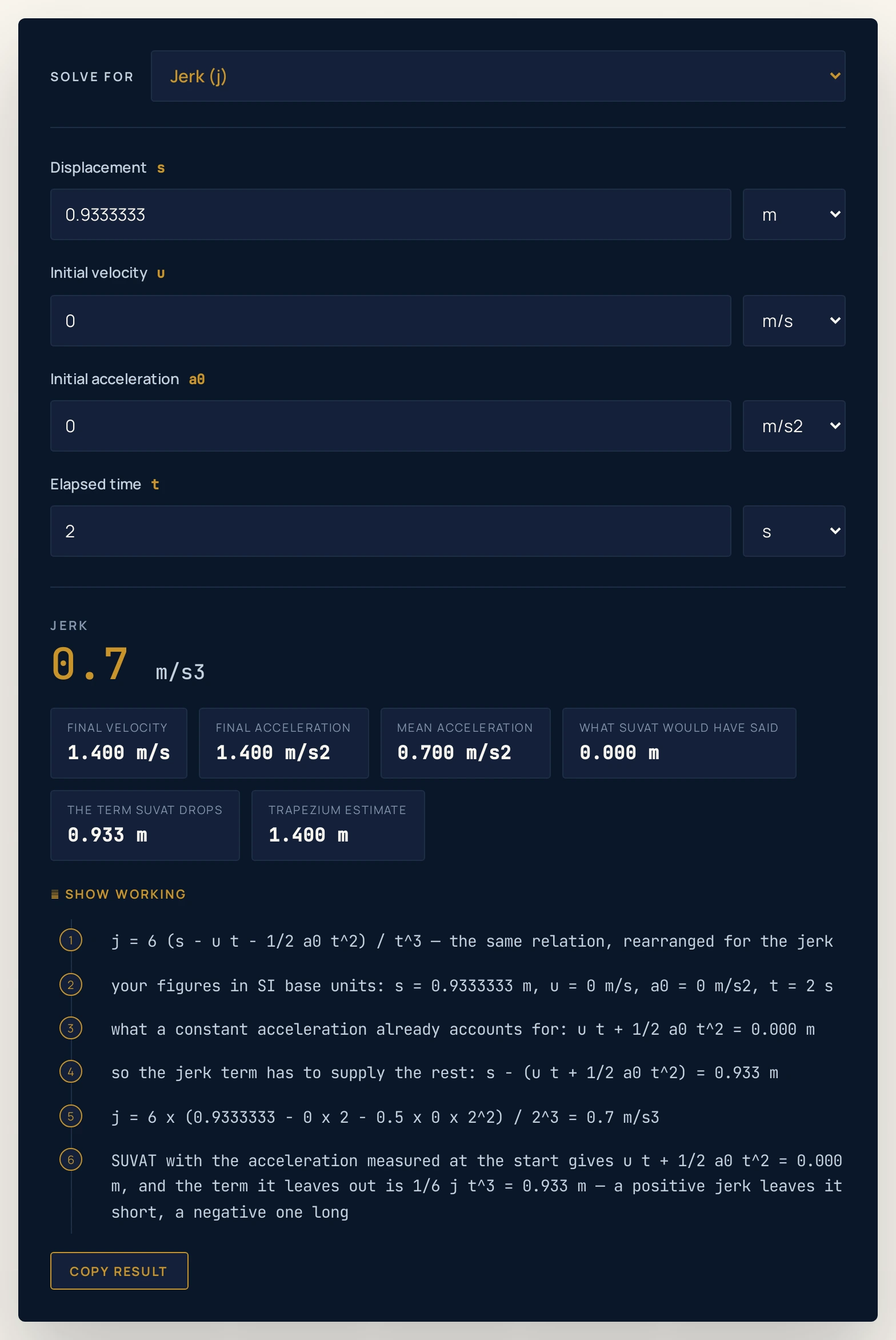
0.9333333 m in two seconds from rest returns 0.7 m/s3. Typing the displacement back as the rounded 0.9333 m the headline carries returns 0.7 as well, but a shorter figure than that will not.Where to go next
For the method in full, with worked problems and the diagrams that go with them, read Jerk in Physics: Displacement When Acceleration Changes. For the constant-acceleration world this page sits just outside — the five equations, the symbol table and the rule that decides which one to use — What Are the SUVAT Equations? is the place to go, with the SUVAT calculator beside it.
Two more are worth a bookmark. The acceleration calculator handles a mean acceleration on its own, and Motion Graphs in Physics covers the area rule this page leans on. The whole physics lab library is open too, if you would rather watch a curve than type one.
Frequently asked questions
What does the jerk physics calculator actually work out?
It works out how far something travels when its acceleration is changing at a steady rate rather than holding still. Enter the initial velocity, the initial acceleration, the jerk and the elapsed time and it returns s = ut + 1/2 a0 t^2 + 1/6 j t^3, along with the final velocity, the final acceleration, the mean acceleration, the figure SUVAT would have given and the trapezium estimate. Move the Solve for menu and the same relation runs backwards, recovering the jerk, the initial acceleration or the initial velocity behind a displacement you already know.
What is jerk in physics?
Jerk is the rate at which acceleration changes, so it is to acceleration what acceleration is to velocity. Its SI unit is the metre per second cubed, and it is the third derivative of position with respect to time. This calculator treats it as constant over the interval you give it, which is the simplest case in which acceleration is allowed to vary at all.
Why can the calculator not solve for the time?
Because the elapsed time appears in the relation as a cubic, and a cubic has up to three real roots. There is no honest way for a calculator to pick one of them for you, since more than one can be a physically sensible answer to the question you asked. The four quantities it does solve for each appear linearly, so each has exactly one answer.
What is wrong with using s = ut + 1/2 at^2 when the acceleration changes?
Nothing is wrong with the equation; it simply has nowhere to put the change. If you feed it the acceleration measured at the start of the interval, the answer is short by exactly 1/6 j t^3, and that is the figure the term SUVAT drops chip prints. The gap grows as the cube of the time, so it is harmless over a short interval and can be the entire answer over a long one.
Why does the SUVAT chip read 0.000 m for the lift cases?
Because those three cases start from rest with no acceleration either, so both of the terms SUVAT keeps are zero. It therefore predicts that the lift never moves at all, while the calculator returns 2.667 m, 0.9333 m or 8 m depending on the jerk. The whole of the displacement is the term SUVAT leaves out, which is why those three cases are worth loading first.
Is the trapezium estimate a good shortcut?
Not when the acceleration is changing. Half the sum of the starting and finishing velocities, times the time, is long by exactly 1/12 j t^3, and it is algebraically the same formula as SUVAT evaluated at the mean acceleration chip. On the opening case it reads 48.000 m against a true 40 m; for the lift running at the rated acceptable jerk it reads 4.000 m against 2.667 m, a pair of rounded strings whose unrounded values stand in the exact ratio 3 to 2.
What units does jerk use?
The SI unit is the metre per second cubed, written m/s3, and that is the only unit the jerk box on this page takes. The other boxes do convert: displacement accepts metres or kilometres, initial velocity accepts metres per second or kilometres per hour, initial acceleration accepts metres per second squared or multiples of standard gravity, and time accepts seconds or minutes. Everything is converted to SI base units before any arithmetic happens, and the second line of Show working restates your figures in those units.
Can a jerk be negative?
Yes, and two of the presets on this page carry one. A negative jerk means the acceleration is falling through the interval, which is what happens when a vehicle eases off towards a steady speed or when braking is gradually released. It makes SUVAT overshoot rather than undershoot, so the term SUVAT drops chip prints a negative number and the answer comes out below the SUVAT figure.
Are the lift figures in the presets real measurements?
The three jerk values are published figures: a vertical jerk of 2 m/s3 is reported as acceptable to most passengers, 6 m/s3 as intolerable, and 0.7 m/s3 is a recommended limit for hospitals. They are reported ratings and a recommendation rather than a standard, and ISO 8100-34 specifies how to measure lift ride quality without setting acceptable levels at all. They are also rated jerks and not ride profiles, so holding 6 m/s3 for a full two seconds reaches 12 m/s2 and 12 m/s, which is not what any lift in service does.
Is constant jerk what really happens?
It is an idealisation, and an honest page has to say so. Real motion has a jerk that changes too, and the next term in the series is a twenty-fourth of the fourth derivative times the fourth power of the time. Constant jerk is the next term after constant acceleration rather than the last word, and where the acceleration changes in some other way the right practical fix is still to split the motion into stages that each hold their own acceleration.
References & formula source
- Wikipedia, "Jerk (physics)", retrieved 22 September 2026: the source of the three lift figures quoted above, of the high-speed rail range, and of the note that ISO 8100-34 specifies measurement methods for lift ride quality without setting acceptable levels.
- The relation itself is the Taylor expansion of the position about the start of the interval, truncated at the third term. A constant jerk makes that truncation exact rather than approximate, which is what puts a 1/6 in front of the cubic term and a 1/2 in front of the quadratic one.
- OpenStax, College Physics 2e, the kinematics chapters, for the constant-acceleration equations this page extends and for the condition under which they hold.
- Every figure quoted in the text above is a string this calculator printed for the inputs named beside it. The three lift jerks are published values and are labelled as such; every other set of numbers on this page is an idealised case chosen to make a point, carries "-like" in its name, and is not a measurement of any real vehicle.
- Further reading: Jerk (physics) — Wikipedia