A bomb calorimeter burns a weighed sample in a sealed steel vessel packed with oxygen and reports the temperature rise of the water and metal around it. The reading itself is qcal = Ccal · ΔT, and because a rigid vessel does no pressure-volume work the heat it gives up is an internal energy change rather than an enthalpy change. This free calculator carries that reading the rest of the way — per gram, per mole, and then through the one correction that turns ΔU into the ΔH a textbook asks for — and runs the same chain backwards so a calibration burn gives you Ccal instead.
Two things make the difference between a number and an answer here. The correction term is Δngas · R · T, and Δngas is readable straight off the molecular formula — it is exactly zero for any carbohydrate, which is why that box is never a solve target and why 0 is its most important value. And the answer is a gross calorific value, because the bomb condenses the water its own reaction makes.
Load a real case
Each button writes the calorimeter constant, the rise, the mass, the molar mass and the change in gaseous moles into the five boxes, so the answer changes the moment you press it. The line underneath quotes back whatever the widget then works out, so nothing in it is stored text. All five sets of figures are stated givens chosen to make a point, not measurements of any named apparatus.
Pick a case above, or type your own figures.
What Is the Bomb Calorimeter Calculator?
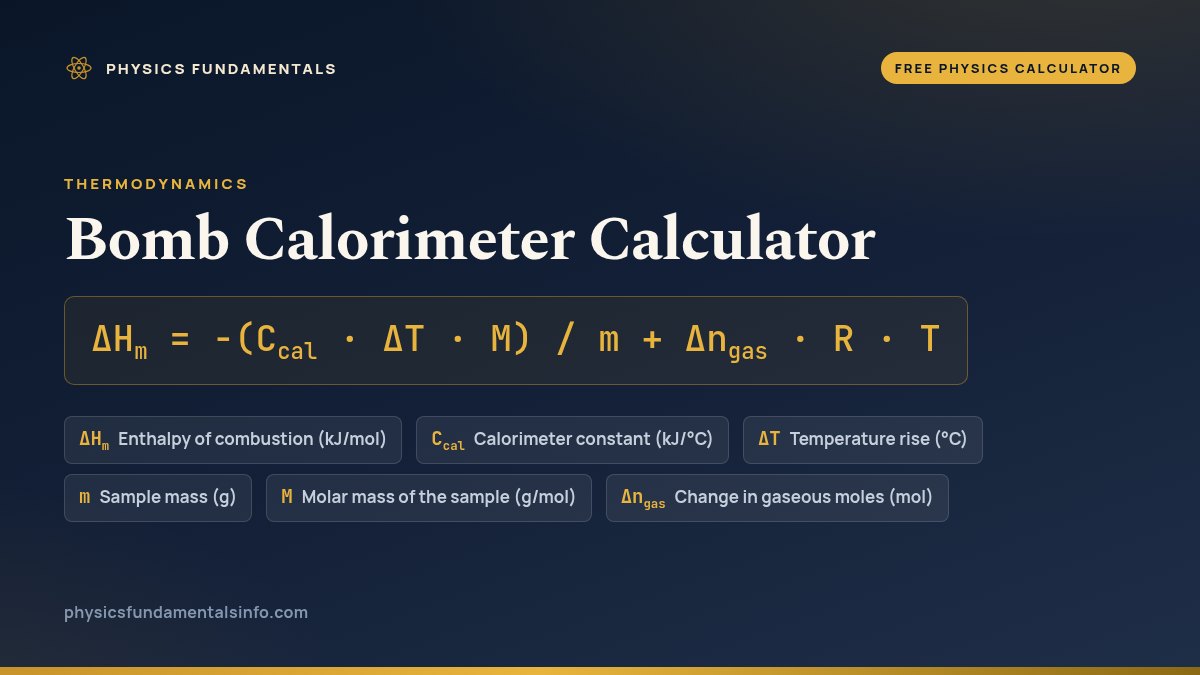
The bomb calorimeter calculator is a free online tool for the whole chain between a thermometer reading and a molar answer: qcal = Ccal · ΔT, then qrxn = −qcal, then kJ per gram, then kJ per mole, and finally the one correction that turns an internal energy change into an enthalpy change. Give it the calorimeter constant, the temperature rise, the sample mass, the molar mass and the change in gaseous moles and it returns ΔHm in kJ/mol; point the Solve for menu at any of the other four instead and it runs the same chain in that direction.
A bomb measures internal energy, not enthalpy, and that is the whole reason the last step exists. The steel vessel cannot change volume, so the reaction does no pressure-volume work and the heat it gives up is exactly ΔU. A calorimeter open to the atmosphere measures the constant-pressure heat instead and so gives ΔH directly, with no correction at all.
The correction is readable off the molecular formula before you measure anything. For complete combustion of a condensed fuel CaHbOc to CO2 and liquid H2O, the change in gaseous moles is twice the oxygen count minus the hydrogen count, all over four — the carbon count cancels — and one less again if the fuel is itself a gas at room temperature. Subtract nothing, add nothing, measure nothing: two integers decide it.
And it is exactly zero for any carbohydrate, which is why that box is never a solve target. The expression vanishes when the hydrogen count is twice the oxygen count, which is the carbohydrate condition: glucose C6H12O6, sucrose C12H22O11 and graphite all make exactly as many moles of gas as they consume. For them the internal energy change and the enthalpy change are the same number, with no arithmetic involved, so 0 is this page's single most important input value rather than an empty box.
Where the correction is live it is also small, and the page states its size rather than calling it negligible. On the opening state it is 0.0384 per cent of the constant-volume figure; the published uncertainty on that same substance is 0.124 per cent, which is 3.23 times larger. That ratio is the measurement that tells a reader when the step can and cannot matter.
Every combustion result here is printed with its minus sign. The heat flowing into the water, the steel and the thermometer is positive and the heat of the reaction is its negative, so a combustion answer is negative and the sign is the physics rather than a formatting choice. A calorific value is conventionally quoted positive — benzoic acid as 26.42 kJ/g at constant volume, or 26.43 kJ/g at constant pressure — and on this page such a figure is always labelled as a calorific value and never as ΔU.
The answer is a gross calorific value. A bomb holds a small fixed amount of water so that its internal atmosphere is saturated and every drop the reaction makes ends up liquid, which puts the heat of condensation inside what the thermometer read. A net value excludes it, the gap is the latent heat of that water, and the two coincide for a fuel such as graphite that makes no water at all.
The plausibility chip has four bounds, not one. They are 33.6 kJ/g for an oxygen-bearing sample, 48.64 for a hydrocarbon you could weigh as a liquid, 55.52 for a light hydrocarbon that is a gas at room temperature, and 141.79 above which no fuel exists — each the highest published gross value in its class. The single ceiling near 45 kJ/g that is sometimes quoted is false against its own source table, where nine non-hydrogen fuels exceed it, methane among them at 55.52.
And the check the band cannot do is named instead of hidden. A reader who correctly measures a 2.6422 °C rise on a one-gram benzoic-acid burn but applies a water-only constant of 8.368 kJ/°C gets 22.110 kJ/g against the true 26.422 — 16.3 per cent low, always low, and still inside a plausible band. That is what the forgotten steel preset puts on screen.
What the page does not do is worth naming as plainly as what it does. It asserts no numeric value for the fuse-wire, acid or ignition corrections that a standard-compliant determination makes, naming them and their standards instead; it has no time input, so it says nothing about how the final temperature was reached; and it carries no mixing relation and no register of other calorimeter designs. It also cannot tell you your own calorimeter constant: that belongs to one assembly on one day, which is exactly why the calibration direction is on the menu.
| Symbol | Quantity | Default unit | Also accepts | Example value |
|---|---|---|---|---|
| ΔHm | Enthalpy of combustion | kJ/mol | kcal/mol | -3227.97331555 |
| Ccal | Calorimeter constant | kJ/°C | J/°C, the energy equivalent | 10.000 |
| ΔT | Temperature rise | °C | a kelvin rise is the same number | 2.6422 |
| m | Sample mass | g | mg or kg, weighed into the crucible | 1.0000 |
| M | Molar mass of the sample | g/mol | kg/mol, here benzoic acid C7H6O2 | 122.123 |
| Δngas | Change in gaseous moles | mol | input only, never a solve target, and zero for any carbohydrate | -0.5 |
How to use the bomb calorimeter calculator
- Check the direction first. This page starts from a thermometer reading and a calorimeter constant and produces a molar enthalpy; the reaction enthalpy calculator does the reverse, taking moles and a molar enthalpy you already have and returning a heat. If your problem hands you moles and an enthalpy, you are on the wrong one of the two.
- Pick what to solve for. The page opens on the molar enthalpy of combustion. The Solve for menu also rearranges the chain for the calorimeter constant, the rise, the sample mass and the molar mass; whichever you choose becomes the headline and the other four become inputs. The gas-moles box is never a target, so it stays on screen in all five directions.
- Enter the calorimeter constant. The default is
10.000kJ/°C, which splits into8.368from a 2000 g water jacket and1.632from the steel, the stirrer and the thermometer. The water half is justmwatertimes the specific heat of water in kJ terms, which the specific heat calculator does on its own and this page does not own. The jacket mass is yours to choose while the specific heat belongs to whatever fills it — the specific heat simulator lets you move either one and see the energy per degree that results. - Enter the rise in °C. The box opens on
2.6422. It is a difference, so a kelvin figure may be typed straight in and nothing here adds 273.15. A negative rise is accepted and returns a positive enthalpy change, which is what an endothermic process does to an assembly. - Enter the mass and the molar mass. The defaults are
1.0000g and122.123g/mol, which is benzoic acid. Both must be strictly positive. Milligrams, kilograms and kg/mol are on the box menus for the cases where that is the natural unit. - Read the gas-moles change off the formula. For a condensed fuel burning to CO2 and liquid H2O it is twice the oxygen count minus the hydrogen count, all over four — the carbon count cancels — and one less again if the fuel is itself a gas. Leave the box at
0and the answer is the internal-energy change the bomb actually measured. - Read the headline. It is the quantity you asked for to eight significant figures with trailing zeros dropped: the defaults read
-3227.9733kJ/mol. The minus sign is kept because a combustion releases energy, and the published value for benzoic acid is-3228kJ/mol with a stated uncertainty of 4 — so the opening screen is already inside that band, off by 0.027 kJ/mol. - Read the eight chips. The heat into the calorimeter comes first, because
q = Ccal · ΔTis what most readers came for. Then the heat of the reaction, the energy per gram, the moles burned, the internal energy per mole, the correction term, the plausibility band and a gross-or-net note. Every one is computed from the unrounded state and none from another chip. - Treat the band as a filter, not a proof. It places your per-gram figure against four published bounds — 33.6, 48.64, 55.52 and 141.79 kJ/g — and it will catch an impossible answer. It will not catch a forgotten hardware term, which leaves you about 16 per cent low and still inside a plausible band.
- Expect a refusal where a box becomes a denominator. A rise of zero is a fine input in the enthalpy direction; ask the same state for the calorimeter constant or the molar mass and it is a division by zero, so the panel refuses rather than printing an infinity. A gas-moles change of zero is never refused.
Two neighbouring ideas are worth separating from this one before you start. The rigid vessel is why the heat equals the internal energy change at all, and that argument is the first law with the work term set to nothing — the first law of thermodynamics is where it is set out, and the guide to pressure-volume diagrams is where you can see a constant-volume path doing no work. Run the same burn in an unsealed vessel at constant pressure and you measure ΔH, not the ΔU a sealed one reports — so the correction this page adds is precisely what separates those two experiments.
The other is the number hidden inside the calorimeter constant. The water jacket term uses 4.184 J/(g·°C), which is also the definition of the thermochemical calorie, and the specific heat capacity of water is where that figure and its rivals are argued out. For the mechanism in prose, with the derivation and a full set of worked problems, read the bomb calorimeter equation guide, which this tool is the arithmetic half of.
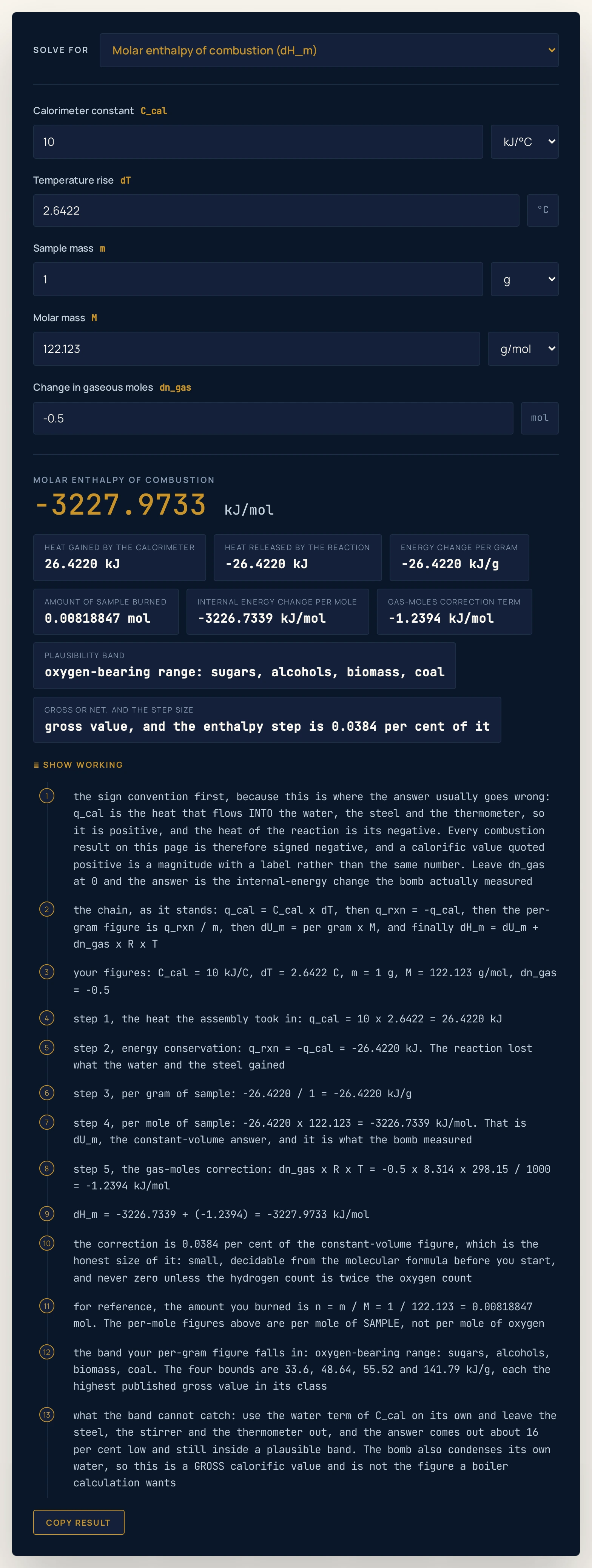
Ccal = 10.000 kJ/°C, ΔT = 2.6422 °C, m = 1.0000 g, M = 122.123 g/mol and Δngas = −0.5. The headline -3227.9733 kJ/mol sits inside the published -3228 ± 4 kJ/mol, off by 0.027.Worked example: change one thing at a time
The table holds the calorimeter constant at 10.000 kJ/°C, the sample at one gram of benzoic acid and the gas-moles change at −0.5, and moves the temperature rise alone. Every chip and headline cell was read out of the running widget rather than worked out by hand. Where a cell and the tool ever part company, believe the tool.
| Temperature rise | Heat into the calorimeter | Energy per gram | Internal energy per mole | Headline molar enthalpy | Plausibility band |
|---|---|---|---|---|---|
| 1.0000 | 10.0000 kJ | -10.0000 kJ/g | -1221.2300 kJ/mol | -1222.4694 | oxygen-bearing range |
| 1.5000 | 15.0000 kJ | -15.0000 kJ/g | -1831.8450 kJ/mol | -1833.0844 | oxygen-bearing range |
| 2.0000 | 20.0000 kJ | -20.0000 kJ/g | -2442.4600 kJ/mol | -2443.6994 | oxygen-bearing range |
| 2.6422 | 26.4220 kJ | -26.4220 kJ/g | -3226.7339 kJ/mol | -3227.9733 | oxygen-bearing range |
| 3.0000 | 30.0000 kJ | -30.0000 kJ/g | -3663.6900 kJ/mol | -3664.9294 | oxygen-bearing range |
| 4.0000 | 40.0000 kJ | -40.0000 kJ/g | -4884.9200 kJ/mol | -4886.1594 | hydrocarbon range |
| -0.5000 | -5.0000 kJ | 5.0000 kJ/g | 610.6150 kJ/mol | 609.37559 | endothermic |
Three things are worth reading off that table. The heat and the per-gram figure are exactly proportional to the rise while the constant is held fixed, so doubling 2.0000 to 4.0000 °C doubles −20.0000 to −40.0000 kJ/g. The correction term never moves: it is −1.2394 kJ/mol in every row, because it depends on the gas-moles box and on nothing else.
That fixed correction is the point the table makes best. At a rise of 1.0000 °C it is 0.1015 per cent of the internal-energy figure and at 4.0000 °C it is 0.0254 per cent, so the relative size of the enthalpy step shrinks as the sample releases more energy while the absolute size never changes at all. The band column changes once, at 4.0000 °C, where 40.0000 kJ/g is above the oxygen-bearing bound of 33.6 and so can no longer be a sugar or an alcohol.
The last row is the only one with a negative rise. It returns a positive 609.37559 kJ/mol and the band chip refuses to band it, because an assembly that cooled has no calorific value to compare with a table of fuels. Switching the Solve for menu runs any row backwards: from -3227.9733 kJ/mol the calibration mode returns 10 kJ/°C, the rise mode 2.6422 °C, the mass mode 1 g and the molar-mass mode 122.123 g/mol.
Formula and symbol reference
| Symbol | What it is | Unit | On this page |
|---|---|---|---|
| ΔHm | The molar enthalpy of combustion: what a textbook question usually asks for. Negative for a combustion | kJ/mol | Box menu reads kJ/mol or kcal/mol. Headline -3227.9733 at the defaults. The box carries the full float -3227.97331555, because a rounded default would stop the other four directions returning their own defaults. |
| Ccal | The calorimeter constant, also called the energy equivalent: the energy the whole assembly absorbs per degree | kJ/°C | Box menu reads kJ/°C or J/°C. 10.000 is the default, which is 8.368 of water jacket plus 1.632 of hardware. |
| ΔT | The temperature rise: final reading minus initial reading. A difference, so degrees Celsius and kelvin are the same number | °C | One scale only, on purpose. 2.6422 °C is the default. A negative value is accepted and gives a positive enthalpy change. |
| m | The mass you weighed into the crucible. Strictly positive | g | Box menu reads g, mg or kg. 1.0000 g is the default; a published apparatus description puts a typical sample at one to one and a half grams. |
| M | The molar mass of the sample. Strictly positive | g/mol | Box menu reads g/mol or kg/mol. 122.123 is the default, which is benzoic acid, C7H6O2. |
| Δngas | The change in the number of moles of gas as the equation is written. May be negative or a half-integer, and is often exactly zero | mol | Never a solve target, so its box is on screen in all five directions. -0.5 is the default. 0 is a legal and important value, not a blank. |
| qcal = Ccal · ΔT | The heat the water, the steel and the thermometer took in. Positive for a combustion | kJ | The first chip beside the answer, never an input: 26.4220 kJ at the defaults. |
| ΔUm | The molar internal energy change: the constant-volume answer, which is what the bomb actually measured | kJ/mol | A chip beside the answer: -3226.7339 kJ/mol at the defaults, and -2810.4336 in the carbohydrate preset, where it equals the enthalpy change exactly. |
| Δngas · R · T | The correction that turns the internal energy change into the enthalpy change, with R = 8.314 J/(mol K) and T = 298.15 K | kJ/mol | A chip beside the answer: -1.2394 kJ/mol at the defaults, and an exact 0.0000 whenever the gas-moles box is 0. |
The physics: why the correction is decidable before you start
The step everybody finds fiddly is the last one, and it is the one that needs no measurement. Write the complete combustion of a condensed fuel CaHbOc to CO2 and liquid H2O, count the gaseous moles on each side, and the carbon count cancels: what is left is twice the oxygen count minus the hydrogen count, all over four. The whole correction follows from two integers you can read off a formula.
That makes one result exact rather than approximate. The expression is zero precisely when the hydrogen count is twice the oxygen count, which is the carbohydrate condition — a carbohydrate's hydrogen and oxygen are already in the ratio they have in water, so burning it makes exactly as many moles of gas as it consumes. For glucose, for sucrose and for graphite the internal energy change and the enthalpy change are the same number, and no arithmetic is involved in getting there.
Where the correction is live it is also small, and saying how small is more useful than calling it negligible. On the defaults it is 0.0384 per cent of the constant-volume figure; in the naphthalene preset, which is the largest on this page, it is 0.0962 per cent. The honest claim is not that this step changes your answer but that its size is knowable before you begin — and the term itself, Δngas · R · T, comes straight from the ideal gas law applied to the gaseous species alone.
There is a sharper way to see the scale. The published uncertainty on the calibrant is 4 kJ/mol, or 0.124 per cent, while the correction for that same substance is 1.2394 kJ/mol, or 0.0384 per cent. The uncertainty is 3.23 times the size of the step that every page on this topic devotes a section to — which is an argument for knowing when the step matters, not for skipping it.
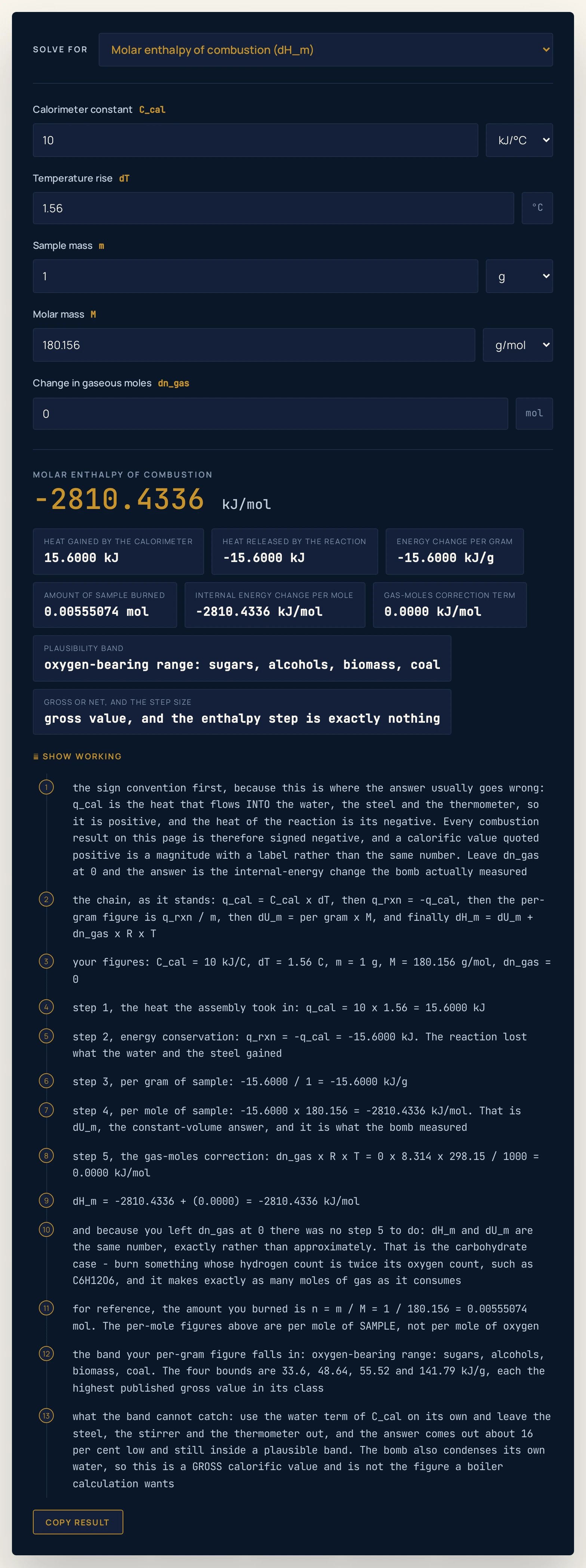
M = 180.156 g/mol and Δngas = 0. The headline and the internal-energy chip read the same string, -2810.4336, and the correction chip reads an exact 0.0000. This is the case a falsiness test such as if (!dn) would silently destroy.Where the bomb calorimeter calculator breaks down
- The calorimeter constant belongs to one assembly on one day
- Nothing on this page can tell you what
Ccalis for your apparatus; it is an input, and it drifts as the jacket is refilled and the hardware changes. That is the entire reason calibration exists, and it is why the calibration direction is on the Solve for menu at all. Two of the ranking calculators on this keyword use the water term alone, which is the mistake the forgotten steel preset puts on screen: about 16 per cent low, always low, and never flagged by a band check. - The three standard corrections are not here, and they have no number attached
- A standard-compliant determination also corrects for the burning fuse wire, for nitric and sulfuric acid formed from nitrogen and sulfur in the sample and found by titrating the residual liquid, and for the electrical ignition energy. These are codified in ASTM D5865 and ISO 1928 for solid fuels and ASTM D240 and D4809 for liquid hydrocarbons. This page names them and asserts no value for any of them, because the size of each depends on your wire, your sample and your igniter.
- The answer is a gross value, and the gap is the water
- Every energy figure this page prints is a gross value: the heat released as the product water condensed is already inside the measured temperature rise, whether that rise is typed in or returned by the Solve for menu, and no box here can take it back out. A net value excludes it, and the difference is the latent heat of the water the sample produced — which is why graphite, making no water at all, has gross and net values that agree to rounding. The latent heat guide is where that quantity belongs; here it appears only as the size of this one gap.
- Ideal gases, and condensed phases contributing no pressure-volume term
- The correction treats the gaseous species as ideal and assumes the solids and liquids contribute nothing to the pressure-volume product. Both approximations are good to well under the 0.124 per cent uncertainty on the calibrant, so neither is the limiting error in any realistic determination. A sample containing nitrogen or sulfur needs the acid correction above before its figure means anything at all.
- Nothing here happens over time
- There is no time input of any kind, so the page describes one steady final state and says nothing about how that state was reached or how long it took. It also carries no mixing relation and no register of other calorimeter designs. For a measured heat that you want turned into a temperature rise on a known mass of water instead, the water heating calculator is the right tool, and the guide to heat against temperature is where the difference between the two quantities is argued out.
Where bomb calorimetry is actually used
- Calibrating the apparatus before trusting it
- In practice the first burn of the day is a known substance and the unknown is the apparatus, which is exactly what the calibration direction is for. One gram of benzoic acid with a published 26.42 kJ/g at constant volume, giving a rise of 2.6422 °C, returns
10kJ/°C — and the page runs that round trip in both directions so the calibration and the measurement cannot drift apart. Benzoic acid is the standard choice because two independent published figures for it agree to 0.0081 per cent. - Food energy, where the gas-moles step vanishes
- The energy on a food label begins as a bomb measurement, and carbohydrates are the clean case: their hydrogen count is twice their oxygen count, so the gas-moles change is exactly zero and the constant-volume figure needs no conversion to be an enthalpy. The carbohydrate preset is that case, and its headline and internal-energy chip print the same string. Protein and fat are not carbohydrates, so for them the correction is live again and has to be read off the formula.
- Fuel specification, where gross against net decides the contract
- A bomb reports the gross value and a boiler or engine calculation usually wants the net one, so the two are never interchangeable in a specification. The gap is the latent heat of the combustion water, so it falls as the hydrogen fraction of the fuel falls, and it is zero for a fuel that makes no water. That is why the standards named above are written separately for solid fuels and for liquid hydrocarbons.
- Identifying an unknown from one burn
- Measure a sample's energy per gram, look its energy per mole up, and the ratio is its molar mass — which is the molar-mass direction on the Solve for menu. It is also the direction most exposed to the correction you chose, because the gas-moles change has to be read off the formula of the very substance you are trying to pin down. Leaving it at zero quietly assumes a carbohydrate, and that assumption is worth making out loud.
- Knowing when a result is impossible rather than merely surprising
- The plausibility chip exists because arithmetic cannot tell you that a figure is beyond any fuel. The four bounds are 33.6, 48.64, 55.52 and 141.79 kJ/g, and a single ceiling near 45 is sometimes quoted and is simply false: nine published non-hydrogen fuels exceed it, methane among them at 55.52.
| Band | Upper bound | What a result there can be | Anchored on |
|---|---|---|---|
| 0 | 33.6 kJ/g | An oxygen-bearing sample: a sugar, an alcohol, biomass or coal | 1-propanol at 33.6 |
| 1 | 48.64 kJ/g | A hydrocarbon with no oxygen in it, of a kind you could weigh as a liquid | pentane at 48.64 |
| 2 | 55.52 kJ/g | A light hydrocarbon, which at room temperature is a gas rather than a weighed solid | methane at 55.52 |
| 3 | 141.79 kJ/g | Impossible unless the sample is hydrogen itself | hydrogen at 141.79 |
| 4 | above that | Impossible for any fuel: check the calorimeter constant and the mass before anything else | nothing is higher |
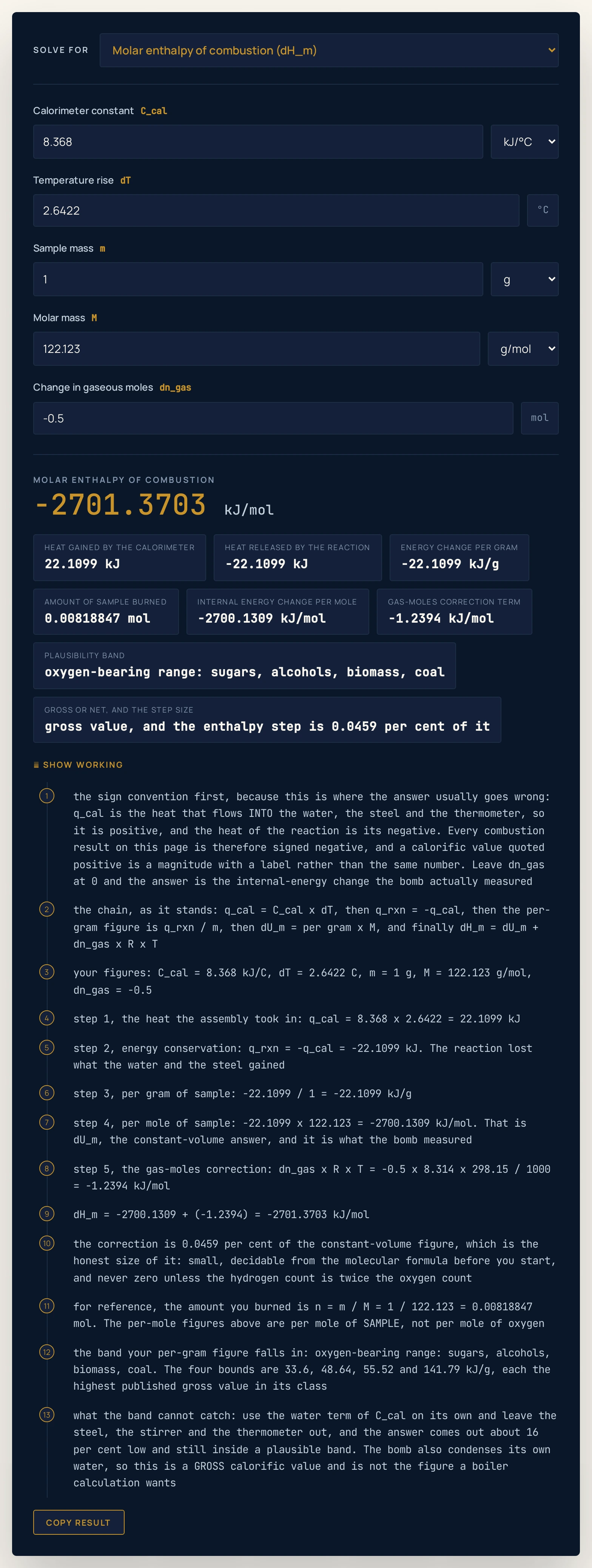
Ccal cut to the 8.368 kJ/°C water term alone. The per-gram chip reads -22.1099 against the correct -26.4220, which is 16.3 per cent low — and the plausibility chip still reads oxygen-bearing range. A band check cannot catch this one.Where to go next
For the derivation in prose, the balanced equations and a full set of worked problems, read the bomb calorimeter equation guide, which this tool is the arithmetic half of. The specific heat capacity guide covers the relation behind the water term, the latent heat guide covers the quantity that is the gross-against-net gap, and the guide to the laws of thermodynamics puts the first law in its context.
Five tools sit beside this one. The reaction enthalpy calculator runs the last step in the other direction; the specific heat calculator owns the water term; the first law of thermodynamics calculator owns the work term this page sets to nothing; the specific heat simulator and the latent heat simulator show the two quantities the constant and the gross-net gap are built from. The full physics lab library and the calculator index are open too.
Frequently asked questions
What does the bomb calorimeter calculator work out?
It carries a constant-volume burn all the way from a thermometer reading to a molar answer. Give it the calorimeter constant, the temperature rise, the sample mass, the molar mass and the change in gaseous moles, and it returns the molar enthalpy of combustion in kJ/mol, with the heat in kilojoules, the energy per gram and the internal energy per mole beside it. The same chain is rearranged four more ways, so you can solve instead for the calorimeter constant, the rise, the mass or the molar mass.
What is the formula used in a bomb calorimeter?
The reading itself is q_cal = C_cal multiplied by the temperature rise, and energy conservation makes the heat of the reaction the negative of that. Dividing by the sample mass gives kJ per gram and multiplying by the molar mass gives kJ per mole, which is the internal energy change because a rigid vessel does no work. Adding the change in gaseous moles multiplied by R and by the reference temperature turns that into the enthalpy change a textbook usually asks for.
Does a bomb calorimeter measure enthalpy or internal energy?
Internal energy. Volume is fixed by the vessel itself, so the burning sample has no expansion to pay for and no pressure-volume work enters the energy balance; what the burn releases is an internal energy change. Enthalpy differs from it by the pressure-volume term, which for ideal gases is the change in gaseous moles multiplied by R and by the temperature, and that is the one extra step this page makes explicit instead of hiding.
How do you find the calorimeter constant from a benzoic acid burn?
Point the Solve for menu at the calorimeter constant and type the known enthalpy of combustion, the molar mass, the mass you weighed and the rise you measured. Benzoic acid is the standard choice because two independent published sources agree on its energy density to four significant figures, which means the constant you get back is traceable rather than assumed. One gram of it at a constant of 10.000 kJ per degree gives a rise of 2.6422 degrees, and the page runs that round trip in both directions.
Why does leaving the change in gaseous moles at zero sometimes give the right answer?
Because for some fuels it really is zero. For a condensed fuel burning to carbon dioxide and liquid water the change is twice the oxygen count minus the hydrogen count, all over four, so it vanishes exactly when the hydrogen count is twice the oxygen count. That is the carbohydrate condition: glucose, sucrose and graphite all make exactly as many moles of gas as they consume, so for them the internal energy change and the enthalpy change are the same number with no arithmetic at all.
Why is the answer negative?
Because a combustion loses energy, and this page keeps the sign rather than reporting a magnitude. The heat flowing into the water and the steel is positive, the thermometer rises, and the heat of the reaction is the negative of that. Calorific values are conventionally quoted as positive numbers, so when you see benzoic acid written as 26.42 kJ/g that is a magnitude with a label and not a contradiction of the minus sign on this page.
Is the result a gross or a net calorific value?
Gross. A bomb contains a small fixed amount of water so that the internal atmosphere is saturated and all the water the reaction makes ends up liquid, and the heat released when that water condenses is included in what the thermometer reads. A net value excludes it, and the gap is the latent heat of the water the sample produced, which is why the two figures coincide for a fuel such as graphite that makes no water at all. Never hand a gross figure to a calculation that wants net.
Why does the calculator refuse some input combinations?
Because the alternative would be printing an infinity or a negative mass as though it meant something. A rise of exactly zero is a legitimate input when you are solving for the enthalpy, but it is a division by zero when you are solving for the calorimeter constant or the molar mass, so those directions refuse it. A result that would be a negative mass, a negative molar mass or a negative calorimeter constant is refused too, and so is any set of inputs whose answer overflows, even when every input you typed was finite.
What does this calculator deliberately leave out?
Three corrections that a standard-compliant determination makes and that no three boxes can supply: the heat from the burning fuse wire, the heat from nitric and sulfuric acid formed from nitrogen and sulfur in the sample, and the electrical energy put in to start the ignition. They are codified in ASTM D5865 and ISO 1928 for solid fuels and ASTM D240 and D4809 for liquid hydrocarbons, and this page names them rather than attaching a number to any of them. It also has no time input of any kind, so it says nothing about how the final temperature was approached.
References & formula source
- The chain on this page is q_cal = C_cal multiplied by the temperature rise, then q_rxn = minus q_cal, then the per-gram figure q_rxn / m, then the molar internal energy change (q_rxn / m) multiplied by M, and finally the molar enthalpy change as that plus the change in gaseous moles multiplied by R and by T. It is a constant-volume determination and nothing else: the vessel does no pressure-volume work, which is why the heat it gives up is an internal energy change rather than an enthalpy change.
- R is printed and used as 8.314 J/(mol K) and the reference temperature as 298.15 K, so the correction term is 2.4788191 kJ per mole of gas. The exact SI value of R is 8.314462618 and the difference is 0.0056 per cent, which is twenty-two times smaller than the stated uncertainty on the calibrant this page opens with; one value is printed and used everywhere so that every displayed operation can be reproduced literally.
- The default state is benzoic acid, the standard calibrant: a calorimeter constant of 10.000 kJ per degree Celsius, a rise of 2.6422 degrees, one gram of sample, a molar mass of 122.123 g/mol and a change in gaseous moles of minus one half. The answer it returns, -3227.9733 kJ/mol, lands inside the National Institute of Standards and Technology value of -3228 plus or minus 4 kJ/mol, off by 0.027 kJ/mol or 0.001 per cent. The six defaults are a mutually consistent set, so switching the Solve for menu never changes the problem.
- Benzoic acid has two legitimate energy densities and both are labelled wherever either is quoted: 26.42 kJ/g at constant volume, which is what a bomb releases, and 26.43 kJ/g at constant pressure, which is what thermochemical tables carry. The 0.04 per cent between them is the size of the enthalpy step on this page measured on its own calibrant. The molar mass 122.123 g/mol is built from conventional atomic weights and agrees with the served value of 122.1213 to 0.0014 per cent.
- Two independent published figures for benzoic acid agree to 0.0081 per cent: a thermochemical compilation gives 3228 kJ/mol over 122.123 g/mol, which is 26.4324 kJ/g, and an encyclopedia article quoting a calorie-era laboratory figure gives 6318 cal/g, which at the defined 4.184 J per thermochemical calorie is 26.4345 kJ/g. The stated uncertainty on the first, 4 kJ/mol or 0.124 per cent, is 3.23 times the size of the enthalpy correction for that same substance. Both are quoted because neither one on its own settles whether the correction is worth carrying in a particular determination.
- The change in gaseous moles for complete combustion of a condensed fuel to carbon dioxide and liquid water is twice the oxygen count minus the hydrogen count, all over four, with one subtracted if the fuel is itself a gas at the reference temperature. A sweep of 18929 integer formulas across carbon 1 to 20, hydrogen 0 to 44 and oxygen 0 to 22 with a positive oxygen demand finds the value exactly zero in 460 of them and no mismatch against the condition that the hydrogen count is twice the oxygen count. The correction is small in relative terms for every combustion, from 0.038 per cent for benzoic acid to about 1.3 per cent for hydrogen, which is the largest in the fetched set; the claim made here is not that it changes your answer but that it is decidable from the formula before you start.
- The plausibility bounds are 33.6 kJ/g for an oxygen-bearing sample, 48.64 for a hydrocarbon you could weigh as a liquid, 55.52 for a light hydrocarbon that is a gas rather than a weighed solid, and 141.79 above which no fuel exists. Each is the highest published gross calorific value in its class, taken from one fetched table and nothing else. A single ceiling of about 45 kJ/g is sometimes quoted and it is false against that same table: nine non-hydrogen fuels in it exceed 45, among them methane at 55.52, ethane at 51.90, propane at 50.33 and pentane at 48.64.
- The error the band cannot catch is sized here in this page’s own numbers. Cutting the calorimeter constant to a water-only 8.368 kJ per degree multiplies every energy result by the ratio of the two constants, so a correctly measured rise of 2.6422 degrees on a one-gram benzoic-acid burn yields 22.110 kJ and hence 22.110 kJ/g where the calibrated constant yields 26.422 kJ/g: a deficit of 16.3 per cent, which for this calorimeter is the same fraction whatever the rise and whatever the sample mass because the constant is a multiplier, and one the oxygen-bearing band still accepts. The water term 8.368 kJ per degree is 2000 g of water at the defined 4.184 J/(g K), the jacket volume a published apparatus description gives.
- The answer is a gross calorific value, because a bomb holds a small fixed amount of water to saturate its internal atmosphere and so condenses all the water the reaction makes. The gap between gross and net values is the latent heat of that water, and across five fuels taken from published tables it recovers to about 44 kJ for each mole of water with a measured spread from 41.83 to 45.63, an 8.7 per cent range. It is presented as a band rather than a determination, because one of the three source tables carries a citation-needed tag and the three round differently.
- Every chip reading and every cell of the worked table on this page is a string this calculator printed for the inputs named beside it. The five preset states and the three screenshot states are stated givens chosen to make a point, not measurements of any named apparatus; the naphthalene case in particular is presented as what those calorimeter readings give, because no published heat of combustion for naphthalene was used in building this page. The formula and the molar mass for it are sourced, the energy figure is not.
- The three standard corrections this page names and then leaves out carry no source entry here, because nothing about their size is asserted: the standards are named as the documents that define each correction and for nothing else. No instrument uncertainty is quoted anywhere on this page either: the uncertainties it does quote belong to published values in tables, not to any apparatus. Sizing those three terms for a real determination means working from the standard that covers the fuel class in front of you, and that is a document this page does not reproduce.
- This page computes one steady burn and nothing else. It has no time input, so it says nothing about how the final temperature was reached, and it carries no mixing relation, no general register of calorimeter designs and no wall-transmittance figure. The oxygen fill is described as about 30 standard atmospheres, which is the figure the fetched apparatus description gives.
- Atkins and de Paula, Physical Chemistry, chapter on the first law (constant-volume calorimetry and the relation between internal energy and enthalpy changes).
- Zumdahl and Zumdahl, Chemistry, chapter on thermochemistry (bomb calorimetry and calibration with a standard substance).
- Further reading: Calorimeter — Wikipedia