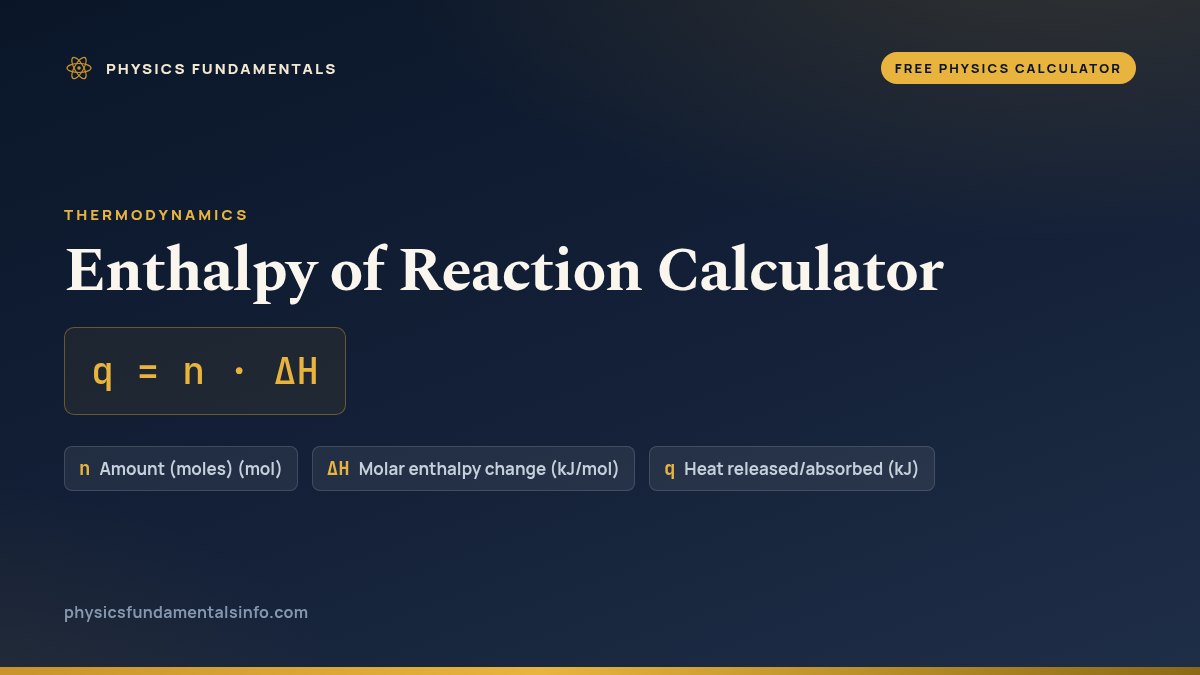
Enthalpy of reaction: the heat released or absorbed when a reaction runs, q = n·ΔH, where n is the amount in moles and ΔH the molar enthalpy change. This free calculator solves for the heat, the moles, or the molar enthalpy, and shows every step.
What Is the Enthalpy of Reaction Calculator?
The enthalpy of reaction calculator is a free online tool built on the formula q = n · ΔH. Enter the values you already know, in whichever units suit you, and it solves for reaction heat, moles or molar enthalpy and shows every step of the substitution. Heat released or absorbed by a reaction from moles and molar enthalpy.
| Symbol | Quantity | Default unit | Also accepts | Example value |
|---|---|---|---|---|
| n | Amount (moles) | mol | mmol, kmol | 2 |
| ΔH | Molar enthalpy change | kJ/mol | J/mol, kcal/mol | -285.8 |
| q | Heat released/absorbed | kJ | J, MJ, kcal | — |
How to calculate reaction enthalpy
To find the heat of a reaction, multiply the moles reacting by the molar enthalpy change: q = n·ΔH. The amount n is measured in moles and the molar enthalpy ΔH is the heat change per mole of reaction. The product is the total heat q exchanged with the surroundings, in joules or kilojoules.
The sign of ΔH carries all the physical meaning. A negative ΔH means the reaction is exothermic — it gives out heat, warming its surroundings, as in combustion. A positive ΔH means the reaction is endothermic — it takes in heat, cooling its surroundings, as in many dissolving or decomposition steps. Enter your values in kJ/mol or kcal/mol; the calculator keeps the sign and converts to consistent units, so the result q comes out with the correct sign automatically.
The heat q is closely tied to a measured temperature change. Once you know the heat a reaction gives out, you can predict how much a mass of water or solution will warm using the specific heat calculator, and phase-change heats are handled by the latent heat calculator. For definitions of the thermochemistry terms used here, see the physics glossary.
Worked example
Burning 2 mol of hydrogen to form water releases energy, with ΔH = -285.8 kJ/mol per mole of water formed. Substituting into the formula gives q = n·ΔH = 2 × (-285.8) = -571.6 kJ. The negative sign shows that the reaction is exothermic and that 571.6 kJ of heat is released to the surroundings. Doubling the amount of hydrogen would double the heat released, because q is directly proportional to n.
Why it matters
Reaction enthalpy underlies the energy content of fuels, the heating and cooling of chemical processes, the thermochemical equations of Hess's law, and the safety analysis of exothermic runaways in industrial reactors. Combined with q = mcΔT, it links a reaction's heat to a measured temperature change in a calorimeter, so a bench experiment can pin down ΔH. The same energy accounting feeds into engine and power-plant design — see the Carnot efficiency calculator for the theoretical limit on turning that heat into work.
Frequently asked questions
What is the enthalpy of reaction?
The enthalpy of reaction is the heat exchanged at constant pressure, q = n x deltaH, positive when heat is absorbed and negative when heat is released.
What does a negative deltaH mean?
A negative deltaH means the reaction is exothermic and gives out heat to the surroundings; a positive deltaH means the reaction is endothermic and takes in heat.
How is molar enthalpy different from total heat?
Molar enthalpy (deltaH) is the heat change per mole; the total heat q is that value multiplied by the number of moles reacting.
How do I find deltaH from standard enthalpies of formation?
Take the sum of the formation enthalpies of the products minus that of the reactants (Hess law), then use q = n x deltaH to find the heat.
How does this relate to calorimetry?
The heat q released can be measured as a temperature change of the surroundings using q = m x c x deltaT.
References & formula source
- Atkins & de Paula — Physical Chemistry, Chapter 2 (The First Law; thermochemistry).
- Zumdahl — Chemistry, Chapter 6 (Thermochemistry and Hess's Law).
- Halliday, Resnick & Walker — Fundamentals of Physics, Chapter 18 (Heat and the First Law).
- Further reading: Standard enthalpy of reaction — Wikipedia